
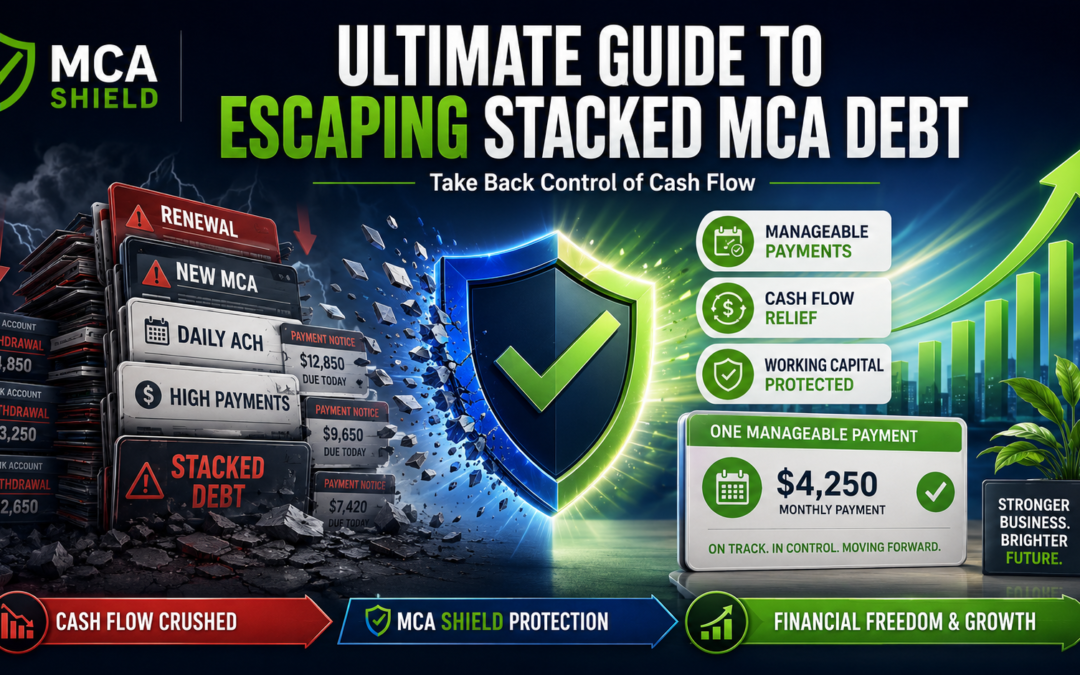
If your business is struggling with stacked MCA debt, the pressure can build quickly. Multiple daily or weekly withdrawals can drain cash flow, make payroll harder to cover, and leave less money available for vendors, inventory, taxes, and everyday operating expenses. What may have started as short-term funding can turn into a cycle of renewals, new advances, and increasingly difficult payments.
The good news is that business owners may have options. Depending on your situation, MCA debt consolidation, restructuring, negotiation, or settlement may help reduce payment pressure and create a more manageable path forward. The right solution starts with understanding what you owe, how much your business can realistically afford, and which obligations are causing the most financial strain.
This ultimate guide explains how to escape stacked MCA debt, what warning signs to watch for, and which relief strategies may be available. You will also learn how stacked merchant cash advances affect cash flow, what to know about UCC filings and personal guarantees, and how to protect the working capital your business needs to keep operating.
Schedule Your Free Consultation
What Is Stacked MCA Debt and How Does It Happen?
Stacked MCA debt develops when a business has more than one merchant cash advance active at the same time. Instead of making one daily or weekly payment, the business may have several funders withdrawing money from its bank account or collecting a percentage of future receivables.
A merchant cash advance can provide fast access to working capital. However, problems often begin when the business takes on another advance before the first one has been fully satisfied. As additional obligations are added, the combined payments can consume a much larger portion of the company’s revenue.
For many businesses, stacking happens gradually. An owner may use the first MCA to cover inventory, payroll, equipment, repairs, or another short-term expense. If cash flow remains tight, a second or third advance may seem like the fastest way to get additional capital. Over time, this can create a cycle where new MCA funding is being used to manage existing MCA payments.
How Multiple Merchant Cash Advances Become Stacked
A business can become stacked when it accepts multiple merchant cash advances from different funders while previous agreements are still active.
For example, imagine a company has one MCA with a $750 daily withdrawal. Revenue slows, but the payment continues. The owner then accepts a second MCA with another $600 daily payment to create additional working capital.
The business is now paying $1,350 every business day before accounting for payroll, rent, vendors, taxes, insurance, and other operating expenses.
If another advance is added, the pressure becomes even greater.
This can create several problems:
- Multiple daily or weekly withdrawals reduce available cash.
- Working capital becomes harder to maintain.
- Payroll and vendor payments may become more difficult to cover.
- Bank balances can fall quickly during slower sales periods.
- The business may become dependent on additional financing to fill cash-flow gaps.
The problem is not simply the number of MCA agreements. What matters most is how much of the company’s revenue is being committed to repayment.
A business with strong revenue may be able to handle more than one obligation for a period of time. However, when combined MCA payments exceed what the business can comfortably support, stacked MCA debt can become a serious cash-flow problem.
This is why business owners should look beyond the amount of new funding being offered. They should also calculate the total daily or weekly payment obligation after the new advance is added.
Why MCA Renewals Can Make the Problem Worse
MCA renewals can also contribute to stacked debt, especially when a business repeatedly renews or replaces advances before previous obligations have been fully resolved.
A renewal may provide additional cash when the business needs it most. However, the amount deposited into the business account may be significantly less than the new total repayment obligation because part of the transaction may be used to address an existing balance.
For example, a business may qualify for a new $100,000 advance but still owe money on its current MCA. After the remaining balance and other applicable costs are accounted for, the business may receive much less than $100,000 in usable working capital.
The company may then have a new repayment obligation without receiving the full amount as fresh operating cash.
Repeated renewals can become especially dangerous when they are used primarily to keep up with existing payments. Instead of solving the underlying cash-flow problem, the business may continue pushing the pressure forward.
Over time, the cycle can look like this:
MCA payment pressure → cash-flow shortage → renewal or new MCA → temporary cash infusion → larger payment obligation → another cash-flow shortage
This is one reason businesses struggling with stacked MCA debt should carefully review every agreement, current balance, payment amount, and remaining obligation before accepting additional funding.
Taking another advance may provide short-term relief, but it can also increase the amount of revenue committed to repayment. When payments are already difficult to manage, the better approach may be to examine MCA consolidation, restructuring, negotiation, or other relief options before adding another obligation.
Warning Signs Your Business Is Trapped in Stacked MCA Debt

Many business owners do not realize how serious stacked MCA debt has become until cash flow starts breaking down. At first, the payments may seem manageable. Over time, however, several daily or weekly withdrawals can make it harder to cover normal business expenses.
The warning signs often appear before the business reaches a financial crisis. Recognizing them early gives you more time to review your options and avoid taking on even more expensive debt.
Daily and Weekly Payments Are Draining Cash Flow
One of the clearest signs of a stacked MCA problem is when daily or weekly MCA payments are consuming too much of your revenue.
A business may still be generating sales, but that does not always mean it has enough usable cash. If several funders are withdrawing money at the same time, a large portion of each day’s revenue may leave the account before the business can use it for operations.
This can create a constant cash-flow shortage.
For example, a company may collect $15,000 in weekly revenue but have several MCA payments totaling $6,000 or more during that same period. The business still needs to pay employees, vendors, rent, utilities, insurance, taxes, and other expenses with what remains.
Warning signs may include:
- Bank balances dropping quickly after MCA withdrawals
- Frequent overdrafts or returned payments
- Difficulty maintaining a cash reserve
- Moving money between accounts to cover withdrawals
- Delaying important purchases because cash is unavailable
- Constantly checking the bank account before making payments
When MCA payments are draining working capital, the business may be operating with very little financial flexibility. Even a small revenue decline or unexpected expense can create a serious problem.
Payroll, Vendors, and Operating Expenses Are Falling Behind
Another major warning sign is when normal business expenses begin falling behind because too much cash is going toward MCA payments.
Payroll, vendors, taxes, rent, inventory, and operating expenses should not consistently be competing with debt withdrawals for the same dollars.
If a business owner has to choose between making payroll and covering multiple MCA payments, the debt structure may no longer be sustainable.
Vendor problems can also become a warning sign. Suppliers may shorten payment terms, stop extending credit, or require payment in advance if invoices are repeatedly late. This can make it even harder for the business to operate.
The same problem can affect payroll. If employees are paid late or payroll taxes are delayed, the financial consequences can become much more serious.
A business may also begin cutting essential expenses just to keep up with MCA obligations. Advertising gets reduced. Equipment repairs are delayed. Inventory purchases are postponed. Necessary improvements are put on hold.
These decisions may protect cash temporarily, but they can also make it harder for the company to generate future revenue.
When stacked MCA debt begins interfering with normal business operations, it is usually a sign that the payment structure needs to be reviewed.
You Are Taking New Advances to Pay Existing MCAs
Perhaps the strongest warning sign is when a business starts taking new merchant cash advances to pay existing MCA obligations.
This can create a dangerous cycle.
A new advance may provide immediate cash, but part of that money may quickly be used to cover previous withdrawals, overdue expenses, or another MCA balance. The business may receive temporary relief while adding another repayment obligation.
The cycle can look like this:
MCA payments reduce cash flow → operating expenses become difficult to cover → new MCA is taken → short-term cash returns → additional payments begin → cash flow becomes tight again
If this pattern continues, the business can become more deeply stacked with each new advance.
Another warning sign is when the company is constantly looking for the next renewal or funding offer before the current obligations are paid off. At that point, new financing may no longer be supporting growth. It may simply be keeping the existing debt cycle alive.
Business owners in this position should carefully review the total amount being withdrawn, current balances, remaining obligations, and available cash flow before accepting another advance.
In some cases, exploring MCA consolidation, MCA restructuring, or other debt relief options may provide a better path than continuing to add new obligations.
The earlier a business recognizes these warning signs, the more options it may have. If daily payments are draining cash flow, operating expenses are falling behind, and new advances are being used to cover older ones, it may be time to address the stacked MCA debt before the financial pressure becomes more difficult to manage.
How Stacked MCA Debt Can Affect Your Business Cash Flow
Stacked MCA debt can create serious cash-flow pressure, even when a business is still producing strong sales. The problem is that revenue does not always equal available cash. When several MCA withdrawals are coming out of the business account each day or week, the amount left for operations can shrink quickly.
This can make it difficult to manage normal expenses and plan ahead. Instead of using revenue to support growth, the business may be using a large share of its income to keep up with multiple MCA obligations.
The Real Cost of Multiple MCA Withdrawals
The true cost of stacked merchant cash advances is not just the total repayment amount. Business owners also need to consider how frequently money is being withdrawn and how those withdrawals affect daily operations.
For example, one MCA payment may seem manageable on its own. But if a business has three or four advances, the combined withdrawals can become much harder to support.
Multiple MCA withdrawals can lead to:
- Lower daily cash balances
- More frequent overdrafts or returned payments
- Less money available for payroll
- Delayed vendor payments
- Reduced ability to purchase inventory
- Difficulty paying taxes, rent, and utilities
- Less cash available for emergencies
These problems can build quickly because MCA payments are often taken directly from the business bank account.
A company may generate enough revenue over the course of a month, but still struggle on certain days because cash is leaving the account faster than it is coming in.
That is why business owners should look at more than total monthly revenue. It is also important to review the timing of deposits, the timing of MCA withdrawals, and the amount of cash that remains after those payments are made.
If several advances are being paid at the same time, stacked MCA debt can reduce financial flexibility and make even routine expenses harder to manage.
Why Working Capital Can Disappear So Quickly
Working capital is the money a business needs to keep operating. It helps cover payroll, inventory, vendors, repairs, marketing, rent, taxes, and other everyday expenses.
When stacked MCA payments take a large portion of available cash, working capital can disappear much faster than expected.
This often creates a chain reaction.
The business starts the week with enough money to operate. Then several MCA withdrawals are processed. Payroll is due. A vendor invoice arrives. A customer payment is delayed. Suddenly, the business may not have enough cash available to cover everything.
That shortage can force the owner to make difficult decisions.
They may delay vendor payments, use credit cards, move money between accounts, postpone payroll, or accept another advance to create temporary cash.
The problem is that each short-term fix can create additional financial pressure.
For this reason, businesses dealing with stacked MCA debt should calculate how much money must remain available after debt payments. This is sometimes more important than simply asking whether the business can make the next withdrawal.
A sustainable payment structure should allow the company to cover essential operating expenses and maintain enough working capital to continue generating revenue.
If MCA withdrawals are leaving too little cash for normal operations, it may be time to review the current agreements and consider whether MCA consolidation, restructuring, or another relief strategy could help reduce the pressure.
What Should You Do First When MCA Payments Become Unmanageable?
When MCA payments become unmanageable, acting early can give your business more options. Waiting until the bank account is empty, payroll is missed, or several payments have defaulted can make the situation much harder to control.
The first step is to get a clear picture of what your business owes and what it can realistically afford. That means reviewing every agreement, calculating the total payment burden, and identifying how much cash must remain available to keep the business operating.
For companies dealing with stacked MCA debt, this process can help separate the immediate problem from the long-term solution.
Review Every MCA Agreement and Current Balance
Start by gathering every active merchant cash advance agreement.
You need to know exactly how many obligations are active, how much is still owed, and how much is being withdrawn from the business account.
For each MCA, review:
- Current estimated balance
- Daily or weekly payment amount
- Payment frequency
- Original funded amount
- Total repayment amount
- Remaining term or estimated payoff period
- Renewal provisions
- Reconciliation language
- Personal guarantee provisions
- UCC filing language
Do not review each MCA separately and stop there. The bigger question is how all of the payments affect the business when they are combined.
For example, three payments of $500, $650, and $800 per day may not seem as alarming when viewed individually. Together, however, they create $1,950 in daily MCA withdrawals.
That combined number is what affects cash flow.
It is also important to confirm balances instead of relying only on the original contract amount. If payments have already been made, the remaining obligation may be different from what was initially owed.
Creating one clear list of every MCA can make it easier to understand the true size of the problem.
Calculate What Your Business Can Actually Afford
The next step is to determine what your business can realistically afford to pay without damaging normal operations.
This is different from asking whether the business can make the next scheduled withdrawal.
A payment may technically clear the bank account while still leaving too little cash for payroll, inventory, vendors, rent, taxes, or other essential expenses.
Start by reviewing average monthly revenue and subtracting necessary operating costs.
Important expenses may include:
- Payroll
- Rent or mortgage payments
- Vendors
- Inventory
- Utilities
- Insurance
- Taxes
- Equipment expenses
- Marketing
- Transportation
- Other essential operating costs
The amount remaining after these expenses gives you a better idea of what may be available for debt payments.
This calculation should also account for revenue fluctuations. If the business has seasonal sales or inconsistent weekly deposits, a payment that works during a strong month may become unaffordable during a slower period.
The goal is to establish an affordable payment range that allows the business to continue operating.
That number can become important when evaluating options such as MCA consolidation, MCA restructuring, or negotiated payment arrangements.
Protect Essential Operating Cash
One of the biggest mistakes a business can make is using nearly every available dollar to keep up with MCA withdrawals.
Operating cash keeps the business alive.
Without enough working capital, the company may struggle to pay employees, purchase materials, fulfill customer orders, or generate new revenue.
Business owners should identify the minimum amount of cash needed to maintain essential operations.
That may include money for:
Payroll, critical vendors, inventory, taxes, rent, utilities, and other expenses required to keep the business running.
Protecting this cash does not mean ignoring financial obligations. It means understanding that a repayment strategy must be sustainable.
If every dollar goes toward stacked MCA payments, the business may lose the ability to generate the revenue needed to repay anything at all.
This is why a realistic recovery plan should balance debt repayment with working capital protection.
Once you understand your agreements, balances, affordable payment range, and operating cash needs, you are in a much stronger position to evaluate your next step. For some businesses, that may mean exploring MCA debt consolidation or restructuring before the payment pressure becomes even more severe.
What Are the Best Options for Escaping Stacked MCA Debt?
There is no single solution that works for every business dealing with stacked MCA debt. The right strategy depends on your current balances, daily or weekly payments, cash flow, revenue, and how much your business can realistically afford.
For many business owners, the goal is to reduce payment pressure, simplify obligations, and protect working capital. Common options may include MCA debt consolidation, MCA debt restructuring, settlement, or direct negotiation.
Before choosing a path, it is important to compare the immediate payment relief with the total cost, repayment terms, and long-term effect on the business.
MCA Debt Consolidation
MCA debt consolidation is designed to simplify multiple merchant cash advance obligations into a more manageable payment structure.
Instead of dealing with several withdrawals from different funders, a consolidation plan may allow a business to replace multiple payments with one structured payment.
This can make cash flow easier to manage.
Potential benefits may include:
- Fewer payments to track
- Lower daily or weekly payment pressure
- More predictable cash flow
- Improved ability to cover payroll and vendors
- More operating cash left in the business
- A clearer repayment structure
For example, a business making several MCA payments throughout the week may be able to move into a payment structure that better matches current revenue.
However, lower payments do not automatically mean a better deal.
Business owners should also review the total repayment amount, repayment period, fees, and overall cost before moving forward. Extending repayment for a longer period can reduce immediate pressure, but it may increase the total amount paid over time.
The best consolidation option should create meaningful cash-flow relief without putting the business into another unsustainable obligation.
MCA Debt Restructuring
MCA debt restructuring focuses on changing the payment structure of existing obligations so they are more manageable.
Instead of replacing multiple advances with an entirely new obligation, restructuring may involve reviewing the current agreements and working toward revised payment terms.
The goal is often to bring payments closer to what the business can reasonably support.
A restructuring strategy may focus on:
- Reducing daily or weekly payment amounts
- Adjusting payment schedules
- Creating a more predictable repayment plan
- Addressing several MCA obligations together
- Protecting enough cash for normal business operations
This can be especially important when the business is still profitable but the current payment schedule is draining too much cash too quickly.
For example, a company may generate enough revenue each month to remain viable, but multiple daily withdrawals can make it difficult to keep enough money in the bank between customer payments.
In that situation, MCA restructuring may help reduce the timing pressure on cash flow.
A successful restructuring plan should be based on real financial numbers. The payment needs to fit the business after payroll, vendors, rent, taxes, and other essential expenses are considered.
The goal is not simply to make payments smaller. It is to create a structure that the business can actually maintain.
Settlement and Negotiation Options
In some situations, MCA settlement or negotiation may also be considered.
Negotiation can involve discussions about payment amounts, repayment schedules, balances, or other terms. Settlement may involve resolving an obligation for an agreed amount under specific circumstances.
These options can vary significantly depending on the funder, agreement, payment history, and financial condition of the business.
Potential goals may include:
- Reducing immediate payment pressure
- Creating a revised payment arrangement
- Resolving disputed or difficult balances
- Reaching a negotiated payoff
- Avoiding further financial disruption
Business owners should be careful with any company that promises a guaranteed settlement or a specific reduction before reviewing the agreements.
No legitimate MCA relief strategy should be based on promises alone.
The agreements, current balances, cash flow, and potential legal risks should all be reviewed first.
Settlement and negotiation can also involve additional risks. Depending on the agreement, missed payments or default may lead to collection activity, UCC enforcement issues, or legal action.
For that reason, businesses facing lawsuits, serious contract disputes, or personal guarantee concerns may also need to speak with a qualified attorney.
Ultimately, the best option for escaping stacked MCA debt is the one that creates a realistic path forward while allowing the business to keep operating.
Whether that means consolidation, restructuring, negotiation, or settlement, the strategy should be built around one central goal: reduce unsustainable payment pressure without sacrificing the working capital the business needs to survive and grow.
Can MCA Consolidation or Restructuring Lower Your Daily Payments?
Yes, MCA consolidation or restructuring may help lower daily or weekly payment pressure for some businesses. The exact result depends on the number of active advances, current balances, revenue, existing payment amounts, and the terms available.
The goal is usually to create a payment structure that is easier to manage while leaving enough cash in the business for normal operations. However, a lower payment by itself does not always mean the new arrangement is better. Business owners should also consider the total repayment cost and how long the obligation will last.
Replacing Multiple Payments With a More Manageable Structure
One of the biggest challenges with stacked MCA debt is having several withdrawals hit the business account throughout the week.
For example, a company may have three separate MCA payments of $500, $700, and $900 per business day. That creates $2,100 in daily withdrawals before payroll, rent, vendors, taxes, or inventory are paid.
A consolidation or restructuring plan may help replace that pressure with a more manageable structure.
Depending on the situation, that could mean:
- Fewer withdrawals
- A lower daily or weekly payment
- One structured payment instead of several
- A longer repayment period
- A payment schedule that better matches business revenue
The purpose is not simply to move debt around. It is to create enough breathing room for the business to continue operating.
A good payment structure should reduce the strain on cash flow while still providing a clear path toward resolving the outstanding obligations.
Comparing Monthly Savings With Total Repayment Cost
A lower payment can provide immediate relief, but business owners should also review the total cost of the new arrangement.
For example, reducing a daily payment may free up several thousand dollars per month. That can be extremely valuable if it allows the business to cover payroll, vendors, or other essential expenses.
However, lower payments may also extend the repayment period.
This means you should compare:
- Current monthly MCA payments
- Proposed monthly payment
- Monthly cash-flow savings
- Length of the new repayment period
- Total amount to be repaid
- Fees and other costs
This comparison helps answer an important question:
How much short-term relief are you receiving, and what will that relief cost over time?
A plan that saves $10,000 per month in cash flow may be helpful, especially if the business is struggling to operate. But the total repayment amount still needs to make financial sense.
The best solution balances immediate cash-flow relief with a reasonable long-term repayment cost.
Making Sure the New Payment Fits Your Cash Flow
Before agreeing to any consolidation or restructuring plan, calculate what your business can actually afford.
The new payment should not be based on the highest revenue month or the best-case scenario.
It should be based on realistic cash flow.
Start with average monthly revenue, then subtract essential operating expenses such as:
- Payroll
- Rent
- Vendors
- Inventory
- Taxes
- Insurance
- Utilities
- Equipment costs
- Other necessary expenses
What remains can help determine a sustainable debt payment.
You should also account for slower weeks, seasonal changes, and unexpected expenses.
If the proposed payment still leaves the business struggling to cover normal operations, the structure may not provide enough relief.
A successful MCA consolidation or restructuring plan should allow the company to make payments while maintaining enough working capital to keep operating.
That is the real goal. Lower payments should create financial stability, not simply delay the same cash-flow problem.
What Happens to UCC Filings, Personal Guarantees, and Legal Risk?
When a business is dealing with stacked MCA debt, the financial pressure may go beyond daily or weekly payments. Some agreements may include UCC filings, personal guarantees, default provisions, and other legal remedies that can become important if payments are missed.
These issues should be reviewed carefully before making major changes to a repayment strategy. Consolidation, restructuring, or negotiation may address payment pressure, but they do not automatically eliminate every contractual or legal obligation tied to the original MCA agreements.
Understanding UCC Filings and Collection Pressure
A UCC filing is commonly used by MCA providers to establish a security interest in certain business assets or receivables.
The exact scope depends on the language in the agreement and the filing itself. In some cases, a UCC filing may cover broad business assets, while other filings may apply to more specific collateral.
If a business begins missing payments, collection activity can increase.
That may include:
- Frequent collection calls or emails
- Demands for payment
- Attempts to enforce contract provisions
- Contact with payment processors or other third parties
- Legal notices or threatened legal action
- Efforts related to UCC rights or secured interests
A UCC filing does not mean the business has automatically lost its assets. However, it is an important part of the agreement that should not be ignored.
Business owners should identify which MCA providers have active UCC filings, what those filings cover, and whether any releases are required after an obligation is resolved.
This can become especially important when several advances are stacked because different funders may have competing interests or different filing positions.
How Personal Guarantees Can Affect the Business Owner
Some MCA agreements include a personal guarantee signed by the business owner.
A personal guarantee may create additional risk because certain obligations may extend beyond the business itself if specific contract conditions are triggered.
The exact effect depends on the agreement.
Business owners should review:
- Who signed the personal guarantee
- What obligations are guaranteed
- What events may trigger enforcement
- Whether default provisions apply
- Whether there are confession-of-judgment or similar clauses where legally permitted
- What remedies the agreement gives the MCA provider
It is important not to assume that every personal guarantee works the same way.
The language can vary significantly between agreements. This is one reason a careful contract review is important when developing a plan to escape stacked MCA debt.
If personal assets may be exposed, the situation may require more than a simple cash-flow analysis.
When an MCA Attorney May Be Necessary
Some businesses can address MCA payment pressure through consolidation, restructuring, or negotiation. However, legal help may become necessary when the situation involves more serious contract or enforcement issues.
Consider speaking with a qualified MCA attorney or business debt attorney if the business is facing:
- An active lawsuit
- Threatened legal action
- A dispute over the MCA agreement
- Personal guarantee enforcement
- UCC enforcement concerns
- Frozen or restrained accounts
- Conflicting claims from multiple funders
- Questions about default or breach of contract
- Unclear or aggressive collection tactics
An attorney can review the legal language in the agreements and explain how it may apply to the specific situation.
This is especially important because MCA agreements can vary widely, and state laws may affect how certain provisions are interpreted or enforced.
For businesses trying to escape stacked MCA debt, the financial and legal sides of the problem should be considered together. A strong recovery plan should address payment affordability, working capital, contract obligations, UCC filings, personal guarantees, and potential legal risk before the pressure becomes more difficult to manage.
How to Choose the Right Stacked MCA Debt Relief Company
Choosing the right stacked MCA debt relief company can have a major impact on your business recovery plan. A reputable company should take time to understand your agreements, current balances, payment pressure, and cash flow before recommending a solution.
The goal should be more than simply lowering a payment. The right company should help you evaluate whether MCA consolidation, restructuring, negotiation, or another strategy fits your financial situation while protecting the working capital your business needs to operate.
Before signing anything, make sure you understand exactly what the company will do, what it will cost, and what results can realistically be expected.
Questions to Ask Before Signing an Agreement
A good MCA debt relief company should be willing to answer clear questions before asking you to sign a contract.
Start by asking:
- How much experience do you have with stacked MCA debt?
- Will you review each MCA agreement and current balance?
- How will you determine what payment my business can afford?
- What relief options are available in my situation?
- Will you communicate with the MCA funders?
- What fees will I be charged?
- What is the estimated total cost of the program?
- How long could the process take?
- What happens if a funder refuses to participate?
- Are there any legal risks I should discuss with an attorney?
You should also ask how the proposed plan will affect your monthly cash flow.
If the company cannot clearly explain how the new payment fits your revenue and operating expenses, you may not have enough information to make an informed decision.
A reputable provider should be able to explain the process in plain language and help you understand both the potential benefits and possible risks.
Red Flags to Watch for in MCA Debt Relief Offers
Not every company offering MCA relief provides the same level of service.
Business owners dealing with severe payment pressure can be especially vulnerable to aggressive promises. That makes it important to recognize warning signs before signing an agreement.
Be cautious if a company:
- Guarantees a specific settlement or reduction
- Promises immediate results without reviewing your agreements
- Refuses to explain fees clearly
- Pressures you to sign immediately
- Avoids questions about total repayment cost
- Cannot explain how funder communication will be handled
- Tells you to ignore legal notices
- Makes promises that are not included in writing
- Recommends a payment that still appears unaffordable
You should also be cautious of companies that focus only on the size of the payment reduction.
A lower payment may sound attractive, but the total cost, length of repayment, fees, and risks also matter.
If an offer sounds unusually easy or guaranteed, take time to review the details before moving forward.
Why Agreements, Fees, and Payment Terms Should Be Reviewed Carefully
Before entering any stacked MCA debt relief program, carefully review the written agreement, fees, payment schedule, and total repayment structure.
The contract should explain what services are being provided and what the business is expected to pay.
Pay particular attention to:
- Program fees
- Payment frequency
- Length of the program
- Total estimated repayment
- Cancellation provisions
- Funder communication procedures
- Settlement or restructuring terms
- Any conditions tied to the agreement
You should also compare the proposed payment with your actual business cash flow.
A payment that looks lower on paper may still be too high if it leaves insufficient cash for payroll, vendors, taxes, rent, inventory, or other essential expenses.
The right plan should provide meaningful payment relief without creating another unsustainable financial obligation.
Choosing a stacked MCA debt relief company should ultimately come down to transparency, experience, affordability, and realistic expectations. Take time to review the company, review the numbers, and understand the agreement before you sign.
How to Escape Stacked MCA Debt and Start Rebuilding Your Business
Escaping stacked MCA debt is not only about lowering payments. The bigger goal is to create enough financial stability for the business to operate, recover, and eventually rebuild.
A strong recovery plan should address both the debt and the underlying cash-flow problem. That means creating an affordable payment structure, protecting working capital, rebuilding cash reserves, and avoiding the same borrowing cycle in the future.
Create a Sustainable Payment Plan
The first step is to create a payment structure that your business can realistically maintain.
A sustainable plan should be based on actual revenue and operating expenses, not on the highest amount your business could possibly pay.
Start by calculating:
- Average monthly revenue
- Essential operating expenses
- Payroll
- Rent
- Vendors
- Taxes
- Inventory
- Insurance
- Other necessary business costs
Once those expenses are accounted for, you can estimate how much cash may be available for debt repayment.
This is where MCA consolidation, restructuring, or negotiation may help. The goal is to reduce the pressure created by multiple daily or weekly withdrawals and replace it with a more manageable structure.
A good payment plan should leave enough room for the business to continue operating.
If every available dollar is still going toward MCA obligations, the plan may not be sustainable.
Rebuild Working Capital and Cash Reserves
After payment pressure is reduced, the next priority should be rebuilding working capital and cash reserves.
This gives the business more flexibility when sales slow, expenses increase, or unexpected problems arise.
Even small improvements can make a difference.
For example, a business may begin setting aside a fixed percentage of weekly revenue into a reserve account. Over time, that money can help cover payroll, vendors, repairs, taxes, or seasonal slowdowns.
Rebuilding cash reserves can also reduce the need to rely on emergency financing.
Focus on:
- Maintaining enough cash for payroll
- Keeping vendors current
- Building a basic emergency reserve
- Planning for taxes and large expenses
- Improving accounts receivable collection
- Reducing unnecessary operating costs
- Monitoring cash flow every week
The more cash the business can keep available, the less vulnerable it becomes to another financial disruption.
For many companies, this is one of the most important parts of recovering from stacked MCA debt.
Avoid Falling Back Into the MCA Renewal Cycle
The final step is to avoid repeating the same pattern that created the problem.
Many businesses become trapped in stacked MCA debt because they continue using MCA renewals or new advances to cover existing obligations or cash-flow shortages.
That can create temporary relief, but it may also restart the cycle.
Before accepting another merchant cash advance, ask whether the funding is being used for growth or simply to fill a financial gap.
There is an important difference.
Funding used for a clear revenue-producing opportunity may have a defined purpose. Funding used to cover payroll, old MCA payments, or routine operating shortages may be a warning sign that the underlying cash-flow problem has not been solved.
To reduce the risk of falling back into the renewal cycle:
- Build and maintain cash reserves
- Review cash flow regularly
- Avoid borrowing to cover existing MCA payments
- Compare financing costs before accepting new capital
- Understand the total repayment obligation before signing
- Make sure any future payment fits normal business cash flow
Escaping stacked MCA debt should lead to more than temporary payment relief. It should create a stronger financial foundation.
The long-term goal is to move from constant payment pressure to manageable obligations, stronger working capital, healthier cash reserves, and greater control over business cash flow.