
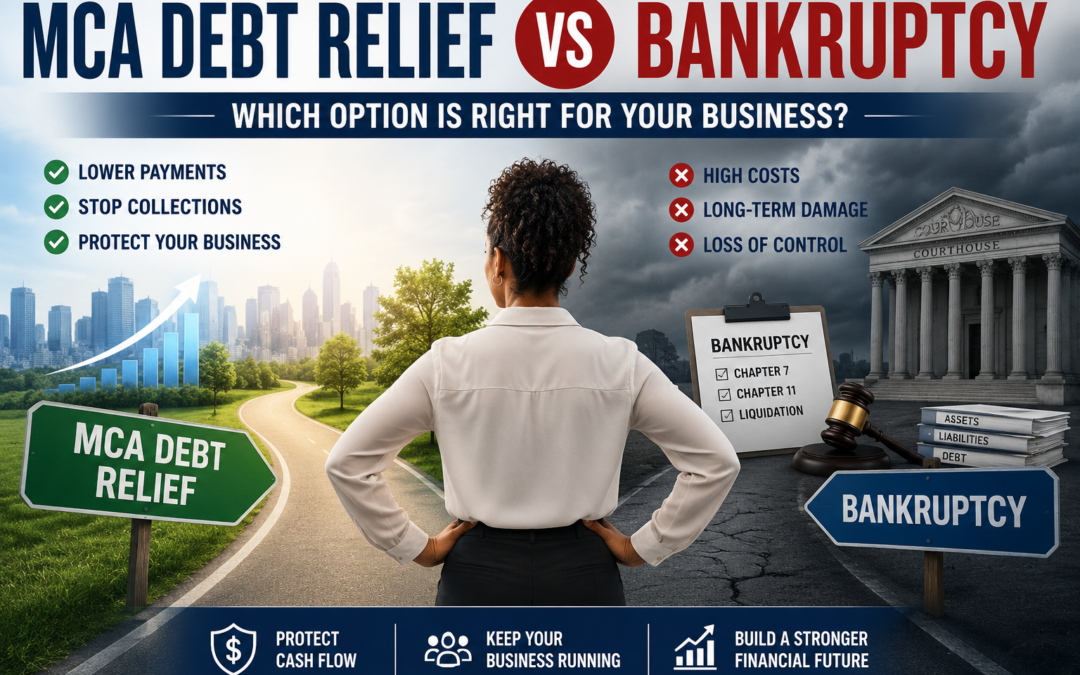
Many small business owners facing overwhelming Merchant Cash Advance payments eventually ask the same question: Should I pursue MCA debt relief or consider bankruptcy?
Daily or weekly withdrawals can consume a significant portion of revenue and place tremendous strain on cash flow. As a result, businesses may struggle to cover payroll, pay vendors, maintain inventory, and meet other operating expenses. Financial pressure often builds quickly, prompting owners to look for solutions that provide relief and restore stability.
Although both MCA debt relief and bankruptcy address serious financial challenges, they work in very different ways. The right solution depends on your company’s financial condition, goals, and ability to recover. Before making a decision that could affect operations, credit, and long-term financial health, it is important to understand the key differences between these options.
This guide compares MCA debt relief vs. bankruptcy, outlines the advantages and disadvantages of each approach, and explains which option may be the better fit for your small business.
Schedule Your Free Consultation
Understanding Merchant Cash Advance Debt
Merchant Cash Advances can provide fast access to capital when traditional financing is unavailable. However, many business owners do not fully understand how MCA debt works until repayment begins affecting daily operations.

How Merchant Cash Advances Work
A Merchant Cash Advance works differently than a traditional business loan. Businesses receive a lump sum in exchange for a portion of future revenue. Rather than using an interest rate, MCA providers apply a factor rate to determine the total repayment amount. Most providers collect payments through automatic daily or weekly withdrawals from the business’s bank account.
Why MCA Debt Can Become Difficult to Manage
Fast access to capital makes MCA funding attractive to many business owners. However, the repayment structure often creates financial challenges. Daily or weekly withdrawals continue even during seasonal slowdowns, unexpected expenses, or temporary revenue declines. Consequently, many businesses struggle to maintain adequate cash flow for normal operations.
Frequent withdrawals can also make it difficult to cover essential expenses such as payroll, rent, inventory, vendor payments, and marketing costs.
The Risk of Stacked Advances
Some business owners seek additional funding when cash flow becomes tight. This practice, commonly known as stacking, occurs when a business takes on multiple Merchant Cash Advances simultaneously.
As repayment obligations grow, pressure on cash flow often increases. What starts as a temporary solution can quickly become a cycle of debt that is difficult to escape.
Why Businesses Explore Relief or Bankruptcy
Business owners often begin exploring relief options when MCA payments interfere with day-to-day operations. Available solutions may include restructuring, consolidation, or negotiated payment reductions. In more difficult situations, bankruptcy may become a consideration.
Understanding how MCA debt works is an important first step when evaluating available solutions and choosing the best path forward for your business.
What Is MCA Debt Relief?
MCA debt relief includes several strategies that help businesses reduce the burden of Merchant Cash Advance payments. Unlike bankruptcy, which is a legal process handled through the courts, debt relief focuses on improving cash flow and creating more manageable repayment arrangements. In many cases, the business can continue operating throughout the process.
Debt Restructuring
MCA debt restructuring is one of the most common solutions. It involves modifying existing payment terms to reduce immediate pressure on cash flow. Possible adjustments include lower payment amounts, extended repayment periods, or alternative payment arrangements negotiated with MCA providers.
MCA Consolidation
Many businesses use MCA consolidation to simplify repayment. A consolidation program combines multiple Merchant Cash Advances into a single payment arrangement. As a result, owners can reduce complexity and avoid managing several daily or weekly withdrawals.
Debt Negotiation and Settlement
Business owners may also pursue mca negotiation or settlement programs. These solutions involve working directly with MCA providers to seek reduced balances, modified repayment terms, or other forms of financial relief. Companies often explore this option when existing payments have become difficult to sustain.
Payment Reduction Programs
Payment reduction programs can help lower the amount withdrawn from a business’s account. By reducing payment pressure, these programs may preserve working capital for payroll, inventory, rent, vendor payments, and other essential operating expenses.
The Goal of MCA Debt Relief
The primary objective of MCA debt relief is to help businesses regain control of cash flow and avoid more severe financial consequences. For revenue-generating companies that remain operational, relief solutions may provide an opportunity to stabilize finances, improve flexibility, and continue moving forward without pursuing bankruptcy.
What Does Bankruptcy Mean for a Small Business?
Bankruptcy is a legal process that helps businesses and individuals address debts they can no longer afford to repay. For small business owners facing severe financial hardship, bankruptcy may provide protection from creditors and create a structured path for resolving outstanding obligations. At the same time, it can carry significant financial and legal consequences that require careful consideration.
Chapter 7 Bankruptcy
Chapter 7 bankruptcy typically involves liquidating business assets to repay creditors. In many situations, the business closes permanently, and eligible remaining debts may be discharged. Business owners often consider Chapter 7 when the company is no longer financially viable, and recovery appears unlikely.
Chapter 11 Bankruptcy
Chapter 11 bankruptcy allows a business to continue operating while reorganizing its debts under court supervision. Through a structured repayment plan, the company works toward restoring financial stability while satisfying creditors over time. Although Chapter 11 may help preserve a business, the process can be complex, time-consuming, and expensive compared to other debt relief options.
Personal Liability Considerations
Personal guarantees can create additional challenges during a bankruptcy proceeding. If an owner signed a personal guarantee when obtaining financing, certain obligations may remain enforceable even after a business bankruptcy filing. Depending on the business structure and the nature of the debt, owners could remain personally responsible for some balances.
Bankruptcy may also affect personal credit, future borrowing opportunities, and long-term financial flexibility.
Is Bankruptcy the Right Choice?
Bankruptcy can provide valuable legal protections under the right circumstances. However, many business owners view it as a last-resort solution. Before filing, companies often explore MCA debt relief, restructuring, or consolidation options to determine whether they can resolve financial challenges while keeping the business operational.
Key Differences Between MCA Debt Relief and Bankruptcy
Both MCA debt relief and bankruptcy can help businesses address overwhelming debt. The two options differ significantly in cost, process, flexibility, and long-term impact. Understanding these distinctions can help business owners choose the solution that best fits their circumstances.
Cost
MCA debt relief programs are often less expensive than bankruptcy proceedings. Court costs, filing fees, attorney fees, and administrative expenses can make bankruptcy significantly more costly, particularly in Chapter 11 cases. By contrast, debt relief solutions typically focus on restructuring or negotiating obligations without court involvement.
Timeline
The timeline for MCA debt relief varies, but many businesses begin seeing payment reductions or improved cash flow relatively quickly. Chapter 11 reorganizations, however, may take months or even years to complete.
Credit Impact
Credit may be affected under either approach. However, bankruptcy generally has a more severe and longer-lasting impact. A bankruptcy filing becomes part of the public record and may remain on credit reports for years. Debt relief programs can still affect credit, but the consequences are often less significant than a formal bankruptcy filing.
Business Operations
A major benefit of MCA debt relief is the ability to keep the business operating. Lower payment obligations and improved cash flow can help owners focus on serving customers and generating revenue. Chapter 7 bankruptcy often leads to liquidation and closure, while Chapter 11 places the business under court-supervised restructuring.
Legal Consequences
Bankruptcy follows a formal legal process, whereas debt relief programs generally rely on negotiation and restructuring outside of court. One advantage of bankruptcy is the automatic stay, which may temporarily halt collection efforts and provide immediate legal protection from creditors.
Future Financing Opportunities
Lenders often view bankruptcy as a significant risk factor when evaluating future financing applications. As a result, obtaining credit after bankruptcy can be challenging. Businesses that successfully restructure debt and stabilize their finances may find it easier to qualify for future financing than those emerging from bankruptcy.
Which Option Makes More Sense?
The best path forward depends on the severity of the financial situation. Businesses that remain operational and have a realistic opportunity to recover may benefit from MCA debt relief. Bankruptcy is often reserved for situations where debt has become unsustainable and alternative solutions are no longer viable.
When MCA Debt Relief May Be the Better Option
MCA debt relief may be the better choice for businesses that continue generating revenue and have a realistic path toward recovery. In many cases, the core problem is cash flow rather than a lack of income. Customers, sales, and growth opportunities may still exist, but daily or weekly MCA withdrawals make normal operations difficult.
Businesses often explore debt relief when MCA payments consume too much revenue. As payment pressure increases, owners may struggle to cover payroll, pay vendors, maintain inventory, or meet other operating expenses. Lowering those obligations can free up working capital and provide valuable breathing room while the business stabilizes.
Companies with multiple Merchant Cash Advances, often referred to as stacked advances, may also benefit from debt relief solutions. Several daily or weekly withdrawals can quickly become overwhelming and create ongoing financial stress. Restructuring, consolidation, or payment reduction programs may simplify repayment and improve cash flow.
Keeping the business operational is another important advantage of MCA debt relief. Instead of closing the company or liquidating assets, these programs focus on creating a more sustainable financial situation that supports continued operations and future growth.
Although every situation is different, debt relief tends to be most effective when financial challenges are serious but not yet irreversible. Taking action early often creates more opportunities to regain control and improve long-term financial stability.
When Bankruptcy May Be Necessary
Although MCA debt relief can help many businesses reduce payment pressure and improve cash flow, some situations require a more aggressive solution. Bankruptcy becomes a consideration when debt levels have grown so large that restructuring, consolidation, or negotiated repayment programs are unlikely to restore financial stability.
A business experiencing ongoing losses, declining revenue, or an inability to cover basic operating expenses may fall into this category. Recovery becomes increasingly difficult when the company cannot generate enough income to support both operations and debt obligations. In these cases, debt relief solutions alone may not be enough.
Multiple forms of debt can also increase the need for bankruptcy protection. Tax liabilities, vendor balances, lawsuits, judgments, lease obligations, and other financial commitments may create a burden that exceeds the company’s ability to repay. Legal protections available through bankruptcy can provide a more comprehensive framework for resolving these challenges.
Severe collection activity is another warning sign. Creditor lawsuits, repeated collection efforts, bank account levies, and other enforcement actions can place significant pressure on a business and disrupt daily operations. Bankruptcy may offer protections that help stop or manage these actions while a longer-term solution is developed.
Many business owners view bankruptcy as a last-resort option. However, it may be the most appropriate path when financial challenges have progressed beyond the point where traditional relief strategies can restore stability. Careful evaluation of all available options, along with professional guidance, can help determine the best course of action.
Can MCA Providers Continue Collections During Debt Relief or Bankruptcy?
Many business owners wonder whether collection efforts will continue while they pursue debt relief or bankruptcy. The answer largely depends on the path the business chooses.
Collections During MCA Debt Relief
Collection activity does not automatically stop during MCA debt relief. MCA providers may continue ACH withdrawals, contact the business regarding payments, or pursue collection efforts unless the parties negotiate alternative arrangements. Many relief programs focus on discussions with creditors that aim to reduce payment pressure, modify repayment terms, or reach mutually acceptable resolutions. Results vary based on the specific circumstances and each creditor’s willingness to negotiate.
Collections During Bankruptcy
Bankruptcy operates differently because it is governed by federal law. In many cases, filing for bankruptcy triggers an automatic stay that generally requires creditors to stop most collection activities. Collection calls, lawsuits, judgments, and other efforts to recover outstanding debts may be paused while the bankruptcy case remains active.
This legal protection can provide valuable breathing room for businesses evaluating their financial situation and pursuing a court-approved resolution.
How Creditors Are Affected
Creditors may be affected differently under each approach. During MCA debt relief, they may negotiate revised payment arrangements outside of court. In bankruptcy proceedings, the legal process often determines repayment terms, which may result in modified payment schedules or partial repayment depending on the circumstances.
Choosing the Right Path
Because every situation is unique, business owners should seek qualified legal and financial guidance before making decisions regarding debt relief or bankruptcy. Understanding how each option may affect collection activity can help businesses choose the most appropriate path forward and avoid unexpected challenges during the process.
The Impact on Your Business Credit and Future Financing
When comparing MCA debt relief vs. bankruptcy, business owners should consider how each option may influence their financial future. Both solutions help businesses address overwhelming debt, but the long-term effects on creditworthiness and access to financing can differ significantly.
How MCA Debt Relief May Affect Future Financing
MCA debt relief programs typically focus on helping businesses stabilize their finances while continuing operations. Lower payment obligations, restructured terms, and consolidated debts can improve cash flow and support long-term financial recovery. Future lenders may still consider a company’s participation in a debt relief program, but the impact is often less severe than a bankruptcy filing.
How Bankruptcy May Affect Future Financing
Bankruptcy generally carries more significant and longer-lasting consequences. Since bankruptcy becomes part of the public record, lenders, banks, and funding providers often view it as a higher credit risk. Businesses and owners who file for bankruptcy may face stricter lending requirements, higher borrowing costs, or greater difficulty obtaining financing in the future.
Personal Credit Considerations
Personal credit can also be affected, particularly when business owners sign personal guarantees. Financial challenges within the business may influence an owner’s ability to obtain credit cards, mortgages, or other financial products.
Recovery Is Still Possible
Neither option automatically prevents future financial recovery. Many businesses rebuild successfully after debt relief, and some recover after bankruptcy as well. The primary difference is that debt relief often focuses on preserving operations and financial relationships, while bankruptcy may require a longer recovery period before financing opportunities become more accessible.
Looking Beyond Immediate Relief
Before making a decision, business owners should evaluate both the short-term benefits and the long-term consequences. Choosing the right path can influence not only current cash flow but also the company’s ability to secure funding and pursue future growth opportunities.
Before choosing either path, business owners should carefully weigh both the immediate benefits and the long-term financial consequences. The decision can affect not only current cash flow but also the company’s ability to secure funding and pursue future growth opportunities.
Questions to Ask Before Choosing Either Option
Choosing between MCA debt relief and bankruptcy is a major decision that can affect the future of your business. Before moving forward, take an honest look at your financial situation and consider the following questions.
✔ Can the Business Still Generate Revenue?
If your business continues to attract customers, generate sales, and produce consistent revenue, there may still be an opportunity to recover through restructuring or debt relief. A viable business often has more options than one that has completely lost its ability to generate income.
✔ Are MCA Payments the Main Problem?
Many businesses are profitable on paper but struggle because daily or weekly MCA withdrawals consume too much cash flow. If payment obligations are the primary issue, relief solutions may help address the problem without requiring bankruptcy.
✔ Is Cash Flow Recoverable?
Consider whether the business could operate successfully if payment pressure were reduced. If lower payments would allow you to cover payroll, vendors, rent, and other operating expenses, debt relief may provide a path toward stability.
✔ Are Multiple MCAs Involved?
Stacked Merchant Cash Advances can quickly create an overwhelming repayment burden. If your business is managing several advances at once, consolidation, restructuring, or other relief strategies may help simplify repayment and improve cash flow.
✔ Is Bankruptcy Truly the Last Resort?
Bankruptcy can be an effective solution in certain situations, but it is often viewed as a last option after other alternatives have been explored. Before filing, consider whether debt relief, negotiation, restructuring, or consolidation could help resolve the problem while allowing the business to remain operational.
Benefits of Seeking Professional Guidance
✔ A clearer understanding of your financial situation
✔ An evaluation of available debt relief, restructuring, consolidation, and bankruptcy options
✔ Better visibility into opportunities to improve cash flow
✔ Greater awareness of potential legal and financial consequences
✔ A strategy tailored to your business’s goals
✔ More confidence when making important financial decisions
How Professional Guidance Can Help You Evaluate Your Options
When financial pressure from Merchant Cash Advances becomes overwhelming, it can be difficult to determine the best path forward. Business owners often face several options. Each comes with its own advantages, risks, and long-term consequences. Making the wrong decision can affect cash flow, business operations, future financing opportunities, and overall financial stability.
This is where experienced professional guidance can be valuable. A qualified advisor can help assess your business’s financial condition, review existing MCA obligations, and identify potential solutions based on your specific circumstances. Rather than relying on a one-size-fits-all approach, professional assistance can help you understand which options may be realistic and which may create additional challenges.
Benefits of Seeking Professional Guidance
✔ A clearer understanding of your financial situation
✔ An evaluation of available debt relief, restructuring, consolidation, and bankruptcy options
✔ Better visibility into opportunities to improve cash flow
✔ Greater awareness of potential legal and financial consequences
✔ A strategy tailored to your business’s goals
✔ More confidence when making important financial decisions
Many business owners wait until financial challenges become severe before seeking help. Unfortunately, delaying action can limit available options and make recovery more difficult. Exploring solutions early may provide greater flexibility and improve the likelihood of achieving a positive outcome.
Whether MCA debt relief, bankruptcy, or another strategy is ultimately the right choice, obtaining experienced guidance can help ensure that your decision is based on a complete understanding of the available options. The sooner you evaluate your situation, the more opportunities you may have to protect your business and work toward long-term financial stability.
Choosing the Best Path Forward for Your Business
Understanding your options can help you choose the right path forward.
⏰ Act Early
Merchant Cash Advance debt can feel overwhelming, but financial challenges do not always mean your business is out of options. The earlier you address cash flow problems, the more opportunities you may have to find an effective solution.
🧭 Explore Your Options
Every business faces different circumstances. Some companies may benefit from MCA debt relief, restructuring, consolidation, or payment reduction programs. Others may determine that bankruptcy is the most appropriate path. Understanding your options is the first step toward making an informed decision.
🛡️ Protect Your Future
Waiting too long can limit available solutions and increase financial pressure. By seeking guidance and exploring your options early, you may be able to stabilize cash flow, protect your business, and create a stronger foundation for future growth.
Waiting too long can limit available solutions and increase financial pressure.
Early action often creates more opportunities.