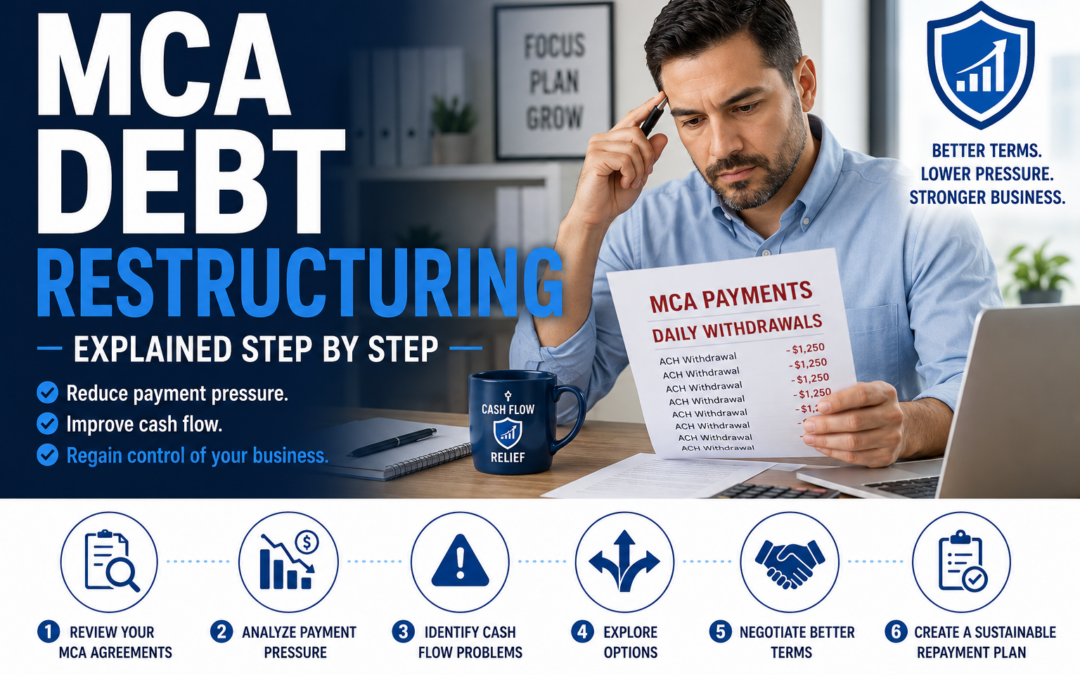
MCA Debt Restructuring can help businesses struggling with overwhelming merchant cash advance payments regain control of their cash flow. Daily or weekly withdrawals can quickly strain finances, making it difficult to cover payroll, pay vendors, purchase inventory, or meet other operating expenses. When payment pressure continues to grow, many business owners begin looking for solutions that can provide immediate relief while keeping the business operating.
MCA debt restructuring is the process of modifying or negotiating existing MCA obligations to create a more manageable repayment structure. Depending on the situation, this may involve reducing payment pressure, restructuring repayment terms, or exploring other debt relief options. In this guide, we’ll walk through the process step by step, including how to evaluate your MCA obligations, identify cash flow problems, explore restructuring options, and develop a plan for long-term financial stability.
Schedule Your Free Consultation
What Is MCA Debt Restructuring?
MCA debt restructuring is the process of modifying or reorganizing existing merchant cash advance obligations to create a more manageable repayment arrangement. Businesses often explore restructuring when daily or weekly MCA payments begin placing excessive pressure on cash flow, making it difficult to cover essential operating expenses such as payroll, rent, inventory, and vendor payments.
The primary goal of MCA debt restructuring is to reduce payment pressure while allowing the business to remain operational. Depending on the situation, restructuring may involve negotiating payment terms, adjusting repayment schedules, pursuing settlement opportunities, or implementing other debt relief strategies to improve cash flow and financial stability.

How MCA Debt Restructuring Differs From Other Options
Although the terms are sometimes used interchangeably, MCA debt restructuring is different from consolidation, settlement, and bankruptcy.
| Option | Primary Goal | Requires New Financing? | Business Continues Operating? |
|---|---|---|---|
| MCA Debt Restructuring | Modify existing obligations to reduce payment pressure | Usually No | Typically Yes |
| MCA Consolidation | Combine multiple debts into a new financing arrangement | Often Yes | Typically Yes |
| MCA Settlement | Resolve debt for less than the full amount owed | No | Often Yes |
| Bankruptcy | Obtain legal protection from creditors through court proceedings | No | Varies by situation |
MCA consolidation generally involves replacing existing obligations with a new loan or financing product. While this can simplify payments, it may also create additional debt or extend repayment periods.
MCA settlement focuses on negotiating a resolution for less than the full balance owed. This approach is often considered when repayment has become difficult, or default appears likely.
Bankruptcy is a formal legal process that may protect from creditors, but it can carry significant legal, financial, and long-term business consequences.
For many businesses, MCA debt restructuring serves as a middle-ground solution. It aims to create a more sustainable repayment path while preserving operations, protecting cash flow, and helping business owners regain control of their finances before the situation becomes severe.
Why Businesses Consider MCA Debt Restructuring
Many businesses seek MCA debt restructuring when merchant cash advance payments begin consuming too much of their available cash flow. While an MCA may provide fast access to capital, the repayment structure can become difficult to manage as obligations increase or revenue becomes less predictable. What starts as a temporary funding solution can quickly create ongoing financial pressure that affects day-to-day operations.
One of the most common reasons businesses pursue restructuring is multiple MCA obligations, often referred to as MCA stacking. Managing multiple daily or weekly payments can significantly reduce working capital, making it difficult to cover essential operating expenses. As payment obligations grow, businesses may find themselves trapped in a cycle where new funding is used to cover existing advances.
Common Reasons Businesses Seek MCA Debt Restructuring
Businesses often consider MCA debt restructuring when:
-
- Multiple MCA obligations creating excessive payment pressure
- Daily ACH withdrawals reducing available operating cash
- Cash flow shortages despite consistent sales revenue
- Payroll challenges caused by limited working capital
- Vendor payment delays that strain business relationships
- Seasonal revenue fluctuations that make fixed payment schedules difficult to maintain
-
These challenges often appear gradually before becoming serious financial problems. Business owners may notice declining bank balances, frequent overdrafts, delayed vendor payments, or increasing difficulty covering payroll. In many cases, the issue is not a lack of revenue but a repayment structure that no longer aligns with the business’s cash flow needs.
MCA debt restructuring is often considered when business owners need a more sustainable repayment arrangement, allowing them to stabilize operations, improve cash flow, and focus on long-term growth rather than constant payment pressure. Taking action early may provide more options and help prevent financial challenges from becoming severe.
Review Your Current MCA Agreements
Before exploring any MCA debt restructuring, you need a complete understanding of every merchant cash advance obligation your business currently has. Many business owners know their approximate payment amounts but may not have a clear picture of the total debt, repayment terms, or legal obligations attached to each agreement. Missing even one advance can make it difficult to develop an effective restructuring strategy.
Start by gathering all MCA contracts, payment schedules, and recent account statements. Create a list of each active advance and review the details carefully.
Information to Review
- Number of active MCAs currently being repaid
- Remaining balances owed on each advance
- Daily versus weekly payment schedules
- Factor rates and total repayment amounts
- Personal guarantee provisions
- UCC liens filed against your business
Why This Step Matters
Many businesses discover they are paying significantly more than expected once all obligations are reviewed together. Multiple MCA payments, overlapping repayment schedules, and existing UCC filings can create challenges that are not immediately obvious when viewed individually.
By identifying every obligation, you can better understand how much cash is leaving the business each day or week and where the greatest financial pressure exists. This information becomes the foundation for evaluating restructuring, settlement, consolidation, or other relief options.
Key Takeaway: You cannot create an effective MCA debt restructuring plan until you fully understand every obligation affecting your business.
Analyze Daily or Weekly Payment Pressure
Once you have identified all of your MCA obligations, the next step is understanding how those payments affect your business’s day-to-day finances. Many businesses discover that the biggest problem is not the total amount owed, but the frequency of the withdrawals. Daily or weekly MCA payments can create constant pressure on cash flow, even when sales remain steady.
Start by calculating how much money leaves your account each day or week for MCA payments. Then compare that amount to the cash needed to operate your business successfully.
Areas Commonly Affected by MCA Payments
- Operating cash flow needed for routine business expenses
- Payroll obligations and employee compensation
- Inventory purchases required to serve customers
- Marketing budgets that support future growth
- Growth opportunities such as equipment, hiring, or expansion
Why Payment Frequency Matters
A business can generate strong revenue and still struggle financially if MCA withdrawals occur too frequently. For example, a company may produce $100,000 in monthly revenue, but if multiple MCA providers withdraw funds every business day, the account balance can remain consistently low. This often leaves little room to cover unexpected expenses or invest in growth.
Daily withdrawals can be especially challenging for businesses with uneven revenue cycles. A retailer may experience strong weekend sales but face withdrawals every weekday. A contractor may wait weeks for customer payments while MCA deductions continue daily. Even profitable businesses can experience cash flow shortages when payment schedules do not align with incoming revenue.
Identifying the Pressure Points
Review your bank statements and map out when revenue enters the business compared to when MCA payments are withdrawn. This exercise often reveals periods where cash flow becomes tight, payroll is at risk, vendor payments are delayed, or growth investments are postponed.
Key Takeaway: The frequency of MCA payments can create significant financial pressure even when sales remain strong. Understanding where and when cash flow is being depleted is a critical step in building an effective MCA debt restructuring strategy.
Identify Cash Flow Problems
Many businesses do not realize they are experiencing serious cash flow problems until the warning signs become impossible to ignore. MCA payments can gradually drain working capital, making it harder to meet everyday obligations and increasing financial stress. Identifying these issues early is an important step in the MCA debt restructuring process.
If your business is experiencing several of the warning signs below, it may indicate that your current repayment structure is no longer sustainable.
Common Warning Signs of MCA Distress
☐ Frequent overdrafts or insufficient funds fees
☐ Bank account balances consistently trending downward
☐ Difficulty covering payroll on time
☐ Delayed payments to vendors or suppliers
☐ Using personal funds to support business expenses
☐ Postponing inventory purchases due to cash shortages
☐ Falling behind on taxes, rent, or other operating expenses
☐ Constant concern about upcoming MCA withdrawals
☐ Receiving collection calls or payment demands
☐ Taking out new MCAs to pay existing MCA obligations
Why These Warning Signs Matter
Many business owners focus on revenue when evaluating financial health. However, cash flow is often the more important measure when managing MCA debt. A business can generate strong sales and still struggle if too much cash is leaving the account through daily or weekly withdrawals.
One of the most concerning warning signs is using new advances to pay existing ones. This often creates a cycle of debt that becomes increasingly difficult to escape. As additional obligations are added, payment pressure typically increases, and available cash flow continues to shrink.
Recognizing these warning signs early may provide more options for restructuring, negotiation, settlement, or other relief strategies before the situation becomes more severe.
Key Takeaway: Frequent overdrafts, declining bank balances, payroll concerns, and reliance on new advances are often signs that MCA payment obligations are placing unsustainable pressure on your business.
Explore Restructuring Options
Once you understand the scope of your MCA obligations and the impact on cash flow, the next step is to evaluate potential solutions. Not every business requires the same approach. The right strategy often depends on factors such as revenue, cash flow, the number of advances, collection activity, and long-term business goals.
The objective is to find a solution that reduces financial pressure while allowing the business to continue operating and meeting its essential obligations.
Common MCA Debt Restructuring Options
MCA Restructuring Programs
MCA restructuring programs focus on modifying existing obligations to create a more manageable repayment arrangement. Depending on the circumstances, this may involve adjusting payment schedules, negotiating revised terms, or implementing other strategies designed to improve cash flow.
Payment Reduction Negotiations
In some situations, negotiations may help reduce the immediate payment burden. The goal is often to create additional breathing room so the business can continue operating while addressing outstanding obligations.
Debt Settlement Strategies
Settlement involves negotiating a resolution for less than the full amount owed. This approach is typically considered when repayment has become difficult or when default appears likely. Settlement outcomes vary based on the specific circumstances and the willingness of funders to negotiate.
Consolidation Alternatives
Some businesses explore consolidation to simplify multiple obligations. However, consolidation often involves obtaining new financing to replace existing advances. While this may reduce the number of payments, it can also create additional debt and extend repayment timelines.
Attorney-Supported Negotiations
In more complex situations, attorney-supported negotiations may be appropriate. Legal guidance can be particularly valuable when businesses are facing aggressive collection activity, multiple funders, personal guarantee concerns, or UCC lien issues.
MCA Debt Restructuring vs. MCA Consolidation
Although the terms are sometimes used interchangeably, MCA restructuring and MCA consolidation are not the same solution.
| Feature | MCA Restructuring | MCA Consolidation |
|---|---|---|
| Goal | Reduce payment pressure | Combine obligations |
| New Financing Required | Often No | Often Yes |
| Focus | Existing debt | Replacement financing |
| Risk of Additional Debt | Lower | Potentially Higher |
For many businesses, restructuring focuses on improving the terms of existing obligations, while consolidation generally replaces those obligations with a new financing arrangement. Understanding the difference can help business owners avoid solutions that may create additional financial pressure in the future.
Key Takeaway: There is no one-size-fits-all solution for MCA debt. Evaluating restructuring programs, payment negotiations, settlement opportunities, consolidation alternatives, and attorney-supported strategies can help identify the option that best supports your business’s recovery and long-term stability.
Negotiate More Manageable Terms
After identifying the most appropriate restructuring strategy, the next step is negotiating terms that better align with your business’s current financial reality. The goal is to reduce immediate payment pressure and create a path that gives the business an opportunity to stabilize operations and improve cash flow.
Negotiations can take many forms depending on the number of MCA obligations, the funders involved, and the overall financial condition of the business. While no specific outcome can be guaranteed, many businesses explore negotiations as a way to create a more manageable repayment structure.
Areas That May Be Addressed During Negotiations
Payment Frequency
One of the most common concerns is the frequency of MCA withdrawals. Daily withdrawals can place significant strain on cash flow, particularly for businesses with uneven revenue cycles. In some situations, negotiations may focus on adjusting payment schedules to better match incoming revenue.
Payment Amounts
Reducing the amount being withdrawn can provide immediate relief from MCAs and improve working capital. Lower payment obligations may help businesses cover payroll, maintain inventory levels, and meet other essential operating expenses.
Settlement Opportunities
Some businesses may explore settlement discussions as part of a broader restructuring strategy. Settlement negotiations typically focus on resolving obligations for less than the full balance owed, although outcomes vary based on the circumstances of each case.
Temporary Payment Relief
Businesses experiencing short-term financial challenges may seek temporary relief while they work to stabilize cash flow. This can provide valuable breathing room during periods of declining revenue, seasonal slowdowns, or operational disruptions.
Resolution Timelines
Negotiations may also address the timeline for resolving outstanding obligations. Creating a realistic repayment schedule can help businesses plan more effectively and avoid ongoing financial uncertainty.
Every Situation Is Different
It is important to understand that negotiation outcomes vary significantly based on the funder, the business’s financial condition, the number of active obligations, and the overall willingness of the parties to reach an agreement. What works for one business may not be appropriate for another.
For this reason, successful negotiations typically begin with a thorough review of cash flow, existing obligations, and long-term business goals before any discussions take place.
Key Takeaway: Effective negotiations focus on creating more manageable payment terms that support business operations while addressing existing MCA obligations. Because every situation is unique, outcomes will vary based on the specific financial circumstances involved.
Create a Sustainable Repayment Plan
Successfully restructuring MCA debt is only part of the solution. Long-term success depends on creating a financial plan that helps your business remain stable after payment pressure has been reduced. Without a clear strategy, businesses can find themselves facing the same cash flow challenges in the future.
A sustainable repayment plan should focus on strengthening cash flow, meeting ongoing obligations, and reducing the need for additional high-cost financing.
Monthly Cash Flow Forecasting
Cash flow forecasting helps business owners anticipate income and expenses before problems arise. By tracking expected revenue and upcoming obligations, businesses can identify potential shortfalls early and make informed financial decisions.
Regular forecasting can help answer important questions such as:
- Will there be enough cash available to cover payroll?
- Are vendor payments scheduled appropriately?
- Can the business handle seasonal revenue fluctuations?
- Are there upcoming expenses that require additional planning?
Build Emergency Reserves
Unexpected expenses are a normal part of running a business. Equipment failures, slow customer payments, seasonal downturns, and other disruptions can quickly create financial stress.
Building an emergency reserve can provide a financial cushion that helps businesses navigate short-term challenges without relying on additional MCA funding.
Stay Current on Vendor Obligations
Strong vendor relationships are critical to maintaining business operations. Delayed vendor payments can lead to supply disruptions, damaged relationships, and reduced flexibility during difficult periods.
A sustainable repayment plan should include a strategy for keeping vendor obligations current while maintaining healthy cash flow.
Plan for Tax Obligations
Many businesses focus on immediate expenses while unintentionally falling behind on tax obligations. Creating a dedicated plan for estimated taxes, payroll taxes, and other required payments can help prevent future financial complications.
Tax planning should be incorporated into the overall cash flow strategy rather than treated as an afterthought.
Evaluate Future Financing Needs
Businesses often require access to capital for growth, equipment purchases, inventory expansion, or other opportunities. Understanding future financing needs in advance allows business owners to explore healthier funding options rather than seeking emergency financing when cash flow becomes tight.
Building Long-Term Financial Stability
The ultimate goal of MCA debt restructuring is not simply to solve today’s payment problem. It is to create a stronger financial foundation that supports long-term business success.
Businesses that regularly monitor cash flow, maintain emergency reserves, plan for taxes, and carefully evaluate financing decisions are often better positioned to avoid future financial distress. Taking these steps can help reduce the likelihood of becoming dependent on additional merchant cash advances to solve recurring cash flow challenges.
Key Takeaway: A successful MCA debt restructuring strategy should include a long-term financial plan. Strong cash flow management, emergency reserves, tax planning, and thoughtful financing decisions can help businesses avoid future MCA dependency and build lasting financial stability.
Common Mistakes to Avoid During MCA Debt Restructuring
MCA debt restructuring can provide meaningful relief, but certain mistakes can limit your options and make an already difficult situation worse. Many businesses wait too long to address financial challenges or make decisions without fully understanding the potential consequences. Avoiding the following mistakes can help improve the likelihood of a successful outcome.
Ignoring Collection Notices
When businesses begin experiencing financial pressure, it can be tempting to avoid emails, letters, or phone calls from MCA providers. However, ignoring collection notices rarely makes the problem disappear. In many cases, delayed communication can reduce available options and allow the situation to escalate.
Addressing issues early often creates more opportunities for negotiation and resolution.
Taking Additional MCAs Too Quickly
One of the most common mistakes is obtaining a new merchant cash advance to cover existing MCA payments. While this may provide temporary relief, it often increases overall payment obligations and creates even greater cash flow pressure.
This cycle, commonly known as MCA stacking, can quickly become difficult to manage and may lead to ongoing financial distress.
Waiting Too Long to Seek Help
Many business owners attempt to manage MCA debt on their own for months before exploring restructuring options. Unfortunately, waiting too long can reduce flexibility and limit available solutions.
The earlier financial challenges are identified, the more options may be available for restructuring, negotiation, or settlement.
Stopping ACH Withdrawals Without a Plan
Business owners sometimes consider stopping ACH withdrawals as an immediate solution to cash flow problems. While there may be situations where banking changes become part of a broader strategy, taking action without a clear plan can create additional legal, financial, and operational complications.
Before making changes to payment arrangements, it is important to understand the potential consequences and available alternatives.
Failing to Review Legal Documents
Many MCA agreements contain important provisions related to personal guarantees, collection rights, reconciliation clauses, UCC liens, and other legal considerations. Failing to review these documents carefully can lead to misunderstandings about obligations and available options.
Understanding the terms of each agreement is a critical part of developing an effective restructuring strategy.
Quick Self-Assessment Checklist
☐ Am I ignoring collection notices or payment demands?
☐ Have I taken out new MCAs to pay existing advances?
☐ Am I waiting for the situation to improve on its own?
☐ Have I considered stopping ACH withdrawals without a plan?
☐ Do I fully understand the legal terms of my MCA agreements?
If you answered “Yes” to one or more of these questions, it may be time to evaluate your options before financial pressure becomes more severe.
When to Get Professional Help With MCA Debt Restructuring
Some businesses can address minor cash flow challenges on their own. However, when MCA obligations begin affecting daily operations, professional guidance may help business owners better understand their options and develop a strategy for moving forward.
Seeking assistance early often provides more flexibility than waiting until the situation becomes a financial emergency.
Multiple Stacked MCAs
Managing one merchant cash advance can be challenging. Managing several at the same time can quickly become overwhelming. Multiple MCA obligations often create overlapping payment schedules that place significant pressure on cash flow.
If your business is juggling several advances and struggling to keep up with daily or weekly withdrawals, it may be time to explore restructuring options.
Collection Pressure
Frequent collection calls, emails, letters, or payment demands are often signs that financial challenges are escalating. Collection activity can become a major distraction for business owners who are already focused on running their companies.
Professional guidance may help businesses evaluate available options before collection efforts become more aggressive.
UCC Lien Concerns
Many MCA providers file UCC liens as part of the funding process. While a UCC lien does not necessarily mean a business is in default, it can affect future financing opportunities and complicate efforts to obtain additional working capital.
Businesses concerned about existing UCC filings or their impact on future funding may benefit from a professional review of their situation.
Potential Defaults
Missing payments, falling behind on obligations, or anticipating an inability to meet future payment requirements are all warning signs that action may be needed. Waiting until a default has already occurred can limit available options and increase financial stress.
Exploring solutions before a default occurs often allows for a more proactive approach.
Severe Cash Flow Disruptions
When MCA payments begin interfering with daily operations, they may be creating more than a simple cash flow challenge. Payroll issues, overdrafts, vendor delays, inventory shortages, and the need to use personal funds often signal that repayment obligations are no longer sustainable.
A Proactive Approach Often Creates More Options
Many business owners wait until the situation feels unmanageable before seeking help. Unfortunately, delaying action can reduce available solutions and make recovery more difficult. Reviewing your options early may provide greater flexibility and allow you to address financial challenges before they become more severe.
Taking Action Before MCA Debt Becomes Unmanageable
MCA debt problems rarely improve on their own. What begins as a manageable payment obligation can quickly become a serious financial burden when daily withdrawals, stacked advances, and cash flow shortages start affecting business operations. The longer these challenges continue, the fewer options may be available to address them effectively.
The good news is that many businesses have alternatives to simply continuing the cycle of payment pressure. By understanding your obligations, evaluating restructuring options, and taking action early, you may be able to improve cash flow and create a more sustainable financial path forward.
The sooner you address MCA payment pressure, the more options may be available. If daily withdrawals, stacked advances, or cash flow challenges are affecting your business, exploring MCA debt restructuring solutions early may help create a more sustainable path forward. Schedule a free consultation with MCA Shield to review your options and determine the best strategy for your situation.