
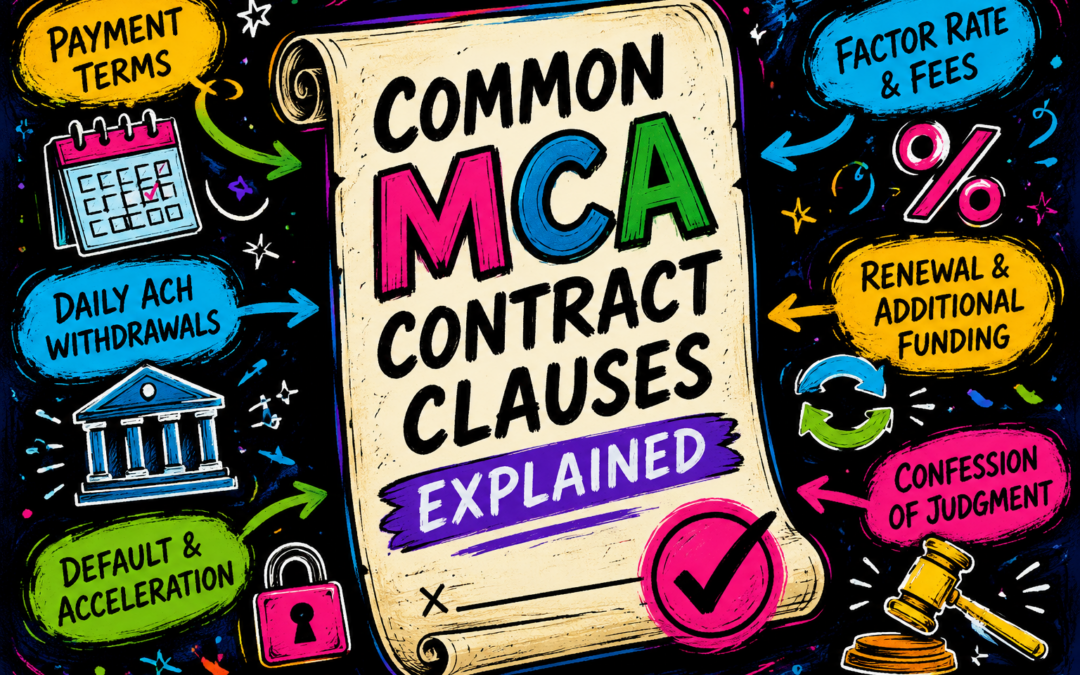
Understanding common MCA contract clauses is important before signing, renewing, or managing a merchant cash advance agreement. Many business owners focus on receiving fast funding but may not fully understand how certain contract terms can affect cash flow, repayment obligations, and daily operations.
MCA contract clauses explain important details such as payment requirements, ACH withdrawals, factor rates, renewal terms, and default conditions. Knowing what these sections mean can help business owners make informed decisions and recognize potential financial challenges early.
This guide explains common MCA contract clauses, how they work, and what options may be available if an agreement becomes difficult to manage.
Schedule Your Free Consultation
Understanding MCA Contract Clauses Before You Sign or Renew
Reviewing MCA contract clauses before signing or renewing an agreement can help business owners understand the full impact of the funding decision. While a merchant cash advance may provide quick access to capital, the structure is often very different from traditional business financing.
Each section of an MCA agreement outlines important details about repayment, fees, business obligations, and what happens if problems occur. Understanding these terms early can help prevent unexpected financial pressure later.
Why Merchant Cash Advance Agreements Are Different From Traditional Loans
Merchant cash advances are usually structured as the purchase of future business receivables rather than a traditional loan. Instead of making a fixed monthly loan payment, businesses often repay the advance through daily or weekly withdrawals based on the terms of the agreement.
Because of this structure, MCA contract clauses may include different language than standard financing documents. Terms related to factor rates, holdback percentages, payment schedules, and revenue requirements can have a major impact on the total repayment amount.
Business owners should carefully review these details before accepting additional funding or renewing an existing advance.
How Contract Terms Affect Your Cash Flow and Business Operations
The terms inside an MCA agreement can directly affect how much working capital remains available for daily operations. Frequent withdrawals may reduce cash available for payroll, inventory, vendor payments, marketing, and other business expenses.
Some MCA contract clauses also explain what happens during periods of reduced revenue or missed payments. Understanding these sections can help business owners identify potential risks before cash flow becomes difficult to manage.
A clear review of the agreement provides a better picture of the true financial commitment and helps business owners make decisions based on long-term stability.
Important MCA Contract Clauses Business Owners Should Review
Every merchant cash advance agreement contains terms that explain how the advance works, how payments are collected, and what responsibilities the business accepts. Reviewing important MCA contract clauses can help owners understand their obligations before financial pressure develops.
While every agreement is different, several common sections deserve careful attention.
Purchase and Sale of Future Receivables Clause
One of the most important MCA contract clauses explains the purchase and sale of future receivables. This section describes how the funding company is purchasing a portion of future business revenue in exchange for providing upfront capital.
Unlike a traditional loan agreement, many MCA contracts are structured around future sales instead of a fixed repayment schedule. Business owners should understand how this arrangement affects their daily revenue and overall cash flow.
Daily or Weekly ACH Withdrawal Authorization Clause
The ACH authorization clause explains how payments are collected from the business account. Many MCA agreements allow automatic withdrawals on a daily or weekly schedule until the repayment obligation is complete.
These frequent withdrawals can create challenges if revenue slows or unexpected expenses occur. Reviewing this clause helps business owners understand how much money may leave their account and how often payments will happen.
Holdback Percentage Clause
The holdback percentage clause outlines the portion of business revenue that may be collected toward repayment. This percentage can influence how much cash remains available for normal business expenses.
A higher holdback amount may create additional pressure by reducing available working capital. Understanding this section helps business owners evaluate whether the payment structure matches their current revenue.
Factor Rate and Repayment Amount Clause
The factor rate clause explains how the total repayment amount is calculated. Instead of a traditional interest rate, many MCA agreements use a factor rate to determine how much the business must repay.
For example, the repayment amount is usually based on the advance amount multiplied by the factor rate. Reviewing this section helps business owners understand the true cost of the funding before accepting the agreement.
Reconciliation Clause
A reconciliation clause may allow payments to be adjusted based on changes in business revenue. This section explains whether payment adjustments are available and what steps are required to request a review.
Business owners should carefully examine the requirements because the process can vary between MCA providers. Understanding this clause may help companies manage payments during periods when revenue decreases.

MCA Contract Clauses That Can Create Financial Pressure
Some MCA contract clauses may create challenges when business revenue changes or cash flow becomes limited. While merchant cash advances can provide fast access to funding, certain agreement terms may increase financial pressure if they are not fully understood.
Business owners should carefully review these sections to understand their obligations, potential risks, and available options if payments become difficult to manage.
Renewal and Additional Funding Clauses
Renewal clauses explain the terms for receiving additional funding from an MCA provider. While another advance may provide temporary cash flow relief, adding new funding before resolving existing obligations can create long-term challenges.
Multiple advances may result in several daily or weekly payments being withdrawn at the same time. This can reduce available working capital and make it harder to cover payroll, inventory, rent, and other operating expenses.
Before accepting a renewal offer, business owners should review the full repayment amount and determine how the new agreement affects overall cash flow.
Default Terms and Acceleration Clauses
Default clauses explain what actions may place a business in violation of the MCA agreement. These situations may include missed payments, blocked withdrawals, account changes, or other terms listed in the contract.
Some agreements may also include acceleration clauses. These provisions may allow the MCA company to request a larger balance or take additional collection steps after a default event occurs.
Understanding these MCA contract clauses early can help business owners recognize potential problems and explore solutions before issues escalate.
Personal Guarantee Requirements
A personal guarantee clause explains whether an individual owner accepts personal responsibility for certain obligations listed in the agreement. This section is important because it may affect the owner beyond normal business operations.
The details of personal guarantees can vary depending on the MCA contract. Business owners should carefully review this language to understand their responsibilities and potential exposure.
Confession of Judgment Clauses
A confession of judgment, sometimes called a COJ, is a contract provision that may allow a creditor to obtain a judgment without a traditional court process in certain situations and jurisdictions.
Not every MCA agreement contains this clause, and laws regarding COJs vary by location. However, business owners should understand whether this language appears in their agreement and what it could mean if payment problems occur.
Reviewing these MCA contract clauses can help owners better understand their position and take action before financial pressure becomes more difficult to manage.
How MCA Contract Terms Impact Your Business After Funding
MCA contract clauses can affect a business long after funding is received. While fast capital may solve an immediate problem, repayment terms can influence cash flow, operations, and future financial options.
Reduced Cash Flow From Automatic Payments
Many MCA agreements include daily or weekly automatic withdrawals. These frequent payments can reduce available cash for payroll, inventory, vendors, and other operating expenses.
When revenue slows but payments remain high, businesses may experience increased financial pressure.
Difficulty Managing Multiple MCA Agreements
Multiple MCA agreements can create several payment schedules and withdrawal obligations at the same time. As payments increase, managing normal business expenses may become more difficult.
Reviewing all MCA contract clauses together helps owners understand the full impact on their finances.
Challenges Accessing Future Financing
Existing MCA obligations may affect future financing opportunities. High payment amounts, reduced cash flow, or multiple advances can make obtaining new funding more challenging.
Understanding contract terms and creating a repayment strategy can help businesses work toward greater financial stability.
Warning Signs Your MCA Agreement May Become Difficult to Manage
Recognizing warning signs early can help business owners address problems before MCA payments create additional financial stress. Certain MCA contract clauses may become harder to manage when revenue changes, expenses increase, or multiple advances begin affecting cash flow.
Understanding these signs can help you determine when it may be time to review your agreement and explore available options.
Payments Are Taking Too Much Revenue
One of the most common warning signs is when MCA payments begin using a large portion of daily or weekly revenue. Frequent withdrawals can leave less money available for payroll, inventory, vendor payments, and other business needs.
If your company is constantly trying to replace cash lost to payments, the agreement may no longer match your current financial situation.
You Are Using New Advances to Cover Old Ones
Taking another merchant cash advance to manage existing payments can create a difficult cycle. While new funding may provide short-term relief, it often adds another repayment obligation.
Over time, multiple advances can increase financial pressure and make it harder for the business to recover.
Contract Terms Are Difficult to Understand
MCA agreements can include complex language related to repayment terms, defaults, reconciliation, and other important conditions.
If the terms are unclear, reviewing your MCA contract clauses can help you understand your obligations and identify potential concerns before making future decisions.
Knowing what is inside your agreement is an important step toward protecting your cash flow and creating a stronger financial plan.
What to Do Before Signing or Renewing an MCA Contract
Before accepting a new merchant cash advance or renewing an existing agreement, it is important to understand how the terms may affect your business. Reviewing MCA contract clauses before making a decision can help you evaluate the true cost and avoid unexpected payment challenges.
Taking time to examine the details can provide a clearer picture of your financial commitment.
Review the Full Repayment Obligation
The advance amount is only one part of the agreement. Business owners should review the total repayment amount, factor rate, fees, and any additional requirements listed in the contract.
Understanding the complete obligation helps determine whether the funding matches your current revenue and long-term business goals.
Understand Your Daily Payment Requirements
Many MCA agreements include daily or weekly payment structures. Before signing, review how often withdrawals occur and how much cash will remain available after payments are made.
A payment schedule that looks manageable at first may become difficult if sales slow or unexpected expenses arise.
Compare Short-Term Funding With Long-Term Impact
Fast access to capital can solve immediate business needs, but it is important to consider the long-term effect. Repayment terms may impact future cash flow, growth plans, and financial flexibility.
Carefully reviewing MCA contract clauses allows business owners to make decisions based on the full picture, not just the immediate funding opportunity.
Options When MCA Contract Terms Become Overwhelming
When MCA contract clauses create financial pressure, business owners may still have options. Difficulty managing payments does not always mean taking another advance or continuing with terms that no longer fit the company’s financial situation.
Reviewing the agreement, understanding current obligations, and creating a clear strategy can help businesses move toward a more manageable solution.
MCA Contract Review and Financial Assessment
The first step is understanding the complete financial picture. A detailed review of MCA contract clauses can help identify payment requirements, balances, repayment terms, and potential areas of concern.
Evaluating revenue, expenses, and current cash flow can also help determine which options may be available. Every business situation is different, so creating a strategy starts with knowing exactly where things stand.
MCA Debt Settlement and Restructuring Options
Businesses struggling with MCA payments may be able to explore settlement or restructuring options. These solutions are designed to help reduce financial pressure and create a more manageable path forward.
Depending on the situation, this may involve negotiating payment terms, addressing multiple advances, or working toward resolving outstanding MCA obligations.
Creating a Sustainable Business Recovery Plan
Long-term recovery requires more than a temporary fix. A strong plan focuses on improving cash flow, stabilizing operations, and preventing the same financial challenges from returning.
MCA Shield helps business owners review their current agreements, understand available options, and create customized strategies focused on rebuilding financial control.
Frequently Asked Questions About MCA Contract Clauses
What Clauses Should I Look for in an MCA Agreement?
Business owners should carefully review MCA contract clauses related to repayment terms, ACH withdrawals, factor rates, holdback percentages, renewals, defaults, and reconciliation options.
Understanding these sections can help identify how the agreement may impact cash flow and daily operations.
Can MCA Contract Terms Be Changed?
In some situations, MCA contract terms may be adjusted through negotiation or restructuring. The available options depend on the agreement, funding company, payment history, and current business circumstances.
Reviewing the contract is an important first step in determining possible solutions.
What Happens If I Cannot Keep Up With MCA Payments?
If MCA payments become difficult to manage, the funding company may begin collection activity based on the terms of the agreement. The specific consequences depend on the MCA contract clauses included in the document.
Business owners experiencing payment problems should review their options early before financial pressure increases.
Are MCA Contracts Legally Binding?
MCA contracts are generally considered legally binding agreements. However, the specific terms, requirements, and enforcement options can vary depending on the contract and applicable laws.
A professional review can help business owners better understand their obligations.
Can Multiple MCA Agreements Be Negotiated?
Multiple MCA agreements may be addressed through negotiation, settlement, or restructuring strategies depending on the situation.
Businesses with several advances should review all agreements together to understand total payments, balances, and cash flow impact.
Understand Your MCA Contract Before It Controls Your Business
MCA contract clauses can affect your cash flow, operations, and long-term stability. Understanding your agreement helps you identify potential problems and explore solutions before financial pressure increases.
Why Reviewing MCA Terms Early Creates More Options
Taking action early allows business owners to evaluate repayment challenges, understand available options, and create a plan to regain financial control.
Schedule a Free Consultation With MCA Shield
MCA Shield helps business owners review MCA contract clauses, explore relief options, and develop strategies focused on reducing payment pressure.
Schedule a free consultation today to learn what options may be available for your business.