

Merchant Cash Advances can provide fast access to working capital when traditional financing is unavailable. However, many business owners eventually find themselves thinking, “I can’t afford my MCA payments anymore.” Daily or weekly withdrawals can quickly reduce cash flow, making it harder to cover payroll, inventory, rent, and other essential operating expenses. What begins as a short-term funding solution can become a significant financial burden when business revenue slows or expenses increase.
If you can’t afford MCA payments anymore, it is important to understand you may still have options. Depending on your situation, solutions such as restructuring, consolidation, settlement, or other Merchant Cash Advance relief programs may help reduce payment pressure and improve cash flow. In this guide, we’ll explain why MCA payments become unaffordable, what can happen if you fall behind, and the steps you can take to regain control before the situation becomes more severe.
Why MCA Payments Become Unaffordable for Many Businesses
Many business owners accept a Merchant Cash Advance to solve a short-term cash flow problem. The funding can arrive quickly and may help cover immediate expenses. However, the repayment structure often creates challenges that become more difficult to manage over time.
One of the most common reasons MCA payments become unaffordable is a decline in revenue. When sales slow unexpectedly, daily or weekly withdrawals can consume a larger percentage of incoming cash. Even businesses with strong long-term potential can struggle when revenue drops for several weeks or months.
Seasonal fluctuations can also create repayment problems. Many industries experience predictable highs and lows throughout the year. During slower periods, businesses may generate less revenue while MCA payments remain unchanged. This can place significant pressure on cash flow and make it difficult to cover operating expenses.
Rising costs are another common factor. Increased payroll expenses, higher inventory costs, inflation, rent increases, and other business expenses can reduce available working capital. As operating costs grow, MCA payments may become harder to sustain even if revenue remains relatively stable.
In some cases, business owners take out additional Merchant Cash Advances to cover existing obligations. This practice, often called stacking, can quickly create a cycle of debt. Multiple daily or weekly withdrawals may leave very little cash available for normal business operations. As repayment obligations increase, the risk of financial distress often grows as well.
Recognizing these challenges early is important. The sooner a business identifies that MCA payments are becoming difficult to manage, the more options may be available to improve cash flow and explore potential relief solutions.
Warning Signs Your MCA Payments Are Creating a Cash Flow Crisis
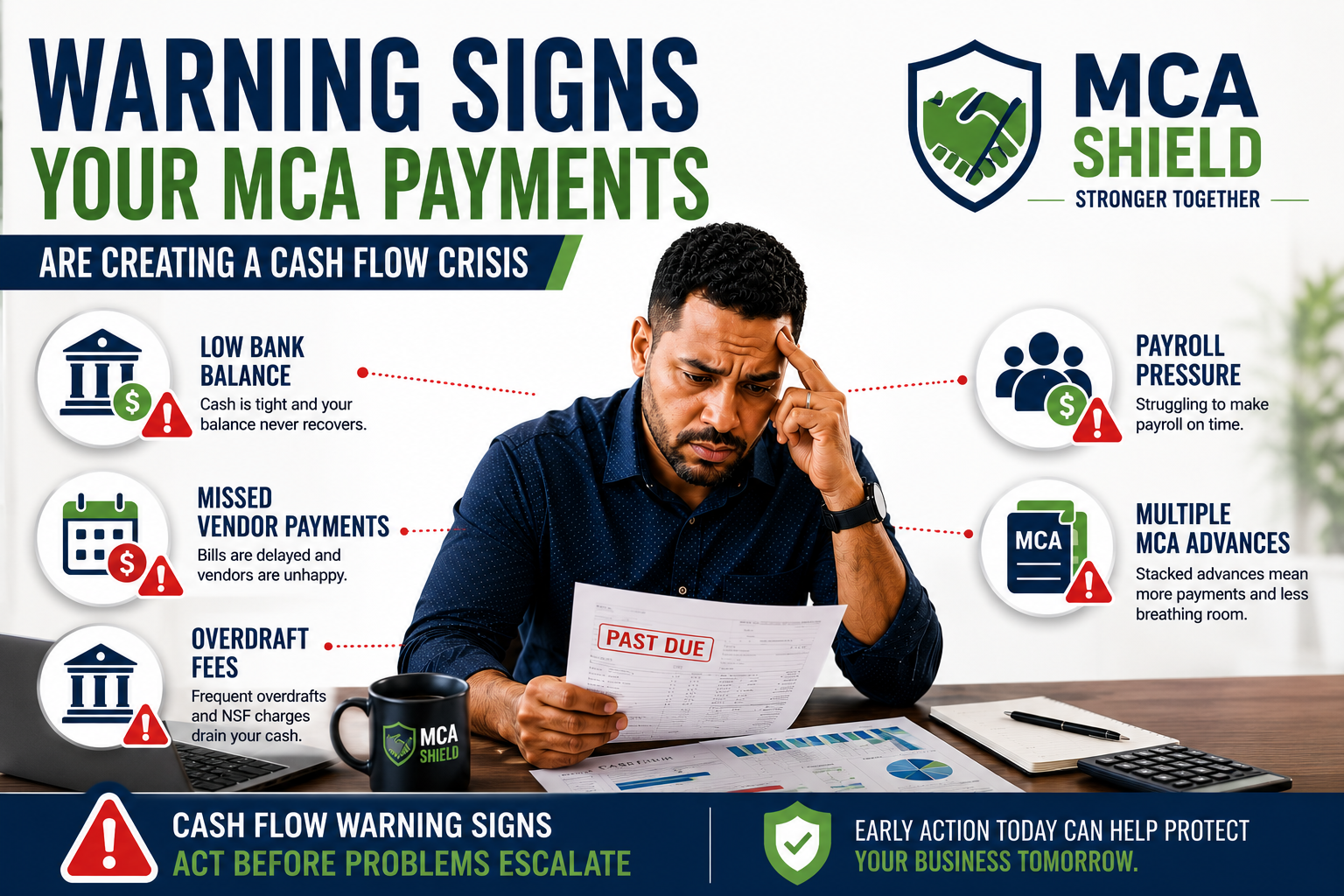
Financial problems caused by Merchant Cash Advance payments rarely appear overnight. In many cases, business owners notice subtle warning signs long before the situation becomes a full-blown crisis. Recognizing these indicators early may provide more time to explore relief options and protect your business’s financial stability.
One of the clearest warning signs is consistently low cash balances. If your account balance drops significantly after each MCA withdrawal and struggles to recover before the next payment, cash flow pressure may be building. Many businesses begin operating with little financial cushion, making it difficult to handle unexpected expenses.
You may also notice that essential bills are becoming harder to pay. Delaying vendor payments, using credit cards to cover operating expenses, postponing equipment purchases, or struggling to make payroll can indicate that MCA obligations are consuming too much of your available cash.
Other common warning signs include:
- Frequent overdrafts or non-sufficient funds (NSF) charges
- Difficulty covering payroll on time
- Falling behind on rent, utilities, or vendor payments
- Using one funding source to pay another
- Declining working capital reserves
- Increased reliance on personal funds to support the business
- Taking out additional Merchant Cash Advances to cover existing payments
If you recognize several of these warning signs, it may be time to take action. Addressing cash flow problems early often provides more flexibility and may help prevent more serious financial and legal consequences later.
What Happens If You Miss an MCA Payment?
Missing a Merchant Cash Advance payment can trigger a series of consequences that may affect your cash flow, business operations, and financial stability. While the exact response varies by funding company and contract terms, business owners should understand the potential risks before payment problems escalate.
📞 Collection Efforts & Payment Demands
When an MCA payment is missed, the funding company will often attempt to contact the business to discuss the issue. Collection efforts may include phone calls, emails, account reviews, and requests for updated financial information. Some providers may be willing to discuss temporary solutions, while others may move quickly to enforce the terms of the agreement.
As missed payments continue, collection activity often becomes more aggressive. Business owners may face increased pressure to make payments or provide explanations for the default.
📄 Default Provisions & Contract Terms
Most Merchant Cash Advance contracts contain default provisions that outline what happens when repayment obligations are not met. Depending on the agreement, a missed payment may trigger additional fees, accelerated repayment demands, or other contractual remedies.
Some MCA agreements contain broad default language that can create significant financial challenges for struggling businesses. Understanding the specific terms of your agreement is important when evaluating available options and determining the best path forward.
⚖️ Legal & Financial Consequences
In some situations, unresolved payment issues may lead to legal action. Depending on the contract and circumstances involved, funding companies may pursue judgments, enforce personal guarantees, seek bank account remedies, or attempt to collect through other legal channels.
Not every missed payment results in legal action. However, ignoring the problem often limits your options and may increase financial pressure over time. Businesses that address repayment challenges early are often in a stronger position to explore restructuring, settlement, or other relief solutions before the situation becomes more severe.
Can You Negotiate Lower MCA Payments?
In some situations, businesses may be able to negotiate lower MCA payments or seek temporary relief when cash flow becomes strained. While every funding company has its own policies and contract terms, many providers would rather discuss possible solutions than face a complete default on payment. Taking action early often improves the chances of reaching a workable arrangement.
One option is to contact the MCA provider directly and explain the financial challenges affecting the business. A temporary decline in revenue, unexpected expenses, seasonal slowdowns, or other hardships may create opportunities for discussion. Some funding companies may consider short-term payment adjustments, revised withdrawal amounts, or other modifications designed to help businesses remain operational.
Business owners may also submit hardship requests when financial difficulties become severe. These requests typically involve providing financial statements, bank records, or other documentation that demonstrates the business’s current condition. The funding company can then evaluate whether temporary accommodations are appropriate based on the circumstances.
However, it is important to maintain realistic expectations. Not every MCA provider is willing to modify payment terms, and some agreements offer limited flexibility. Even when negotiations are successful, the total amount owed may remain unchanged, or repayment may be extended over a longer period. Businesses should carefully evaluate any proposed modification to understand its long-term impact.
Options for Businesses That Can't Afford MCA Payments
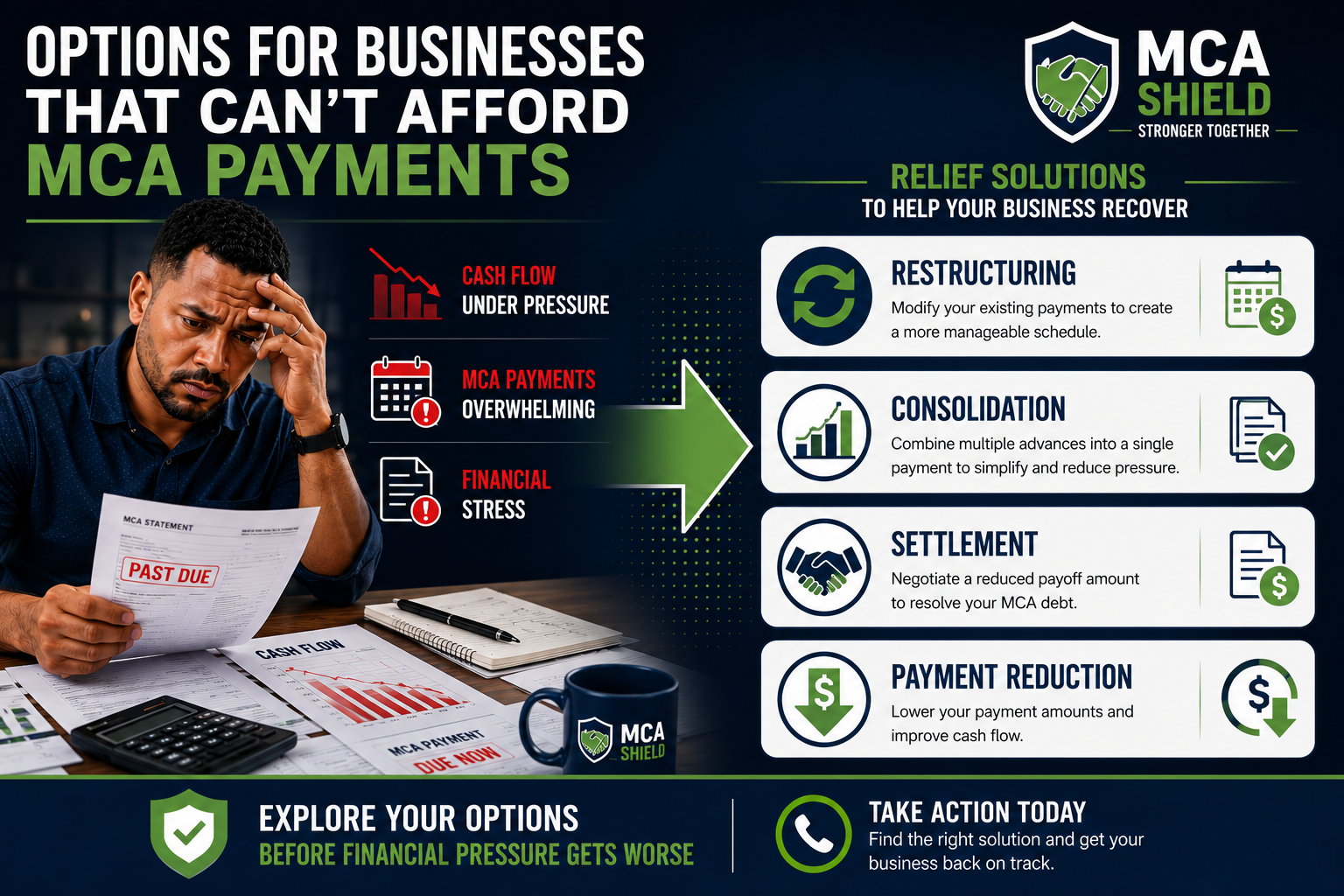
If your Merchant Cash Advance payments have become unmanageable, it is important to know that multiple relief options may be available. The right solution depends on factors such as your cash flow, the amount of debt involved, the number of advances outstanding, and your long-term business goals. Taking action early often provides the greatest flexibility and may help prevent more serious financial consequences.
One potential option is MCA restructuring. Restructuring programs are designed to modify existing repayment obligations and create a more manageable payment schedule. By reducing payment pressure, businesses may improve cash flow while continuing normal operations.
Some businesses may benefit from MCA consolidation. Consolidation combines multiple payment obligations into a single structured payment, which can simplify repayment and reduce the burden of managing several advances at once. This approach is often considered when stacked Merchant Cash Advances have created significant cash flow challenges.
In certain situations, MCA settlement may be an option. Settlement typically involves negotiating a reduced payoff amount in exchange for resolving the debt. While settlement is not appropriate for every business, it can provide a path toward resolving overwhelming obligations when other solutions are not feasible.
Businesses experiencing severe cash flow problems may also qualify for payment reduction programs or other forms of Merchant Cash Advance relief. These solutions are intended to lower financial pressure, improve working capital, and provide a realistic path toward long-term stability.
Because every situation is unique, it is often beneficial to evaluate all available options before making a decision. Understanding the advantages and limitations of each approach can help business owners choose the solution that best supports their financial recovery goals.
MCA Debt Consolidation vs MCA Restructuring: What's the Difference?
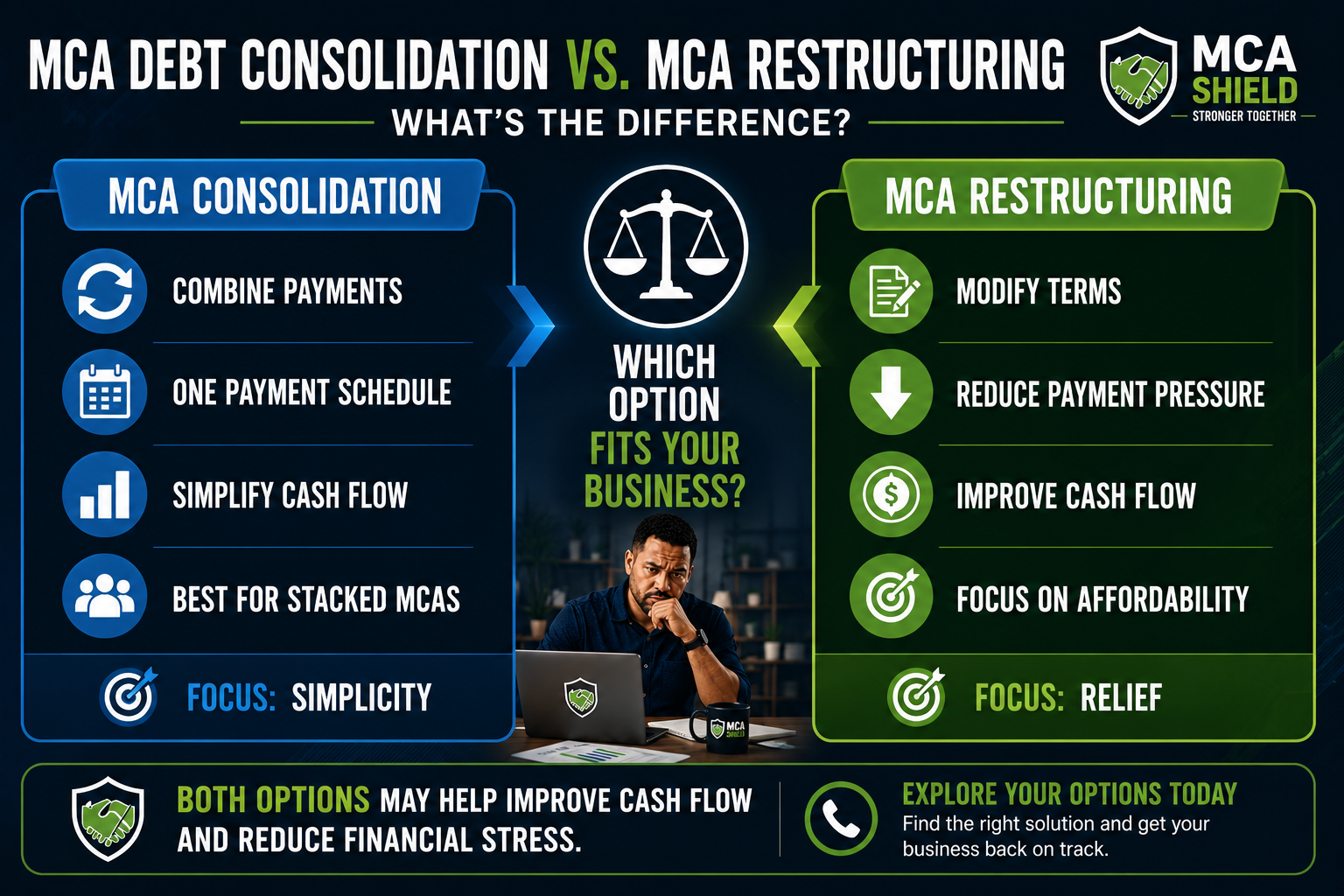
When business owners begin exploring relief options, two terms often appear repeatedly: MCA debt consolidation and MCA restructuring. While both solutions are designed to reduce financial pressure and improve cash flow, they work in different ways. Understanding the differences can help you determine which approach may be better suited for your business.
In general, consolidation focuses on combining multiple obligations into a more manageable payment structure. Restructuring focuses on modifying existing repayment terms to reduce immediate financial strain. The right solution depends on factors such as the number of Merchant Cash Advances involved, your current cash flow, and your long-term recovery goals.
MCA Consolidation vs MCA Restructuring
| Feature | MCA Consolidation | MCA Restructuring |
|---|---|---|
| Primary Goal | Combine multiple obligations into one payment | Modify existing repayment terms |
| Best For | Businesses with multiple MCA payments | Businesses struggling with one or more existing MCA payments |
| Payment Structure | Single consolidated payment | Reduced or adjusted payment schedule |
| Cash Flow Impact | Simplifies repayment management | Reduces immediate payment pressure |
| Number of Advances | Often used with stacked MCAs | Can be used with one or multiple advances |
| Focus | Organization and simplification | Payment relief and affordability |
| Potential Benefit | Easier budgeting and fewer payments | Improved cash flow and business stability |
Neither option is universally better than the other. Some businesses benefit from consolidating multiple Merchant Cash Advances into a single payment, while others achieve better results through restructuring existing obligations. In certain situations, a combination of strategies may provide the most effective path forward.
The most important step is evaluating your current financial situation before payment problems become more severe. The sooner you explore available options, the more flexibility you may have to improve cash flow and regain control of your business finances.
How Stacked Merchant Cash Advances Make Payment Problems Worse
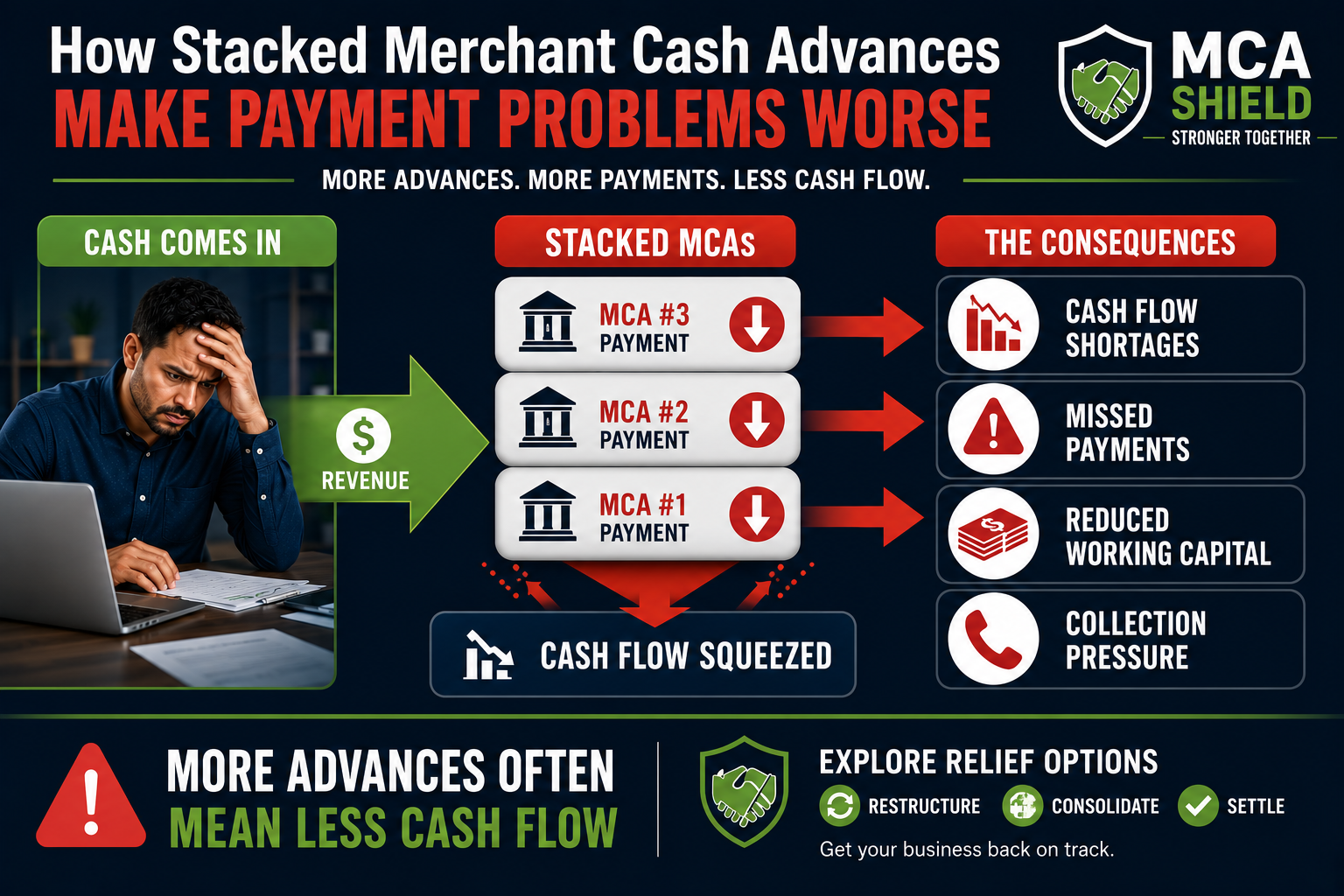
Many businesses turn to a second Merchant Cash Advance when cash flow becomes tight. At first, the additional funding may seem like a temporary solution. However, taking out multiple advances, commonly known as stacking, often creates even greater financial pressure and can accelerate a business’s financial distress.
Each new MCA adds another daily or weekly payment obligation. As withdrawals increase, a larger percentage of the business’s revenue is used to repay debt rather than support normal operations. This can leave less money available for payroll, inventory, rent, marketing, and other essential expenses needed to keep the business running.
Over time, stacked Merchant Cash Advances can create a cycle that becomes difficult to escape. A business may take out a new advance to cover existing payments, only to discover that the additional withdrawal further reduces available cash flow. As repayment obligations continue to grow, financial flexibility often shrinks.
Common Risks of Stacked MCAs
- Multiple daily or weekly ACH withdrawals
- Reduced working capital
- Increased cash flow shortages
- Greater difficulty covering operating expenses
- Higher risk of missed payments and default
- Increased collection activity and financial pressure
The more advances that are stacked together, the harder it often becomes to maintain healthy cash flow. For many business owners, recognizing the risks of stacking early can help prevent a temporary funding challenge from becoming a long-term debt problem. Exploring restructuring, consolidation, or other relief options may provide a more sustainable path forward.
Can You Stop ACH Withdrawals From an MCA Company?
Many Merchant Cash Advance agreements rely on Automated Clearing House (ACH) withdrawals to collect payments directly from a business’s bank account. While this arrangement simplifies repayment for the funding company, it can create serious challenges when cash flow becomes strained. Business owners often begin searching for ways to stop ACH withdrawals when payments become unaffordable or threaten the company’s ability to cover essential expenses.
In some situations, it may be possible to stop or restrict ACH withdrawals. However, doing so is not always straightforward. The ability to stop withdrawals depends on factors such as the terms of the MCA agreement, the authorization provided to the funding company, applicable banking rules, and the specific circumstances involved. Taking action without understanding these factors can sometimes create additional complications.
Business owners should also consider the potential consequences before attempting to stop ACH payments. Depending on the agreement, blocked withdrawals may trigger default provisions, increased collection activity, accelerated repayment demands, or other contractual remedies. What appears to be a simple banking decision can sometimes lead to larger financial and legal issues.
Because MCA agreements can be complex, professional guidance is often beneficial before making changes to payment arrangements. An experienced professional can help evaluate your agreement, explain available options, and determine whether restructuring, consolidation, settlement, or other relief solutions may provide a safer path forward. Understanding your options before taking action may help protect both your business and your long-term financial stability.
How MCA Debt Relief Can Help Reduce Financial Pressure
When Merchant Cash Advance payments begin consuming too much of a business’s revenue, financial pressure can quickly build. Daily or weekly withdrawals may leave less money available for payroll, inventory, rent, marketing, and other essential operating expenses. As cash flow tightens, many business owners find themselves searching for a sustainable way to regain control of their finances.
MCA debt relief programs are designed to help businesses address overwhelming repayment obligations and improve cash flow. Depending on the circumstances, relief solutions that involve restructuring existing payments, consolidating multiple advances, negotiating settlements, or pursuing other strategies that reduce financial strain. The goal is not simply to address immediate payment challenges, but to create a more manageable path forward.
One of the primary benefits of debt relief is improved cash flow. When payment obligations become more affordable, businesses may have greater flexibility to cover operating expenses, invest in growth opportunities, and stabilize day-to-day operations. Reducing financial pressure can also allow owners to focus more on running the business and less on managing constant repayment demands.
Potential Benefits of MCA Debt Relief
- Lower monthly or periodic payment obligations
- Improved working capital and cash flow
- Reduced financial stress
- Simplified repayment structures
- Greater flexibility to cover operating expenses
- A clearer path toward long-term financial stability
Every business situation is unique, which is why evaluating available relief options is an important step. The right solution can help reduce financial pressure, improve cash flow, and position the business for a stronger financial future.
When Should You Seek Professional Help for MCA Debt?

Many business owners wait too long before seeking help with Merchant Cash Advance debt. They often hope that sales will improve, expenses will decrease, or cash flow problems will resolve on their own. While temporary setbacks can sometimes improve naturally, ongoing financial pressure often becomes more difficult to manage over time.
If MCA payments are interfering with your ability to operate the business, it may be time to explore professional guidance. The earlier you evaluate your options, the more flexibility you may have to address repayment challenges before they lead to missed payments, defaults, collection activity, or additional borrowing.
Signs It May Be Time to Seek Help
- You’re struggling to cover payroll or operating expenses
- Daily or weekly MCA payments are consuming too much cash flow
- You have multiple stacked Merchant Cash Advances
- You’re considering taking out another advance to cover existing payments
- ACH withdrawals are causing bank account problems
- You’re receiving collection calls or default notices
- Cash flow shortages are becoming more frequent
- You are unsure which relief option is best for your situation
Professional guidance can help you better understand your options and evaluate potential solutions such as restructuring, consolidation, settlement, or other relief strategies. Taking action early may help reduce financial pressure and provide a clearer path toward long-term stability.
The most important thing is not to ignore the problem. Seeking help does not mean your business has failed. In many cases, it simply means you are taking proactive steps to protect your business, improve cash flow, and position the company for future success.
Taking Action Before MCA Debt Gets Worse
Merchant Cash Advances can provide valuable access to working capital, but repayment obligations can quickly become overwhelming when cash flow declines or expenses increase. If you’re struggling to keep up with daily or weekly withdrawals, it is important to recognize that financial pressure rarely improves by itself. In many cases, waiting too long limits available options and allows the situation to become more difficult to manage.
The good news is that businesses facing MCA challenges often have more options than they realize. Solutions such as restructuring, consolidation, settlement, payment modifications, and other relief strategies may help reduce financial pressure and create a more sustainable path forward. The key is identifying potential problems early and exploring available solutions before missed payments, defaults, or collection efforts escalate.
Every business situation is unique, which is why a careful evaluation of your financial circumstances is an important first step. Understanding your obligations, cash flow needs, and available relief options can help you make informed decisions that support both short-term stability and long-term success.
If MCA payments are putting your business under pressure, don’t wait until the situation becomes a crisis. Exploring your options today may help protect your cash flow, preserve business operations, and position your company for a stronger financial future.