
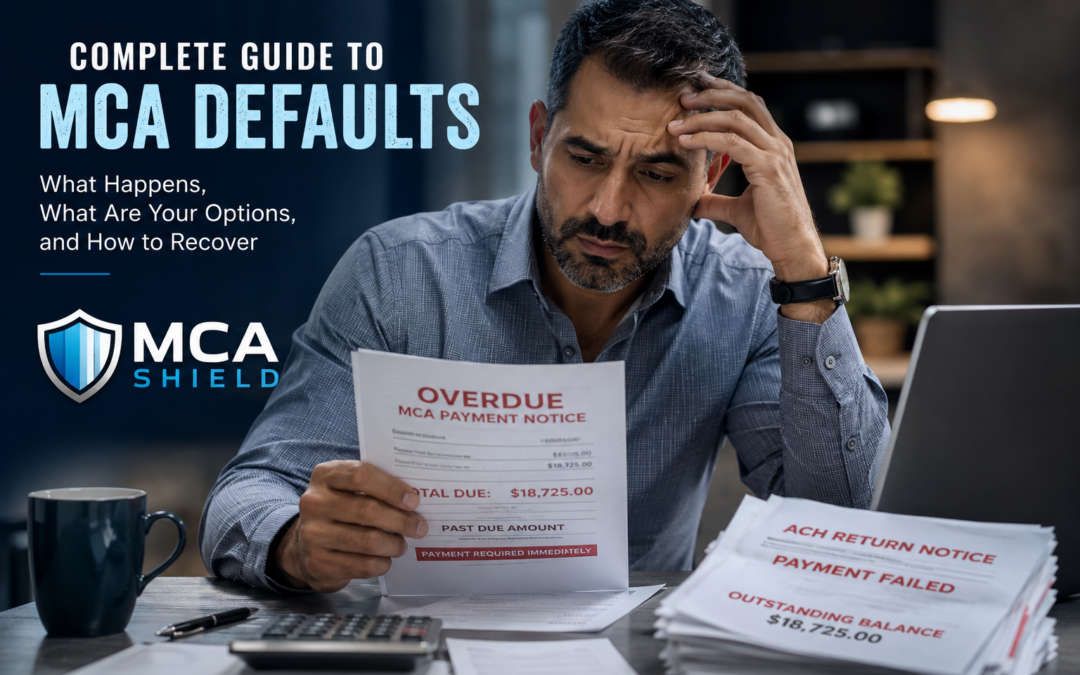
A merchant cash advance default occurs when a business is unable to meet the repayment terms outlined in its merchant cash advance agreement. For many business owners, default can feel overwhelming, especially when daily or weekly payments continue to reduce cash flow. However, reaching this point does not automatically mean your business is out of options. Instead, understanding what happens after a merchant cash advance default is the first step toward making informed financial decisions and protecting your company’s future.
Businesses default on merchant cash advances for many reasons, often because of financial challenges beyond their control. For example, declining sales, seasonal revenue fluctuations, unexpected expenses, rising operating costs, or taking on multiple merchant cash advances can all make repayment difficult. As financial pressure builds, business owners may struggle to keep up with daily obligations while maintaining payroll, purchasing inventory, and serving customers.
Fortunately, a merchant cash advance default does not have to be the end of your business. In fact, many companies have successfully recovered by taking action early, understanding their available options, and working toward a realistic financial solution. Whether you’re concerned about an upcoming default or are already behind on payments, this guide explains what to expect, the potential consequences, and the practical steps you can take to regain control of your finances.
Schedule Your Free Consultation
What Is an MCA Default?
Understanding what an MCA default means is essential for any business that relies on a merchant cash advance for working capital. Although every agreement contains its own terms, a default generally occurs when a business no longer meets the repayment obligations outlined in its contract. By understanding how defaults happen—and how they differ from temporary payment issues—business owners can recognize warning signs earlier and respond before the situation becomes more difficult.
When a Merchant Cash Advance Is Considered in Default
A merchant cash advance default occurs when a business fails to comply with one or more terms of its merchant cash advance agreement. While missed or insufficient payments are common reasons, a default may also result from violating other provisions within the contract.
Depending on the agreement, a default may occur when a business:
- Misses required daily or weekly payments
- Fails to maintain the agreed-upon payment method
- Closes or changes business bank accounts without authorization
- Violates specific terms outlined in the merchant cash advance contract
- Stops operating or experiences a significant interruption in business activity
Because every MCA agreement is different, understanding the specific conditions that could trigger a default is an important part of protecting your business.
Common Reasons Businesses Default on MCA Payments
Most businesses do not intentionally default on their merchant cash advance payments. Instead, financial pressures often build over time until repayment becomes difficult to sustain.
Some of the most common reasons include:
- Declining sales or seasonal revenue fluctuations
- Unexpected operating expenses
- Rising payroll, rent, or supplier costs
- Cash flow shortages caused by daily withdrawals
- Taking on multiple merchant cash advances, often called MCA stacking
- Economic conditions that reduce customer demand
As these financial challenges grow, business owners may find themselves choosing between making MCA payments and covering essential operating expenses. Eventually, when cash flow becomes too tight, the risk of default increases significantly.
Default vs. Late Payments: What’s the Difference?
A late payment and an MCA default are not always the same thing. In many cases, a business may experience a temporary payment delay because of short-term cash flow issues without being considered in default.
Generally, a merchant cash advance default occurs when the business no longer complies with the repayment terms or other contractual obligations defined in the agreement. For example, repeated missed payments or another event identified in the contract may trigger a default.
Recognizing this distinction is important because a temporary payment issue may still leave time to explore solutions before the situation escalates. Ultimately, taking action early can help businesses evaluate their options and reduce the financial pressure associated with an MCA default.
What Happens After an MCA Default?

A merchant cash advance default can create significant financial pressure, but understanding what may happen next allows business owners to prepare and make informed decisions. Although every situation is different, many MCA providers follow similar collection practices after a default occurs. By knowing what to expect, you can evaluate your options sooner and respond with a clearer strategy. Most importantly, taking action early may create more opportunities to address financial challenges before they become even more difficult to manage.
Increased Collection Activity
After an MCA default, businesses often experience an increase in collection efforts. Typically, MCA providers may contact business owners by phone, email, or written correspondence to discuss missed payments and request repayment.
Collection activity may include:
- Frequent communication regarding past-due balances
- Requests for updated financial information
- Formal notices regarding the default
- Discussions about potential repayment or resolution options
Rather than ignoring these communications, understanding your available options and responding appropriately can help you make informed decisions as the situation develops.
ACH Withdrawals and Cash Flow Problems
Many merchant cash advances are repaid through automated ACH withdrawals from a business bank account. As a result, withdrawals may continue based on the terms of the agreement even when business revenue declines, placing additional strain on daily cash flow.
Consequently, businesses may struggle to:
- Cover payroll obligations
- Pay suppliers and vendors on time
- Purchase inventory or materials
- Keep up with operating expenses
- Maintain enough working capital for daily operations
When automatic withdrawals continue while revenue falls, financial pressure can increase quickly. Without a proactive plan, it often becomes more difficult for a business to regain stability and restore healthy cash flow.
Potential Legal Actions After Default
In some situations, an MCA default may result in legal action; however, the outcome depends on the specific terms and the circumstances surrounding the default. For example, some MCA providers may pursue legal remedies to recover the outstanding balance, while others may first explore opportunities to resolve the matter through negotiation.
Because every merchant cash advance agreement is different, it is important to understand your contractual obligations before making significant financial decisions. Therefore, reviewing your agreement and seeking professional guidance early can help you better understand your options and develop a strategy that supports your business’s long-term financial stability.
Signs Your Business May Be Headed Toward Default
A merchant cash advance default rarely happens overnight. Instead, most businesses experience warning signs weeks or even months before they can no longer manage their repayment obligations. By recognizing these early indicators, business owners can evaluate their financial situation, explore available solutions, and take action before the problem becomes more difficult to resolve.
Daily Payments Are Becoming Unmanageable
One of the earliest warning signs is when daily or weekly MCA payments begin consuming too much of your available cash flow. What may have once seemed manageable can quickly become a burden as revenue fluctuates or operating expenses increase.
You may notice that you are:
- Struggling to maintain a positive bank balance
- Delaying purchases or inventory orders
- Cutting essential business expenses
- Worrying about whether enough cash will be available for the next payment
If these challenges continue, your merchant cash advance payments may begin affecting your ability to operate your business effectively. At that point, it may be time to evaluate your options before the situation worsens.
Using One MCA to Pay Another
Taking out a new merchant cash advance to cover payments on an existing one—often called MCA stacking—is another common warning sign. Although this approach may provide temporary relief, it frequently increases the overall repayment burden and places even greater pressure on future cash flow.
As multiple MCA payments accumulate, businesses often experience:
- Higher daily repayment obligations
- Reduced working capital
- Increased financial stress
- Greater risk of a merchant cash advance default
Over time, this cycle can become increasingly difficult to break. Fortunately, recognizing the pattern early may provide more opportunities to improve cash flow and pursue a sustainable financial solution.
Falling Behind on Payroll or Vendors
When businesses begin delaying payroll, supplier invoices, rent, or other essential operating expenses to keep up with MCA payments, it is often a clear sign that cash flow has become severely strained.
Warning signs may include:
- Late payroll or reduced staffing
- Past-due vendor invoices
- Difficulty purchasing inventory or materials
- Missed utility, rent, or equipment payments
- Frequent overdrafts or insufficient funds
Beyond creating immediate financial stress, these challenges can affect daily operations, employee morale, and customer relationships. Ultimately, addressing financial difficulties before they lead to an MCA default can help preserve more recovery options and improve your business’s long-term financial stability.
Can You Avoid an MCA Default?
What Are Your Options After an MCA Default?
An MCA default does not mean your business has run out of options. While every financial situation is unique, several strategies may help reduce financial pressure and support long-term recovery. Understanding these options allows business owners to make informed decisions based on their current cash flow, outstanding obligations, and future business goals.
MCA Settlement
An MCA settlement involves negotiating with a merchant cash advance provider to resolve the outstanding balance under mutually agreed-upon terms. Depending on the circumstances, a settlement may provide an opportunity to bring the matter to a conclusion while reducing ongoing financial pressure.
Businesses often explore settlement when:
- Repayment has become unsustainable
- Cash flow has significantly declined
- The business wants to resolve outstanding MCA obligations
- A negotiated resolution may be possible
Every settlement is different, and the available options depend on the specific facts and terms of each merchant cash advance agreement.
MCA Debt Restructuring
For some businesses, MCA debt restructuring may provide an alternative to settlement. Rather than resolving the obligation through a negotiated payoff, restructuring focuses on developing a repayment strategy that better aligns with the business’s current financial condition.
Restructuring may help businesses:
- Improve day-to-day cash flow
- Create a more manageable repayment plan
- Reduce financial strain on daily operations
- Support long-term business stability
Because every business has different financial needs, restructuring strategies are tailored to the individual circumstances of each case.
Negotiating With Multiple MCA Providers
Businesses with multiple merchant cash advances often face greater financial challenges than those managing a single obligation. When several MCA providers are involved, repayment schedules can overlap, placing even more pressure on cash flow.
A coordinated approach to negotiating with multiple providers can help businesses:
- Understand all outstanding obligations
- Prioritize financial recovery
- Reduce the complexity of managing multiple repayment schedules
- Develop a comprehensive resolution strategy
A proactive approach after an MCA default can help businesses regain control of their finances and work toward a more stable financial future. Evaluating all available options early often provides the greatest flexibility for finding a solution that fits the business’s unique circumstances.
How MCA Defaults Affect Your Business
Steps to Take Immediately After an MCA Default
If your business has experienced a merchant cash advance default, acting quickly can help you better understand your financial position and evaluate your available options. While every situation is different, taking a structured approach allows you to make informed decisions instead of reacting under pressure. The following steps can help you begin moving toward financial recovery.
Gather Every MCA Agreement
Next, take an honest look at every merchant cash advance agreement your business has signed. If you have more than one MCA, gather each contract along with any amendments, payment schedules, account statements, and correspondence from your providers.
Reviewing these documents provides a clearer picture of your financial obligations, including:
- Outstanding balances
- Daily or weekly repayment requirements
- The number of active MCA agreements
- Contract terms related to default
- Important notices or communications from MCA providers
Having all of your agreements in one place creates the foundation for evaluating your options and developing an effective recovery plan.
Review Your Current Cash Flow
Next, take an honest look at your business’s current financial condition. Understanding exactly how money is coming in and going out will help you identify the areas creating the greatest financial strain.
Pay close attention to:
- Current monthly revenue
- Operating expenses
- Payroll obligations
- Vendor and supplier payments
- Available working capital
- Existing debt and repayment obligations
A thorough cash flow review helps determine whether your current financial structure is sustainable and highlights where adjustments may be needed.
Build a Financial Recovery Strategy
Once you understand your agreements and current cash flow, the next step is developing a realistic plan for moving forward. Every business has unique financial challenges, so recovery strategies should be based on your specific circumstances rather than a one-size-fits-all approach.
A comprehensive recovery strategy may include:
- Prioritizing essential operating expenses
- Evaluating available debt relief options
- Exploring settlement or restructuring opportunities
- Creating a sustainable cash flow plan
- Developing long-term financial goals
Although a merchant cash advance default can feel overwhelming, it does not have to determine your business’s future. Taking practical steps early can help reduce financial pressure, restore stability, and position your business for long-term success.
How MCA Shield Helps Businesses Recover From MCA Defaults
Recovering from a merchant cash advance default begins with understanding your business’s unique financial situation. No two businesses face the same challenges, which is why a personalized approach is essential. At MCA Shield, we work with business owners to evaluate their merchant cash advance obligations, explain available options, and develop practical strategies that support long-term financial recovery. Our goal is to help businesses reduce financial pressure, improve cash flow, and regain control of their financial future.
Reviewing Existing MCA Agreements
Every merchant cash advance agreement contains different repayment terms, balances, and contract provisions that may affect your available resolution options. Our team begins by carefully reviewing each agreement to gain a complete understanding of your financial obligations.
During this review, we evaluate important details such as:
- Outstanding balances
- Daily or weekly repayment requirements
- Multiple active merchant cash advances
- Contract provisions related to default
- Current payment obligations and overall financial commitments
A thorough review provides the foundation for developing a strategy that is tailored to your business’s specific circumstances rather than relying on a one-size-fits-all solution.
Developing a Customized Resolution Strategy
Once your agreements and financial position have been evaluated, we work with you to develop a strategy to address your business’s unique needs. Every company faces different cash flow challenges, so the most effective path forward depends on your current financial situation and long-term goals.
Depending on your circumstances, your customized strategy may include:
- Evaluating settlement opportunities
- Exploring restructuring solutions
- Reviewing options for multiple merchant cash advances
- Identifying ways to improve cash flow
- Creating a practical roadmap toward financial recovery
Our focus is on helping you understand your options so you can make informed decisions with confidence.
Helping Businesses Regain Financial Stability
A merchant cash advance default does not have to define the future of your business. With the right strategy and timely action, many businesses reduce financial pressure, stabilize operations, and move forward with greater confidence.
At MCA Shield, we are committed to helping business owners:
- Reduce financial stress
- Improve cash flow
- Develop sustainable financial solutions
- Restore long-term business stability
- Move toward a stronger financial future
If your business is facing an MCA default or showing signs that one may be approaching, taking action early can create more opportunities for a successful resolution and long-term recovery.
Frequently Asked Questions About MCA Defaults
When you’re facing a merchant cash advance default, it’s easy to feel like you’re navigating unfamiliar territory. Below are some of the questions business owners ask most often—along with straightforward answers to help you better understand what comes next.
❓ Can My Business Recover After an MCA Default?
✅ Yes.
Many businesses recover after a merchant cash advance default by taking action early and developing a plan to improve their financial situation.
Recovery often starts by:
- Reviewing all MCA agreements
- Evaluating current cash flow
- Exploring debt relief options
- Creating a customized financial recovery strategy
Bottom Line: A default is a serious challenge, but it doesn’t have to be the end of your business.
❓ Will an MCA Default Lead to a Lawsuit?
⚖️ Sometimes—but not always.
Whether legal action occurs depends on the terms of your merchant cash advance agreement and the specific circumstances surrounding the default. Some situations are resolved through negotiation or other resolution strategies before litigation becomes necessary.
Bottom Line: Every case is unique, so understanding your agreement and exploring your options early is important.
❓ Can Multiple MCA Defaults Be Resolved?
✅ Yes.
Even if your business has multiple merchant cash advances, there may still be practical solutions available. While managing several MCA obligations is more complex, many businesses regain control by reviewing all agreements and developing a structured financial strategy.
Bottom Line: Multiple defaults make recovery more challenging—but not impossible.
❓ How Long Does MCA Default Resolution Usually Take?
⏳ It depends.
There is no standard timeline because every business and every merchant cash advance agreement is different.
Resolution time may depend on:
- The number of MCA agreements
- Outstanding balances
- Your business’s financial condition
- The resolution strategy being pursued
- How quickly action is taken
Bottom Line: Taking action sooner often creates more opportunities for successful outcome.
❓ Should I Continue Making Payments During Default?
📝 Every situation is different.
There is no single answer that applies to every business. Before making significant financial decisions, it’s important to understand your agreements, review your cash flow, and evaluate your available options.
Bottom Line: Decisions should be based on your business’s unique financial circumstances—not assumptions.
💡 Fast Facts About MCA Defaults
✔ A merchant cash advance default does not automatically mean your business will close.
✔ The earlier you take action, the more financial options you may have.
✔ Every MCA agreement contains different terms and conditions.
✔ Businesses with multiple MCA defaults may still have viable resolution options.
✔ Understanding your options is the first step toward financial recovery.
Take the First Step Toward Recovering From an MCA Default
A merchant cash advance default can feel overwhelming, but it doesn’t have to determine the future of your business. Every day you wait, financial pressure can continue to grow. Taking action early allows you to better understand your financial situation, explore available solutions, and begin building a path toward recovery.
Why Acting Early Creates More Financial Options
When businesses respond quickly to an MCA default, they often have greater flexibility to evaluate their options before financial challenges become more difficult to manage. Waiting until cash flow has completely stalled or additional obligations have accumulated can reduce the number of potential solutions available.
By acting early, you may be able to:
- Gain a clear understanding of your merchant cash advance agreements
- Evaluate your current cash flow and financial obligations
- Explore settlement or restructuring opportunities
- Reduce financial pressure before it continues to grow
- Develop a long-term strategy for restoring business stability
The sooner you understand your options, the sooner you can begin working toward a stronger financial future.
Schedule a Free Consultation With MCA Shield
You don’t have to navigate a merchant cash advance default alone. At MCA Shield, we help business owners understand their agreements, evaluate their financial situation, and develop customized strategies designed to support long-term recovery.
Whether you’re already in default or beginning to see the warning signs, our team is here to help you take the next step with confidence.
Schedule your free consultation with MCA Shield today and discover how a personalized recovery strategy can help your business reduce financial pressure, improve cash flow, and regain control of its future.
Your business deserves more than survival—it deserves the opportunity to recover, rebuild, and grow.