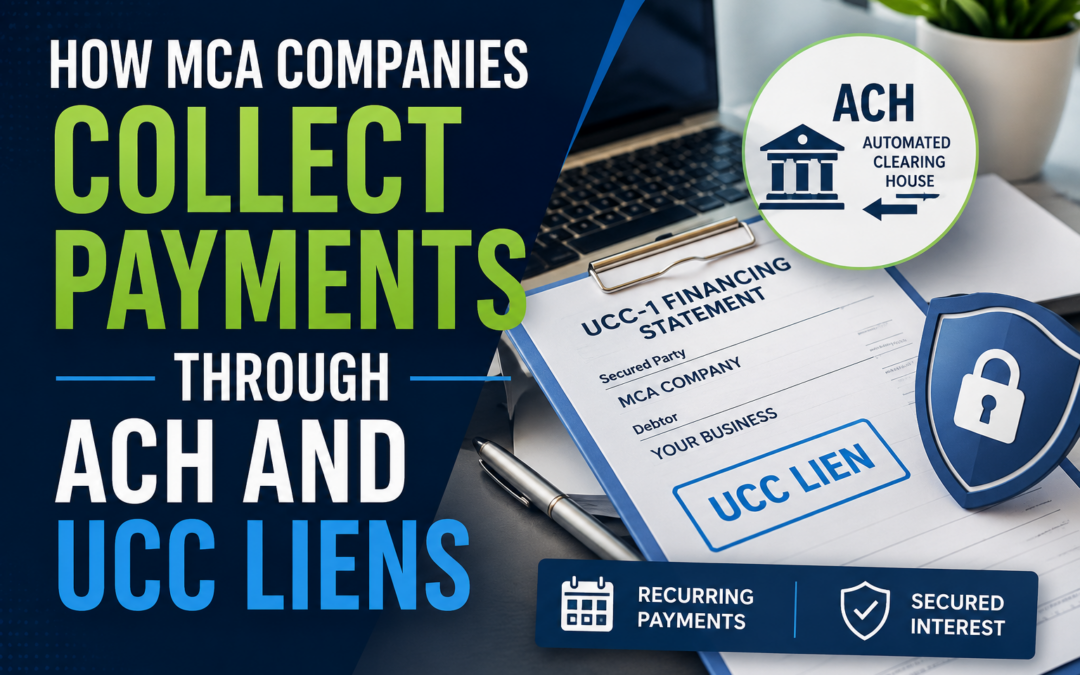
Understanding MCA ACH withdrawals and UCC liens is important for any business owner considering a Merchant Cash Advance or currently struggling with MCA debt. While Merchant Cash Advances can provide fast access to working capital, many business owners do not fully understand how MCA companies collect payments after funding is issued.
Most MCA providers rely on automatic ACH withdrawals to collect payments directly from a business bank account. In addition, many providers file UCC liens to protect their financial interest in the business. These collection tools are common throughout the Merchant Cash Advance industry and can significantly impact a company’s cash flow and future financing options.
Problems often arise when daily or weekly withdrawals become difficult to manage. As revenue fluctuates, ACH payments can place increasing pressure on working capital. At the same time, a UCC lien may limit a business owner’s ability to obtain additional funding from other lenders.
In this guide, we will explain how MCA companies use ACH withdrawals and UCC liens, what happens when payments are missed, and how MCA collection methods can affect your business. We will also discuss options that may be available if MCA payments have become unaffordable.
Schedule Your Free Consultation
What Is an ACH Withdrawal in a Merchant Cash Advance?
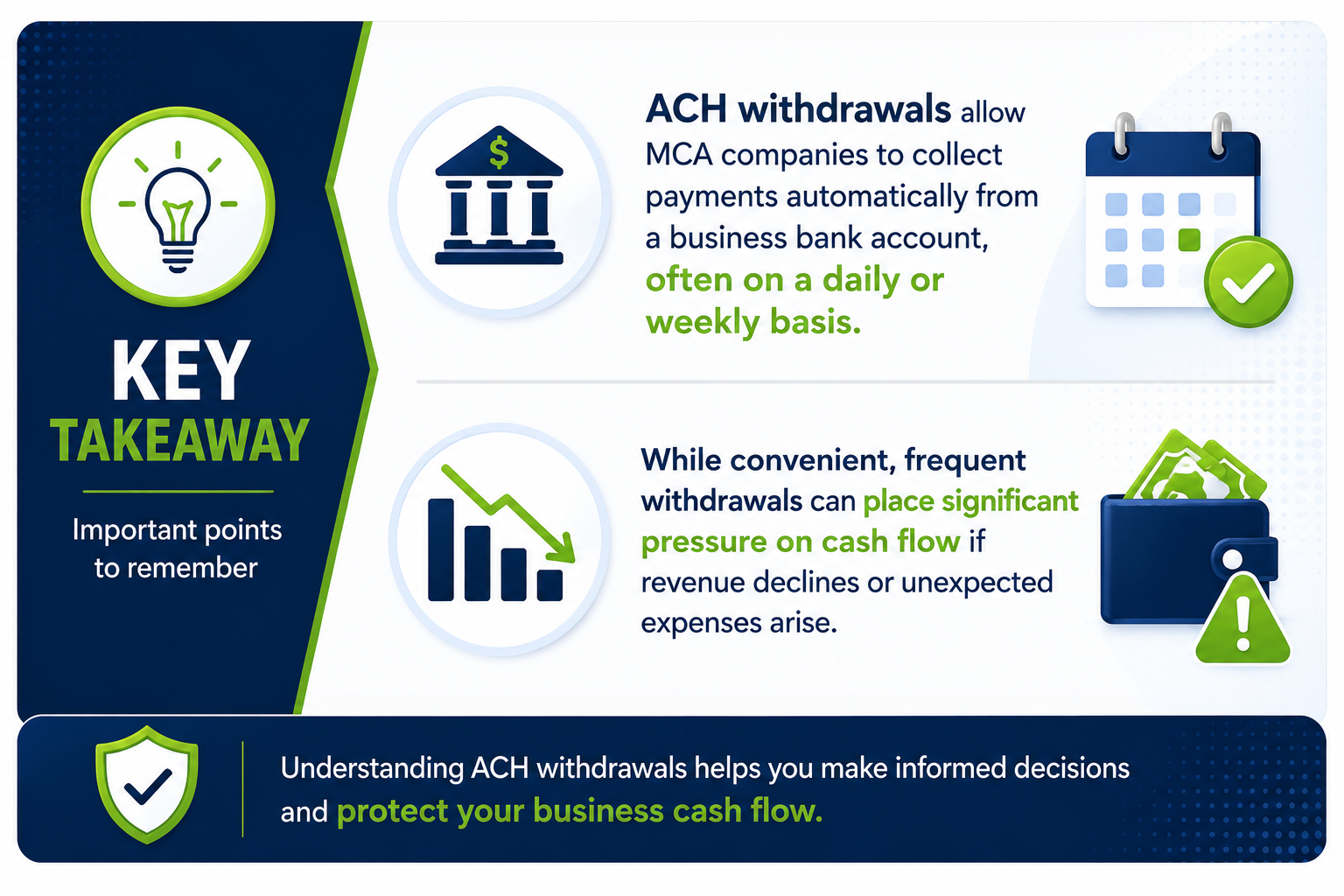
An ACH withdrawal is one of the most common ways MCA companies collect payments from businesses. ACH stands for Automated Clearing House, which is an electronic network that allows money to be transferred directly between bank accounts.
When a business receives a Merchant Cash Advance, it typically authorizes the MCA provider to withdraw payments automatically from its business checking account. Instead of monthly payments like a traditional loan, the business agrees to daily or weekly ACH withdrawals until the full amount owed is repaid.
These automatic withdrawals are designed to simplify the repayment process for the MCA company. Because payments are collected electronically, the provider can receive funds on a consistent schedule without requiring the business owner to submit payments manually.
The amount withdrawn depends on the terms of the agreement. Some MCA providers collect a fixed daily or weekly payment. Others use a percentage of the business’s revenue and adjust withdrawals based on sales performance.
While ACH withdrawals can make repayment convenient, they can also create cash flow challenges. Daily deductions reduce the amount of money available to cover payroll, inventory, rent, utilities, and other operating expenses. As a result, businesses with fluctuating revenue may find it difficult to maintain adequate working capital.
Understanding how ACH withdrawals work is important because these automatic payments are often the primary method MCA companies use to collect repayment. Before accepting funding, business owners should carefully review the repayment schedule and understand how recurring withdrawals may affect day-to-day operations.
How MCA Companies Use Daily and Weekly ACH Payments
Most Merchant Cash Advance providers collect repayment through scheduled ACH withdrawals that occur on a daily or weekly basis. Unlike traditional business loans that typically require one monthly payment, MCA payments are often withdrawn much more frequently. This allows the funding company to recover its investment quickly while maintaining a consistent repayment schedule.
There are two common methods MCA companies use to calculate ACH payments.
Fixed Daily or Weekly Withdrawals
Many MCA agreements require a fixed payment amount that is automatically withdrawn from the business bank account each day or week. The payment remains the same regardless of whether the business experiences strong sales or a temporary decline in revenue.
For example, a business may be required to pay $250 every business day until the full balance is satisfied. While predictable, fixed withdrawals can become difficult to manage during slower periods when cash flow is reduced.
Percentage-Based ACH Collections
Some MCA providers structure payments around a percentage of future receivables or revenue. Under this model, the amount collected may increase or decrease based on the business’s sales activity.
This approach can provide additional flexibility because payments may adjust when revenue changes. However, businesses can still experience financial pressure if the collection percentage is high or if sales decline unexpectedly.
Why Frequent ACH Payments Create Cash Flow Challenges
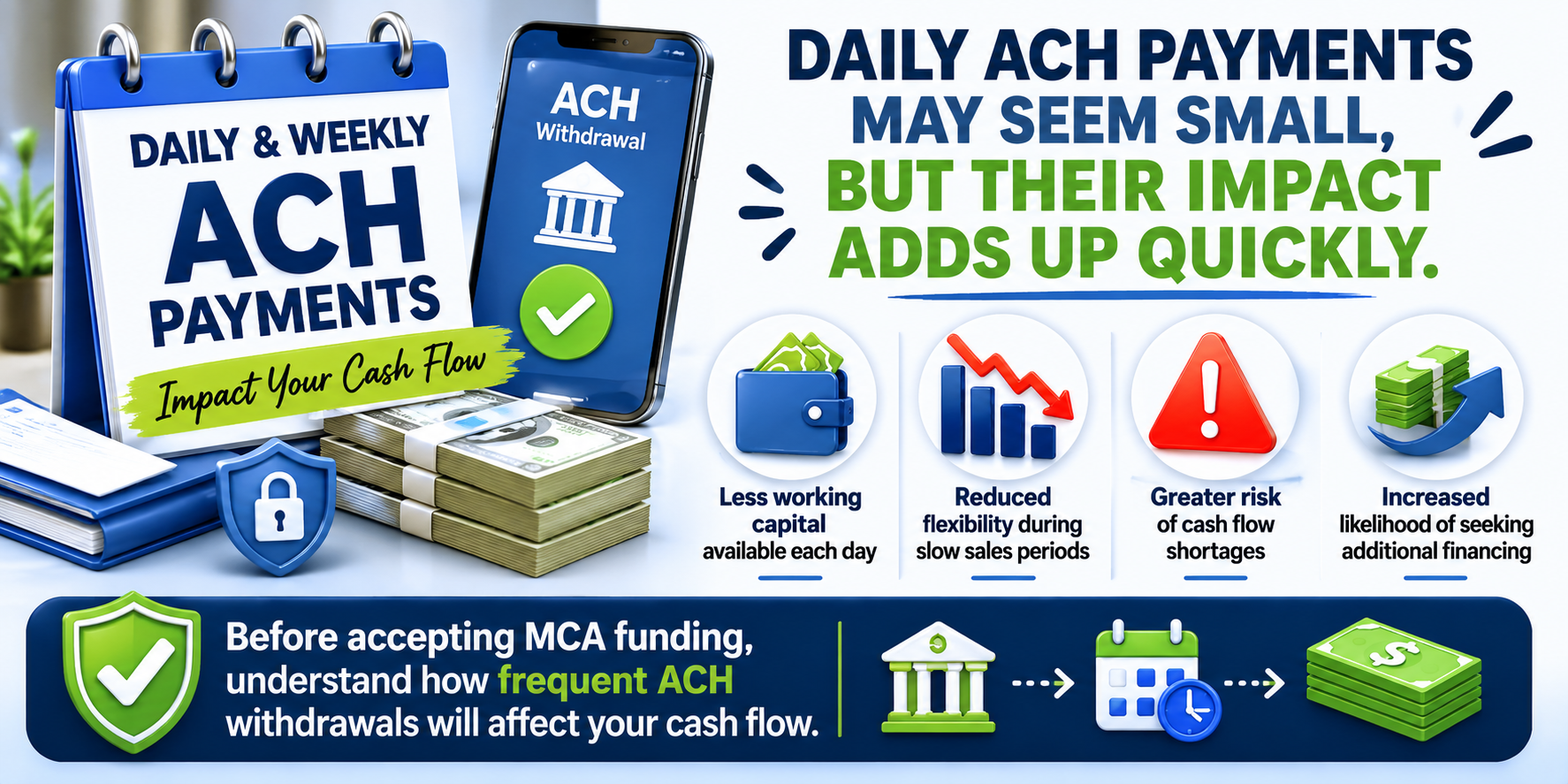
The biggest concern for many business owners is the frequency of the withdrawals. Daily ACH payments leave less working capital available to cover normal operating expenses such as payroll, rent, inventory, utilities, marketing, and vendor payments.
As a result, businesses may find themselves constantly monitoring account balances to ensure sufficient funds are available. When revenue fluctuates, even a short period of slower sales can create significant cash flow stress.
In some cases, business owners respond by seeking additional financing to cover operating expenses or existing MCA obligations. This can lead to stacked Merchant Cash Advances, which often increase financial pressure and make repayment even more difficult.
Understanding how daily and weekly ACH payments work is essential before accepting MCA funding. While automatic withdrawals may seem manageable at first, the long-term impact on cash flow can become a serious challenge if revenue does not consistently support the repayment schedule.
What Is a UCC Lien and Why Do MCA Companies File One?
In addition to collecting payments through ACH withdrawals, many Merchant Cash Advance providers file a UCC lien after funding a business. A UCC lien serves as a public notice that the MCA company has a financial interest in certain business assets.
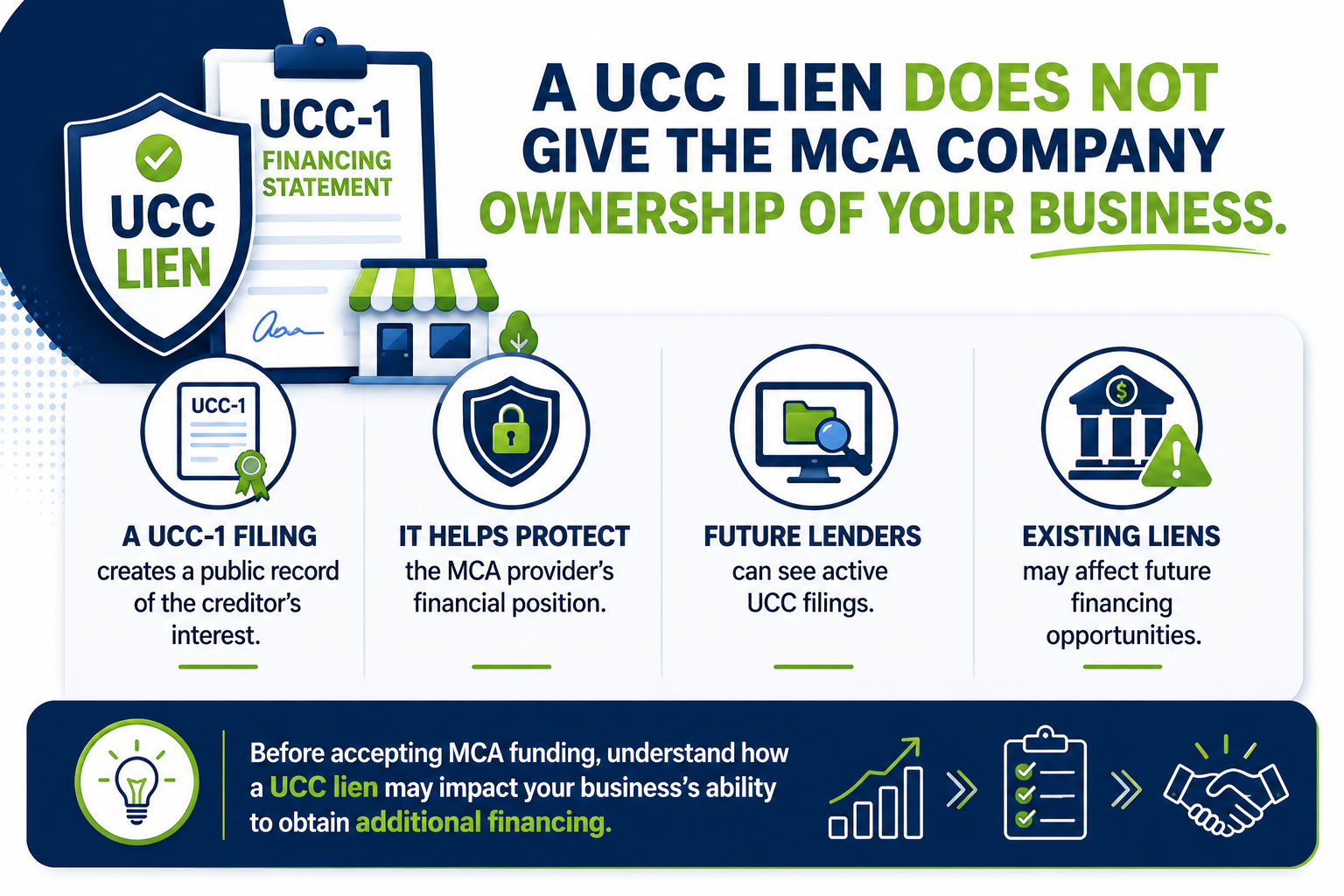
UCC stands for the Uniform Commercial Code, a set of laws that governs commercial transactions throughout the United States. When an MCA provider files a UCC-1 Financing Statement, it does not mean the lender owns the business or its assets. Instead, it alerts other lenders and creditors that the funding company may have a claim against specific business property if the business fails to meet its obligations.
What Is a UCC-1 Financing Statement?
A UCC-1 Financing Statement is a legal document filed with the appropriate state agency, usually the Secretary of State’s office. The filing identifies the business, the funding company, and the collateral covered by the agreement.
In many Merchant Cash Advance transactions, the collateral may include business assets, accounts receivable, future receivables, inventory, equipment, or other property specified in the contract.
Because UCC filings become part of the public record, banks, lenders, and financing companies can see existing liens when evaluating a business for future funding.
Why MCA Companies File UCC Liens
The primary purpose of a UCC lien is to protect the MCA provider’s financial interest. By filing a UCC-1, the funding company establishes its position as a creditor and publicly records its claim.
This protection can become important if the business seeks additional financing, defaults on its obligations, or experiences financial difficulties. The UCC filing helps ensure that the MCA company is recognized as a creditor with a legal interest in the collateral identified in the agreement.
For MCA providers, filing a UCC lien is a common risk-management practice. It provides an additional layer of protection beyond ACH withdrawals and other collection methods.
What Business Owners Should Know About UCC Liens
Many business owners are surprised to learn that a UCC filing can affect future financing opportunities. Before approving a new loan, line of credit, equipment lease, or other funding product, lenders often review existing UCC filings.
If a prior MCA company has an active lien on the business, a new lender may require the lien be subordinated, modified, or terminated before providing additional funding. As a result, UCC liens can sometimes create obstacles when a business needs access to new capital.
Understanding how UCC liens work is important before accepting Merchant Cash Advance funding. While the filing is a standard industry practice, it can have implications that extend beyond the initial advance and affect future borrowing opportunities.
How a UCC Lien Can Affect Your Business Financing
Many business owners do not realize that a UCC lien can continue affecting their company long after the Merchant Cash Advance funds have been received. Because UCC filings are public records, lenders often review them when evaluating applications for new financing.
An active UCC lien does not automatically prevent a business from obtaining additional funding. However, it can create challenges that may limit financing options or delay the approval process.
How Lenders View Existing UCC Liens
Before approving financing, lenders want to understand whether other creditors already have a legal interest in the business’s assets. An existing UCC lien may signal that another funding company has a claim on certain collateral, which can increase the lender’s perceived risk.
As a result, some lenders may require additional documentation, request clarification regarding the lien, or decline the application altogether.
Impact on Business Loans and Lines of Credit
Traditional lenders and banks often review UCC filings as part of their underwriting process. If an active MCA lien appears during the review, the lender may be concerned about repayment priority and collateral rights.
In some situations, the lender may require the lien to be released, subordinated, or modified before approving a business loan or line of credit. This additional step can delay funding and complicate the approval process.
Equipment Financing and Asset-Based Lending Challenges
UCC liens can also affect equipment financing and asset-based lending programs. These financing products often rely on specific business assets as collateral.
If another creditor already has a recorded interest in those assets, the new lender may be unwilling to move forward until the lien issue is resolved. This can limit a business owner’s ability to finance equipment purchases, vehicles, machinery, and other essential assets.
Potential Obstacles to Future Funding
Even if a business qualifies for additional financing, an active UCC lien may reduce the number of available funding options. Some lenders have strict policies regarding existing liens and may decline applications that involve competing creditor claims.
This becomes especially important for businesses seeking growth capital, expansion funding, seasonal financing, or emergency working capital. The existence of a UCC lien may narrow the pool of lenders willing to provide funding.
Why It Is Important to Monitor UCC Filings
Business owners should periodically review their UCC records to ensure filings are accurate and properly terminated when obligations have been satisfied. In some cases, liens remain active even after a financing agreement has been paid off, creating unnecessary complications when applying for future funding.
Understanding how UCC liens affect business financing can help owners make informed decisions before accepting an MCA. While a UCC filing is common in the Merchant Cash Advance industry, its impact may extend far beyond the original funding transaction and influence future borrowing opportunities.
What Happens If an ACH Withdrawal Fails?
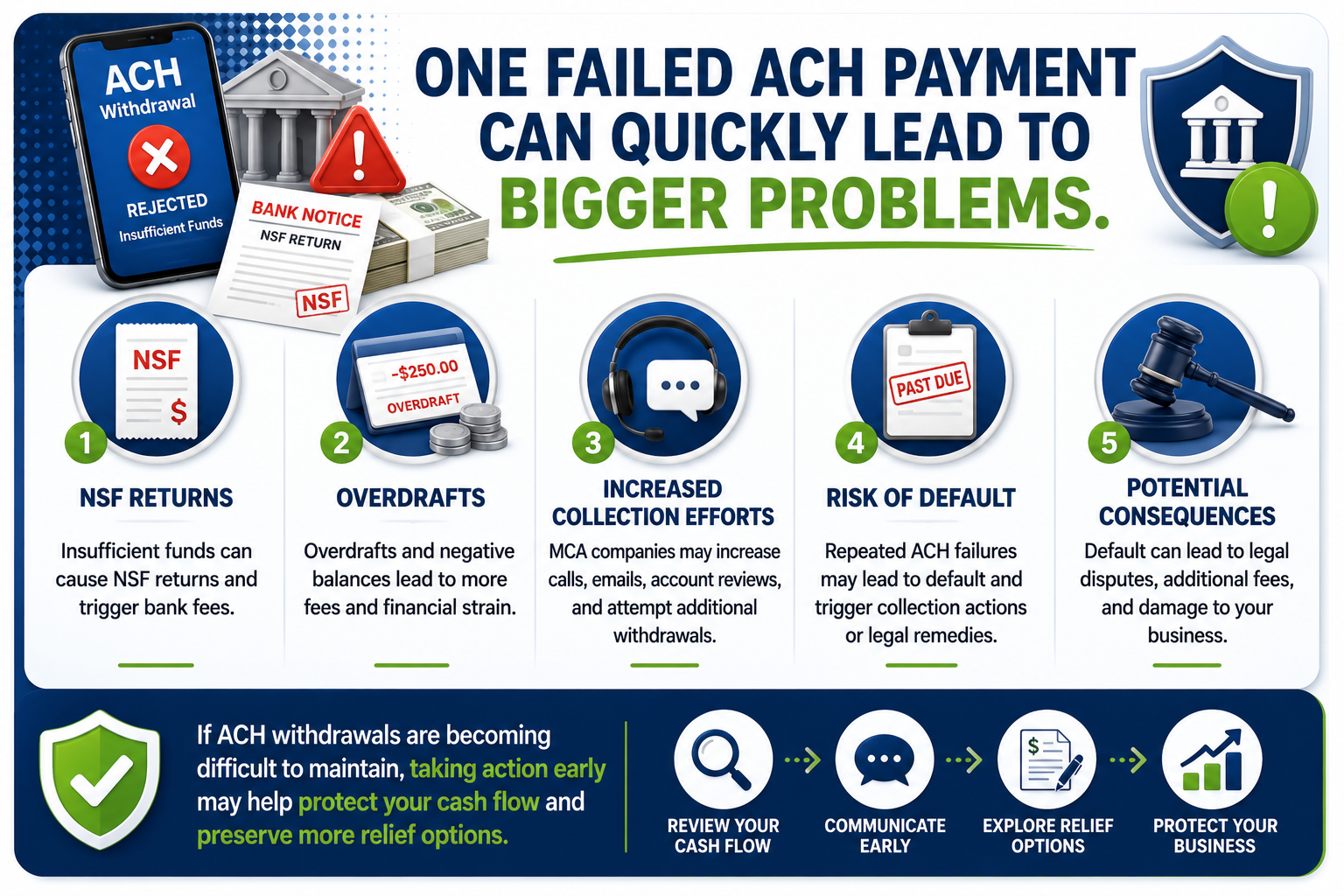
A failed ACH withdrawal is often one of the first warning signs that a business is experiencing cash flow problems. When an MCA company attempts to collect a scheduled payment and there are not enough funds available in the account, the transaction may be rejected by the bank.
Although a single failed payment may seem like a minor issue, repeated ACH failures can quickly lead to increased financial pressure, collection activity, and potential default concerns.
Non-Sufficient Funds (NSF) Returns
The most common reason an ACH withdrawal fails is that the account has insufficient funds available to cover the payment. This is commonly referred to as a Non-Sufficient Funds (NSF) return.
When this occurs, the MCA provider is notified that the withdrawal was unsuccessful. Depending on the agreement, the company may attempt to collect the payment again or contact the business owner to discuss the missed withdrawal.
In some cases, the business may also incur NSF fees from its bank, adding another expense during an already difficult financial situation.
Overdrafts and Negative Account Balances
Even when sufficient funds are not available, some banks may still process the withdrawal allowing the account to become overdrawn. This can result in overdraft fees, negative account balances, and additional banking charges.
As ACH withdrawals continue, the business may struggle to maintain enough funds for payroll, vendor payments, rent, inventory purchases, and other operating expenses.
Over time, repeated overdrafts can create a cycle of financial stress that becomes increasingly difficult to manage.
Increased Collection Efforts
When ACH payments begin failing, MCA companies often increase communication with the business owner. Collection efforts may include phone calls, emails, account reviews, and requests for updated financial information.
The funding company may also attempt additional ACH withdrawals to recover missed payments. As a result, businesses often experience ongoing pressure as the provider works to bring the account current.
The frequency and intensity of collection activity typically depend on the terms of the agreement and the number of missed payments.
When Failed ACH Payments Lead to Default
If ACH withdrawals continue to fail and they do not resolve the repayment issue, the MCA provider may determine that the business is in default under the terms of the agreement.
A default can trigger additional collection actions and may increase the risk of legal disputes, enforcement of contractual remedies, or other recovery efforts available to the funding company.
The specific consequences vary depending on the contract and the circumstances involved. However, the longer repayment problems continue, the more limited a business owner’s options may become.
Why Early Action Matters
Many business owners wait until multiple ACH payments have failed before seeking help. Unfortunately, delaying action often allows financial pressure to build and reduces the number of available solutions.
If ACH withdrawals are becoming difficult to maintain, addressing the issue early may create opportunities to negotiate, restructure obligations, explore consolidation options, or pursue other forms of MCA debt relief before the situation becomes severe.
Can MCA Companies Freeze Your Bank Account?
One of the most common concerns among business owners is whether an MCA company can freeze their bank account after missed payments or a default. The answer is more complicated than a simple yes or no.
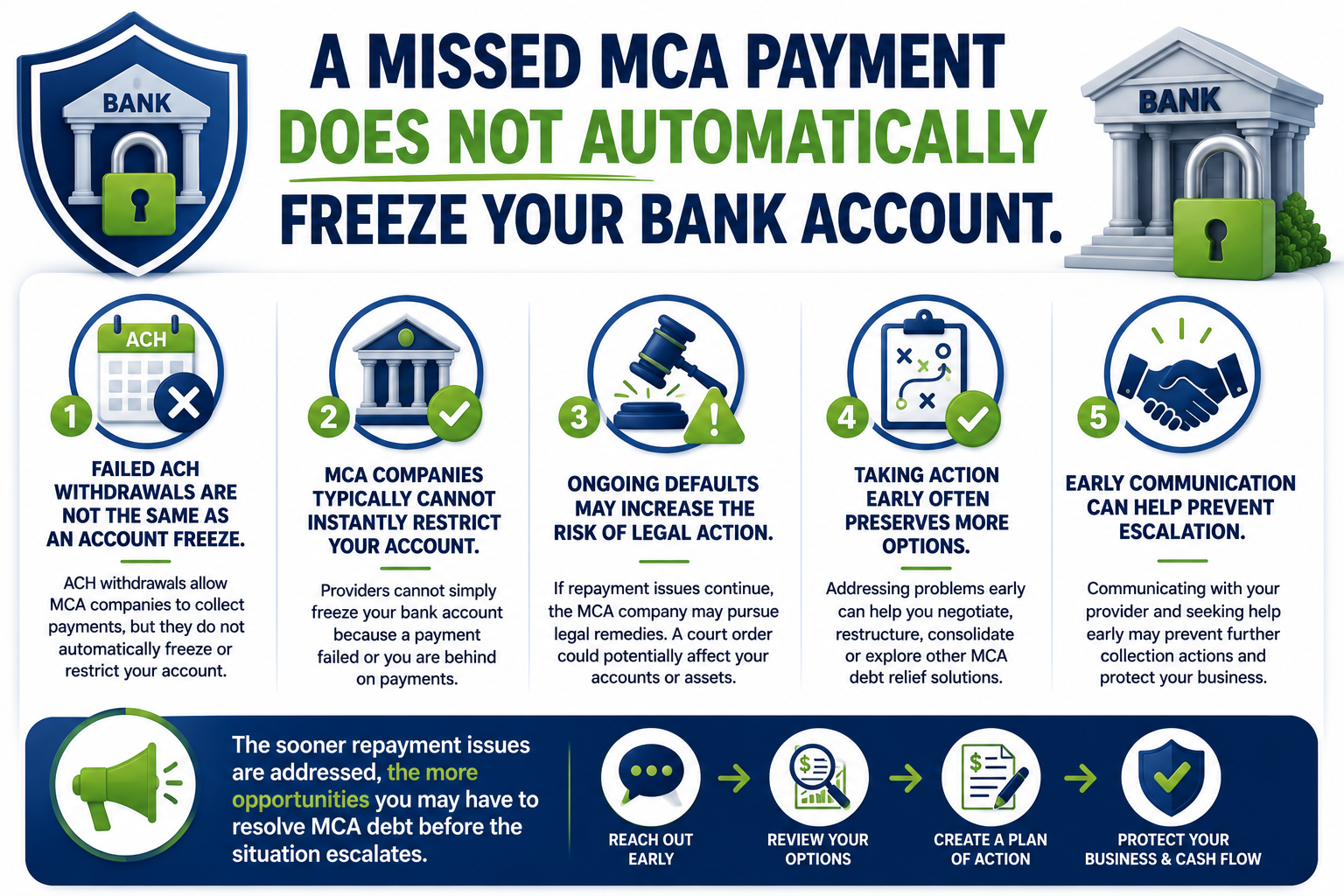
In most situations, an MCA provider cannot immediately freeze a business bank account simply because an ACH payment failed. However, under certain circumstances, legal actions or court orders may result in account restrictions if a dispute escalates.
ACH Withdrawals Are Not the Same as a Bank Account Freeze
When a business accepts Merchant Cash Advance funding, it typically authorizes the provider to collect payments through ACH withdrawals. These automatic withdrawals allow the MCA company to deduct scheduled payments from the account in accordance with the terms of the agreement.
While repeated ACH attempts can reduce available funds and create cash flow challenges, they do not automatically freeze the account. The business generally retains access to its banking relationship unless additional legal actions occur.
When Legal Action May Become a Factor
If repayment issues continue and the business is considered in default, some MCA companies may pursue legal remedies available under the contract and applicable law.
Depending on the circumstances, this could involve lawsuits, judgments, negotiated settlements, or other collection actions. In certain cases, a court may issue orders that affect a business’s assets or accounts. The specific process varies by state, the terms of the agreement, and the facts surrounding the dispute.
Because legal procedures differ significantly from one situation to another, business owners should avoid assuming that every default automatically results in account restrictions.
Why Business Owners Should Take ACH Problems Seriously
Although a failed payment does not automatically freeze a bank account, repeated ACH failures should never be ignored. Ongoing repayment issues often signal deeper cash flow challenges that may continue to worsen if left unaddressed.
As collection efforts increase, business owners may face additional stress, operational disruptions, and fewer available options for resolving the situation.
Early Action Can Help Protect Your Options
The best approach is often to address repayment problems before they escalate. Businesses that seek assistance early may have more opportunities to negotiate with creditors, explore restructuring solutions, evaluate consolidation options, or pursue other forms of MCA debt relief.
Waiting until legal action becomes a possibility can significantly reduce flexibility and make resolving the problem more difficult.
Understanding the difference between ACH withdrawals, collection efforts, and potential legal remedies can help business owners make informed decisions. While MCA companies generally cannot instantly freeze a bank account due to a missed payment, unresolved defaults may create situations in which legal action becomes a much greater concern.
What Happens If You Default on a Merchant Cash Advance?
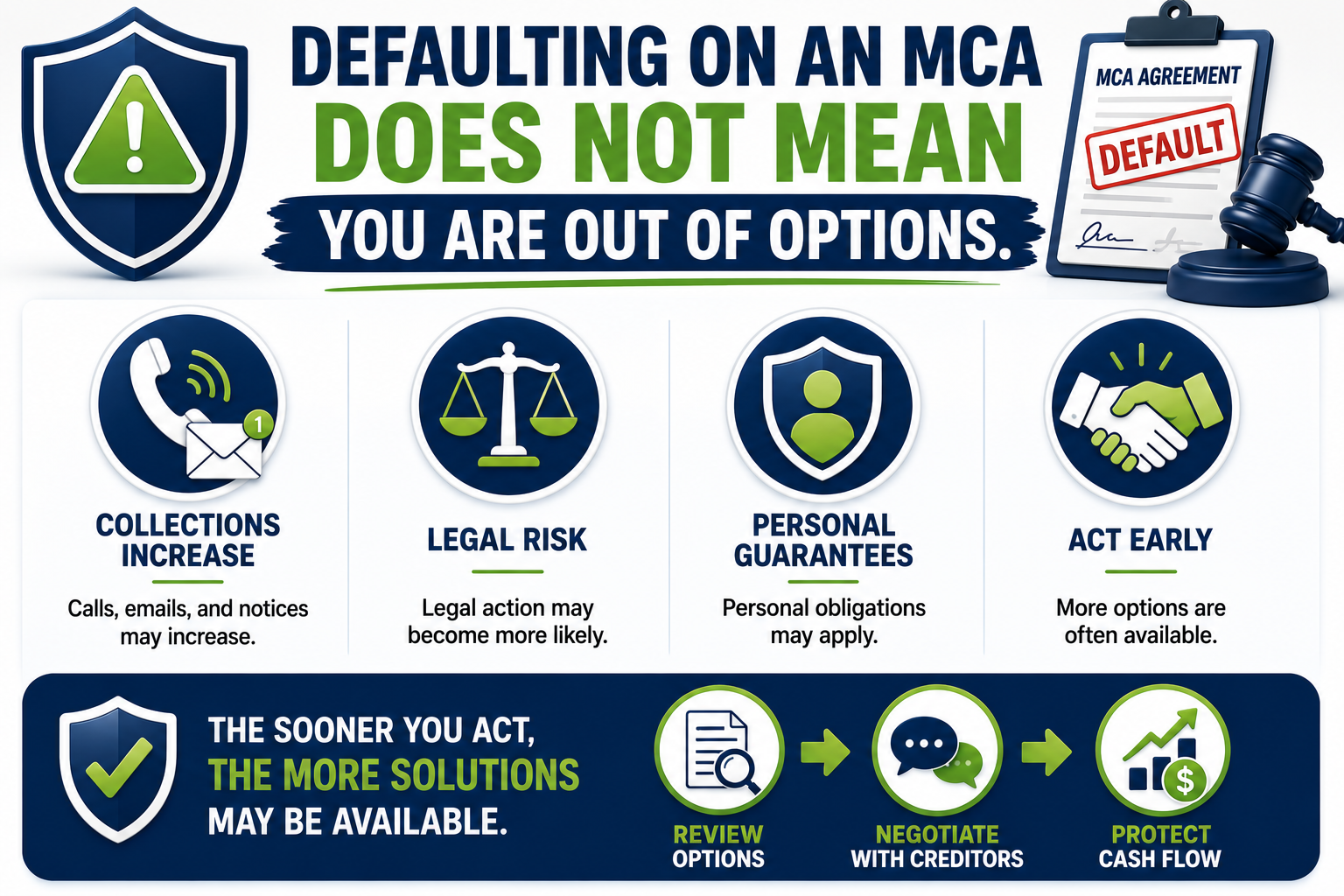
Defaulting on a Merchant Cash Advance can trigger a series of collection and enforcement actions that may place additional pressure on an already struggling business. While the specific consequences depend on the terms of the agreement and the circumstances involved, MCA providers often have several options available when a borrower stops making payments.
Understanding what may happen after a default can help business owners recognize potential risks and take action before the situation escalates.
Collection Efforts Typically Increase
In many cases, default does not immediately result in a lawsuit. Instead, MCA companies often begin by increasing collection activity in an effort to recover the remaining balance.
This may include phone calls, emails, demand letters, requests for updated financial information, and repeated attempts to resolve the repayment issue. Some providers may also continue monitoring business accounts and financial activity as permitted under the agreement.
As repayment problems continue, collection efforts often become more aggressive.
Potential Legal Remedies
If collection efforts are unsuccessful, an MCA company may pursue legal remedies that are available under the contract and applicable law.
Depending on the situation, this could include filing a lawsuit, seeking a judgment, enforcing contractual rights, or pursuing other legal recovery options. The process varies based on the agreement, the state involved, and the facts of the case.
Not every default results in litigation. However, the risk of legal action generally increases when repayment issues remain unresolved for an extended period.
Personal Guarantees May Increase Exposure
Many Merchant Cash Advance agreements include personal guarantees. A personal guarantee means the business owner may agree to accept certain personal obligations if the business fails to satisfy its responsibilities under the contract.
The scope and enforceability of personal guarantees vary significantly depending on the language of the agreement and applicable law. For this reason, business owners should carefully review their contracts and seek professional guidance when questions arise.
Confessions of Judgment May Apply in Certain Situations
Some MCA agreements have historically included confession of judgment provisions. These provisions are intended to allow a creditor to obtain a judgment under specific circumstances without going through a traditional litigation process.
However, the rules governing confessions of judgment vary by jurisdiction, and their availability has changed in certain states over time. Whether a confession of judgment applies depends on the terms of the agreement and the applicable legal requirements.
Because this area of law can be complex, business owners facing a potential default should seek qualified legal advice regarding their specific situation.
Enforcement Actions After Default
If a creditor obtains the legal authority to enforce its rights, additional collection actions may become possible. Depending on the circumstances, this could involve efforts to recover funds, enforce judgments, pursue collateral rights, or exercise other remedies available under the agreement and the law.
The exact enforcement tools available vary from case to case. However, the longer a default remains unresolved, the greater the likelihood that collection efforts and legal pressure may increase.
Why Early Action Matters
Many business owners wait until a default has already occurred before exploring solutions. Unfortunately, waiting often reduces flexibility and limits available options.
Businesses that address repayment challenges early may have more opportunities to negotiate with creditors, pursue restructuring solutions, explore consolidation programs, or evaluate other forms of MCA debt relief before legal issues become more serious.
Understanding the potential consequences of default can help business owners make informed decisions and take proactive steps to protect their business, cash flow, and future financing opportunities.
Warning Signs Your MCA Payments Are Becoming Unmanageable
Merchant Cash Advances can provide fast access to capital when a business needs funding. However, repayment problems often develop gradually rather than all at once. What begins as a manageable daily or weekly ACH withdrawal can eventually create significant cash flow pressure if revenue declines or expenses increase.
Recognizing the warning signs early may help business owners take action before the situation escalates into a more serious financial problem.
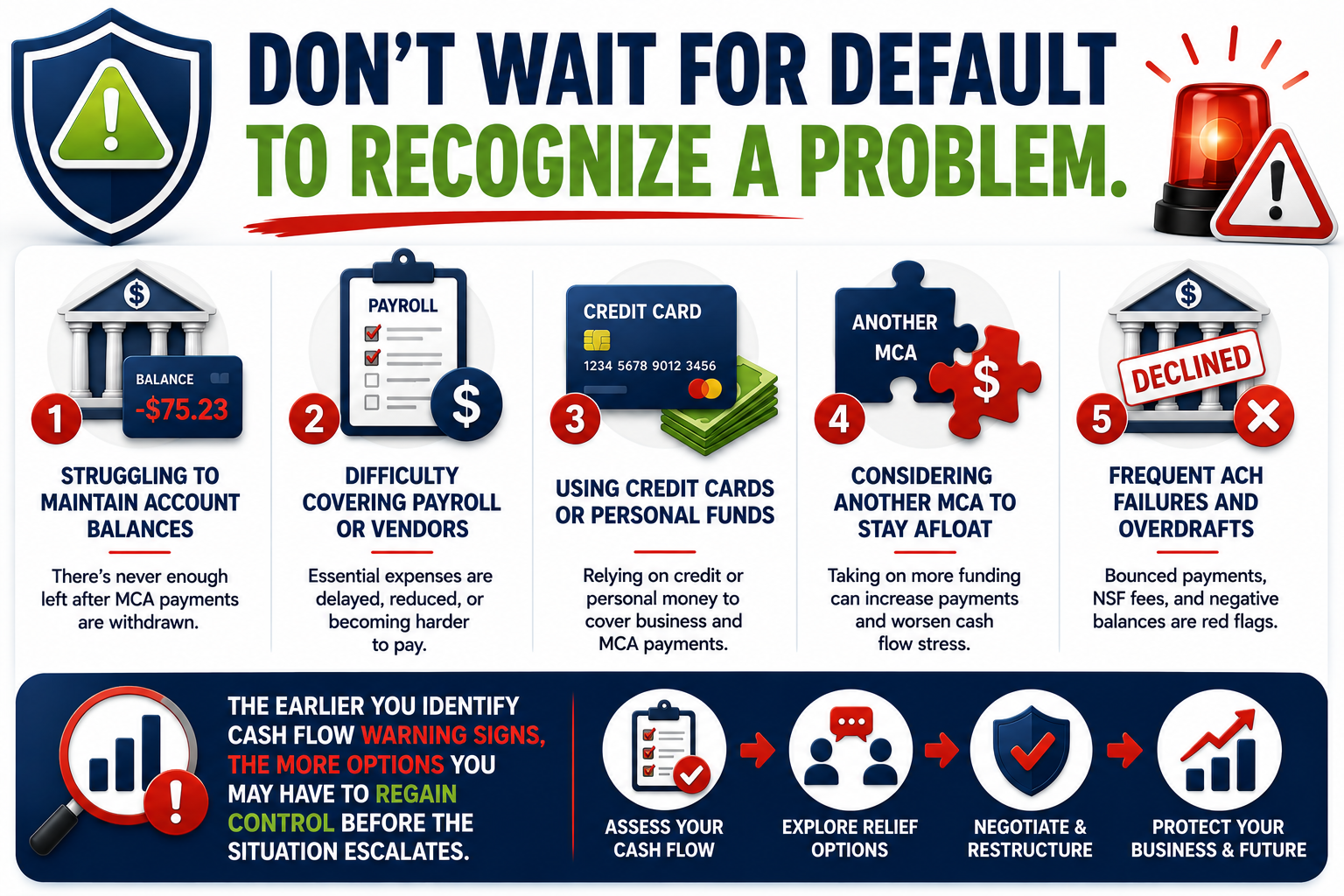
You Are Constantly Struggling to Maintain Your Account Balance
One of the earliest warning signs is feeling like there is never enough money left in the account after MCA payments are withdrawn.
If you find yourself checking account balances multiple times a day, delaying purchases, or constantly moving funds to avoid failed ACH withdrawals, the repayment obligation may be consuming too much of your available cash flow.
Payroll, Rent, or Vendor Payments Are Becoming Difficult
A healthy business should be able to cover its essential operating expenses without constant financial stress.
When MCA payments begin interfering with payroll, rent, inventory purchases, utilities, or vendor obligations, it may indicate that the repayment structure is no longer sustainable. Missing or delaying critical business expenses can quickly create additional operational challenges.
You Are Relying on Credit Cards or Personal Funds
Many business owners attempt to bridge cash flow gaps by using business credit cards, personal savings, or personal credit.
While this may provide temporary relief, it can also be a sign that the business is struggling to support both operating expenses and MCA repayment obligations. Over time, this approach may increase overall debt and financial pressure.
You Are Considering Another MCA to Cover Existing Payments
One of the most serious warning signs is taking out additional funding to keep up with an existing Merchant Cash Advance.
This practice, often referred to as stacking, can dramatically increase repayment obligations and place even greater strain on cash flow. While it may provide short-term breathing room, it often makes the underlying problem more difficult to solve.
ACH Withdrawals Are Frequently Failing
Repeated ACH failures, NSF returns, and overdraft fees are strong indicators that cash flow is becoming insufficient to support the repayment schedule.
If ACH withdrawals are regularly bouncing or causing negative account balances, the business may already be approaching a potential default situation.
Financial Stress Is Affecting Daily Operations
Many business owners notice that MCA payments begin influencing nearly every financial decision they make. Instead of focusing on growth, customer service, hiring, or expansion, they spend most of their time worrying about cash flow and upcoming withdrawals.
When repayment pressure starts dictating business decisions, it may be time to evaluate whether the current funding arrangement remains realistic.
Taking Action Before Problems Escalate
Ignoring repayment challenges rarely improves the situation. In many cases, financial pressure increases as cash flow tightens and MCA obligations continue.
If you recognize several of these warning signs, exploring relief, restructuring, consolidation, or negotiation options sooner rather than later may help preserve more solutions and prevent the situation from becoming more severe.
How to Stop ACH Withdrawals From an MCA Company
When MCA payments become unaffordable, many business owners start searching for ways to stop ACH withdrawals and regain control of their cash flow. While every situation is different, it is important to understand that simply blocking payments without a plan can sometimes create additional complications.
The most effective approach is often to evaluate available solutions and address the underlying financial problem before the situation escalates further.
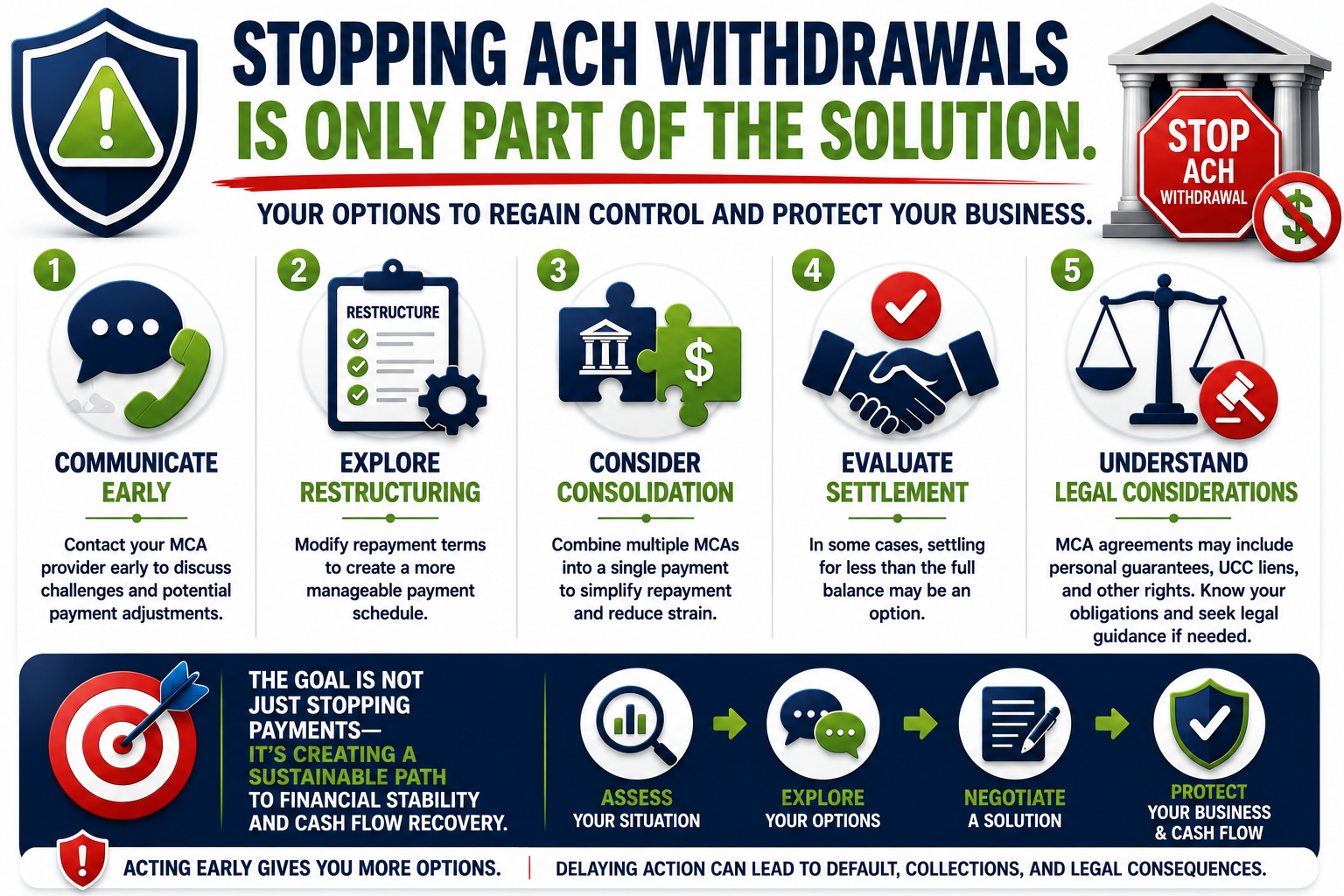
Start by Communicating With the MCA Provider
If cash flow problems are temporary, contacting the MCA company may be the first step. Some providers are willing to discuss payment adjustments, short-term accommodations, or alternative arrangements when a business demonstrates genuine financial hardship.
While not every provider offers flexibility, early communication may create opportunities that become more difficult to obtain after a default occurs.
Explore MCA Restructuring Options
Restructuring involves modifying the repayment terms of an existing Merchant Cash Advance to create a more manageable payment schedule.
Depending on the circumstances, restructuring may involve reducing payment amounts, extending repayment periods, modifying collection schedules, or creating other adjustments designed to improve cash flow.
For businesses that are still generating revenue but struggling with current payment obligations, restructuring may provide valuable relief.
Consider MCA Consolidation
Businesses with multiple Merchant Cash Advances often face the greatest financial pressure. In these situations, MCA consolidation may combine existing obligations into a single payment structure.
Consolidation can simplify repayment and may reduce the strain caused by multiple daily or weekly ACH withdrawals. For some businesses, it creates a more predictable path toward financial stability.
However, not every business qualifies, and consolidation options vary based on financial circumstances.
Evaluate Merchant Cash Advance Settlement
In certain situations, settlement may become an option. A settlement typically involves negotiating with MCA lenders to agree to a resolution for less than the full amount claimed to be owed.
Settlement discussions often occur when a business is experiencing significant financial hardship and repayment under the original terms is no longer realistic.
Because settlement negotiations can be complex, many business owners choose to seek professional assistance when exploring this option.
Understand the Legal Considerations
Business owners should carefully consider the legal implications before taking steps to stop ACH withdrawals. MCA agreements may contain provisions related to defaults, collection rights, personal guarantees, UCC liens, and other contractual obligations.
The legal consequences of missed payments vary depending on the agreement, applicable law, and the facts of the situation. For this reason, obtaining qualified legal guidance may be appropriate when significant repayment disputes arise.
Focus on Solving the Problem, Not Just Stopping Payments
Stopping ACH withdrawals alone does not eliminate the underlying obligation. In many cases, the goal should be creating a sustainable solution that allows the business to stabilize operations while addressing outstanding debt responsibly.
Whether through negotiation, restructuring, consolidation, settlement, or other relief options, early action often provides the greatest flexibility.
Businesses that address MCA repayment problems before they become severe frequently have more opportunities to protect cash flow, preserve operations, and avoid more aggressive collection activity.
Options for Businesses Struggling With MCA Debt
When Merchant Cash Advance payments become difficult to manage, many business owners feel trapped between mounting repayment obligations and the need to keep their businesses operating. The good news is that struggling with MCA debt does not automatically mean bankruptcy or business closure.
Depending on the circumstances, several relief options may help reduce financial pressure, improve cash flow, and create a more sustainable path forward.
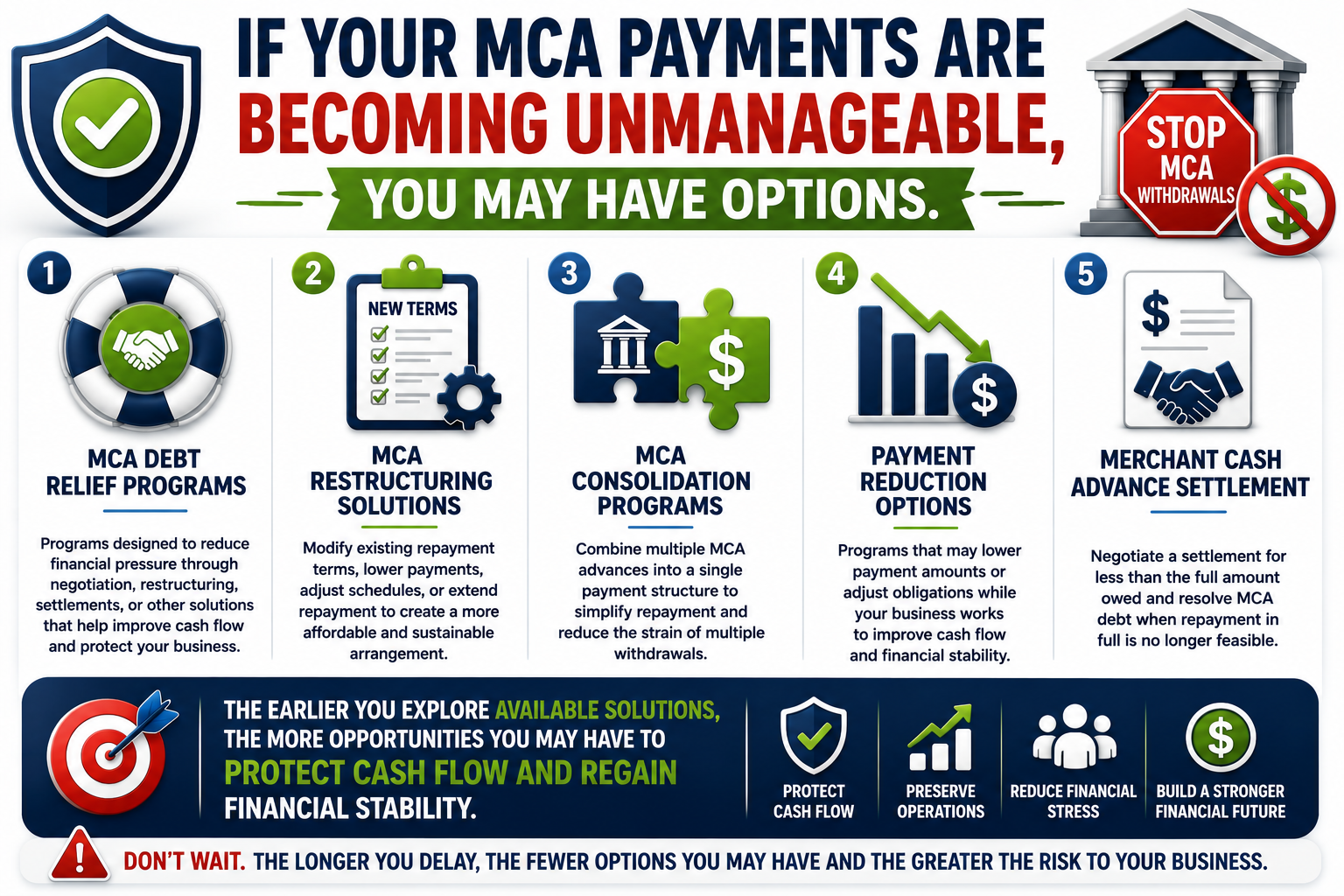
MCA Debt Relief Programs
MCA debt relief programs are designed to help businesses address overwhelming repayment obligations while preserving operations whenever possible.
These programs may involve negotiations with creditors, payment restructuring, settlement discussions, or other strategies intended to create a more manageable financial situation. The goal is often to reduce immediate cash flow strain and provide businesses with an opportunity to stabilize.
MCA Restructuring Solutions
Restructuring focuses on modifying existing repayment arrangements to better align with a business’s current financial reality.
Depending on the situation, restructuring may involve lower payments, adjusted collection schedules, extended repayment terms, or other modifications that improve affordability.
For businesses that continue to generate revenue but struggle with existing payment requirements, restructuring may provide meaningful relief without requiring additional borrowing.
MCA Consolidation Programs
Businesses with multiple Merchant Cash Advances often face the most severe cash flow challenges. Consolidation programs may combine several MCA obligations into a single payment structure.
By replacing multiple daily or weekly ACH withdrawals with more manageable arrangements, consolidation can simplify repayment and improve cash flow visibility.
For some businesses, consolidation creates breathing room and reduces the financial stress associated with stacked advances.
Payment Reduction Programs
In certain situations, businesses may qualify for programs designed to reduce payment pressure while financial conditions improve.
The availability of these options varies depending on the creditors involved, the business’s financial circumstances, and the specific repayment obligations.
Reducing payment demands can often help businesses redirect cash flow toward payroll, inventory, vendor relationships, and other critical operating expenses.
Merchant Cash Advance Settlement
When repayment under the original terms is no longer realistic, settlement may be a solution.
Settlement generally involves negotiating a resolution for less than the full amount claimed owed. While not every business qualifies, settlement can provide a path toward resolving MCA debt and moving forward when financial hardship has become severe.
Because settlement negotiations can be complex, many business owners seek professional assistance during the process.
Choosing the Right Solution
Every business faces unique challenges. The best solution depends on factors such as revenue, cash flow, the number of MCA obligations, overall debt levels, and long-term business goals.
What works for one company may not be the best fit for another. That is why evaluating all available options is often an important first step.
Taking Action Before the Situation Worsens
The longer MCA debt problems continue, the more difficult they often become to resolve. Collection pressure may increase, cash flow may continue to tighten, and available options may become more limited.
Businesses that seek assistance early often have more opportunities to explore debt relief, restructuring, consolidation, payment reduction programs, or settlement solutions before the financial situation becomes more severe.
Understanding your options is the first step toward regaining control, protecting cash flow, and creating a more stable financial future for your business.
ACH Withdrawals vs UCC Liens: Understanding the Difference
ACH withdrawals and UCC liens are two of the most common tools MCA companies use to protect their financial interests and collect repayment. Although they are often discussed together, they serve very different purposes.
Understanding the difference can help business owners better evaluate the potential impact of a Merchant Cash Advance before accepting funding.
What ACH Withdrawals Do
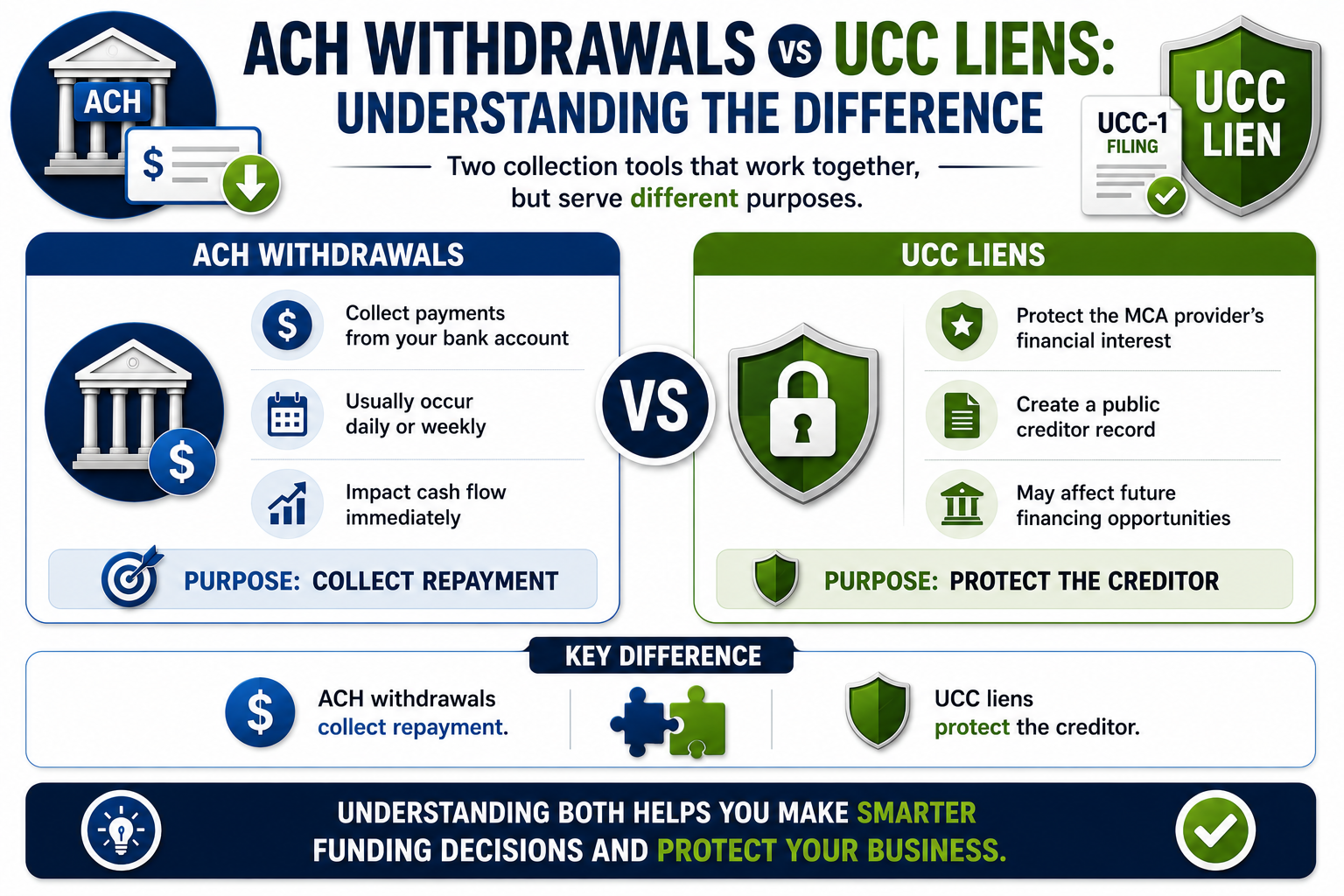
ACH withdrawals are the primary method many MCA companies use to collect payments. When a business accepts funding, it typically authorizes the provider to withdraw payments automatically from its business bank account on a daily or weekly basis.
The purpose of an ACH withdrawal is straightforward: it allows the MCA company to collect repayment electronically in accordance with the terms of the agreement.
Because payments are collected directly from the bank account, ACH withdrawals can have an immediate impact on cash flow and working capital.
What UCC Liens Do
A UCC lien serves a different purpose. Rather than collecting payments, a UCC-1 filing creates a public record showing that the MCA company has a legal interest in certain business assets identified in the agreement.
The lien helps protect the provider’s position as a creditor and alerts other lenders that an existing claim exists.
Unlike ACH withdrawals, a UCC lien does not remove money from a bank account. Instead, it may affect future financing opportunities and the business’s ability to obtain additional funding.
How ACH Withdrawals and UCC Liens Work Together
Although they function differently, ACH withdrawals and UCC liens often work together in the same MCA transaction.
ACH withdrawals are the day-to-day repayment mechanism, while the UCC lien helps protect the MCA provider’s broader financial interest.
In simple terms, ACH withdrawals are designed to collect money, while UCC liens are designed to secure the creditor’s position.
Key Differences at a Glance
| ACH Withdrawals | UCC Liens |
|---|---|
| Collect payments directly from a bank account | Create a public record of a creditor’s interest |
| Usually occur daily or weekly | Remain active until released or terminated |
| Directly impact cash flow | May impact future financing |
| Serve as a repayment tool | Serve as a creditor protection tool |
| Withdraw funds electronically | Do not collect payments directly |
Why Business Owners Should Understand Both
Many business owners focus on the daily or weekly ACH payments because those withdrawals affect cash flow immediately. However, UCC liens can have long-term consequences that may not become apparent until the business seeks additional financing.
Before accepting MCA funding, it is important to understand both collection tools and how they may affect your business. ACH withdrawals influence day-to-day operations, while UCC liens can affect future borrowing opportunities and lender relationships.
By understanding the difference between ACH withdrawals and UCC liens, business owners can make more informed funding decisions and better prepare for the obligations that come with a Merchant Cash Advance.
When to Seek Professional Help for MCA Debt Problems
Many business owners wait too long before seeking help with Merchant Cash Advance debt. In the beginning, it may seem like the cash flow problem is temporary or that things will improve with increased sales. However, MCA repayment challenges often become more difficult to resolve as collection pressure increases and available options become limited.
Recognizing when to seek professional assistance can help protect your business before the situation reaches a crisis point.
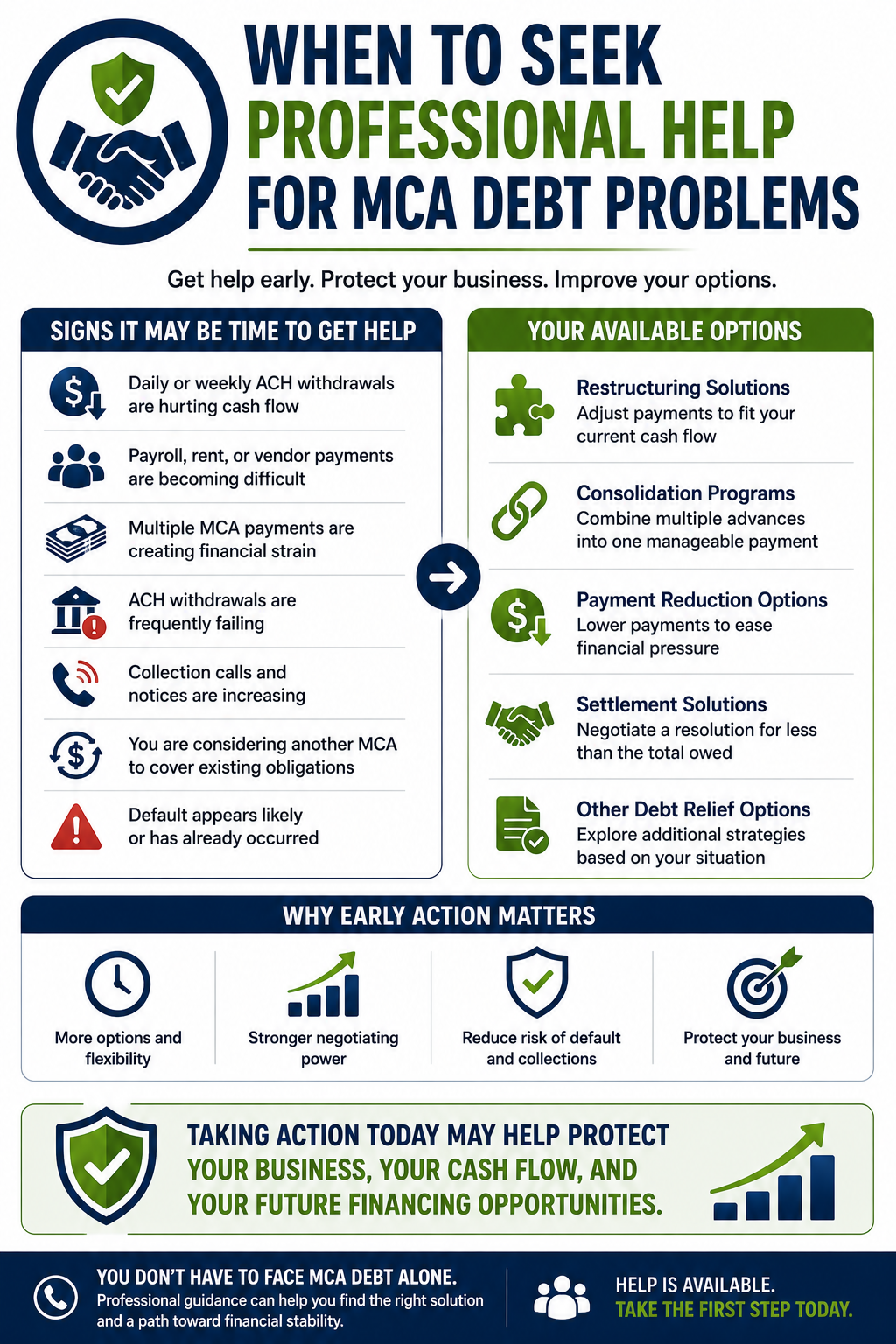
Signs It May Be Time to Get Help
You may benefit from professional guidance if:
- Daily or weekly ACH withdrawals are disrupting cash flow
- Payroll, rent, or vendor payments are becoming difficult to make
- Multiple MCA payments are creating ongoing financial strain
- ACH withdrawals are frequently failing
- Collection calls and notices are increasing
- You are considering another MCA to cover existing obligations
- Default appears likely or has already occurred
The sooner these issues are addressed, the more opportunities a business may have to pursue workable solutions.
Understanding Your Available Options
Every business faces unique financial circumstances. As a result, there is no single solution that works for everyone.
Depending on your situation, available options may include restructuring, consolidation, payment reduction programs, settlement negotiations, or other forms of MCA debt relief. Evaluating these solutions early can help you identify the most appropriate path forward before financial pressure becomes overwhelming.
Why Early Action Matters
Waiting rarely improves an MCA debt problem. In many cases, repayment obligations continue while cash flow becomes increasingly strained.
By taking action early, business owners may have more flexibility, more negotiating power, and more opportunities to protect their operations. Early intervention can also help reduce the risk of defaults, collection activity, and potential legal disputes.
Moving Forward With Confidence
Merchant Cash Advances can create significant financial challenges when repayment obligations outpace a business’s cash flow. Fortunately, businesses often have more options than they realize.
Understanding how ACH withdrawals and UCC liens work is an important first step. Evaluating relief options before problems escalate is the next.
If MCA payments are becoming difficult to manage, seeking professional guidance may help you regain control, stabilize cash flow, and develop a realistic plan for moving forward.