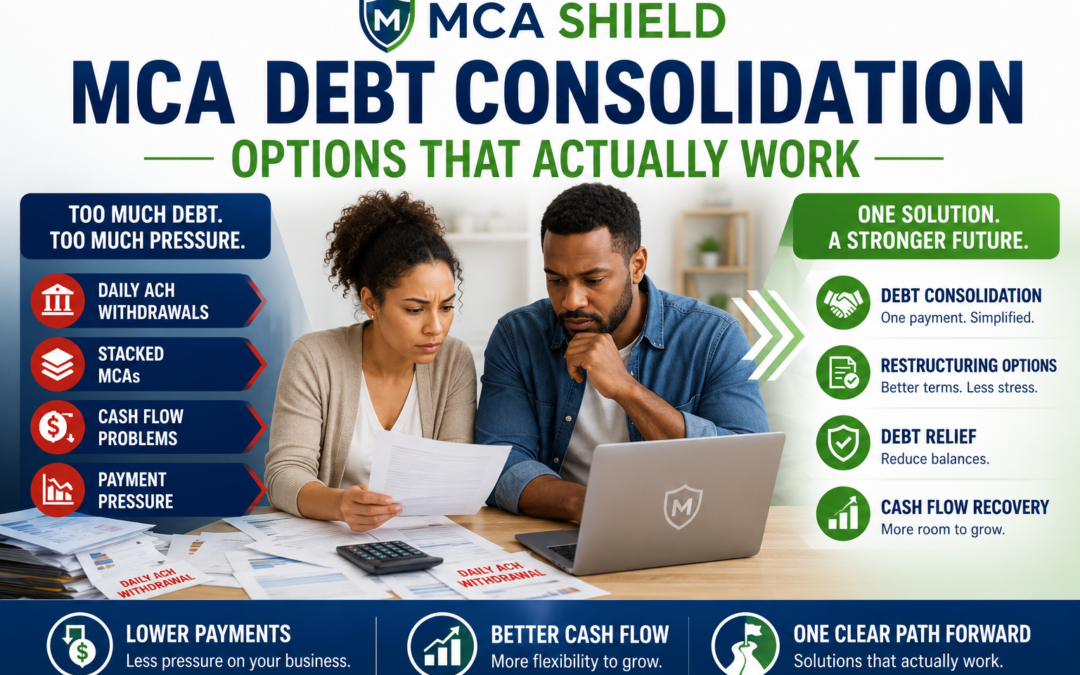
Businesses often turn to Merchant Cash Advances for fast funding, but repayment can quickly become overwhelming. Many business owners begin searching for MCA debt consolidation options when daily or weekly ACH withdrawals start consuming too much revenue. As payments increase, cash flow may tighten, making it difficult to cover payroll, inventory, rent, and other operating expenses.
For businesses with multiple advances or growing financial pressure, MCA debt consolidation may be a more manageable path forward. Consolidation solutions are designed to simplify repayment, improve cash flow, and help businesses regain financial stability.
In this guide, we will explain the most effective MCA debt consolidation options, how they work, and when they may be appropriate. You will also learn how consolidation, restructuring, and other merchant cash advance debt relief solutions can help reduce payment pressure and support long-term business recovery.
Schedule Your Free Consultation
What Is MCA Debt Consolidation?
Merchant Cash Advance (MCA) debt consolidation is a strategy that helps businesses manage multiple MCA obligations by combining them into a more structured and manageable repayment solution. Instead of juggling several daily or weekly withdrawals, businesses may be able to reduce payment pressure through consolidation, restructuring, or other debt relief programs designed to improve cash flow.
Many business owners seek MCA debt consolidation options after taking on multiple advances. While each advance may have provided short-term funding, the combined repayment obligations can quickly strain revenue. As withdrawals increase, businesses often struggle to cover operating expenses such as payroll, inventory purchases, rent, and vendor payments.

How MCA Debt Consolidation Differs From Traditional Business Debt Consolidation
Traditional business debt consolidation typically involves combining multiple loans into a single loan with a fixed interest rate and predictable monthly payment. Banks and traditional lenders often require strong credit profiles, substantial documentation, and lengthy approval processes.
MCA debt consolidation works differently because Merchant Cash Advances are generally structured as purchases of future receivables rather than conventional loans. As a result, many businesses facing MCA challenges may not qualify for traditional consolidation financing.
Instead, MCA debt consolidation solutions often focus on:
- Reducing overall payment pressure
- Restructuring repayment schedules
- Replacing multiple withdrawals with a more manageable arrangement
- Improving cash flow stability
- Creating a path toward long-term financial recovery
The goal is not simply to combine debts. The goal is to create a repayment strategy that better aligns with the business’s current revenue and financial circumstances.
Common Misconceptions About MCA Debt Consolidation
Many business owners misunderstand how MCA debt consolidation works. These misconceptions can prevent them from exploring solutions that may help relieve financial stress.
Misconception #1: Consolidation eliminates the debt.
Consolidation does not make the debt disappear. Instead, it restructures or reorganizes repayment obligations into a more manageable format.
Misconception #2: Only businesses with excellent credit qualify.
While some consolidation programs have qualification requirements, many MCA relief solutions focus heavily on business performance and cash flow rather than credit scores alone.
Misconception #3: Taking another MCA solves the problem.
Many businesses attempt to cover existing MCA payments with additional advances. This practice, often called stacking, can increase financial pressure and create a cycle of growing repayment obligations.
Misconception #4: Waiting will improve the situation.
In many cases, payment difficulties become more severe over time. Exploring MCA debt consolidation options early may provide more flexibility and potentially better outcomes.
Understanding how MCA debt consolidation works is the first step toward evaluating whether it may be an appropriate solution for your business. The sooner financial challenges are addressed, the more options may be available to help restore cash flow and stability.
Why Businesses Turn to MCA Debt Consolidation
Many businesses initially use Merchant Cash Advances to solve short-term cash flow needs. The funding process is often faster and more accessible than traditional financing. However, repayment obligations can become increasingly difficult to manage as daily or weekly withdrawals consume a larger portion of incoming revenue.
What starts as a temporary solution can quickly create long-term financial pressure. As cash flow tightens, business owners may struggle to keep up with operating expenses while simultaneously meeting MCA repayment obligations.
Daily ACH Withdrawals Can Strain Cash Flow
One of the most common reasons businesses seek MCA debt consolidation options is the impact of daily ACH withdrawals. Unlike traditional loans that often require monthly payments, many Merchant Cash Advances collect payments every business day.
These frequent withdrawals can make it difficult to maintain healthy cash flow. Even businesses with strong sales may experience challenges when a significant portion of daily revenue is automatically deducted before other expenses can be paid.
As a result, business owners may struggle to:
- Cover payroll on time
- Purchase inventory
- Pay vendors and suppliers
- Manage seasonal fluctuations
- Maintain adequate working capital
Over time, these cash flow challenges can limit growth and create ongoing financial stress.
Stacked Advances Often Make the Problem Worse
When cash flow becomes tight, some businesses obtain additional Merchant Cash Advances to cover existing obligations. This practice is commonly known as stacking.
While another advance may provide temporary relief, it often increases the overall repayment burden. Multiple MCA payments can quickly consume revenue, leaving even less cash available for daily operations.
Businesses with stacked advances frequently experience:
- Multiple daily withdrawals
- Increased repayment costs
- Greater cash flow instability
- Difficulty planning future expenses
- Growing financial pressure
In many cases, the cycle becomes difficult to break without exploring alternative solutions.
Financial Pressure Builds Quickly
The Most Common MCA Debt Consolidation Options
Businesses struggling with Merchant Cash Advance payments often assume there is only one solution available. In reality, several MCA debt consolidation options may help reduce financial pressure and improve cash flow. The right approach depends on factors such as revenue, the number of outstanding advances, overall debt obligations, and long-term business goals.
Understanding the most common solutions can help business owners evaluate which path may be best suited to their situation.
Consolidation Loans
A consolidation loan allows a business to replace multiple debts with a single financing solution. Instead of managing several repayment obligations, the business makes one consolidated payment under new terms.
Potential benefits may include:
- Simplified repayment management
- Reduced payment frequency
- Improved cash flow predictability
- Elimination of multiple daily withdrawals
Qualification requirements vary and may depend on factors such as revenue, credit profile, and overall financial health.
MCA Restructuring Programs
MCA restructuring focuses on modifying existing repayment obligations to create a more manageable payment structure. Rather than replacing the debt entirely, restructuring seeks to reduce the immediate financial burden placed on the business.
Restructuring programs may help:
- Lower payment pressure
- Improve working capital
- Create more sustainable repayment terms
- Reduce the impact of daily ACH withdrawals
For businesses experiencing cash flow challenges, restructuring can provide additional flexibility while preserving ongoing operations.
Debt Relief Programs
Some businesses explore debt relief programs when repayment obligations have become difficult to sustain. These programs are generally designed to help businesses address overwhelming debt while working toward a more realistic repayment strategy.
Debt relief solutions may include:
- Payment reduction strategies
- Negotiated repayment arrangements
- Debt restructuring options
- Customized financial recovery plans
The primary objective is often to improve cash flow and help the business regain financial stability.
Settlement Options
In certain situations, businesses may pursue settlement solutions. Settlement typically involves negotiating an MCA agreement that resolves an outstanding obligation for less than the full balance owed.
Settlement may be considered when:
- Financial hardship is severe
- Existing payments are no longer sustainable
- Other repayment solutions have proven ineffective
- The business needs a structured resolution strategy
Because every situation is different, settlement outcomes can vary significantly based on the circumstances involved.
Alternative Financing Solutions
Some businesses may qualify for alternative financing that helps replace costly MCA obligations. These solutions may offer more manageable repayment structures and improved long-term affordability.
Examples may include:
- Working capital loans
- Business term loans
- Equipment financing
- Revenue-based financing
- SBA financing programs
For some business owners, alternative financing can provide an opportunity to stabilize cash flow while reducing dependence on Merchant Cash Advances.
Choosing the Right Solution
No single solution works for every business. The most effective MCA debt consolidation option depends on the company’s financial condition, cash flow needs, and recovery goals. Evaluating available options early often provides greater flexibility and may help prevent financial pressure from becoming more severe.
How MCA Debt Consolidation Can Lower Monthly Payment Pressure
Warning Signs You Need MCA Debt Consolidation
Merchant Cash Advances can become difficult to manage, making it easy for business owners to overlook growing financial pressure. What begins as an affordable repayment obligation can eventually create serious cash flow challenges that affect daily operations.
Recognizing the warning signs early may help you explore MCA debt consolidation options before the situation becomes severe.
You Have Multiple MCA Balances
One of the clearest indicators of financial strain is carrying more than one Merchant Cash Advance at the same time. While multiple advances may provide short-term funding, they also create multiple repayment obligations.
As balances accumulate, businesses often face:
- Several daily ACH withdrawals
- Increased repayment costs
- Reduced working capital
- Greater cash flow instability
The more advances a business carries, the more difficult it can become to maintain financial flexibility.
Frequent Overdrafts Are Becoming Common
Occasional cash flow fluctuations happen in most businesses. However, frequent overdrafts may indicate that repayment obligations are consuming too much revenue.
Warning signs include:
- Repeated overdraft fees
- Negative account balances
- Difficulty maintaining operating reserves
- Constant concern about upcoming withdrawals
These issues often signal that cash flow pressure is reaching an unsustainable level.
Payroll Is Becoming Difficult to Cover
Payroll is one of the most important responsibilities for any business owner. If MCA payments are making it harder to pay employees on time, it may be time to evaluate alternative solutions.
Signs of payroll strain include:
- Delaying payroll transfers
- Moving funds between accounts to cover payroll
- Using credit or additional financing to meet payroll obligations
- Constant anxiety surrounding pay periods
When payroll becomes a recurring challenge, immediate action is often necessary.
You Are Using New Advances to Pay Existing Ones
Many businesses fall into a cycle of taking out additional Merchant Cash Advances to cover current MCA payments. This practice is commonly known as stacking.
While a new advance may provide temporary relief, it often increases overall repayment pressure and creates even greater financial risk.
If you find yourself borrowing to cover existing obligations, it may indicate that your current repayment structure is no longer sustainable.
Financial Stress Is Affecting Daily Decisions
When MCA debt influences financial decisions, the problem is likely more than a temporary cash flow issue.
Business owners often notice:
- Delayed vendor payments
- Reduced inventory purchases
- Postponed growth initiatives
- Constant concern about account balances
- Difficulty planning for the future
These challenges can limit growth and make long-term success harder to achieve.
Don’t Ignore the Warning Signs
The earlier financial challenges are addressed, the more options may be available. If you recognize several of these warning signs, exploring MCA debt consolidation solutions may help reduce payment pressure, improve cash flow, and create a more sustainable path forward.
How to Choose the Right MCA Debt Consolidation Solution
The Most Common MCA Debt Consolidation Options
Taking Action Before MCA Debt Becomes Unmanageable
Merchant Cash Advances can provide valuable access to capital, but repayment challenges rarely improve on their own. As daily or weekly withdrawals continue, financial pressure often increases, making it more difficult to maintain healthy cash flow and keep up with operating expenses.
The good news is that businesses facing MCA debt problems may have options. Solutions such as MCA debt consolidation, restructuring programs, debt relief strategies, and alternative financing can help create a more manageable path forward. The earlier these options are explored, the more flexibility businesses often have when evaluating potential solutions.
If you are experiencing multiple MCA balances, frequent overdrafts, payroll challenges, or growing cash flow pressure, now may be the time to take a closer look at your situation. Waiting too long can limit available options and allow financial stress to become severe.
Don’t Wait for the Problem to Get Worse
Taking action early may help you:
- Reduce payment pressure
- Improve cash flow
- Simplify repayment obligations
- Protect business operations
- Create a stronger financial foundation for the future
Every business situation is unique, but one principle remains the same: addressing financial challenges early often leads to better outcomes. By evaluating your MCA debt consolidation options today, you can take the first step toward regaining control and building a more stable future for your business.
Struggling with MCA payments? Explore your options now and discover whether MCA debt consolidation or debt relief solutions may help your business move forward with greater confidence.