
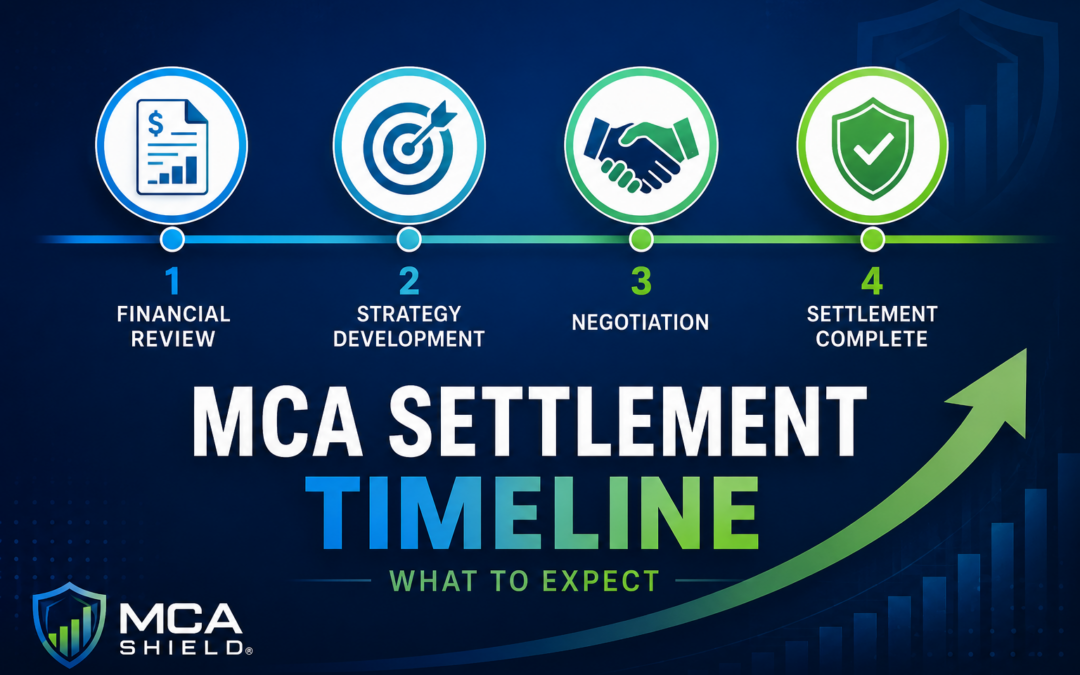
Understand what happens between the first review, an accepted settlement offer and the final payment—and what can slow the process down.
Free MCA Shield consultation. Third-party fees may apply. No guaranteed settlement or completion date.
How long does MCA debt settlement take?
There is no single reliable timeframe for every MCA settlement. The time to reach an agreement depends on the documents, account status, available funds and each funder's response. Completion then depends on the accepted payment schedule and the agreement's remaining conditions.
Time to reach an agreement
This includes reviewing records, preparing a proposal, receiving a response, handling counteroffers and documenting accepted terms. A proposal may be declined, and some discussions never produce a settlement.
Time to complete the agreement
An accepted lump-sum offer and an installment settlement have different payment schedules. The written agreement determines when its conditions are fulfilled and when the specified releases take effect.
For an overview of offers, fees and provider selection, read our MCA debt settlement guide. This page focuses specifically on timing and the milestones to track.
MCA settlement timeline: from review to completion
Use these checkpoints to understand progress. Steps may overlap, repeat or stop if the parties do not reach an agreement.
- 1
Organize the records
Agreements, balances, payments and cash flow.
Checkpoint: a clear account inventory. - 2
Prepare a proposal
Assess available funds, objectives and alternatives.
Checkpoint: a specific proposal to discuss. - 3
Seek funder agreement
Responses, document requests and counteroffers.
Checkpoint: accepted terms, if agreement is reached. - 4
Review the written terms
Amounts, due dates, fees, conditions and releases.
Checkpoint: the parties understand the written agreement. - 5
Complete and document
Fulfill required payments and other conditions.
Checkpoint: records of completion and applicable releases.
1. Financial review and case evaluation
Start with a list of every MCA, the latest claimed balance, recent withdrawals and any collection or legal notices. Missing statements or conflicting payoff figures can create additional review work.
Identify the provisions that need professional attention using our guide to MCA contract terms and risks.
2. Proposal preparation
A proposal needs to reflect the business's actual resources. Determine what funds are available, what operating costs must be covered and whether a proposed payment schedule is practical. Provider fees also belong in the comparison.
Settlement and MCA payment restructuring address different objectives. Clarify the intended outcome before comparing timelines.
3. Negotiation and counteroffers
A funder may accept, decline, counter or ask for supporting information. There is no universal response time to an MCA settlement offer. Track when the proposal was delivered, who received it and what information remains outstanding.
Our MCA negotiation guide explains the broader discussion process.
4. Written agreement review
Confirm the covered accounts, parties, payment amounts, deadlines, release provisions and consequences if a payment is missed. A verbal projection or a provider's estimate is not the same as an accepted written agreement.
Ask a licensed attorney to address questions about guarantees, pending litigation and enforceability.
5. Payment and completion records
Signing alone may not complete the settlement. Follow the written payment schedule and other conditions, retain receipts, and confirm the completion documents specified in the agreement.
Any agreed UCC filing actions, lawsuit dismissals or guarantee releases need to be reviewed separately rather than presumed automatic.
What can delay an MCA settlement?
Identify the specific obstacle rather than relying on a general promise that the account will be resolved soon.
| Possible delay | What to clarify | Useful preparation |
|---|---|---|
| Missing or inconsistent documents | Which exact records or figures need clarification? | Organize agreements, payoff statements and payment records by funder. |
| A pending funder response | Was the proposal received, and is anything else requested? | Keep dated communication records and an agreed follow-up plan. |
| Several stacked advances | Which funders have responded and which accounts remain unresolved? | Track each account's status separately. |
| Funds are not available as proposed | Can the business meet the proposed schedule and known fees? | Prepare an accurate cash-flow picture without assuming new financing. |
| Disagreement over terms | Is the issue the amount, schedule, releases or another condition? | Identify the unresolved terms for qualified review. |
| Collection activity or litigation | Are there deadlines requiring immediate legal attention? | Give notices promptly to a licensed attorney; negotiations do not pause them. |
If collection activity is part of the delay, review MCA collections and the questions to raise. Do not wait for a routine settlement update to address legal papers.
Lump sum vs. installments: when is settlement complete?
Lump-sum settlement
The agreement specifies a payment amount and deadline. Having the money available does not guarantee quick acceptance. Payment processing and any remaining agreement conditions still need to be addressed.
Ask: “After payment clears, what confirms completion, and when should I receive it?”
Settlement payment plan
An installment arrangement can extend the time between acceptance and final completion. Review every due date, additional charge and the consequences of failing to complete the schedule.
Ask: “Which protections or releases apply now, and which depend on my final payment?”
Does settling multiple MCAs take longer?
It can. Each funder may have different requirements and response times. One account can reach an agreement while another remains under review. Ask for account-by-account milestones rather than one completion date for the entire group.
If overlapping withdrawals are the main concern, explore options when multiple MCAs are stacked together.
What can you prepare now?
These records help explain your situation. Check off what you have; this checklist stays in your browser page and does not upload or submit documents.
You can start with a conversation even if your records are incomplete. Ask how to share sensitive financial documents securely. Never send banking passwords.
Frequently asked questions about MCA settlement timelines
How long does a funder take to respond to an MCA settlement offer?
There is no universal response period for settlement proposals. Ask the person handling discussions to confirm receipt, identify outstanding requests and establish an update schedule. Silence is not acceptance, and an unanswered proposal does not suspend your existing obligations.
Can an MCA settlement be completed in 30 days?
A fixed 30-day promise cannot be applied to every case. Ask whether a quoted timeframe concerns an initial review, an accepted offer or full completion. The number of accounts, funder response, payment terms and remaining conditions determine what is feasible.
Why is my MCA settlement taking longer than expected?
Ask for a specific status report: documents outstanding, funder responses, counteroffers, funds needed and agreement terms still under review. Those details are more useful than a revised date without an explanation. Some negotiations do not result in an agreement.
Do I need to be in default before discussing settlement?
You can request a review while current or behind. A funder's willingness to consider settlement is a separate matter. Do not intentionally default to try to accelerate negotiations; get advice about your agreement and legal exposure before changing payments.
Do daily MCA withdrawals stop when settlement discussions begin?
No automatic payment change follows from requesting a consultation or starting discussions. Review what to consider before stopping daily MCA withdrawals and obtain qualified advice before acting.
How does a lawsuit affect an MCA settlement timeline?
Legal proceedings introduce deadlines and issues that need an attorney's attention. Settlement discussions do not automatically pause a case or extend response deadlines. Have counsel explain how any proposed agreement would address the litigation.
What happens after the final MCA settlement payment?
Retain proof of payment and request the completion documentation called for by the agreement. Verify any remaining conditions and agreed actions regarding liens, guarantees or litigation. Do not assume every release occurs immediately or without further steps.
How soon is a UCC lien removed after settlement?
There is no single timetable that applies to every agreement and filing. Ask counsel to review whether termination is required, who must file, what conditions apply and how completion will be verified. A payment receipt alone does not establish that a filing has been terminated.
Is MCA restructuring faster than settlement?
Not necessarily. They pursue different outcomes and depend on agreement-specific facts. MCA restructuring generally concerns changes to payment terms; settlement concerns an agreed resolution of the covered obligation. Compare suitability and total cost as well as timing.
Need clarity on your MCA settlement situation?
Tell us how many advances you have, whether an offer exists and what is putting pressure on your business. Start with a free consultation about the options to explore.
Monday–Friday, 8 a.m.–5 p.m. Central. Our consultation is free; third-party services may have fees.
About MCA Shield's role
MCA Shield provides financial consulting and referrals. We may connect businesses with third-party providers and may receive compensation from select referral partners. Those providers evaluate and perform services under their own agreements. We do not lend money, assume debt, make payments to funders or provide legal or tax advice.
Settlement, payment reductions, eligibility and completion dates are not guaranteed. Not every business reaches or completes an agreement. Availability varies by provider and state. Consult a licensed attorney about contracts and enforcement, and a qualified tax professional about possible tax consequences. Privacy Policy · Terms of Service