
Schedule Your Free Consultation
An MCA renewal trap can keep businesses stuck in a cycle of ongoing debt, high repayment obligations, and persistent cash flow problems. Many business owners accept renewals believing they will provide relief, only to discover that each new advance creates additional financial pressure. Understanding how an MCA renewal trap develops is the first step toward breaking the cycle and regaining control of your business finances.
What Is an MCA Renewal?
An MCA renewal occurs when a funding company offers a business additional financing before the current merchant cash advance has been fully repaid. Instead of allowing the existing advance to run its course, the funder provides a new advance and uses a portion of the proceeds to satisfy some or all of the remaining balance on the original MCA.
Renewals are often marketed as a convenient way to obtain more working capital, reduce immediate cash flow pressure, or access funds quickly without applying for traditional financing. While a renewal can provide short-term relief, it also creates a new repayment obligation that may increase the business’s overall debt burden.
For businesses already struggling with daily or weekly withdrawals, repeated renewals can make it difficult to achieve meaningful financial recovery.
How MCA Renewal Offers Are Typically Presented
MCA renewal offers are often presented as opportunities rather than warnings. A business owner may receive calls, emails, or text messages stating that they qualify for additional funding because of their positive payment history or strong sales performance.
Common renewal sales messages include:
- “You’re eligible for more capital.”
- “We can lower your payment pressure.”
- “Use this funding to grow your business.”
- “Pay off your current advance and receive additional cash.”
- “You qualify for a larger approval amount.”
In many cases, the business owner receives only a portion of the new funding after the existing balance is satisfied. Although the transaction may provide immediate access to cash, it also replaces one obligation with another and may extend the repayment cycle significantly.
Why Businesses Often Accept Renewal Funding
Most business owners do not accept renewals because they want additional debt. They accept them because they are facing ongoing cash flow challenges and need immediate access to working capital.
Common reasons businesses accept MCA renewals include:
- Covering payroll expenses
- Paying vendors and suppliers
- Replenishing inventory
- Managing seasonal revenue fluctuations
- Resolving overdrafts or negative account balances
- Replacing cash already being consumed by MCA payments
Unfortunately, the underlying financial pressure often remains unchanged. Because the new advance creates another repayment obligation, many businesses find themselves needing additional funding again in the future.
This cycle can lead to a pattern of repeated borrowing where each renewal provides temporary relief but makes long-term financial recovery more difficult. Over time, businesses may become increasingly dependent on new funding simply to maintain normal operations, creating the very MCA renewal trap they were hoping to escape.
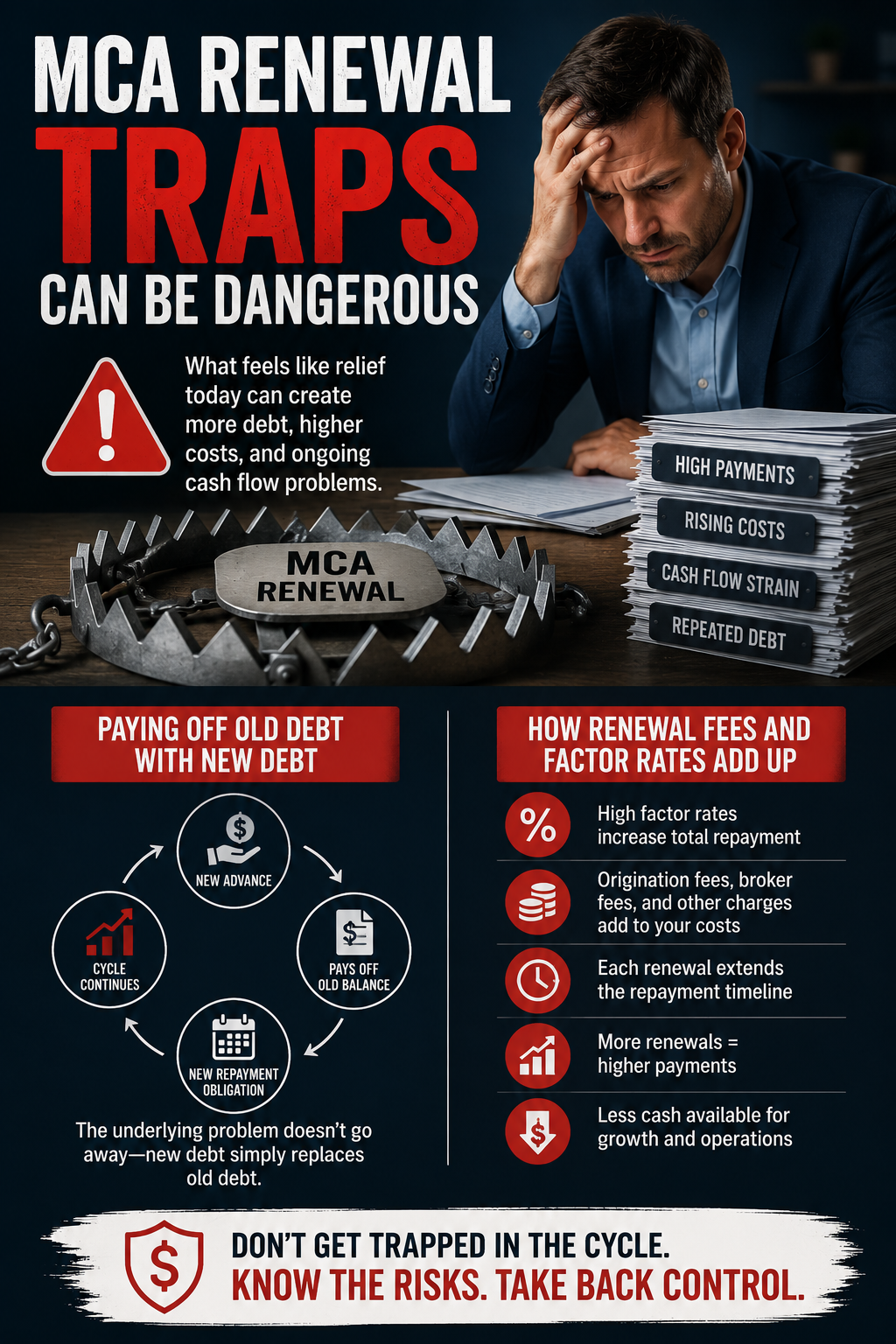
Why MCA Renewal Traps Can Be Dangerous
At first glance, an MCA renewal may seem like a practical solution to a cash flow problem. The promise of additional working capital and immediate access to funds can make a renewal appear helpful, especially for businesses facing payroll deadlines, vendor obligations, or seasonal slowdowns.
The danger is that many MCA renewals provide only temporary relief while creating a new repayment obligation. Instead of improving the business’s financial position, repeated renewals can increase total debt, extend repayment timelines, and make future cash flow challenges even harder to overcome.
Over time, businesses may find themselves relying on one renewal after another simply to stay current on existing obligations. This cycle can create ongoing financial pressure that becomes increasingly difficult to escape.
Paying Off Old Debt With New Debt
One of the biggest risks of an MCA renewal trap is using new funding to satisfy existing debt. Rather than generating new revenue or improving profitability, a large portion of the renewal proceeds is often used to pay off a previous advance balance.
While this may temporarily reduce immediate pressure, it does not eliminate the underlying problem. The business still faces ongoing withdrawals and now has a new repayment obligation that may be larger than the one it replaced.
This pattern can create a cycle where:
- Existing MCA balances are paid off with new advances
- New repayment obligations replace old ones
- Cash flow remains strained
- Additional funding becomes necessary in the future
As this cycle continues, businesses may become increasingly dependent on MCA funding just to maintain normal operations.
How Renewal Fees and Factor Rates Add Up
Every MCA renewal introduces a new set of costs. These may include factor rates, origination fees, broker commissions, administrative charges, or other expenses associated with the new advance.
Even if each individual renewal appears manageable, the cumulative cost can become substantial over time. Businesses that repeatedly renew advances may end up repaying significantly more than the amount of capital they originally received.
Additional costs can include:
- Higher total repayment amounts
- Extended repayment periods
- Increased daily or weekly withdrawals
- Additional fees tied to new funding agreements
As repayment costs grow, less revenue remains available for payroll, inventory, marketing, equipment purchases, and other critical business expenses. What begins as a short-term funding solution can gradually turn into a long-term financial burden that limits growth and puts continued operations at risk.
Common Signs You Are Caught in an MCA Renewal Trap
Many businesses do not realize they are caught in an MCA renewal trap until cash flow problems become severe. Because renewals often provide temporary relief, the cycle can continue for months or even years before the long-term consequences become obvious.
If your business is experiencing any of the warning signs below, it may be time to evaluate whether repeated MCA renewals are helping solve the problem or simply extending it.
Frequent Renewal Offers
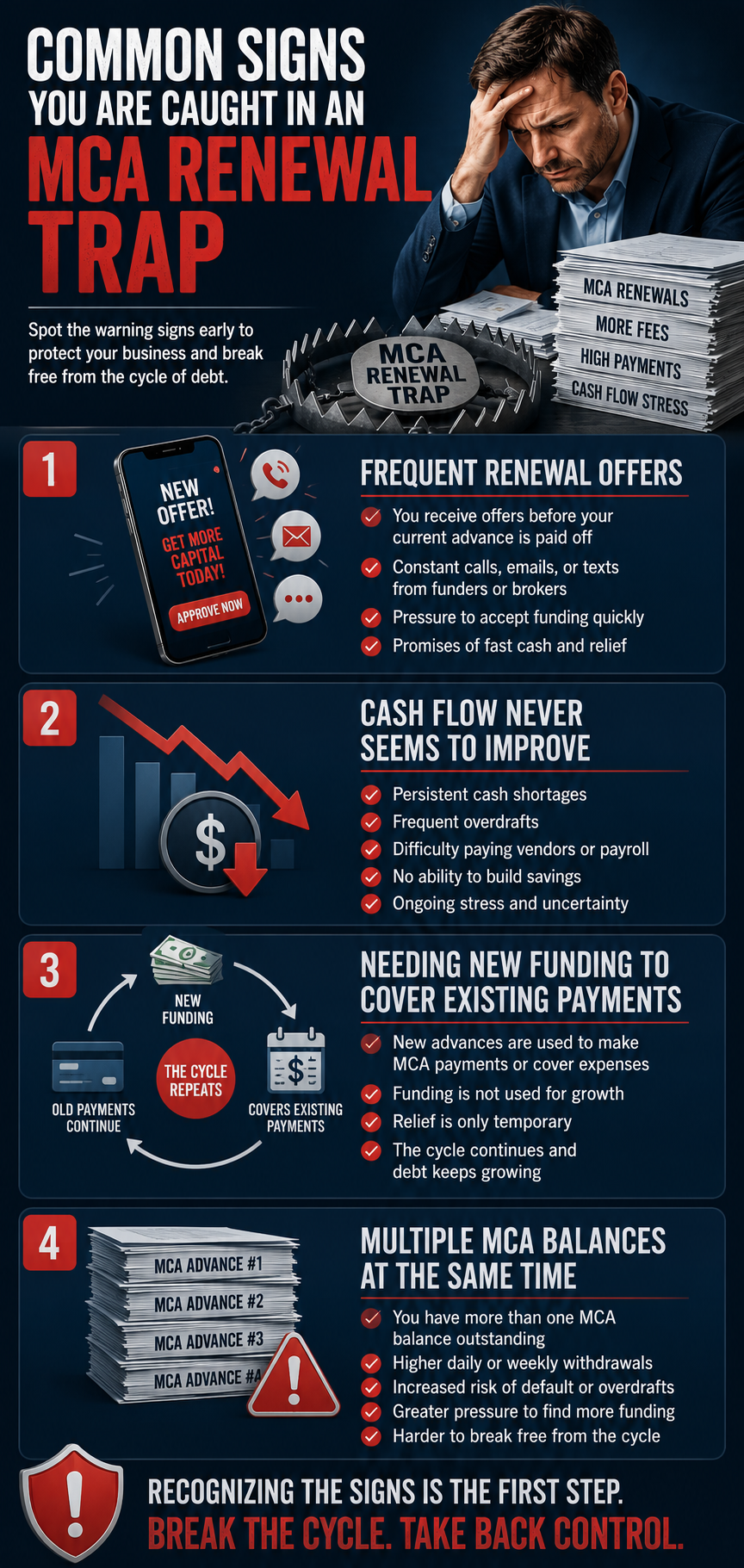
One of the most common signs of an MCA renewal trap is receiving constant offers for additional funding. MCA companies often begin contacting businesses about renewal opportunities long before an existing advance is fully repaid.
While these offers may seem like a sign of financial strength, they are often designed to encourage ongoing borrowing. If funders regularly call, email, or text with offers to “unlock more capital” or “qualify for additional funding,” it may indicate that the renewal cycle has already begun.
Common signs include:
- Renewal offers arriving before the current advance is paid off
- Frequent calls from brokers or funders
- Pressure to accept funding quickly
- Promises of immediate cash flow relief
Cash Flow Never Seems to Improve
A healthy financing solution should help a business move toward greater financial stability. If your cash flow remains strained despite multiple MCA renewals, the underlying problem may not be getting solved.
Many businesses find that after the initial relief wears off, daily or weekly withdrawals continue to consume a significant portion of incoming revenue. As a result, payroll, vendor payments, inventory purchases, and operating expenses remain difficult to manage.
Warning signs include:
- Persistent cash shortages
- Frequent overdrafts
- Delayed vendor payments
- Difficulty building cash reserves
- Ongoing financial stress despite new funding
Needing New Funding to Cover Existing Payments
Perhaps the clearest sign of an MCA renewal trap is when new funding becomes necessary just to keep up with existing obligations.
Instead of using financing to support growth, hire employees, purchase equipment, or expand operations, businesses may find themselves using new advances to cover current MCA payments and everyday expenses.
This often creates a cycle where:
- MCA payments reduce available cash flow
- The business experiences financial pressure
- Another renewal is taken to create breathing room
- New payments replace old payments
- The cycle repeats
When funding is being used primarily to manage previous funding obligations, the business may be trapped in a cycle of debt rather than achieving financial recovery.
Multiple MCA Balances at the Same Time
Another major warning sign is carrying multiple MCA balances simultaneously. In some cases, businesses renew one advance while still making payments on another. In others, additional advances are added on top of existing obligations.
This practice, often called MCA stacking, can dramatically increase repayment pressure and make cash flow management far more difficult.
Businesses with multiple MCA balances often experience:
- Higher daily or weekly withdrawals
- Increased overdraft risk
- Greater difficulty making payroll
- More pressure to seek additional funding
- Reduced flexibility to invest in growth
The more MCA obligations a business carries at the same time, the harder it often becomes to break free from the renewal cycle. Recognizing these warning signs early may help business owners explore alternative solutions before the debt burden grows even larger.
How MCA Renewals Lead to MCA Stacking
The Financial Consequences of Repeated MCA Renewals
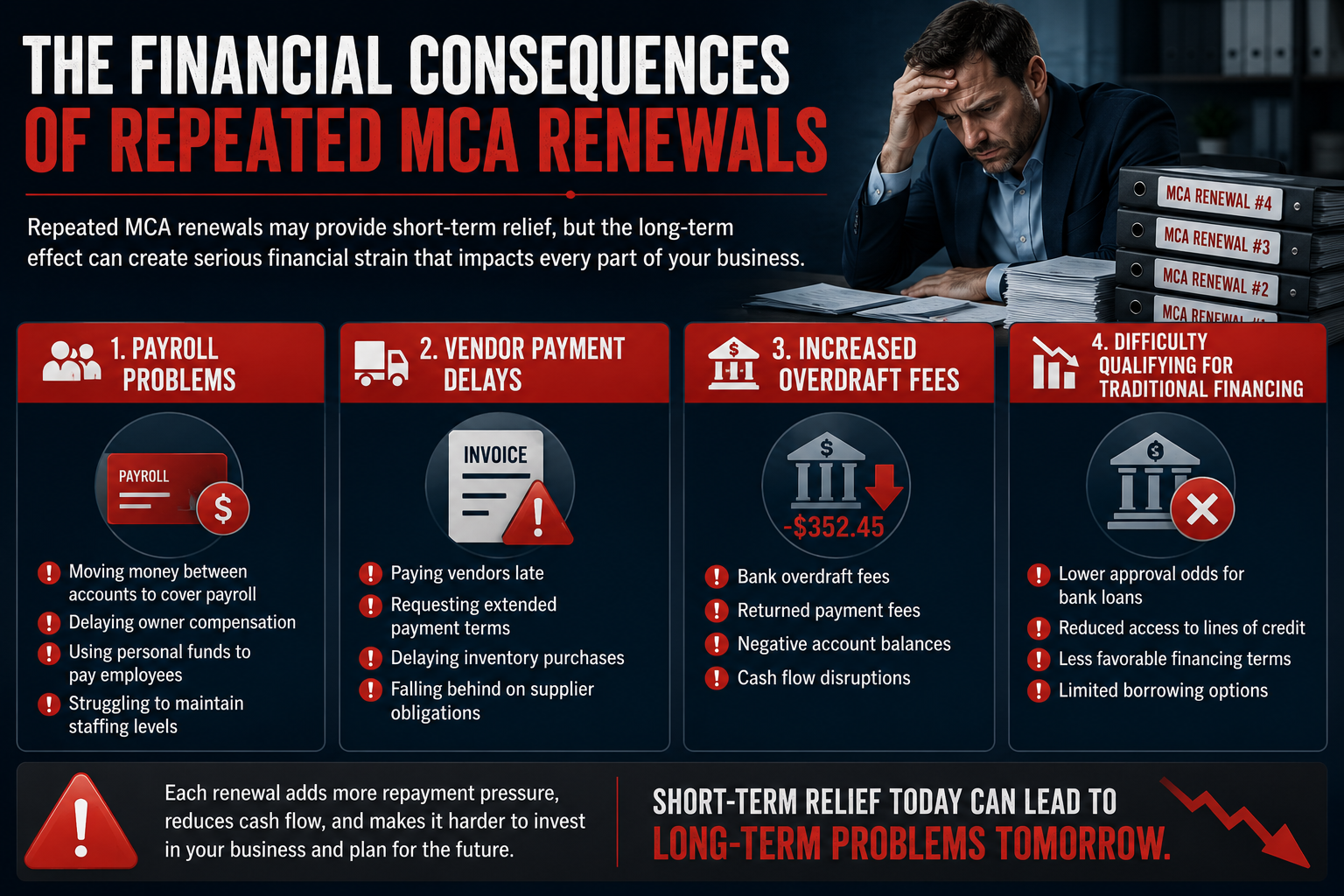
Repeated MCA renewals often create problems that extend far beyond the cost of the funding itself. While each renewal may provide temporary relief, the long-term effect can be increasing financial pressure that impacts nearly every aspect of a business.
As repayment obligations grow, less cash remains available for essential operating expenses. Business owners may find themselves constantly managing cash shortages, delaying important payments, and making difficult decisions to keep the business running.
Over time, these challenges can affect profitability, growth opportunities, and the company’s overall financial stability.
Payroll Problems
Payroll is often one of the first areas impacted by repeated MCA renewals. Daily or weekly withdrawals can reduce available cash to the point where meeting payroll becomes increasingly stressful.
Business owners may find themselves:
- Moving money between accounts to cover payroll
- Delaying owner compensation
- Using personal funds to pay employees
- Struggling to maintain staffing levels
When payroll becomes difficult to manage, employee morale and business operations can suffer, creating additional challenges beyond the financial strain itself.
Vendor Payment Delays
Businesses rely on vendors and suppliers to maintain normal operations. As MCA repayment obligations increase, vendor invoices may be pushed further down the priority list.
Common warning signs include:
- Paying vendors late
- Requesting extended payment terms
- Delaying inventory purchases
- Falling behind on supplier obligations
Over time, vendor relationships may become strained, and some suppliers may require upfront payment before providing additional products or services.
Increased Overdraft Fees
Many businesses caught in an MCA renewal cycle experience frequent overdrafts. Because MCA payments are often withdrawn automatically, unexpected expenses or slower-than-expected sales can quickly create account shortages.
This can lead to:
- Bank overdraft fees
- Returned payment fees
- Negative account balances
- Cash flow disruptions
Although individual fees may seem minor, repeated overdrafts can become an expensive and ongoing drain on business resources.
Difficulty Qualifying for Traditional Financing
One of the lesser-known consequences of repeated MCA renewals is the impact they can have on future financing opportunities.
Traditional lenders often review cash flow, existing debt obligations, bank activity, and overall financial stability when evaluating loan applications. Multiple MCA renewals or stacked advances can make a business appear financially stressed, even if revenue remains strong.
As a result, businesses may face:
- Lower approval odds for bank loans
- Reduced access to lines of credit
- Less favorable financing terms
- Limited borrowing options
Unfortunately, this can create a difficult cycle where businesses become increasingly dependent on MCA funding because traditional financing becomes harder to obtain.
The longer repeated renewals continue, the greater the risk that short-term funding challenges will evolve into broader financial problems affecting the entire business.
When to Seek Professional Help With MCA Debt
Many business owners wait too long before seeking help with MCA debt. They often hope that sales will improve, cash flow will stabilize, or another renewal will provide enough breathing room to solve the problem. Unfortunately, delaying action can reduce available options and allow financial pressure to continue building.
If MCA payments are beginning to affect daily operations, it may be time to explore professional guidance before the situation becomes more difficult to manage.
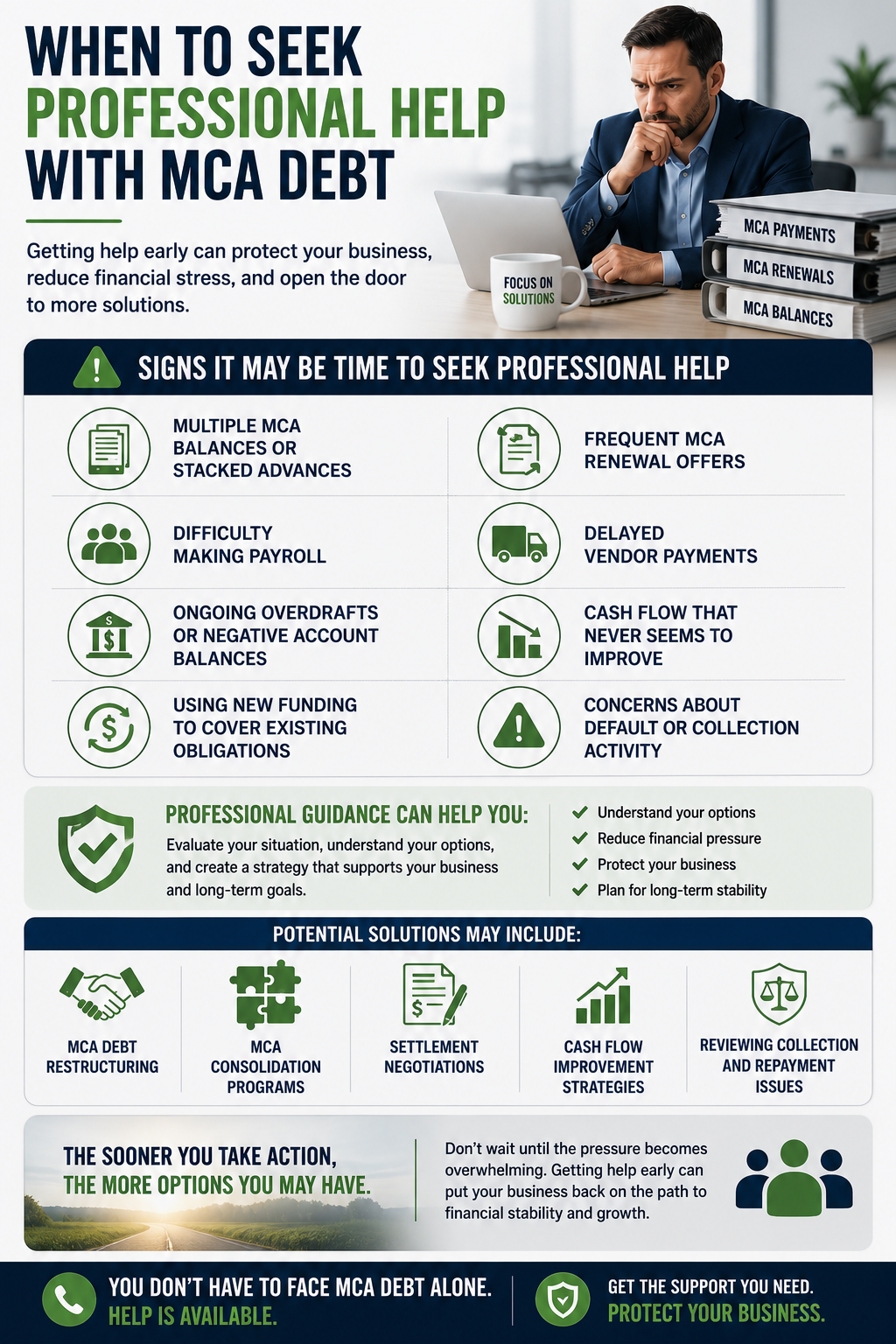
Common signs that professional assistance may be appropriate include:
- Multiple MCA balances or stacked advances
- Frequent MCA renewal offers
- Difficulty making payroll
- Ongoing overdrafts or negative account balances
- Delayed vendor payments
- Using new funding to cover existing obligations
- Cash flow that never seems to improve
- Concerns about default or collection activity
Professional guidance can help business owners evaluate available solutions, understand the risks and benefits of each option, and develop a strategy that aligns with their financial situation and long-term goals.
Depending on the circumstances, potential solutions may include:
- MCA debt restructuring
- MCA consolidation programs
- Settlement negotiations
- Cash flow improvement strategies
- Reviewing collection and repayment issues
The most important factor is timing. Businesses that address MCA problems early often have more flexibility and more potential solutions than those that wait until financial pressure becomes overwhelming.
If repeated MCA renewals, stacked advances, or ongoing cash flow challenges are affecting your business, seeking professional help sooner rather than later may provide the best opportunity to regain control and create a more sustainable financial future.
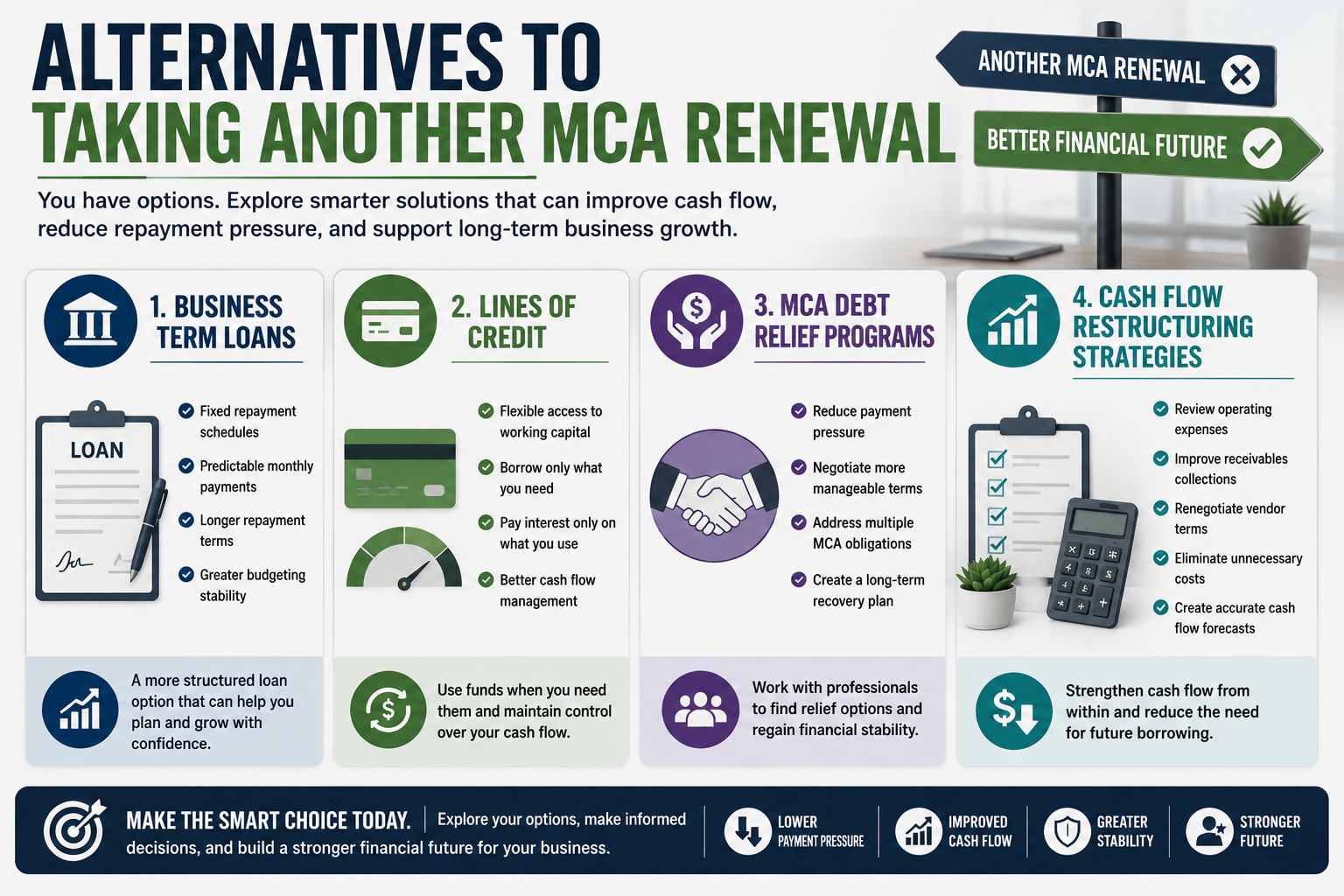
Alternatives to Taking Another MCA Renewal
When cash flow becomes tight, accepting another MCA renewal may seem like the easiest solution. However, a renewal is not always the best option for a business already struggling with repayment pressure.
Depending on the company’s financial situation, there may be alternatives that provide working capital, improve cash flow, or address existing debt without creating another cycle of repeated renewals.
Exploring these options before accepting additional MCA funding may help businesses create a more sustainable path forward.
Business Term Loans
For businesses that qualify, a traditional business term loan may offer a more structured financing solution than a merchant cash advance.
Unlike most MCAs, term loans typically provide:
- Fixed repayment schedules
- Predictable monthly payments
- Longer repayment terms
- Greater budgeting stability
Qualification requirements are often more stringent than MCA funding, but businesses with improving financials may find that a term loan offers a lower-cost alternative to repeated renewals.
Lines of Credit
A business line of credit can provide flexibility for managing short-term cash flow needs without requiring a lump-sum advance.
Instead of borrowing a large amount all at once, businesses can access funds as needed and only use what is necessary.
Potential benefits include:
- Flexible access to working capital
- Borrowing only when needed
- Improved cash flow management
- Reduced reliance on emergency funding
For some businesses, a line of credit can serve as a valuable tool for handling seasonal fluctuations, unexpected expenses, or temporary revenue gaps.
MCA Debt Relief Programs
Businesses already facing significant MCA payment pressure may benefit from exploring MCA debt relief programs.
Depending on the circumstances, relief strategies may focus on:
- Reducing payment pressure
- Improving cash flow
- Addressing multiple MCA obligations
- Negotiating more manageable repayment arrangements
- Creating a long-term financial recovery plan
For businesses trapped in a cycle of renewals, debt relief solutions may offer an alternative to taking on additional funding.
Cash Flow Restructuring Strategies
Sometimes the best solution is not new financing at all. Improving cash flow management can often reduce the need for future borrowing and help businesses regain financial stability.
Common cash flow restructuring strategies include:
- Reviewing operating expenses
- Improving accounts receivable collection processes
- Renegotiating vendor payment terms
- Eliminating unnecessary costs
- Creating more accurate cash flow forecasts
While these strategies may not provide immediate funding, they can strengthen the business’s financial position and reduce dependence on MCA renewals over time.
Before accepting another MCA renewal, it is often worthwhile to evaluate all available options. In many cases, a solution that addresses the underlying cash flow challenge may provide greater long-term benefits than simply replacing one advance with another.
Taking Action Before MCA Renewals Create More Debt
An MCA renewal can provide temporary relief, but repeated renewals often create a larger problem over time. What starts as a short-term solution can gradually turn into a cycle of ongoing debt, increasing repayment obligations, and persistent cash flow challenges that make it difficult for a business to move forward.
If your business is relying on repeated MCA renewals, struggling with daily or weekly withdrawals, or carrying multiple advances at the same time, it may be time to explore alternative solutions. The sooner you address the underlying financial pressure, the more options may be available to improve cash flow and reduce repayment burdens.
Whether through MCA debt consolidation or other relief strategies, taking action early can help prevent additional debt from accumulating and create a more sustainable path forward.
If MCA renewals are keeping your business trapped in a cycle of debt, MCA Shield may be able to help. Schedule a free consultation today to review your situation, explore available options, and develop a strategy designed to protect your business and improve financial stability.
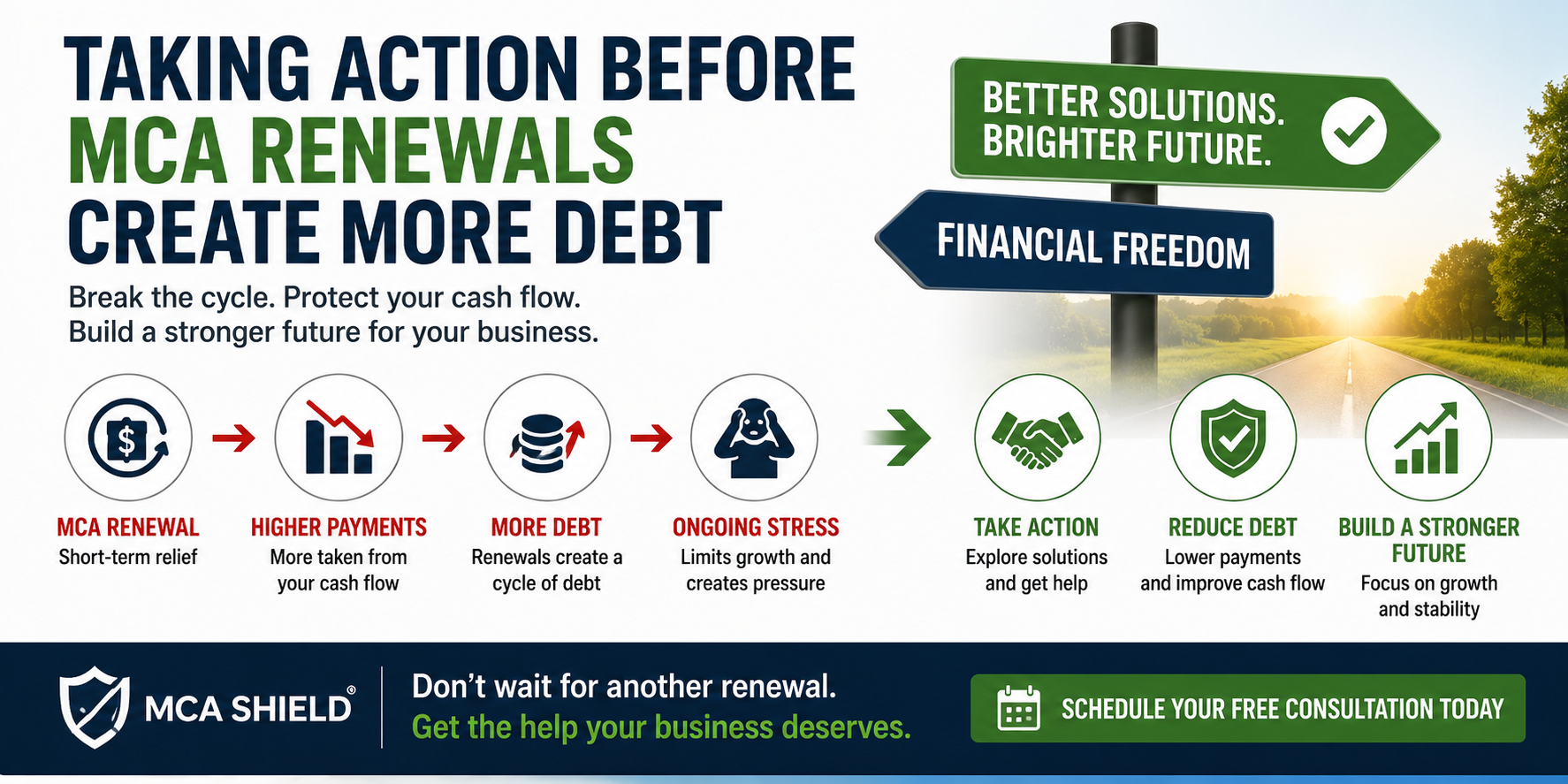
Conclusion: Taking Action Before MCA Renewals Create More Debt
MCA renewals may offer short-term cash flow relief, but repeated renewals can keep businesses trapped in a cycle of increasing debt, higher repayment costs, and ongoing financial pressure. What begins as a temporary solution can gradually lead to cash flow problems, payroll challenges, vendor payment delays, and dependence on future funding.
The good news is that alternatives may be available. Whether through MCA debt restructuring, consolidation, settlement opportunities, or other relief strategies, addressing the problem early often provides more options and greater flexibility. The longer the cycle continues, the harder it can become to regain control of your finances.
If MCA renewals are putting pressure on your business, don’t wait until the situation becomes overwhelming. Contact MCA Shield for a free consultation to review your MCA obligations, explore available solutions, and develop a strategy that helps protect your business and create a more sustainable financial future.