
Many business owners sign Merchant Cash Advance (MCA) agreements without fully understanding every contract provision. One of the most discussed and often misunderstood provisions is the Confession of Judgment (COJ). While not every MCA agreement contains one, a COJ can have significant legal implications if a dispute arises or the business allegedly defaults under the terms of the agreement. Understanding how Confessions of Judgment work is an important part of evaluating the risks associated with MCA funding.
A Confession of Judgment is a contractual provision that may allow a lender or funding company to obtain a judgment under certain circumstances without going through a traditional court process. Because these provisions can affect a business owner’s legal rights and options, they have received increased attention from regulators, courts, and business advocates in recent years. Business owners should carefully review any MCA agreement and understand the legal provisions it contains before signing.
The more you understand about Confessions of Judgment, the better prepared you will be to evaluate MCA contracts, protect your business interests, and avoid unexpected legal complications in the future.
What Is a Confession of Judgment in an MCA Agreement?
A Confession of Judgment (COJ) is a contract provision that has appeared in some MCA agreements. In general, it is a document that a business owner signs in advance as part of the funding process. Under certain circumstances outlined in the agreement, the provision may allow the funding company to seek a judgment without following the same court procedures typically associated with a standard lawsuit. Because of the legal consequences involved, Confessions of Judgment have become one of the most closely scrutinized provisions in the MCA industry.
Not all MCA agreements contain a COJ, and laws regarding their use vary by jurisdiction. However, business owners should carefully review any agreement that includes this provision and understand its potential impact. A Confession of Judgment can affect a company’s legal options if a dispute or alleged default occurs, making it an important contract term to evaluate before signing an MCA agreement.
Why MCA Companies Have Historically Used Confessions of Judgment
Historically, some MCA companies included Confessions of Judgment as a way to strengthen their contractual remedies if a dispute or alleged default occurred. From the funding company’s perspective, a COJ could provide a faster path to enforcing certain rights under the agreement. Because MCA providers often fund businesses that may not qualify for traditional financing, some companies viewed these provisions as an additional layer of protection.
Over time, Confessions of Judgment attracted increased scrutiny from regulators, lawmakers, and courts. Concerns about fairness, transparency, and the potential impact on business owners led several jurisdictions to restrict or prohibit their use in certain situations. As a result, business owners should never assume that all MCA agreements contain a COJ, but they should always review contract terms carefully and understand any legal provisions before signing.
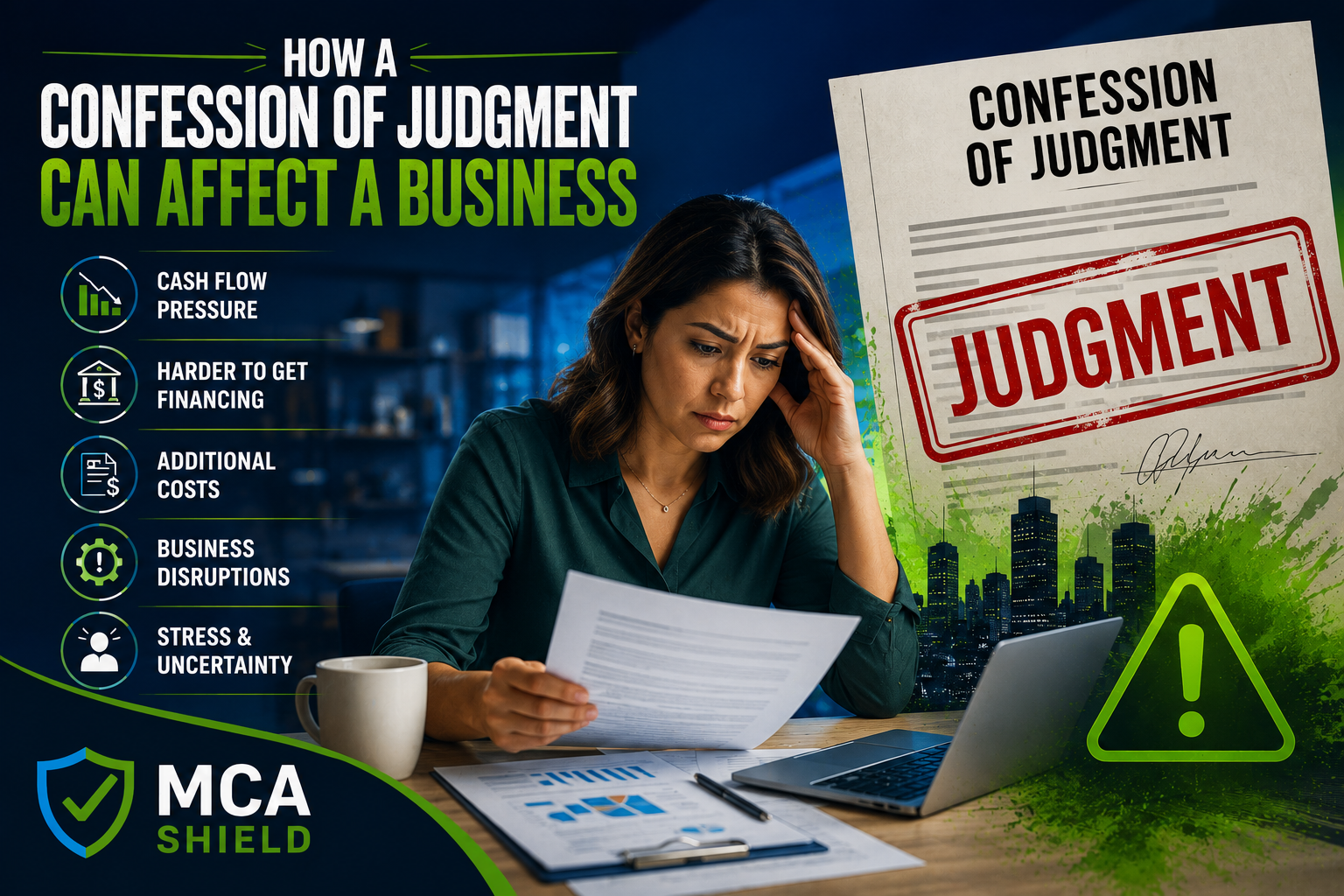
How a Confession of Judgment Can Affect a Business
A Confession of Judgment (COJ) can have serious consequences for a business if the provision becomes enforceable under applicable law and contract terms. Because a COJ may allow a funding company to obtain a judgment more quickly than through a traditional lawsuit, business owners can face significant challenges if a dispute arises. The impact often extends beyond the immediate legal issue and can affect the company’s financial flexibility and day-to-day operations.
Potential consequences may include:
- Increased pressure on business cash flow
- Difficulty obtaining new financing
- Additional legal and administrative costs
- Disruptions to normal business operations
- Greater stress and uncertainty for ownership
The specific impact depends on the facts of each situation, the contract language, and the laws that apply. However, understanding the risks associated with a Confession of Judgment can help business owners make more informed decisions before entering an MCA agreement. Careful contract review and early action often provide more options than waiting until a problem develops.
States That Restrict or Prohibit Confessions of Judgment
Over the years, several states have restricted or prohibited the use of Confessions of Judgment because of concerns about fairness and due process. Lawmakers and regulators in these jurisdictions concluded that business owners should have greater opportunities to respond to legal claims through traditional court procedures. As a result, the rules governing Confessions of Judgment can vary significantly depending on where a business operates and where an agreement is enforced.
Because state laws continue to evolve, business owners should never assume that a Confession of Judgment is valid or enforceable in every situation. Understanding the laws that apply to your MCA agreement is critical when evaluating potential legal risks. A careful review of the contract and applicable state regulations can help businesses better understand their rights and avoid unexpected legal complications.
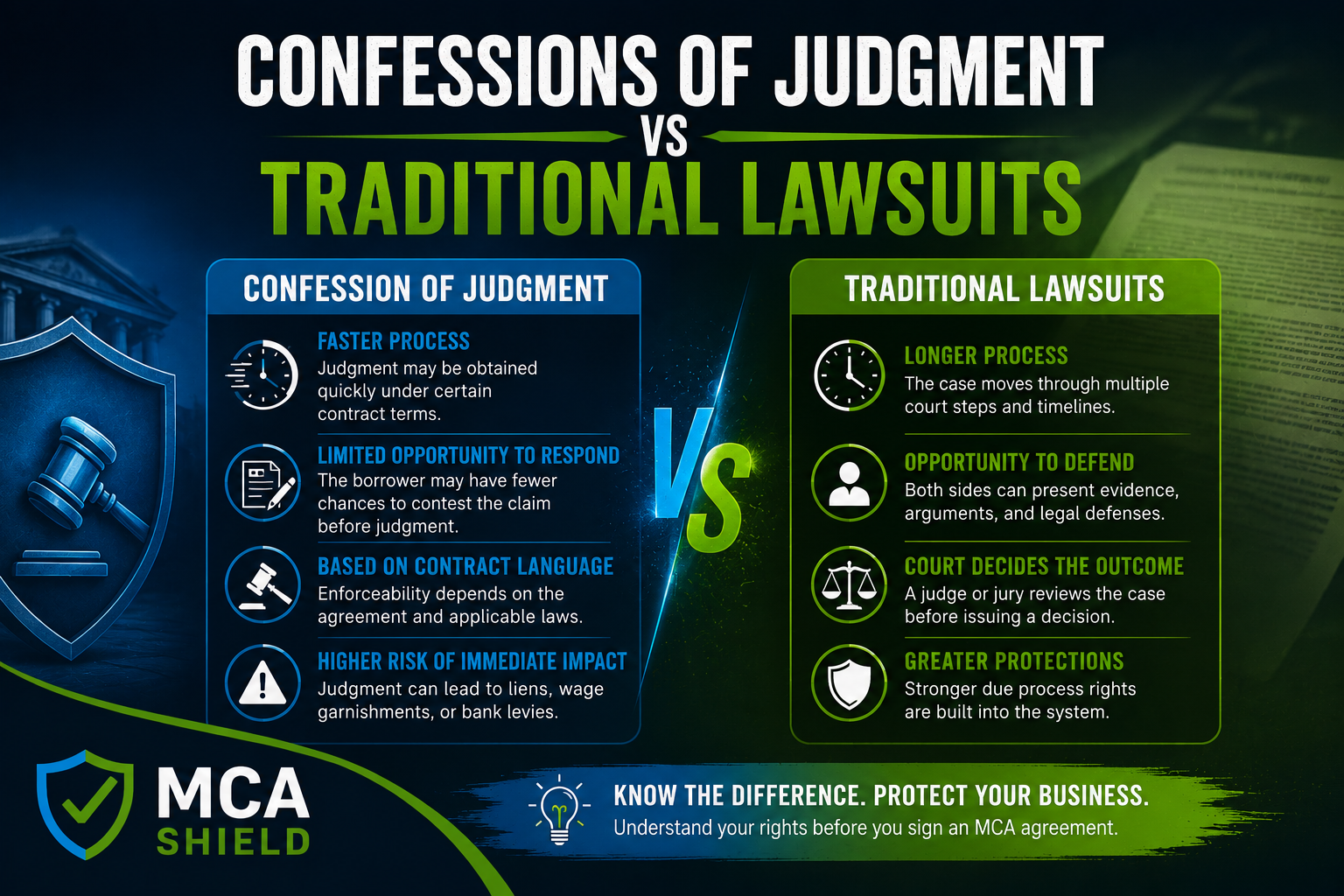
Confessions of Judgment vs Traditional Lawsuits
One of the biggest differences between a Confession of Judgment (COJ) and a traditional lawsuit involves the legal process itself. In a traditional lawsuit, both parties generally have an opportunity to present their positions before a court reaches a decision. A COJ, however, may allow a judgment to be entered under specific circumstances outlined in the agreement. That distinction has made Confessions of Judgment one of the most debated provisions in some MCA contracts.
From a business owner’s perspective, understanding the differences is important when evaluating legal risk. A traditional lawsuit often involves multiple steps, court filings, and opportunities to respond. A COJ may follow a different process depending on the contract language and the laws that apply.
Key differences may include:
- How quickly a judgment can be obtained
- The legal procedures involved
- The opportunity to respond to claims
- The overall impact on business operations
- The rights available under applicable law
Because every situation is unique, business owners should carefully review contract terms and seek qualified legal guidance when necessary. Understanding how a Confession of Judgment differs from a traditional lawsuit can help businesses make more informed decisions before signing an MCA agreement.
Warning Signs in MCA Contracts Business Owners Should Review Carefully
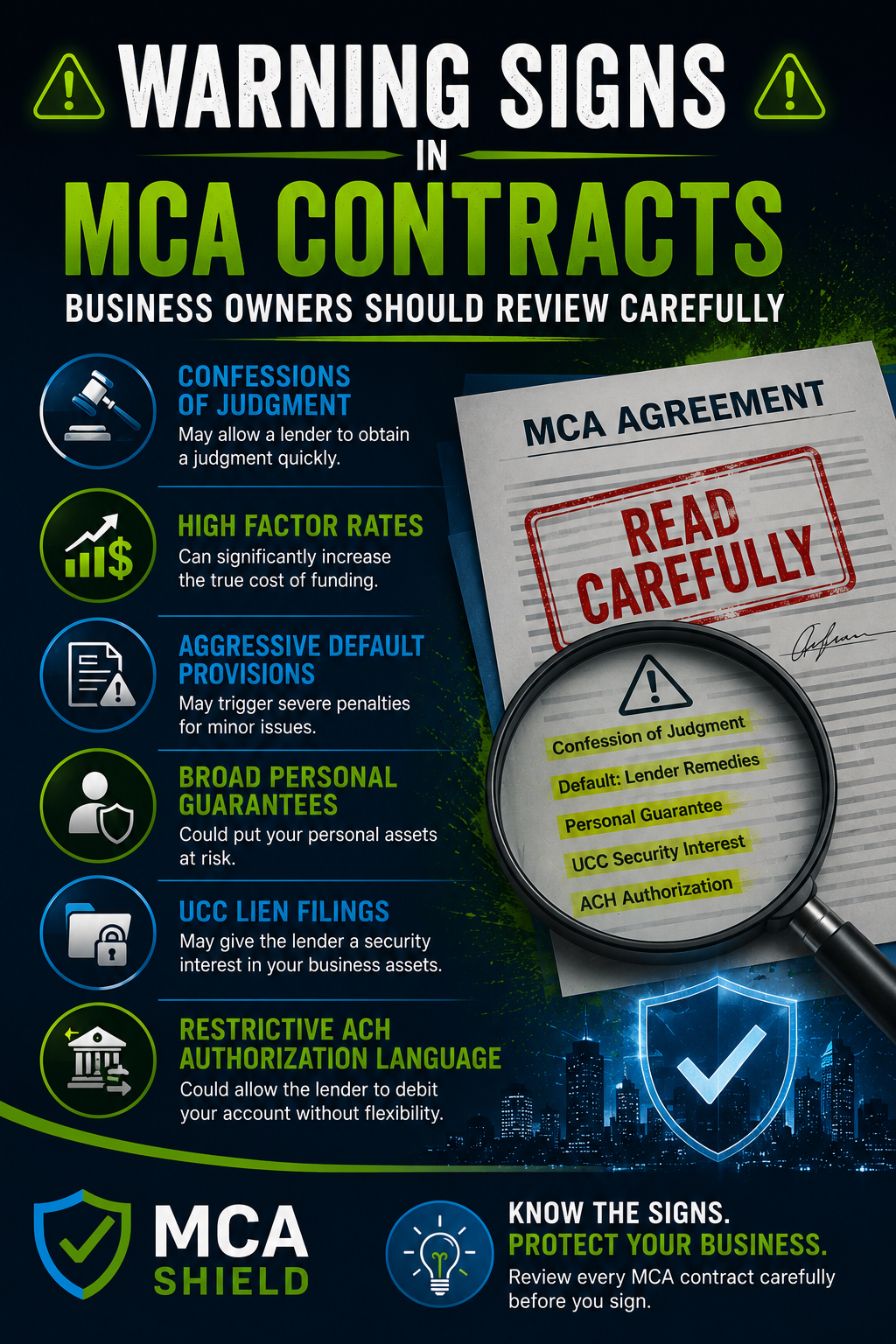
Not every MCA contract contains the same level of risk, which is why business owners should review key provisions before signing. Certain contract terms can create financial pressure, limit flexibility, or increase legal exposure if problems arise later. Taking the time to understand these provisions can help prevent costly surprises and support better financial decisions.
Pay close attention to contract terms such as:
- Confessions of Judgment (COJs)
- High factor rates
- Aggressive default provisions
- Broad personal guarantees
- UCC lien filings
- Restrictive ACH authorization language
If an agreement contains terms that seem unclear, overly restrictive, or difficult to explain, that is often a sign to investigate further. A careful contract review today can help protect your cash flow, your financing options, and your business tomorrow.
What Happens If You Default on an MCA With a Confession of Judgment Clause?
When a business defaults on an MCA agreement that contains a Confession of Judgment (COJ) provision, the situation can become more serious very quickly. The specific outcome depends on the contract terms, the applicable laws, and the facts surrounding the alleged default. However, a COJ may allow the funding company to pursue legal remedies through a different process than a traditional lawsuit. That possibility is one reason many business owners pay close attention to this provision before signing an agreement.
A default can create immediate challenges beyond the legal issues themselves. Business owners often face increased pressure while trying to maintain normal operations, manage cash flow, and communicate with lenders or funding companies. In some situations, concerns about future financing, vendor relationships, and business stability may also arise.
The most important takeaway is that businesses often have more options before a default occurs than afterward. If MCA payments become difficult to manage, taking action early can help preserve flexibility and create opportunities to explore restructuring, negotiation, or other relief strategies before the situation escalates.
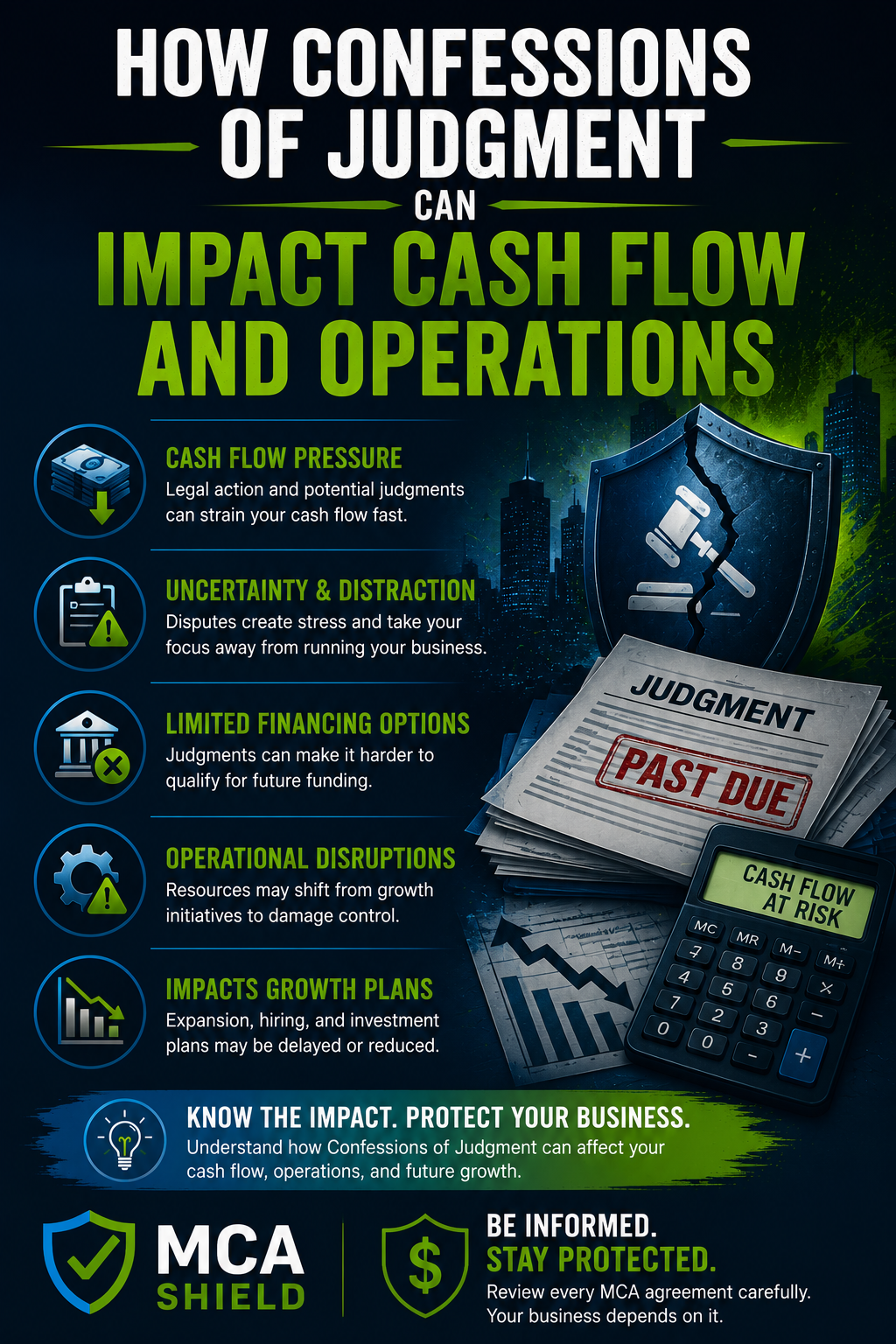
How Confessions of Judgment Can Impact Cash Flow and Operations
A Confession of Judgment (COJ) can create significant pressure on a business when financial challenges already exist. If a dispute or alleged default arises, the potential legal consequences can add uncertainty to an already difficult situation. Business owners often find themselves focusing on immediate financial concerns rather than growth, customer service, or day-to-day operations.
The impact can extend beyond legal matters. Cash flow may become more difficult to manage, future financing options may become more limited, and operational decisions may require greater caution. As financial pressure increases, some businesses delay expansion plans, postpone equipment purchases, or reduce spending in other critical areas. Understanding the potential operational and cash flow risks associated with a Confession of Judgment can help business owners make more informed decisions before entering an MCA agreement.
Options for Businesses Facing MCA Collection Pressure
When MCA collection pressure begins to escalate, many business owners feel like they have run out of options. In reality, several solutions may exist depending on the company’s financial situation, the number of MCA obligations involved, and the stage of the collection process. The earlier a business addresses the problem, the more flexibility it often has to pursue relief strategies and reduce financial stress.
Common options may include:
- MCA debt restructuring to pursue more manageable payment terms
- MCA debt settlement to resolve obligations for less than the full claimed balance when appropriate
- Professional negotiation assistance to communicate with MCA companies and explore available solutions
- Cash flow analysis and budgeting adjustments to improve financial stability
- Reviewing MCA agreements to better understand rights, obligations, and potential risks
Every business faces unique challenges, which is why no single solution works for everyone. The most effective approach starts with a clear understanding of the company’s cash flow, debt obligations, and long-term goals. Taking action before collection pressure intensifies can help protect operations, preserve future options, and create a path toward greater financial stability.

When to Seek Professional Help for MCA Contract Issues
Many business owners try to manage MCA contract issues on their own at first. However, there comes a point when professional guidance can make a meaningful difference. If you struggle to understand contract terms, face increasing collection pressure, or worry about legal provisions such as Confessions of Judgment, personal guarantees, or UCC liens, it may be time to seek experienced assistance. The sooner you address potential problems, the more options you may have available.
Professional help can provide clarity when MCA agreements become complex or difficult to navigate. An experienced advisor can review contract terms, identify potential risks, evaluate relief options, and help develop a strategy based on your business’s specific situation. Taking action early often helps businesses protect cash flow, reduce uncertainty, and avoid situations that become more difficult and costly to resolve later.