

A factor rate is one of the most important concepts business owners should understand before accepting a Merchant Cash Advance (MCA) offer. Merchant Cash Advances can provide quick access to working capital, but the factor rate determines the total amount you repay and majorly impacts the overall cost of funding.
Traditional loans use interest rates to calculate borrowing costs over time. Merchant Cash Advances work differently. MCA providers use factor rates to determine repayment costs upfront. Even a seemingly small factor rate can significantly increase the total amount a business repays.
By understanding how factor rates work, business owners can compare funding offers more effectively, estimate repayment obligations, and avoid costly financial mistakes.
This guide explains what a factor rate is in Merchant Cash Advance financing, how it differs from an interest rate, and how it affects the total cost of an MCA. You’ll also learn how to evaluate factor rates, identify expensive funding offers, and explore potential solutions if MCA payments become difficult to manage.
Schedule Your Free Consultation
What Does a Factor Rate Mean in a Merchant Cash Advance?
factor rate is the multiplier a Merchant Cash Advance provider uses to determine the total amount you must repay. Rather than charging interest over time like a traditional loan, MCA providers apply a factor rate to the funding amount upfront and calculate the full repayment obligation from the start.
For example, a $50,000 Merchant Cash Advance with a factor rate of 1.30 would require total repayment of $65,000. Once the agreement is signed, that repayment amount remains fixed. Paying off the advance early typically does not reduce the total amount owed.
One of the biggest distinctions between a factor rate and an interest rate is how repayment costs are calculated. Traditional loans generally use an annual percentage rate (APR), and interest charges may decline as the loan balance decreases. By contrast, a factor rate acts as a one-time multiplier that applies to the entire advance amount from day one.
Many business owners underestimate the true cost of funding because factor rates are expressed as numbers such as 1.15, 1.25, or 1.40 instead of percentages. For that reason, understanding how factor rates work is essential when comparing Merchant Cash Advance offers and deciding whether the financing makes sense for your business.
How Are Factor Rates Calculated
Merchant Cash Advance factor rates typically range from 1.10 to 1.50 or higher, depending on the risk level of the business and the terms of the funding agreement. The factor rate is multiplied by the amount advanced to determine the total repayment amount.
Example: How Factor Rates Affect Repayment
| Funding Received | Factor Rate | Total Owed |
|---|---|---|
| $40,000 | 1.20 | $48,000 |
| $40,000 | 1.30 | $52,000 |
| $40,000 | 1.40 | $56,000 |
| $40,000 | 1.50 | $60,000 |
📈 Notice: Every increase in the factor rate raises the total repayment amount. What appears to be a small difference in the factor rate can add thousands of dollars to the overall cost of funding.
The repayment structure can also influence the factor rate. Shorter repayment periods, larger funding amounts, and businesses that have previously used Merchant Cash Advances may be viewed differently by funders. In some cases, businesses with multiple outstanding advances, often called “stacked MCAs,” may receive higher factor rates due to the increased repayment risk.
Understanding how factor rates are calculated can help business owners evaluate funding offers more effectively and identify when an MCA may be more expensive than it first appears.
Factor Rate vs. Interest Rate: Understanding the Difference
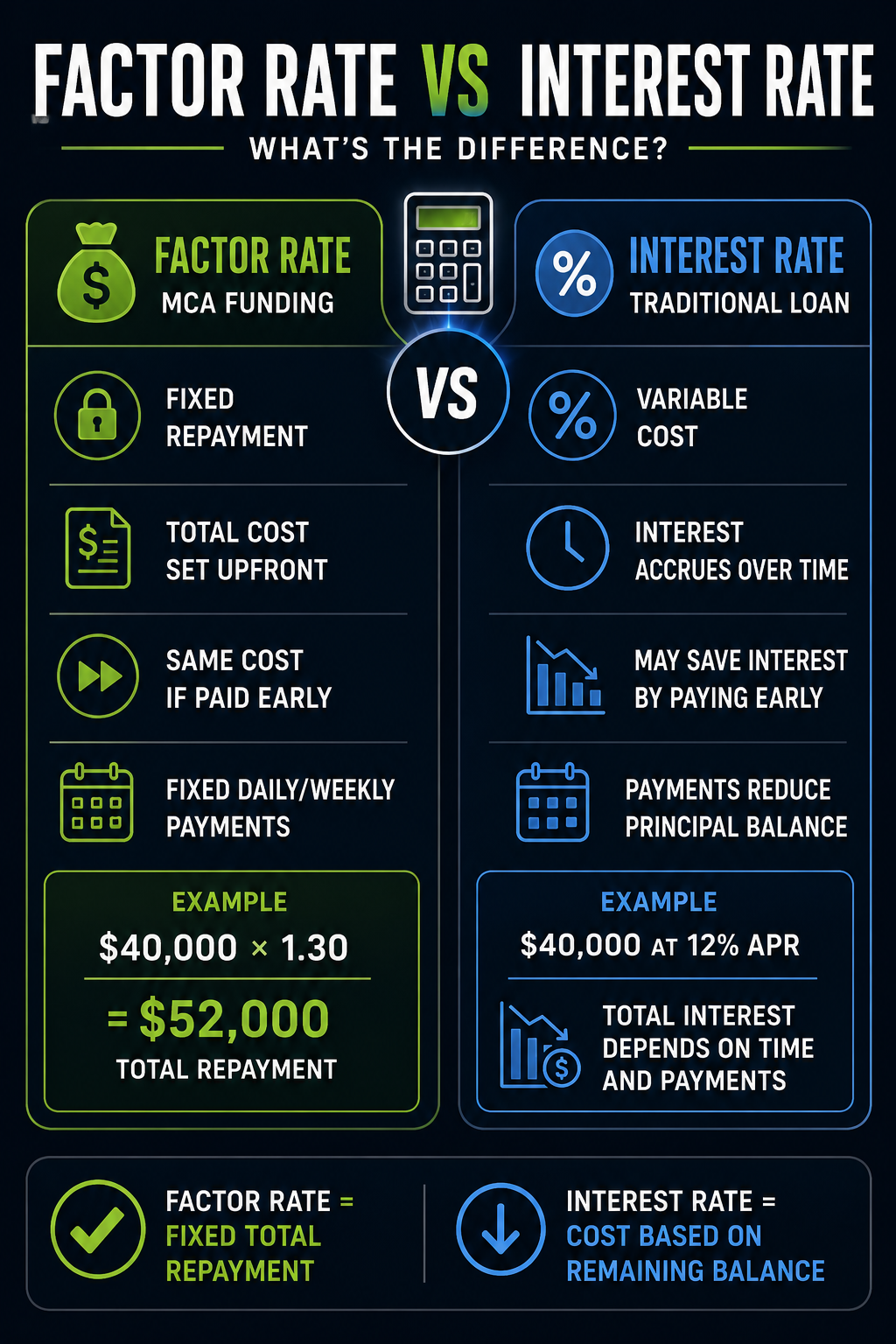
One of the most common misconceptions about Merchant Cash Advances is that a factor rate works the same way as an interest rate. In reality, they are calculated very differently.
A traditional loan uses an interest rate, often expressed as an Annual Percentage Rate (APR). Interest is charged on the remaining loan balance, which means the amount of interest paid may decrease over time as the balance is reduced.
A Merchant Cash Advance uses a factor rate instead. The factor rate is applied to the funding amount upfront to determine the total repayment obligation. Regardless of how quickly the advance is repaid, the total amount owed generally remains the same.
Because factor rates are expressed as numbers such as 1.20 or 1.40 rather than percentages, they can appear lower than they actually are. For this reason, business owners should focus on the total repayment amount and overall cost of funding rather than comparing a factor rate to an interest rate.
How a Factor Rate Impacts the Total Cost of an MCA
The factor rate directly impacts how much your Merchant Cash Advance will ultimately cost. Because the factor rate is multiplied by the funding amount upfront, even a small increase can add thousands of dollars to the total repayment obligation.
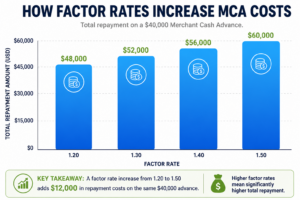
For example, a business that receives $40,000 in funding will repay significantly different amounts depending on the factor rate offered.
| Funding Amount | Factor Rate | Total Repayment |
|---|---|---|
| $40,000 | 1.20 | $48,000 |
| $40,000 | 1.30 | $52,000 |
| $40,000 | 1.40 | $56,000 |
| $40,000 | 1.50 | $60,000 |
📈 Notice: A factor rate increase from 1.20 to 1.50 raises the total repayment cost by $12,000 on the same funding amount.
Because Merchant Cash Advances are often repaid through daily or weekly withdrawals, business owners may focus on the payment amount rather than the total repayment obligation. However, understanding the full cost of the advance is essential when comparing offers and evaluating whether the funding is affordable for your business.
Before accepting an MCA, always calculate the total repayment amount and consider how the payments will affect your cash flow over time.
Merchant Cash Advance Factor Rate Examples
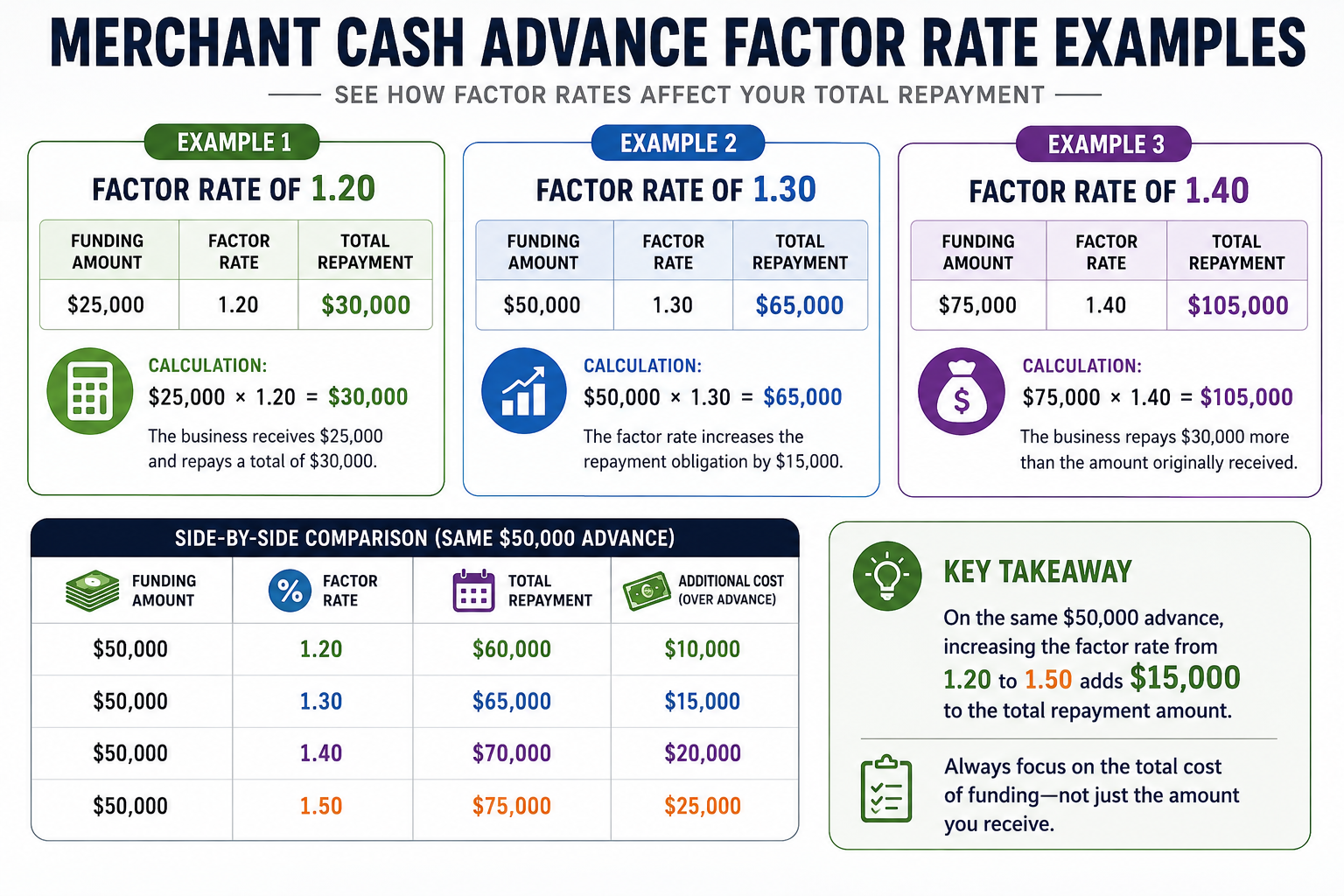
Understanding a Merchant Cash Advance factor rate becomes much easier when you look at real-world examples. The infographic below shows how different factor rates affect the total repayment amount on an MCA.
As you review the examples, notice that even a small increase in the factor rate can significantly raise the total cost of funding. While factor rates such as 1.20, 1.30, or 1.40 may appear similar, the difference in repayment costs can add up quickly.
The most important lesson is to focus on the total repayment amount, not just the amount being advanced. Comparing the true cost of funding can help business owners make more informed decisions and avoid unexpectedly expensive financing.
Key Takeaway: Before accepting a Merchant Cash Advance, calculate exactly how much you will repay and consider how those payments will impact your cash flow over time.
Why Merchant Cash Advances Can Be More Expensive Than Traditional Loans
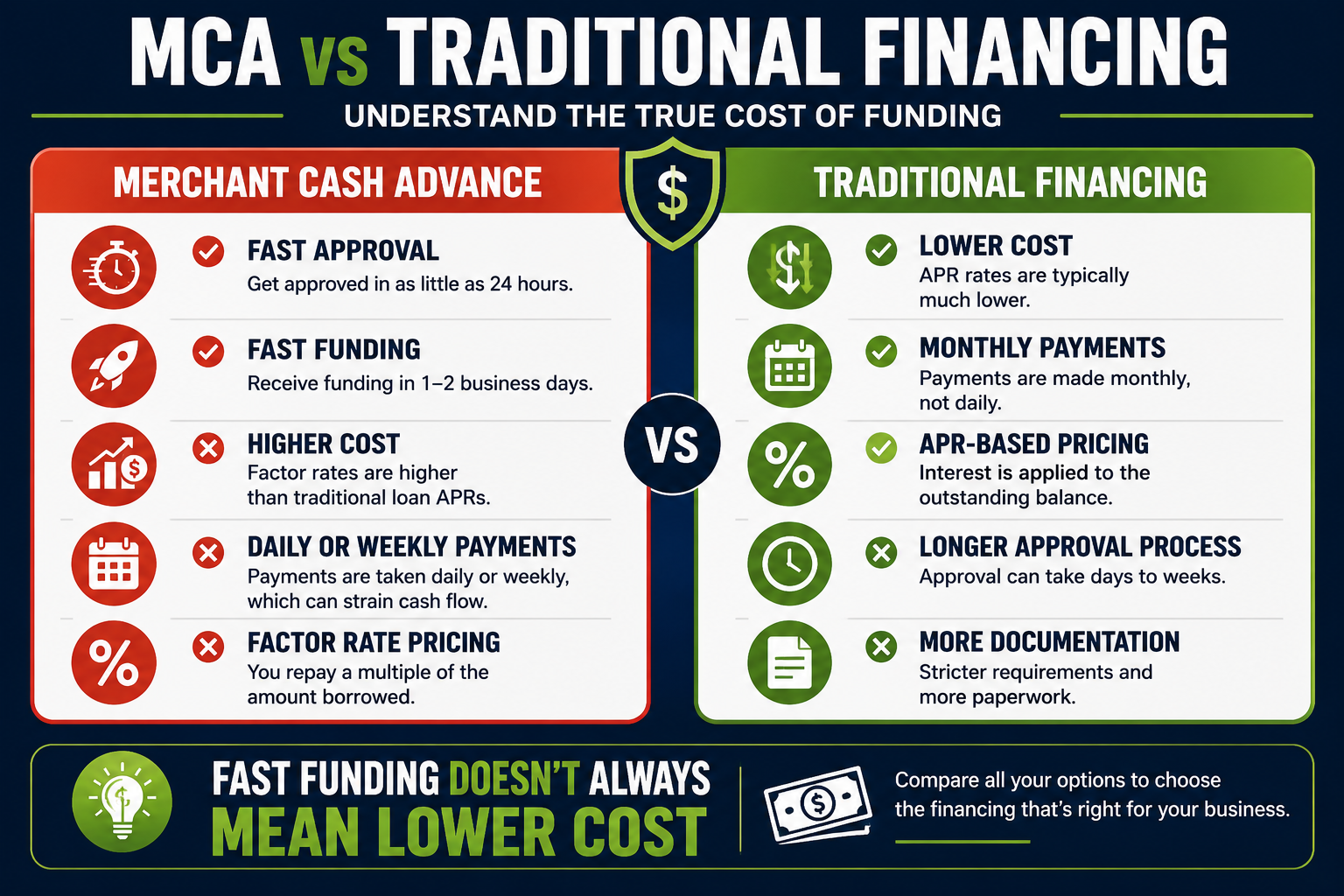
Merchant Cash Advances are often easier and faster to obtain than traditional financing. However, that convenience can come at a significantly higher cost.
Traditional business loans, SBA loans, and business lines of credit typically use interest rates that are expressed as an Annual Percentage Rate (APR). As the balance is repaid, the amount of interest charged may decrease over time. Merchant Cash Advances work differently. Instead of charging interest, MCA providers use factor rates that determine the total repayment amount upfront.
In addition to higher financing costs, Merchant Cash Advances often require daily or weekly payments. While these frequent withdrawals may seem manageable at first, they can place substantial pressure on a business’s cash flow. Traditional loans and lines of credit typically offer monthly payments, giving business owners flexibility to manage operating expenses.
The table below highlights some of the key differences:
| Financing Type | Typical Cost Structure | Payment Frequency | Funding Speed |
|---|---|---|---|
| Merchant Cash Advance | Factor Rate | Daily or Weekly | Fast |
| Bank Loan | Interest Rate (APR) | Monthly | Slower |
| SBA Loan | Interest Rate (APR) | Monthly | Slower |
| Business Line of Credit | Interest on Amount Used | Monthly | Moderate |
While Merchant Cash Advances can provide quick access to capital, business owners should carefully compare the total repayment cost against other financing options whenever possible. Understanding the true cost of funding can help you choose the solution that best supports your long-term financial health.
Key Takeaway: Fast funding may solve an immediate cash flow challenge, but it is important to evaluate the total cost of repayment before committing to any financing agreement.
Can a Lower Factor Rate Save Your Business Money?
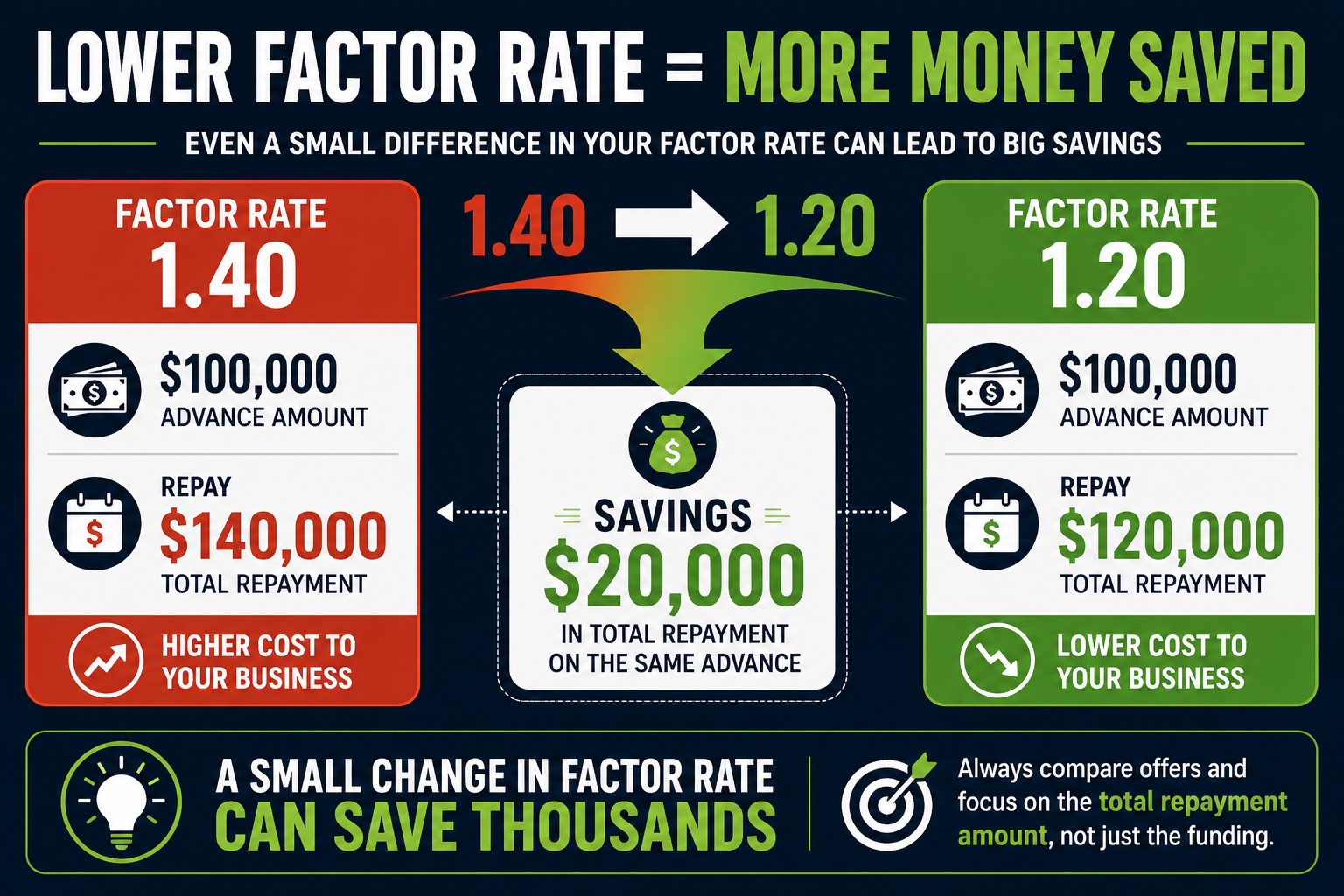
The short answer is yes. Even a small reduction in a Merchant Cash Advance factor rate can result in substantial savings over the life of the agreement.
Many business owners focus on the funding amount or the speed of approval, but the factor rate often has the greatest impact on the total repayment obligation. Because the factor rate is applied to the entire advance amount upfront, a difference of just 0.10 or 0.20 can add thousands of dollars to the overall cost of funding.
Consider a $100,000 Merchant Cash Advance:
| Factor Rate | Total Repayment |
|---|---|
| 1.20 | $120,000 |
| 1.30 | $130,000 |
| 1.40 | $140,000 |
In this example, choosing a factor rate of 1.20 instead of 1.40 saves $20,000 in repayment costs on the same funding amount.
While a lower factor rate is generally preferable, business owners should also consider repayment terms, payment frequency, and the overall impact on cash flow. Comparing multiple offers can help ensure you are receiving the most affordable financing available.
Key Takeaway: Small differences in factor rates can create large differences in total repayment costs. Always calculate the total amount owed before accepting a Merchant Cash Advance offer.
Hidden Costs Beyond the Factor Rate
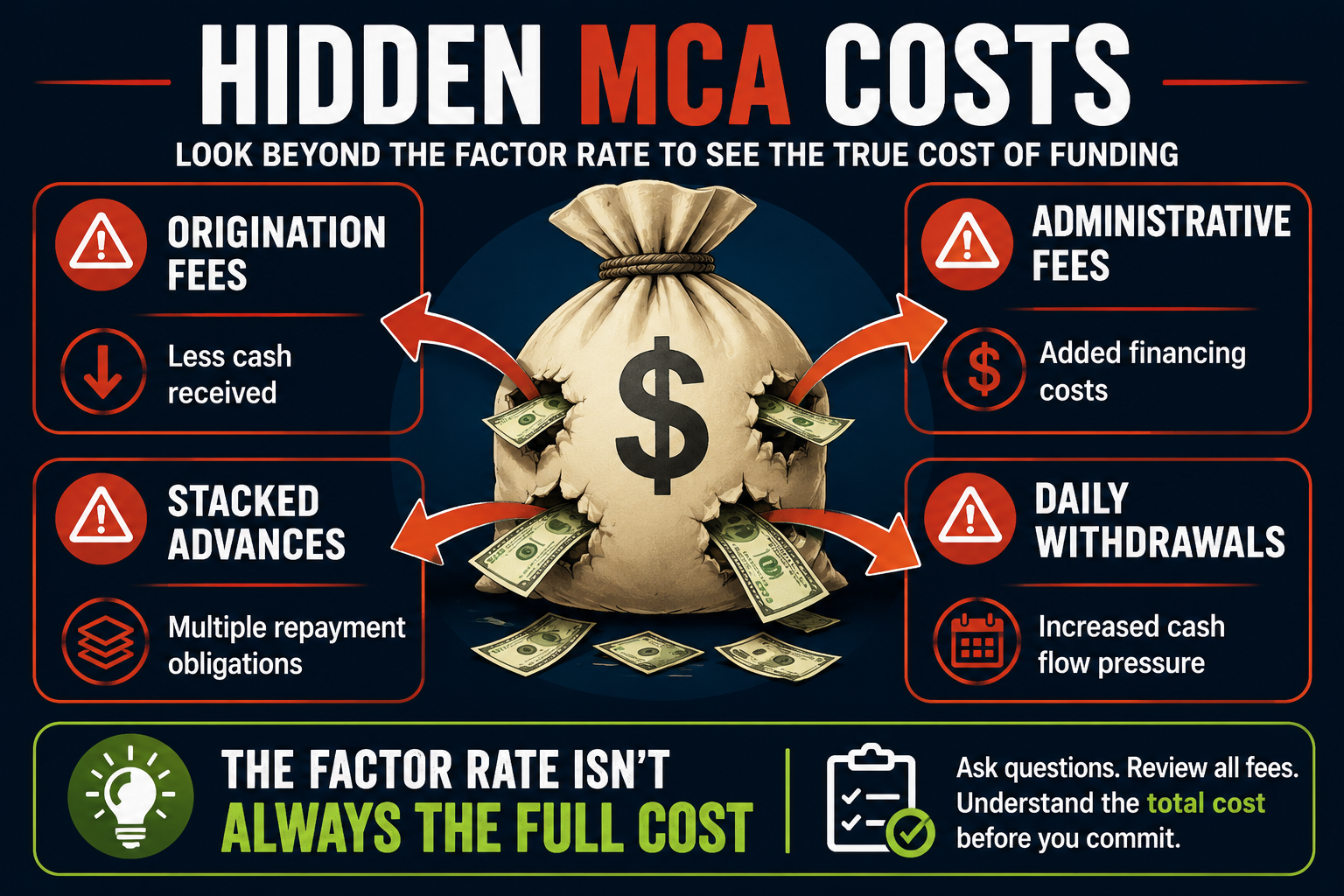
While the factor rate plays a major role in determining the cost of a Merchant Cash Advance, it is not always the only expense business owners should consider. Additional fees and financing practices can increase the total cost of funding and place even more pressure on cash flow.
Some MCA providers charge origination, underwriting, administrative, or other fees that are deducted from the funding amount before the business receives the funds. As a result, a business may receive less cash than expected while still being responsible for repaying the full advance amount.
Another common issue is stacking, which occurs when a business takes out a new Merchant Cash Advance before paying off an existing one. While this may provide temporary relief, multiple daily or weekly withdrawals can quickly become difficult to manage and significantly increase overall repayment obligations.
Business owners should also pay close attention to payment frequency. Daily withdrawals may seem manageable when sales are strong, but they can become problematic during slow periods, seasonal downturns, or unexpected revenue disruptions.
Before signing any Merchant Cash Advance agreement, carefully review all fees, repayment terms, and funding conditions. Understanding the complete cost of financing can help you avoid surprises and make more informed decisions for your business.
Key Takeaway: The factor rate is important, but it does not always tell the whole story. Fees, stacked advances, and aggressive repayment schedules can significantly increase the true cost of MCA funding.
Warning Signs Your MCA Payments Are Becoming Unaffordable
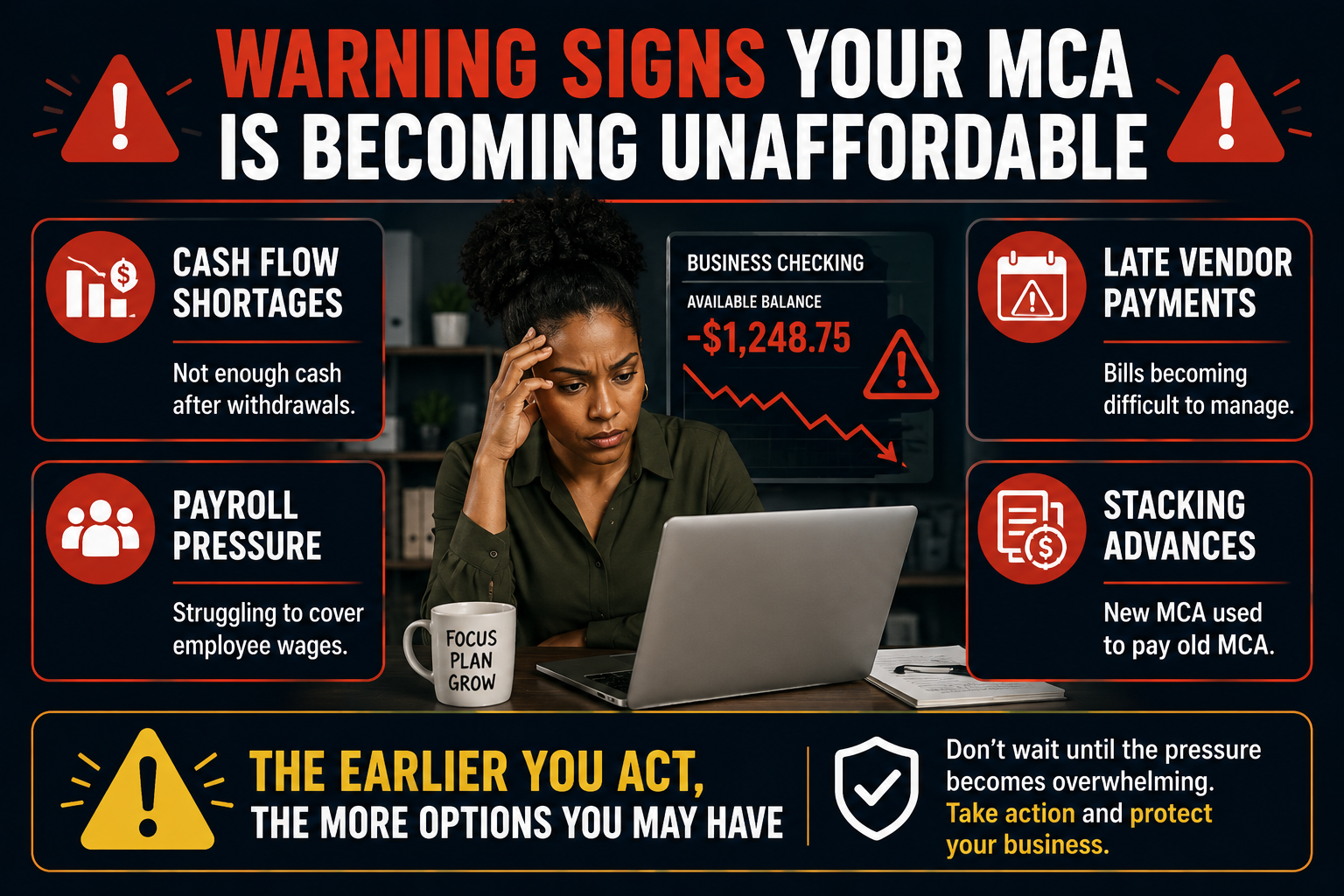
Merchant Cash Advances can become problematic when repayment obligations begin consuming too much of your available cash flow. Recognizing the warning signs early may help you take action before financial pressure escalates.
One of the most common signs is struggling to cover everyday operating expenses after MCA payments are withdrawn. If payroll, rent, inventory purchases, vendor payments, or other essential costs are becoming difficult to manage, your funding may be placing too much strain on your business.
Another warning sign is relying on additional financing to stay current on existing obligations. Taking out new advances to cover previous MCA payments, often called stacking, can create a cycle of debt that becomes increasingly difficult to escape.
You may also notice that your business account balance remains consistently low, cash reserves are shrinking, or unexpected expenses create immediate financial stress. These issues often indicate that repayment obligations are limiting your financial flexibility.
Common warning signs include:
- Difficulty covering payroll or operating expenses
- Frequent cash flow shortages
- Late vendor or supplier payments
- Declining cash reserves
- Taking out additional advances to cover existing debt
- Constant concern about upcoming withdrawals
- Delaying important business investments due to cash constraints
Key Takeaway: If your MCA payments are affecting daily operations or forcing difficult financial decisions, it may be time to explore mca restructuring, consolidation, or other relief options before the situation becomes more severe.
What Options Are Available If Your MCA Factor Rate Is Too Expensive?
If your Merchant Cash Advance payments have become difficult to manage, you may still have options. The earlier you address the problem, the more flexibility you may have to reduce financial pressure and regain control of your cash flow.
One potential solution is MCA restructuring. Restructuring may involve modifying repayment terms, reducing payment frequency, or creating a more manageable repayment schedule. For businesses experiencing temporary cash flow challenges, restructuring can provide immediate relief without requiring additional funding.
Another option is Merchant Cash Advance consolidation. Consolidation combines multiple MCA obligations into a single payment, which can simplify repayment and reduce the strain caused by multiple daily or weekly withdrawals. This approach is often considered by businesses dealing with stacked advances.
In some situations, Merchant Cash Advance settlement may be appropriate. Settlement typically involves negotiating a reduced payoff amount to resolve the obligation for less than the full balance owed. While not every business qualifies for settlement, it can be an effective option when repayment has become unsustainable.
Businesses may also benefit from broader MCA relief programs, which are designed to help improve cash flow and create a realistic path toward financial stability. These solutions often focus on reducing payment pressure while helping business owners avoid further financial deterioration.
The best solution depends on your business’s financial situation, cash flow, outstanding obligations, and long-term goals. Evaluating your options early can often lead to better outcomes and more available choices.
Key Takeaway: If your MCA factor rate and repayment obligations are putting excessive pressure on your business, restructuring, consolidation, settlement, or other relief solutions may help create a more sustainable path forward.
Understanding Your MCA Costs Can Help You Make Better Financial Decisions
A Merchant Cash Advance can provide fast access to capital, but understanding the true cost of funding is essential before signing an agreement. Factor rates, fees, repayment schedules, and other financing terms can significantly impact your cash flow and long-term financial health.
If your MCA payments have become difficult to manage, don’t wait until the situation becomes overwhelming. Exploring your options early may help you reduce financial pressure, improve cash flow, and regain control of your business finances.
Need help evaluating your MCA situation? Contact MCA Shield today to discuss your options and learn whether restructuring, consolidation, settlement, or other relief solutions may be available for your business.