
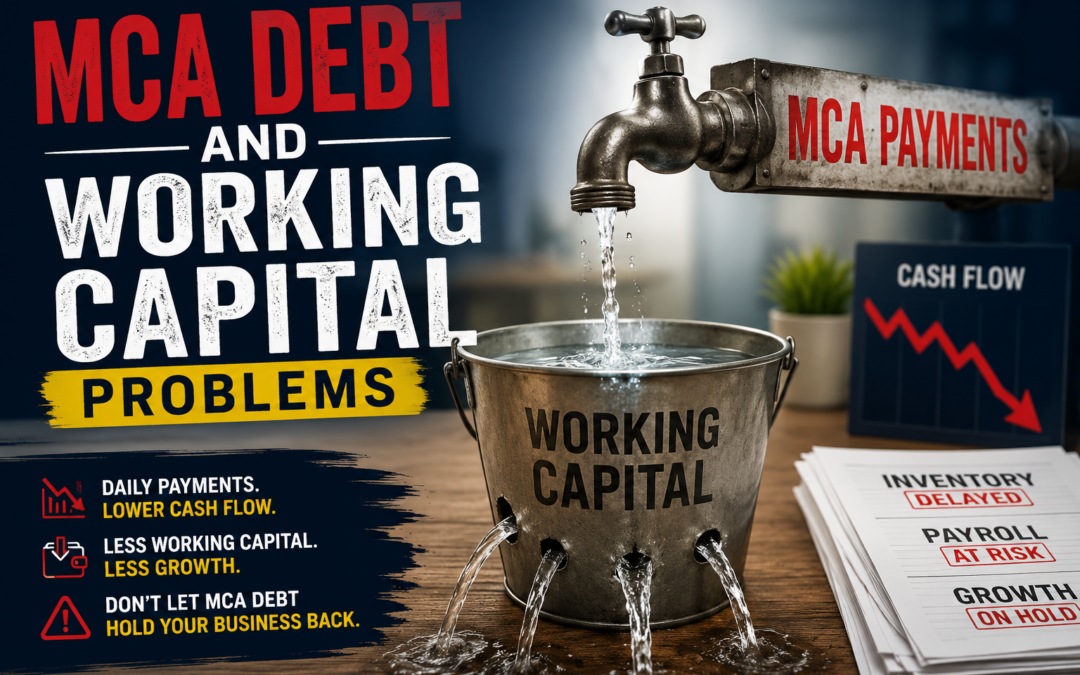
MCA debt and working capital problems often go hand in hand. While merchant cash advances can provide fast access to funding, their daily repayment structure can steadily reduce available cash, making it harder to cover payroll, pay vendors, purchase inventory, and invest in growth. Understanding how MCA debt affects working capital is the first step toward protecting your cash flow and restoring your business’s financial stability.
Schedule Your Free Consultation
What Is Working Capital and Why Does It Matter?
Working capital is one of the most important indicators of a business’s financial health. It represents the money available to cover day-to-day operating expenses after accounting for short-term obligations. When working capital is strong, a business can pay its bills, respond to unexpected expenses, and invest in opportunities with confidence.
When MCA Debt and Working Capital problems begin affecting the same business, even profitable companies can struggle to maintain enough cash to operate efficiently. Understanding how working capital works makes it easier to recognize why daily MCA payments can create financial pressure.
What Working Capital Means for a Business
Working capital is generally calculated by subtracting current liabilities from current assets. In simpler terms, it is the cash and other short-term resources available after covering immediate financial obligations.
Healthy working capital gives business owners the flexibility to:
- Pay employees on time
- Purchase inventory when needed
- Pay vendors and suppliers
- Cover rent, utilities, and operating expenses
- Handle unexpected repairs or emergencies
- Invest in business growth opportunities
Without enough working capital, even businesses with strong sales can experience cash shortages that make everyday operations more difficult.
Think of working capital as your business’s financial fuel tank. Revenue fills the tank, but expenses drain it. If cash leaves the business faster than it comes in, the tank eventually runs low.
Why Healthy Cash Flow Depends on Working Capital
Cash flow and working capital are closely connected, but they are not the same.
Cash flow measures how money moves into and out of your business. Working capital reflects how much of that money remains available after short-term obligations are paid.
A business may generate significant monthly revenue but still experience working capital problems if large amounts of cash are allocated to daily debt payments, payroll, vendor invoices, or other immediate expenses.
This is one reason many businesses carrying merchant cash advances experience financial stress. Daily ACH withdrawals reduce available cash before owners can use it for essential operating costs, leaving less flexibility throughout the month.
As working capital declines, business owners are forced to make difficult decisions about which bills to pay first at the expense of focusing on serving customers and growing the business.
How Businesses Use Working Capital Every Day
Working capital supports nearly every aspect of daily business operations. It provides the financial flexibility needed to keep the business moving forward without constant cash shortages.
Businesses rely on working capital to:
- 💼 Meet payroll obligations
- 📦 Purchase inventory and supplies
- 🚚 Pay vendors and service providers
- 📣 Fund marketing and advertising
- 🔧 Maintain equipment and facilities
- 💻 Invest in technology and software
- 📈 Take advantage of growth opportunities
- 🛡️ Build reserves for unexpected expenses
When working capital begins to shrink, these routine activities become increasingly difficult. Business owners may delay purchases, postpone hiring, reduce marketing budgets, or rely on additional financing to cover normal operating expenses.
Over time, these challenges can limit growth and create a cycle of financial pressure that becomes harder to escape. Recognizing the importance of working capital is the first step toward understanding why managing MCA debt and working capital effectively is critical for long-term business success.
How MCA Debt Creates Working Capital Problems

Merchant cash advances are designed to provide businesses with quick access to funding, but their repayment structure can significantly affect working capital. Unlike traditional loans with monthly payments, most MCAs are repaid through automatic daily or weekly ACH withdrawals. While each withdrawal may seem manageable on its own, the cumulative effect can steadily reduce the cash available to operate your business.
Understanding the relationship between MCA Debt and Working Capital helps explain why many businesses experience financial pressure even when sales remain steady or continue to grow.
Daily Withdrawals Reduce Available Cash
Every automatic MCA payment reduces the amount of cash available to cover daily operating expenses. Because these withdrawals occur so frequently, business owners have less flexibility to decide how and when to use their revenue.
As available cash declines, routine expenses become more difficult to manage, including:
- Payroll
- Vendor and supplier payments
- Inventory purchases
- Rent and utilities
- Equipment maintenance
- Marketing and advertising
Unlike a monthly payment that allows businesses to plan around one due date, daily withdrawals continuously reduce working capital, making it harder to maintain a healthy cash flow throughout the month.
The more frequently cash leaves your account, the less flexibility you have to respond to everyday business needs.
Revenue Can Grow While Working Capital Shrinks
One of the most frustrating aspects of MCA debt is that increasing revenue does not always solve the problem.
A business may be winning new customers, generating more sales, and reporting higher revenue than ever before. However, if a significant portion of that income is immediately withdrawn to satisfy MCA payments, working capital can continue to decline.
This creates a misleading financial picture. On paper, the business appears to be growing. In reality, the cash available to purchase inventory, hire employees, expand operations, or build emergency reserves continues to shrink.
When MCA Debt and Working Capital become increasingly disconnected, business owners may feel as though they are working harder every month without improving their financial position.
Multiple MCAs Increase Financial Pressure
The pressure becomes even greater when a business carries more than one merchant cash advance.
Each additional MCA introduces another series of automatic withdrawals, further reducing available working capital. What may have started as a short-term funding solution can quickly evolve into a cycle where daily payments consume a substantial portion of incoming revenue.
Businesses with multiple MCAs commonly experience:
- Increased cash flow volatility
- Difficulty paying vendors on time
- Delayed payroll or tax payments
- Reduced ability to invest in growth
- Greater dependence on additional financing
As financial pressure builds, many owners consider taking another advance to keep up with existing payments. Unfortunately, this can deepen the working capital shortage and make long-term recovery even more difficult.
Recognizing how MCA Debt and Working Capital influence one another is an important step toward restoring cash flow, improving financial flexibility, and creating a stronger foundation for future growth.
Warning Signs Your Working Capital Is Running Out
Working capital problems rarely appear overnight. In most cases, the warning signs develop gradually as cash becomes tighter and business owners find themselves making increasingly difficult financial decisions.
If several of the following situations sound familiar, MCA Debt and Working Capital issues may be placing your business under more pressure than you realize.
Struggling to Pay Vendors on Time
One of the earliest warning signs of declining working capital is difficulty paying vendors and suppliers according to agreed-upon terms.
As daily MCA withdrawals reduce available cash, businesses may start delaying payments, making partial payments, or asking vendors for additional time. While this may provide temporary relief, repeated delays can strain valuable business relationships and make it harder to negotiate favorable pricing or payment terms in the future.
Warning signs include:
- Past-due vendor invoices are becoming more common
- Suppliers requesting payment before shipping products
- Losing early payment discounts
- Receiving collection notices from vendors
- Damaging long-term supplier relationships
When vendor payments become a constant concern, working capital may no longer be sufficient to support normal business operations.
Delaying Payroll or Other Essential Expenses
Payroll is one of the last expenses most business owners want to postpone. Unfortunately, shrinking working capital can force difficult choices when cash is limited.
Some businesses begin delaying payroll, postponing tax payments, reducing inventory purchases, or putting off equipment repairs to keep enough money in the bank for daily MCA withdrawals.
These decisions may solve today’s cash shortage, but they can create even larger operational and financial challenges over time.
Common examples include:
- Delaying payroll processing
- Paying payroll taxes late
- Postponing inventory purchases
- Deferring equipment maintenance
- Cutting marketing and advertising budgets
When essential expenses repeatedly take a back seat to debt payments, it is a strong indication that working capital is under significant pressure.
Constantly Monitoring Your Bank Balance
Healthy businesses typically review their financial position regularly. Businesses experiencing working capital problems, however, often monitor their bank account several times each day to ensure enough cash is available for automatic withdrawals.
If your daily routine revolves around checking balances before ACH payments are processed, your business may be operating with little financial cushion.
Many owners find themselves:
- Checking their bank account multiple times each day
- Timing deposits around MCA withdrawals
- Delaying outgoing payments until additional revenue arrives
- Worrying about unexpected expenses or overdrafts
When managing your bank balance becomes a daily priority, it may be time to address the underlying cash flow problem rather than simply reacting to it.
Running a business should be about serving customers and creating growth—not constantly calculating whether today’s withdrawals will clear.
Using New Funding to Cover Existing Payments
Perhaps the clearest warning sign of working capital trouble is relying on new financing to cover existing MCA payments.
While another merchant cash advance may provide temporary breathing room, it often increases the number of daily withdrawals and places even greater pressure on future cash flow.
Businesses caught in this cycle may notice they are:
- Taking new advances to pay existing advances
- Renewing MCAs before the current balance is repaid
- Accumulating multiple daily ACH withdrawals
- Borrowing simply to cover routine operating expenses
Over time, this pattern can reduce financial flexibility, weaken working capital, and make recovery more difficult.
Recognizing these warning signs early gives business owners more opportunities to restore MCA Debt and Working Capital before financial pressure escalates into a larger threat to the business.
How Working Capital Problems Affect Business Growth
Why Taking Another MCA Usually Makes the Problem Worse
When working capital becomes tight, accepting another merchant cash advance can seem like the quickest solution. The immediate funding may help cover payroll, pay vendors, or bring overdue accounts current. Unfortunately, that short-term relief often creates even greater financial pressure over time.
Rather than restoring cash flow, an additional MCA frequently increases daily repayment obligations, reduces financial flexibility, and makes it more difficult to rebuild healthy working capital.
Temporary Relief Can Lead to More Debt
Many businesses use a new MCA to pay off an existing advance or cover operating expenses while waiting for revenue to improve. While this strategy may solve today’s cash shortage, it rarely addresses the underlying cash flow problem.
Instead, businesses often find themselves:
- Replacing one debt with another
- Paying additional fees and financing costs
- Extending the amount of time they remain in debt
- Reducing the cash available for daily operations
Without improving MCA Debt and Working Capital, new financing may simply postpone financial challenges rather than resolve them.
Higher Daily Payments Reduce Flexibility
Every new merchant cash advance adds another repayment obligation. Whether the new funding replaces an existing advance or is added alongside one or more MCAs, the result is often less cash available each day.
Higher daily withdrawals can make it increasingly difficult to:
- Cover payroll and operating expenses
- Purchase inventory when needed
- Pay vendors on time
- Build emergency cash reserves
- Invest in marketing or business growth
As repayment obligations grow, business owners lose the flexibility needed to respond to changing business conditions or unexpected expenses.
More funding does not always create more financial freedom. In many cases, it simply creates more daily payment pressure.
The Cycle of MCA Renewals
One of the biggest risks of merchant cash advances is the renewal cycle.
As working capital continues to decline, business owners may be offered another advance before the current one is fully repaid. While accepting the renewal may provide immediate cash, it can also restart the repayment cycle and keep daily withdrawals in place for even longer.
Over time, this pattern can lead to:
- Repeated MCA renewals
- Multiple daily ACH withdrawals
- Increasing financing costs
- Greater dependence on short-term funding
- Reduced working capital and cash flow
Breaking this cycle usually requires more than another advance. It often requires a strategy that eases financial pressure, preserves working capital, and builds a stronger foundation for sustainable growth.
Recognizing when MCA Debt and Working Capital are driving the need for repeated renewals is an important step toward finding a sustainable solution and positioning your business for future growth.
Options for Improving Working Capital While Managing MCA Debt
Working capital problems do not have to define the future of your business. While every financial situation is different, there are practical steps business owners can take to reduce cash flow pressure and regain greater financial flexibility.
The sooner MCA Debt and Working Capital challenges are addressed, the more options are typically available to strengthen cash flow and build long-term business stability.
Reviewing Existing MCA Agreements
The first step is understanding exactly where your cash is going.
Many business owners have multiple merchant cash advances with different repayment terms, funding companies, and daily withdrawal amounts. Carefully reviewing each agreement can help identify opportunities to improve cash flow and eliminate unnecessary financial strain.
A thorough review may include:
- Current daily or weekly payment obligations
- Outstanding balances
- Repayment terms and conditions
- Total financing costs
- The combined impact of multiple MCAs on working capital
A clear financial picture makes it easier to evaluate potential solutions and prioritize the most effective next steps.
Negotiating More Manageable Payment Structures
In some situations, it may be possible to negotiate repayment arrangements that better align with a business’s current financial circumstances.
More manageable payment structures can help:
- Improve day-to-day cash flow
- Increase available working capital
- Reduce financial strain
- Create greater flexibility for operating expenses
Every situation is unique, but exploring available options may help businesses regain more control over their finances while continuing to focus on daily operations.
Reducing Financial Pressure Through Debt Resolution
For businesses facing significant MCA debt, debt resolution may provide a path toward improving working capital and reducing ongoing financial pressure.
Depending on the circumstances, a customized debt resolution strategy may help:
- Lower the overall financial burden
- Reduce payment pressure
- Improve cash flow management
- Create a more sustainable financial outlook
The goal is not simply to address today’s financial challenges but to help establish healthier financial conditions that support long-term business success.
Creating a Long-Term Cash Flow Strategy
Improving working capital requires more than solving immediate cash flow challenges. It also involves building a financial strategy that lays the foundation for long-term stability and sustainable growth.
An effective long-term cash flow strategy may include:
- Strengthening working capital reserves
- Improving cash flow forecasting
- Prioritizing essential operating expenses
- Reducing reliance on short-term financing
- Planning for future growth opportunities
When businesses focus on strengthening both MCA Debt and Working Capital, they are better positioned to navigate unexpected expenses, invest in growth, and make financial decisions with greater confidence.
Taking action early can expand the number of available solutions and help create a stronger financial foundation for the future.
How MCA Shield Helps Businesses Restore Working Capital
Frequently Asked Questions About MCA Debt and Working Capital Problems
Have questions about MCA Debt and Working Capital? You’re not alone. Below are answers to some of the questions business owners ask most often when daily MCA payments begin disrupting cash flow and business operations.
💼 What Is Working Capital?
Working capital is the money your business has available to cover everyday operating expenses after accounting for short-term financial obligations. Healthy working capital helps you pay employees, purchase inventory, cover vendor invoices, and respond to unexpected expenses without disrupting your operations.
💸 Can MCA Debt Cause Working Capital Problems?
Yes. Merchant cash advances are commonly repaid through automatic daily or weekly withdrawals. Those frequent payments reduce the amount of cash available for normal business expenses, which can gradually strain working capital and make it more difficult to manage day-to-day operations.
📈 How Can I Improve Working Capital Without Taking Another MCA?
Many businesses improve working capital by reviewing existing MCA agreements, reducing unnecessary expenses, strengthening cash flow management, negotiating more manageable repayment arrangements when appropriate, and exploring debt resolution options. Taking on additional financing may provide temporary relief, but it does not always address the underlying cash flow challenges.
🤝 Can MCA Payments Be Reduced?
Depending on your financial situation, there may be options that help reduce payment pressure or improve repayment terms. Every business is different, so it is important to have your MCA agreements reviewed before deciding on the most appropriate course of action.
⏳ How Long Does It Take to Improve Working Capital?
The timeline varies based on factors such as the number of merchant cash advances, the overall financial condition of the business, and the strategy used to address the debt. Many businesses begin experiencing meaningful improvements as financial pressure eases and more cash becomes available to support daily operations.
🚦 Should I Wait Before Asking for Help?
Generally, no. The sooner you address MCA Debt and Working Capital challenges, the more financial options may be available. Taking action early can help preserve cash flow, improve financial flexibility, and reduce the risk of additional debt or ongoing cash shortages.
💡 The earlier you address working capital problems, the more opportunities you have to strengthen cash flow and position your business for long-term success.
Restore Your Working Capital Before Financial Pressure Gets Worse
Working capital is the financial foundation that keeps your business moving forward. When daily MCA payments begin draining the cash needed for payroll, vendors, inventory, and operating expenses, business owners often find themselves focused on surviving each day rather than growing their business.
The good news is that financial pressure does not have to define your business’s future. Addressing MCA Debt and Working Capital challenges early can help improve cash flow, strengthen financial flexibility, and position your business for long-term success.
Why Acting Early Creates More Financial Options
Waiting rarely makes working capital problems easier to solve. As daily withdrawals continue, available cash can become tighter, limiting the number of solutions available.
Taking action early may help your business:
- Improve cash flow and working capital
- Reduce financial pressure
- Explore debt resolution options
- Avoid additional MCA renewals
- Strengthen long-term financial stability
The earlier you begin addressing the problem, the greater your opportunity to regain control of your finances and focus on growing your business.
Schedule a Free Consultation With MCA Shield
If MCA Debt and Working Capital problems are making it difficult to manage your business, you do not have to face those challenges alone.
The team at MCA Shield works with business owners to review their current financial situation, evaluate available options, and develop customized strategies that help relieve financial pressure and build a stronger financial foundation.
Schedule your free, confidential consultation today and take the first step toward improving cash flow, restoring working capital, and creating a healthier financial future for your business.