
Schedule Your Free Consultation
Understanding merchant cash advance repayment is one of the most important steps before accepting funding. While an MCA can provide quick access to cash, MCA companies calculate repayment very differently from traditional lenders. Knowing how factor rates, repayment amounts, and daily or weekly withdrawals work can help you make informed financial decisions and avoid unexpected cash flow challenges.
What Is Merchant Cash Advance Repayment?
Merchant cash advance repayment differs from repaying a traditional business loan. Instead of borrowing money and repaying it with interest over time, you sell a portion of your future receivables to an MCA company in exchange for immediate funding. When you accept the agreement, the MCA company calculates your total repayment and collects it through daily or weekly payments until you satisfy the obligation.
Understanding how merchant cash advance repayment works can help you evaluate the true cost of funding and avoid repayment structures that can strain your cash flow and limit your business’s financial flexibility.
Merchant Cash Advance Repayment Is Based on Future Receivables
Unlike a bank loan, a merchant cash advance is typically structured as the purchase of a portion of your future receivables. The MCA company provides funding upfront and, in return, purchases the right to collect an agreed-upon amount from your future business revenue.
Most businesses repay their MCA through automatic daily or weekly ACH withdrawals from your business bank account, although some agreements use a percentage of credit card sales or other receivables.
The agreement explains the payment structure before the MCA company provides funding.
Why the Repayment Amount Is Higher Than the Funding You Receive
Many business owners are surprised to learn that the total repayment amount surpasses the amount deposited into their bank account. That’s because merchant cash advance repayment is typically calculated using a factor rate rather than a traditional interest rate.
For example, if a business receives a $50,000 merchant cash advance with a factor rate of 1.35, its total repayment would equal $67,500. The agreement sets this amount before funding is released.
Understanding the total repayment amount before accepting funding can help you determine whether the payments fit comfortably within your business’s cash flow.
How Merchant Cash Advance Repayment Differs From Traditional Business Loans
Traditional business loans typically charge interest over time and often allow borrowers to reduce the total cost by paying the loan off early. Merchant cash advance repayment works differently. The total amount to be repaid is generally established when the agreement is signed and is based on the purchased receivables rather than an interest rate.
Merchant cash advances typically require more frequent payments than many traditional loans. Daily or weekly withdrawals reduce available working capital and make it harder to cover payroll, inventory, rent, and other operating expenses.
Before accepting any funding, take time to understand exactly how merchant cash advance repayment works, including the total repayment amount, payment schedule, and the impact those withdrawals could have on your business’s day-to-day cash flow.
How Merchant Cash Advance Repayment Is Calculated
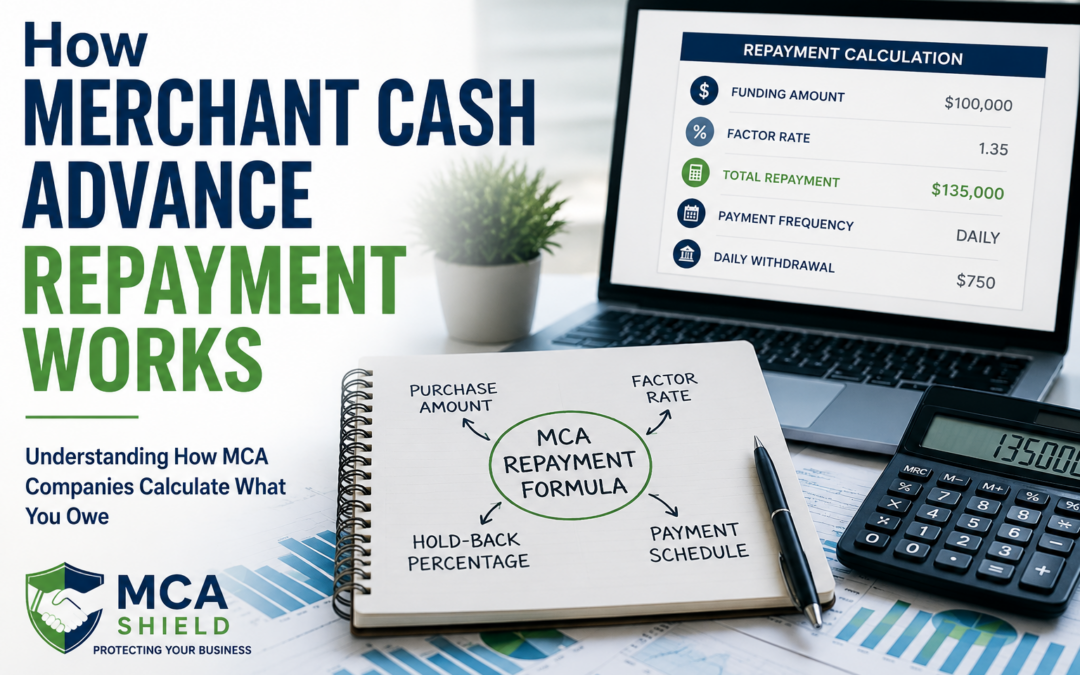
Understanding how merchant cash advance repayment is calculated can help you make more informed financing decisions. While the process may seem complicated at first, it generally comes down to four key components: the purchase amount, the factor rate, the holdback percentage, and the repayment schedule. Together, these determine how much you’ll repay and how those payments will affect your cash flow.
The Purchase Amount vs. the Amount You Receive
A common misunderstanding is that the cash deposited into your business account is the same as the total you’ll repay. In reality, they are two different numbers.
The amount you receive is the cash deposited into your business account. The purchase amount represents the total value of the future receivables that the MCA company purchases. Because the purchase amount includes the factor rate, it is always higher than the amount you receive.
For example:
- Funding received: $50,000
- Factor rate: 1.35
- Total repayment (purchase amount): $67,500
Knowing both numbers before signing an agreement gives you a clearer picture of the true cost of the funding.
How the Factor Rate Determines Total Repayment
Instead of charging an interest rate like a traditional loan, most merchant cash advances use a factor rate to determine the total repayment amount.
The MCA company multiplies the funding amount to calculate how much must be repaid over the life of the agreement.
Here are a few simple examples:
| Funding Received | Factor Rate | Total Repayment |
|---|---|---|
| $25,000 | 1.25 | $31,250 |
| $50,000 | 1.35 | $67,500 |
| $100,000 | 1.45 | $145,000 |
Unlike traditional loan interest, the factor rate generally does not decrease over time. In many MCA agreements, the contract sets the total repayment when you sign the agreement.
How Holdback Percentages Affect Payments
Some merchant cash advances use a holdback percentage instead of a fixed payment amount.
A holdback represents the percentage of your daily credit card sales or business receivables that is collected until the purchase amount is repaid.
For example, if your agreement includes a 15% holdback and your business processes $10,000 in eligible sales, approximately $1,500 would be applied toward your merchant cash advance repayment.
The exact calculation depends on the terms of your agreement. Some MCA providers use true holdback percentages tied to sales volume, while others rely on fixed ACH withdrawals that remain the same regardless of how much revenue your business generates.
How Daily or Weekly ACH Withdrawals Are Calculated
Many merchant cash advances are repaid through automatic ACH withdrawals from your business bank account.
Depending on the agreement, these withdrawals may occur every business day or every week. The MCA company typically calculates the payment amount and the expected repayment period.
For example, if the total repayment amount is $67,500 and the agreement calls for repayment over approximately 225 business days, the daily ACH withdrawal would be about $300 per business day.
While automatic withdrawals make repayment predictable, they also reduce the cash available to operate your business. Payroll, rent, inventory, utilities, and vendor payments must all be covered after each withdrawal occurs. When a business is repaying multiple merchant cash advances simultaneously, recurring withdrawals can place significant pressure on working capital and make it increasingly difficult to maintain healthy cash flow.
Factors That Affect Merchant Cash Advance Repayment

No two merchant cash advances are exactly alike. While every agreement outlines how repayment will work, several factors can influence the size of your payments and the impact they have on your business. Understanding these factors can help you evaluate whether an MCA fits your financial situation and identify potential cash flow challenges before they become larger problems.
Your Business Revenue and Cash Flow
Your business’s revenue and cash flow play an important role in how manageable merchant cash advance repayment will be.
A business with steady, predictable income may be better positioned to handle regular withdrawals than one with fluctuating sales. Even if your annual revenue looks strong, inconsistent cash flow can make it difficult to cover payroll, inventory, rent, and other operating expenses after daily or weekly payments are deducted.
Before accepting a merchant cash advance, consider not only how much your business earns but also when that revenue is available. Healthy cash flow—not just strong sales—is what keeps a business operating smoothly.
The Impact of Multiple Merchant Cash Advances
Many businesses take out a second or third merchant cash advance to cover payments on an existing one. While this may provide temporary MCA relief, it often increases the total repayment obligation and places even more pressure on cash flow.
Each additional MCA typically brings another series of daily or weekly withdrawals. As those payments add up, less working capital remains available to operate the business.
If your business relies on new funding to keep up with existing merchant cash advance payments, your current repayment structure is likely not sustainable.
Fixed ACH Payments vs. Percentage-Based Collections
Not every merchant cash advance uses the same repayment method.
Some agreements require fixed ACH withdrawals, meaning the same amount is automatically withdrawn from your business bank account on a daily or weekly schedule. These payments remain consistent regardless of whether your business has a strong sales day or a slow one.
Other agreements use a percentage-based collection, often called a holdback. With this approach, the agreement ties payments to a percentage of eligible sales or receivables. When sales increase, payments typically increase. When sales decline, payments may decrease as well.
Understanding which repayment structure your agreement uses can help you anticipate how it may affect your cash flow throughout the year.
Why Seasonal Businesses May Face Greater Challenges
Seasonal businesses often experience significant changes in revenue throughout the year. During peak seasons, merchant cash advance repayment may feel manageable. During slower periods, however, the same repayment schedule can become much more difficult to maintain.
Industries such as retail, construction, landscaping, hospitality, and tourism frequently experience these seasonal fluctuations. If repayments continue while revenue temporarily declines, businesses may have less cash available for payroll, inventory, vendor payments, and other essential operating expenses.
Before accepting a merchant cash advance, seasonal businesses should carefully evaluate whether the repayment structure matches thier expected revenue cycle. Planning can help reduce financial strain during slower months and support healthier long-term cash flow.
Why Merchant Cash Advance Repayment Can Become Difficult
Merchant cash advance repayment may seem manageable when your business first receives funding. However, as daily or weekly withdrawals continue, many businesses discover that maintaining healthy cash flow becomes increasingly challenging. Even businesses with growing sales can experience financial strain when repayment obligations outpace available working capital.
Recognizing the warning signs early can help you take action before financial pressure begins affecting your day-to-day operations.
Daily Withdrawals Reduce Working Capital
Every automatic withdrawal leaves less cash available to operate your business.
While a single daily payment may seem manageable, those withdrawals continue regardless of other financial obligations. Payroll, rent, inventory, utilities, taxes, and vendor invoices must all be paid from the remaining funds.
As working capital decreases, business owners often have less flexibility to respond to unexpected expenses or invest in growth opportunities. Over time, even a profitable business can begin feeling the effects of reduced cash availability.
Revenue Growth Does Not Always Solve Cash Flow Problems
Many business owners assume that increasing sales will naturally solve cash flow challenges. Unfortunately, that’s not always the case.
As revenue grows, operating expenses often grow as well. Hiring employees, purchasing inventory, increasing marketing efforts, and expanding operations all require additional cash. When merchant cash advance payments continue alongside these expenses, higher revenue doesn’t always translate into healthier cash flow.
Strong sales are important, but maintaining sufficient working capital is what allows a business to operate successfully.
MCA Renewals Can Increase Total Repayment
When cash flow becomes tight, some MCA companies encourage businesses to renew an existing advance before it has been fully repaid.
A renewal can provide immediate funding, but it often increases the total repayment obligation and extends the period of daily or weekly withdrawals. Instead of relieving financial pressure, renewing an MCA can make repayment more difficult over time.
Before accepting a renewal offer, carefully evaluate whether it improves your financial position or postpones a larger cash flow problem.
Using One MCA to Pay Another Creates a Debt Cycle
One of the clearest warning signs of financial distress is using a new merchant cash advance to make payments on an existing one.
While this approach may temporarily free up cash, it often results in multiple repayment obligations, higher daily withdrawals, and increasing financial pressure. As more of your revenue is committed to repayment, less working capital remains available to operate your business.
If your business has reached the point where new funding is needed to keep up with existing MCA payments, it’s often a strong indication that the current repayment structure is no longer sustainable. Seeking professional guidance early can help you explore alternatives before the debt cycle becomes even more difficult to break.
How to Review Merchant Cash Advance Repayment Terms Before Signing
Before accepting a merchant cash advance, it’s important to understand exactly what you’re agreeing to. While fast funding can be appealing, reviewing the repayment terms carefully can help you avoid unexpected costs and cash flow challenges later. Taking a few extra minutes to review the agreement may provide valuable insight into how the advance will affect your business over time.
Understand the Total Repayment Amount
The funding you receive is only part of the financial picture. You should also understand the total repayment required under the agreement.
Review the purchase price, factor rate, and total amount you’ll be expected to repay. Comparing these figures gives you a clearer understanding of the true cost of the funding and helps you determine whether the repayment fits comfortably within your business budget.
If the agreement isn’t clear about the total repayment, ask for an explanation before signing.
Review the Payment Schedule Carefully
Knowing how much, how often, and when payments will be collected is just as important as knowing the total repayment.
Determine whether the MCA company will withdraw payments daily or weekly, and whether they are fixed ACH withdrawals or based on a percentage of your receivables. Then consider how those withdrawals will affect your ability to cover payroll, rent, inventory, taxes, and other operating expenses.
A repayment schedule that appears manageable on paper may become much more difficult during slower business periods.
Look Beyond the Advertised Funding Amount
It’s easy to focus on the amount being deposited into your bank account, but that number doesn’t tell the whole story.
Look beyond the advertised funding and evaluate the complete repayment structure. Consider the total repayment, payment frequency, factor rate, and the impact of automatic withdrawals on your working capital.
Understanding the full agreement—not just the upfront funding—can help you avoid financial surprises after the funds have been received.
Ask Questions Before Accepting an MCA Offer
Never feel pressured to sign an agreement you don’t fully understand.
Ask questions about anything that seems unclear, including how the repayment is calculated, whether early repayment changes the total amount owed, how renewals work, and what happens if your business experiences a temporary decline in revenue.
Taking the time to understand the agreement today can help you make a more informed financial decision and reduce the likelihood of future cash flow problems.
How MCA Shield Helps Businesses Manage Merchant Cash Advance Repayment
If your merchant cash advance payments have become difficult to manage, you don’t have to face the situation alone. Many business owners seek help after daily or weekly withdrawals begin affecting cash flow, payroll, vendor relationships, or growth plans. At MCA Shield, our goal is to help businesses understand their options and develop a strategy that reduces financial pressure while supporting long-term stability.
Reviewing Existing MCA Agreements
Every merchant cash advance agreement is different. That’s why the first step is a thorough review of your existing obligations.
Our team carefully evaluates your agreements to understand repayment terms, payment schedules, factor rates, and the overall impact on your business. By reviewing the complete financial picture, we can identify the factors contributing to your cash flow challenges. Our review often uncovers opportunities to reduce financial pressure.
Identifying Opportunities to Reduce Financial Pressure
Many businesses carry repayment obligations that have become increasingly difficult to sustain. In some cases, multiple merchant cash advances or frequent ACH withdrawals leave very little working capital available for day-to-day operations.
MCA Shield works with business owners to identify practical solutions that may help reduce financial pressure. Every business faces different financial challenges, which is why we focus on strategies tailored to your business’s specific circumstances rather than a one-size-fits-all approach.
Developing a Customized Debt Resolution Strategy
There is no universal solution for merchant cash advance debt. The right strategy depends on your financial situation, business goals, and existing repayment obligations.
After reviewing your agreements and cash flow, we recommend practical solutions based on your current financial position. Our goal is to reduce repayment pressure, improve working capital, and help your business regain financial stability.
Supporting Long-Term Financial Recovery
Resolving immediate repayment challenges is only part of the process. Long-term success depends on restoring healthier cash flow and creating a stronger financial foundation for the future.
MCA Shield is committed to helping businesses move beyond short-term financial stress by supporting sustainable recovery strategies. Our goal is to help you regain control of your finances, strengthen working capital, and position your business for long-term stability and growth.
Frequently Asked Questions About Merchant Cash Advance Repayment
Understanding merchant cash advance repayment can make it easier to evaluate funding offers and recognize when repayment obligations have become difficult to manage. Here are answers to some of the questions business owners ask most often.
💬 How Is Merchant Cash Advance Repayment Calculated?
Merchant cash advance repayment is typically calculated by multiplying the funding amount by a factor rate. The result is the total repayment obligation. Depending on the agreement, repayment is then collected through fixed daily or weekly ACH withdrawals or a percentage of future receivables until the full amount has been repaid.
💬 What Is a Merchant Cash Advance Factor Rate?
A factor rate is the number used to calculate how much you’ll repay on a merchant cash advance. Unlike a traditional interest rate, a factor rate determines the total repayment at the beginning of the agreement.
For example, a $50,000 advance with a 1.35 factor rate results in a total repayment of $67,500.
💬 Can Merchant Cash Advance Payments Be Reduced?
In some situations, repayment obligations may be reduced or restructured depending on your financial circumstances and the options available. Every case is different, so it’s important to have your agreements reviewed before assuming there are no alternatives.
💬 Why Is the Repayment Amount Higher Than the Funding Amount?
The amount deposited into your business account is only the funding you receive. MCA companies use the factor rate to calculate the total repayment, meaning you’ll typically repay more than the amount deposited into your business account.
💬 Can You Pay Off a Merchant Cash Advance Early?
Some merchant cash advance agreements allow early repayment, while others require repayment of the full purchase amount regardless of when the balance is satisfied. Review your agreement carefully and ask questions before assuming early payoff will reduce the total repayment.
💬 Is Merchant Cash Advance Repayment Negotiable?
In some cases, businesses experiencing financial hardship may have options to negotiate or resolve their repayment obligations. The available solutions depend on factors such as your agreements, cash flow, and overall financial situation. Reviewing your options early often provides more flexibility than waiting until financial pressure becomes more severe.
Understand Merchant Cash Advance Repayment Before Financial Pressure Grows
Understanding merchant cash advance repayment is about more than knowing how payments are calculated. It’s about recognizing how repayment terms can affect your cash flow, working capital, and long-term financial stability. The earlier you understand your obligations, the more opportunities you have to make informed decisions and protect your business.
Why Understanding Repayment Creates More Financial Options
Financial pressure rarely appears overnight. It often develops gradually as daily or weekly withdrawals begin consuming more of your available cash. Taking action early gives you more flexibility to evaluate your options before repayment obligations begin affecting payroll, vendors, inventory, or future growth.
If you’re already managing multiple merchant cash advances or finding it difficult to keep up with payments, reviewing your agreements now may help you identify solutions before the situation becomes more challenging.
Schedule a Free Consultation With MCA Shield
If merchant cash advance repayment is placing pressure on your business, MCA Shield is here to help. Our team will review your existing agreements, evaluate your financial situation, and discuss practical options that may help reduce repayment pressure and improve cash flow.
A free consultation gives you the clarity you need to make confident financial decisions and take the next step toward restoring stability. Contact MCA Shield today to learn how we can help your business move forward.