
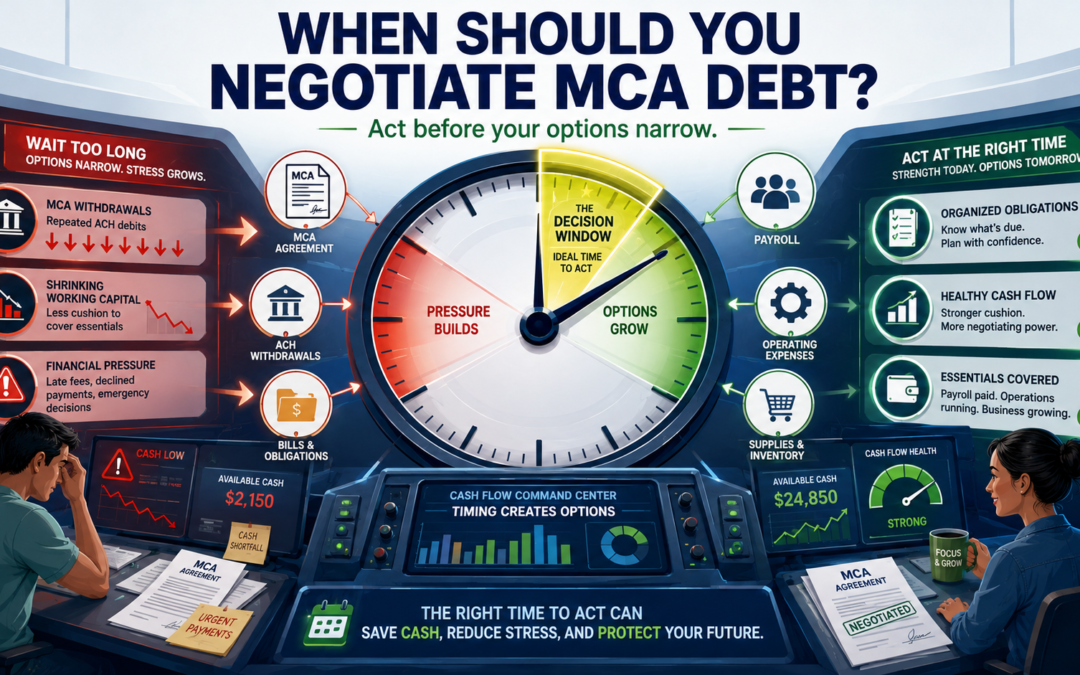
Knowing when to negotiate MCA debt can make a major difference in the options your business has. Waiting until payments are completely unmanageable may leave you with less working capital and more financial pressure.
The right time to act is often before you miss payments or fall into default. Warning signs can include shrinking cash flow, difficulty covering payroll, or using new financing to keep up with existing MCA withdrawals.
By recognizing these signs early, you may have more time to review your obligations, protect essential business expenses, and build a realistic negotiation strategy before the situation becomes harder to manage.
Schedule Your Free Consultation
When Is the Right Time to Start Negotiating MCA Debt?
The best time to begin negotiating MCA debt is often before the situation reaches a crisis. You do not necessarily need to wait until your business misses payments, defaults, or struggles to cover basic operating expenses.
Watch how MCA withdrawals affect your available cash. If daily or weekly payments are making it harder to cover payroll, inventory, rent, taxes, or other essential expenses, it may be time to evaluate your options.
Starting the conversation earlier can give you more time to understand your obligations and determine what your business can realistically afford. The goal is to address MCA payment pressure before it controls your financial decisions.
Why You Do Not Have to Wait Until Default
Many business owners assume they cannot discuss their MCA obligations until they have already missed payments. However, waiting for default can allow financial pressure to grow unnecessarily.
Your business may already be showing warning signs even if every MCA payment is still being made. For example, you might be:
- Using most of your available cash to cover MCA withdrawals.
- Delaying vendor or operating expenses.
- Struggling to maintain payroll.
- Relying on credit cards or other financing for routine expenses.
- Considering another MCA to create additional working capital.
These signs can indicate that the current payment structure is becoming difficult to maintain.
Being current on your payments does not always mean the payments are sustainable. If MCA withdrawals are steadily reducing the cash needed to operate your business, it may be worth exploring negotiation before a missed payment occurs.
Acting before default may also give you more time to gather financial information, review your MCA agreements, and develop a strategy instead of responding to an immediate financial emergency.
How Early Negotiation Can Create More Options
Timing can play an important role when deciding when to negotiate MCA debt. The sooner you recognize that the existing payment structure is creating problems, the more opportunity you may have to make thoughtful decisions.
Early action can help you evaluate your MCA balances, payment schedules, revenue, and essential operating costs. From there, you can determine how much cash the business actually needs to continue operating.
That information can help form the basis of a realistic MCA negotiation strategy.
Starting earlier may also help you avoid decisions that could worsen the situation. For example, taking another merchant cash advance to cover existing withdrawals can add another payment to an already strained cash flow.
There is no guarantee that an MCA funder will agree to different terms. However, waiting until working capital is nearly exhausted can make every financial decision more difficult.
The key is to recognize the warning signs early. If MCA payments are beginning to interfere with normal business operations, it may be time to start reviewing your negotiation options.
Start Negotiating When MCA Payments Begin Straining Cash Flow

One of the clearest signs that it may be time to start negotiating MCA debt is when payments begin interfering with normal business cash flow.
Merchant cash advance payments can feel manageable when revenue is strong. However, problems can develop quickly when sales slow, expenses increase, or several withdrawals hit the business account each week.
If MCA payments are forcing you to move money to keep the business operating, the current repayment structure may no longer be sustainable.
Daily or Weekly Withdrawals Are Reducing Working Capital
Frequent MCA withdrawals can gradually consume the cash your business needs for everyday operations.
At first, the impact may seem manageable. Over time, however, repeated ACH withdrawals can leave less money available for inventory, vendors, marketing, equipment, taxes, and other operating costs.
This can create a dangerous pattern. Revenue comes into the account, MCA payments are deducted, and the business is left with less working capital to fund the next day or week of operations.
Watch for signs such as:
- Bank balances dropping faster than expected.
- Less cash available between customer payments.
- Repeated transfers just to keep the operating account funded.
- Increased reliance on credit cards or short-term financing.
- Difficulty maintaining a reasonable cash reserve.
When these patterns become consistent, it may be time to evaluate whether the MCA payment structure is putting too much pressure on the business.
Payroll and Essential Expenses Are Getting Harder to Cover
MCA payments should not leave your business choosing between withdrawals and essential operating expenses.
If you are beginning to worry about payroll, rent, utilities, insurance, taxes, suppliers, or inventory, that is a serious warning sign. These expenses keep the business functioning and should remain part of any realistic financial strategy.
A business may still be making every MCA payment on time while struggling behind the scenes. You might postpone a vendor payment, reduce inventory purchases, delay maintenance, or use personal funds to cover payroll.
Those decisions can temporarily hide the problem, but they do not solve it.
When MCA withdrawals begin competing directly with the expenses required to keep your doors open, waiting for the situation to improve on its own can increase the pressure.
Starting negotiations earlier can give you time to review your obligations and determine what level of payment the business can realistically support while continuing to operate.
Negotiate Before You Miss MCA Payments
You do not have to wait until a payment is missed before considering MCA debt negotiation. In many cases, the strongest warning signs appear when the business is still technically current on its obligations.
If each withdrawal leaves less money available for normal operations, that can signal that the existing payment structure is becoming difficult to maintain. Recognizing the problem early gives you more time to review your finances and consider possible next steps.
Warning Signs That Your Current Payment Structure Is Becoming Unsustainable
An MCA payment schedule can become unsustainable before an actual default occurs.
Pay attention to patterns such as:
- MCA withdrawals consuming a growing share of weekly revenue.
- Bank balances regularly falling close to zero.
- Payroll becoming harder to fund on time.
- Vendor payments being delayed.
- Taxes or other essential expenses being pushed back.
- Credit cards being used to cover routine operating costs.
- Personal funds being used to keep the business account afloat.
- Another MCA being considered to cover existing obligations.
One isolated cash-flow problem does not always mean the payment structure is failing. However, when several of these warning signs appear repeatedly, the business may be operating with too little financial breathing room.
That is often the point when it makes sense to review whether the current MCA payments are realistic.
Why Acting Before a Missed Payment Can Matter
Waiting until a missed payment occurs can add another layer of pressure to an already difficult situation.
Once cash flow becomes severely strained, the business may have less flexibility to cover payroll, maintain inventory, pay vendors, or respond to unexpected expenses. Decisions can become more reactive because there is less money and less time available.
By acting earlier, you can review MCA balances, withdrawal schedules, business revenue, and essential expenses while you still have a clearer picture of your finances.
This can help you determine what your business can realistically afford before the situation becomes urgent.
Early action does not guarantee that a funder will agree to different terms. However, it may give you more time to develop a strategy and avoid choices that could increase the problem, such as stacking another merchant cash advance on top of existing debt.
If you are wondering when to negotiate MCA debt, do not focus only on whether you have missed a payment. Focus on whether the current payments are still allowing your business to operate normally.
Consider Negotiation Before Taking Another Merchant Cash Advance
If your business is considering a new merchant cash advance to keep up with existing MCA payments, it may be a sign it is time to explore MCA debt negotiation instead.
A new advance can create a temporary cash boost, but it also adds another repayment obligation. If the underlying cash-flow problem has not changed, the business may soon face even more withdrawals from the same revenue stream.
Before adding another MCA, it is important to ask whether the new funding will actually solve the problem or delay it.
Why Using New MCA Debt to Cover Existing Payments Can Increase Pressure
Using new MCA funding to cover old MCA payments can create a cycle that becomes increasingly difficult to manage.
The business receives new capital, but some of that money may immediately go toward existing withdrawals, overdue expenses, or other short-term obligations. Then the new MCA begins taking its own daily or weekly payments.
This can leave the business with:
- More frequent withdrawals.
- Less available working capital.
- Higher overall payment pressure.
- Greater difficulty covering payroll and operating costs.
- Less room to handle a slow week or unexpected expense.
In other words, the business may receive more cash today while giving up even more cash flow tomorrow.
If new financing is mainly being used to keep existing MCA obligations current, the repayment structure itself may need attention. That can be a strong signal to review negotiation options before taking on another advance.
How MCA Stacking Can Reduce Your Future Options
MCA stacking occurs when a business takes multiple merchant cash advances before earlier advances are fully resolved.
Each additional MCA can place another claim on the same business revenue. Over time, several withdrawals may hit the account each day or week, leaving less money available for normal operations.
Stacking can also make the financial picture more complicated. Instead of dealing with one obligation, the business may need to manage multiple balances, withdrawal schedules, funders, and payment demands at the same time.
As working capital shrinks, your options may become more limited. The business may have less cash available to negotiate, maintain operations, or absorb temporary revenue declines.
That is why it can be important to consider when to negotiate MCA debt before adding another MCA to the stack.
If your business is considering borrowing again to keep existing MCA payments moving, it may be more useful to review the current obligations first. Addressing the existing payment pressure can be more sustainable than adding another withdrawal to an already strained cash flow.
When Multiple MCA Payments Signal It Is Time to Negotiate
Managing one merchant cash advance can already put pressure on cash flow. When a business has multiple MCA payments, that pressure can increase quickly.
Several daily or weekly withdrawals may hit the same operating account. Even when each payment seems manageable, the combined amount can consume a large share of incoming revenue.
If multiple MCA obligations make it difficult to predict how much cash will remain available each week, it may be time to consider negotiating MCA debt. The goal should be to reivew the entire financial picture instead of treating each MCA as a separate problem.
Coordinating Several MCA Obligations
Multiple MCAs can create a complicated payment schedule. Each funder may have a different balance, withdrawal amount, payment frequency, and agreement.
Without a coordinated strategy, one payment decision can affect every other obligation.
For example, increasing payments toward one MCA could leave too little cash available for another payment or for essential operating expenses. That is why businesses with several advances should first understand how all MCA withdrawals affect total cash flow.
A coordinated review can include:
- The remaining balance on each MCA.
- Daily or weekly withdrawal amounts.
- The timing of each withdrawal.
- Current business revenue.
- Essential operating expenses.
- The amount of working capital needed to keep the business running.
Looking at these obligations together can help identify where the greatest financial pressure exists.
It can also help the business determine what it can realistically afford across all MCA obligations, rather than making promises based on one agreement at a time.
Protecting Enough Cash to Keep the Business Operating
Negotiating MCA debt should not focus only on making payments. The business also needs enough cash to continue generating revenue.
Payroll must be funded. Vendors may need to be paid. Inventory needs to be replaced. Rent, utilities, insurance, taxes, and other operating expenses continue while MCA payments are being made.
If multiple withdrawals leave too little money for these necessities, the payment structure may be putting the business itself at risk.
A realistic strategy should account for the cash required to keep daily operations moving. After all, reducing the operating capital of the business too aggressively can make it harder to generate the revenue needed to cover MCA obligations.
This is especially important when deciding when to negotiate MCA debt. If several MCA payments are already competing with payroll and essential expenses, waiting on the business account to dip dangerously low may reduce your flexibility.
The objective is not simply to manage multiple payments. It is to create a coordinated approach that addresses MCA obligations while preserving enough working capital to keep the business operating.
Should You Start Negotiating After an MCA Default?
Missing an MCA payment does not necessarily mean that negotiation is no longer possible. In fact, default can be a clear sign that the current payment structure is no longer working for the business.
If your business has already missed payments, the priority should be to understand what changed, what you can realistically afford, and how quickly the financial pressure is increasing.
While it is often better to consider MCA debt negotiation before default, acting after a missed payment may still be better than allowing the situation to continue without a plan.
Negotiation May Still Be Possible After Payments Are Missed
A missed MCA payment can change the relationship with a funder, but it does not always end the possibility of negotiation.
Depending on the circumstances, a business may still be able to discuss payment terms, temporary adjustments, or other possible resolutions. The outcome will depend on the agreement, the funder, the business finances, and the stage of the default.
Before beginning those discussions, it can help to gather a clear picture of:
- Current MCA balances.
- Missed or returned payments.
- Recent business revenue.
- Available cash.
- Essential operating expenses.
- Other MCA obligations.
- What the business can realistically pay going forward.
This information can help support a more realistic conversation.
The goal should not be to promise a payment the business cannot maintain. Instead, the business should understand its actual cash flow and work from numbers that reflect current operations.
Why Delaying Further Can Increase Financial Pressure
Once an MCA is in default, waiting can create additional uncertainty.
Repeated payment attempts, collection activity, account pressure, and other consequences may make it harder to manage the business. At the same time, payroll, rent, inventory, utilities, taxes, and vendor expenses still need to be covered.
The longer the situation remains unresolved, the more likely it is that the business will make short-term decisions to survive the next payment cycle.
That may include using personal funds, delaying essential expenses, maxing out credit cards, or taking another merchant cash advance. Those choices can increase financial pressure rather than solving the underlying problem.
If you are wondering when to negotiate MCA debt after default, the answer is generally sooner rather than later. Once payments have already been missed, there is little benefit in allowing the situation to become more complicated before reviewing your options.
Default does not automatically mean you are out of options, but continued delay can make the situation harder to manage. A prompt review can help your business understand its obligations and determine what steps may still be available.
What Should You Prepare Before Starting MCA Negotiations?
What Happens If You Wait Too Long to Negotiate MCA Debt?
Shrinking Working Capital Can Limit Your Choices
Every MCA withdrawal reduces the cash available for business operations. When revenue cannot keep pace with those withdrawals, working capital can disappear quickly.
As available cash shrinks, the business may have fewer options for managing:
- Payroll and employee expenses
- Inventory and supplies
- Rent and utilities
- Vendor payments
- Taxes and insurance
- Unexpected operating costs
A business with adequate cash reserves has more room to make thoughtful decisions. A business operating with almost no available cash may be forced into short-term choices simply to get through the week.
Waiting can also increase the temptation to take another MCA, use high-cost financing, or delay important expenses.
The less working capital your business has, the harder it can become to build a sustainable solution. That is why recognizing when to negotiate MCA debt before cash reserves are exhausted can be so important.
Collection and Legal Pressure May Become More Difficult to Manage
If payments are missed and the situation remains unresolved, communication from MCA funders or collection representatives may increase.
Depending on the agreement and circumstances, the business could face collection demands, repeated payment attempts, notices, or potential legal action. Not every MCA default follows the same path, but additional pressure can make an already strained financial situation more difficult.
At the same time, the business still needs to focus on customers, employees, vendors, and daily operations.
Waiting until several problems develop at once can make it harder to evaluate your options calmly and coordinate a response.
Early action does not guarantee a particular negotiation outcome. However, addressing the problem before financial and collection pressure escalates may give you more time to organize your obligations, understand your cash flow, and determine the next appropriate step.
Frequently Asked Questions About When to Negotiate MCA Debt
Business owners often wonder whether they should act immediately or wait until MCA payments become more difficult to manage. The right timing depends on your cash flow, existing obligations, and ability to continue covering essential business expenses.
The following answers address some of the most common questions about when to negotiate MCA debt.
💬 Can You Negotiate an MCA Before Default?
Yes. You do not necessarily have to miss payments before discussing your MCA obligations.
If daily or weekly withdrawals are beginning to strain working capital, it may make sense to review your situation before default occurs. Early warning signs can include difficulty covering payroll, falling bank balances, delayed vendor payments, or increasing reliance on credit.
Starting earlier can also give you more time to gather financial information and determine what your business can realistically afford.
⚠️ Keep in mind: Every MCA agreement and funder is different. Negotiation is not guaranteed, and available terms will depend on your specific circumstances.
⏰ Is It Better to Negotiate Early or Wait Until Payments Are Missed?
In general, it can be better to evaluate your options as soon as you recognize that the current payment structure is becoming unsustainable.
Waiting for a missed payment does not necessarily improve your negotiating position. Instead, the business may have less available cash and more immediate financial pressure by that point.
Watch the health of the business rather than focusing only on whether payments are current.
If MCA withdrawals are already interfering with payroll, inventory, rent, taxes, or other essential expenses, that may be a signal to act.
✅ Key takeaway: The goal is to address the problem while your business still has enough working capital to make thoughtful decisions.
🔄 Can You Negotiate Several MCAs at the Same Time?
Potentially, yes. Businesses with multiple merchant cash advances may need to address several MCA obligations as part of one coordinated financial strategy.
Each MCA will still have its own agreement, balance, payment schedule, and funder. However, looking at them together can help determine how much total cash is leaving the business.
This becomes especially important when several daily or weekly withdrawals are competing for the same revenue.
📊 A coordinated strategy should consider:
- All MCA balances and payments.
- Daily or weekly withdrawal schedules.
- Available working capital.
- Essential operating expenses.
- Realistic payment capacity.
Focusing on only one MCA without considering the others can create additional cash-flow problems.
🛡️ Do You Have to Be in Financial Crisis Before Negotiating an MCA?
No. A business does not have to wait until its bank account is empty or operations are in immediate danger.
Recurring cash-flow strain can be an earlier warning sign. If MCA payments continually leave too little money for routine expenses, it may be worth reviewing your options before the problem becomes a crisis.
💡 Early warning matters: Negotiation may be worth considering when payments are still being made but the business is losing the financial cushion needed to operate comfortably.
🚨 What Is the Biggest Sign That It Is Time to Negotiate MCA Debt?
One of the strongest signs is when MCA payments begin competing directly with the money required to operate the business.
That can include difficulty covering:
- Payroll.
- Inventory and supplies.
- Rent and utilities.
- Vendor invoices.
- Taxes and insurance.
- Other essential operating costs.
If your business regularly has to choose between MCA withdrawals and these expenses, the current payment structure may no longer be sustainable.
✅ Bottom line: When MCA payments begin threatening normal business operations, it may be time to review your obligations and explore negotiation options.
Start MCA Negotiations Before Your Options Narrow
Knowing when to negotiate MCA debt can be just as important as knowing how to negotiate it.
If MCA withdrawals are reducing working capital, making payroll harder to cover, or pushing your business toward another advance, waiting may only increase the pressure. The earlier you understand the problem, the more time you may have to review your obligations and consider a realistic strategy.
You do not necessarily need to wait for a default, empty bank account, or collection pressure before taking action. The best time to review your MCA situation is often when you first realize the current payment structure is becoming difficult to sustain.
Acting earlier can help you:
- Understand what you currently owe.
- See how much MCA payments are affecting cash flow.
- Protect essential operating expenses.
- Avoid adding another MCA to the problem.
- Build a more coordinated negotiation strategy.
The goal is to address the problem before your financial options become more limited.
Schedule a Free Consultation With MCA Shield
If MCA payments are putting pressure on your business, MCA Shield can review your situation and help you understand your available options.
During a free consultation, you can discuss your MCA agreements, payment schedules, current cash flow, and the financial challenges your business is facing. From there, MCA Shield can help determine whether a negotiation strategy may make sense for your situation.
You do not have to wait until the pressure becomes overwhelming.
Schedule a Free Consultation With MCA Shield today and take the first step toward building a more manageable plan for your MCA obligations.