
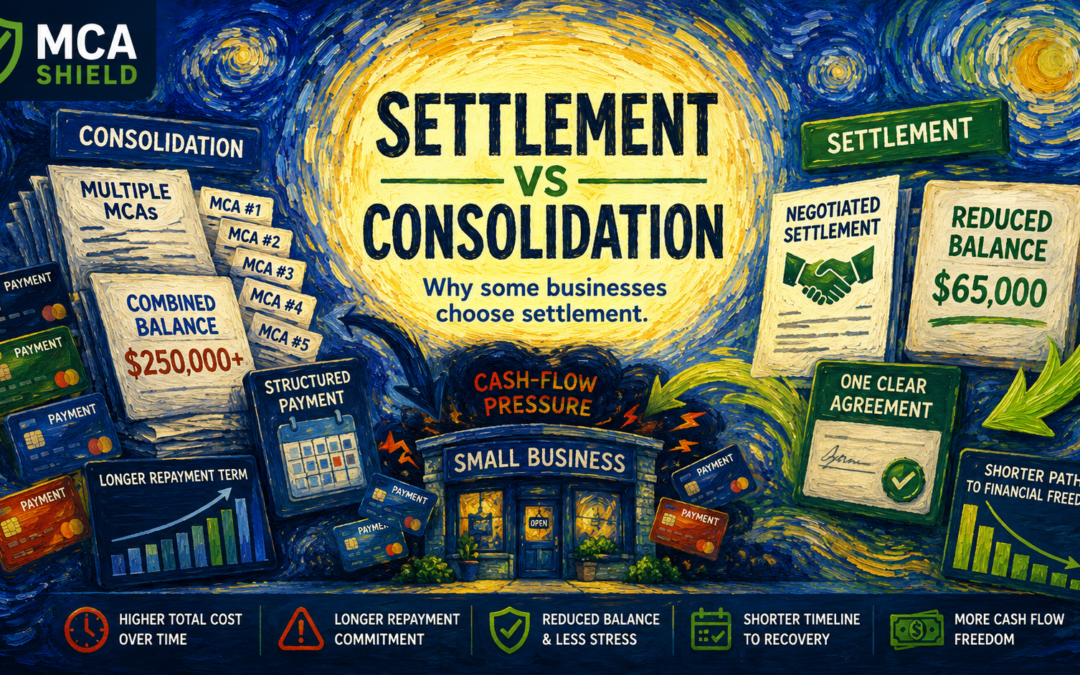
When a business is overwhelmed by merchant cash advance payments, choosing between MCA settlement vs consolidation can have a major impact on cash flow. Both strategies are designed to reduce financial pressure, but they work in very different ways. Consolidation reorganizes existing balances into a new payment structure, while settlement may focus on negotiating a reduced amount owed.
For some businesses, consolidation can provide needed breathing room. However, it may not always lower the total repayment enough to solve the underlying cash-flow problem. If revenue has dropped, multiple MCAs are stacked, or the business can no longer support a large structured payment, MCA settlement may become the more practical option.
In this article, we will compare MCA settlement and consolidation, explain when each strategy may make sense, and review the risks, costs, and cash-flow factors that should guide the decision. The goal is to help business owners understand which option may provide a more realistic path toward manageable payments and long-term financial stability.
Schedule Your Free Consultation
What Is the Difference Between MCA Settlement and Consolidation?
The main difference between MCA settlement vs consolidation is how each strategy handles the amount a business owes. Consolidation typically reorganizes multiple merchant cash advance obligations into a new repayment structure. Settlement, on the other hand, may involve negotiating with funders to accept a reduced amount.
Both options are designed to reduce financial pressure, but they can affect cash flow, repayment terms, and total cost in very different ways. The best choice depends on the business’s current revenue, expenses, remaining balances, and ability to make payments.
How MCA Debt Consolidation Works
MCA debt consolidation is generally used when a business has multiple merchant cash advances with separate daily or weekly withdrawals. A consolidation strategy may combine those obligations into one more organized payment structure.
The goal is often to make payments easier to manage and reduce the amount of cash leaving the business each week. Instead of tracking several funders and withdrawal schedules, the business may be able to work with one structured repayment plan.
However, a lower payment does not automatically mean a lower total cost. The business may still be responsible for a significant balance, and a longer repayment term can affect the overall amount paid.
Before choosing consolidation, it is important to review:
- Remaining MCA balances
- Current daily or weekly payments
- Business revenue and operating expenses
- Proposed repayment terms
- Total expected repayment
- Available working capital
The new payment should fit within the business’s cash flow without creating another financial problem.
How MCA Settlement Works
MCA settlement takes a different approach. Rather than combining the full balances into a new repayment structure, settlement may involve negotiating with MCA funders for revised terms or a reduced payoff amount.
A settlement strategy may be considered when a business can no longer afford its current payments and does not have enough cash flow to support consolidation. The goal is often to reach an agreement that gives the business a more realistic way to resolve the obligation.
Settlement results are not guaranteed. The outcome can depend on the MCA agreement, remaining balance, payment history, business finances, and the funder’s willingness to negotiate.
Businesses should also understand that settlement can involve additional risks. Collection activity, UCC filings, personal guarantees, or legal action may affect the negotiation process. Any final agreement should be clearly documented before payments are made under the new terms.
Why the Total Repayment Structure Matters
When comparing MCA settlement vs consolidation, business owners should look beyond the size of the new payment. A payment may appear affordable while still creating a costly or lengthy repayment obligation.
For example, consolidation may reduce weekly pressure but extend repayment over a longer period. Settlement may offer the possibility of reducing the amount owed, but it may also involve negotiation risks and stricter payment requirements once an agreement is reached.
The key is to compare the entire repayment structure, including the payment amount, total repayment, repayment period, fees, and impact on working capital.
A good MCA relief strategy should leave enough cash available to cover payroll, vendors, rent, taxes, inventory, and other essential business expenses. If the payment structure still prevents the company from operating normally, the underlying cash-flow problem has not been solved.
Why Do Some Businesses Choose MCA Settlement Instead of Consolidation?
Some businesses choose MCA settlement instead of consolidation because consolidation does not always reduce the financial burden enough. A lower daily or weekly payment may help temporarily, but the business could still be responsible for repaying a large balance over time.
Settlement takes a different approach. Instead of simply reorganizing the debt, an MCA settlement strategy may attempt to negotiate a lower amount owed. For businesses facing severe cash-flow pressure, that difference can be important.
Settlement May Reduce the Total Amount Owed
One of the main reasons a business may consider settlement is the possibility of reducing the total amount it has to repay.
Depending on the MCA agreement, remaining balance, financial condition of the business, and willingness of the funder to negotiate, a settlement may result in a reduced payoff or revised repayment amount.
This can be especially important when a business is dealing with:
- Multiple stacked MCAs
- Declining revenue
- High daily or weekly withdrawals
- Limited working capital
- Payroll or vendor pressure
- Difficulty keeping the business account funded
If a business simply cannot support the full outstanding obligations, reducing the repayment burden may provide a more realistic path forward.
However, MCA settlement is not guaranteed. Every funder, agreement, and financial situation is different. Business owners should review the proposed terms carefully and confirm any agreement in writing.
Consolidation May Still Require Significant Repayment
MCA consolidation can lower payment pressure, but it may not reduce the underlying debt. In many cases, the remaining MCA balances are still being repaid through a new or reorganized payment structure.
For example, a business might replace several daily withdrawals with one more manageable payment. That can improve short-term cash flow, but the company may still face a significant total repayment obligation.
A longer repayment period can also create additional concerns. Even if the payment is smaller, the business needs enough consistent revenue to make that payment while continuing to cover normal operating expenses.
Before choosing consolidation, a business should compare the proposed payment against:
- Monthly revenue
- Payroll
- Vendor payments
- Rent and utilities
- Taxes
- Inventory or materials
- Other essential operating costs
If consolidation still leaves the business with very little operating cash, it may not provide enough relief.
The Right Option Depends on the Business’s Financial Condition
There is no single MCA relief strategy that works for every business. The choice between MCA settlement vs consolidation should be based on what the business can realistically afford.
A company with stable revenue and enough cash flow may benefit from consolidation if the new payment is manageable. A business experiencing a serious revenue decline or carrying several large MCA balances may need to consider whether settlement offers a more realistic solution.
The decision should be based on the complete financial picture, including remaining MCA balances, current withdrawals, revenue, essential expenses, available cash, and legal risk.
Most importantly, the strategy should allow the business to continue covering payroll, vendors, taxes, and daily operating expenses. The goal is not simply to change the payment. It is to create a repayment structure the business can actually sustain.
When MCA Consolidation May Not Solve the Cash-Flow Problem
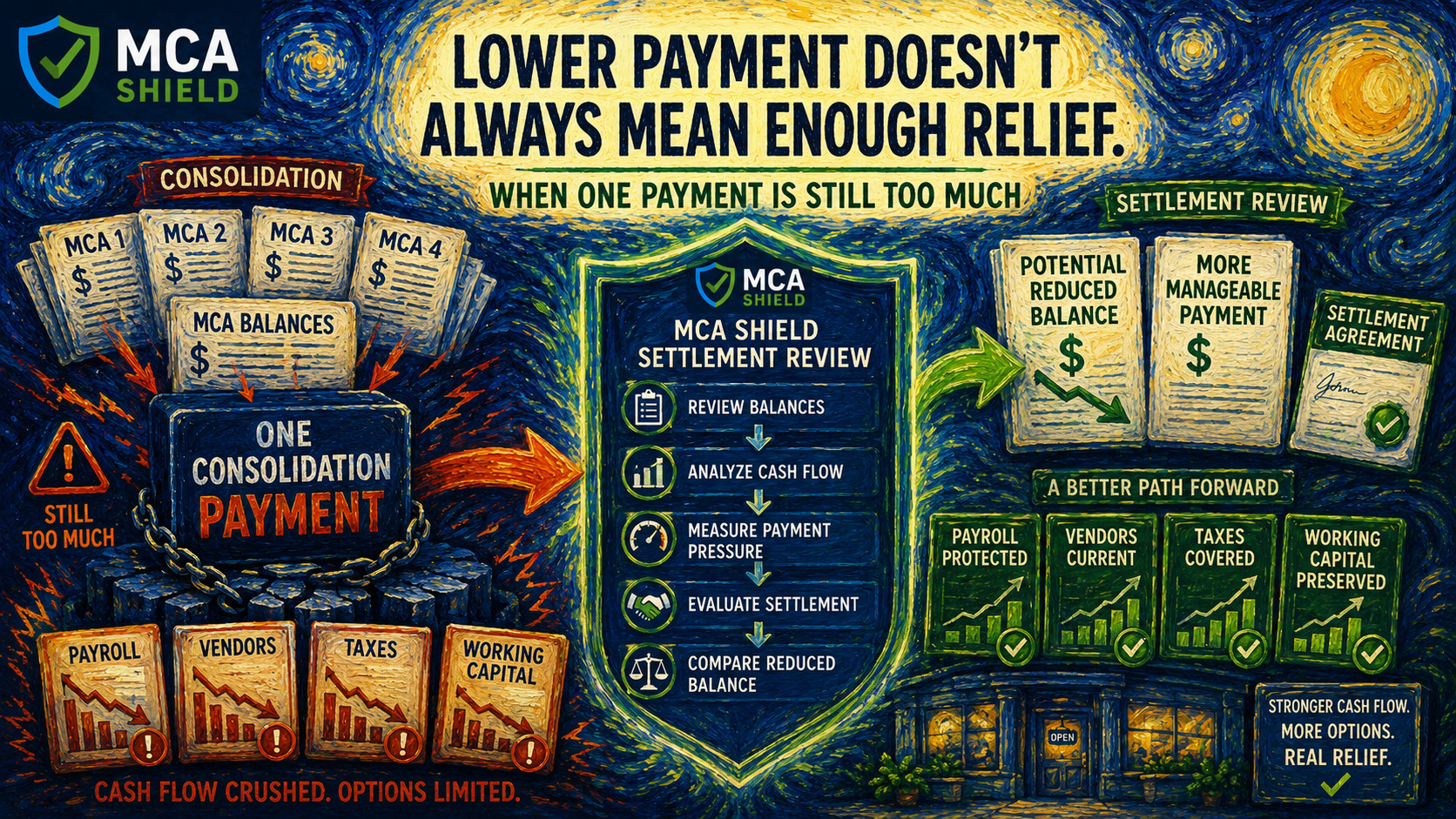
MCA consolidation can reduce payment pressure, but it does not automatically fix the financial problems that caused the business to struggle in the first place. If the new payment is still too large, the remaining balances are too high, or revenue has fallen significantly, consolidation may only delay the cash-flow problem.
This is why businesses should look beyond the promise of one simplified payment. The real question is whether the new structure leaves enough money available for payroll, vendors, taxes, inventory, rent, and other essential operating expenses.
The New Payment May Still Be Too High
A consolidation plan may replace several daily or weekly MCA withdrawals with one payment. That can make the debt easier to manage, but the new payment still has to fit the business’s current cash flow.
For example, a business may reduce its total weekly withdrawals but still find that the new payment consumes too much of its available revenue. If there is not enough cash left to cover normal expenses, the company may continue experiencing the same financial pressure.
Before accepting a consolidation offer, business owners should calculate how much they can realistically afford after covering:
- Payroll
- Vendor payments
- Rent or lease expenses
- Taxes
- Insurance
- Inventory and materials
- Utilities
- Other essential operating costs
The goal should be to create a sustainable payment, not simply a smaller one.
If the proposed consolidation payment still forces the business to delay bills, use overdrafts, or take another advance, it may not provide meaningful relief.
Multiple MCA Balances Can Make Consolidation Expensive
Businesses with multiple stacked MCAs may have substantial remaining balances. Combining those obligations into a single repayment structure can simplify payments, but it can also create a large total balance that still needs to be repaid.
The business should compare more than the new weekly or monthly payment. It should also review the total repayment amount, repayment period, fees, and overall cost of the consolidation.
A lower payment spread over a longer period can appear attractive at first. However, the business may remain committed to repayment for much longer than expected.
This is one reason some companies compare MCA settlement vs consolidation before making a decision. If the business cannot realistically repay the full combined balance, settlement may be worth evaluating as another possible option.
Extending Repayment Does Not Always Fix the Underlying Problem
Extending repayment can create breathing room, but more time does not always solve a cash-flow shortage.
If business revenue has dropped, profit margins have narrowed, or operating expenses have increased, the company may still struggle even with a longer repayment schedule. The payment may be lower, but the underlying financial imbalance remains.
A business should ask whether the proposed repayment structure allows it to:
- Maintain enough working capital
- Keep payroll current
- Pay vendors on time
- Cover taxes and operating expenses
- Avoid new MCA borrowing
- Rebuild cash reserves
If the answer is no, consolidation may only move the problem further into the future.
The right MCA relief strategy should address both the debt and the business’s ability to operate. A payment plan only works when the company can afford it without sacrificing the cash needed to stay in business.
When MCA Settlement May Be a Better Option
MCA settlement may be a better option when a business can no longer afford its current merchant cash advance payments and consolidation would still leave the company under too much financial pressure.
Unlike consolidation, settlement may focus on reducing the amount that must be repaid rather than simply reorganizing the existing balances. This can make settlement worth considering when the business needs more than a smaller payment. It may need a meaningful reduction in the overall debt burden.
The Business Cannot Afford Its Current MCA Payments
One of the clearest signs that settlement may need to be considered is when the business cannot keep up with its current MCA payments.
Daily or weekly withdrawals can quickly consume the cash needed for normal operations. As payment pressure increases, business owners may begin falling behind on other important expenses.
Common warning signs include:
- Difficulty covering payroll
- Delayed vendor payments
- Frequent overdrafts
- Insufficient funds for taxes
- Trouble purchasing inventory or materials
- Using new financing to cover existing MCA payments
- Little or no operating cash remaining after withdrawals
In this situation, consolidation may help only if the new payment is low enough to fit within the business’s actual cash flow.
If the business cannot realistically support the consolidated payment, MCA settlement may provide another option to evaluate.
Revenue Has Declined or Cash Reserves Are Depleted
A business that once supported its MCA payments may begin struggling after a decline in revenue.
Sales can fall because of seasonality, lost customers, economic changes, rising costs, or unexpected business expenses. When revenue drops but MCA withdrawals remain high, cash-flow pressure can increase very quickly.
The situation can become even more difficult when cash reserves have already been depleted. Without available working capital, even a temporary decline in revenue can make it difficult to cover basic expenses.
Settlement may become more appropriate when the business no longer has enough cash flow to repay the full MCA balances under a traditional consolidation structure.
Before making a decision, the business should review its:
- Current monthly revenue
- Available cash reserves
- Remaining MCA balances
- Daily or weekly withdrawals
- Essential operating expenses
- Expected future revenue
This financial review can help determine whether the business can support consolidation or needs to consider a different strategy.
The Business Needs a More Significant Reduction in Debt Pressure
Sometimes lowering the payment is not enough.
A business may have several stacked MCAs, large remaining balances, and limited working capital. Even after consolidation, the total repayment obligation may continue to place significant pressure on the company.
In that situation, the business may need a strategy aimed at reducing the overall debt burden, not simply extending repayment.
This is one of the main reasons some businesses choose MCA settlement instead of consolidation. A negotiated settlement may provide the opportunity to resolve an obligation for less than the full claimed balance, depending on the agreement and the funder’s willingness to negotiate.
However, settlement also carries risks. Reduced balances are not guaranteed, and collection activity or legal pressure may continue while negotiations are underway.
The best option is the one that gives the business a realistic chance to meet its obligations while still protecting payroll, vendors, working capital, and daily operations. If consolidation does not create enough financial breathing room, settlement may be worth considering as part of a broader MCA relief strategy.
Can MCA Settlement Reduce the Amount a Business Has to Repay?
Yes, MCA settlement may reduce the amount a business ultimately repays, but the outcome depends on the specific agreement, the remaining balance, the business’s financial condition, and the funder’s willingness to negotiate.
Unlike consolidation, which often reorganizes existing obligations into a new payment structure, settlement may focus on reaching an agreement for less than the full amount claimed. This is one reason businesses under severe payment pressure may compare MCA settlement vs consolidation before deciding how to move forward.
Settlement Negotiations May Seek a Reduced Balance
The goal of an MCA settlement negotiation is often to reach terms that are more manageable for the business.
Depending on the circumstances, negotiations may seek a reduced payoff amount, revised payment schedule, or both. A lower balance can be especially valuable when a business has experienced a major decline in revenue or is carrying several stacked MCA obligations.
Factors that may influence settlement discussions include:
- Remaining MCA balance
- Payment history
- Current business revenue
- Available cash flow
- Number of active MCA obligations
- Financial hardship
- Collection or legal activity
- The terms of the original agreement
A reduced settlement can create a clearer path toward resolving the obligation. However, there is no guarantee that a funder will agree to reduce the balance.
Payment Terms Can Vary by Funder and Agreement
Every MCA agreement is different. Because of this, settlement terms can vary significantly from one funder to another.
One funder may be willing to accept a reduced lump-sum payment. Another may agree to a structured settlement over several weeks or months. In some cases, the funder may offer revised terms without reducing the principal balance.
Businesses should review each proposal carefully and compare:
- The total settlement amount
- Required down payment
- Weekly or monthly payment
- Length of the repayment period
- Deadlines
- Fees or added costs
- Consequences of missing a payment
The payment should fit within the company’s realistic cash flow. Agreeing to settlement terms that are still unaffordable can create another financial problem.
Any Settlement Terms Should Be Confirmed in Writing
Before making payments under a negotiated settlement, the business should receive clear written documentation of the agreement.
The written terms should explain the amount being accepted, the payment schedule, deadlines, and what happens after the settlement is completed. It should also identify whether any remaining balance will be considered satisfied once all required payments are made.
Business owners should avoid relying only on verbal promises. A written agreement provides a clear record of what both sides have accepted.
It is also important to review how the settlement may affect UCC filings, personal guarantees, collection activity, and other contractual rights. If those issues are involved, professional legal guidance may be appropriate.
A successful MCA settlement should do more than reduce immediate pressure. It should create clear, affordable, and documented terms that give the business a realistic opportunity to stabilize cash flow and move forward.
What Are the Risks of Choosing MCA Settlement Over Consolidation?
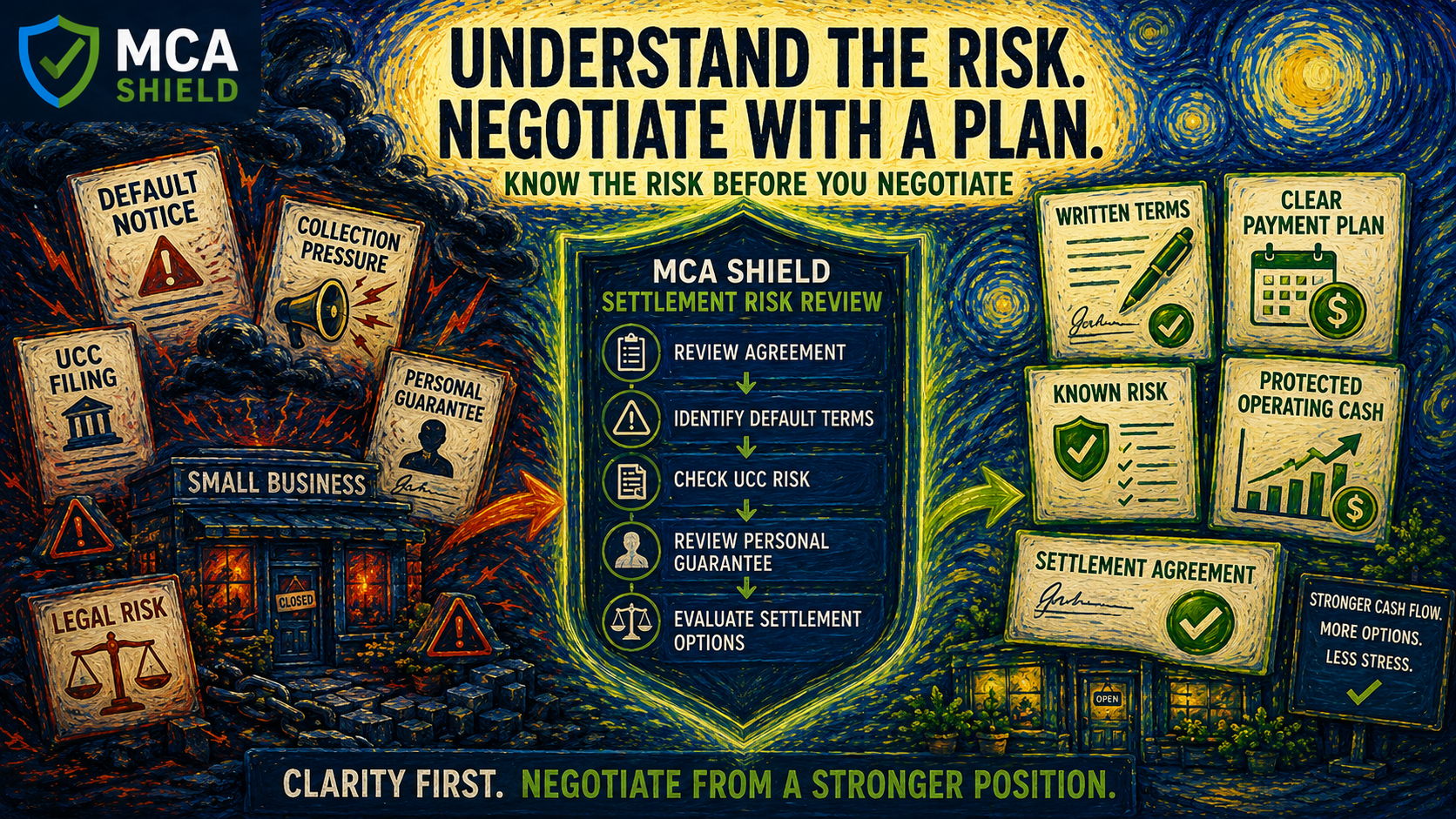
MCA settlement can provide meaningful relief, but it also carries risks that businesses should understand before moving forward. Unlike consolidation, settlement often involves negotiating existing obligations after the business is already under financial pressure.
The process may affect collections, legal exposure, and the relationship with the MCA funder. This is why a business should carefully review the potential consequences before choosing MCA settlement instead of consolidation.
Default and Collection Activity May Continue During Negotiations
One important risk is that collection activity may continue while settlement negotiations are in progress.
Depending on the agreement and the status of the account, a funder may continue attempting withdrawals, contacting the business, or pursuing other collection options. In some situations, default-related charges or legal pressure may also increase.
Business owners should not assume that negotiations automatically stop collection activity.
Before entering a settlement process, it is important to understand:
- The current payment status
- Any default provisions
- Ongoing ACH withdrawals
- Collection notices
- Legal demands
- Additional fees or charges
A business should also maintain clear records of all communication with the funder. That includes emails, letters, payment proposals, and written responses.
UCC Filings and Personal Guarantees Can Affect the Risk
Some MCA agreements include UCC filings, personal guarantees, or other contractual protections for the funder.
These provisions can increase the risk if the business falls behind on payments.
A UCC filing may give the funder certain rights related to business assets or receivables, depending on the agreement and applicable law. A personal guarantee may also expose the business owner to additional liability in certain situations.
Because these issues can become complex, business owners should review the original MCA documents carefully before making major changes to payments.
If there is a lawsuit, threatened legal action, disputed contract terms, or concern about a personal guarantee, legal advice may be appropriate.
Settlement Is Not Guaranteed
Another major risk is that MCA settlement is not guaranteed.
A funder does not have to accept a reduced balance or revised payment proposal. The final outcome can depend on the agreement, payment history, remaining balance, financial hardship, and willingness of both sides to negotiate.
Even when a funder agrees to discuss settlement, the final terms may not be affordable.
For this reason, a business should avoid building its recovery plan around an assumed reduction.
Instead, it should compare several possible outcomes, including:
- Settlement
- Consolidation
- Restructuring
- Reconciliation, when available
- Continuing under the existing agreement
The best strategy should balance potential savings with the risks involved.
When comparing MCA settlement vs consolidation, business owners should look at more than the payment amount. They should also consider legal exposure, collection pressure, total repayment, and the effect on day-to-day operations.
A good decision should protect the business while creating the most realistic path toward manageable payments and stronger cash flow.
How Cash Flow Determines Whether Settlement or Consolidation Makes Sense
When comparing MCA settlement vs consolidation, cash flow should be one of the most important factors in the decision. A payment may look manageable on paper, but it still has to fit within the business’s actual revenue and operating needs.
The right strategy should reduce financial pressure without making it harder to run the business. That means looking closely at how much cash comes in, how much must go out, and how much remains available after essential expenses are paid.
Calculate What the Business Can Realistically Afford
Before choosing settlement or consolidation, the business should determine what it can actually afford to pay.
That calculation should be based on current financial performance, not on the hope that revenue will improve later.
A useful review should include:
- Average monthly revenue
- Current MCA withdrawals
- Payroll
- Vendor payments
- Rent or lease costs
- Taxes
- Insurance
- Inventory or materials
- Utilities
- Other essential expenses
After these costs are covered, the remaining cash shows what may be available for an MCA repayment plan.
This is important because an affordable payment is more than a lower payment. It must be low enough to allow the business to continue operating without constant financial stress.
Protect Payroll, Vendors, and Essential Operating Expenses
A business cannot focus only on MCA debt and ignore the expenses that keep the company running.
Any settlement or consolidation plan should leave enough cash available to protect payroll, vendors, taxes, rent, inventory, and other essential operating expenses.
If too much money is committed to debt payments, the business may begin delaying other obligations. That can create new problems even if the MCA payment has been reduced.
For example, a payment plan may not be sustainable if it causes the business to:
- Miss payroll
- Delay vendor invoices
- Fall behind on rent
- Skip tax payments
- Reduce inventory too far
- Use overdrafts to cover normal expenses
- Take another MCA just to stay current
The goal should be to improve the financial condition of the business as a whole, not simply change the repayment schedule.
Avoid Agreeing to a Payment That Creates Another Cash-Flow Crisis
One of the biggest mistakes a business can make is accepting a new payment that is only slightly better than the old one.
A consolidation payment may be lower, but it can still be too high. A settlement agreement may reduce the balance, but the required payment schedule may still put too much pressure on the business.
Before signing any new agreement, the business should ask whether the payment can be made consistently during both strong and slow revenue periods.
A sustainable strategy should provide room for unexpected expenses and normal changes in revenue.
This is why cash flow should drive the decision between MCA settlement and consolidation. The best option is the one that gives the business a realistic chance to meet its obligations while keeping enough working capital available to operate.
If a new payment immediately puts payroll, vendors, or operating cash at risk, the business may simply be replacing one cash-flow problem with another.
MCA Settlement vs Consolidation: Which Costs Less?
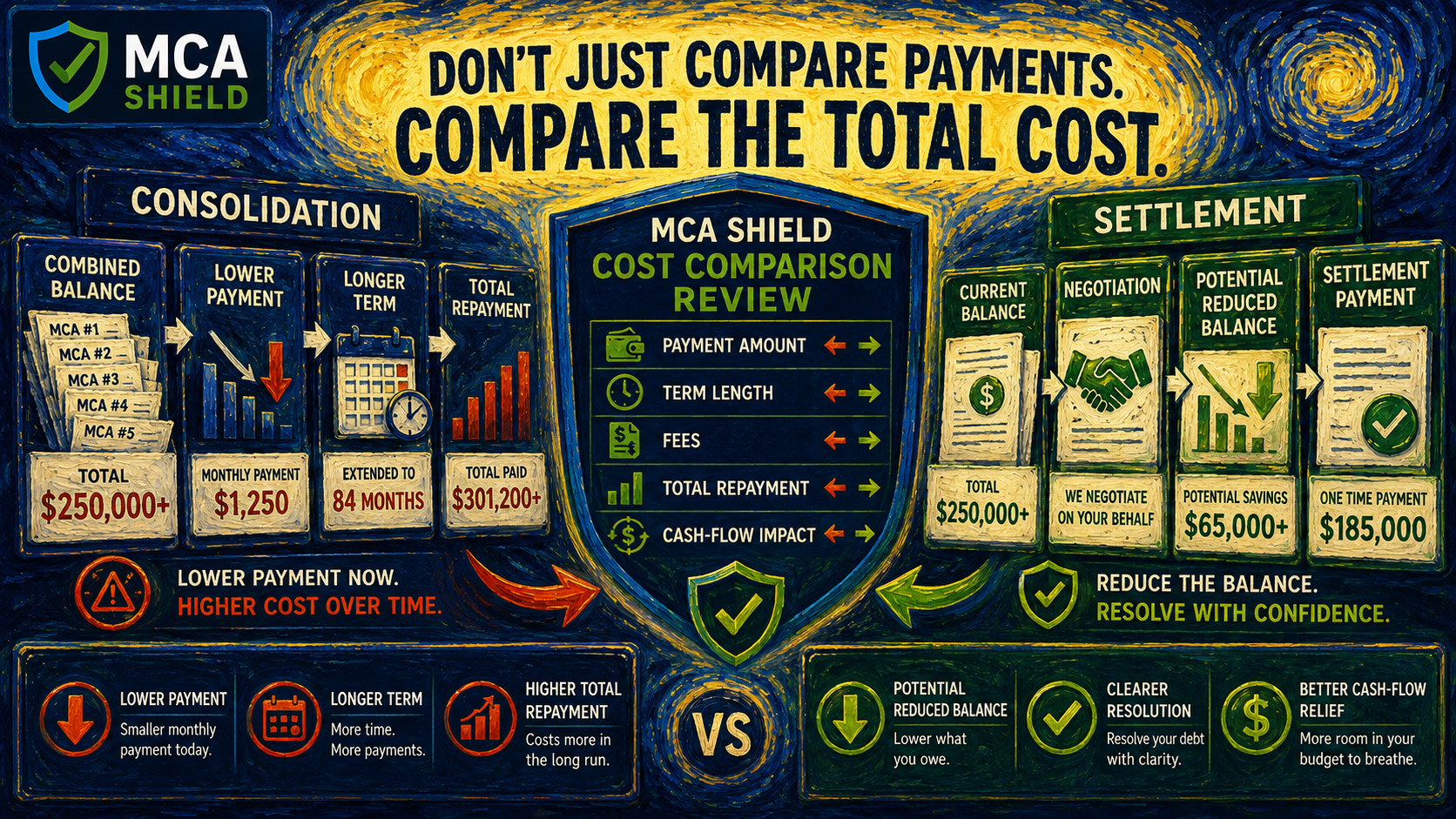
When comparing MCA settlement vs consolidation, the lowest payment is not always the lowest-cost option. A business needs to consider the total amount it will repay, how long repayment will last, and whether the payment fits within available cash flow.
Consolidation may lower daily or weekly payment pressure, but it can still require repayment of a large combined balance. Settlement may offer the possibility of reducing the amount owed, but the final cost depends on the agreement and the outcome of negotiations.
Compare the Total Repayment, Not Just the Monthly Payment
A smaller monthly or weekly payment can look attractive, especially when a business is struggling with multiple MCA withdrawals. However, payment size alone does not show the true cost.
A consolidation plan may lower the payment by extending repayment over a longer period. While this can improve short-term cash flow, the business may still repay a significant amount over time.
Settlement works differently. If a funder agrees to accept less than the full claimed balance, the total repayment may be lower. However, a reduced settlement is not guaranteed.
Before choosing either option, compare:
- Total amount to be repaid
- Weekly or monthly payment
- Number of payments
- Repayment term
- Any fees or added costs
- Amount of debt being resolved
The goal is to understand the entire financial commitment, not just the payment due each week.
Consider Fees, Term Length, and Remaining MCA Balances
The cost of MCA relief can also depend on fees, repayment length, and the size of the remaining balances.
A business with several stacked MCAs may have a large total obligation. Consolidating those balances can simplify repayment, but the combined amount may still be difficult to manage.
A longer repayment term can also change the overall cost. Even if the payment is lower, the business may remain committed to the obligation for many additional months.
With settlement, business owners should review the negotiated amount along with any professional fees, payment requirements, and deadlines.
Important numbers to compare include:
- Remaining MCA balances
- Proposed settlement amount
- Consolidation balance
- Payment frequency
- Repayment term
- Fees
- Total expected cost
Looking at these numbers side by side can make it easier to determine which option offers the stronger financial outcome.
Evaluate the Cost Against the Business’s Available Cash Flow
The cheapest option on paper is not always the best option for the business.
A repayment plan must also leave enough cash available for payroll, vendors, rent, taxes, inventory, and normal operating expenses.
For example, a settlement may reduce the total amount owed, but the required payments could still be too aggressive. Consolidation may have a higher total cost but offer a payment schedule that better fits current revenue.
This is why businesses should compare cost and affordability together.
The right option should provide enough financial relief to help the company continue operating while meeting its repayment obligations. If the payment leaves the business short on working capital every week, the plan may not be sustainable.
When evaluating MCA settlement vs consolidation, focus on the total repayment, the payment schedule, and the effect on daily operations. The best strategy is one the business can realistically afford without creating another cash-flow crisis.
Choose the MCA Relief Strategy Your Business Can Actually Afford
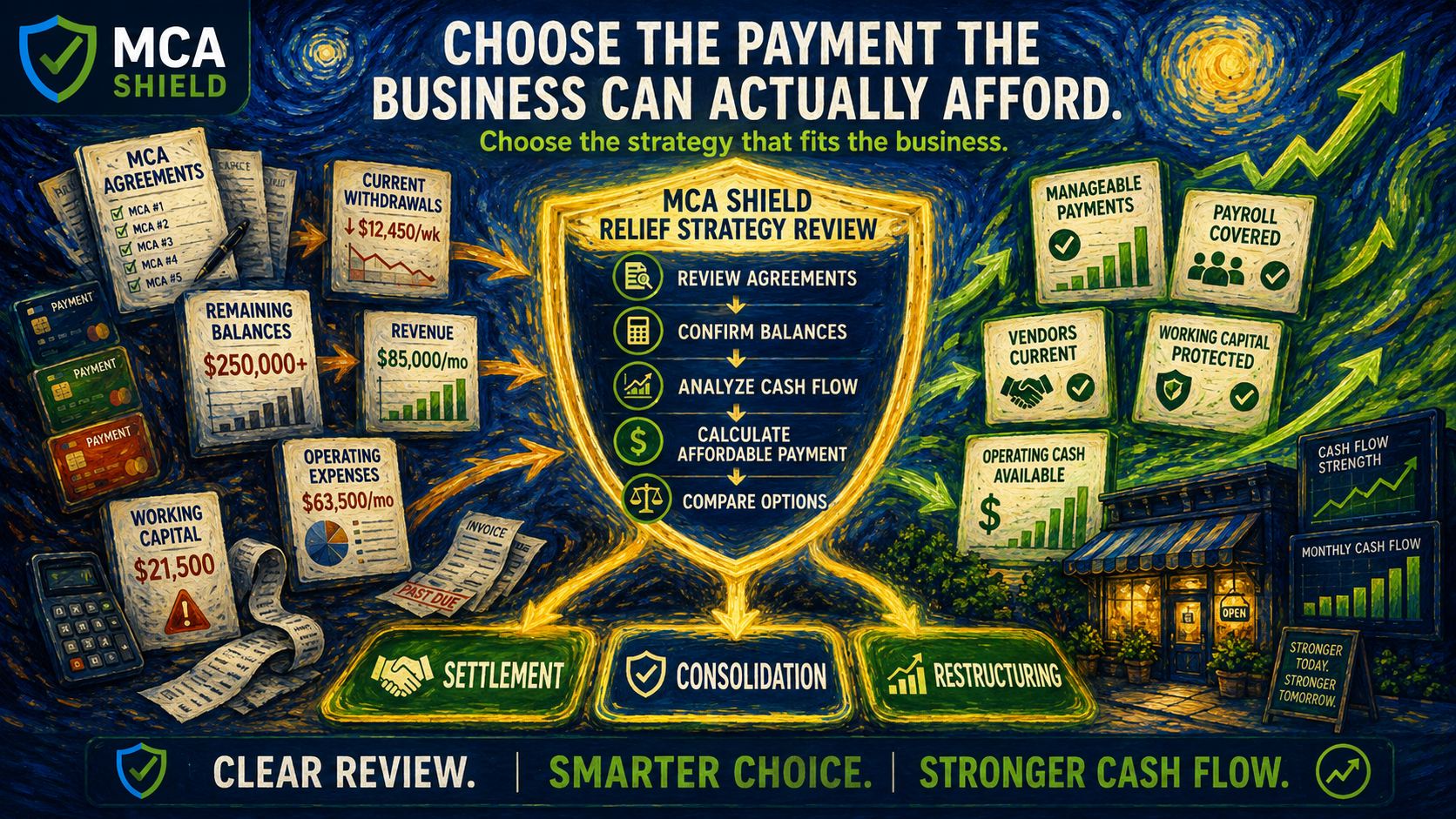
The best MCA relief strategy is not simply the one with the lowest advertised payment. It is the option that gives the business a realistic way to reduce pressure while continuing to operate.
When comparing MCA settlement vs consolidation, business owners should look at the entire financial picture. That includes current balances, payment schedules, revenue, essential expenses, and available working capital.
A good strategy should help the business move toward manageable payments, stronger cash flow, and greater financial stability.
Review Every MCA Agreement and Remaining Balance
Before choosing a relief option, start by reviewing every active MCA agreement.
A complete review should identify:
- Remaining balances
- Daily or weekly withdrawals
- Payment history
- Reconciliation provisions
- Default terms
- UCC filings
- Personal guarantees
- Collection activity
- Other important contract terms
This helps create a clear picture of what the business owes and what risks may exist.
It is also important to compare the total MCA burden against current revenue and operating expenses. A business may discover that one obligation is manageable while another is creating most of the cash-flow pressure.
The goal is to understand the full situation before agreeing to any new payment structure.
Compare Settlement, Consolidation, and Restructuring Options
Businesses under MCA pressure may have more than one possible path forward.
MCA consolidation may help organize multiple obligations into a more manageable repayment structure. MCA settlement may seek to reduce the amount that must be repaid. MCA restructuring may focus on changing payment terms so they better match the business’s cash flow.
Each option has different benefits, costs, and risks.
When comparing strategies, consider:
- Total repayment
- Weekly or monthly payment
- Length of repayment
- Fees
- Cash-flow impact
- Legal or collection risk
- Amount of working capital left after payments
The right solution should not force the business to sacrifice payroll, vendors, taxes, or essential operating expenses just to remain current.
Schedule a Free Consultation With MCA Shield
If daily or weekly MCA payments are putting pressure on your business, it may be time to review your options before the situation becomes more difficult.
MCA Shield can review your MCA agreements, remaining balances, current payments, and business cash flow to help identify which relief strategies may be worth considering.
Whether the business is evaluating settlement, consolidation, or restructuring, the goal is to find a payment strategy that fits the company’s actual financial condition.
Schedule a free consultation with MCA Shield to review your MCA obligations, understand your available options, and determine what your business can realistically afford.