
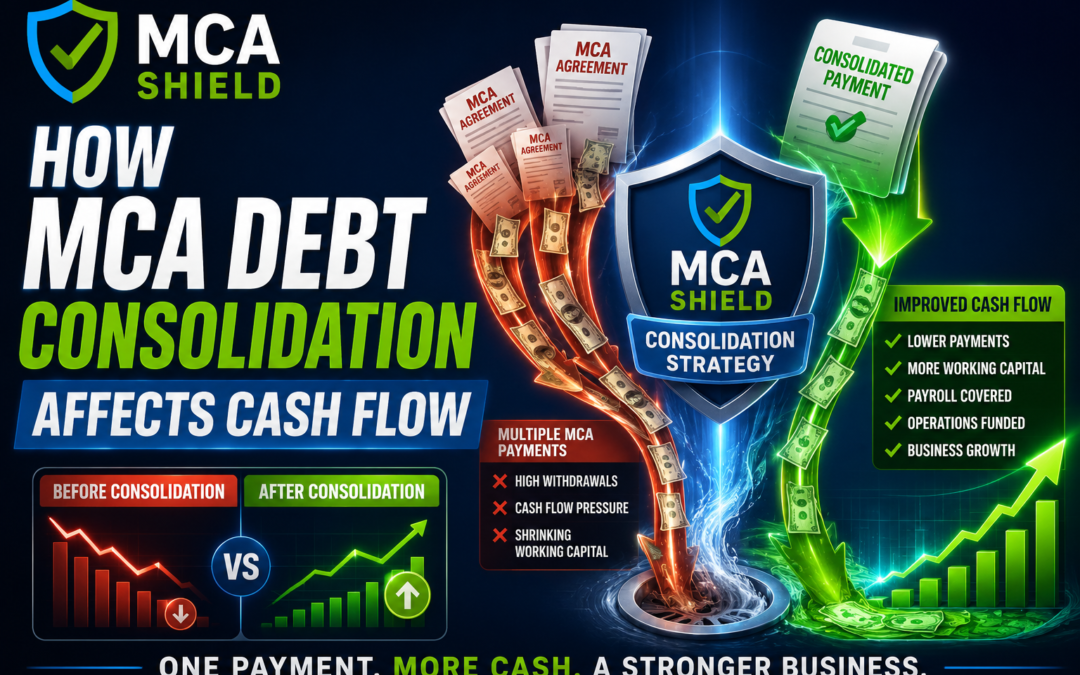
MCA debt consolidation and cash flow are closely connected. When a business has several merchant cash advances, multiple daily or weekly withdrawals can quickly reduce the cash available for payroll, inventory, operating expenses, and working capital.
MCA debt consolidation may help by replacing several payment obligations with a more manageable payment structure. If the new arrangement lowers the amount leaving the business each week, it can create more breathing room and make cash flow easier to predict. However, a lower payment does not automatically mean the consolidation is financially beneficial.
Before choosing consolidation, business owners should compare the new payment, repayment term, total cost, fees, and available working capital. The goal should be more than temporary payment relief. A successful strategy should help the business protect cash flow, cover essential expenses, and remain financially stable.
Schedule Your Free Consultation
How MCA Debt Consolidation Changes Your Daily Cash Flow
One of the biggest effects of MCA debt consolidation and cash flow restructuring is the amount of money that leaves the business each day or week. When several merchant cash advances are active at the same time, each provider may withdraw its own payment. As a result, a large portion of incoming revenue can disappear before the business has a chance to use it.
Consolidation may reduce that pressure by reorganizing multiple MCA obligations into a more manageable payment structure. When the payment fits the company’s actual revenue and operating needs, the business may keep more cash available for essential expenses.
However, the size of the payment is only part of the equation. Business owners should also consider the repayment term, total cost, fees, and remaining working capital before deciding whether consolidation will truly improve cash flow.
Replacing Multiple Withdrawals With a More Manageable Payment
Multiple MCA agreements can create several withdrawals from the same business bank account. Depending on the agreements, those withdrawals may occur daily or weekly. When several payments hit at once, managing ordinary business expenses can become difficult.
For example, a business may need cash for:
- Payroll
- Inventory or materials
- Rent and utilities
- Taxes
- Vendor payments
- Insurance
- Other operating expenses
If MCA withdrawals consume too much revenue, these essential expenses begin competing for the cash that remains.
A properly structured MCA consolidation may replace several separate obligations with one more predictable payment. Instead of trying to manage several withdrawal schedules, the business can work with a clearer payment structure.
The goal is not simply to reduce the number of transactions. The new payment should also be affordable based on the business’s actual cash flow.
If the consolidated payment remains too high, combining the obligations may do little to solve the underlying problem. Therefore, the business should compare its current total MCA withdrawals with the proposed payment before accepting a consolidation agreement.
How Lower Payment Pressure Can Increase Available Cash
When less money leaves the business for MCA payments, more revenue may remain available for everyday operations. This can immediately improve available working capital.
For example, suppose several MCA withdrawals currently remove thousands of dollars from a business account each week. If consolidation significantly reduces that weekly payment burden, the difference may remain in the business.
That additional cash can help the company:
- Cover payroll on time
- Purchase inventory or supplies
- Pay vendors and operating expenses
- Maintain a stronger cash reserve
- Handle unexpected expenses
- Avoid relying on another MCA for short-term cash
This is why the effect of consolidation should be measured by more than the new payment amount. The important question is: How much usable cash will the business have left after the payment is made?
A lower payment can provide valuable breathing room, but only when the overall structure makes financial sense. The strongest MCA consolidation strategy should help the business reduce payment pressure while protecting the cash needed to continue operating.
Ultimately, effective MCA debt consolidation and cash flow management should leave the business with more control over its revenue—not simply a different repayment schedule.
Why Multiple MCA Payments Can Drain Working Capital
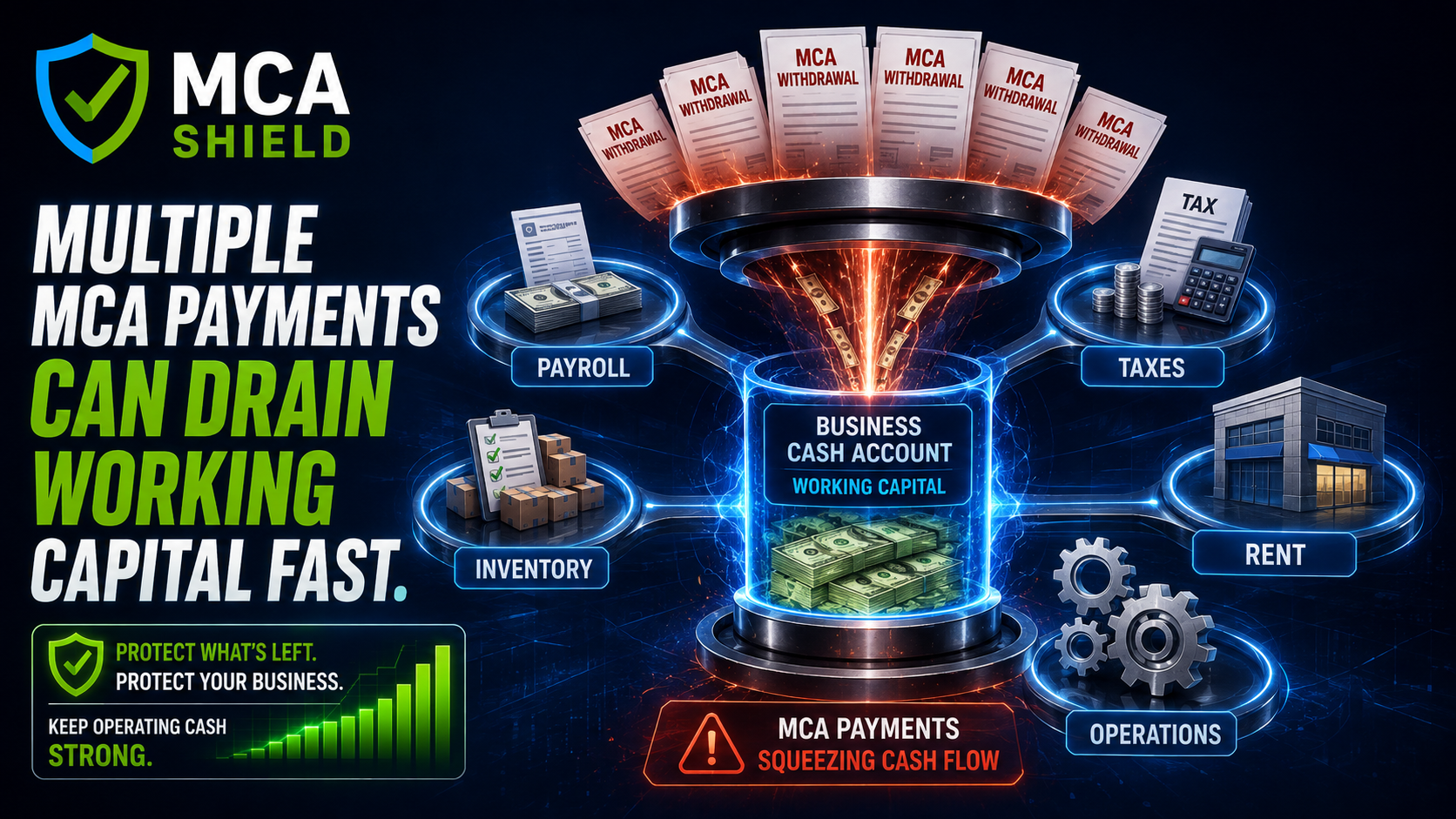
Working capital is the money a business relies on to cover its everyday expenses. When several merchant cash advances are active at the same time, repeated withdrawals can reduce that available cash quickly.
This is one of the biggest reasons MCA debt consolidation and cash flow should be evaluated together. A business may still generate strong revenue, yet struggle financially because too much of that revenue is being removed for MCA payments.
As working capital declines, the business has less flexibility to handle normal expenses, unexpected costs, or temporary drops in revenue. Over time, this pressure can make it harder to operate without borrowing again.
Daily and Weekly Withdrawals Compete With Operating Expenses
Each MCA agreement usually has its own payment schedule. Some payments may be withdrawn daily, while others may come out weekly. When a business has multiple agreements, those withdrawals can overlap and place constant pressure on the bank account.
At the same time, the business still needs money for essential expenses such as:
- Payroll
- Rent and utilities
- Inventory and materials
- Vendor payments
- Insurance
- Taxes
- Equipment and maintenance
The problem is that MCA payments and operating expenses are competing for the same incoming revenue.
For example, a business may receive customer payments throughout the week. However, if several MCA withdrawals occur before payroll or vendor bills are due, the available balance can fall quickly.
This can force the owner to delay expenses, move money between accounts, use personal funds, or search for additional financing.
A healthy payment structure should allow the business to meet its debt obligations while still keeping enough cash available to operate. If MCA withdrawals regularly interfere with payroll or essential expenses, the payment burden may no longer match the company’s real cash-flow capacity.
Stacked Payments Can Create a Cash-Flow Shortfall
A cash-flow shortfall happens when the money available to the business is not enough to cover its obligations. With stacked merchant cash advances, this can happen even when the company continues to make sales.
Suppose a business brings in enough revenue to cover payroll, rent, inventory, and other expenses under normal circumstances. If several MCA payments are deducted from that same revenue, the remaining cash may no longer be enough to cover everything.
This can create a cycle:
MCA payments reduce available cash → operating expenses become harder to cover → the business needs additional money → another MCA appears to provide temporary relief.
However, adding another advance can increase the number of withdrawals and make the next cash-flow shortage even worse.
That is why protecting working capital is so important. The goal is not simply to keep making MCA payments. The business must also preserve enough cash to continue generating revenue.
When considering consolidation, owners should calculate how much money currently leaves the business for all MCA payments combined. They can then compare that amount with the proposed consolidated payment and determine how much cash would remain afterward.
A successful MCA debt consolidation and cash flow strategy should reduce financial pressure while leaving enough money available for payroll, operations, taxes, inventory, and unexpected expenses.
If the new structure does not protect those essential needs, it may not provide the working-capital relief the business actually needs.
How MCA Debt Consolidation Can Improve Working Capital
One of the main goals of MCA debt consolidation is to reduce the amount of cash being pulled from the business on a regular basis. When the new payment is lower than the combined existing MCA withdrawals, the business may be able to keep more money in its bank account.
That extra cash can strengthen working capital and give the business more flexibility to handle normal operating costs. Instead of constantly reacting to payment pressure, the owner may have more room to plan ahead.
This is why MCA debt consolidation and cash flow should be evaluated together. The real benefit comes from how much usable cash remains after the new payment is made.
Keeping More Cash Available for Payroll and Operations
Payroll, rent, inventory, utilities, taxes, and vendor payments all depend on available cash. When MCA withdrawals consume too much of the business’s revenue, these essential expenses can become harder to manage.
A properly structured consolidation may help by reducing the amount leaving the account each day or week. That can leave more money available for:
- Payroll and employee expenses
- Inventory and supplies
- Rent and utilities
- Vendor payments
- Taxes and insurance
- Repairs and equipment
- Unexpected operating costs
Keeping more cash inside the business can also reduce the need to depend on another short-term advance when an unexpected expense appears.
For example, if a company currently pays several MCA providers throughout the week, those withdrawals may leave very little cash available by the time payroll arrives. If consolidation lowers the total payment burden, more of the company’s revenue can remain available for employees and daily operations.
However, the new payment must still fit the business’s financial reality. A consolidation agreement that lowers payments only slightly may not create enough working-capital relief.
The goal should be to establish a payment that allows the business to meet its obligations while still maintaining enough cash to operate effectively.
Creating More Predictable Business Cash Flow
Cash flow becomes difficult to manage when several MCA payments leave the business at different times. Multiple withdrawal schedules can make it harder to know how much money will actually remain available from one day to the next.
Consolidation may simplify that situation by creating a more predictable payment structure.
Predictability can make it easier to plan for:
- Upcoming payroll
- Monthly operating expenses
- Inventory purchases
- Vendor obligations
- Taxes
- Cash reserves
When owners know how much money is expected to leave the account, they can make better decisions about when to spend, save, or invest in the business.
More predictable cash flow can also help prevent the cycle of using new financing to cover temporary shortages caused by existing MCA withdrawals.
Still, predictability alone is not enough. The payment must also be affordable.
Before accepting a consolidation offer, the business should compare the proposed payment with its average revenue, essential expenses, and required working capital. This helps determine whether the new structure will actually improve the company’s financial position.
Effective MCA debt consolidation and cash flow management should do more than combine payments. It should help the business keep more cash available, plan expenses with greater confidence, and build a healthier working-capital position over time.
How Much Cash-Flow Relief Can MCA Consolidation Actually Provide?
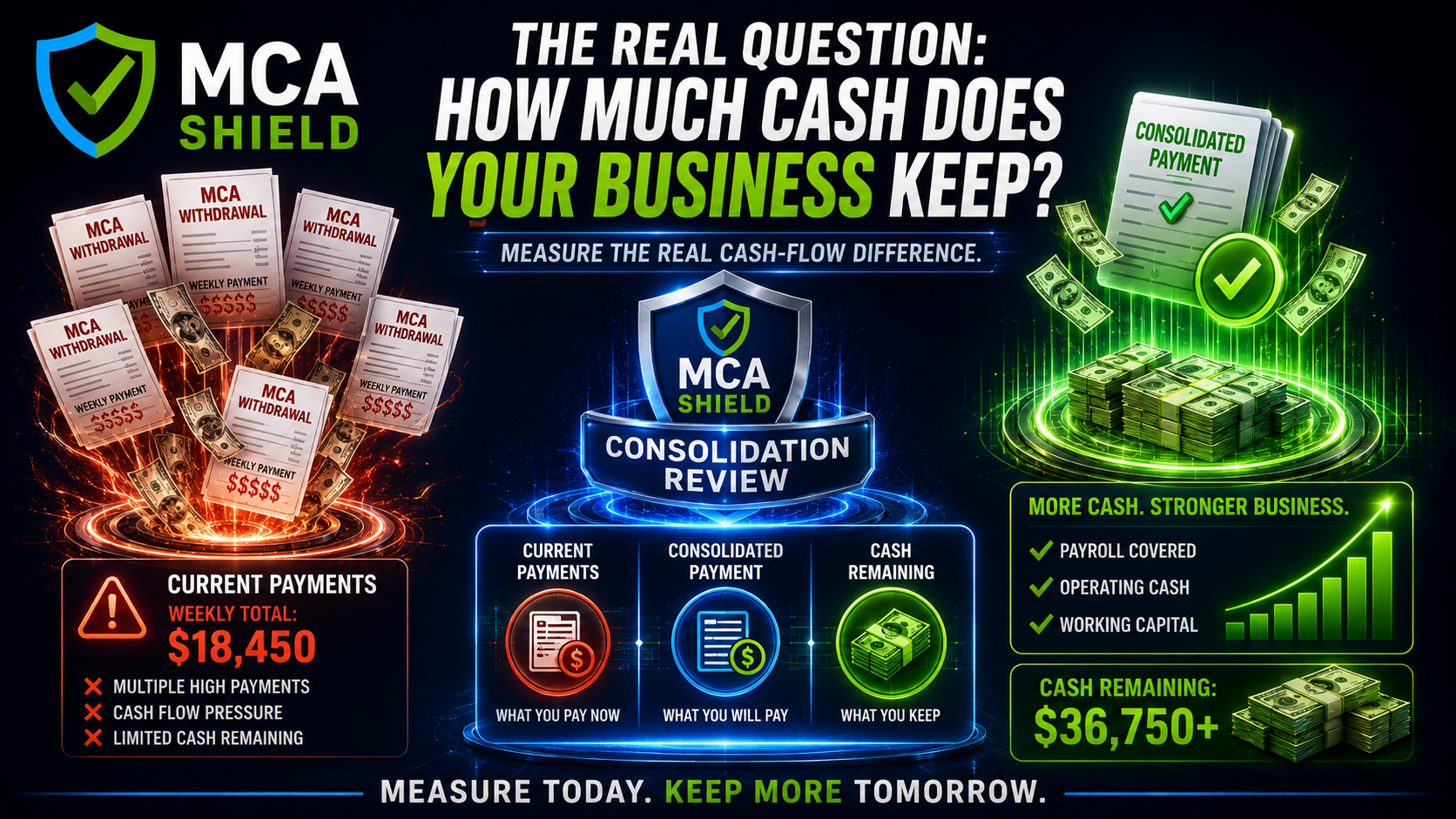
The amount of relief a business receives from MCA debt consolidation depends on the difference between its current payment burden and the proposed new payment. A consolidation offer may look attractive because it combines several obligations. However, the real question is whether it leaves the business with more usable cash each week or month.
This is where MCA debt consolidation and cash flow must be reviewed together. A lower payment can improve financial flexibility, but only if the savings are large enough to help cover normal operating expenses.
Business owners should look beyond the number of payments being combined. They should measure the actual impact on working capital, payroll, operating expenses, and cash reserves.
Compare Current MCA Payments With the Proposed Consolidated Payment
The first step is to calculate how much the business currently pays toward all active merchant cash advances.
For example, if a business has three MCA agreements requiring weekly payments of $1,500, $1,000, and $750, the total weekly MCA payment is $3,250.
If a consolidation proposal reduces that amount to $2,000 per week, the business could potentially keep an additional $1,250 each week.
That difference can be significant. However, the comparison should include more than the payment amount.
Business owners should also review:
- Total repayment amount
- Length of the repayment term
- Interest, fees, or other costs
- Frequency of payments
- Any new funding being added
- Prepayment terms or penalties
A lower weekly payment may improve short-term cash flow while increasing the total amount paid over time. That does not automatically make the consolidation a bad option. However, the business should understand the full financial impact before agreeing to new terms.
The strongest consolidation structure is one that provides meaningful payment relief without creating another financial burden that becomes difficult to manage later.
Measure the Cash Your Business Keeps After Consolidation
The most important number is not simply the new MCA payment. It is the amount of cash the business keeps after that payment is made.
Suppose a company generates $20,000 in weekly revenue and has $14,000 in essential operating expenses. If current MCA payments total $5,000 per week, only $1,000 remains after those obligations are covered.
If consolidation reduces the weekly MCA payment to $3,000, the business could potentially retain $3,000 instead of $1,000.
That additional cash may help cover unexpected costs, strengthen reserves, or reduce the need for additional financing.
Business owners should determine whether the proposed payment leaves enough money available for:
- Payroll
- Rent and utilities
- Inventory or materials
- Taxes
- Vendor payments
- Emergency expenses
- Working-capital reserves
This calculation provides a clearer picture of whether the consolidation actually improves the company’s financial position.
A payment that looks affordable on paper may still be too high if it leaves the business with almost no cash after essential expenses. On the other hand, a properly structured payment can create meaningful room between incoming revenue and outgoing obligations.
Ultimately, the best way to measure MCA debt consolidation and cash flow relief is to ask one simple question: How much more cash will the business have available after consolidation?
If the answer shows enough room to cover essential expenses and rebuild working capital, the consolidation may provide real financial relief. If very little cash remains, the business may need to consider a different payment structure or debt-relief strategy.
MCA Debt Consolidation Can Affect More Than the Payment Amount
A lower payment can make MCA debt consolidation look appealing. However, payment size is only one part of the financial picture.
Business owners should also review the repayment term, total cost, fees, and any new funding included in the agreement. These details can determine whether consolidation creates lasting relief or simply spreads the obligation over a longer period.
For that reason, MCA debt consolidation and cash flow should be measured by the complete financial impact, not just the new daily or weekly payment.
Repayment Term and Total Cost Matter
Extending the repayment period can reduce the amount a business pays each week. That can improve short-term cash flow and leave more money available for operations.
However, a longer term may also increase the total amount paid over time.
For example, a business may reduce its weekly MCA payment substantially by extending repayment. The lower withdrawal can provide valuable breathing room for payroll, inventory, rent, and other operating expenses. Still, the business must compare that immediate relief with the total cost of the new arrangement.
Before accepting a consolidation offer, review:
- The new payment amount
- The length of the repayment term
- The total amount to be repaid
- How much payment relief is created
- The amount of working capital left after each payment
The goal should be to find a structure that balances immediate cash-flow relief with reasonable long-term costs.
A lower payment can be valuable when it gives the business enough room to operate and recover. However, extending repayment without understanding the total cost can create a different financial challenge later.
New Fees or Funding Can Reduce the Real Cash-Flow Benefit
Some consolidation offers may include origination fees, administrative charges, closing costs, or additional funding. These features can change the true value of the agreement.
Additional funding may sound attractive, especially when the business is already short on cash. However, borrowing more money also increases the amount that must eventually be repaid.
For example, a consolidation may reduce several existing payments but also provide extra capital. If that additional funding increases the new balance significantly, part of the expected cash-flow benefit may disappear.
Business owners should separate two questions:
How much does the consolidation reduce existing MCA payment pressure?
How much new debt or additional cost does the agreement create?
This distinction is important. A consolidation strategy should ideally improve the business’s financial position rather than encourage another cycle of borrowing.
Before signing, calculate the net cash-flow benefit after all fees, costs, and new obligations are included. Then determine whether enough money remains for essential business needs.
A strong MCA debt consolidation and cash flow strategy should create meaningful breathing room while protecting working capital and long-term financial stability. The best agreement is not necessarily the one with the lowest payment. It is the one that leaves the business in a stronger financial position after all costs are considered.
When MCA Debt Consolidation May Not Improve Cash Flow
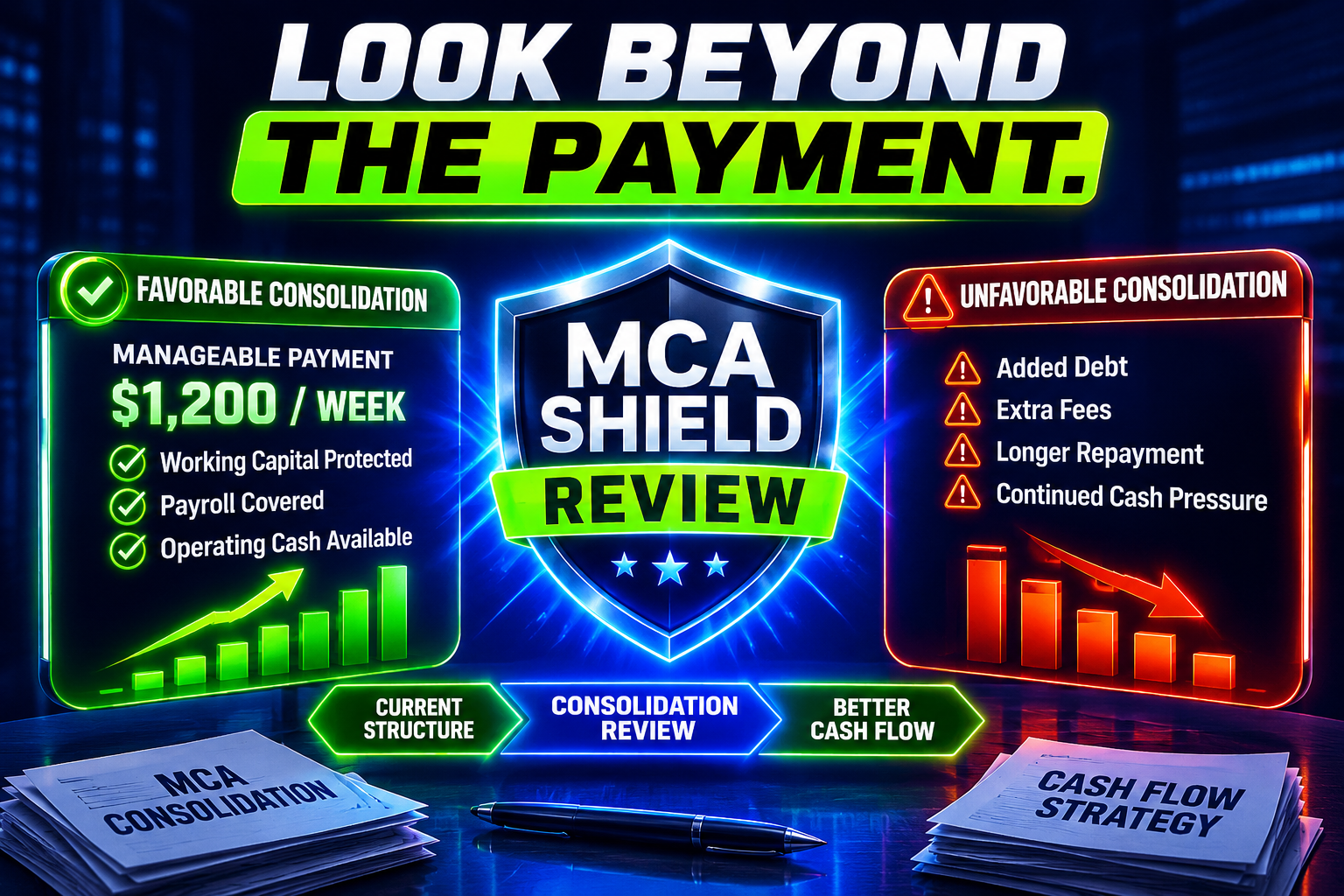
MCA debt consolidation can reduce payment pressure, but it does not automatically improve a business’s financial position. The new agreement must create enough room for the company to cover payroll, operating expenses, taxes, inventory, and other essential costs.
For this reason, business owners should evaluate MCA debt consolidation and cash flow carefully before accepting new terms. If the consolidation adds debt, leaves payments too high, or creates expensive long-term obligations, the expected relief may be limited.
The goal should be simple: the business should have more usable cash after consolidation than it had before.
Consolidation That Adds More Debt
Some consolidation offers include additional funding along with the payoff or restructuring of existing MCA obligations. Although extra cash can seem helpful, it may also increase the total amount the business owes.
For example, a company may consolidate several MCA balances and receive new working capital at the same time. The immediate cash injection can provide temporary relief. However, the larger balance may lead to higher total repayment costs or a longer repayment period.
This can create a dangerous pattern:
Existing MCA pressure → consolidation with new funding → larger total obligation → continued cash-flow pressure.
Before accepting additional funding, the business should ask whether that money is truly necessary. It should also calculate how the new balance affects future payments.
Business owners should compare:
- Existing MCA balances
- Amount being consolidated
- Any new money being advanced
- New payment amount
- Total repayment obligation
- Expected cash remaining after each payment
If consolidation simply replaces several debts with a larger debt that still strains the business, it may not provide meaningful cash-flow improvement.
Payments That Still Exceed What the Business Can Afford
A consolidated payment may be lower than the current combined MCA withdrawals and still be unaffordable.
For example, reducing weekly MCA payments from $6,000 to $4,500 may look like significant relief. However, if the business can realistically afford only $3,000 after covering essential expenses, the new payment still creates a cash-flow problem.
That is why payment affordability should be based on the company’s actual revenue and operating budget, not simply on how much lower the new payment appears.
Before agreeing to consolidation, determine how much cash must remain available for:
- Payroll
- Rent and utilities
- Taxes
- Inventory or materials
- Vendor obligations
- Insurance
- Normal operating expenses
- Emergency reserves
The proposed payment should fit around those essential needs.
If the business must continue delaying bills, using personal funds, or seeking additional financing after consolidation, the new structure may not have solved the underlying problem.
A successful consolidation should create sustainable payment relief, not simply a smaller version of the same cash-flow pressure.
Short-Term Relief That Creates Longer-Term Financial Pressure
Some consolidation agreements can improve cash flow immediately while creating a larger financial burden over time.
A longer repayment term, for example, can lower weekly payments. That may give the business valuable breathing room. However, extending the obligation could also increase the total cost of repayment.
Likewise, fees and additional financing can reduce the real value of the payment savings.
Business owners should therefore look beyond the first few weeks or months of relief. Consider how the agreement will affect the company throughout the entire repayment period.
Ask several important questions:
- Will the business have enough cash to operate after every payment?
- Can the company rebuild working capital and cash reserves?
- Does the longer repayment period make financial sense?
- What is the total cost compared with the existing obligations?
- Could the new structure increase the risk of needing another MCA later?
Effective MCA debt consolidation and cash flow management should improve both immediate affordability and long-term stability.
The right structure should not simply move financial pressure further into the future. It should give the business a realistic opportunity to cover essential expenses, protect working capital, and regain control of cash flow.
How to Evaluate Whether MCA Consolidation Fits Your Business Cash Flow
Before moving forward with MCA debt consolidation, a business should determine whether the proposed payment actually fits its cash flow.
The goal is not simply to combine several obligations into one. The new structure should leave enough money available for payroll, taxes, operating expenses, and working capital.
A careful review of MCA debt consolidation and cash flow can help business owners avoid accepting a payment that looks better on paper but still creates financial pressure.
Calculate Total MCA Withdrawals
Start by identifying every active merchant cash advance and calculating the total amount being withdrawn from the business.
Include all:
- Daily MCA payments
- Weekly MCA payments
- Automatic ACH withdrawals
- Percentage-based revenue withdrawals
- Other required fees or payments
If the business has several MCAs, convert the payments into the same time period so they are easier to compare.
For example, if one MCA withdraws $500 per day and another withdraws $1,200 per week, calculate the approximate weekly burden of both agreements. Then add any other active MCA payments.
This gives the business a clearer picture of its total MCA payment burden.
Next, compare that amount with the proposed consolidation payment.
A consolidation offer should create a meaningful difference between what the business currently pays and what it would pay under the new structure. If the reduction is small, the improvement in cash flow may also be limited.
Business owners should also review the remaining balances and total repayment obligations. This helps determine whether the new payment structure provides real relief or simply rearranges the existing debt.
Determine an Affordable Payment Level
The next step is to determine how much the business can realistically afford to pay without disrupting normal operations.
Start with the company’s average revenue. Then subtract the money needed for essential expenses.
These expenses may include:
- Payroll
- Rent
- Utilities
- Inventory and materials
- Taxes
- Insurance
- Vendor payments
- Equipment and maintenance
- Other necessary operating costs
The cash remaining after these expenses helps show how much the business can reasonably devote to MCA payments.
It is important to leave room for normal changes in revenue as well. A payment that works during a strong sales week may become difficult during a slower period.
For that reason, an affordable payment should not consume every available dollar.
The business should maintain enough working capital and cash reserves to handle unexpected expenses, seasonal changes, or temporary revenue declines.
A sustainable consolidation payment should fit the business’s actual financial capacity rather than forcing the company to constantly find additional cash.
Protect Payroll, Taxes, and Essential Operating Expenses
MCA payments should not leave a business unable to meet its basic operating responsibilities.
Before accepting a consolidation agreement, determine whether the proposed payment still allows the company to cover its most important expenses on time.
Payroll should remain protected. Employees need to be paid regardless of when MCA withdrawals occur.
Taxes should also remain protected. Falling behind on tax obligations can create additional financial and legal problems.
The same applies to rent, utilities, inventory, vendor payments, insurance, and other expenses required to keep the business operating.
A useful way to evaluate a consolidation offer is to calculate the expected bank balance after both the new MCA payment and essential operating expenses have been paid.
If very little cash remains, the payment may still be too aggressive.
If the new structure leaves enough room to operate, maintain reserves, and handle unexpected costs, the consolidation may provide more meaningful relief.
The strongest MCA debt consolidation and cash flow strategy should protect the money the business needs to function. A successful consolidation should not merely make MCA payments easier to manage. It should help the company preserve working capital, meet essential obligations, and create a more sustainable cash-flow structure.
Protect Your Cash Flow Before MCA Payments Become Unsustainable
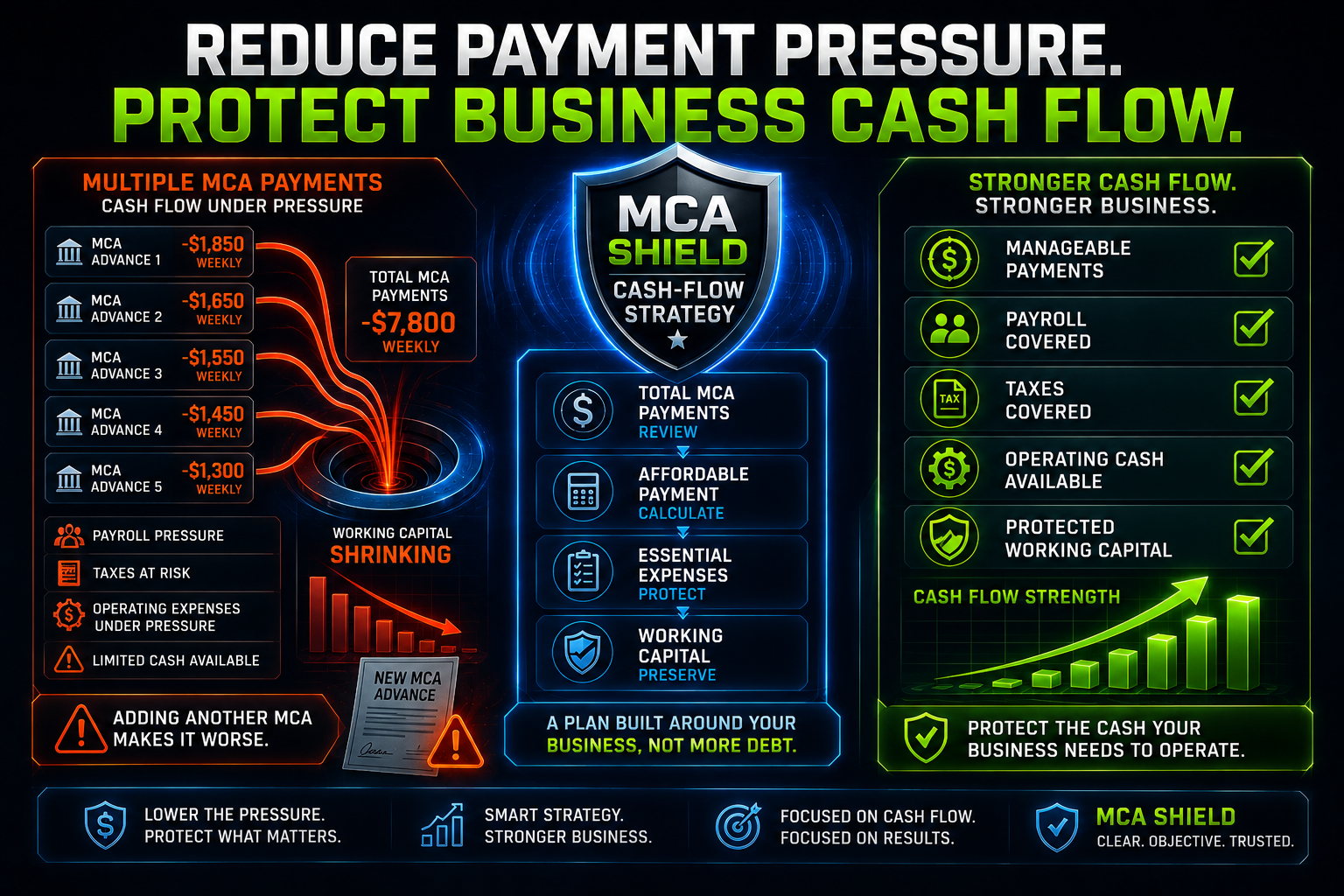
Cash-flow problems often become harder to solve when a business waits until several MCA payments are already consuming most of its available revenue. Taking action earlier can provide more flexibility and more time to evaluate possible solutions.
If daily or weekly withdrawals are beginning to interfere with payroll, taxes, inventory, or essential operating expenses, it may be time to review the entire payment structure.
The goal of MCA debt consolidation and cash flow planning should be to reduce financial pressure before the business reaches a point where every incoming dollar is already committed.
Review Your MCA Obligations Before Taking Another Advance
When cash becomes tight, another merchant cash advance can appear to provide a quick solution. The new funding may cover payroll, an overdue vendor bill, or another immediate expense.
However, another advance also creates another repayment obligation.
If the business is already struggling with existing MCA withdrawals, adding another payment can make the underlying cash-flow problem worse. The additional funding may provide temporary relief while increasing the amount of future revenue committed to repayment.
Before accepting another MCA, review all existing obligations together.
Consider:
- Total daily and weekly MCA withdrawals
- Remaining balances
- Current working capital
- Average business revenue
- Payroll and tax obligations
- Essential operating expenses
- Available cash reserves
This review can show whether the business truly needs additional financing or whether the larger problem is the amount already leaving the account.
For example, a company may believe it needs another $25,000 advance because cash is running low each week. However, if existing MCA payments are removing thousands of dollars from the account before operating expenses are paid, adding another advance may only continue the cycle.
A better first step may be to determine whether the current MCA obligations can be consolidated, restructured, negotiated, or otherwise addressed before taking on more debt.
Choose a Solution That Leaves the Business Financially Stronger
The best MCA solution is not necessarily the one that produces the lowest payment or the largest amount of immediate funding.
It is the solution that leaves the business in a stronger financial position.
Before agreeing to consolidation or another form of MCA relief, compare how the proposed structure will affect the business after all payments and expenses are considered.
Ask whether the new arrangement will help the company:
- Keep more working capital
- Cover payroll consistently
- Stay current on taxes
- Pay vendors and essential expenses
- Maintain an operating cash reserve
- Reduce dependence on additional MCAs
- Create more predictable cash flow
Also consider the total repayment cost, repayment term, fees, and any additional debt included in the agreement.
A consolidation that lowers weekly payments but leaves almost no cash for operations may not provide enough relief. Likewise, a structure that creates immediate breathing room but significantly increases long-term costs deserves careful review.
The objective should be sustainable improvement. The business needs enough cash not only to make debt payments, but also to continue operating, serving customers, and generating revenue.
When MCA payments begin putting those priorities at risk, waiting can narrow the available options. Reviewing the numbers early can help business owners identify a strategy that protects both immediate cash needs and long-term stability.
Ultimately, effective MCA debt consolidation and cash flow management should do more than reorganize debt. It should help the business reduce payment pressure, protect working capital, and regain greater control over its financial future.