
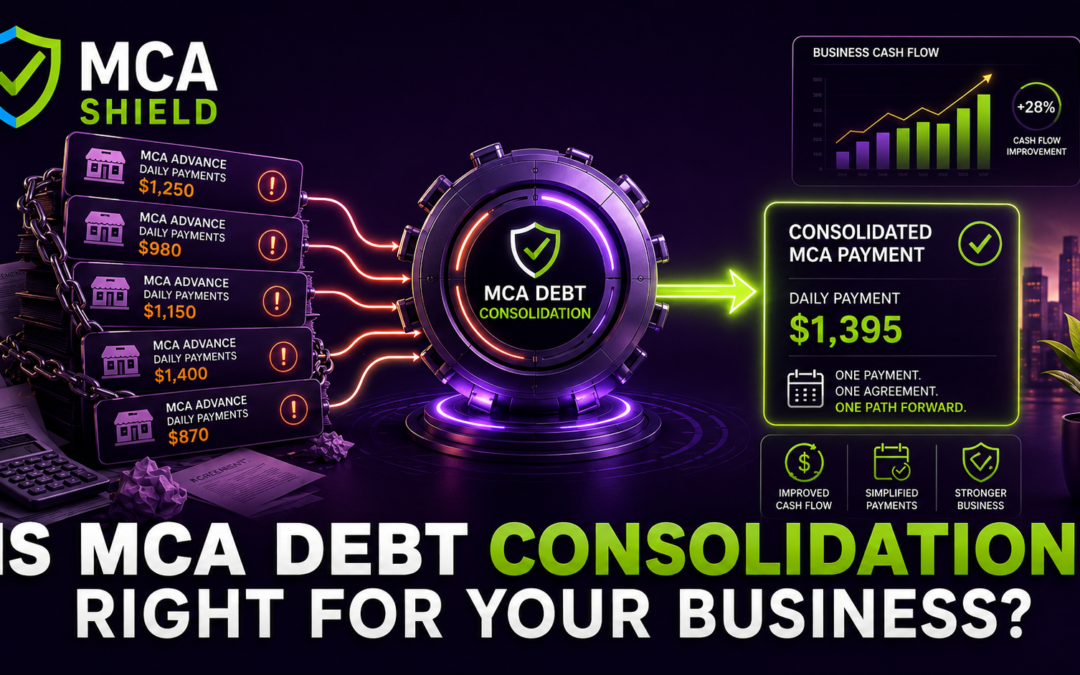
If your business is juggling several merchant cash advances, the repeated withdrawals can put serious pressure on daily cash flow. MCA debt consolidation may offer a way to simplify those obligations, reduce payment pressure, and make your finances easier to manage.
However, consolidation is not automatically the right solution for every business. The new payment structure, total repayment cost, available working capital, and your current financial condition all matter.
In this guide, we will explain how MCA debt consolidation works, when it may make sense, when another option may be better, and what to review before making a decision. The goal is to help you protect cash flow and choose a strategy that supports the long-term health of your business.
Schedule Your Free Consultation
What MCA Debt Consolidation Actually Means for Your Business
MCA debt consolidation is designed to simplify the way a business manages multiple merchant cash advance obligations. Instead of dealing with several separate payments, funders, and withdrawal schedules, the goal is to create a more manageable payment structure.
For many businesses, the biggest problem is not simply the amount owed. It is the combined effect of several MCA payments hitting the same cash flow.
When multiple withdrawals occur each day or week, available cash can disappear quickly. As a result, the business may struggle to cover payroll, inventory, rent, taxes, and other essential operating costs.
MCA debt consolidation attempts to reduce that pressure by bringing multiple obligations into a more organized structure. However, the specific method can vary. Some consolidation options involve new financing, while others may focus on reorganizing or replacing existing payment obligations.
That is why business owners should look beyond the word “consolidation.” The real question is whether the new arrangement creates meaningful cash-flow relief without adding unnecessary cost or risk.
How MCA Debt Consolidation Changes Your Payment Structure
The most noticeable change is usually the number and size of payments leaving the business account.
For example, a company might currently have four MCA agreements with separate daily or weekly withdrawals. Those payments may hit at different times, making cash flow difficult to predict.
A consolidation strategy may replace those obligations with one coordinated payment structure. This can make budgeting easier and may leave more cash available for daily operations.
A stronger payment structure should help the business:
- Reduce payment pressure on daily cash flow
- Create a more predictable payment schedule
- Preserve working capital for operations
- Make budgeting and forecasting easier
- Reduce the complexity of managing multiple MCA obligations
However, fewer payments do not always mean a better deal. A consolidation agreement could extend the repayment period, increase the total cost, or create new fees.
Therefore, businesses should compare the new payment amount, total repayment obligation, payment frequency, and remaining working capital before moving forward.
The best MCA debt consolidation option should do more than combine payments. It should create a structure that the business can realistically afford while still leaving enough cash to operate.
Ultimately, MCA debt consolidation should improve the financial structure of the business—not simply move the debt into a different agreement.
Signs MCA Debt Consolidation May Be the Right Choice
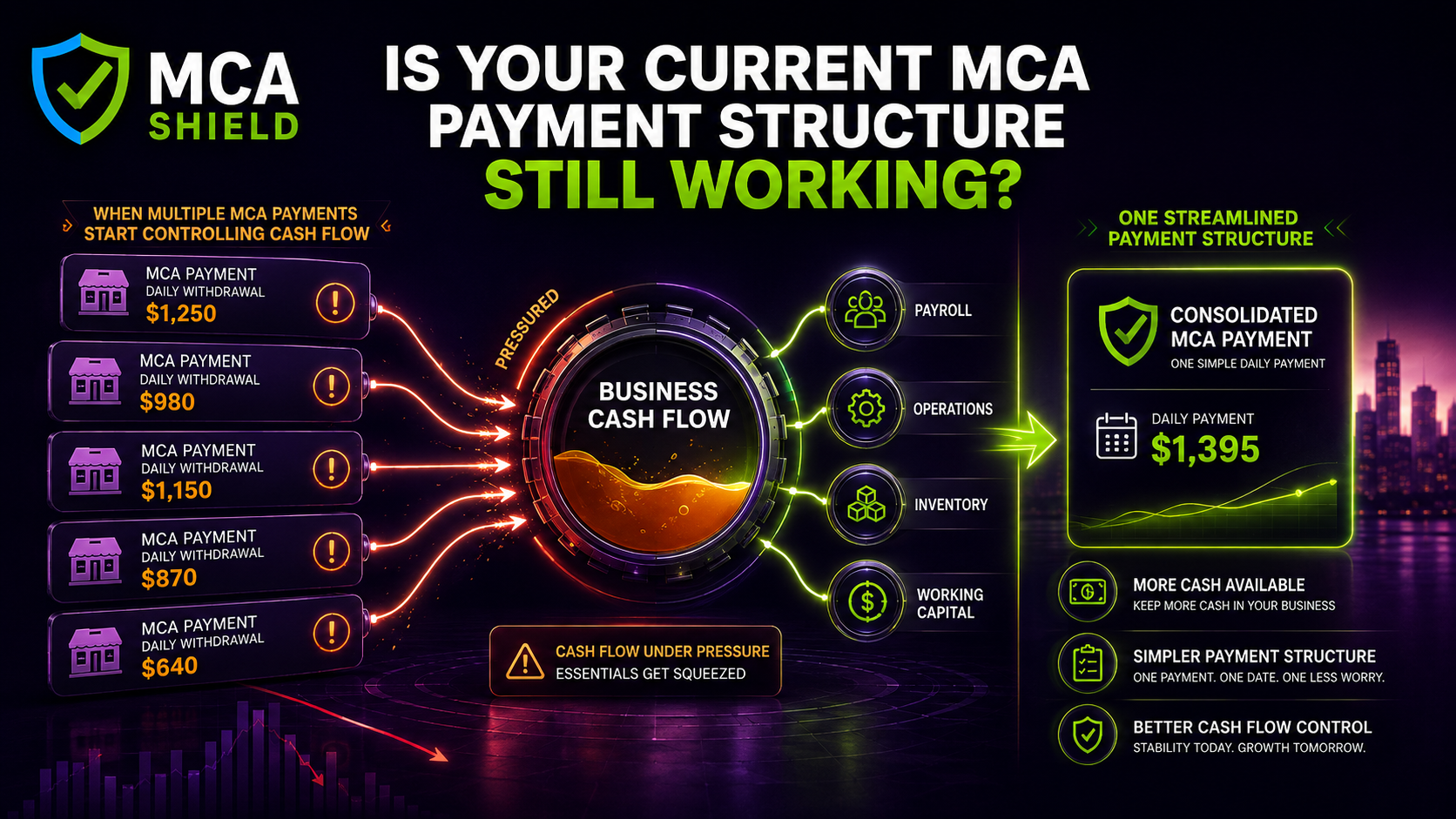
Not every business with merchant cash advances needs consolidation. However, certain warning signs can show that the current payment structure is becoming difficult to sustain.
MCA debt consolidation may be worth considering when multiple withdrawals are reducing available cash, creating budgeting problems, or forcing the business to delay important expenses.
The key is to determine whether consolidation would create a payment structure that is truly more affordable.
Multiple MCA Payments Are Straining Daily Cash Flow
One of the clearest signs is when several MCA payments are pulling money from the same operating account.
Even if each payment seemed manageable on its own, the combined withdrawals can create serious pressure. As a result, the business may struggle to keep enough cash available for normal operations.
Common warning signs include:
- Payroll becoming harder to cover
- Inventory or supplies being delayed
- Operating expenses competing with MCA withdrawals
- Cash reserves shrinking each week
- Another advance being considered just to cover existing payments
When MCA payments begin controlling how the business uses its daily revenue, the current structure may no longer be sustainable.
In this situation, MCA debt consolidation may help reduce payment pressure by replacing several competing obligations with a more organized payment structure.
Your Business Can Support One Affordable Payment
Consolidation only works when the new payment fits the actual cash flow of the business.
A lower number of payments can make finances easier to manage. However, the new consolidated payment must still leave enough money available for payroll, rent, inventory, taxes, and other essential expenses.
Before moving forward, calculate how much the business can realistically afford after its normal operating costs are covered.
A workable consolidation payment should provide enough room for the company to:
- Pay employees on time
- Cover essential operating expenses
- Maintain inventory or materials
- Handle taxes and other obligations
- Keep some cash available for unexpected costs
If one affordable payment can replace several aggressive withdrawals, consolidation may create greater predictability.
However, if the proposed payment still consumes too much of the business’s available cash, another form of MCA relief may be more appropriate.
Consolidation Would Preserve More Working Capital
A strong consolidation strategy should leave the business with more usable cash after payments are made.
Working capital is the money available to keep the business operating. It supports payroll, inventory, equipment, marketing, repairs, and other everyday expenses.
When multiple MCA withdrawals drain working capital, even a profitable business can experience cash-flow problems.
That is why businesses should compare how much money remains under the current payment structure with how much would remain after consolidation.
For example, if several MCA payments currently leave very little cash available each week, a more manageable consolidated payment could provide additional room for operations.
The goal should not simply be to combine debt. The goal should be to create more breathing room in the business’s cash flow.
If MCA debt consolidation allows the company to meet its obligations while protecting enough working capital to continue operating, it may be a strong option to consider.
When MCA Debt Consolidation May Not Be the Best Solution
MCA debt consolidation is not always the best answer. A new payment structure may look simpler, but that does not automatically mean it will improve the financial health of the business.
Before choosing consolidation, review the new payment, total cost, repayment term, and effect on working capital. In some cases, the business may need a different form of relief.
The New Payment Is Still Too High
A consolidation plan should reduce financial pressure, not simply replace several payments with one payment that is still difficult to afford.
If the new payment consumes too much of the business’s available revenue, the underlying cash-flow problem remains.
For example, one consolidated payment may be easier to track than several MCA withdrawals. However, if that payment still leaves too little money for payroll, rent, inventory, taxes, and operating expenses, the business may continue struggling.
Before agreeing to new terms, compare the proposed payment with the company’s actual available cash flow after essential expenses.
A payment may be too high if it causes the business to:
- Delay payroll or vendor payments
- Reduce necessary inventory or supplies
- Use emergency cash reserves
- Fall behind on taxes or operating expenses
- Consider another advance to cover the new payment
The goal of MCA debt consolidation should be to create meaningful financial relief. If the payment remains unaffordable, consolidation may not solve the problem.
Consolidation Requires Taking on More Expensive Debt
Some MCA consolidation options involve taking on new financing to pay off existing obligations.
That can make sense in certain situations. However, businesses should carefully review the full cost before replacing current obligations with a new agreement.
A lower payment can sometimes come with a longer repayment period, higher fees, or a greater total repayment amount.
Therefore, do not evaluate consolidation based only on the size of the new weekly or monthly payment.
Review:
- The total amount being financed
- All fees and closing costs
- The total repayment amount
- The length of the repayment term
- Any early payoff restrictions or penalties
If the new agreement creates substantially more expensive debt, the short-term payment relief may come at a high long-term cost.
A strong consolidation option should improve cash flow without creating a new financial burden that becomes difficult to escape.
The Business Needs Restructuring Rather Than Refinancing
Some businesses do not need another financing product. They need the existing MCA obligations to become more manageable.
This is where MCA debt restructuring may be more appropriate than consolidation.
Restructuring may focus on modifying or negotiating existing payment obligations instead of replacing them with new debt. Depending on the situation, the goal may be to reduce payment pressure, change payment frequency, or create terms that better match the business’s current cash flow.
This can be especially important when the business:
- Cannot qualify for affordable replacement financing
- Already has several high-cost obligations
- Does not have enough cash flow to support another large payment
- Needs immediate relief from aggressive daily or weekly withdrawals
The right strategy depends on the financial condition of the business.
If new financing would only move the problem into another agreement, restructuring may provide a more practical path toward manageable payments and stronger cash flow.
Compare Your Current MCA Payments With the Proposed Consolidation
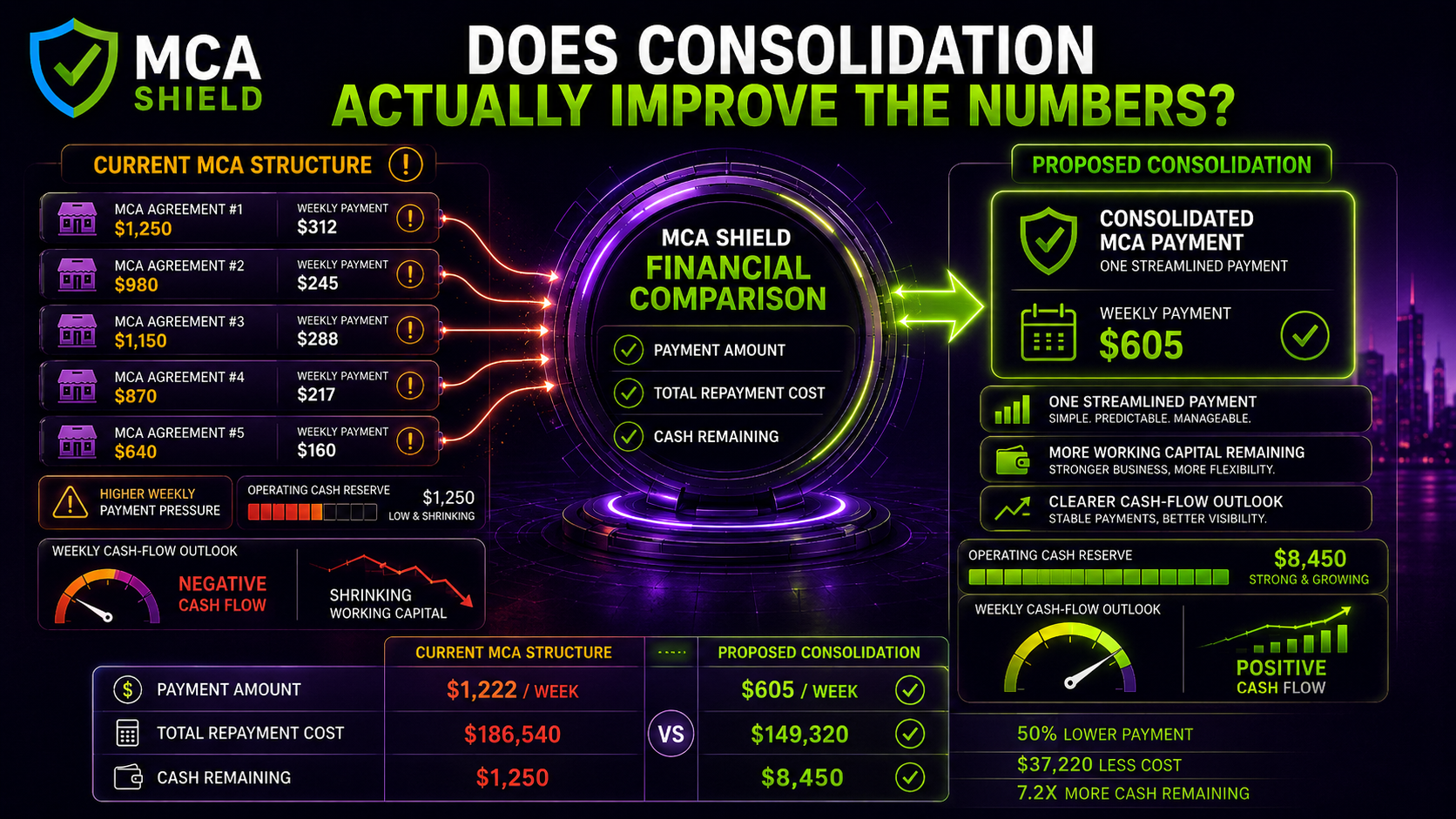
Before choosing MCA debt consolidation, compare the proposed terms with what your business is paying now.
A lower payment can look attractive at first. However, the real value of consolidation depends on how much cash it frees up and what the business will pay over the full term.
The best comparison should focus on both cash-flow improvement and total repayment cost.
Calculate the Real Impact on Weekly and Monthly Cash Flow
Start by adding together every current MCA payment.
If your business has several daily or weekly withdrawals, calculate the total amount leaving the business account each week and each month. This gives you a clear picture of the current payment burden.
Then compare that amount with the proposed consolidated payment.
For example, if several MCA obligations currently require $8,000 per week and consolidation would reduce that amount to $5,000, the business could regain $3,000 in weekly cash flow.
That additional cash could help cover:
- Payroll
- Inventory and supplies
- Rent and utilities
- Taxes
- Vendor payments
- Emergency working capital
However, do not stop with the payment reduction.
Ask how much cash will actually remain after the new payment and essential operating expenses are covered. A consolidation payment should leave enough room for the business to function without constantly relying on credit or additional advances.
The most important question is simple: Will the proposed payment give the business enough cash to operate comfortably?
If the answer is yes, MCA debt consolidation may provide meaningful relief.
Compare Total Repayment Costs Before Making a Decision
A lower payment does not always mean a lower cost.
Some consolidation agreements reduce weekly or monthly payments by extending the repayment period. While this may improve short-term cash flow, the business could pay more over time.
Before signing anything, compare the total repayment amount under both scenarios.
Review the proposed consolidation for:
- Outstanding balances being consolidated
- New financing or origination fees
- Total repayment amount
- Length of the repayment term
- Payment frequency
- Early payoff terms
- Any additional charges or penalties
Then compare those numbers with the remaining cost of the current MCA agreements.
For example, a consolidation plan may save several thousand dollars per month in cash flow but add significantly more to the total repayment obligation. That tradeoff needs to make financial sense for the business.
The strongest solution should balance affordable payments, protected working capital, and reasonable overall cost.
Ultimately, the right MCA debt consolidation strategy should improve more than the appearance of the payment schedule. It should create measurable cash-flow relief without replacing the current problem with a more expensive one.
MCA Debt Consolidation vs. MCA Debt Restructuring: Which Fits Your Situation?
Businesses dealing with multiple merchant cash advances may have more than one path toward payment relief. Two common options are MCA debt consolidation and MCA debt restructuring.
Although both strategies may improve cash flow, they work differently.
MCA debt consolidation generally focuses on combining multiple obligations into a new, more organized payment structure. In contrast, MCA debt restructuring typically focuses on changing or negotiating existing obligations so the payments better match the business’s current financial condition.
The right choice depends on your cash flow, outstanding balances, ability to qualify for new financing, and how much payment relief the business actually needs.
When MCA Debt Consolidation Makes More Sense
MCA debt consolidation may make sense when the business is financially stable enough to support a new payment but wants to simplify several existing obligations.
For example, a company may have three or four separate MCA withdrawals hitting its account every week. The business is still generating steady revenue, but the number and timing of those payments make cash flow difficult to manage.
A well-structured consolidation could replace those obligations with one predictable and affordable payment.
Consolidation may be worth considering when:
- The business has consistent revenue
- Multiple MCA payments are creating unnecessary cash-flow pressure
- One consolidated payment would be significantly easier to afford
- The new agreement would preserve more working capital
- The total repayment cost remains reasonable
- The business can qualify for acceptable consolidation terms
In this situation, consolidation can make financial management much simpler.
Instead of tracking several funders, withdrawal dates, and balances, the business may have one payment structure to manage. That can also make it easier to forecast payroll, inventory purchases, taxes, and other operating expenses.
However, the numbers still need to work.
The value of MCA debt consolidation comes from creating real financial improvement—not simply reducing the number of payments.
If the proposed consolidation lowers payment pressure while protecting enough cash for normal operations, it may be the stronger option.
When MCA Debt Restructuring May Provide Better Relief
MCA debt restructuring may be more appropriate when the business cannot comfortably support new financing or when the existing payment burden has already become too severe.
Instead of replacing MCA obligations with another loan or advance, restructuring may focus on making the current obligations more manageable.
For example, a business may have experienced a decline in revenue after taking several merchant cash advances. Daily withdrawals that once seemed manageable may now consume too much of the company’s available cash.
In that situation, adding new debt could create another layer of financial pressure.
MCA debt restructuring may deserve closer consideration when:
- Current MCA payments are already unaffordable
- The business cannot qualify for reasonable consolidation financing
- Revenue has declined since the original agreements were obtained
- Daily or weekly withdrawals are threatening payroll or essential expenses
- Taking on additional debt would make the situation worse
- The business needs payment relief more than replacement financing
The goal is to create a payment structure that reflects what the business can realistically afford.
Depending on the circumstances, restructuring may involve reviewing existing obligations, communicating with MCA providers, and pursuing changes that reduce short-term payment pressure.
Most importantly, businesses should avoid choosing consolidation simply because it appears easier.
If a new financing agreement carries high costs or still leaves the company short on working capital, MCA debt restructuring may provide a more practical form of relief.
Ultimately, the right strategy should match the financial reality of the business. Consolidation may work best for a company that can support affordable replacement financing, while restructuring may be better when the existing payment structure itself needs to change.
What to Review Before Agreeing to an MCA Debt Consolidation
Before agreeing to MCA debt consolidation, review the full financial impact of the new arrangement.
A lower payment can be helpful, but it should not be the only factor in the decision. The business also needs to understand the total cost, payment schedule, and how much cash will remain after each payment.
A strong consolidation plan should create real cash-flow relief while keeping the overall cost reasonable.
Total Cost of the New Agreement
Start by looking beyond the payment amount and reviewing the total cost of the consolidation agreement.
A lower weekly or monthly payment may seem attractive. However, the business could still pay significantly more if the repayment period is longer or if the agreement includes additional fees.
Review:
- The total amount being consolidated
- Any origination or closing fees
- The total repayment amount
- The length of the repayment term
- Any prepayment restrictions
- Additional charges or penalties
Then compare those numbers with what the business would pay if it continued under the existing MCA agreements.
The goal is not simply to lower the payment. The goal is to create a payment structure that is both affordable and financially reasonable over time.
If the new agreement provides short-term relief but adds a large amount to the total repayment obligation, the business should carefully consider whether the tradeoff is worth it.
Payment Amount and Payment Frequency
Next, review how much the business will pay and how often the payment will occur.
Merchant cash advance obligations often involve frequent withdrawals. Therefore, payment frequency can have a major effect on working capital.
For example, a lower daily payment may still create pressure if money is withdrawn from the business account every weekday. In some cases, a weekly or monthly structure may provide more room to manage incoming revenue and operating expenses.
Before agreeing to MCA debt consolidation, calculate the impact of the proposed payment on a:
- Daily basis
- Weekly basis
- Monthly basis
Then compare that amount with the current combined MCA withdrawals.
The new payment should fit the normal revenue cycle of the business. It should also leave enough cash available between payments to cover essential costs.
A simpler payment schedule has value, but an affordable payment schedule is more important than simply having fewer withdrawals.
Working Capital Remaining After the Payment
One of the most important numbers to review is how much cash will remain after the consolidation payment is made.
Working capital keeps the business operating. It helps cover payroll, inventory, supplies, rent, utilities, taxes, repairs, marketing, and unexpected expenses.
If the new payment still drains most of the available cash, consolidation may not provide enough relief.
Estimate how much money will remain after:
- Revenue enters the business.
- The consolidation payment is made.
- Essential operating expenses are covered.
The remaining amount should provide enough flexibility for the business to handle normal expenses without immediately depending on another advance.
A stronger MCA debt consolidation plan should help the business protect working capital, rebuild cash reserves, and regain control of day-to-day cash flow.
Before signing a new agreement, ask one final question: Will this payment structure leave the business financially stronger than it is today?
If the answer is not clear, the terms may need a closer review before moving forward.
Make the Decision Before MCA Payments Limit Your Options
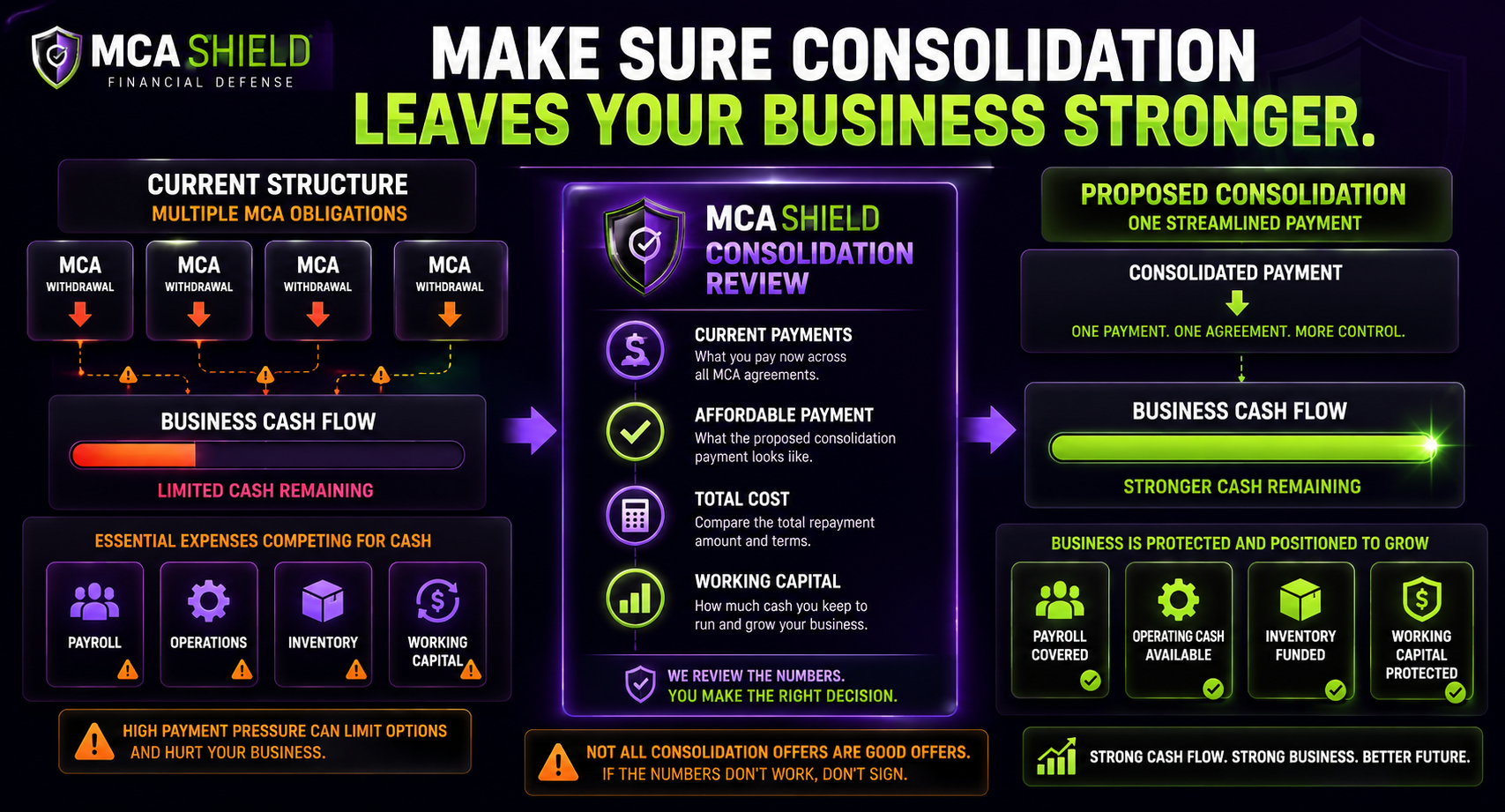
Waiting too long to address merchant cash advance pressure can make the situation harder to fix.
As more revenue goes toward MCA withdrawals, the business may have less cash available for payroll, inventory, taxes, and other essential expenses. Over time, that pressure can reduce the number of realistic financial options available.
MCA debt consolidation is often easier to evaluate while the business still has stable revenue, working capital, and room to make a planned decision.
If payments are already causing serious cash shortages, missed obligations, or repeated overdrafts, the business may have fewer consolidation choices and may need to consider restructuring or another form of MCA relief.
That is why timing matters.
Review Your MCA Debt Consolidation Options While You Still Have Flexibility
The best time to review MCA debt consolidation options is before cash flow reaches a crisis point.
Start by looking at the full picture:
- Total MCA balances
- Current daily or weekly withdrawals
- Available working capital
- Monthly operating expenses
- Revenue trends
- The payment amount the business can realistically afford
Then compare any consolidation offer with the current payment structure.
A strong option should do more than reduce the number of withdrawals. It should help the business protect working capital, maintain essential operations, and create a more manageable path forward.
It is also important to avoid making a rushed decision simply because payment pressure is increasing. A new agreement should be reviewed carefully for cost, payment frequency, repayment terms, and long-term impact.
If the numbers do not create meaningful improvement, another strategy may be more appropriate.
The goal is to make a decision while the business still has choices.
Reviewing MCA debt consolidation before payment pressure becomes critical can give you more time to compare solutions, avoid unnecessary new debt, and choose a strategy based on the needs of the business rather than an immediate cash-flow emergency.
If multiple MCA payments are already putting pressure on your business, schedule a free consultation with MCA Shield to review your obligations, cash flow, and available options before the situation becomes more difficult to manage.