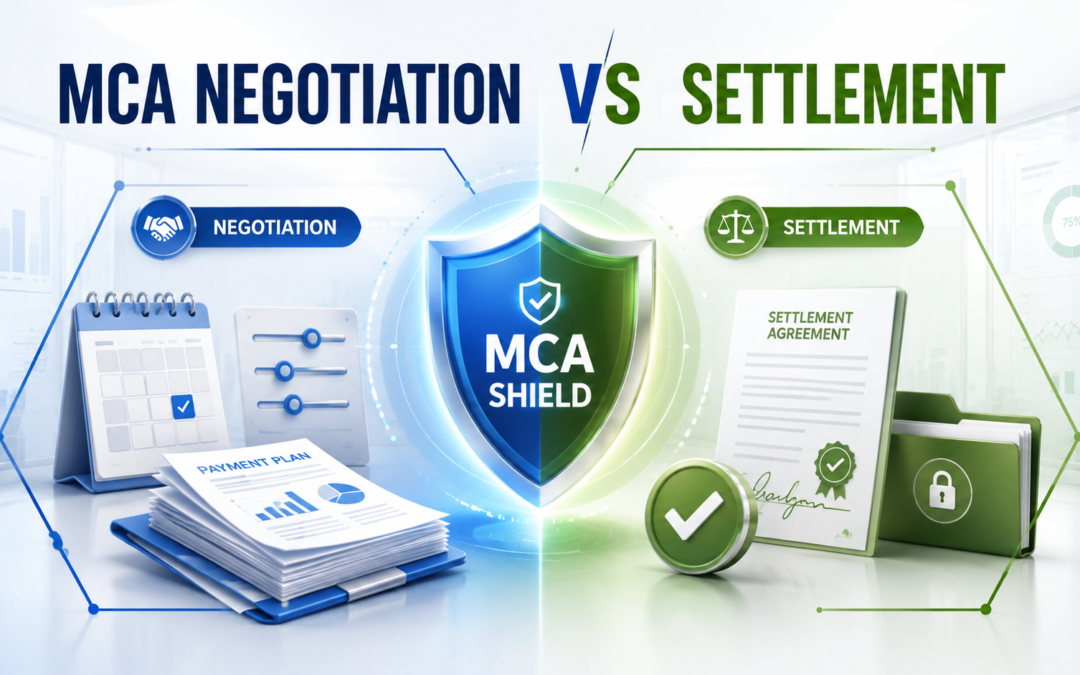
When merchant cash advance payments begin to strain your business cash flow, you may hear two possible solutions: MCA negotiation and MCA settlement. While the terms are sometimes used interchangeably, they can involve very different strategies and outcomes.
Understanding MCA negotiation vs settlement can help you determine which approach may better fit your cash flow, outstanding obligations, and current financial situation. Negotiation may focus on changing payment terms, while settlement may involve resolving an MCA balance for an agreed amount.
In this guide, we will compare MCA negotiation vs settlement, explain how each option works, and discuss when one strategy may make more sense than the other.
Schedule Your Free Consultation
What Is the Difference Between MCA Negotiation and Settlement?
MCA settlement typically focuses on resolving the outstanding obligation for an agreed amount. Rather than simply adjusting the payment schedule, the parties may negotiate an amount that satisfies the obligation in accordance with written settlement terms.
Depending on the circumstances, a settlement could involve a lump-sum payment or a structured series of payments.
Settlement may become an option when the original payment structure is no longer sustainable or when a business has access to funds to resolve the MCA obligation.
The potential advantage is that a successful settlement may provide a clearer path toward closing the obligation. However, settlement terms can vary significantly from one funder and agreement to another.
Business owners should understand exactly:
- How much must be paid
- When payments are due
- Whether the settlement amount is fixed
- What happens after the agreed amount is paid
- How the funder will document that the obligation has been satisfied
Written terms are especially important. A business should clearly understand the agreement before sending settlement funds or making commitments that could create additional financial pressure.
Why Negotiation and Settlement Are Often Confused
Negotiation and settlement are often confused because settlement itself usually involves negotiation.
A business owner may contact an MCA funder seeking lower payments. During those discussions, the parties might negotiate revised payment terms. In another situation, the negotiations could eventually lead to an agreement to resolve the remaining balance for a specific amount.
In other words, negotiation describes the process, while settlement can be one possible outcome of that process.
This distinction becomes especially important when comparing potential MCA relief strategies. A business may need temporary payment relief without pursuing a settlement. Another business may determine that resolving the obligation through a negotiated settlement makes more sense.
There is no single solution that works for every MCA situation. Revenue, cash flow, remaining balances, payment history, and the terms of each agreement can all influence which strategy is appropriate.
That is why a careful review should come before choosing between MCA negotiation and settlement. The objective is not simply to secure the lowest payment today. It is to develop a strategy that addresses the MCA obligation while protecting enough working capital for the business to continue operating.
How MCA Negotiation Can Change Your Payment Terms

One of the main goals of MCA negotiation is to make an existing payment structure more manageable for the business. When daily or weekly withdrawals begin consuming too much revenue, changing the payment terms may help create additional breathing room.
Depending on the agreement and the funder’s willingness to negotiate, changes may involve lower payments, a different withdrawal schedule, or a revised payment structure. The purpose is usually to reduce immediate cash flow pressure without creating a payment plan the business cannot realistically maintain.
However, it is important to understand that changing the payment terms does not automatically mean reducing the total MCA balance.
Reducing Daily or Weekly Payment Pressure
Daily and weekly MCA withdrawals can quickly strain working capital, especially when revenue slows or operating expenses increase.
Through negotiation, a business may seek to reduce the amount being withdrawn each day or week. A lower payment can help leave more cash available for essential expenses such as:
- Payroll
- Rent
- Inventory
- Taxes
- Utilities
- Vendor payments
- Other operating costs
For example, a business may still have enough revenue to remain viable, but its current MCA withdrawals may be leaving too little cash available between payments. In that situation, reducing the payment amount could help the company operate more consistently.
The goal is not simply to obtain the lowest possible payment. The revised payment should be realistic based on actual business cash flow. Agreeing to a payment that is still too high may only delay the same financial problem.
Changing Payment Frequency or Structure
MCA negotiation may also involve changing how often payments are collected or how the repayment arrangement is structured.
A business making daily withdrawals may benefit from a different schedule if the funder agrees. In some cases, negotiations may involve moving toward weekly payments, adjusting withdrawal amounts, or establishing another structured arrangement.
Changing the payment frequency can make it easier for a business to match MCA obligations with the timing of its revenue.
For example, a company with uneven weekly sales may struggle to manage fixed daily withdrawals. A revised structure may provide more flexibility and make cash flow easier to manage.
When reviewing a proposed change, the business should consider more than the individual payment amount. It should also evaluate how the new structure affects total monthly cash requirements and available working capital.
A payment may appear affordable on its own but still create problems when combined with payroll, taxes, operating expenses, and other MCA obligations.
Why Negotiation Does Not Always Reduce the Total Balance
One of the most important differences between MCA negotiation vs settlement is that a negotiated payment reduction does not necessarily reduce the total amount that must be paid.
A funder may agree to lower daily or weekly withdrawals while extending the time needed to satisfy the obligation. This can provide valuable short-term relief, but the remaining balance may be unchanged.
That is why business owners should distinguish between:
- Reducing the payment amount
- Extending the payment period
- Changing the payment frequency
- Reducing the total amount required to resolve the obligation
These are not the same outcome.
A lower payment can still be extremely helpful when the immediate problem is cash flow pressure. However, if the business is seeking to resolve the obligation for less than the remaining amount, that may require a settlement strategy rather than a payment modification alone.
Before accepting revised terms, it is important to understand exactly what is changing and what is not. The best negotiation strategy should improve cash flow while creating a payment arrangement the business can realistically sustain.
How MCA Settlement Can Resolve an Outstanding Balance
MCA settlement focuses on resolving an outstanding merchant cash advance obligation for an agreed amount. Instead of simply modifying the payment schedule, settlement discussions typically center on what the business can realistically pay to bring the obligation to a close.
This can make settlement very different from a standard payment modification. The business is not only asking for smaller withdrawals. It may be seeking an agreement that reduces the amount required to satisfy the remaining obligation.
Whether a settlement is possible depends on the circumstances, the MCA agreement, the funder, the business’s financial condition, and the amount of money available to resolve the account.
How a Reduced Settlement Amount May Work
A reduced settlement may involve the funder agreeing to accept less than the full outstanding amount in exchange for payment under specific terms.
For example, if a business can no longer sustain the existing MCA payment structure, the parties may negotiate an amount that the business can realistically fund. In return, the funder may agree that payment of the settlement amount will satisfy the obligation according to the written agreement.
Several factors can influence whether a reduced settlement is possible, including:
- The remaining MCA balance
- The business’s current revenue
- Available cash reserves
- Payment history
- Whether the account is already in default
- The number of MCA obligations involved
- How quickly settlement funds can be provided
A lower settlement amount can potentially create a clearer path toward resolution. However, a proposed reduction should still fit the business’s overall cash flow strategy.
Using too much working capital to settle one MCA can create new problems if the business still has payroll, taxes, rent, inventory, or other funders to pay.
Lump-Sum vs Structured MCA Settlements
An MCA settlement does not always have to be paid in one transaction.
A lump-sum settlement generally requires the business to pay the agreed amount at once or within a relatively short period. This approach may provide the fastest path to resolving the obligation, but it also requires enough available cash to complete the settlement without disrupting operations.
A structured settlement divides the agreed amount into a series of scheduled payments. This can make the settlement more manageable when the business cannot provide a large lump sum immediately.
Each approach has trade-offs.
A lump-sum settlement may provide faster resolution, while a structured settlement may preserve more working capital in the short term. However, structured payments still need to be realistic. Agreeing to an aggressive settlement schedule can recreate the same cash flow pressure the business was trying to escape.
Before choosing either option, the business should consider how much cash must remain available for essential expenses and other obligations.
Why Written Settlement Terms Matter
Written terms are one of the most important parts of any MCA settlement.
A business should clearly understand exactly what the settlement requires and what happens after the agreed amount is paid. Verbal discussions or informal promises can create uncertainty if the final terms are not documented.
A written settlement agreement should clearly address important details such as:
- The total settlement amount
- Payment deadlines
- Whether the settlement is lump sum or structured
- What happens if a payment is late
- Whether additional fees or charges apply
- How the obligation will be treated after the settlement is completed
- Whether collection activity will stop under the agreement
The business should also confirm that the written terms match what was discussed during negotiations.
This is especially important when comparing MCA negotiation vs settlement. A revised payment arrangement may change how the obligation is paid, while a settlement is intended to resolve it under agreed terms.
The goal is not just to obtain a lower number. It is to secure a clear, workable agreement that the business can follow without creating another cash flow crisis.
MCA Negotiation vs Settlement: Which Provides Better Cash Flow Relief?
When comparing MCA negotiation vs settlement, the better option for cash flow relief depends on what is creating the greatest financial pressure.
Negotiation may provide faster relief by lowering or restructuring ongoing payments. Settlement may offer a more complete resolution by reducing the amount needed to satisfy an outstanding obligation.
The right choice often comes down to three questions: How much relief does the business need now? How much will the strategy cost overall? How much working capital can the business afford to use?
Comparing Immediate Payment Relief
If the most urgent problem is a daily or weekly withdrawal that is draining operating cash, MCA negotiation may provide more immediate relief.
A negotiated arrangement could reduce the payment amount, change the payment schedule, or create a more manageable structure. That can help free up cash for payroll, inventory, rent, taxes, and other essential expenses.
Settlement can also reduce payment pressure, but the timing may depend on the terms of the agreement. A lump-sum settlement, for example, may require a significant amount of cash upfront.
For businesses with limited reserves, that may not be realistic.
The key is to compare how each option affects cash available for operations right now, not simply which one appears to offer the largest reduction.
Comparing the Total Amount the Business May Pay
Immediate relief and total cost are not always the same thing.
A negotiated payment reduction may improve short-term cash flow while leaving the overall obligation largely unchanged. If the payment period is extended, the business may still be required to satisfy most or all of the remaining amount.
A settlement may potentially reduce the total amount required to resolve the obligation. However, that reduction often comes with different payment requirements, deadlines, or funding needs.
This is why a business should compare more than the size of the next payment.
It should also evaluate:
- The total amount expected under the new arrangement
- How long payments will continue
- Whether the balance is being reduced
- How much cash is required upfront
- Whether the proposed terms are sustainable
A lower weekly payment may improve cash flow, while a settlement may provide greater long-term savings. The better result depends on the business’s financial position and ability to complete the agreement.
How Working Capital Changes the Decision
Working capital can have a major impact on whether negotiation or settlement makes more sense.
A business may receive an attractive settlement offer but still be unable to accept it if doing so would consume the cash needed to operate.
For example, using most available reserves to fund a settlement could leave too little money for:
- Payroll
- Taxes
- Inventory
- Rent
- Vendor obligations
- Emergency expenses
In that situation, a negotiated payment structure may provide more practical relief by protecting operating cash.
On the other hand, a business with sufficient reserves may decide that using part of its available cash to resolve an MCA obligation creates a stronger long-term financial position.
This is why working capital should be evaluated alongside the settlement amount or negotiated payment.
The strongest strategy is not necessarily the one with the lowest payment or biggest reduction. It is the one that relieves MCA pressure while leaving the business with enough cash to continue operating and recover financially.
When MCA Negotiation May Be the Better Strategy
MCA negotiation may be the better strategy when the business can continue making payments, but the current payment structure is creating cash flow pressure.
In these situations, the goal is often not to eliminate the obligation immediately. Instead, the business may need a more manageable arrangement that creates enough room to cover essential operating expenses while continuing to address the MCA.
Negotiation may be especially useful when the business still has consistent revenue, wants to preserve available cash, or recognizes the problem before missed payments and collection pressure begin.
When the Business Can Still Support Reduced Payments
A business does not have to be completely unable to pay before considering MCA negotiation.
In many cases, the problem is that the current daily or weekly payment is too aggressive for the business’s present cash flow. Revenue may still be coming in, but the withdrawal amount leaves too little money available for normal operations.
Negotiation may make sense when the business can support a reduced payment that better reflects its financial reality.
For example, the company may still be able to cover:
- Payroll
- Rent
- Taxes
- Inventory
- Utilities
- Vendor expenses
- A reduced MCA payment
The important question is whether the proposed payment can be maintained consistently.
A realistic payment arrangement is generally more valuable than a temporary reduction the business cannot sustain. Before agreeing to new terms, the company should compare the proposed payment against actual revenue and essential monthly expenses.
When Preserving Working Capital Is the Priority
Settlement may require access to a significant amount of cash, particularly when a lump-sum payment is involved. For some businesses, using that much capital at once could create additional financial strain.
If preserving operating cash is the immediate priority, MCA negotiation may offer a way to reduce payment pressure without draining available reserves.
Working capital may be needed to:
- Meet payroll
- Purchase inventory
- Pay taxes
- Cover rent or equipment costs
- Maintain vendor relationships
- Handle unexpected business expenses
A business that uses most of its available cash to resolve one obligation could struggle to meet these other responsibilities.
That does not mean negotiation is always preferable to settlement. However, when cash reserves are limited, protecting enough working capital to keep the business functioning can become the deciding factor.
When You Want to Act Before Default Pressure Increases
Negotiation may also be more effective when the business acts before the situation becomes critical.
Early warning signs can include shrinking cash reserves, difficulty covering payroll, delayed vendor payments, or the temptation to take another MCA simply to keep up with existing withdrawals.
At that stage, the business may still have more flexibility to review its finances and propose a workable payment structure.
Waiting until payments are repeatedly missed can add new complications. Depending on the agreement and circumstances, the business may face increased collection activity, account restrictions, or other forms of financial pressure.
Acting earlier allows the company to focus on solving the cash flow problem before it becomes a larger default problem.
When comparing MCA negotiation vs settlement, negotiation may be the stronger first strategy when the business is still operating, can support a reasonably reduced payment, and needs to protect working capital while addressing the obligation.
When MCA Settlement May Be the Better Strategy
MCA settlement may be the better strategy when modifying the payment schedule is no longer enough to resolve the underlying problem.
If the business cannot realistically sustain even reduced payments, continuing to extend the obligation may only prolong the financial pressure. In those situations, settlement may provide a clearer path toward resolving the outstanding balance under agreed terms.
Settlement can be especially relevant when cash flow has deteriorated significantly, funds are available to support a resolution, or default and collection activity have already begun.
When Existing MCA Payments Are No Longer Sustainable
There is an important difference between a payment that is uncomfortable and one that the business cannot support.
If revenue has declined substantially or operating expenses have increased, even a reduced MCA payment may continue to consume too much working capital.
Warning signs can include:
- Repeated difficulty covering payroll
- Falling behind on taxes or rent
- Delayed vendor payments
- Insufficient cash for inventory
- Overdrafts or returned payments
- Using new financing to cover existing MCA obligations
- Multiple MCA withdrawals competing for the same revenue
At that point, simply lowering the payment may not address the larger financial problem.
Settlement may become more practical when the business needs to resolve the obligation rather than extend it over a longer period.
However, the business should still evaluate whether the proposed settlement is realistic. An agreement that requires more cash than the company can safely provide may create another financial crisis.
When the Business Has Access to Settlement Funds
Access to available cash can significantly influence the decision between MCA negotiation vs settlement.
If the business has capital available to fund a reasonable settlement while continuing to cover essential expenses, settlement may offer a faster route to resolving the obligation.
Potential sources could include:
- Existing cash reserves
- Improved recent revenue
- Sale of nonessential business assets
- Owner contributions
- Other legitimate sources of available capital
The key is determining how much money can be committed without interfering with normal operations.
For example, a settlement may look attractive because it reduces the amount needed to resolve the MCA. However, using nearly every available dollar to complete that settlement could leave the business unable to make payroll or purchase inventory the following week.
A strong settlement strategy should consider both sides of the equation: how much it takes to resolve the obligation and how much cash the business needs to keep operating afterward.
When Default or Collection Pressure Has Already Started
Settlement may also become more relevant after an MCA account has entered default or collection activity has begun.
At this stage, the original payment arrangement may already have broken down. The focus can shift from modifying routine withdrawals to finding a realistic way to resolve the outstanding obligation.
Depending on the situation, the business may be dealing with:
- Default notices
- Increased collection calls or correspondence
- Demands for payment
- Multiple funders seeking payment at the same time
- Greater pressure on business accounts and cash flow
These circumstances can make it more important to evaluate the entire financial picture before agreeing to new terms.
A settlement may provide a path toward resolution, but business owners should carefully review any proposed agreement before making payments or accepting new obligations.
When comparing MCA negotiation vs settlement, settlement may make more sense when the existing payment structure has failed, the business has access to funds that support a resolution, and continuing the current arrangement would only deepen the financial strain.
Can MCA Negotiation Lead to an MCA Settlement?
How Multiple MCA Agreements Affect Negotiation vs Settlement
When a business has more than one merchant cash advance, deciding between MCA negotiation vs settlement becomes more complicated.
Each MCA may have its own payment amount, balance, funder, collection status, and contract terms. However, every payment is ultimately coming from the same pool of business revenue.
That means a decision involving one MCA can directly affect the company’s ability to handle the others.
A successful strategy should look beyond individual accounts and evaluate the total MCA payment burden, available working capital, and essential operating expenses before deciding which obligations to negotiate, settle, or address first.
Why One MCA Cannot Always Be Evaluated by Itself
An offer from one MCA funder may appear manageable when viewed on its own.
For example, a reduced weekly payment may sound affordable. However, the business may still have two or three additional MCA withdrawals hitting the account during the same week.
Similarly, using a large amount of cash to settle one obligation could leave too little money available for the remaining funders.
That is why businesses with multiple MCAs should evaluate:
- Total daily and weekly MCA withdrawals
- Remaining balances across all agreements
- Payroll and operating expenses
- Available cash reserves
- Revenue trends
- Which accounts are current or in default
- Potential settlement requirements
- Upcoming taxes, rent, inventory, and vendor expenses
Solving one MCA problem should not create a larger cash flow problem somewhere else.
When several advances are involved, each negotiation or settlement decision should be viewed as part of the company’s overall financial picture.
Deciding Which MCA Obligations to Address First
Not every MCA obligation will necessarily require the same strategy or level of urgency.
One funder may be creating the greatest daily withdrawal pressure. Another account may already be in default. A third funder may be willing to discuss revised terms, while another may present a potential settlement opportunity.
Therefore, businesses may need to prioritize obligations based on factors such as:
- Which MCA is consuming the most cash flow
- Which payments are most difficult to maintain
- Whether default or collection activity has started
- The remaining balance on each agreement
- Whether a funder is willing to negotiate
- Whether settlement funds are available
- How resolving one obligation would affect the others
For example, reducing the payment on the largest daily withdrawal could create immediate operating relief. In another situation, settling one MCA completely may free enough cash flow to make the remaining obligations manageable.
The first MCA addressed should be the one that best supports the overall strategy, not simply the funder demanding attention most aggressively.
Building a Strategy Around the Total Payment Burden
With multiple MCA agreements, the most important number is often not the payment on any single account. It is the total amount leaving the business across all MCA obligations.
A coordinated strategy begins by determining how much the company can realistically devote to MCA payments while still funding normal operations.
That calculation should leave enough cash available for:
- Payroll
- Rent
- Taxes
- Inventory
- Utilities
- Vendor payments
- Insurance
- Other essential business expenses
Once that amount is established, the business can evaluate whether negotiation, settlement, or a combination of both may provide the strongest path forward.
For example, one MCA may be restructured to reduce weekly payment pressure while another is resolved through settlement. A third obligation may need to be addressed later as cash flow improves.
This approach is often more practical than trying to force the same solution onto every account.
When comparing MCA negotiation vs settlement across multiple obligations, the goal should be to create one coordinated strategy that reduces overall payment pressure, protects working capital, and keeps the business financially functional.
Choosing Between MCA Negotiation and Settlement Before Your Options Narrow
Choosing between MCA negotiation and settlement should be based on what gives the business the strongest chance to stabilize cash flow and meet its remaining obligations.
Negotiation may make more sense when the business can continue paying under revised terms. Settlement may be more appropriate when the existing obligation needs a clearer path toward resolution.
The key is to evaluate these options before financial pressure becomes severe enough to limit flexibility.
Review Your Cash Flow Before Making a Decision
Before choosing a strategy, start with a realistic review of the business’s current cash flow.
Look at how much revenue is coming in, how much is leaving for MCA payments, and what must be reserved for essential operating expenses.
Important numbers to review include:
- Average weekly and monthly revenue
- Current MCA withdrawals
- Payroll
- Rent or lease payments
- Taxes
- Inventory and supplies
- Vendor obligations
- Available cash reserves
- Other debt payments
This review helps determine whether the business can support a reduced payment or whether continuing the obligation under modified terms would still create pressure.
For example, if a lower MCA payment leaves enough cash for payroll and operating expenses, negotiation may be practical. If even a reduced payment would continue draining working capital, settlement may warrant closer consideration.
The decision should begin with what the business can realistically afford, not with what a funder is asking it to pay.
Compare Short-Term Relief With Long-Term Cost
A payment reduction can provide valuable relief today, but business owners should also consider what the arrangement will cost over time.
Negotiation may lower daily or weekly withdrawals while extending the period needed to satisfy the obligation. Settlement may require more cash upfront but could resolve the account sooner or for an agreed reduced amount.
When comparing the two, consider:
- How much cash flow improves immediately
- The total amount expected to be paid
- How long the obligation will continue
- Whether the outstanding amount is actually reduced
- How much working capital must be committed
- Whether the proposed terms are realistic
This is where the MCA negotiation vs settlement comparison becomes especially important.
A lower payment is not automatically the better deal, just as a reduced settlement amount is not automatically the better choice. The stronger option is the one that balances immediate relief with the long-term financial health of the business.
Get Professional Help Evaluating Your MCA Options
MCA agreements can contain complicated payment provisions, default terms, reconciliation language, guarantees, and other conditions that may affect the available options.
When several MCA obligations are involved, the situation can become even more difficult to evaluate.
Professional assistance can help a business review:
- Current MCA agreements
- Remaining balances
- Payment schedules
- Cash flow pressure
- Settlement proposals
- Revised payment offers
- Multiple-funder obligations
- The overall financial impact of each option
The purpose is not simply to negotiate the lowest possible payment. It is to develop a strategy that the business can realistically complete.
MCA Shield can review your current obligations, evaluate negotiation and settlement options, and help build a strategy around the financial needs of your business.
If MCA payments are beginning to restrict your ability to operate, waiting can make the situation harder to manage.
Schedule a Free Consultation With MCA Shield
A careful review can help you understand whether negotiation, settlement, or a coordinated combination of both may offer the strongest path forward.
Schedule a Free Consultation With MCA Shield to discuss your MCA obligations, cash flow, and available options before the financial pressure grows.