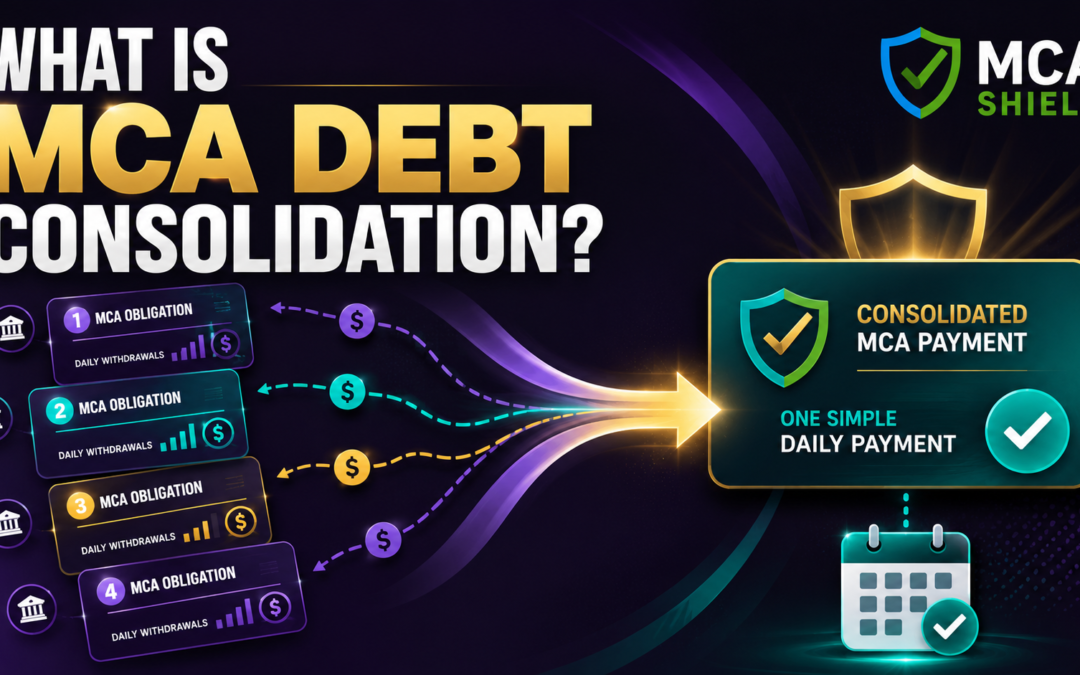
MCA debt consolidation is a strategy businesses may explore when multiple merchant cash advance payments begin putting too much pressure on cash flow. Instead of managing several daily or weekly withdrawals, the goal is to create a more manageable payment structure.
For many businesses, stacked MCA payments can quickly reduce the cash available for payroll, inventory, operating expenses, and other essential costs. As a result, business owners may look for ways to lower the overall payment burden and regain control of working capital.
However, MCA debt consolidation does not always mean taking out one new loan to pay off every advance. Depending on the situation, restructuring, negotiation, or other MCA debt relief strategies may provide a better path. Understanding how each option works can help you choose a solution that protects your business and improves cash flow.
Schedule Your Free Consultation
What Is MCA Debt Consolidation and How Does It Work?
MCA debt consolidation is a strategy designed to make multiple merchant cash advance obligations easier to manage. A business with several MCAs may have multiple daily or weekly withdrawals coming from the same operating account. Over time, those payments can place significant pressure on cash flow and working capital.
The basic idea behind MCA debt consolidation is to replace or reorganize several separate payment obligations into a simpler and more manageable payment structure. Depending on the business and the agreements involved, this may be done through new financing, restructuring, negotiation, or another debt relief strategy.
The right approach depends on factors such as the number of MCA agreements, current payment amounts, remaining balances, business revenue, and how much the company can realistically afford to pay.
The Goal of Consolidating Multiple MCA Payments
The main goal of consolidating multiple MCA payments is to reduce financial pressure and improve cash-flow management.
When several MCA companies are withdrawing money from the same business account, the combined payment burden can quickly become difficult to maintain. Even a profitable business may struggle if too much revenue is being removed before essential expenses are paid.
A successful consolidation or restructuring strategy may help a business:
- Reduce the number of separate payments
- Lower the overall daily or weekly payment burden
- Preserve more cash for payroll and operating expenses
- Make payment obligations easier to track
- Improve short-term working capital
- Create a more predictable financial structure
The goal is not simply to move debt from one place to another. The new structure must actually be more affordable for the business.
If the replacement payment is still too high, or if the business takes on expensive new financing, consolidation may only delay the underlying cash-flow problem.
MCA Debt Consolidation vs. Traditional Business Debt Consolidation
MCA debt consolidation is different from traditional business debt consolidation because merchant cash advances are structured differently from standard business loans.
With traditional debt consolidation, a company may take out one new loan and use the proceeds to pay off several existing loans or credit accounts. The business then makes one payment on the new consolidation loan.
Merchant cash advances can be more complicated. MCA agreements often involve daily or weekly withdrawals tied to business receivables or revenue. Businesses with multiple MCAs may also have different funders, payment schedules, balances, and contract terms.
Because of this, qualifying for a traditional consolidation loan may be difficult, especially when the business is already experiencing cash-flow problems.
In some cases, negotiating or restructuring existing MCA obligations may provide a more realistic alternative than taking on another loan.
Before choosing any form of MCA debt consolidation, businesses should compare the new payment structure with their current obligations. The most important question is whether the solution will leave enough cash available to operate the business successfully while meeting the new payment terms.
Why Businesses Consider MCA Debt Consolidation
Businesses often consider MCA debt consolidation when merchant cash advance payments begin taking too much money out of daily operations. One MCA payment may be manageable on its own. However, several advances can create a much heavier financial burden.
Each MCA agreement may have its own payment amount, withdrawal schedule, and remaining balance. When those obligations overlap, a large portion of business revenue can leave the account before the company has a chance to cover normal expenses.
For this reason, businesses may explore consolidation or restructuring as a way to reduce payment pressure, simplify obligations, and preserve working capital.
When Multiple MCA Payments Strain Cash Flow
Cash-flow problems often begin when several MCA payments compete with essential business expenses.
A company may still be generating strong sales, but that does not always mean enough cash remains available after MCA withdrawals. If several funders are collecting payments from the same operating account, the business may struggle to keep enough money available for:
- Payroll
- Rent or lease payments
- Inventory and supplies
- Taxes
- Vendor payments
- Utilities
- Insurance
- Other operating expenses
As more revenue goes toward MCA obligations, the business has less flexibility to handle unexpected costs or slower sales periods.
This is often when business owners begin searching for MCA debt consolidation options. The goal is to create a payment structure that better reflects what the business can realistically afford while continuing to operate.
However, consolidation should do more than simply reduce the number of payments. A successful strategy should help improve the company’s overall cash-flow position.
How Daily and Weekly Withdrawals Can Become Difficult to Manage
Many merchant cash advances require daily or weekly withdrawals from the business bank account. These frequent payments can create significant pressure because money leaves the account continuously.
For example, a business may be able to manage one daily withdrawal without difficulty. Add a second, third, or fourth MCA, and the total amount removed each week can increase quickly.
The problem becomes even more serious when revenue changes from day to day.
A business may have enough cash during a strong sales week but struggle during a slower period. Meanwhile, payroll, rent, inventory, and other expenses still need to be paid.
Repeated withdrawals can also make it harder to build a financial cushion. Instead of accumulating reserves, the business may find that available cash disappears almost as quickly as revenue enters the account.
At that point, taking another merchant cash advance may seem like a quick solution. However, adding new debt can create an even larger payment burden.
Exploring MCA debt consolidation, restructuring, or negotiation before adding another advance may help the business find a more sustainable way to manage its obligations and protect the cash needed for daily operations.
Can Multiple Merchant Cash Advances Be Consolidated Into One Payment?

In some situations, multiple merchant cash advances can be combined into a more manageable payment structure. However, MCA debt consolidation does not always work like traditional loan consolidation.
A business may have several MCA companies withdrawing payments from the same operating account. Combining those obligations into one payment can sound appealing because it may simplify cash-flow management and reduce the number of withdrawals.
The challenge is finding a solution that actually improves the business’s financial position. A new payment should not simply replace several difficult obligations with one equally unaffordable obligation.
Before pursuing MCA debt consolidation, businesses should compare the proposed payment with their current total payment burden. The goal should be to create enough room for payroll, operating expenses, taxes, inventory, and other essential costs.
Why Traditional Consolidation Loans May Not Be an Option
Traditional business debt consolidation usually involves taking out a new loan and using the proceeds to pay off existing debts.
For a business carrying multiple merchant cash advances, qualifying for that type of financing may be difficult.
Multiple MCA payments can reduce available cash and weaken the financial picture lenders review. A business may also have high existing obligations, recent financing activity, or inconsistent cash flow.
As a result, traditional lenders may be unwilling to provide enough financing to pay off the existing MCA balances. Even when financing is available, the terms may not provide enough relief.
A consolidation option should be evaluated carefully. Businesses should consider:
- The new payment amount
- The repayment period
- The total cost of the new financing
- Fees associated with the transaction
- Whether existing MCA obligations will be fully resolved
- How much working capital will remain available afterward
The key question is not simply whether the business can qualify. It is whether the new structure will actually create a more sustainable cash-flow position.
Alternatives to a New Consolidation Loan
If a traditional consolidation loan is unavailable or does not provide enough relief, other strategies may be worth exploring.
One option is MCA debt restructuring, which focuses on changing how existing obligations are handled rather than replacing them with another loan.
Businesses may also explore MCA negotiation. Depending on the circumstances and the willingness of individual funders, negotiations may involve changes to payment amounts, payment frequency, or other repayment terms.
In more serious situations, MCA settlement may also be considered. Settlement generally involves attempting to resolve an obligation for an agreed amount under negotiated terms. However, it is different from consolidation and may involve additional financial, contractual, or legal considerations.
The best approach depends on the business’s cash flow, number of MCA agreements, remaining balances, and overall financial condition.
Most importantly, businesses should avoid assuming that another merchant cash advance is the only way to manage existing MCA debt. Adding more financing without addressing the total payment burden can make the problem worse.
A careful review of all existing obligations can help determine whether MCA debt consolidation, restructuring, negotiation, or another debt relief strategy offers the most realistic path forward.
MCA Debt Consolidation vs. MCA Debt Restructuring
Although the terms are sometimes used interchangeably, MCA debt consolidation and MCA debt restructuring are not the same strategy.
MCA debt consolidation generally involves replacing several existing obligations with a new financing arrangement. MCA debt restructuring, on the other hand, focuses on changing the terms or payment structure of existing MCA obligations.
Both approaches may help reduce financial pressure. However, the right option depends on the business’s cash flow, current balances, number of MCA agreements, and ability to qualify for new financing.
Understanding the difference can help a business avoid taking on another obligation that does not actually solve the underlying cash-flow problem.
Consolidating Debt by Taking New Financing
Traditional MCA debt consolidation often involves obtaining new financing and using those funds to pay off several existing merchant cash advances.
Instead of making payments to multiple MCA companies, the business may then have one new payment to manage.
This approach can be helpful if the new financing provides:
- A lower overall payment burden
- Fewer withdrawals from the business bank account
- A longer repayment period
- More predictable payments
- Additional room for working capital and operating expenses
However, the numbers must make sense.
If the new financing carries high fees, a short repayment period, or another aggressive daily withdrawal, the business may simply be replacing one cash-flow problem with another.
Businesses should also look beyond the size of the new payment. It is important to compare the total repayment amount, fees, payment frequency, and length of the financing before moving forward.
A consolidation strategy should improve cash flow rather than simply move existing MCA debt into a new agreement.
Restructuring Existing MCA Obligations
MCA debt restructuring takes a different approach. Instead of obtaining new financing, the business works to change how its current MCA obligations are handled.
Depending on the circumstances, restructuring may involve seeking:
- Lower daily or weekly payments
- Changes to payment frequency
- Temporary payment relief
- Revised repayment arrangements
- A coordinated strategy across several MCA obligations
The goal is to make the existing payment structure more sustainable for the business.
This can be especially important when a company cannot qualify for affordable consolidation financing or when taking on additional debt would create more financial pressure.
For businesses carrying several merchant cash advances, restructuring may also provide an opportunity to look at the entire payment burden together. Rather than focusing on one MCA at a time, the business can determine how much it can realistically afford across all obligations while still covering essential expenses.
Ultimately, the better option is the one that leaves the business with enough cash to continue operating. Whether that involves MCA debt consolidation or MCA debt restructuring, the strategy should support long-term cash flow instead of creating another short-term fix.
How MCA Debt Consolidation Can Affect Business Cash Flow
One of the main reasons businesses explore MCA debt consolidation is to improve cash flow. When several merchant cash advances are pulling money from the same operating account, the combined payments can leave very little cash available for daily business needs.
A well-structured consolidation strategy may reduce that pressure by replacing several separate obligations with a more manageable payment structure. This can give the business more control over how much money remains available after MCA payments are made.
However, consolidation only helps if the new arrangement creates meaningful financial relief. The goal should be to improve the amount of cash the business can keep and use for operations.
Reducing the Total Payment Burden
Multiple merchant cash advances can create a large combined payment burden, especially when several funders are making daily or weekly withdrawals.
For example, each individual MCA payment may appear manageable. Yet when four or five payments are deducted during the same week, the total amount leaving the business account can become difficult to sustain.
Effective MCA debt consolidation may help reduce this pressure by creating a payment structure that better matches the business’s current revenue and operating needs.
A more manageable structure may provide:
- Lower combined payments
- Fewer separate withdrawals
- More predictable payment amounts
- Better control over weekly cash flow
- Additional cash available for business operations
The most important number is the total amount leaving the business each week or month.
Reducing the number of payments has limited value if the new obligation still removes too much cash from the business. For that reason, any consolidation option should be compared with the company’s current total MCA payment burden.
The business should also determine how much it can realistically afford before agreeing to a new payment structure.
Protecting Payroll, Operating Expenses, and Working Capital
Improving cash flow is not only about making MCA payments easier. It is also about protecting the money needed to keep the business operating.
Every dollar used for merchant cash advance payments is a dollar that cannot be used elsewhere. When MCA withdrawals become too large, important expenses may begin competing for the same limited cash.
A business still needs enough money available for:
- Payroll and employee costs
- Rent and utilities
- Inventory and supplies
- Vendor payments
- Taxes and insurance
- Equipment and maintenance
- Marketing and other operating expenses
The business also needs working capital for unexpected expenses and changes in revenue.
Without that cushion, even a small disruption can create another financial emergency. The company may then feel pressured to seek additional financing, which can restart the cycle of MCA debt.
A successful MCA debt consolidation strategy should help create enough breathing room to cover existing obligations while preserving cash for essential business expenses.
That is why the best solution is not always the one with the fewest payments. It is the one that creates a sustainable balance between MCA obligations and the cash needed to operate the business.
When consolidation improves that balance, the business may have a better opportunity to rebuild cash reserves, stabilize operations, and avoid relying on another merchant cash advance to cover routine expenses.
When MCA Debt Consolidation May Not Be the Best Solution
MCA debt consolidation can be helpful, but it is not the right solution for every business. In some situations, replacing several merchant cash advances with new financing may only move the problem instead of solving it.
The most important question is whether the new arrangement truly improves cash flow. If the replacement debt carries high fees, aggressive payments, or a short repayment period, the business may remain under the same financial pressure.
Before choosing consolidation, a business should compare the total cost, payment amount, payment frequency, and long-term impact on working capital.
The Risk of Replacing Existing MCAs With More Expensive Debt
A new consolidation offer may look attractive because it reduces the number of payments. However, fewer payments do not always mean lower financial pressure.
Some financing options may come with:
- Higher total repayment costs
- Expensive fees
- Short repayment terms
- Frequent withdrawals
- Additional liens or guarantees
- A payment amount that still strains cash flow
This is why businesses should look beyond the promise of one payment.
If a company replaces several MCAs with new financing that costs more or still removes too much money from the operating account, the underlying problem may continue.
In some cases, the business may even end up seeking another merchant cash advance later to cover payroll or operating expenses. That can restart the same cycle that caused the problem in the first place.
A good MCA debt consolidation strategy should create measurable relief. The business should have more cash available after payments, not simply a different creditor or payment schedule.
When Negotiation or Settlement May Be a Better Strategy
When affordable consolidation financing is not available, MCA negotiation or settlement may provide another path.
MCA negotiation focuses on trying to change the terms of existing obligations. Depending on the funder and the circumstances, this may include seeking lower payments, a different payment schedule, or another arrangement designed to reduce immediate cash-flow pressure.
MCA settlement is different. Settlement generally involves attempting to resolve an MCA obligation for an agreed amount under negotiated terms. This approach may become more relevant when the existing payment structure is no longer sustainable.
Negotiation or settlement may be worth exploring when:
- The business cannot qualify for affordable consolidation financing
- Daily or weekly payments have become unsustainable
- Multiple MCA obligations are draining working capital
- Payroll or essential expenses are becoming difficult to cover
- The business is approaching or has already experienced payment problems
- Taking on additional financing would create more debt pressure
The right strategy depends on the business’s financial condition, existing MCA agreements, available cash, and long-term ability to pay.
For some businesses, restructuring or negotiating existing MCA obligations may provide more meaningful relief than taking on another loan. The goal should always be to improve cash flow and create a payment structure the business can realistically maintain.
What to Do Before Consolidating MCA Debt
Before moving forward with MCA debt consolidation, take time to understand the full financial picture. A consolidation offer may sound attractive, especially when several daily or weekly payments are creating pressure. However, the new arrangement should solve the cash-flow problem rather than simply replace existing obligations with another expensive payment.
Start by reviewing every merchant cash advance, calculating what the business can truly afford, and comparing all available relief options.
Review Every MCA Agreement and Payment
The first step is to create a complete picture of your current MCA debt.
Gather every agreement and identify the important details for each obligation, including:
- Current balance
- Daily or weekly payment amount
- Payment frequency
- Estimated remaining repayment period
- Total amount still expected to be paid
- Fees or other charges
- Renewal or refinancing offers
- Any recent changes in payment terms
If the business has multiple merchant cash advances, look at them together rather than one at a time.
For example, a $600 daily payment may not appear overwhelming by itself. However, several similar withdrawals can create a much larger total MCA payment burden.
Knowing exactly how much money leaves the business account each day, week, and month makes it easier to determine whether a consolidation proposal would provide meaningful relief.
Calculate What the Business Can Realistically Afford
Next, determine how much the business can afford to pay toward MCA obligations without disrupting normal operations.
Start with average business revenue. Then account for essential expenses such as:
- Payroll
- Rent or mortgage payments
- Utilities
- Inventory and supplies
- Vendor obligations
- Taxes and insurance
- Equipment expenses
- Other necessary operating costs
The amount remaining after those expenses gives a clearer picture of what may be available for debt payments.
This calculation matters because accepting a lower payment does not automatically make an arrangement affordable. If the business still struggles to cover payroll, inventory, or other essential expenses after making the new payment, the financial pressure has not truly been resolved.
A sustainable MCA debt consolidation plan should leave enough working capital available to operate the business and handle normal changes in revenue.
It can also help to leave room for unexpected expenses. Without a financial cushion, one slow week or emergency expense could put the business back under pressure.
Explore Your MCA Debt Relief Options Before Taking Another Advance
When cash flow becomes tight, taking another merchant cash advance can appear to provide immediate relief. The new funds may cover payroll, bills, or existing MCA payments for a short period.
However, using a new MCA to manage existing MCA debt can increase the overall payment burden.
Before signing another advance, compare other possible strategies.
Depending on the circumstances, those options may include:
- MCA debt consolidation
- MCA debt restructuring
- Negotiating existing payment terms
- Coordinating negotiations across multiple MCA funders
- MCA settlement when appropriate
- Other business debt relief strategies
Each option works differently, and no single strategy is right for every business.
The goal should be to determine which approach creates the most sustainable payment structure while protecting business cash flow.
If several MCA payments are already affecting payroll, operating expenses, or working capital, adding another advance may only postpone the problem. Reviewing the entire financial situation before taking on additional debt can help prevent the payment burden from becoming even more difficult to manage.
At MCA Shield, the focus is on reviewing the complete MCA payment picture and identifying options that fit the business’s actual financial situation. If multiple merchant cash advances are putting pressure on your cash flow, schedule a free consultation with MCA Shield to discuss your obligations and explore possible next steps.