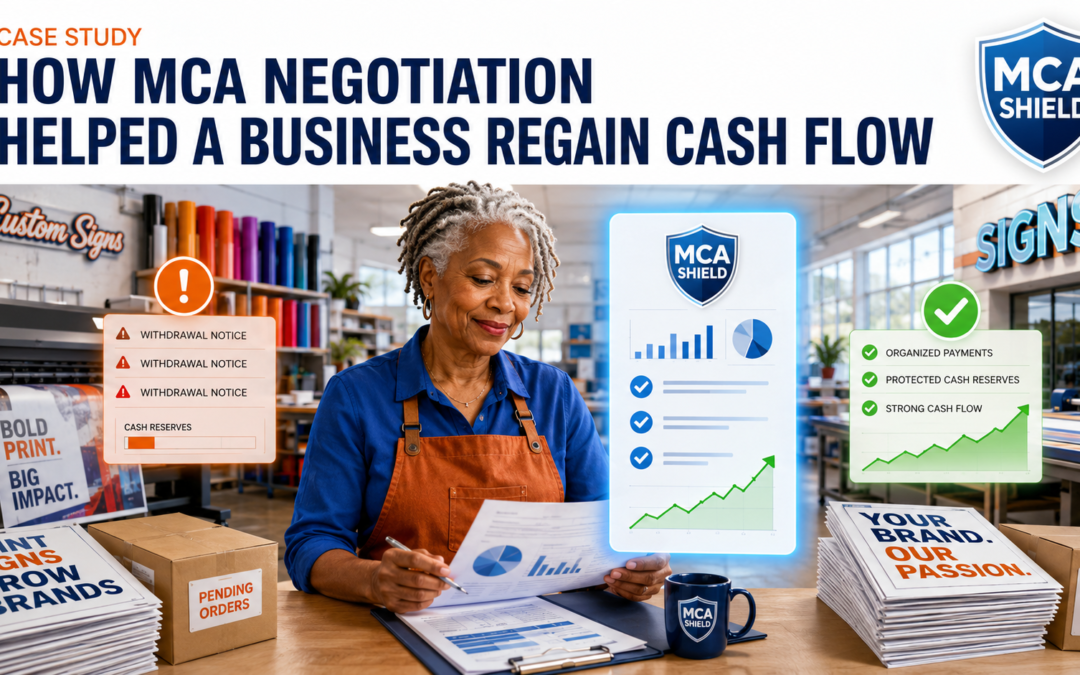
This MCA negotiation case study follows a commercial printing business whose daily withdrawals were consuming the cash needed for payroll, materials, equipment, and customer orders. As working capital declined, even routine expenses became harder to manage.
Instead of taking another advance, the owner pursued a strategy based on what the business could realistically afford. After negotiation, the company gained a more manageable payment structure, protected its cash flow, and created room to rebuild.
This case shows how taking action before the pressure becomes critical can help a business regain control of its finances and continue operating.
Schedule Your Free Consultation
How MCA Payments Began Draining the Business’s Cash Flow
The commercial printing company had steady customers and a reliable stream of incoming orders. However, revenue alone did not guarantee that enough cash would remain available when the business needed it.
The company accepted a merchant cash advance to cover immediate business expenses. At first, the funding provided quick access to working capital. The daily withdrawals seemed manageable while sales remained strong and customers paid their invoices on time.
That balance eventually changed. The MCA payment continued leaving the business account every business day, even when customer payments slowed or large invoices remained unpaid. As a result, the company had less control over how it used its incoming revenue.
This MCA negotiation case study shows how a profitable business can still experience serious financial pressure when frequent withdrawals consume the cash needed for daily operations.
Daily Withdrawals Left Less Money for Essential Expenses
A commercial printing business must pay many expenses before completing and delivering a customer’s order. Paper, ink, vinyl, banners, sign materials, packaging, and equipment maintenance all require cash.
The company also needed money for:
- Rent and utilities
- Software and design subscriptions
- Equipment repairs
- Delivery and transportation costs
- Insurance and taxes
- Marketing and administrative expenses
Each MCA withdrawal reduced the amount available to cover those costs. Although the company continued generating sales, too much of its daily revenue went toward the advance before the owner could direct it toward the business.
The timing of customer payments made the situation even harder. Some commercial clients paid their invoices several weeks after receiving an order. Meanwhile, the MCA withdrawals continued. This created a growing gap between when the business incurred expenses and when it collected payment.
The owner began moving money between expenses and delaying purchases that the company would normally make without hesitation. A routine equipment repair or slower sales week could suddenly create a cash shortage.
Payroll, Materials, and Customer Orders Came Under Pressure
The cash-flow strain eventually began affecting the company’s most important responsibilities. Payroll required a predictable amount of money on specific dates. However, the daily MCA withdrawals made it harder to preserve enough cash for employees.
Material purchases also became more difficult. The company often needed to buy supplies before it could begin a large printing or signage project. Without enough working capital, accepting a profitable order could create an immediate financial problem.
The owner faced several difficult choices:
- Delay purchasing materials for upcoming jobs
- Postpone payments to vendors
- Use money reserved for payroll
- Decline orders that required high upfront costs
- Consider taking another advance to cover the shortage
Taking another MCA might have provided temporary cash, but it also would have added another payment to the same limited revenue. Instead of resolving the underlying problem, additional funding could have increased the daily pressure.
The business had customers, equipment, employees, and orders waiting to be completed. The problem was not a lack of opportunity. The problem was that the existing MCA payment structure consumed too much working capital before the company could use it to operate.
Once payroll, materials, and customer orders came under pressure, the owner realized that continuing under the same payment structure was no longer sustainable. The business needed a strategy to reduce the immediate burden while protecting the cash required to keep serving customers.
Why Another Merchant Cash Advance Was Not the Answer

As the company’s available cash continued shrinking, another merchant cash advance appeared to offer a quick solution. Additional funding could cover payroll, purchase materials, pay vendors, and provide temporary relief from the immediate financial pressure.
However, the owner recognized that another merchant cash advance would not correct the underlying cash-flow problem. It would add another payment to revenue that was already stretched too thin.
The company lacked customers, equipment, and profitable orders. The existing MCA withdrawals consumed too much of the business’s revenue before it could use it for essential expenses. Adding more funding would not change that payment structure.
Another MCA Would Have Increased the Daily Payment Pressure
A second advance might have provided enough cash to manage the next few weeks. Soon afterward, however, the business would need to support both the existing MCA payment and an additional withdrawal.
Each payment would draw from the same business account. Therefore, the owner would have even less money available for payroll, materials, rent, utilities, equipment repairs, and other operating expenses.
Another MCA could have created several new problems:
- More frequent withdrawals from the business account
- Less money available for payroll and operating costs
- Greater difficulty purchasing materials for customer orders
- Less flexibility during slow sales periods
- A higher risk of missed or returned payments
- Greater dependence on additional short-term funding
Even stronger sales might not have solved the problem. Larger printing and signage orders required the company to purchase paper, ink, vinyl, banners, and other materials before completing the work.
If multiple MCA withdrawals consumed the incoming revenue, the company could struggle to finance the orders needed to generate those sales. The business could become busier while its available cash continued declining.
The owner also understood that using new funding to manage existing payments would provide only temporary relief. Once the new money ran out, the business would face the original payment pressure along with another MCA obligation.
How New Funding Could Have Created an MCA Stacking Cycle
Taking another advance before paying off the existing obligation could have led to MCA stacking. This occurs when a business carries multiple merchant cash advances at the same time, with each funder collecting payments from the same revenue stream.
MCA stacking can create a cycle that becomes increasingly difficult to escape. A business accepts one advance to solve an immediate cash shortage. When the payment begins straining cash flow, the owner takes another advance to cover operating expenses. The new advance then adds another withdrawal, leaving even less money available.
Eventually, the business uses new funding to manage payments created by earlier advances. At that point, the advances no longer support growth or new opportunities—they simply help the business survive the growing payment burden.
For the printing company, another MCA could have turned a difficult situation into a much larger financial crisis. The owner might have gained temporary access to cash, but the company would have sacrificed more of its future revenue.
Instead of asking how much additional funding the business could obtain, the owner needed to answer a more important question:
How much could the company realistically afford to pay while still covering payroll, materials, and essential operating expenses?
That question changed the direction of the case. The owner stopped viewing another merchant cash advance as the only available option and began looking for a strategy that addressed the existing payment burden.
Choosing not to take another MCA prevented the business from adding more pressure to an already strained cash flow. It also created an opportunity to review the existing agreement, understand the company’s true financial position, and determine whether MCA negotiation could provide a more manageable path forward.
The Cash Flow Cycle Created by Stacked MCA Loans
The printing company did not reach a financial crisis overnight. Instead, the owner noticed a series of warning signs that became harder to ignore.
Customer orders continued coming in, and the company remained busy. However, the amount of cash available to operate the business kept declining. Revenue entered the account, but the daily MCA withdrawals removed a portion of it before the owner could decide where the money was needed most.
At first, the owner adjusted spending and delayed nonessential purchases. Those changes provided temporary relief. Eventually, though, the financial pressure began affecting the company’s ability to manage routine operations.
The owner realized that a busy schedule and strong sales did not matter if the business lacked enough working capital to complete orders and meet its obligations.
Working Capital Continued to Shrink
Working capital gave the printing company the flexibility to purchase materials, pay employees, repair equipment, and handle unexpected expenses. Before the MCA payment became difficult, the business maintained enough available cash to manage the normal timing gaps between project completion and payment.
That financial cushion gradually disappeared.
Each daily withdrawal reduced the balance in the company’s operating account. When customers paid large invoices, the revenue only provided a brief improvement. MCA payments, vendor costs, payroll, and other expenses quickly consumed it.
Several warning signs began appearing:
- Cash reserves no longer recovered after strong sales weeks
- Customer deposits went toward existing expenses instead of the related orders
- The owner delayed supply purchases until customer payments cleared
- Unexpected repairs created immediate financial strain
- The business relied on future revenue to cover current obligations
- Account balances became difficult to predict from one week to the next
The owner also lost the ability to respond quickly to new opportunities. A large order could produce a healthy profit, but the company still needed cash to purchase materials and begin production. Without enough working capital, accepting more business sometimes increased the immediate pressure.
This created a troubling contradiction. The company had opportunities to grow, but the MCA withdrawals limited its ability to finance the work required to generate that growth.
As working capital continued to shrink, the owner could no longer treat the problem as a temporary slowdown. The payment structure had begun limiting the company’s ability to operate effectively.
Routine Expenses Became Harder to Cover
The next warning sign appeared when normal business expenses became difficult to manage. Costs that the owner once paid without concern began requiring careful timing and difficult decisions.
Payroll created the greatest concern. Employees depended on the company to pay them on schedule, and the business needed its experienced team to complete customer orders. However, daily MCA withdrawals made it harder to preserve enough money for each payroll period.
Material purchases also became more challenging. Printing and sign orders often required paper, ink, vinyl, substrates, packaging, and other supplies before production could begin. When the business lacked available cash, the owner sometimes had to delay ordering materials until a customer payment arrived.
Other routine expenses also came under pressure, including:
- Rent and utilities
- Vendor invoices
- Equipment maintenance
- Insurance payments
- Software subscriptions
- Delivery and transportation costs
- Taxes and administrative expenses
The owner began deciding which obligation required immediate attention and which one could wait. That approach helped the business continue operating in the short term, but it did not provide a sustainable solution.
Every delayed payment created another problem to manage. Postponing a vendor invoice could affect the company’s ability to order materials. Delaying equipment maintenance could interrupt production. Using money reserved for payroll could place employees and customer deadlines at risk.
The owner finally recognized that the MCA payment was no longer affecting only the business account balance—it was beginning to affect nearly every operational decision.
Rather than wait for missed payments, returned withdrawals, or a complete cash-flow crisis, the owner decided to seek help. The goal was not simply to obtain more money. The business needed a careful review of its financial position and an MCA negotiation strategy based on what it could realistically afford.
Reviewing the Business’s Total MCA Payment Burden
Before developing an MCA negotiation strategy, the company needed a clear picture of its financial condition. Looking only at the current bank balance would not reveal how much payment pressure the business could manage over time.
The review examined how money moved through the company each week. It compared incoming revenue with MCA withdrawals, payroll, materials, rent, utilities, vendor payments, and other operating costs.
This process helped separate the company’s gross revenue from the cash it actually had available. Although the printing business generated consistent sales, a large portion of that revenue had to support customer orders before it could contribute to MCA payments.
The review also revealed when the greatest pressure occurred. Some weeks included payroll, major supply purchases, and equipment expenses at the same time. During those periods, the daily withdrawals left the business with very little flexibility.
Instead of asking how much the company had paid in the past, the review focused on what it could sustain going forward.
Identifying What the Business Could Realistically Afford
An affordable MCA payment could not rely on the company’s strongest sales week or largest customer payment. The amount needed to work during normal weeks and remain manageable when revenue slowed.
To identify that level, the review considered:
- Average weekly and monthly revenue
- The timing of customer invoice payments
- Payroll and employment-related expenses
- Material costs for upcoming orders
- Rent, utilities, insurance, and taxes
- Vendor and equipment obligations
- Seasonal or unpredictable changes in sales
- The minimum cash reserve needed for emergencies
The review also examined the difference between booked sales and collected revenue. A customer might approve a large order, but the business could not use that revenue until the customer paid. Meanwhile, the company still needed to purchase materials and pay employees to complete the project.
For that reason, sales volume alone could not determine an affordable MCA payment. The payment needed to reflect the timing of actual cash entering and leaving the business.
The company also needed room for normal fluctuations. A payment structure that worked only when every customer paid on time would remain too risky. One delayed invoice, equipment repair, or slow week could place the business under pressure again.
By examining the full financial picture, the owner could identify a payment range that supported the MCA obligation without immediately creating another shortage. That range became an important foundation for the negotiation strategy.
Protecting Cash Needed to Continue Operating
Determining what the company could afford required more than subtracting expenses from revenue. The owner also needed to preserve enough cash to keep the business open and meet customer needs.
The company could not generate future revenue without employees, materials, functioning equipment, and a stable production facility. Therefore, those operating needs had to remain part of the financial plan.
The review prioritized cash for:
- Employee payroll
- Paper, ink, vinyl, and sign materials
- Rent and essential utilities
- Equipment maintenance and repairs
- Insurance and required taxes
- Vendor relationships
- Delivery and production expenses
Protecting this money did not mean ignoring the MCA obligation. Instead, it meant developing a payment strategy that recognized the business’s ability to continue operating.
If the company directed too much revenue toward the MCA, it could lose the ability to complete customer orders. That would reduce future income and make every financial obligation harder to manage. A payment arrangement that forced the company to choose between the MCA and basic operations would not provide a lasting solution.
The owner needed enough working capital to accept new projects, purchase the necessary materials, and deliver completed orders. Keeping the business operational was essential to maintaining the revenue needed for any negotiated payment plan.
This review changed the owner’s understanding of the problem. The goal was not to avoid payment or promise an amount the business could not maintain. The goal was to establish a realistic structure that balanced the MCA obligation with the company’s operating needs.
With a clear, affordable payment range and a protected operating budget, the business could begin building an MCA negotiation strategy based on its actual financial capacity.
Building an MCA Negotiation Strategy Around the Business
Once the owner understood the company’s true payment burden, the next step was to translate that information into an MCA negotiation strategy.
The strategy could not rely on a random payment request or the amount that offered the most immediate relief. It needed to reflect the printing company’s revenue, operating cycle, essential expenses, and ability to maintain payments over time.
A proposal might look affordable during a strong sales week but become impossible when customer payments slowed. Therefore, the negotiation strategy needed to work during both favorable and difficult periods.
The goal was not simply to secure the lowest possible payment. The goal was to pursue a payment structure the business could consistently manage without sacrificing payroll, materials, or customer orders.
Turning the Financial Review Into a Realistic Proposal
The financial review provided the foundation for the negotiation proposal. It showed how much revenue the company collected, when that money entered the account, and how much cash the business needed for essential operations.
The strategy considered several important factors:
- The current MCA payment amount and frequency
- Average weekly and monthly revenue
- The timing of customer invoice payments
- Payroll and employment expenses
- Material costs for scheduled projects
- Rent, utilities, insurance, and taxes
- Vendor and equipment obligations
- The minimum working capital required for operations
The owner also needed to account for changes in weekly cash flow. Commercial printing revenue did not arrive in equal amounts every day. Some customers paid deposits before production, while others paid invoices after receiving completed orders.
Because of those differences, the strategy focused on actual collected revenue rather than projected sales or unpaid invoices. This helped establish a payment level based on money the company could use.
The proposed amount also needed room for unexpected expenses. Equipment repairs, delayed customer payments, and supply cost increases could quickly change the company’s financial position. A payment that consumed every available dollar would place the business at risk again.
Protecting Operations During MCA Negotiations
The company needed to continue operating while the negotiation moved forward. Customer orders, payroll deadlines, supply purchases, and other responsibilities did not stop during the process.
For that reason, the strategy protected enough cash for the business’s most important operating needs. The owner prioritized payroll, materials, rent, utilities, equipment, and other costs tied directly to generating revenue.
This approach helped prevent the negotiation from creating a different financial problem. If the company agreed to a payment that left too little money for materials, it could not complete customer orders. If it fell behind on payroll, it could lose the experienced employees needed to maintain production.
Protecting operations also supported the MCA payment itself. A functioning business could continue to generate revenue, while a business deprived of working capital would face even greater difficulty meeting any payment arrangement.
Depending on the agreement and the funder’s willingness to negotiate, a proposed change might address:
- The amount collected during each withdrawal
- The frequency of payments
- A temporary payment adjustment
- A longer payment schedule
- Another arrangement based on the company’s financial capacity
No specific result could be guaranteed. However, a proposal supported by current financial information gave the negotiation a clear and credible foundation.
Preparing for Counteroffers Without Overpromising
The owner also needed a plan for responding to questions, requests, or counteroffers from the MCA funder. Accepting the first proposed adjustment might have provided quick relief, but it would not help if the company could not maintain the new amount.
Each potential payment needed to be compared with the company’s affordable range. The owner had to consider how the amount would affect payroll weeks, major material purchases, slower revenue periods, and unexpected operating costs.
The strategy established clear limits before those conversations began. This helped the owner avoid making a rushed promise under pressure.
A sustainable proposal needed to meet three standards:
- The company could make the payment consistently
- Essential operating expenses would remain covered
- The business would retain enough cash to continue generating revenue
Clear communication also played an important role. The owner needed accurate records of payment discussions, proposed terms, and any requested financial information. Any final change required written confirmation so the company could understand the payment amount, schedule, and other conditions.
This disciplined approach kept the negotiation focused on long-term stability rather than temporary relief. The strategy connected every proposed payment to the company’s real financial capacity and operating needs.
By building the MCA negotiation strategy around the business, the owner could pursue relief without making another promise the company could not keep. That foundation created a path toward reducing daily payment pressure while protecting the printing company’s ability to operate.
How MCA Negotiation Reduced the Daily Payment Pressure
After reviewing the company’s financial position, the owner entered the negotiation with a clear understanding of what the business could realistically afford. The proposal reflected actual revenue, essential operating costs, and the working capital needed to complete customer orders.
The negotiation focused on reducing the immediate pressure created by the existing withdrawal schedule. The owner did not ask the funder to ignore the obligation. Instead, the strategy presented a payment level the company could maintain while continuing to operate.
The negotiated arrangement reduced the amount of cash leaving the business account on scheduled payment days. That change gave the company more control over its revenue and created room for essential expenses.
MCA negotiation did not erase the company’s financial obligation. It made the payment pressure more manageable and gave the business a better opportunity to meet its responsibilities.
Creating a More Manageable Payment Structure
Before the negotiation, the existing withdrawals placed the company under pressure nearly every business day. Customer payments could enter the account in the morning, but the MCA payment quickly reduced the available balance.
The adjusted structure brought the payment closer to the company’s actual financial capacity. The arrangement reflected a payment level the printing business could consistently sustain under normal operating conditions.
A more manageable structure helped the company:
- Reduce the immediate strain on its operating account
- Improve the predictability of weekly cash flow
- Plan for upcoming payments more accurately
- Avoid promising an amount it could not consistently maintain
- Lower the risk of another sudden cash shortage
- Reduce the temptation to seek another merchant cash advance
The new structure also helped the owner plan beyond the next withdrawal. With a clearer view of the company’s available cash, the owner could make better decisions about materials, staffing, equipment, and customer deadlines.
The adjustment did not solve every financial challenge at once. The company still needed to control spending, monitor incoming payments, and follow the negotiated terms. However, the business no longer faced the same level of daily pressure from the original payment schedule.
That difference gave the owner time to stabilize the company rather than respond to one urgent expense after another.
Preserving Cash for Payroll and Operations
Reducing the payment pressure meant more cash remained available for the expenses that kept the printing company functioning.
Payroll remained one of the owner’s highest priorities. The company relied on experienced employees to design, print, finish, and deliver customer orders. The adjusted payment structure made it easier to reserve money for payroll instead of hoping enough cash would remain after the daily withdrawal.
The company could also direct more money toward essential operating costs, including:
- Paper, ink, vinyl, and sign materials
- Rent and utilities
- Equipment maintenance
- Vendor invoices
- Insurance and taxes
- Delivery and production expenses
Preserving cash for materials produced an important benefit. The business could begin customer projects without waiting for unrelated invoices to clear. That helped the company maintain production schedules and deliver completed orders on time.
The owner also gained more flexibility when unexpected expenses appeared. A repair or delayed customer payment still required careful management, but it no longer created the same immediate threat to payroll or daily operations.
Most importantly, the business could use its revenue to support the work that generated future income. Protecting operating cash helped the company complete orders, retain customers, and maintain the revenue needed for the negotiated MCA payments.
The relief created by negotiation did not mean the owner could stop monitoring cash flow. The company continued tracking revenue, expenses, payment dates, and reserves. Careful financial management remained essential.
However, the business had moved away from constant financial reaction. The owner could plan purchases, protect payroll, and make operating decisions with greater confidence.
By reducing the daily payment pressure, the MCA negotiation gave the printing company something additional funding could not provide: a more sustainable way to manage its existing obligation while preserving the cash needed to keep the business moving forward.
What Changed After the MCA Negotiation
Lessons From This MCA Negotiation Case Study
This MCA negotiation case study shows that payment pressure can affect a successful business even when customers and revenue remain strong. The printing company did not lack opportunities. It lacked enough available cash to support its daily operations.
Three important lessons helped the owner move from unpredictable withdrawals toward a more manageable financial structure.
Act Before Cash Flow Reaches a Crisis
The owner sought help when shrinking working capital began affecting payroll, materials, and routine expenses. Acting before a complete cash-flow crisis gave the company more time to review its options and develop a strategy.
Business owners should not wait for missed payments or severe operating problems before examining their MCA burden. Warning signs such as declining reserves, delayed vendor payments, and difficulty covering payroll may indicate that the current structure has become unsustainable.
Base Negotiations on Real Business Numbers
A sustainable proposal must reflect actual revenue, operating expenses, and payment timing. The printing company reviewed its collected income, payroll, materials, rent, and other obligations before identifying an affordable payment range.
Promising more than the business can maintain may create another shortage. A financial review helps the owner support the negotiation with accurate information and avoid decisions based on fear or guesswork.
The right payment target protects the business while addressing the MCA obligation.
Protect Working Capital After Negotiation
A negotiated arrangement creates an opportunity to recover, but the business must protect that progress. The owner continued to monitor cash flow, plan purchases, track invoices, and reserve money for essential expenses.
The company also avoided taking another MCA while rebuilding its financial position. That decision prevented a new withdrawal from consuming the cash preserved through negotiation.
By protecting working capital, the business could complete customer orders, maintain payroll, rebuild reserves, and create greater financial stability over time.
Regain Control Before MCA Payments Threaten Your Business
If MCA withdrawals make it harder to cover payroll, purchase materials, pay vendors, or manage routine expenses, waiting may place even more pressure on your business.
The printing company in this MCA negotiation case study still had customers, employees, and profitable work. However, its payment structure consumed too much working capital. Seeking help before the situation became critical allowed the owner to review the numbers, identify an affordable payment range, and pursue a more manageable arrangement.
Your business may need a financial review if you notice:
- Working capital shrinking each week
- Payroll becoming harder to cover
- Vendor payments falling behind
- Customer deposits covering unrelated expenses
- MCA withdrawals controlling daily decisions
- Another advance appearing necessary to stay current
Taking another MCA may provide temporary cash, but it can also add another payment to revenue that is already under pressure. A coordinated negotiation strategy focuses on the existing burden and what your business can realistically afford.
MCA Shield can review your MCA payment structure, operating expenses, and available cash flow. From there, the team can help you understand options and develop a strategy specific to your business.
Each MCA agreement and financial situation is unique, and negotiation results will vary. However, acting early may give you more time to evaluate your position before dwindling cash reserves limit your choices.
Schedule a Free Consultation With MCA Shield to discuss your MCA payments and take the first step toward protecting your working capital, stabilizing your operations, and regaining control of your business cash flow.