
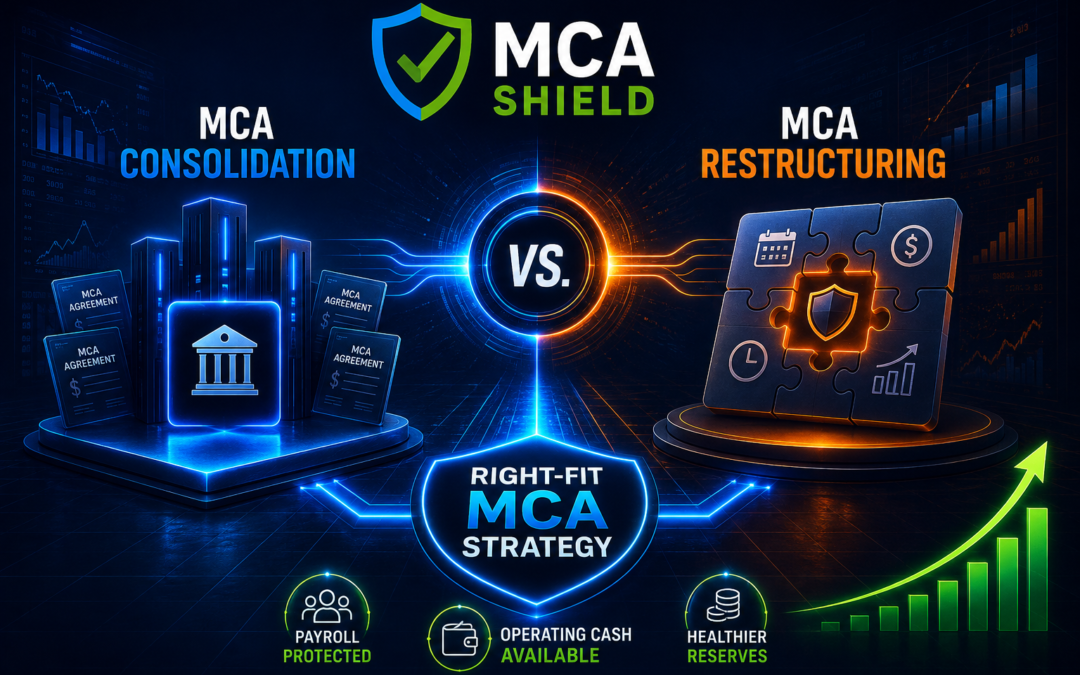
Choosing between MCA consolidation vs MCA debt restructuring can have a major impact on your business cash flow. Both strategies may help reduce payment pressure, but they work in very different ways.
MCA consolidation may combine multiple merchant cash advance payments into one new payment structure. MCA debt restructuring, however, focuses on changing the terms or payment demands tied to existing MCA obligations.
The right option depends on your total debt, current withdrawals, available working capital, and what your business can realistically afford. Understanding the difference can help you avoid adding more financial pressure and choose a strategy that supports stronger, more manageable cash flow.
Schedule Your Free Consultation
MCA Consolidation vs. MCA Debt Restructuring: What Is the Difference?
Understanding the difference between MCA consolidation vs MCA debt restructuring is important before choosing a strategy for merchant cash advance debt. Both approaches may reduce financial pressure, but they do not solve the problem in the same way.
MCA consolidation generally focuses on combining several obligations into a new payment structure. MCA debt restructuring focuses on changing how existing obligations are repaid. The better option depends on the number of MCAs, current payment amounts, remaining balances, and the amount of cash the business needs to operate.
How MCA Consolidation Combines Multiple Obligations
A business with several merchant cash advances may have multiple daily or weekly withdrawals hitting the same bank account. Those payments can quickly reduce the cash available for payroll, inventory, rent, utilities, and other operating expenses.
MCA consolidation attempts to replace several separate obligations with one more manageable payment structure. In some situations, this may involve new financing that pays off or replaces the existing advances.
The main goal is usually to simplify payments and reduce the immediate strain on cash flow. However, business owners should look beyond the new payment amount. They should also consider the total repayment cost, length of the new obligation, fees, and additional debt created by the transaction.
A lower payment does not automatically mean the business has received a better financial solution.
How MCA Debt Restructuring Changes Existing Payment Terms
MCA debt restructuring takes a different approach. Instead of automatically replacing existing obligations with new financing, restructuring focuses on the payments the business already has.
This process may involve reviewing each MCA agreement, outstanding balance, withdrawal schedule, and current cash-flow situation. From there, the goal is to determine whether the existing payment structure can be adjusted to better match what the business can afford.
Depending on the circumstances, restructuring may seek changes such as lower payments, different payment schedules, or more coordinated repayment arrangements.
For a business already struggling with high MCA withdrawals, this approach can be especially important because it does not necessarily require taking another advance just to create temporary breathing room.
The objective is to create a payment structure that gives the business enough cash to continue operating while addressing its existing obligations.
Why the Difference Matters for Business Cash Flow
The difference between consolidation and restructuring matters because cash flow is often the real problem behind MCA payment pressure.
A company may generate solid revenue and still struggle if too much money leaves the bank account every day. When several MCA withdrawals compete with payroll and operating expenses, even a profitable business can experience a serious cash shortage.
For that reason, the decision should not focus only on whether one option produces a smaller payment. The business should determine whether the new structure leaves enough money available for payroll, operations, inventory, taxes, and working capital.
A consolidation option that simply replaces several MCAs with another expensive obligation may not solve the underlying problem. In contrast, restructuring existing payments may provide greater flexibility when adding new debt would create additional risk.
The best strategy should improve more than the payment schedule. It should help the business regain greater control over cash flow while creating a realistic path for managing its MCA obligations.
How MCA Consolidation Works With Multiple Merchant Cash Advances

When a business has several merchant cash advances, each funder may collect its own daily or weekly payment. Over time, those withdrawals can place heavy pressure on the same operating account.
MCA consolidation is designed to bring multiple obligations into a more organized payment structure. The goal is usually to reduce the number of separate withdrawals and create a payment plan that is easier to manage.
However, consolidation can work in different ways. Before moving forward, a business should understand whether the strategy requires new financing and what will happen to the existing MCA agreements.
Replacing Multiple Payments With One Payment Structure
With multiple MCAs, a business may be making several payments to different funders at the same time. That can make cash flow difficult to track and even harder to control.
A consolidation strategy may replace those separate payments with one combined payment structure. Instead of several withdrawals hitting the bank account throughout the week, the business may have one scheduled payment to manage.
This can improve predictability and make it easier to plan for payroll, operating expenses, inventory, taxes, and working capital.
Still, the new payment must be affordable. Simply combining several obligations does not automatically improve the business’s financial position. The combined structure should leave enough cash available to support normal operations.
When Consolidation Requires New Financing
Some forms of MCA consolidation require new financing. In that situation, a new lender or funding source provides enough capital to pay off some or all of the existing MCA balances.
The business then repays the new financing instead of continuing to make separate payments to several MCA funders.
This can reduce the number of active obligations, but the details matter. A business should review the new payment amount, repayment term, total cost, fees, and funding conditions before agreeing to the transaction.
In addition, the business should confirm that the new financing actually improves cash flow. If the new obligation remains too expensive, consolidation may only move the payment pressure from several accounts into one.
What Happens to Your Existing MCA Agreements
What happens to existing MCA agreements depends on how the consolidation is structured.
If new financing pays off an MCA in full, that obligation should be satisfied according to the agreed payoff terms. The business should obtain written confirmation of the payoff and verify that automatic withdrawals stop.
In other situations, only some MCA obligations may be included. The business could still have separate payments remaining after the consolidation takes effect.
That is why it is important to review every agreement before moving forward. The business should know which MCA balances will be paid, which obligations will remain, and what the total payment burden will be afterward.
A successful consolidation strategy should create more than a cleaner payment schedule. It should provide a structure that supports better cash-flow control and continued business operations.
How MCA Debt Restructuring Works Without Adding Another Advance
MCA debt restructuring focuses on changing the way existing merchant cash advance obligations are handled. Instead of automatically taking on new financing, the process begins with the debt the business already has.
This can be especially important when current withdrawals are already putting pressure on cash flow. Before considering another advance, the business should understand the full payment burden and determine what level of repayment is actually sustainable.
Reviewing Current MCA Balances and Withdrawals
The first step is to review every active MCA obligation.
That includes the remaining balance, daily or weekly withdrawal, payment frequency, estimated payoff date, and current agreement terms. If several MCAs are active at once, each one should be included in the review.
The business should also compare those withdrawals against current revenue and available cash. This helps show how much money remains after MCA payments are deducted.
A complete review can reveal whether the problem comes from one unusually large payment or from the combined effect of several obligations hitting the account at the same time.
Adjusting Payments Around What the Business Can Afford
The next step is to determine what the business can realistically pay without damaging normal operations.
That means looking beyond revenue alone. A workable payment should leave enough cash for payroll, rent, inventory, utilities, taxes, insurance, and other essential expenses.
If current MCA payments are consuming too much available cash, restructuring may focus on reducing the immediate payment burden or changing the repayment schedule.
The goal is not simply to create a smaller payment. It is to create a structure the business can maintain while continuing to operate.
A payment arrangement that still leaves the company short on payroll or essential expenses may not provide meaningful relief.
Coordinating Multiple MCA Obligations
Restructuring becomes more complex when a business has several merchant cash advances.
Changing one payment without considering the others can create a new problem. For example, reducing one withdrawal may provide temporary relief, but the business may still face excessive pressure from the remaining obligations.
That is why multiple MCAs should be reviewed as one overall cash-flow problem.
A coordinated restructuring strategy looks at the total amount leaving the business account and how each obligation affects available working capital. The objective is to create a more manageable overall payment burden rather than addressing each MCA in isolation.
When handled carefully, MCA debt restructuring can help organize existing obligations without automatically adding another advance, giving the business a better opportunity to stabilize cash flow and protect day-to-day operations.
Which Option Can Reduce MCA Payment Pressure More Effectively?
When comparing MCA consolidation vs MCA debt restructuring, the most important question is not simply which option creates the lowest payment. The better strategy is the one that reduces payment pressure while leaving enough cash for the business to continue operating.
Both options may improve cash flow, but the results depend on the structure of the agreement. A business should compare the total payment burden before and after any change.
Comparing Daily and Weekly Payment Obligations
Start by adding together every current daily or weekly MCA payment. This shows how much cash is leaving the business account over a typical week or month.
Next, compare that amount with the payment required under the proposed consolidation or restructuring plan.
For example, consolidation may replace several withdrawals with one payment. Restructuring may reduce or adjust existing payments without creating a new advance. In either case, the new structure should provide a meaningful reduction in the amount leaving the account.
It is also important to consider payment frequency. A lower weekly payment may be easier to manage than several daily withdrawals because it gives the business more time to collect revenue and plan expenses.
However, businesses should also review the total repayment cost and length of the obligation. A smaller payment spread over a much longer period may improve short-term cash flow while increasing the overall cost.
Measuring the Impact on Available Working Capital
The strongest way to compare the two options is to measure how much working capital remains after MCA payments are made.
Available working capital helps cover the expenses that keep the business running. These may include payroll, inventory, rent, utilities, taxes, supplies, insurance, and other operating costs.
If a payment structure leaves too little cash for these expenses, the business may continue to struggle even after the payment amount has been reduced.
For that reason, businesses should calculate how much cash will remain under each option. Then, they can compare that amount with their normal operating needs.
The more effective strategy should create enough breathing room to support daily operations while still addressing the MCA obligations.
Ultimately, reducing MCA payment pressure is about protecting cash flow, not just lowering a number on paper. The right structure should make payments more manageable and give the business a stronger opportunity to rebuild working capital.
When MCA Consolidation May Make Sense for a Business
MCA consolidation may make sense when it replaces several difficult payments with a structure that is easier for the business to manage.
However, consolidation should improve more than convenience. The new arrangement should reduce payment pressure, improve cash-flow planning, and make financial sense when the full cost is considered.
Before moving forward, the business should compare the proposed consolidation terms with its current MCA obligations.
When the New Payment Is Truly More Affordable
A lower payment can help, but it must be low enough to support normal business operations.
The business should compare the new payment with current revenue, operating expenses, and available working capital. After the payment is made, there should still be enough cash for payroll, rent, inventory, taxes, utilities, and other essential expenses.
It is also important to compare the new payment with the combined amount currently being withdrawn by existing MCA funders.
If consolidation creates a meaningful reduction in payment pressure, it may give the business more room to operate. If the reduction is small, the new structure may not provide enough relief to solve the underlying cash-flow problem.
When Consolidation Improves Cash-Flow Predictability
Multiple MCA withdrawals can make it difficult to predict how much cash will remain in the business account from day to day.
A well-structured consolidation may replace several separate withdrawals with one predictable payment. That can make budgeting easier and help the business plan upcoming expenses with greater confidence.
More predictable cash flow can also reduce the risk of falling short when payroll or other major expenses are due.
The value of consolidation is not just having fewer payments. It is having a payment structure that allows the business to better understand how much cash will remain available after the obligation is paid.
When the Cost of the New Financing Still Makes Financial Sense
Some MCA consolidation options require new financing. In that case, the business should look carefully at the total cost of the new obligation.
A lower payment may appear attractive, but extending the repayment period or adding new fees can increase the amount paid over time.
Before accepting a consolidation offer, review the total repayment amount, fees, payment frequency, repayment term, and any other financial obligations tied to the agreement.
The business should also compare those costs with the benefit of improved cash flow.
MCA consolidation may make sense when the new structure is both affordable and sustainable. The goal should be to reduce financial pressure without replacing existing MCA debt with another obligation that creates a different cash-flow problem.
When MCA Debt Restructuring May Be the Better Option
MCA debt restructuring may be the better option when taking on new financing would create more risk than relief.
Instead of replacing existing obligations with another advance, restructuring focuses on making the current payment burden more manageable. This can be especially useful when cash flow is already tight and the business needs a solution that does not depend on qualifying for additional financing.
When the Business Cannot Qualify for Traditional Financing
Some businesses under MCA pressure may not qualify for a traditional bank loan or lower-cost financing.
High existing payments, limited cash reserves, recent credit issues, or inconsistent revenue can make approval difficult. In those situations, MCA debt restructuring may provide another path to reducing payment pressure.
Rather than relying on a new loan, the business can focus on its current obligations and determine whether the payment structure can be adjusted.
This may be especially important when the business is still generating revenue but cannot meet the requirements of traditional lenders.
When Another Advance Would Increase the Total Debt Burden
Taking another MCA to solve an existing MCA problem can sometimes make the situation worse.
A new advance may provide temporary cash, but it also adds another repayment obligation. If that obligation comes with high costs or frequent withdrawals, the business may end up with more total debt and greater long-term payment pressure.
Before accepting new financing, the business should calculate how much debt it will have after the transaction.
If the new advance simply shifts the problem forward, restructuring existing obligations may be the more practical option.
The goal should be to improve cash flow without creating another cycle of borrowing.
When Existing Payments Are Already Straining Operations
MCA debt restructuring may also make sense when current payments are already affecting daily operations.
Warning signs can include difficulty covering payroll, rent, inventory, taxes, utilities, supplier costs, or other essential expenses.
At that point, the business needs to understand how much of its available cash is going toward MCA payments and how much remains for operations.
If the current withdrawal structure is unsustainable, restructuring may focus on bringing payments closer to a level the business can realistically afford.
The purpose is not simply to delay the problem. It is to create a more workable payment structure that protects working capital and day-to-day business operations.
When another advance would add risk or traditional financing is unavailable, MCA debt restructuring may offer a more direct way to address the existing payment burden.
The Risks of Using Another MCA to Consolidate Existing MCA Debt
Using another merchant cash advance to consolidate existing MCA debt may seem like a fast solution. The new advance may reduce the immediate number of withdrawals or create a lower short-term payment.
However, adding another MCA can also increase the total debt burden. Before accepting new funding, the business should look beyond the immediate payment and consider the full financial impact.
Why a Lower Payment Does Not Always Mean Less Debt
A lower payment can improve short-term cash flow, but it does not always mean the business owes less money.
The new MCA may extend the repayment period, add fees, or increase the total amount that must be repaid. As a result, the business could have a smaller payment while carrying a larger overall obligation.
That is why the payment amount should never be reviewed by itself.
Businesses should compare the total repayment amount, payment frequency, fees, and expected payoff period before deciding whether consolidation truly improves the situation.
A lower payment is helpful only when the full structure is sustainable.
How Refinancing Can Restart the MCA Debt Cycle
Businesses often turn to a new MCA because existing withdrawals have reduced available cash.
The new advance may provide temporary relief. However, once that money is used for operating expenses or to satisfy earlier obligations, the business still has to repay the new advance.
If those payments begin creating another cash shortage, the business may feel pressure to seek additional funding again.
This can restart the MCA debt stacking cycle:
Existing payments reduce cash flow, another advance provides temporary relief, and the new payment creates additional pressure.
Without correcting the underlying cash-flow problem, repeated refinancing can make it harder for the business to regain financial stability.
The Danger of Trading Short-Term Relief for a Larger Obligation
Short-term relief can be valuable when a business is struggling with several MCA payments. However, that relief should not come at the cost of a much larger long-term obligation.
A new MCA may free up cash immediately while increasing the amount the business must repay over time.
Before using another MCA for consolidation, the business should determine whether the new structure will leave enough money for payroll, operating expenses, inventory, taxes, and working capital.
It should also compare the proposed option with MCA debt restructuring, which may focus on adjusting existing obligations without automatically adding another advance.
The goal should be more than getting through the next few weeks. A strong strategy should reduce payment pressure while helping the business move toward healthier and more sustainable cash flow.
How to Compare Consolidation and Restructuring Before Making a Decision
Before choosing between MCA consolidation vs MCA debt restructuring, compare both options using the same financial standards.
The best choice should do more than lower the immediate payment. It should reduce pressure on cash flow, fit within the business budget, and support long-term stability.
A careful comparison can help prevent a business from accepting a solution that looks affordable at first but creates another financial problem later.
Calculate the Total Cost of Each Option
Start by calculating the total cost of consolidation and restructuring.
For consolidation, review the new financing amount, fees, repayment term, payment frequency, and total amount due. Then compare those numbers with the remaining balances on the current MCA obligations.
For restructuring, review any proposed changes to payment amounts, schedules, fees, and payoff expectations.
Do not compare options based only on the size of the weekly or daily payment. A smaller payment may still result in a higher total cost over time.
The stronger option should provide a reasonable balance between short-term payment relief and long-term financial cost.
Determine the Payment Your Business Can Actually Afford
Next, determine how much the business can realistically pay.
Start with average revenue and subtract the expenses required to keep the business operating. Then identify how much cash can safely go toward MCA obligations.
The payment should fit within the business budget without creating repeated shortages.
A sustainable payment should leave enough money for payroll, rent, inventory, utilities, taxes, insurance, and other necessary expenses.
If the proposed payment still forces the business to choose between MCA withdrawals and essential operating costs, the structure may not provide enough relief.
Protect Payroll, Operations, and Essential Working Capital
Any MCA strategy should protect the cash the business needs to function.
That means looking closely at what remains after the proposed payment is made. The business should have enough available cash to cover payroll, operating expenses, inventory, taxes, and essential working capital.
Working capital also provides a cushion for slower sales periods, unexpected expenses, and normal changes in revenue.
When comparing consolidation and restructuring, ask a simple question: Will this payment structure leave the business with enough cash to operate comfortably?
If the answer is no, the solution may need to be reconsidered.
The right approach should reduce MCA payment pressure while helping the business maintain stronger, more predictable cash flow.
Choose an MCA Strategy That Protects Long-Term Business Cash Flow
Choosing between MCA consolidation vs MCA debt restructuring should come down to one central question: Which option gives the business the strongest chance to regain control of its cash flow?
A lower payment can provide immediate relief, but the long-term effect matters just as much. The right strategy should leave enough money available for operations while creating a realistic plan for addressing existing MCA obligations.
Before signing anything new, review the complete financial picture.
Review Every MCA Before Committing to a New Agreement
When several merchant cash advances are active, each agreement affects the same business cash flow.
Start by reviewing the remaining balance, current payment, payment frequency, repayment terms, and expected payoff date for every MCA. Then calculate the total amount being withdrawn each week or month.
Next, compare those obligations with the business’s current revenue and essential expenses.
This review can help determine whether consolidation, restructuring, or another strategy provides the most workable path forward.
Be especially careful before accepting another MCA simply because it offers immediate cash or a smaller payment. A new agreement may appear to solve the short-term problem while increasing the total repayment burden.
The goal should be to create a structure that leaves enough cash for payroll, inventory, rent, taxes, operating expenses, and working capital.
Most importantly, consider the entire group of MCA obligations together. Solving one payment while ignoring the others may not provide the relief the business actually needs.
Schedule a Free Consultation With MCA Shield
If multiple MCA payments are putting pressure on your business, you do not have to choose a strategy based on payment size alone.
MCA Shield can review your existing MCA obligations, current payment burden, and business cash flow to help identify available options. The goal is to understand what the business can realistically afford before another financial decision creates additional pressure.
Whether you are considering MCA consolidation, MCA debt restructuring, or another approach, understanding the numbers first can help you make a more informed decision.
Do not wait until MCA withdrawals make it difficult to cover payroll or essential operating expenses.
Schedule a Free Consultation With MCA Shield to review your MCA obligations and explore a strategy designed to protect working capital, business operations, and long-term cash flow.