
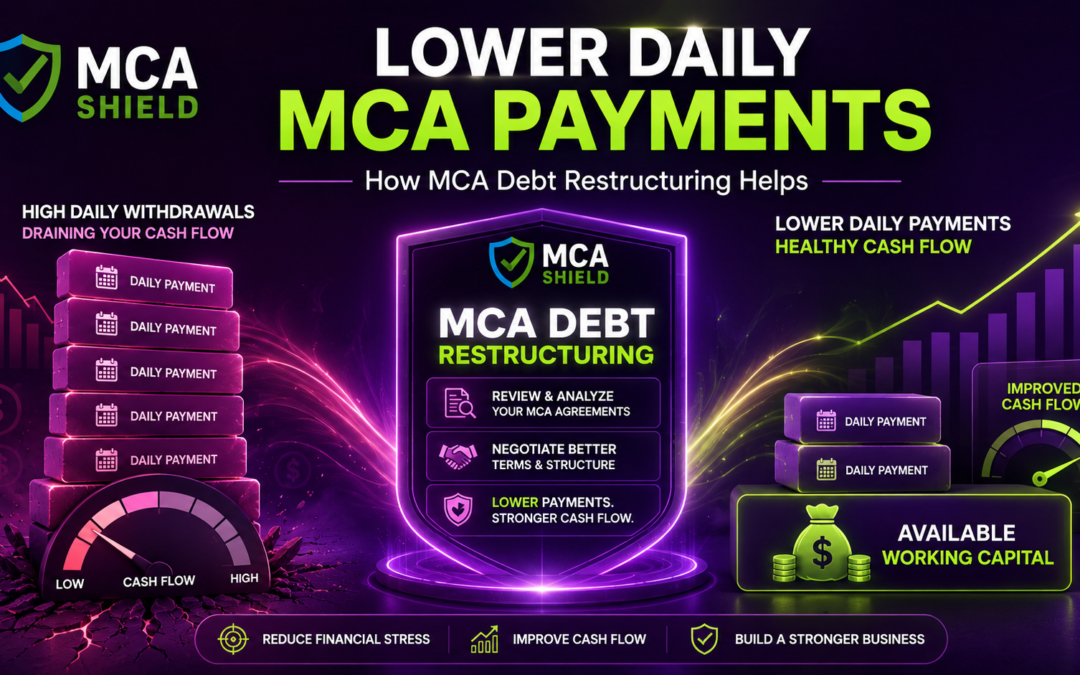
High daily merchant cash advance withdrawals can quickly put pressure on business cash flow. When too much money leaves your account each day, it becomes harder to cover payroll, inventory, rent, and other essential expenses. MCA debt restructuring may help reduce that pressure by creating a more manageable payment structure.
By lowering daily MCA payments, a business may be able to keep more working capital available for everyday operations. However, the right restructuring plan should be based on what the business can realistically afford.
In this article, we explain how MCA debt restructuring can lower your daily payments, what affects the amount of relief available, and how restructuring may help your business regain greater control over its cash flow.
Schedule Your Free Consultation
Why Daily MCA Payments Put So Much Pressure on Business Cash Flow
Merchant cash advances can create serious pressure when payments are withdrawn from a business account every day. Unlike a traditional monthly loan payment, daily MCA payments can reduce available cash before the business has time to cover its regular expenses.
This can make it harder to manage payroll, rent, inventory, utilities, taxes, and other operating costs. Over time, the business may have less flexibility to handle unexpected expenses or slower sales periods.
Frequent ACH Withdrawals Reduce Available Working Capital
Many merchant cash advances use automatic ACH withdrawals to collect payments directly from a business bank account. These withdrawals may happen daily or several times each week.
As a result, money can leave the account soon after customer payments are deposited. That means less cash remains available for working capital and normal business operations.
When available cash keeps shrinking, owners may begin delaying purchases, postponing bills, or using reserves to keep the business running. This is one reason MCA debt restructuring may become necessary when the original payment schedule no longer fits the business’s cash flow.
Multiple MCA Payments Can Make the Pressure Worse
The situation can become even more difficult when a business has multiple merchant cash advances at the same time. Each MCA may have its own withdrawal schedule, which means several payments can hit the same bank account within a short period.
These combined withdrawals can consume a large portion of daily revenue and leave too little cash for essential expenses.
When several MCAs are competing for the same cash flow, reducing only one payment may not provide enough relief. A broader MCA debt restructuring strategy may be needed to evaluate the total payment burden and create a more manageable structure.
How MCA Debt Restructuring Can Lower Your Daily Payments

The goal of MCA debt restructuring is to make existing payment obligations more manageable for the business. Instead of continuing with withdrawals that strain cash flow, restructuring may adjust the payment structure to better match current revenue and operating needs.
Lower payments can give a business more room to cover payroll, inventory, rent, taxes, and other essential expenses. However, the new structure should still be realistic for both the business and the MCA provider.
Extending the Payment Structure
One way MCA debt restructuring can lower daily payments is by extending the payment period. When the balance is spread over a longer period, the amount withdrawn each day may decrease.
This can reduce immediate pressure on the business bank account. In turn, more cash may remain available for working capital and daily operations.
However, a longer payment period can also affect the total cost. Business owners should review the complete terms before agreeing to a new structure.
Reducing the Amount Withdrawn From Each Deposit
Some MCA agreements collect a fixed amount or a percentage of incoming revenue. If those withdrawals are too high, restructuring may help create a lower withdrawal amount.
Reducing the amount taken from each deposit can leave more money in the account after sales are processed. That can make it easier to cover essential expenses and manage short-term cash needs.
For businesses experiencing tight cash flow, even a modest reduction in daily MCA payments can create meaningful breathing room.
Creating Payments the Business Can Realistically Afford
A successful restructuring plan should be based on what the business can actually pay without disrupting normal operations. That requires reviewing revenue, operating expenses, existing MCA obligations, and available cash.
The goal is not simply to get the lowest payment possible. The goal is to create a manageable MCA payment structure that the business can maintain.
When payments better match the company’s real cash flow, MCA debt restructuring can help reduce daily financial pressure while protecting the working capital needed to keep the business operating.
How Lower MCA Payments Can Improve Business Cash Flow
Reducing the amount that leaves a business account each day can have an immediate effect on business cash flow. When daily withdrawals become more manageable, the company keeps more of its revenue available for essential expenses.
This is one of the main benefits of MCA debt restructuring. Lower payments can give the business more financial flexibility while it continues to meet its obligations.
More Cash Remains Available for Payroll and Operations
High MCA withdrawals can force a business to choose between making payments and covering normal operating expenses. When daily MCA payments are reduced, more money may remain in the bank account for payroll, rent, inventory, utilities, and other costs.
Keeping enough cash available for these expenses is critical. A business still needs money to operate, serve customers, and generate revenue while paying down its MCA obligations.
A more manageable payment structure can help protect the cash needed to keep those operations moving.
Working Capital Has Time to Recover
Constant withdrawals can gradually drain working capital, especially when sales fluctuate or expenses increase. Without enough available cash, even a profitable business may struggle to handle short-term financial needs.
Lower MCA payments can give working capital time to rebuild. Instead of sending a large portion of daily revenue toward MCA obligations, the business may be able to keep more cash in reserve.
Stronger working capital can also help a business handle unexpected expenses without immediately looking for another source of financing.
Cash-Flow Planning Becomes More Predictable
Managing a business becomes difficult when large withdrawals repeatedly reduce the account balance. Owners may not know how much cash will remain available for upcoming expenses.
A successful MCA debt restructuring can make payments easier to plan around. When withdrawals fit the company’s actual financial capacity, management can create a more realistic operating budget.
More predictable cash flow can make it easier to schedule payroll, purchase inventory, pay vendors, and prepare for future expenses. Ultimately, lower daily payments can give the business greater control over how its available cash is used.
What Determines How Much Your MCA Payments Can Be Reduced
The amount of relief available through MCA debt restructuring can vary from one business to another. There is no single reduction that applies to every merchant cash advance.
Instead, the final payment structure usually depends on the company’s financial condition, the amount still owed, and the terms each provider is willing to consider. Reviewing these factors helps determine what level of daily MCA payment reduction may be realistic.
Current Revenue and Cash Flow
A business’s current revenue and cash flow play a major role in determining what it can afford to pay.
If revenue has declined, the original withdrawal amount may no longer fit the company’s operating budget. A restructuring review may look at recent deposits, monthly expenses, payroll needs, and other essential costs before determining a more manageable payment level.
The goal is to create a payment structure that reflects the business’s actual financial capacity, rather than relying on terms that no longer match current performance.
Total MCA Balances and Existing Payment Obligations
The amount a business still owes also affects how much its payments may be reduced. A company with one MCA may have more flexibility than a business managing several large balances at the same time.
For businesses with multiple merchant cash advances, it is important to look at the total amount leaving the bank account each day or week. One reduced payment may provide some relief, but the overall burden may still remain too high.
That is why an effective MCA debt restructuring strategy should consider all existing obligations together, not just one agreement at a time.
The Terms Each MCA Provider Is Willing to Restructure
Every MCA provider may approach restructuring differently. Some may be willing to adjust payment amounts, extend the payment period, or modify the withdrawal schedule. Others may offer fewer options.
Because of this, the final result depends in part on what each MCA provider is willing to negotiate.
Business owners should carefully review any proposed changes before agreeing to new terms. A lower daily payment can be helpful, but the full agreement should still support the company’s long-term cash flow and working capital needs.
Restructuring One MCA vs. Restructuring Multiple Merchant Cash Advances
Restructuring a single merchant cash advance can be much different from dealing with several at the same time. With one MCA, the business can focus on one balance, one payment schedule, and one provider.
However, businesses with multiple merchant cash advances must look at the entire payment burden. Even if one payment is reduced, the remaining withdrawals may continue to put heavy pressure on cash flow.
For that reason, MCA debt restructuring should focus on the total amount a business can realistically afford.
Every MCA Payment Affects the Same Business Budget
Each MCA may have its own agreement, but every payment ultimately comes from the same pool of business revenue.
Money used for one MCA payment is no longer available for payroll, rent, inventory, taxes, utilities, or other operating expenses. When several withdrawals occur each day or week, they can quickly consume a large portion of available cash.
That is why businesses with multiple MCAs should evaluate the combined payment burden, rather than reviewing each agreement in isolation.
One Restructured Payment May Not Solve the Entire Problem
Reducing one MCA payment can provide some immediate relief. However, it may not be enough if several other advances continue withdrawing money at their original rates.
For example, lowering one daily withdrawal while three others remain unchanged may still leave the business with an unaffordable total payment.
An effective MCA debt restructuring plan should consider whether the business can afford all remaining payments after essential operating expenses are covered. The goal is to improve the overall cash-flow position, not simply reduce one individual withdrawal.
Multiple MCAs Require a Coordinated Payment Strategy
Businesses with several merchant cash advances often need a coordinated restructuring strategy. This means reviewing all MCA balances, withdrawal amounts, payment schedules, and provider terms together.
From there, the business can determine how much money must remain available for working capital and essential expenses before deciding what payment level is sustainable.
A coordinated approach can also help prevent one restructured agreement from being undermined by other large withdrawals. When every MCA is considered as part of one business budget, the company has a better chance of creating a manageable payment structure that supports long-term cash-flow stability.
Does Lowering Daily MCA Payments Increase the Total Cost?
Lowering daily MCA payments can improve short-term cash flow, but business owners should also consider the total financial impact of the new payment structure.
In some cases, MCA debt restructuring may reduce the amount withdrawn each day while extending the time needed to satisfy the obligation. That can provide valuable breathing room, but it may also change the overall cost of repayment.
Before accepting new terms, it is important to compare both the immediate payment relief and the long-term financial effect.
Lower Payments Can Sometimes Extend the Repayment Period
One common way to reduce daily payment pressure is to spread the remaining obligation over a longer period.
A longer payment schedule may lower the amount withdrawn from the business account each day or week. This can leave more cash available for payroll, inventory, operating expenses, and working capital.
However, extending the payment period may also affect the total amount the business pays over time. Any new fees, added costs, or changes to the agreement should be reviewed carefully.
The goal of MCA debt restructuring should be to create a payment structure the business can actually maintain without creating a larger financial problem later.
Compare Immediate Cash-Flow Relief With the Total Financial Cost
A lower daily payment can be extremely helpful when a business is struggling to keep enough cash in its account. Still, the lowest payment is not always the best financial option.
Business owners should compare the new payment amount, repayment period, total expected cost, and effect on working capital before agreeing to a restructuring plan.
The right solution should provide meaningful cash-flow relief while keeping the overall financial obligation reasonable.
By looking at both short-term affordability and long-term cost, a business can make a more informed decision about whether the proposed MCA debt restructuring truly improves its financial position.
When MCA Debt Restructuring May Be Better Than Taking Another Advance
When cash flow becomes tight, taking another merchant cash advance can seem like a fast way to bring money into the business. However, new funding may only provide temporary relief if the company is already struggling with high daily withdrawals.
In some situations, MCA debt restructuring may be a better option because it focuses on reducing pressure from existing obligations instead of adding another payment.
New MCA Funding Can Add Another Payment Obligation
A new merchant cash advance may provide immediate cash, but it also creates another repayment obligation.
If the business already has one or more MCAs, the new advance can add another daily or weekly withdrawal to the same operating account. This may leave even less money available for payroll, inventory, rent, taxes, and other essential expenses.
The additional funding may solve a short-term cash shortage, but the extra payment can make the overall cash-flow problem more difficult to manage.
Before taking another advance, business owners should consider whether the new payment will actually improve the company’s position or simply increase the total MCA payment burden.
Restructuring Addresses Existing Payment Pressure Instead of Adding Debt
Rather than adding another obligation, MCA debt restructuring focuses on the payments already affecting the business.
A restructuring strategy may seek to lower withdrawals, adjust payment schedules, or create terms that better match current revenue and cash flow. The goal is to make existing obligations more manageable while protecting the money needed to operate the business.
This approach can help a company address the source of its daily payment pressure instead of using new financing to cover old obligations.
For a business already struggling with merchant cash advance payments, reviewing restructuring options before taking another MCA may help protect working capital, cash flow, and long-term financial stability.
Take Action Before Daily MCA Payments Limit Your Options
High daily MCA payments can become harder to manage the longer cash-flow problems continue. As working capital declines, a business may have fewer options and less flexibility to negotiate new payment terms.
Taking action early gives owners more time to review the full financial picture and consider whether MCA debt restructuring could create a more manageable path forward.
Review Your MCA Obligations Before Cash Flow Becomes Critical
Start by reviewing every merchant cash advance agreement, remaining balance, payment amount, and withdrawal schedule.
This helps show how much money is leaving the business each day or week. It also makes it easier to identify whether MCA payments are consuming too much available cash.
Waiting until payroll, rent, taxes, or essential expenses are already at risk can make the situation more difficult. An early review can help the business understand the problem before cash flow reaches a critical point.
Determine What Your Business Can Realistically Afford
Before discussing new payment terms, the business should determine how much it can actually afford to pay.
Review current revenue, payroll, rent, inventory, taxes, utilities, and other necessary operating expenses. Then determine how much cash must remain available to keep the company running.
A successful MCA debt restructuring plan should be based on a realistic payment amount, not simply the lowest number available. The goal is to create payments the business can maintain while protecting working capital and essential operations.
Explore Restructuring Before Adding Another MCA
When cash is tight, another merchant cash advance may seem like a quick solution. However, adding another MCA can create an additional payment and place even more pressure on the same business revenue.
Before taking on new funding, consider whether restructuring existing MCA obligations could address the underlying payment problem.
Reducing current payment pressure may help the business preserve cash, stabilize operations, and avoid creating another layer of debt. Acting before the situation becomes critical can provide more time to evaluate options and build a more sustainable cash-flow strategy.