
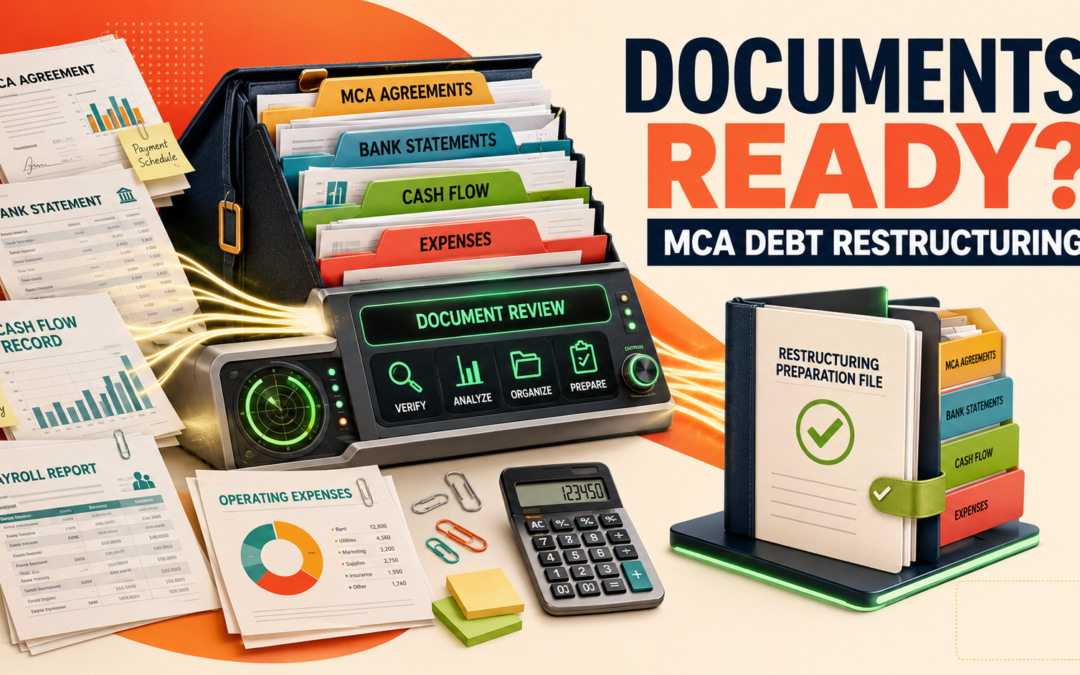
Knowing the documents needed for MCA debt restructuring can help you prepare for a faster, more accurate financial review. MCA agreements, bank statements, cash-flow records, and expense reports show how current payments affect your business.
Complete records also help identify an affordable payment structure based on your revenue and essential operating costs. This guide explains which documents to gather and why each one matters during the restructuring process.
Schedule Your Free Consultation
Why Documentation Matters During MCA Debt Restructuring
Accurate documentation gives a restructuring professional a clear picture of your business’s financial position. Without complete records, it can be difficult to understand how MCA withdrawals affect your cash flow, payroll, operating expenses, and working capital.
The documents needed for MCA debt restructuring also confirm essential details about each obligation. These details may include the remaining balance, payment frequency, withdrawal amount, factor rate, and contract terms. If your business has multiple MCAs, each agreement should be reviewed as part of the overall financial picture.
Complete records can also help prevent decisions based on estimates or incomplete information. The goal is to develop a strategy that reflects your business’s actual income and expenses.
How Financial Records Help Determine an Affordable Payment
Financial records show how much money enters your business and how much must remain available for essential expenses. Recent bank statements, profit and loss reports, merchant processing statements, and cash-flow records help identify revenue patterns and available working capital.
A restructuring review should consider expenses such as:
- Payroll and employee benefits
- Rent or mortgage payments
- Taxes and insurance
- Inventory and supplies
- Utilities and equipment costs
- Vendor and transportation expenses
After reviewing these obligations, a restructuring professional can estimate what the business may realistically afford. An affordable payment should reduce financial pressure while leaving enough cash to support normal operations.
The lowest possible payment is not always the best option. The payment structure must also account for the repayment period, total cost, and the business’s ability to meet proposed terms.
Gather Every MCA Agreement and Funding Contract

Collect a complete copy of every merchant cash advance agreement connected to your business. These contracts provide the terms needed to understand each obligation and the effect on your cash flow.
A restructuring professional may review details such as:
- Original funding amount
- Total purchased amount
- Daily or weekly withdrawal
- Factor rate
- Holdback percentage
- Estimated remaining balance
- Reconciliation provisions
- ACH authorization
- Personal guarantee or confession of judgment, if included
Do not rely only on current withdrawal amounts or verbal information from a funder. The signed agreement helps confirm the original terms and identifies provisions that may affect an MCA debt restructuring strategy.
Include Renewals, Amendments, and Additional MCA Positions
Your records should include more than the original funding contract. Gather all renewal documents, payment modifications, addenda, payoff statements, and written communications that changed the agreement.
If your business has stacked MCAs, provide the agreement for every position. Include newer advances even if they came from a different funder. Multiple withdrawals can place significant pressure on the same business bank account. Therefore, each obligation must be reviewed within the full payment structure.
Organize the agreements by funder and label each one with its current payment amount. This makes it easier to compare the obligations and identify how much money leaves the business each day or week. A complete set of contracts supports a more accurate and coordinated restructuring review.
Provide Recent Business Bank Statements
Prepare Business Revenue and Cash-Flow Records
Business revenue and cash-flow records show whether your company earns enough to support daily operations and a revised MCA payment. These records add context to your bank statements and help explain changes in deposits.
Gather documents that show both gross revenue and available operating cash. Revenue alone does not tell the full story. A business may generate strong sales but still struggle after paying payroll, inventory, taxes, and other necessary expenses.
Helpful records may include:
- Merchant processing statements
- Profit and loss reports
- Business tax returns
- Cash-flow statements
- Accounts receivable reports
- Sales reports or invoices
- Current balance sheets
Organize these records by month whenever possible. Monthly reports make it easier to identify seasonal changes, revenue declines, and periods of stronger cash flow.
Merchant Processing Statements, Profit and Loss Reports, and Tax Returns
Merchant processing statements show credit and debit card sales. They can help confirm revenue for restaurants, retailers, medical practices, and other businesses that accept card payments. These statements may also show processing fees, refunds, and chargebacks.
A profit and loss report compares revenue with business expenses. It shows whether the company generates a profit or operates at a loss during a specific period. A current year-to-date report often provides a clearer picture of recent performance than older financial records.
Business tax returns provide a longer-term view of revenue and expenses. They can help verify annual income and show how the company performed in previous years.
Together, these documents create a more complete financial picture. They help a restructuring professional compare past performance, current revenue, and available cash flow before evaluating a possible payment structure.
Document Payroll and Essential Operating Expenses
Create a Complete List of Business Debts and Payments
MCA payments are only one part of your company’s financial picture. Before restructuring, create a complete list of all debt and recurring financial obligations.
This list helps show how much money leaves the business each month. It also reveals whether several payments compete for the same revenue. Without this information, a proposed MCA payment may appear affordable even though it leaves too little cash for other obligations.
Include debts such as:
- Merchant cash advances
- Business term loans
- Lines of credit
- Business credit cards
- Equipment financing
- Vehicle loans
- Commercial leases
- Tax payment plans
- Past-due vendor balances
- Other secured or unsecured business debts
Separate business debts from ordinary operating expenses. For example, loan payments belong on the debt list. However, payroll, rent, utilities, and inventory should appear in your operating-expense records.
Record Balances, Payments, and Due Dates
For each debt, record the creditor, estimated balance, payment amount, payment frequency, and next due date. You should also note whether the account is current, past due, or has collection activity.
A simple debt summary may include:
- Name of the creditor or funder
- Type of obligation
- Original amount
- Estimated current balance
- Daily, weekly, or monthly payment
- Payment method
- Remaining repayment period
- Account status
Include current payoff statements when available. These statements may provide a more accurate balance than older account records.
Include Secured Debts, Tax Obligations, and Past-Due Accounts
Some obligations may carry greater financial or legal consequences than others. Therefore, identify any debt connected to business equipment, vehicles, property, or other collateral.
Also include unpaid taxes and active tax payment plans. Tax obligations can affect how much money the business has available for a revised MCA payment.
Do not leave out past-due accounts. Late payments, collection notices, and defaulted obligations help show the full level of pressure on your business.
Review Total Debt Alongside MCA Payments
A restructuring professional should review your MCA obligations alongside your other business debts. This creates a more accurate view of your company’s total payment burden.
For example, reducing an MCA payment may provide limited relief if large loan, tax, or equipment payments continue to strain cash flow. The review must consider how all payments affect payroll, operating expenses, and working capital.
A complete debt list supports a more realistic MCA debt restructuring plan. It helps identify a payment structure that accounts for the business’s full financial position—not only its merchant cash advances.
Include Collection Notices, UCC Filings, and Legal Documents
What Happens If Some Required Documents Are Missing?
Organize Your Records Before Requesting MCA Debt Restructuring
Organized records can make an MCA debt restructuring review faster and more accurate. They allow the reviewer to focus on your financial situation not spending time searching for missing information.
Create a separate digital folder for each MCA funder. Add the following records to the appropriate folder:
- Signed MCA agreement
- Renewals and amendments
- Current balance or payoff statement
- Payment history
- Emails and written communications
- Default or collection notices
- UCC filings and legal documents
Next, create folders for your bank statements, revenue records, tax returns, payroll reports, operating expenses, and other business debts. Use clear file names that include the document type and date. For example, use “Business Bank Statement — July 2026” instead of keeping an unclear download number.
Prepare a short summary of your current financial position as well. Include:
- Number of active MCAs
- Combined daily or weekly payment
- Estimated remaining balances
- Average monthly revenue
- Essential monthly expenses
- Primary cash-flow concerns
- Pending collection or legal activity
Review every folder before submitting your documents. Make sure the records cover all MCA positions and business bank accounts. Also, identify missing information and note any estimates that still require confirmation.
Schedule a Free Consultation With MCA Shield
If MCA withdrawals make it difficult to cover payroll or essential expenses, consider requesting a review before cash flow becomes more strained.
MCA Shield can review your MCA agreements, bank statements, revenue records, operating expenses, and other business obligations. This information helps the team understand your current payment pressure and evaluate potential restructuring options.
Every business has different contracts, revenue patterns, and expenses. Therefore, the available options will depend on your company’s complete financial position.
Schedule a Free Consultation With MCA Shield to discuss your current MCA payments and learn which documents you should prepare for your restructuring review.