
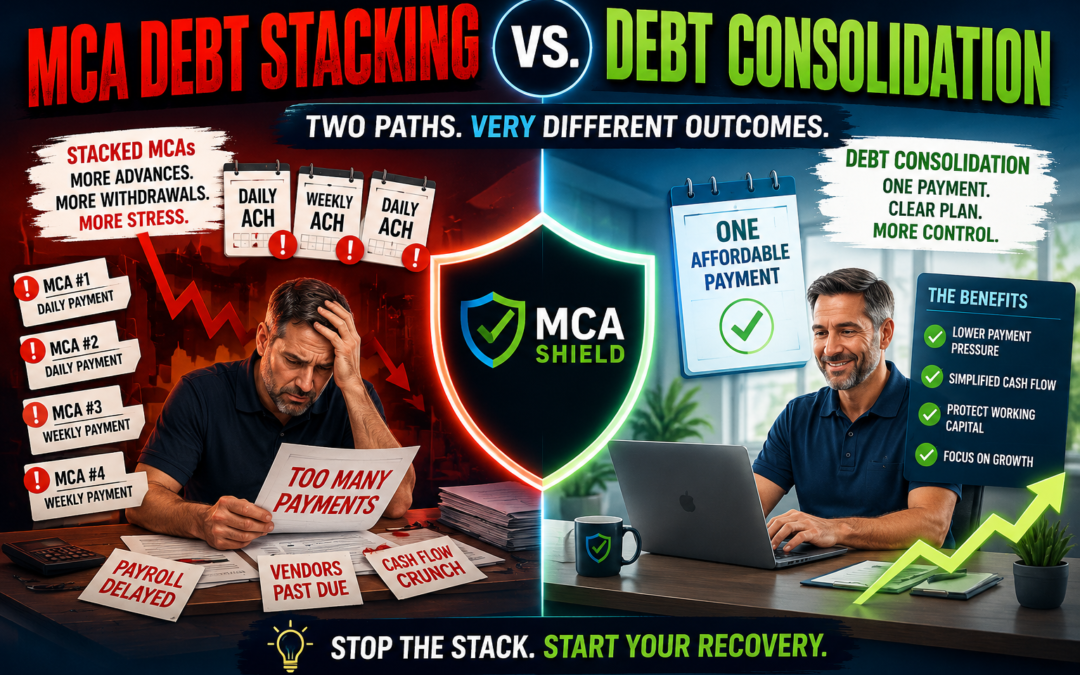
When a business takes on multiple merchant cash advances, the payments can quickly become difficult to manage. Understanding MCA debt stacking vs debt consolidation can help business owners see why cash flow becomes strained and what options may be available to regain control.
MCA debt stacking happens when a business carries several advances at the same time. Each advance may have its own daily or weekly withdrawal. As those payments add up, less money remains for payroll, vendors, inventory, rent, and other operating expenses. In some cases, businesses take another advance simply to keep up with existing obligations.
By contrast, MCA debt consolidation may provide a more organized approach to managing multiple obligations. The goal is often to reduce payment pressure, simplify the repayment structure, and protect more working capital for normal business operations. This article explains the key differences, warning signs to watch for, and when consolidation may be worth considering.
Schedule Your Free Consultation
What Is MCA Debt Stacking and Why Does It Create Cash-Flow Pressure?
MCA debt stacking happens when a business takes on multiple merchant cash advances before earlier advances are fully repaid. Each new advance adds another payment obligation to the business. Over time, these overlapping payments can place serious pressure on daily cash flow.
At first, an additional advance may seem like a quick way to cover payroll, inventory, repairs, or another urgent expense. However, the new funding also creates another repayment obligation. If several advances are active at once, a large portion of the business’s revenue may be withdrawn before it can be used for normal operating costs.
The result can be a difficult cycle. The business needs more cash to operate, but multiple MCA payments continue reducing the money available each day or week.
How Multiple Merchant Cash Advances Become Stacked
MCA stacking often begins with a single merchant cash advance. The business receives funding and agrees to repay the advance through daily or weekly withdrawals. If revenue falls or expenses increase, the remaining cash may no longer be enough to cover the company’s needs.
The owner may then accept a second advance to create additional working capital. Later, another cash shortage could lead to a third or even fourth advance. Each new agreement adds another withdrawal to the business’s existing payment schedule.
For example, a business might have:
- One MCA withdrawing payments every weekday
- A second MCA making its own daily withdrawal
- A third MCA collecting a weekly payment
- Additional expenses for payroll, rent, inventory, taxes, and vendors
This is how stacked merchant cash advances can become difficult to manage. Revenue has not necessarily increased, yet more money is leaving the business to cover MCA obligations.
In some situations, business owners begin using new advances to help make payments on older ones. This can create a renewal or borrowing cycle that increases financial pressure instead of solving the underlying cash-flow problem.
Why Daily and Weekly ACH Withdrawals Can Become Unmanageable
Daily and weekly ACH withdrawals can create problems because they reduce the amount of cash a business can use for operations. One payment may be manageable. Several withdrawals happening at the same time can create a much larger burden.
The pressure becomes especially serious when business revenue changes from week to week. A company may still have the same MCA withdrawals even during a slow sales period. That can leave less money available for payroll, suppliers, rent, utilities, inventory, and other essential expenses.
Businesses with stacked MCAs may also experience more frequent overdrafts or difficulty maintaining sufficient bank balances. In severe cases, owners may delay vendors, postpone purchases, or use additional financing simply to keep the business operating.
This is one of the biggest differences when comparing MCA debt stacking vs debt consolidation. Stacking creates multiple competing payment obligations. Consolidation may provide a way to organize those obligations into a more manageable payment structure and reduce the pressure on working capital.
What Is MCA Debt Consolidation and How Does It Work?
MCA debt consolidation is a strategy used to simplify multiple merchant cash advance obligations. Instead of managing several separate payments, a business may be able to combine those obligations into a more organized repayment structure.
The main goal is to reduce payment pressure and make cash flow easier to manage. A consolidation plan may replace several daily or weekly withdrawals with one structured payment that better fits the business’s current revenue and operating needs.
For companies dealing with stacked advances, consolidation can provide a clearer path forward. It can also help business owners better understand what they owe, what they can afford, and how much cash needs to remain available for operations.
Combining Multiple MCA Payments Into One Structured Payment
When several MCAs are active at the same time, each funder may be withdrawing money on a different schedule. This can make it difficult to track payments and maintain enough cash in the business bank account.
With MCA debt consolidation, multiple obligations may be reviewed together. The goal is to create a payment structure that is easier to manage than several competing withdrawals.
A consolidation strategy may consider:
- Current MCA balances
- Daily and weekly payment amounts
- Business revenue
- Essential operating expenses
- Available working capital
- The amount the business can realistically afford
Instead of several withdrawals hitting the account throughout the week, the business may have one more predictable payment obligation. This can make budgeting easier and reduce the confusion that often comes with stacked MCA debt.
However, consolidation should not be based only on getting a lower payment. Business owners should also review the total cost, repayment terms, fees, and long-term impact before agreeing to a new structure.
How Consolidation Can Simplify Business Cash Flow
Cash flow becomes much easier to manage when a business knows how much money is leaving the account and when the payment will occur. Multiple MCA withdrawals can make that difficult because several funders may be competing for the same revenue.
A more organized consolidation structure can help the business plan around payroll, inventory, rent, vendors, taxes, and other essential expenses. This can provide more visibility into how much cash remains available after debt payments are made.
Consolidation may also reduce the need to constantly move money between accounts or take on new financing to cover short-term shortages. Instead, the business can focus on maintaining a payment that fits within its normal operating cash flow.
When comparing MCA debt stacking vs debt consolidation, this is one of the biggest differences. Stacking creates multiple overlapping obligations, while consolidation aims to create a clearer payment structure and more predictable cash flow.
MCA Debt Stacking vs. Debt Consolidation: What Is the Difference?
The biggest difference between MCA debt stacking vs debt consolidation is how the business manages its merchant cash advance obligations. Debt stacking creates several separate payments that compete for the same revenue. Debt consolidation aims to replace that pressure with a more organized repayment structure.
With stacked MCAs, a business may have multiple funders withdrawing money from the same bank account. Each agreement can have its own payment amount, frequency, and repayment terms. As more advances are added, cash-flow pressure can increase quickly.
By contrast, MCA debt consolidation focuses on simplifying the repayment process. The goal is often to reduce the number of separate payments, improve predictability, and leave more working capital available for normal business expenses.
Multiple Competing Payments vs. One Organized Repayment Strategy
When a business has stacked merchant cash advances, several payments may be scheduled throughout the week. One funder may withdraw money every weekday, while another collects weekly. A third advance may have its own separate payment schedule.
This can create several problems at once. The business may struggle to keep enough money in its account for payroll, vendors, inventory, rent, taxes, and other operating costs.
With consolidation, the business may be able to move toward one organized repayment strategy instead of managing several competing obligations. That can make it easier to understand how much money is leaving the account and how much remains available for operations.
A simpler payment structure may also help the owner create a more accurate weekly or monthly budget. Instead of reacting to multiple withdrawals, the business can plan around a clearer payment schedule.
Comparing Payment Frequency, Cash-Flow Impact, and Total Cost
Payment frequency is only one factor to consider when comparing MCA debt stacking vs debt consolidation. Business owners should also look at the effect each option has on cash flow and the total amount that will be repaid.
With stacked MCAs, the business may face several daily or weekly withdrawals. Even if each individual payment appears manageable, the combined amount can consume a significant portion of incoming revenue.
Consolidation may help reduce that pressure by creating a more predictable and manageable payment structure. However, a lower payment does not automatically mean the overall arrangement is better.
Before moving forward, business owners should compare:
- Payment frequency
- Total weekly or monthly payment burden
- Remaining MCA balances
- Fees and repayment terms
- Total repayment cost
- Impact on working capital
- Cash available for essential business expenses
The right strategy should do more than simply change the payment schedule. It should help the business maintain enough cash to operate while creating a realistic path toward resolving its MCA obligations.
Ultimately, MCA debt consolidation should be evaluated based on both affordability and total cost. A payment that fits the company’s cash flow can be valuable, but the full financial impact should always be reviewed before making a decision.
What Are the Warning Signs That MCA Debt Stacking Is Hurting Your Business?
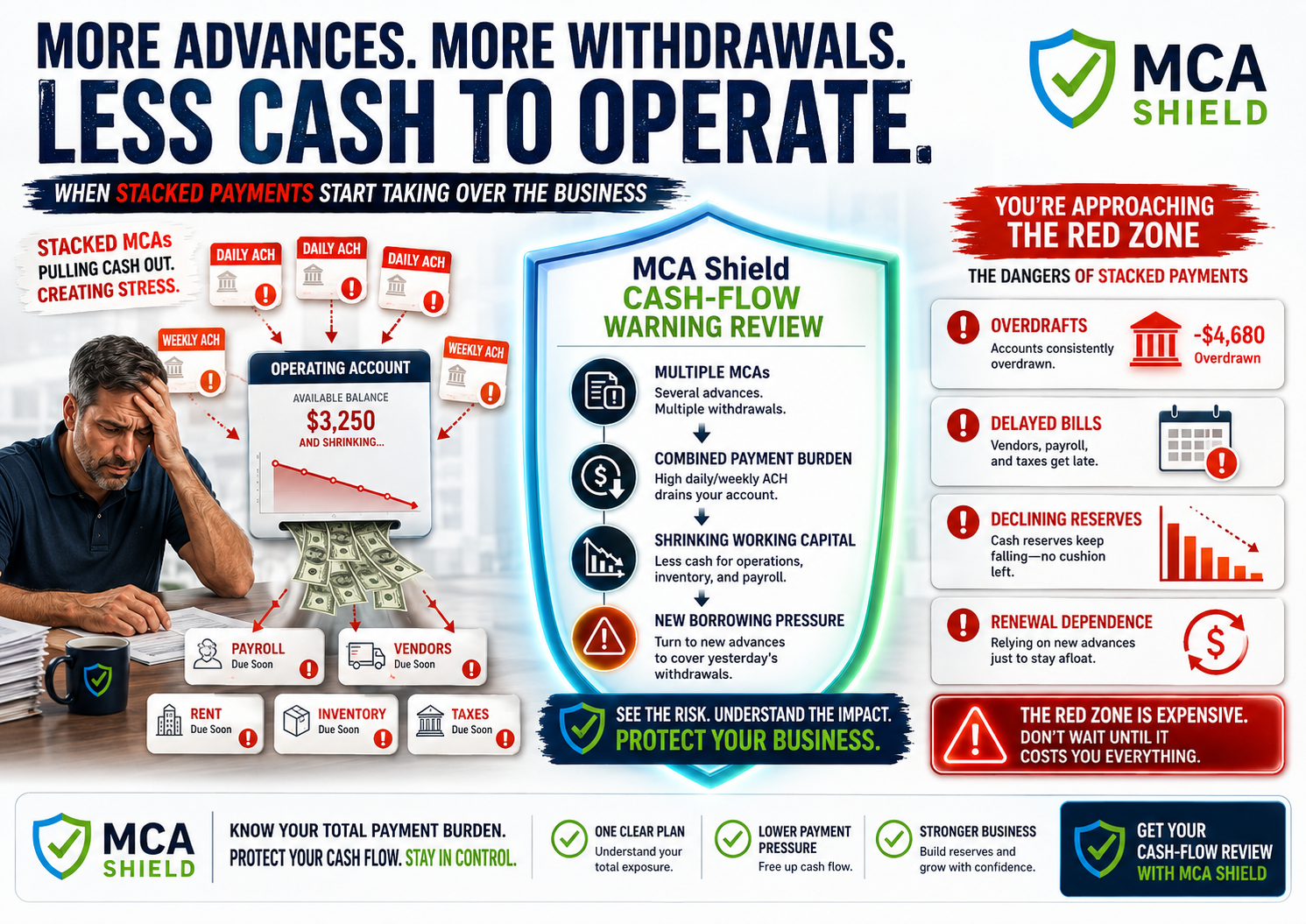
MCA debt stacking becomes dangerous when the business can no longer cover normal expenses after merchant cash advance payments are withdrawn. At that point, the problem is no longer just the number of advances. The larger issue is how much operating cash remains after the payments are made.
Business owners should watch for changes in everyday financial behavior. Frequent overdrafts, delayed bills, missed vendor payments, and repeated cash shortages can all signal that stacked MCA payments are consuming too much revenue.
Recognizing these warning signs early can give a business more time to review its options before the situation becomes more difficult.
Payroll, Vendors, and Operating Expenses Become Harder to Cover
One of the clearest warning signs is difficulty paying normal business expenses. A company may still be generating revenue, but several daily or weekly MCA withdrawals can reduce the amount of cash available to operate.
As payment pressure increases, the business may begin struggling with:
- Payroll and employee expenses
- Vendor and supplier invoices
- Rent and utilities
- Inventory and equipment purchases
- Taxes and insurance
- Marketing and other operating costs
A business that regularly has to decide which expense gets paid first may be experiencing a serious cash-flow problem.
Payroll is especially important. If MCA withdrawals are making it difficult to pay employees on time, the payment structure may no longer fit the company’s financial capacity.
Vendor problems can create additional pressure. Late payments may reduce available credit, interrupt inventory deliveries, or damage important supplier relationships.
The goal of business financing should be to support operations. When debt payments begin interfering with basic operating expenses and working capital, it may be time to review the existing MCA obligations.
Renewals and New Advances Are Needed to Make Existing Payments
Another major warning sign occurs when a business needs new financing simply to keep up with existing MCA payments.
For example, an owner may take another merchant cash advance to cover a temporary cash shortage. Part of that money may then be used to make payments on earlier advances or cover expenses that existing withdrawals have made difficult to afford.
This can create a cycle:
Cash shortage → New MCA → Additional payment → Less working capital → Another cash shortage
Each new advance may provide temporary relief, but it also adds another repayment obligation. If revenue does not increase enough to support the additional payment, the business can become even more financially strained.
Repeated renewals can create a similar problem. Refinancing or renewing an advance may provide additional cash, but the owner should carefully review the new balance, payment amount, fees, and total repayment cost.
When comparing MCA debt stacking vs debt consolidation, this borrowing cycle is an important distinction. Stacking may continue adding payments, while consolidation aims to create a more organized strategy for managing existing MCA debt.
If a business is borrowing primarily to make other debt payments, that is a strong sign that the current structure needs to be reviewed.
Can MCA Debt Consolidation Lower Daily or Weekly Payments?
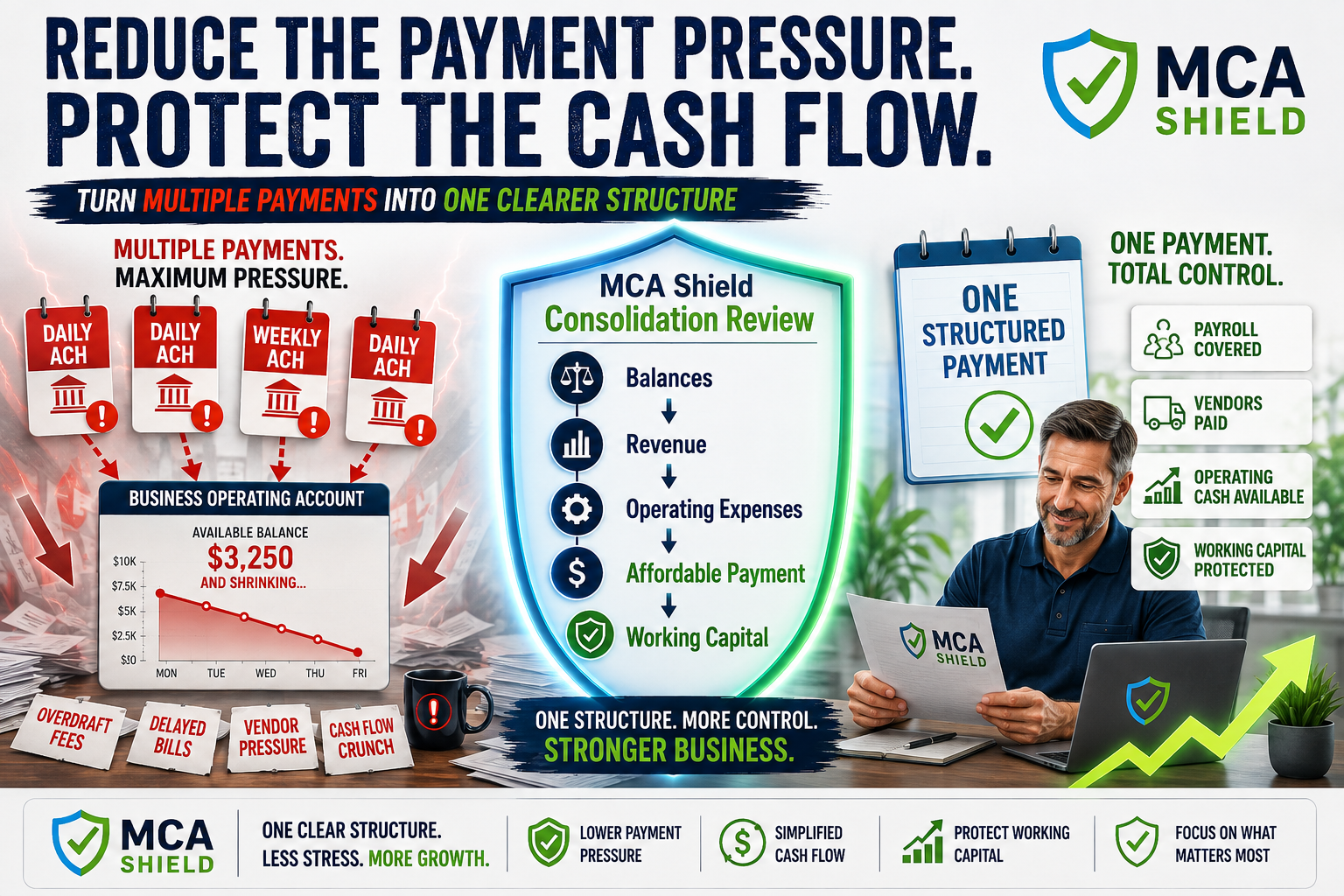
MCA debt consolidation may help lower the amount a business pays each day or week by replacing several separate obligations with a more manageable payment structure. For businesses dealing with stacked advances, this can reduce the pressure caused by multiple withdrawals hitting the same bank account.
The exact payment depends on the business’s current obligations, revenue, expenses, and available cash flow. The goal is not simply to create the lowest possible payment. A stronger strategy focuses on what the business can realistically afford while continuing to operate.
Lower payment pressure can give a company more room to cover essential expenses and avoid the cycle of taking on new advances just to stay current.
How an Affordable Consolidated Payment Is Calculated
An affordable consolidated payment should be based on the company’s actual financial condition. That means reviewing more than the total MCA balance.
A proper evaluation may include:
- Current MCA balances
- Daily and weekly withdrawal amounts
- Average business revenue
- Payroll and labor costs
- Rent, utilities, and insurance
- Vendor and inventory expenses
- Taxes and other fixed obligations
- Available working capital
The purpose of this review is to determine how much the business can pay toward MCA debt without creating another cash shortage.
For example, if several advances are withdrawing a combined $4,000 each week, but the business can only support $2,500 after essential expenses, the current payment burden may be too high. A consolidation strategy may aim to bring the payment closer to a level the business can actually sustain.
However, business owners should also review the total repayment amount, fees, and length of the new payment structure. A lower weekly payment may improve cash flow, but the complete financial impact still matters.
Why Lower Payment Pressure Can Help Protect Working Capital
Working capital is the money a business needs to handle day-to-day operations. It helps cover payroll, vendors, inventory, taxes, utilities, and unexpected expenses.
When stacked MCA payments consume too much revenue, working capital can disappear quickly. Even a profitable company can struggle if too much cash leaves the account before operating expenses are paid.
Lower daily or weekly payments may help the business keep more cash available for:
- Payroll
- Inventory and materials
- Vendor payments
- Rent and utilities
- Taxes and insurance
- Emergency expenses
- Business growth
This extra breathing room can also reduce the need to rely on another merchant cash advance when a short-term expense appears.
When evaluating MCA debt stacking vs debt consolidation, protecting working capital is one of the most important considerations. A successful consolidation strategy should create a payment that the business can maintain while still leaving enough cash to keep the company operating.
When Should a Business Consider Consolidating Stacked MCA Debt?
A business should consider consolidating stacked MCA debt when multiple daily or weekly payments begin interfering with normal operations. Waiting until the situation becomes critical can reduce flexibility and make the financial strain harder to control.
Common signs that it may be time to explore consolidation include frequent overdrafts, delayed vendor payments, difficulty covering payroll, and the need to take new advances to keep up with existing obligations.
The best time to review options is often before the business reaches default. Taking action earlier can provide more time to evaluate balances, cash flow, payment terms, and the overall cost of a possible consolidation strategy.
Why Acting Before Default Can Create More Options
Default can create additional problems for a business. Depending on the MCA agreements involved, missed payments may lead to collection activity, increased pressure from funders, legal disputes, or other consequences.
By reviewing the situation before payments are missed, the business may have more time to make an informed decision. It may also be easier to determine what payment level can be supported without putting essential expenses at risk.
Early warning signs can include:
- MCA payments consuming too much weekly revenue
- Frequent negative bank balances or overdrafts
- Payroll becoming difficult to cover
- Vendor payments being delayed
- Cash reserves continuing to decline
- New financing being used to pay existing debt
- Multiple MCA renewals creating additional payment pressure
These signs do not always mean default is unavoidable. However, they may indicate that the current payment structure is no longer sustainable.
Acting earlier also gives the owner time to review the complete financial picture. That includes MCA balances, repayment terms, operating expenses, revenue trends, and available working capital.
What to Review Before Choosing an MCA Consolidation Strategy
Not every consolidation option will be right for every business. Before agreeing to a new repayment structure, the owner should understand exactly how the change will affect both short-term cash flow and long-term cost.
Important factors to review include:
- Total outstanding MCA balances
- Current daily and weekly payments
- Proposed consolidated payment
- Payment frequency
- Length of the repayment period
- Fees and other costs
- Total amount expected to be repaid
- Available working capital after payments
- Any UCC filings or personal guarantees
- Terms contained in each existing MCA agreement
The proposed payment should leave enough cash available for payroll, vendors, rent, inventory, taxes, and other essential operating expenses.
Business owners should also avoid choosing a consolidation plan based only on the size of the payment. A smaller payment may look attractive, but the total repayment cost and length of the agreement should still be carefully reviewed.
When comparing MCA debt stacking vs debt consolidation, the best strategy is the one that creates a realistic payment structure without placing the business under another unsustainable financial burden.
How Can MCA Shield Help Businesses Move From Stacked MCAs to a Clearer Debt Strategy?
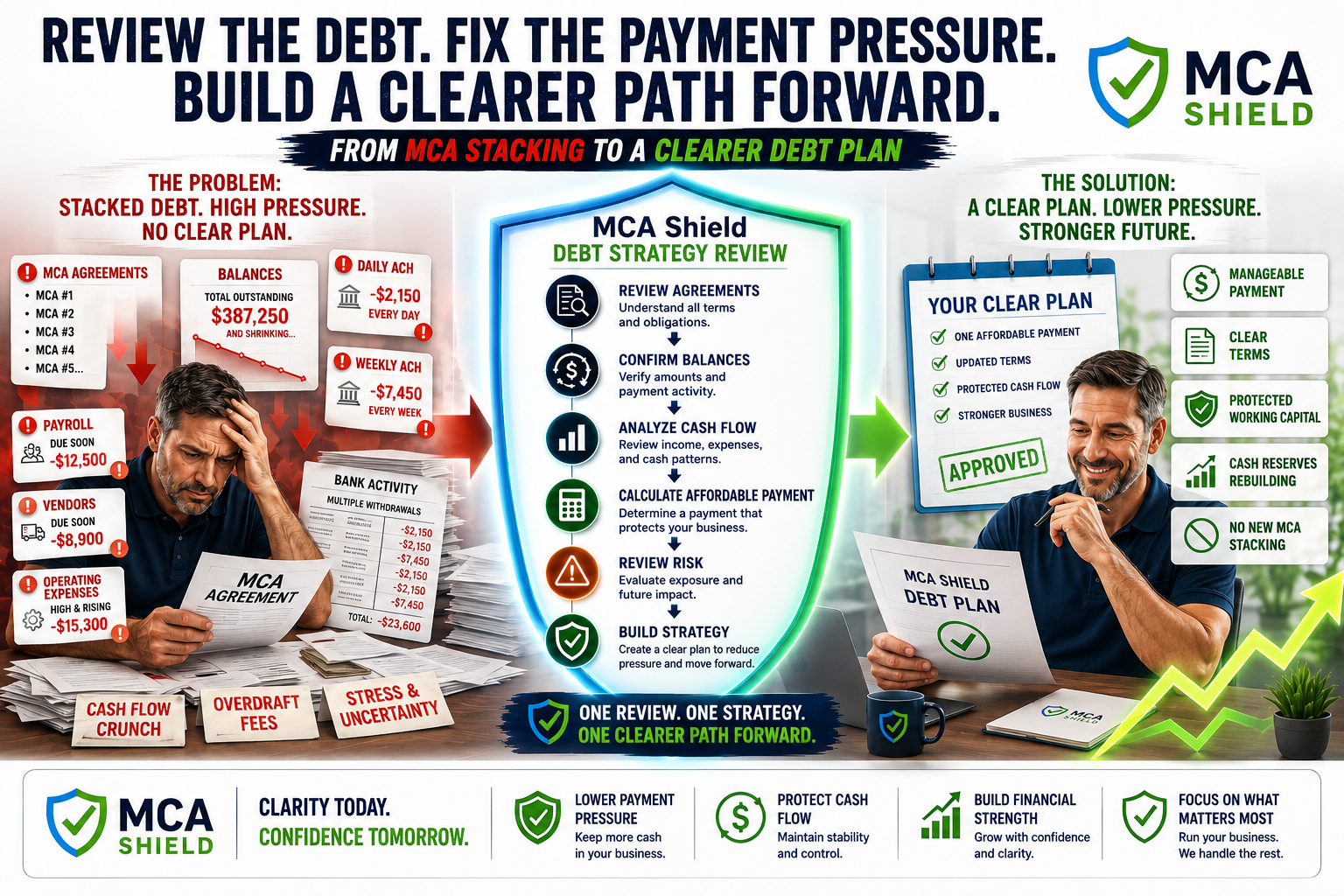
When several merchant cash advances are draining cash flow, the first step is understanding the full financial picture. MCA Shield helps business owners review stacked MCA debt, current payments, and operating cash flow before considering a restructuring or consolidation strategy.
The goal is to move away from a cycle of overlapping payments and toward a plan that is easier to understand and more realistic to maintain. That process starts with the numbers, not promises.
Reviewing MCA Agreements, Balances, and Current Cash Flow
Every business is different. Before recommending a strategy, MCA Shield can review the details of each existing merchant cash advance.
That review may include:
- Current MCA agreements
- Remaining balances
- Daily and weekly payment amounts
- Payment frequency
- Business bank activity
- Average monthly revenue
- Payroll and operating expenses
- Available working capital
- UCC filings and personal guarantees
This helps create a clearer picture of how much pressure the current MCA payments are placing on the business.
It also makes it easier to identify whether the problem is mainly payment frequency, total debt burden, declining cash flow, or a combination of several factors.
A complete review is especially important when comparing MCA debt stacking vs debt consolidation. The right strategy depends on what the business owes and what it can realistically support.
Building a Payment Strategy Around What the Business Can Afford
A payment strategy should not be based on what looks good on paper. It should be based on what the business can afford after essential operating expenses are covered.
MCA Shield can evaluate current revenue alongside expenses such as payroll, rent, vendors, inventory, insurance, taxes, and utilities. This helps determine how much cash needs to remain available for normal operations.
The objective is to create a more manageable payment structure while protecting the business’s ability to function.
That may mean focusing on:
- Reducing daily or weekly payment pressure
- Improving cash-flow predictability
- Protecting working capital
- Avoiding additional MCA stacking
- Creating a clearer path for repayment
A lower payment can be helpful, but affordability is only part of the equation. Business owners should also understand the total cost, timeline, and terms of any proposed strategy.
Schedule a Free Consultation With MCA Shield
If stacked merchant cash advances are making it difficult to cover normal business expenses, waiting can allow the pressure to grow.
A free consultation with MCA Shield can help you understand your current MCA obligations and review possible options based on your business’s cash flow.
There is no one-size-fits-all solution. The right approach depends on your balances, payment structure, operating expenses, and financial goals.
Schedule a Free Consultation With MCA Shield to review your agreements, understand your options, and determine whether MCA debt consolidation or another restructuring strategy may be appropriate for your business.