
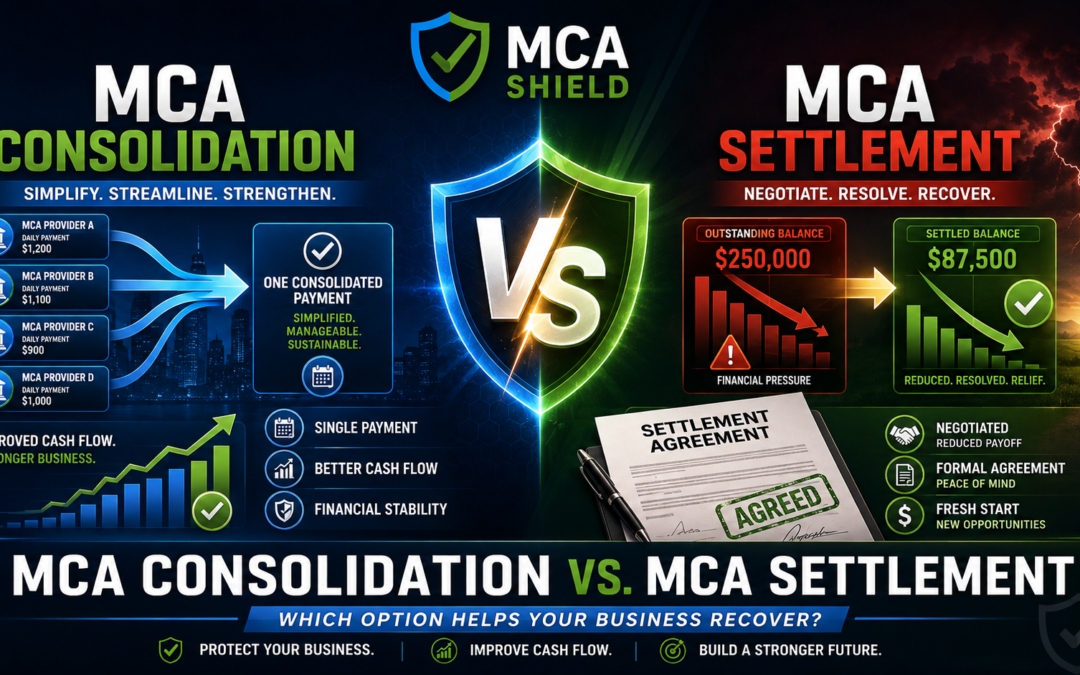
When a business is struggling with merchant cash advance debt, choosing the right relief strategy can make a major difference. Two common options are MCA consolidation vs MCA settlement. While both may help reduce financial pressure, they work in very different ways.
MCA consolidation focuses on combining or restructuring multiple MCA obligations into a more manageable payment plan. The goal is often to improve cash flow, simplify payments, and help the business keep more working capital available for payroll, vendors, and daily operations.
MCA settlement, on the other hand, usually involves negotiating with MCA funders to resolve an outstanding balance for less than the amount claimed. In this guide, we will compare MCA consolidation and MCA settlement, explain the benefits and risks of each, and help you understand which option may be better for your business.
Schedule Your Free Consultation
What Is the Difference Between MCA Consolidation and MCA Settlement?
The main difference between MCA consolidation and MCA settlement is how each strategy addresses merchant cash advance debt. Consolidation focuses on creating a more manageable payment structure. Settlement focuses on resolving an outstanding balance through negotiation.
Both options may help a business facing high daily or weekly MCA payments, but they are designed for different financial situations. Understanding how each one works can help a business owner make a more informed decision.
How MCA Consolidation Works
MCA consolidation is used to simplify one or more merchant cash advance obligations. Instead of managing several separate withdrawals, a business may be able to combine those payments into a more organized repayment structure.
The goal is often to reduce payment pressure and improve cash flow. A lower or more predictable payment can leave more money available for important operating expenses such as:
- Payroll
- Vendor payments
- Rent and utilities
- Inventory
- Taxes
- Working capital
For businesses with stacked MCAs, consolidation may also make repayment easier to track. Rather than dealing with multiple funders and withdrawal schedules, the business may have a clearer payment structure.
However, consolidation does not automatically mean that the total amount owed will be reduced. The terms, fees, repayment period, and overall cost should always be reviewed carefully.
How MCA Settlement Works
MCA settlement takes a different approach. Instead of reorganizing the full obligation into a new payment structure, settlement generally involves negotiating with the MCA provider over the amount that must be paid to resolve the account.
In some situations, a funder may agree to accept less than the outstanding amount claimed. The settlement may be paid through a lump sum or through an agreed payment schedule.
Settlement is often considered when a business is already experiencing serious financial pressure and may no longer be able to maintain the original MCA payment terms.
A settlement negotiation may involve reviewing:
- The remaining balance
- Current cash flow
- Default status
- Collection activity
- Personal guarantees
- UCC filings
- Potential legal risks
Settlement can provide significant relief in some cases, but it may also involve greater risk. Missed payments, collection activity, lawsuits, or other consequences may already be involved depending on the agreement and the business’s situation.
Why the Two Strategies Solve Different Problems
Although both strategies fall under the broader category of MCA debt relief, they do not solve the same problem.
MCA consolidation is generally focused on payment affordability and cash-flow management. A business may still be operating successfully but struggling because too much revenue is being withdrawn every day or week.
MCA settlement is generally focused on resolving debt that has become difficult or impossible to repay under the existing terms. The priority may be reducing the amount required to close the obligation rather than simply reorganizing payments.
For that reason, choosing between MCA consolidation vs MCA settlement should depend on the business’s cash flow, number of active advances, outstanding balances, repayment ability, and legal exposure. The right strategy should provide meaningful relief without creating a new financial problem.
How Does MCA Consolidation Work With Multiple Merchant Cash Advances?

When a business has several merchant cash advances at the same time, the payments can quickly become difficult to manage. Each MCA may have its own daily or weekly withdrawal, leaving less money available for normal business expenses.
MCA consolidation is designed to simplify this situation. Instead of managing several separate obligations, the business may be able to move toward one more manageable payment structure. The goal is to reduce cash flow pressure and make repayment easier to track.
Combining Multiple MCA Payments Into a More Manageable Structure
Businesses with stacked MCAs may have several funders withdrawing money from the same operating account. Even when each individual payment seems manageable, the combined withdrawals can consume a large portion of daily revenue.
An MCA consolidation strategy may bring multiple obligations into a more organized repayment plan. Before that happens, the business’s existing agreements, balances, payment schedules, and current cash flow should be reviewed.
A typical review may include:
- Current MCA balances
- Daily or weekly withdrawal amounts
- Number of active MCA agreements
- Remaining repayment terms
- Average monthly business revenue
- Payroll and vendor expenses
- Available working capital
The purpose is not simply to replace several payments with one. The new payment structure should also be affordable based on the business’s actual cash flow.
How Consolidation Can Reduce Daily or Weekly Payment Pressure
One of the biggest problems with multiple MCAs is the amount of money leaving the business account every day or week. High withdrawals can make it difficult to cover payroll, inventory, rent, vendors, taxes, and other operating expenses.
If MCA consolidation lowers the required payment, the business may keep more cash available for daily operations.
For example, a company making several separate MCA payments may be able to move toward one structured payment that better fits current revenue. This can create more predictable cash flow and reduce the risk of constantly operating with a low bank balance.
Improved payment affordability may also help the business avoid:
- Overdrafts
- Late vendor payments
- Payroll shortages
- Emergency borrowing
- Taking another MCA to cover existing payments
That last point is especially important. Using a new merchant cash advance to make payments on older advances can create a cycle of renewals and stacked MCA debt.
When MCA Consolidation May Make Sense
MCA consolidation may make sense when the business can still support repayment but the current payment structure has become too aggressive. In this situation, the underlying business may still be viable, but daily or weekly withdrawals are placing too much pressure on working capital.
Consolidation may be worth evaluating when a business has multiple active MCAs, declining cash reserves, frequent overdrafts, difficulty covering operating expenses, or repeated reliance on renewals.
However, every business is different. The total cost, repayment period, fees, current balances, and proposed payment should all be reviewed before moving forward.
The goal of MCA consolidation should be to create a payment structure the business can realistically maintain while protecting enough cash to continue operating and rebuilding financial stability.
How Does MCA Settlement Work?
MCA settlement is a debt resolution strategy that focuses on negotiating the amount required to satisfy a merchant cash advance obligation. Instead of reorganizing the full balance into a new repayment structure, settlement attempts to reach an agreement that allows the business to resolve the account for an agreed amount.
This approach is usually considered when a business is under serious financial pressure and the original MCA payments are no longer realistic. The exact outcome depends on the funder, the agreement, the remaining balance, and the financial condition of the business.
Negotiating an MCA Balance for Less Than the Amount Claimed
The central goal of MCA settlement is often to negotiate a lower payoff amount. In some cases, an MCA provider may agree to accept less than the amount currently claimed in exchange for resolving the obligation.
Before negotiations begin, it is important to review the business’s financial situation and the MCA agreement. This may include:
- Current outstanding balance
- Amount already paid
- Daily or weekly withdrawal amount
- Current business revenue
- Available cash reserves
- Default or collection status
- Personal guarantee provisions
- UCC filings and other legal concerns
A settlement is not automatic, and there is no guarantee that a funder will reduce the balance. The final result depends on the specific circumstances and the willingness of both sides to reach an agreement.
If a settlement is reached, the terms should be clearly documented. Business owners should understand how much must be paid, when it is due, and what happens after the settlement is completed.
Lump-Sum Settlements vs. Structured Settlement Payments
An MCA settlement agreement may be paid in different ways.
A lump-sum settlement requires the business to pay the negotiated amount in one payment or within a short period. A funder may be more willing to consider a reduced amount when funds are available quickly.
However, many businesses facing MCA debt do not have enough cash available for a large one-time payment.
In those situations, a structured settlement payment plan may be considered. This allows the agreed settlement amount to be paid over a defined period rather than all at once.
The best structure depends on the business’s current cash flow. A payment plan should leave enough money available to cover essential operating expenses, including payroll, rent, inventory, vendors, and taxes.
An agreement that looks attractive on paper may still create problems if the payments are too high to maintain.
When MCA Settlement May Become an Option
MCA settlement may become an option when the business can no longer realistically maintain the original payment terms. This often happens after revenue declines, several MCAs have been stacked, or daily withdrawals have consumed too much working capital.
Settlement may be worth evaluating when a business is experiencing:
- Repeated missed or returned payments
- Severe cash-flow shortages
- Multiple stacked MCA obligations
- Collection activity
- Threatened or pending legal action
- Difficulty making payroll or paying vendors
- No realistic ability to continue the original repayment schedule
Settlement is generally different from consolidation because the focus is not simply on making payments easier to manage. The objective is to resolve an MCA obligation through a negotiated agreement.
Before choosing settlement, a business owner should carefully compare the possible savings with the potential risks. Reviewing MCA consolidation vs MCA settlement can help determine whether the business needs a more manageable repayment structure or a negotiated resolution of the existing debt.
MCA Consolidation vs. MCA Settlement: Which Can Reduce Payments More?
When comparing MCA consolidation vs MCA settlement, one of the biggest questions is which option can reduce payment pressure more. The answer depends on the business’s current cash flow, outstanding balances, number of active MCAs, and ability to continue making payments.
Both strategies may lower the amount of money leaving the business each week or month. However, they do so in different ways. MCA consolidation usually focuses on restructuring payments, while MCA settlement focuses on negotiating the amount required to resolve the debt.
Comparing Monthly and Weekly Cash-Flow Relief
For many business owners, the most urgent problem is not the total MCA balance. It is the amount being withdrawn from the operating account every day or week.
MCA consolidation may provide immediate cash-flow relief by replacing multiple payments with a more manageable payment structure. This can be especially helpful for businesses with stacked merchant cash advances.
For example, a business may be dealing with several separate withdrawals each week. If those payments are consolidated into a lower structured payment, more cash may remain available for:
- Payroll
- Inventory
- Vendor payments
- Rent and utilities
- Taxes
- Daily operating expenses
MCA settlement may also reduce payment pressure, but the structure can be different. A settlement may require a lump-sum payment or a defined series of payments based on the negotiated agreement.
For a business with limited cash reserves, a large lump-sum settlement may be difficult even if the total amount owed is reduced. A structured settlement may provide more flexibility, but the payment must still fit the company’s actual cash flow.
The best option is generally the one that allows the business to meet its obligations while keeping enough money available to continue operating.
Comparing Total Repayment Cost
Payment size is only one part of the comparison. Business owners should also look at the total amount they may pay over the life of the agreement.
With MCA consolidation, the business may receive lower payments, but the repayment period could be longer. Depending on the terms, fees, and structure, this may affect the total cost.
With MCA settlement, the goal may be to negotiate a payoff for less than the amount claimed. If successful, this could reduce the total amount required to resolve the MCA obligation.
However, settlement can involve other considerations. These may include:
- Settlement fees
- Legal expenses
- Collection activity
- Default-related costs
- UCC filing issues
- Potential lawsuits
- Personal guarantee exposure
Because of these factors, a lower negotiated balance does not always mean the settlement will be the least expensive option overall.
Before choosing between MCA consolidation and MCA settlement, the business should compare both the immediate payment and the total expected cost of each strategy.
Why the Lowest Payment Is Not Always the Best Option
A very low payment can look attractive when cash flow is tight. However, the lowest payment is not always the best financial solution.
A lower payment may come with a longer repayment period, higher fees, or other terms that increase the total cost. Likewise, a settlement offer with a large balance reduction may still require payments that the business cannot realistically afford.
The better question is whether the proposed solution creates a sustainable payment that fits the business’s cash flow.
Business owners should consider several factors before making a decision:
- Can the business make the payment consistently?
- Will enough cash remain for payroll and vendors?
- What is the total repayment amount?
- How long will the repayment period last?
- Are there additional fees or costs?
- What happens if a payment is missed?
- Are there legal or UCC-related risks?
The goal should not simply be to secure the smallest payment. It should be to choose a strategy that helps the business reduce payment pressure, protect working capital, and move toward long-term financial stability.
When evaluating MCA consolidation vs MCA settlement, the strongest option is usually the one that provides meaningful relief without creating another payment structure the business cannot maintain.
What Are the Risks of MCA Consolidation vs. MCA Settlement?
When comparing MCA consolidation vs MCA settlement, it is important to look beyond the potential payment reduction. Both strategies can provide relief, but each may also involve financial, contractual, and legal risks.
The right option depends on the business’s current MCA agreements, cash flow, repayment history, and overall financial condition. Before moving forward, business owners should understand exactly what changes, what remains owed, and what could happen if the new arrangement is not maintained.
Default, Collections, and Funder Escalation
One of the biggest concerns with MCA debt is what happens when a business can no longer maintain its required payments.
With MCA consolidation, the goal is usually to create a payment structure that is easier to afford. However, the business still needs to make the new payments as agreed. If the consolidated payment is still too high, the business could eventually face the same cash-flow problems again.
That is why affordability matters. A consolidation plan should be based on real business revenue and operating expenses, not simply on getting the lowest possible short-term payment.
MCA settlement may involve greater collection and default-related risk, particularly if the account is already behind or in dispute. Depending on the agreement and circumstances, a funder may pursue collection efforts or other remedies while settlement discussions are taking place.
Possible concerns can include:
- Collection calls or notices
- Returned ACH payments
- Default notices
- Additional fees
- Legal demands
- Lawsuits
- Attempts to enforce contractual remedies
Settlement negotiations do not automatically stop collection activity. Business owners should understand the status of each MCA account and what protections, if any, are included in a written agreement.
UCC Filings and Personal Guarantees
Many merchant cash advance agreements contain provisions involving UCC filings, personal guarantees, or other contractual remedies. These terms can become especially important when a business is considering consolidation or settlement.
A UCC filing may give notice that a funder claims an interest in certain business assets or receivables. Multiple UCC filings can also make it more difficult for a company to obtain additional financing.
Business owners should determine whether existing UCC filings will remain in place after consolidation or settlement. If an MCA obligation is fully resolved, the written agreement should clearly explain what happens to any related filing.
A personal guarantee can also create additional risk. Depending on the wording of the agreement and applicable law, a business owner may have personal exposure if certain obligations are not satisfied.
Before entering any debt relief arrangement, review:
- UCC filing provisions
- Personal guarantee language
- Default provisions
- Confession of judgment provisions, where applicable
- Collection remedies
- Release terms
- Requirements for terminating UCC filings
These issues can be complicated. If there is an active lawsuit, disputed contract language, or significant personal liability concern, speaking with a qualified attorney may be appropriate.
Business Credit and Future Financing Considerations
Business owners should also consider how MCA consolidation or MCA settlement may affect future financing.
Merchant cash advance providers do not all report payment activity in the same way. However, lenders and financing companies may still discover existing MCA obligations through bank statements, UCC searches, credit reports, payment history, or underwriting documents.
A consolidation arrangement may improve the company’s financial picture if it lowers payment pressure and helps stabilize cash flow. However, taking on a new consolidation obligation may also affect the company’s debt load and future borrowing capacity.
Settlement can create different concerns. A lender reviewing the business in the future may consider prior defaults, settlements, collection activity, legal disputes, or unresolved UCC filings when evaluating an application.
For that reason, business owners should not evaluate MCA consolidation vs MCA settlement based only on today’s payment. They should also consider how the decision may affect the company’s ability to obtain working capital, equipment financing, lines of credit, or other business funding later.
The strongest strategy is usually one that provides meaningful relief while also protecting the company’s cash flow, operating stability, and long-term financial options.
Should You Consolidate or Settle Your MCA Debt?
Choosing whether to consolidate or settle MCA debt depends on the financial condition of the business and how difficult the current payments have become. There is no single strategy that works for every company.
In general, MCA consolidation may be better for a business that can still afford repayment but needs lower and more manageable payments. MCA settlement may be more appropriate when the business can no longer reasonably maintain the existing obligations and needs to negotiate a resolution.
Before deciding, business owners should review their cash flow, outstanding balances, number of active MCAs, operating expenses, and any legal or collection activity.
When Consolidation May Be the Better Strategy
MCA consolidation may be the better strategy when the business is still financially viable but daily or weekly withdrawals are creating too much pressure on cash flow.
For example, a company may be generating enough revenue to operate successfully, yet several MCA payments are being withdrawn from the same bank account. This can leave too little money available for payroll, vendors, inventory, taxes, and other operating expenses.
Consolidation may make sense when the business:
- Has multiple active merchant cash advances
- Is still making its MCA payments
- Has enough revenue to support a reduced payment
- Needs to lower daily or weekly payment pressure
- Is struggling to maintain adequate working capital
- Wants to simplify several payments into a more organized structure
- Is trying to avoid taking another MCA to cover existing obligations
The goal should be to create an affordable and sustainable repayment structure. Simply extending the repayment period or replacing several obligations with a new expensive obligation may not solve the underlying problem.
Business owners should compare the proposed payment, repayment period, fees, and total cost before agreeing to any consolidation plan.
When Settlement May Be the Better Strategy
MCA settlement may be worth considering when the business can no longer realistically maintain the original repayment terms.
This situation may develop after a major drop in revenue, loss of an important customer, unexpected expenses, or the accumulation of several stacked merchant cash advances.
Settlement may become a stronger option when the business is dealing with:
- Repeated missed payments
- Returned ACH withdrawals
- Severe cash-flow shortages
- Collection activity
- Multiple defaulted MCA accounts
- Threatened or pending legal action
- An inability to maintain the original payment schedule
The purpose of settlement is usually to negotiate a specific amount that will resolve the MCA obligation. Depending on the circumstances, this may involve a reduced lump-sum payment or structured settlement payments.
However, settlement carries important considerations. A business owner should understand whether collection activity will continue, whether legal action has already started, and how UCC filings or personal guarantees may affect the situation.
Any settlement terms should be clearly documented before payment is made.
What to Consider When Your Business Has Stacked MCAs
A business with stacked MCAs may have a more complicated decision to make. Several funders may be withdrawing money at different times, and each agreement may have different balances, terms, and remedies.
The first step should be to understand the full financial picture.
Review each MCA and identify:
- Current balance
- Daily or weekly payment
- Remaining repayment obligation
- Amount already paid
- Current account status
- UCC filings
- Personal guarantees
- Default provisions
- Collection or legal activity
Next, calculate how much the business can realistically afford to pay while still covering essential operating expenses.
A business that can support repayment after lowering the payment burden may benefit more from MCA consolidation or restructuring. A business that cannot reasonably repay its existing obligations may need to evaluate MCA settlement and other available options.
The key is to avoid choosing a solution based only on short-term relief. The right approach should help the business protect working capital, maintain operations, avoid additional MCA stacking, and build a more stable financial position.
When comparing MCA consolidation vs MCA settlement, the best strategy is the one that fits the business’s actual cash flow and provides a realistic path toward resolving its MCA obligations.
How to Choose the Right MCA Debt Relief Strategy for Your Business
Choosing the right MCA debt relief strategy starts with understanding the full financial picture of your business. The best option is not always the one with the lowest payment or the largest advertised savings.
A strong strategy should address the immediate pressure caused by merchant cash advance payments while also protecting working capital, payroll, vendor relationships, and daily operations. That means reviewing the agreements, calculating what the business can actually afford, and comparing available options before making a decision.
Review Your MCA Agreements and Current Balances
Before choosing between MCA consolidation, MCA restructuring, or MCA settlement, review every active merchant cash advance agreement.
Start by identifying:
- Current balance
- Daily or weekly payment amount
- Remaining repayment obligation
- Amount already paid
- Payment frequency
- Renewal history
- UCC filing provisions
- Personal guarantee language
- Default terms
- Collection or legal activity
This review is especially important for businesses with multiple or stacked MCAs. Several advances may have different payment schedules, balances, and contract terms.
Business owners should also confirm that the balances being discussed are accurate. Knowing exactly what is owed can make it easier to compare different MCA debt relief options and avoid making decisions based on incomplete information.
Calculate an Affordable Payment Based on Cash Flow
The next step is to determine what the business can realistically afford.
An affordable MCA payment should be based on actual revenue and operating expenses, not on an amount that only works during the strongest weeks of the month.
Review the cash needed for:
- Payroll
- Rent
- Inventory
- Vendor payments
- Utilities
- Taxes
- Insurance
- Essential operating expenses
After those costs are considered, the business can estimate how much cash is available for MCA repayment.
This step is critical because a debt relief plan that still consumes too much working capital may only delay the problem. A successful strategy should help the company reduce payment pressure while keeping enough cash available to operate.
Cash flow can also change over time. Seasonal businesses, companies with uneven customer payments, and businesses experiencing declining revenue may need a payment structure that accounts for those fluctuations.
Compare Consolidation, Restructuring, and Settlement Before Deciding
Business owners should compare all realistic options before committing to a specific MCA debt relief strategy.
MCA consolidation may be appropriate when multiple advances can be combined into a more manageable payment structure.
MCA restructuring may focus on changing the terms of existing obligations, such as the payment amount, frequency, or repayment schedule.
MCA settlement may be considered when the business can no longer reasonably maintain the original obligations and needs to negotiate a resolution.
When comparing these options, look at more than the weekly payment. Consider:
- Total repayment amount
- Payment frequency
- Length of the repayment period
- Fees and other costs
- Impact on working capital
- UCC filings
- Personal guarantees
- Default and collection risks
- Potential legal exposure
- Future financing needs
The goal is to choose a strategy that the business can actually maintain.
For many companies, the decision between MCA consolidation vs MCA settlement comes down to whether the business needs a more manageable repayment structure or a negotiated resolution of debt it can no longer reasonably support.
A careful review of the agreements, balances, and cash flow can help business owners choose a path that protects operations and creates a more realistic opportunity for long-term financial recovery.