ClickCease
Explore options for your business’s MCA payments.Call (918) 608-0117

Lowering MCA payments can give a business more room to cover payroll, pay vendors, manage taxes, and protect working capital. However, business owners often have questions about how payments are reduced, what information is required, and whether changing the payment will increase the total repayment cost.

This guide answers the most frequently asked questions about lowering MCA payments. It explains how payment adjustments work, when to request help, what risks to consider, and how to choose a strategy that fits the business’s actual cash flow.

Schedule Your Free Consultation

Can Merchant Cash Advance Payments Really Be Lowered?

Yes, merchant cash advance payments can sometimes be lowered through reconciliation, negotiation, restructuring, consolidation, or settlement. The right approach depends on the MCA agreement, the remaining balance, the business’s revenue, and whether the current withdrawals are still affordable.

A lower payment is not automatic. The business must usually demonstrate that its financial circumstances have changed and that the existing daily or weekly withdrawal is creating unsustainable cash-flow pressure.

When MCA Funders May Consider Changing the Payment

An MCA funder may consider changing the payment when the business has experienced a legitimate reduction in revenue. This could result from seasonal fluctuations, the loss of a major customer, delayed receivables, unexpected expenses, or changes within the industry.

Some MCA agreements include a reconciliation provision that allows payments to be adjusted based on actual receivables. If revenue has declined, the business may be able to request a payment that more accurately reflects its current sales. The agreement should be reviewed carefully because reconciliation requirements and procedures vary.

A funder may also consider a temporary payment reduction or modified schedule when it improves the likelihood that the business can continue operating and complete the repayment.

Why Lower Payments Are Not Guaranteed

Requesting a lower payment does not mean the funder must approve it. The outcome can depend on the agreement, payment history, current account status, supporting financial records, and the funder’s willingness to negotiate.

A request is more likely to be taken seriously when it includes accurate information instead of a general statement that the payment is unaffordable. The business may need to provide bank statements, processing statements, revenue reports, operating expenses, and details regarding other MCA obligations.

Business owners should also examine the complete cost of any proposed change. A smaller withdrawal may extend the repayment period, add fees, or increase the total amount paid. Every new arrangement should be reviewed and confirmed in writing before the business changes its payments.

How Business Cash Flow Supports the Request

Current cash flow helps show what the business can realistically afford. The review should account for revenue, MCA withdrawals, payroll, rent, inventory, utilities, taxes, vendor obligations, and other essential expenses.

After these numbers are organized, the business can calculate how much cash remains available for MCA payments without disrupting operations. This creates a factual basis for requesting a more manageable payment.

The goal is not simply to secure the smallest possible withdrawal. It is to establish a payment that gives the business enough breathing room to operate while remaining realistic about its repayment responsibilities. A payment structured around actual cash flow is more likely to support long-term stability than one based on outdated revenue or overly optimistic projections.

How Are Lower MCA Payments Calculated?
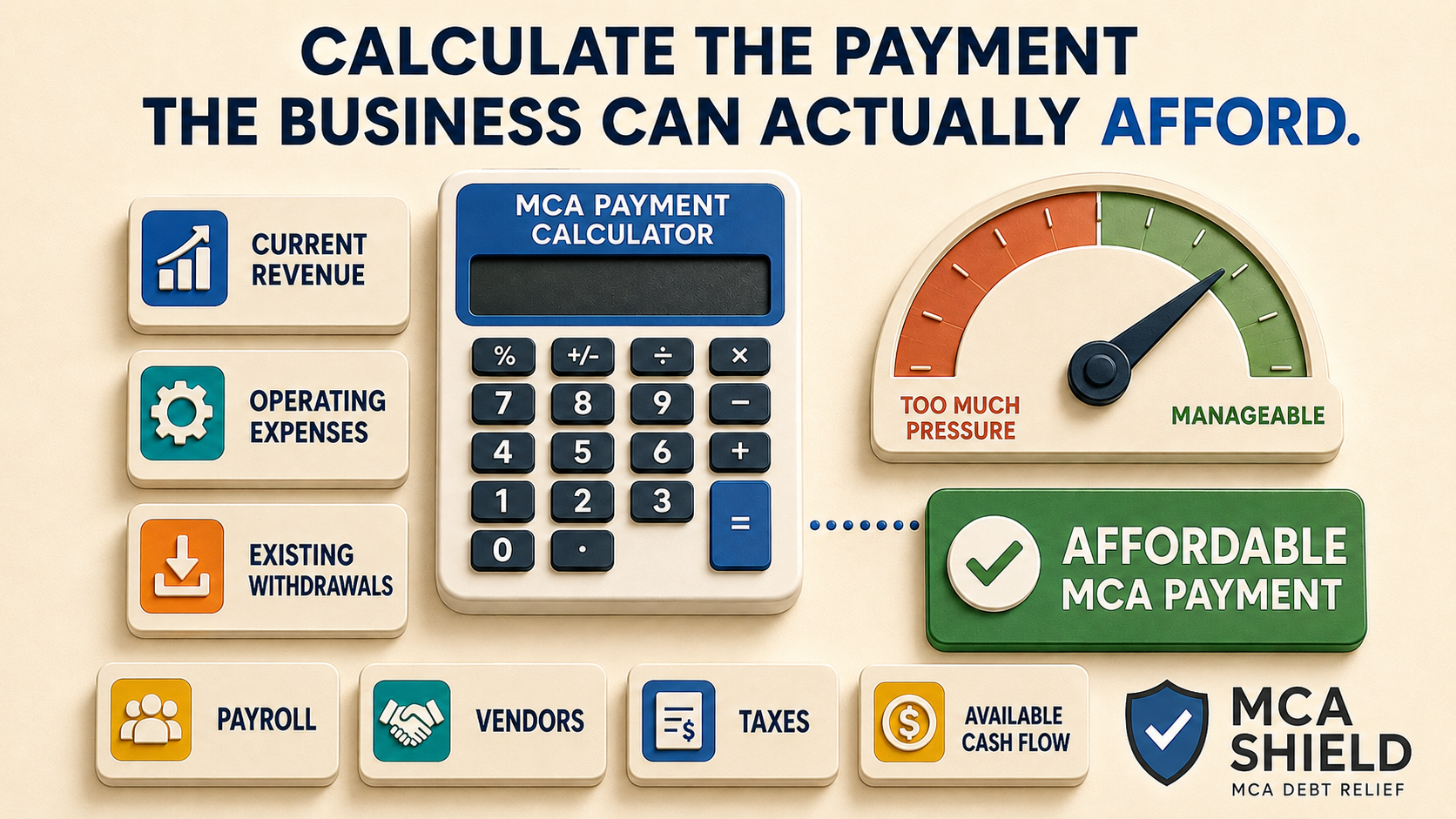
MCA payment calculator using revenue, expenses, withdrawals, payroll, vendors, taxes, and cash flow to calculate an affordable MCA payment

Lower MCA payments should be calculated based on the business’s current financial performance, not the revenue it earned when the advance was originally funded. The goal is to identify a payment the business can maintain without sacrificing the expenses required to keep operating.

This calculation requires a complete review of revenue, operating costs, existing MCA withdrawals, and available cash flow. Looking at only the bank balance or the amount owed can create a payment that appears manageable but quickly creates additional pressure.

Review Current Revenue and Operating Expenses

Start by calculating the business’s average revenue over a representative period. Depending on the business, this may require reviewing several weeks or months of bank statements, merchant processing statements, invoices, and accounting records.

The review should also identify the business’s essential operating expenses, including:

  • Payroll and employee-related costs
  • Rent or mortgage payments
  • Inventory and materials
  • Utilities and insurance
  • Vendor payments
  • Equipment and transportation expenses
  • Taxes and required government payments
  • Existing loan and MCA obligations

Seasonal businesses should avoid calculating affordability based on their strongest sales period alone. The payment must remain manageable during slower weeks or months, not just when revenue is at its peak.

Determine What the Business Can Realistically Afford

Once revenue and necessary expenses are documented, the business can estimate its available cash flow. A simplified calculation is:

Current revenue − essential operating expenses = cash available before MCA payments

That remaining amount should not automatically become the proposed MCA payment. The business still needs room for revenue fluctuations, delayed customer payments, unexpected costs, and ordinary working-capital needs.

The review should also account for every existing MCA. When multiple advances are stacked, focusing on only one withdrawal can produce an inaccurate picture of affordability. Daily and weekly payments should be converted into a consistent monthly estimate so the total burden is easier to evaluate.

A realistic proposal is one the business can make consistently. Agreeing to a payment that only works during unusually strong weeks could lead to another default or a renewed request for relief.

Leave Enough Cash for Payroll, Vendors, and Taxes

A lower MCA payment should protect the expenses that allow the business to remain open. Payroll, critical vendors, rent, insurance, and taxes should be accounted for before determining the amount available for MCA payments.

Business owners should also preserve a reasonable operating cushion. Without one, even a minor revenue decline or unexpected repair could cause overdrafts, missed payroll, or additional borrowing.

The final payment calculation should balance three priorities:

  • Keeping essential business expenses current
  • Maintaining enough working capital to continue operating
  • Creating an MCA payment the business can complete

Before accepting a revised arrangement, review the payment amount, frequency, duration, fees, and total repayment cost. The complete terms should be confirmed in writing so the business understands exactly how the lower payment will affect its cash flow and remaining obligation.

When Should a Business Ask for Lower MCA Payments?

A business should request lower MCA payments as soon as current withdrawals begin interfering with normal operations. Waiting until the bank account is empty, payroll is missed, or multiple payments are returned can reduce the available options and make negotiations more difficult.

The best time to act is when the business can clearly show that revenue or available cash flow has changed but is still operating and able to support a reasonable payment.

Request Help Before Missing Payments

Business owners do not need to wait until they default to request a payment adjustment. Early action provides more time to review the MCA agreements, calculate an affordable payment, and communicate with funders before the situation becomes more serious.

Warning signs may include:

  • Using credit cards to cover operating expenses
  • Delaying vendor payments to make MCA withdrawals
  • Struggling to maintain payroll reserves
  • Moving money between accounts to prevent returned payments
  • Taking another advance to cover an existing MCA
  • Falling behind on taxes, rent, or insurance

These problems indicate that the current payment structure may no longer fit the business. Addressing them early may reduce the risk of returned ACH payments, collection pressure, default notices, or additional borrowing.

Watch for Overdrafts and Declining Account Balances

Frequent overdrafts are one of the clearest signs that MCA withdrawals are consuming too much of the business’s available cash. Even if every payment is still being processed, repeated negative balances and bank fees can weaken the company’s financial position.

Business owners should monitor their accounts for patterns such as:

  • Lower balances immediately after MCA withdrawals
  • Returned checks or rejected vendor payments
  • Recurring overdraft or insufficient-funds fees
  • Difficulty keeping enough money available for automatic expenses
  • Account balances that continue declining despite steady sales

A business should also compare its cash position before and after each daily or weekly withdrawal. This can reveal whether MCA payments are leaving enough money to support operations between revenue deposits.

Act When Revenue No Longer Supports the Withdrawal

Many MCA payments are established when the business is producing stronger revenue. If sales decline but the withdrawal remains unchanged, the payment can consume a much larger share of current receipts.

Revenue may fall because of seasonal changes, customer losses, delayed receivables, industry conditions, equipment problems, construction, or an unexpected interruption. Whatever the cause, the business should document the decline with bank statements, processing statements, sales reports, or accounting records.

If the MCA agreement contains a reconciliation provision, the business may be able to request an adjustment based on actual receivables. Other situations may require negotiation, restructuring, consolidation, or settlement.

The goal is to act before the withdrawal causes more serious financial damage. A timely review can help the business pursue a payment based on its current cash flow while protecting payroll, vendors, taxes, and essential operating expenses.

What Information Is Needed to Request a Lower Payment?

A request for lower MCA payments is stronger when it is supported by complete and accurate financial records. Funders typically need evidence that the business’s revenue or cash flow has changed and that the current withdrawal is no longer sustainable.

Before making a request, organize every MCA obligation, verify the amounts being withdrawn, and calculate what the business can realistically afford.

Gather MCA Agreements and Current Balances

Collect the complete agreement for every active merchant cash advance. Do not rely only on emails, payment summaries, or the original funding amount. The agreement may contain important provisions covering reconciliation, payment frequency, default, fees, UCC filings, personal guarantees, and notice requirements.

For each MCA, record:

  • The funder’s name
  • The original purchase price
  • The purchased amount or total repayment amount
  • The amount already paid
  • The estimated remaining balance
  • The current payment amount and frequency
  • Any missed payments, returned withdrawals, or added fees
  • The agreement’s reconciliation procedure

Request an updated balance or payoff statement when possible. The amount shown in the business’s internal records may differ from the funder’s calculation, especially if fees, returned payments, or prior modifications have been added.

If the business has multiple MCAs, include all of them. Omitting one agreement can make the proposed payment appear affordable when the combined withdrawals remain unsustainable.

Document Daily or Weekly Withdrawals

Create a clear record of every MCA withdrawal from the business bank account. Bank statements should be reviewed carefully because a withdrawal may appear under a payment processor’s name rather than the funder’s public business name.

Document the amount, frequency, and date of each withdrawal. Then convert daily and weekly payments into monthly estimates so the business can see the total MCA burden.

For example, a daily withdrawal may seem manageable when viewed by itself. However, multiplying it by the number of business days in a month may reveal that a significant portion of revenue is being removed before payroll, vendors, and other expenses are paid.

Also identify any irregular activity, including duplicate withdrawals, changing payment amounts, overdraft charges, returned payments, or withdrawals that continued after a different arrangement was discussed.

Provide Bank Statements and Cash-Flow Records

Recent bank statements help demonstrate the business’s actual deposits, withdrawals, account balances, and overdraft activity. Depending on the situation, additional records may include:

  • Merchant processing statements
  • Profit-and-loss statements
  • Accounts receivable reports
  • Payroll records
  • Tax obligations
  • Vendor invoices
  • Rent, insurance, and utility expenses
  • Current cash-flow projections

These documents should show how revenue has changed and why the existing payment is creating financial pressure. They should also help establish the amount the business can afford after covering essential expenses.

Provide records that are accurate, consistent, and current. Incomplete or conflicting information can delay the review or weaken the request. Once the numbers are organized, the business can present a payment proposal based on documented cash flow instead of an unsupported estimate.

Can You Lower Payments on Multiple or Stacked MCAs?
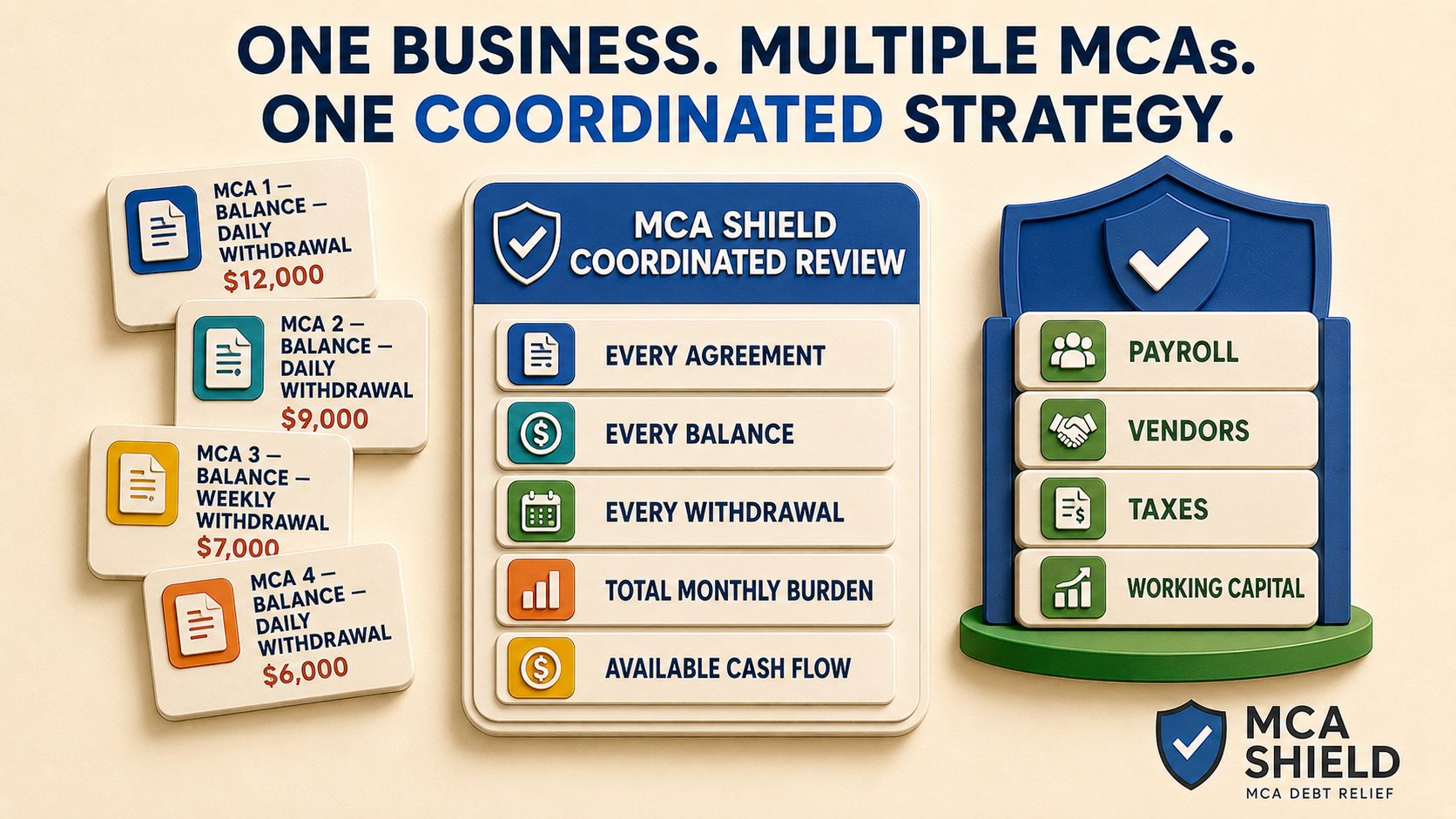
Coordinated MCA review comparing multiple stacked advances, balances, withdrawals, cash flow, and essential business expenses

Payments on multiple or stacked MCAs can sometimes be lowered, but the process is more complicated than addressing a single advance. Each funder has its own agreement, balance, withdrawal schedule, and collection rights. Reducing one payment may provide temporary relief, but it will not solve the problem if the remaining withdrawals continue draining the business account.

An effective approach starts with the complete MCA picture and creates a coordinated plan that the business can realistically maintain.

Review Every Advance Before Negotiating

Begin by reviewing every active MCA agreement. For each advance, identify:

  • The original funding amount
  • The purchased amount or total repayment obligation
  • The estimated remaining balance
  • The daily or weekly withdrawal
  • The payment history
  • Reconciliation provisions
  • Default terms and additional fees
  • UCC filings and personal guarantees

Confirm which funders are currently withdrawing money and whether any payments have been missed or returned. The business should also determine whether one funder holds an earlier UCC filing or whether any agreement contains provisions that could affect negotiations with other funders.

This review helps prevent decisions that address one advance while creating a new problem elsewhere. It also reveals the total amount being withdrawn from the business each day, week, and month.

Prioritize the Payments Creating the Most Pressure

Some MCA payments may create more immediate pressure than others. A large daily withdrawal could be causing repeated overdrafts, while a smaller weekly payment may remain manageable. An account already in default may also require more urgent attention than one that is still current.

Priorities should be based on factors such as:

  • The size and frequency of each withdrawal
  • The percentage of revenue consumed
  • The remaining balance
  • Returned payments or overdraft activity
  • Collection communications or default notices
  • The effect on payroll and essential expenses
  • Any potential legal or operational risks

Prioritizing does not mean ignoring the other advances. It means identifying where the most severe cash-flow damage is occurring so that the relief strategy addresses the greatest pressure first.

Build One Coordinated MCA Relief Strategy

A coordinated strategy calculates how much the business can afford to pay across all MCA obligations, not how much it can offer to each funder separately. The available payment budget should be based on current revenue after payroll, vendors, taxes, rent, and other necessary operating costs are covered.

Depending on the business’s circumstances, the strategy may involve:

  • Requesting reconciliation under applicable agreements
  • Negotiating lower daily or weekly withdrawals
  • Restructuring payment schedules
  • Consolidating qualifying obligations
  • Pursuing settlement when repayment in full is not realistic

Each option has different costs, risks, and qualification requirements. A lower payment may extend the repayment period, and resolving one MCA does not automatically change the terms of another.

Before modifying any payments, the business should understand how the proposed plan affects every funder. Any approved adjustment should be documented in writing, including the payment amount, schedule, fees, duration, and effect on the remaining balance. A coordinated plan can help prevent one MCA solution from being undermined by the withdrawals attached to the others.

Will Lowering MCA Payments Increase the Total Repayment Cost?

Lowering an MCA payment may increase the total repayment cost, but it depends on the type of relief and the terms offered. A reduced daily or weekly withdrawal could spread the existing balance over a longer period. In other situations, the revised arrangement may include modification fees, additional charges, or a higher total repayment amount.

Business owners should compare the full cost of the new arrangement instead of evaluating it only by the size of the payment.

Compare the New Payment Schedule With the Current Terms

Start by comparing the existing payment schedule with the proposed arrangement. Review the current withdrawal amount, payment frequency, estimated remaining balance, and expected completion date.

Next, calculate the same figures under the revised terms:

  • New daily, weekly, or monthly payment
  • Number of expected payments
  • Revised completion date
  • Total amount remaining to be paid
  • Effect on any existing fees or past-due amounts

A smaller withdrawal may improve immediate cash flow while keeping the total repayment amount unchanged. However, it could also extend the payment period and keep the MCA obligation active for considerably longer.

A reconciliation based on lower receivables may work differently from a negotiated restructuring. The business should understand what type of adjustment is being offered and whether the change affects only the payment schedule or the total obligation.

Review Fees and Extended Repayment Periods

A revised payment agreement may include administrative fees, modification fees, legal expenses, or charges related to returned payments. These costs can reduce the financial benefit of obtaining a lower withdrawal.

An extended repayment period can also create indirect costs. The business may have less financial flexibility for a longer time, and the agreement may continue affecting its bank account, receivables, or ability to obtain other financing.

Before accepting a proposal, ask:

  • Are any new fees being added?
  • Will interest or other charges continue accumulating?
  • Does the remaining balance change?
  • How many payments will be required?
  • Can the payment increase again under certain conditions?
  • Is there a penalty for completing the obligation early?
  • What happens if revenue declines further?

The lowest payment is not always the least expensive option. The strongest arrangement balances immediate cash-flow relief with a reasonable total cost and a payment schedule the business can complete.

Confirm the Total Cost in Writing

Do not rely on a verbal statement that the payment will be lowered. The revised terms should be provided in writing before the business changes its payment activity.

The written agreement should clearly identify:

  • The new payment amount and frequency
  • The effective date
  • The total amount to be paid
  • All fees and additional charges
  • The expected repayment duration
  • Any conditions that could change the payment
  • The treatment of previous defaults or returned payments
  • What happens after the final payment

Review the written terms carefully and compare them with the original agreement. If the total cost is unclear, request a payment schedule showing each expected withdrawal and the final amount due.

A lower MCA payment can be valuable when it protects payroll, vendors, taxes, and working capital. However, the business should know exactly what that relief will cost before accepting the arrangement.

Can You Stop MCA ACH Withdrawals While Requesting Lower Payments?
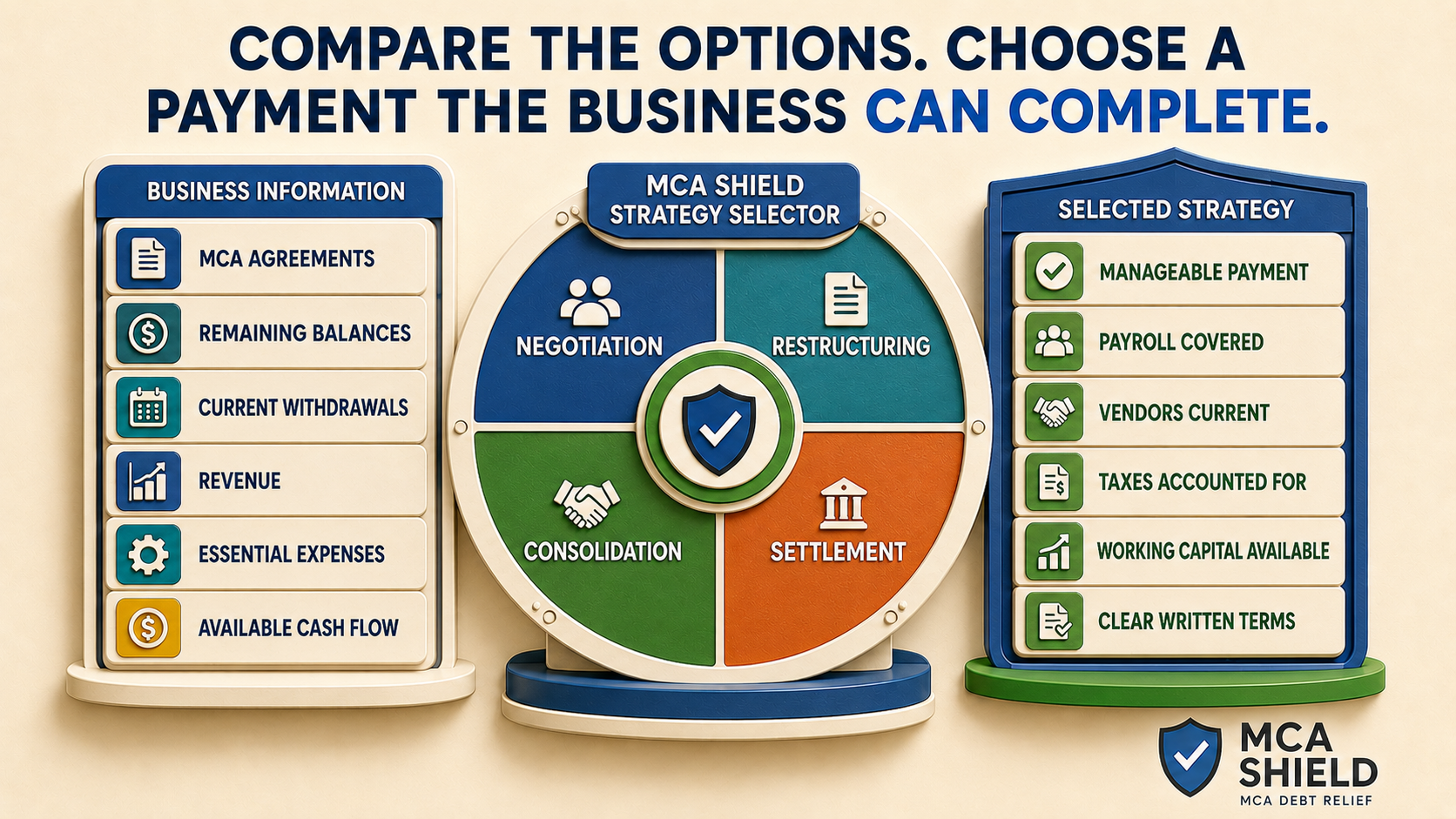
MCA Shield strategy selector comparing negotiation, restructuring, consolidation, and settlement to create a manageable MCA payment plan

A business may be able to ask its bank to block a specific ACH debit or revoke authorization for future withdrawals. However, stopping the bank transaction does not automatically cancel the MCA agreement, eliminate the remaining balance, or require the funder to approve lower payments.

Changing ACH activity without reviewing the agreement can lead to default claims, collection pressure, added fees, or legal action. Business owners should understand the consequences and seek appropriate financial or legal guidance before acting.

Understand the Risks of Blocking or Revoking ACH

Blocking an ACH withdrawal affects how the payment is collected. It does not necessarily change the business’s contractual obligations to the MCA funder.

The agreement may contain provisions addressing:

  • Authorization for ACH withdrawals
  • Requirements for changing bank accounts
  • Events considered a default
  • Returned-payment fees
  • UCC filings
  • Personal guarantees
  • Collection costs and legal remedies

The funder could claim that blocking withdrawals or closing the account violates the agreement. The exact consequences depend on the contract, the circumstances, and applicable law.

Repeatedly allowing withdrawals to overdraw the account can also damage the business. Therefore, the decision should consider both the immediate cash-flow risk and the potential consequences of stopping payments.

Know What Happens When Withdrawals Stop

When an expected ACH payment is returned or blocked, the funder may contact the business quickly. Communication may begin with payment reminders but could progress to default notices or collection efforts if the issue is not resolved.

Possible developments include:

  • Calls, emails, and requests for updated financial information
  • Returned-payment or default fees
  • Increased collection activity
  • Contact with customers or payment processors when permitted
  • Enforcement involving a UCC filing
  • Claims against a personal guarantor
  • Arbitration or litigation

These outcomes are not automatic in every case. They depend on the agreement and how the funder responds. Still, the business should be prepared for increased pressure and should keep detailed records of all payments, notices, and communications.

Stopping withdrawals without a plan may provide temporary access to cash, but it can leave the underlying MCA problem unresolved.

Obtain Written Confirmation Before Changing Payments

A conversation about lower payments is not the same as an approved modification. Until revised terms are documented, the original payment schedule may remain in effect.

Before changing a payment, request written confirmation that clearly states:

  • The new withdrawal amount
  • Whether payments will remain daily, weekly, or monthly
  • The date the change begins
  • The length of the revised schedule
  • Any fees or changes to the remaining balance
  • Whether past defaults or returned payments are waived
  • How the new payments will be processed

The business should also confirm whether previously scheduled ACH debits will be canceled or replaced. This can help prevent the original and revised payments from being withdrawn at the same time.

A written agreement gives both sides a clear record of the arrangement. It also allows the business to verify that the lower payment fits its actual cash flow before authorizing a new withdrawal schedule.

Do UCC Filings and Personal Guarantees Affect Payment Negotiations?

Yes. UCC filings and personal guarantees can affect the business’s risks, negotiating position, and available MCA relief strategies. However, their impact depends on the language of the agreement, the collateral described, the events defined as defaults, and the laws that apply.

Neither provision should be evaluated in isolation. The complete MCA agreement must be reviewed before the business stops payments, changes bank accounts, or accepts new terms.

How a UCC Filing May Affect the Business

An MCA funder may file a UCC financing statement to provide public notice of its claimed interest in specified business assets. Depending on the agreement, those assets may include receivables, deposit accounts, inventory, equipment, or other property.

A UCC filing may affect the business by:

  • Making it harder to obtain new financing
  • Creating priority questions among multiple funders
  • Affecting relationships with payment processors or account debtors
  • Giving the funder potential remedies after a claimed default
  • Complicating the sale or transfer of business assets

A UCC filing does not automatically mean that the funder owns the business or can immediately seize every asset. Its effect depends on whether the interest is valid, what collateral is covered, the funder’s priority, and applicable law.

During payment negotiations, the business should identify every active filing and determine which MCA agreement it relates to. This is especially important when multiple advances are stacked.

When a Personal Guarantee May Increase Risk

A personal guarantee may allow a funder to pursue the individual guarantor if specific obligations are violated. The events that trigger liability should be defined in the agreement and may include actions such as diverting receivables, providing inaccurate information, interfering with collections, or closing an account without following contractual requirements.

A personal guarantee does not always make the owner automatically responsible simply because revenue declined or the business could not maintain its original payment. The exact language matters.

The risk may increase when:

  • ACH withdrawals are blocked without addressing the agreement
  • Business funds or receivables are transferred improperly
  • Required financial information is withheld
  • The business stops operating or closes its account
  • The funder alleges fraud or another defined default
  • The owner signs a revised agreement that expands personal liability

Before accepting a lower-payment arrangement, confirm whether the modification changes, renews, or broadens the personal guarantee.

Why the Entire Agreement Must Be Reviewed

Payment amount is only one part of an MCA agreement. A proposed modification can affect default provisions, collection rights, fees, collateral, dispute procedures, and the obligations of any guarantor.

A complete review should examine:

  • The purchased amount and remaining balance
  • Daily or weekly withdrawal terms
  • Reconciliation rights and procedures
  • Events defined as defaults
  • UCC and collateral provisions
  • Personal guarantee language
  • Collection costs and legal remedies
  • Governing law and dispute requirements
  • Terms contained in any proposed modification

Business owners should not assume that receiving a lower payment resolves every issue in the original agreement. Unless the written modification says otherwise, many existing protections and enforcement rights may remain active.

Because UCC filings and personal guarantees can create significant legal consequences, businesses should consider having qualified legal counsel review the documents. Understanding the entire agreement makes it easier to compare relief options and avoid accepting terms that provide short-term payment relief while creating additional long-term risk.

How Long Does It Take to Lower MCA Payments?

The time required to lower MCA payments varies. Some payment adjustments may be discussed within a few business days, while negotiations involving multiple funders, disputed balances, or legal concerns may take several weeks.

Submitting complete financial records and a realistic payment proposal can help prevent unnecessary delays. However, no specific timeline or outcome is guaranteed.

Factors That Influence the Negotiation Timeline

Every MCA situation is different. The time needed to reach an agreement may depend on:

  • The number of active MCAs
  • Whether the business is current or in default
  • The funder’s review and approval process
  • The accuracy of the remaining balances
  • The severity of the revenue decline
  • The availability of bank statements and financial records
  • Existing UCC filings or personal guarantees
  • Collection activity or pending legal action
  • Disagreements about fees or repayment terms

A reconciliation request under the existing agreement may follow a different timeline from a negotiated restructuring or settlement. Cases involving several stacked MCAs typically require more coordination because each funder must be reviewed separately.

Delays can also occur when documents are incomplete, account information conflicts with the business’s records, or the proposed payment is not supported by current cash flow.

What the Business Should Do While Waiting

The business should continue to track revenue, withdrawals, bank balances, and essential expenses while the request is being reviewed. Updated records may be needed if cash flow changes during negotiations.

Business owners should also:

  • Keep copies of all emails, notices, and payment proposals
  • Record the date and details of every conversation
  • Monitor the bank account for scheduled withdrawals
  • Preserve funds needed for payroll, vendors, taxes, and rent
  • Respond promptly to reasonable requests for documentation
  • Review every proposed change before accepting it

Submitting a request for lower payments does not automatically pause ACH withdrawals or replace the original agreement. Unless the funder confirms a change in writing, the existing payment terms may remain active.

The business should avoid agreeing to a temporary payment it cannot maintain simply to obtain immediate relief. Any proposal should be measured against current revenue and essential operating costs.

When Faster Action May Be Necessary

Immediate attention may be needed when MCA withdrawals are causing repeated overdrafts, missed payroll, unpaid taxes, returned vendor payments, or an inability to purchase essential inventory.

The situation may also require faster action when:

  • One or more MCA payments have already been returned
  • The business receives a default notice
  • Collection activity becomes more aggressive
  • A funder contacts customers or payment processors
  • The bank account is at risk of becoming unusable
  • The business receives an arbitration demand, summons, or lawsuit
  • Operations may be interrupted without prompt relief

Legal notices and court deadlines should never be ignored. If a lawsuit, asset claim, personal guarantee, or UCC enforcement issue is involved, the business should speak with a qualified attorney promptly.

Acting quickly does not mean accepting the first proposal offered. It means organizing the financial records, reviewing the agreements, calculating an affordable payment, and responding before the business loses additional cash-flow flexibility.

How Do You Choose the Right Strategy for Lowering MCA Payments?

The right strategy depends on the business’s current revenue, remaining MCA balances, withdrawal schedule, operating expenses, and available cash flow. A solution that works for one business may create additional pressure for another.

Before choosing a strategy, review every agreement and compare the payment amount, total cost, repayment period, qualification requirements, and potential risks.

Compare Negotiation, Restructuring, Consolidation, and Settlement

Several strategies may be available for addressing unaffordable MCA payments:

  • Negotiation: Requests a lower payment, temporary adjustment, or different withdrawal schedule from the existing funder.
  • Restructuring: Modifies the repayment arrangement to create a payment that better reflects the business’s current cash flow.
  • Consolidation: Replaces or combines qualifying MCA obligations with a more manageable payment structure. Approval may depend on revenue, credit, balances, and the condition of the business.
  • Settlement: Attempts to resolve an MCA obligation for an agreed amount when full repayment under the existing terms is no longer realistic. Settlement may involve default, collection, legal, credit, and tax consequences.

The business should compare more than the immediate payment reduction. It should also review the total repayment amount, fees, duration, funding requirements, written protections, and effect on existing UCC filings or personal guarantees.

Choose a Payment the Business Can Complete

The strongest strategy is not necessarily the one offering the lowest initial payment. It is the one the business can maintain while continuing to meet its essential obligations.

Calculate the affordable payment only after accounting for:

  • Payroll and employee expenses
  • Rent, utilities, and insurance
  • Inventory and necessary supplies
  • Critical vendor obligations
  • Taxes and government payments
  • Other loans and MCA withdrawals
  • A reasonable working-capital reserve

The calculation should reflect normal and slower revenue periods. A payment that works only during the business’s strongest month may lead to another cash-flow problem later.

Before accepting any arrangement, confirm the payment amount, frequency, duration, fees, total cost, and treatment of the remaining balance in writing. The business should also understand what happens if revenue declines again or a payment is returned.

Schedule a Free Consultation With MCA Shield

Choosing among negotiation, restructuring, consolidation, and settlement can be difficult when daily or weekly withdrawals are already putting pressure on the business.

MCA Shield can review your MCA agreements, current balances, withdrawals, revenue, operating expenses, and available cash flow. This complete financial review can help identify which options may be available and what payment the business can realistically support.

The goal is to develop a strategy that reduces immediate pressure while protecting payroll, vendors, taxes, working capital, and continued operations. Results are not guaranteed, and available options depend on the business’s financial circumstances and MCA agreements.

Schedule a free consultation with MCA Shield to review your payments and begin building a strategy around the cash flow your business actually has.

Schedule Your Free Consultation