
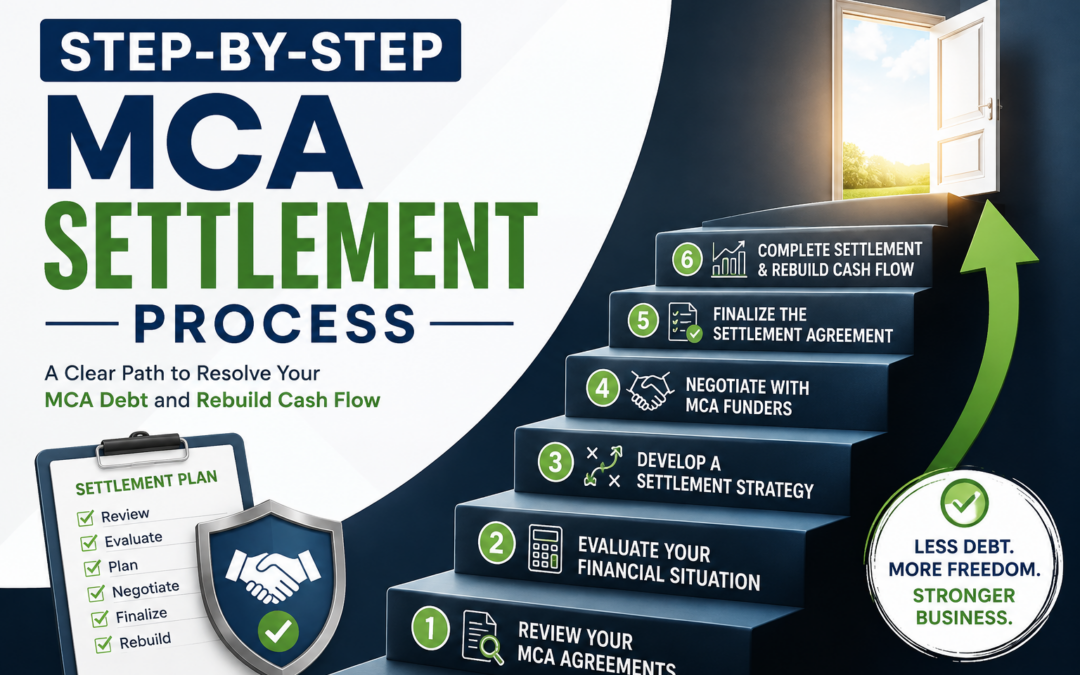
If daily or weekly Merchant Cash Advance payments are putting pressure on your business, understanding the MCA settlement process can help you determine your next steps. Settlement may provide a way to address MCA debt when the original payment structure has become difficult to maintain.
The MCA settlement process typically involves reviewing your agreements, evaluating your finances, developing a strategy, and communicating with MCA funders. Each situation is different, so the available settlement terms will depend on your agreements and financial circumstances.
In this guide, we break down the step-by-step MCA settlement process from the initial review through a potential resolution. You will also learn what to expect along the way and how acting early may give your business more options for managing MCA debt.
Schedule Your Free Consultation
What Is Merchant Cash Advance Settlement?
The MCA settlement process is a structured approach to addressing Merchant Cash Advance debt when the original payment terms become difficult to maintain. Instead of continuing under the existing repayment structure, a business may explore whether alternative terms are available.
The process often begins with a review of the business’s MCA agreements, outstanding balances, payment history, and current cash flow. From there, the financial situation can be evaluated to determine what type of resolution may be realistic.
If settlement is appropriate, communication with MCA funders may begin. The goal is to work toward terms that address the outstanding obligation while considering the business’s financial circumstances.
However, MCA settlement is not guaranteed. Available options can vary based on the agreements, funders, balances, and financial condition of the business.
How MCA Settlement Differs From Standard MCA Repayment
Under a standard MCA arrangement, the business continues making payments according to the original agreement. These payments may occur daily or weekly, depending on the terms.
MCA settlement takes a different approach. Rather than simply continuing the existing payment schedule, the business seeks to resolve the outstanding MCA obligation under negotiated terms.
Those terms may involve changes to the amount or payment structure. However, the outcome depends on the funder and the specific circumstances.
The key difference is that standard repayment follows the existing agreement, while settlement involves pursuing a negotiated resolution.
Why Businesses Consider Settling Merchant Cash Advance Debt
Businesses often begin exploring the MCA settlement process when frequent withdrawals put too much pressure on cash flow. A company may still generate revenue but struggle to keep enough working capital available for everyday expenses.
For example, MCA withdrawals can compete with payroll, rent, inventory, utilities, taxes, and other operating costs. The pressure can become even greater when a business has multiple active MCAs.
Some owners may also consider settlement when the original payment structure no longer matches the company’s current financial position. A decline in revenue or unexpected expenses can make previously manageable payments much harder to maintain.
In these situations, settling Merchant Cash Advance debt may provide a potential path toward resolution. Understanding your financial position early can help you evaluate your options before the pressure becomes more difficult to manage.
When Should a Business Consider MCA Settlement?

A business may consider MCA settlement when Merchant Cash Advance payments begin interfering with normal operations. The warning signs often appear in cash flow before the situation becomes a serious financial problem.
For example, a business may struggle to cover payroll or delay paying important expenses. It may also depend on new financing just to keep up with existing obligations.
Recognizing these signs early can give a business more time to explore the MCA settlement process and determine what options may be available.
Daily ACH Withdrawals Are Straining Cash Flow
Daily ACH withdrawals can quickly reduce the cash available to operate a business. Even when sales remain steady, frequent withdrawals may leave little money for payroll, inventory, rent, utilities, and other essential expenses.
Cash flow pressure can become especially difficult when revenue changes from week to week. The MCA withdrawal may continue while the amount of available working capital falls.
As a result, owners may begin moving money between accounts or delaying expenses to keep the business operating. They may also struggle to maintain enough cash for unexpected costs.
When daily ACH withdrawals consistently interfere with normal business operations, it may be time to explore MCA settlement options.
Multiple MCAs Are Creating Financial Pressure
One Merchant Cash Advance can place pressure on cash flow. However, multiple active MCAs can make that pressure much greater.
Each advance may have its own withdrawal schedule. Therefore, several payments can leave the business with significantly less working capital each day or week.
In some cases, a business takes another MCA to cover a temporary cash shortage. That additional advance creates another payment obligation and can make the existing problem harder to manage.
If multiple MCAs are consuming a large portion of business revenue, reviewing the MCA settlement process may help determine whether another approach is possible.
The Original Payment Structure Is No Longer Sustainable
Business conditions can change after an MCA agreement is signed. Revenue may decline, operating costs may increase, or an unexpected expense may affect available cash.
As a result, a payment structure that once seemed manageable may no longer fit the business’s financial situation.
One important warning sign is when the business can only maintain MCA payments by falling behind on essential expenses or repeatedly seeking new financing. Continuing that cycle may increase financial pressure rather than solve the underlying problem.
At that point, the business may need to evaluate whether the original payment structure remains realistic. Acting before cash flow reaches a crisis can create more time to explore potential MCA settlement options.
Step 1: Review Your Merchant Cash Advance Agreements
The first step in the MCA settlement process is understanding exactly what your business owes. Before considering potential settlement options, gather every active Merchant Cash Advance agreement and review the terms carefully.
This review can provide a clearer picture of your total MCA obligations. It can also help identify the payments and contract terms that are creating the most financial pressure.
If your business has multiple advances, review each MCA separately. Then, look at the combined impact on your overall cash flow.
Identify Your Current MCA Balances and Payment Terms
Start by determining the current balance of each Merchant Cash Advance. You should also identify the original funding amount, purchased amount, payment frequency, and other key terms.
Next, compare these obligations with your current business revenue. A payment that was manageable when sales were stronger may now place significant pressure on working capital.
Creating a complete list of your MCA obligations can make this process easier. Include the remaining balance, payment amount, payment frequency, and funder for each advance.
This information establishes an important starting point for the next stages of the MCA settlement process.
Review Daily or Weekly ACH Withdrawals
Next, determine how much money is being withdrawn from your business account each day or week. Look at each MCA individually and then calculate the combined amount.
Frequent ACH withdrawals can have a major effect on available business cash flow. Money that leaves the account cannot be used for payroll, rent, inventory, utilities, or other operating expenses.
Reviewing recent bank statements can help show the actual impact of these withdrawals. It can also reveal whether MCA payments are consuming an increasing share of available revenue.
The goal is to understand how much cash your MCA payments are taking from normal business operations.
Look for Important Contract and Collection Provisions
An MCA agreement contains more than the payment amount. Therefore, it is important to review the entire contract before making decisions about settlement.
Pay attention to provisions involving payment adjustments, reconciliation, default, collection procedures, personal guarantees, and other obligations. The exact language and available provisions can vary between agreements.
You should also review any notices or communications received from the MCA funder. Keep these documents together with your original agreements and payment records.
A careful contract review helps create a more complete financial picture. Understanding what you agreed to is an essential first step before developing an MCA settlement strategy.
Step 2: Evaluate Your Business's Financial Situation
Once you understand your MCA agreements, the next step is to evaluate your business finances. This part of the MCA settlement process helps determine how much financial pressure the current payments are creating.
Start by looking at the business as a whole. Review your revenue, operating expenses, cash flow, and other financial obligations. The goal is to understand what your business needs to remain operational while addressing its MCA debt.
A clear financial picture can also help you determine what type of settlement arrangement may be realistic.
Review Revenue, Expenses, and Available Cash Flow
Begin by reviewing your recent business revenue. Look for changes in sales, seasonal fluctuations, or other trends that affect the amount of cash coming into the business.
Next, identify your essential operating expenses. These may include payroll, rent, inventory, utilities, insurance, taxes, and vendor payments.
Then, compare your income with your expenses and MCA withdrawals. This can show how much working capital remains after your regular obligations are paid.
The goal is not simply to determine how much revenue your business generates. Instead, you need to understand how much cash is actually available to operate the business.
Determine How MCA Payments Affect Business Operations
MCA payments can become a problem when they begin competing with essential business expenses.
For example, daily or weekly withdrawals may leave the business short on payroll. They may also make it harder to purchase inventory, pay vendors, or cover rent on time.
Review how your business operates before and after each MCA withdrawal. This can help reveal the true effect of those payments on your day-to-day cash flow.
If MCA payments regularly force you to delay important expenses, the existing payment structure may no longer be sustainable. That information becomes important as you move through the MCA settlement process.
Understand What Your Business Can Realistically Afford
A potential settlement strategy should reflect the financial reality of your business. Agreeing to new terms that the company cannot maintain may simply create another cash flow problem.
Determine how much money must remain available for essential operating expenses. Then, evaluate what your business could realistically devote toward resolving its MCA obligations.
Be careful not to base this number on your best sales month. Instead, consider normal revenue, expected expenses, seasonal changes, and reasonable cash reserves.
A realistic assessment provides a stronger foundation for the next step. The goal is to pursue a resolution your business can manage while protecting the cash flow needed to continue operating.
Step 3: Develop an MCA Settlement Strategy
After reviewing your agreements and finances, the next step is to develop an MCA settlement strategy. This strategy should reflect your current obligations, available cash flow, and ability to make payments.
A good strategy does not simply focus on eliminating debt as quickly as possible. Instead, it considers how a potential resolution could affect the financial stability of your business.
This stage of the MCA settlement process also helps you prepare before communicating with MCA funders. The more clearly you understand your situation, the better prepared you can be for those discussions.
Determine Which MCA Obligations Need Immediate Attention
If your business has multiple MCAs, some obligations may require more immediate attention than others. Review each advance based on its balance, payment amount, withdrawal frequency, and current status.
For example, one MCA may be taking a larger share of your daily revenue. Another may have collection activity or other issues that require attention.
Look at how each obligation affects your overall business cash flow. This can help you determine where the greatest financial pressure exists.
Prioritizing your MCA obligations creates a more organized approach. It also helps prevent you from treating every advance as if it has the same impact on your business.
Establish Realistic Settlement Goals
Next, determine what your business could realistically manage if settlement terms become available.
Your goals should be based on actual revenue, operating expenses, available cash flow, and other financial obligations. Avoid creating a plan that depends on unusually strong future sales or unrealistic cost reductions.
A potential settlement may involve a lump-sum payment, scheduled payments, or another negotiated arrangement. However, specific settlement terms are never guaranteed and will depend on the circumstances.
The objective is to pursue a resolution that addresses the MCA obligation without creating another payment structure your business cannot maintain.
Prepare for Communication With MCA Funders
Before contacting MCA funders, organize the information that supports your financial situation. This may include MCA agreements, bank statements, revenue records, expense reports, and other relevant documents.
You should also be prepared to clearly explain why the existing payment structure has become difficult to maintain. Keep the discussion focused on your current financial circumstances and the resolution you are seeking.
In addition, document important communications and keep copies of any proposed terms. Do not rely only on verbal discussions when evaluating a potential settlement.
Preparation can make the next stage of the MCA settlement process more organized. A clear strategy gives your business a stronger foundation before settlement negotiations begin.
Step 4: Begin Negotiating With MCA Funders
Once you have a clear strategy, the next step in the MCA settlement process is communicating with MCA funders. The purpose is to discuss the current financial situation and explore whether a potential resolution is available.
Settlement negotiations can vary from one funder to another. Therefore, businesses should enter these discussions with realistic expectations and organized financial information.
It is also important to remain focused on terms the business can reasonably manage. Agreeing to a resolution that creates another cash flow problem may not improve the situation.
Present the Business’s Financial Situation
MCA funders need to understand why the original payment structure has become difficult for the business to maintain. Provide a clear picture of your current revenue, expenses, cash flow, and existing MCA obligations.
Relevant financial records may help support the discussion. These can include bank statements, revenue reports, operating expenses, and information about other MCA payments.
Keep the information accurate and consistent. The goal is to demonstrate how the current MCA payments affect your ability to meet essential business expenses.
A well-documented financial picture can provide a stronger foundation for discussing potential settlement terms.
Discuss Potential Settlement Terms
Once the financial situation has been presented, discussions may turn to possible ways to resolve the outstanding MCA obligation.
Potential terms can vary significantly. Depending on the circumstances, discussions may involve the settlement amount, payment schedule, timing, or other conditions of the resolution.
However, a funder is not required to accept a particular proposal. MCA settlement terms are negotiated and are never guaranteed.
Consider whether any proposed terms fit within the financial limits identified earlier in the MCA settlement process. The objective should be a resolution that your business can realistically fulfill.
Evaluate Any Settlement Offers Carefully
Receiving a settlement offer does not mean you should immediately accept it. Review the entire proposal and make sure you understand exactly what is required.
Pay close attention to the total settlement amount, payment deadlines, installment terms, and conditions attached to the agreement. You should also determine what happens after all required payments are completed.
Whenever possible, obtain the settlement terms in writing before sending payment. Written documentation can help clarify what both parties have agreed to.
Most importantly, compare the offer with your business’s available cash flow. A settlement should be evaluated based on both its terms and your ability to complete the agreement successfully.
Step 5: Review and Finalize the MCA Settlement Agreement
If you reach a potential settlement, the next step is to carefully review the proposed agreement. This is an important stage of the MCA settlement process because it defines the terms of the resolution.
Do not focus only on the settlement amount. Review the payment requirements, deadlines, and other conditions included in the agreement.
Before moving forward, make sure the settlement terms are clear and accurately reflect what was negotiated.
Confirm the Settlement Amount and Payment Schedule
Start by confirming the total amount required to complete the settlement. Then, determine whether the agreement requires a lump-sum payment or scheduled installments.
If payments will be made over time, review the payment amount, due dates, frequency, and final payment date. Make sure these terms fit within your business’s available cash flow.
Also, check for any conditions that could affect the settlement if a payment is late or missed.
The goal is to know exactly how much your business must pay and when each payment is due.
Review the Agreement Before Making Payment
Before sending money, carefully read the written settlement agreement. Compare it with the terms discussed during negotiations.
Look for details explaining what happens after the required settlement payments are completed. You should also review any language involving defaults, fees, releases, payment methods, or remaining obligations.
If anything appears unclear or different from what you expected, seek clarification before making payment.
Most importantly, avoid relying only on verbal promises. Make sure the terms you intend to accept are clearly documented in writing.
Keep Written Documentation of the Resolution
Good recordkeeping remains important even after a settlement agreement is finalized.
Keep copies of the signed settlement agreement, payment confirmations, emails, letters, and other related communications. Store these records where they can be easily accessed if questions arise later.
After completing the required payments, retain any written confirmation showing that the settlement terms have been satisfied.
These records provide a clear history of the resolution. Complete documentation can help your business close out the MCA settlement process with greater clarity and organization.
Step 6: Complete the Settlement and Rebuild Business Cash Flow
Completing the settlement is an important milestone in the MCA settlement process. However, the work does not necessarily end with the final payment.
The next goal is to strengthen your financial position and improve the way cash moves through the business. With fewer MCA-related pressures, you may have more flexibility to address essential operating needs.
Use this opportunity to rebuild working capital, improve budgeting, and create healthier cash flow habits for the future.
Follow the Agreed Settlement Terms
Once a settlement agreement is finalized, follow the payment terms carefully. Make each required payment according to the agreed amount and schedule.
Keep records of every payment. These may include bank statements, payment confirmations, receipts, and correspondence with the MCA funder.
After making the final required payment, confirm that you have satisfied the terms of the settlement agreement. Keep any written confirmation with your other settlement documents.
Following the agreement through completion is a critical final stage of the MCA settlement process.
Adjust Your Business Budget After Settlement
Once the settlement is complete, review your business budget again. Your cash flow may look different without the same MCA payment obligations.
Determine how much money is now available for payroll, inventory, rent, taxes, vendors, savings, and other operating expenses. Then, decide where that money can have the greatest impact.
Consider building a larger cash reserve for slow periods or unexpected expenses. Even a modest reserve can give your business more flexibility when revenue changes.
The goal is to create a budget that supports both current operations and long-term stability. Improved cash flow should become an opportunity to strengthen the business rather than increase unnecessary spending.
Avoid Falling Back Into the MCA Debt Cycle
After resolving MCA debt, it can be tempting to seek another advance when a new cash shortage appears. However, repeatedly using new MCAs to solve cash flow problems can restart the same financial cycle.
Instead, identify what contributed to the original shortage. Review pricing, expenses, seasonal revenue changes, inventory needs, and other factors that affect working capital.
Also, consider building cash reserves and more predictable financial planning before another shortage occurs.
Completing the MCA settlement process can provide an opportunity for a financial reset. The long-term goal is not simply to resolve existing MCA debt, but to build a stronger financial foundation for your business.
How Long Does the MCA Settlement Process Take?
There is no standard timeline for the MCA settlement process. Some situations may move faster than others, depending on the funder, the agreements involved, and the business’s financial circumstances.
The process includes several stages. These can include reviewing agreements, evaluating finances, developing a strategy, negotiating terms, and finalizing a potential settlement.
Because each case involves different circumstances, businesses should be cautious of anyone who promises an exact settlement timeline or guaranteed result.
Factors That Can Affect the Settlement Timeline
Several factors can influence how long the MCA settlement process takes. One of the most important is the number of Merchant Cash Advances involved.
A business with one MCA may have a less complex situation than a company with several active advances. Multiple funders can require separate discussions and negotiations.
Other factors may include:
- The number of active MCA agreements
- Outstanding MCA balances
- The business’s current financial condition
- How quickly financial documents are available
- The responsiveness of MCA funders
- The complexity of settlement negotiations
- The terms required to reach a resolution
Changes in business revenue can also affect the process. If cash flow changes during negotiations, the business may need to reevaluate what it can realistically afford.
Being organized can help prevent unnecessary delays. Having agreements, bank statements, payment records, and financial information ready can make it easier to move through each step.
Why Every MCA Settlement Situation Is Different
No two businesses enter the MCA settlement process with exactly the same circumstances.
One business may have a single MCA and relatively stable revenue. Another may have several advances, declining sales, and significant daily ACH withdrawals. These situations may require very different settlement strategies.
MCA funders can also approach settlement discussions differently. A resolution available in one situation may not be available in another.
For this reason, the focus should not be on completing settlement within a specific number of days. Instead, the goal should be to pursue realistic terms that fit the business’s financial situation.
Understanding these differences can help business owners set reasonable expectations. The MCA settlement process should be based on the individual circumstances of the business, not a one-size-fits-all timeline.
Common Mistakes During the MCA Settlement Process
The MCA settlement process can involve important financial decisions. Avoiding common mistakes may help a business approach those decisions with greater clarity and preparation.
Some owners wait too long before exploring their options. Others accept settlement terms without fully reviewing them. In some cases, businesses take another MCA to cover existing payments.
Understanding these risks can help you make more informed decisions about your MCA debt.
Waiting Until Cash Flow Reaches a Crisis
One common mistake is waiting until the business has almost no working capital left before seeking help.
Daily or weekly MCA withdrawals can gradually reduce the money available for operations. Eventually, the business may struggle to cover payroll, rent, inventory, taxes, or vendor payments.
Waiting can also create additional pressure. When cash is extremely limited, the business may have less flexibility when considering potential settlement terms.
Watch for warning signs before the situation becomes critical. Acting early may provide more time to evaluate your finances and explore available MCA settlement options.
Accepting Terms Without Reviewing the Details
A settlement offer may appear attractive at first. However, the amount owed is only one part of the agreement.
Before accepting an offer, review the settlement amount, payment schedule, deadlines, conditions, and other requirements. Make sure you understand what happens if a payment is late or missed.
You should also confirm what happens after the settlement terms are completed. Whenever possible, get the final terms in writing before making payment.
Do not allow the urgency of the situation to replace careful review. Understanding the entire settlement agreement is essential before accepting the terms.
Taking Out Another MCA to Cover Existing Payments
When cash flow becomes tight, another Merchant Cash Advance may seem like a quick way to create breathing room. However, the new advance also creates another financial obligation.
The business may then have additional withdrawals competing for the same revenue. As a result, a temporary cash shortage can develop into a larger financial problem.
This can create an MCA debt cycle: existing payments reduce cash flow, the business takes another advance, and the new payments place even more pressure on working capital.
Before adding another MCA, consider whether it addresses the underlying financial problem. Breaking the cycle may require resolving existing obligations and improving cash flow rather than adding another payment.
Can You Settle Multiple Merchant Cash Advances?
Yes, businesses with more than one Merchant Cash Advance may be able to pursue settlement. However, settling multiple MCAs can be more complicated than addressing a single obligation.
Each MCA may have a different balance, payment schedule, funder, and agreement. As a result, each obligation may need to be evaluated separately as part of the MCA settlement process.
The goal is to understand how all active MCAs affect the business. From there, you can develop a strategy that considers both individual obligations and overall cash flow.
Why Multiple MCAs Can Make Settlement More Complex
When a business has several MCAs, multiple withdrawals may be coming from the same revenue stream. This can quickly reduce the cash available for normal operations.
Each funder may also have different policies and approaches to settlement. Therefore, terms that may be available with one MCA funder may not be available with another.
In addition, resolving one MCA does not automatically resolve the others. The business must consider how each potential settlement could affect its ability to address the remaining obligations.
For this reason, multiple MCAs require a careful review of the total debt, payment schedules, available cash flow, and individual agreements.
Prioritizing MCA Obligations During the Settlement Process
When several MCAs are active, it may not make sense to approach every obligation in the same way or at the same time.
Start by reviewing which advances are creating the greatest financial pressure. Consider the outstanding balance, withdrawal amount, payment frequency, and status of each MCA.
You should also look at the combined effect of all withdrawals. An MCA with a smaller balance could still have a significant impact if its payments are consuming valuable working capital.
Prioritizing obligations can bring structure to the MCA settlement process. It helps the business focus its resources where they may have the greatest impact.
Creating a Strategy for Multiple Funders
A multiple-MCA settlement strategy should consider how negotiations with one funder may affect the business’s ability to resolve other obligations.
Before making proposals, determine how much the business can realistically afford. Then, consider how those funds may need to be divided among multiple MCA obligations.
Keep detailed records of communications, proposed settlement terms, payment schedules, and written agreements for each funder. This can help prevent confusion as negotiations progress.
Most importantly, avoid agreeing to several settlements that collectively exceed the business’s available cash flow. A coordinated strategy should address multiple MCA obligations without creating another payment structure the business cannot sustain.
How MCA Shield Helps With the MCA Settlement Process
Navigating the MCA settlement process can become complicated, especially when a business is already under financial pressure. Understanding agreements, evaluating cash flow, and communicating with funders can require careful planning.
MCA Shield helps business owners understand their MCA obligations and explore potential paths toward resolution. The process begins by looking at the business’s specific financial circumstances rather than applying the same approach to every situation.
The goal is to develop a strategy that considers both the MCA debt and the long-term financial stability of the business.
Reviewing Your MCA Agreements and Financial Situation
The first step is gaining a clear understanding of your current MCA obligations. MCA Shield reviews your agreements, balances, payment structures, and other relevant details.
The review also considers how MCA withdrawals affect your revenue, operating expenses, and available cash flow. This provides a more complete picture of the financial pressure facing your business.
If you have multiple Merchant Cash Advances, each obligation can be reviewed individually. The combined effect of those payments is also considered.
This financial review helps identify the issues that may need the most immediate attention during the MCA settlement process.
Developing a Customized Settlement Strategy
Every business has different revenue, expenses, MCA agreements, and financial challenges. Therefore, an MCA settlement strategy should reflect the individual circumstances of the business.
MCA Shield uses the information gathered during the review to help develop a customized approach. This may include identifying priority obligations and evaluating what the business can realistically afford.
The strategy also considers the need to maintain enough working capital for essential operations. After all, resolving MCA debt should not come at the expense of keeping the business running.
Settlement amounts and outcomes cannot be guaranteed. However, a well-prepared strategy can provide a clearer direction for pursuing a potential resolution.
Helping You Work Toward a Resolution
Once a strategy is established, MCA Shield can help guide the business through the next stages of the MCA settlement process.
That may include helping with funder communications, evaluating potential settlement terms, and reviewing proposed payment arrangements. The focus remains on pursuing terms that reflect the business’s financial situation.
MCA Shield can also help keep the process organized when multiple MCA funders are involved.
Most importantly, the objective extends beyond addressing today’s payments. MCA Shield works to help businesses pursue a resolution while creating an opportunity for stronger cash flow and greater financial stability moving forward.
Frequently Asked Questions About the MCA Settlement Process
Business owners often have questions about what to expect from the MCA settlement process. While every situation is different, understanding the basics can help you make more informed decisions.
Below are answers to several common questions about MCA settlement, ACH withdrawals, and what happens after a settlement is completed.
How Much Can an MCA Settlement Reduce?
There is no standard amount or percentage that an MCA settlement will reduce. The potential settlement amount depends on several factors, including the outstanding balance, the funder, and the financial circumstances of the business.
Other factors may include the number of active MCAs and the business’s ability to fund a potential settlement.
Be cautious of companies that promise a specific reduction before reviewing your situation. MCA settlement results are not guaranteed, and each obligation must be evaluated individually.
The goal of the MCA settlement process is to explore whether a realistic resolution can be reached based on the circumstances.
Can an MCA Settlement Reduce Daily ACH Withdrawals?
Potentially. Changes to daily ACH withdrawals may be discussed as part of a settlement or resolution strategy. However, a reduction in ACH payments is not automatic or guaranteed.
The available options depend on the MCA agreement, funder, current balance, and financial situation of the business.
If daily withdrawals are creating severe cash flow pressure, it is important to understand exactly how much they are affecting operations. That information can help guide discussions about a potential resolution.
Reducing payment pressure may give a business more room to cover essential operating expenses, but any changes should be clearly documented and agreed upon.
What Happens After an MCA Settlement Is Completed?
After completing the required settlement payments, keep all documentation related to the resolution. This includes the settlement agreement, payment records, correspondence, and written confirmation of completion.
Next, review your business finances. If MCA-related payment pressure has decreased, consider how the available cash can support operations and future stability.
This may be a good time to rebuild cash reserves, improve budgeting, and strengthen working capital. It is also important to address the financial issues that contributed to the original cash shortage.
Completing the MCA settlement process can mark the end of one financial challenge. The next step is building stronger cash flow habits that can help your business move forward.
Take the First Step Toward Resolving Your MCA Debt
MCA debt can become harder to manage when daily or weekly payments continue to reduce available cash flow. If those payments are affecting normal operations, waiting may increase the financial pressure on your business.
Understanding the MCA settlement process can help you determine what options may be available. The first step is reviewing your agreements, finances, and current payment obligations.
You do not have to wait until your business reaches a financial crisis. Taking action early may provide more time to develop a realistic strategy for resolving MCA debt.
Why Acting Early May Create More Settlement Options
Financial problems often become more difficult when working capital continues to decline. As cash becomes tighter, a business may have less flexibility to manage expenses or consider potential settlement arrangements.
Acting early gives you time to review your MCA balances, payment terms, cash flow, and operating expenses. It can also help you identify which obligations are creating the greatest pressure.
Early action does not guarantee a particular settlement or outcome. However, having more time and financial flexibility may help when evaluating possible solutions.
Most importantly, you can begin addressing the problem before MCA payments place even greater pressure on your business.
Schedule a Free Consultation With MCA Shield
If Merchant Cash Advance payments are affecting your cash flow, MCA Shield can help you better understand your situation and potential options.
During a free consultation, you can discuss your MCA agreements, current payments, and financial challenges. MCA Shield can then review your circumstances and help determine what next steps may be appropriate.
Every business and MCA agreement is different. That is why the process begins with understanding your specific financial situation rather than making promises about results.
Schedule a free consultation with MCA Shield today to learn more about the MCA settlement process and take the first step toward resolving your MCA debt.