
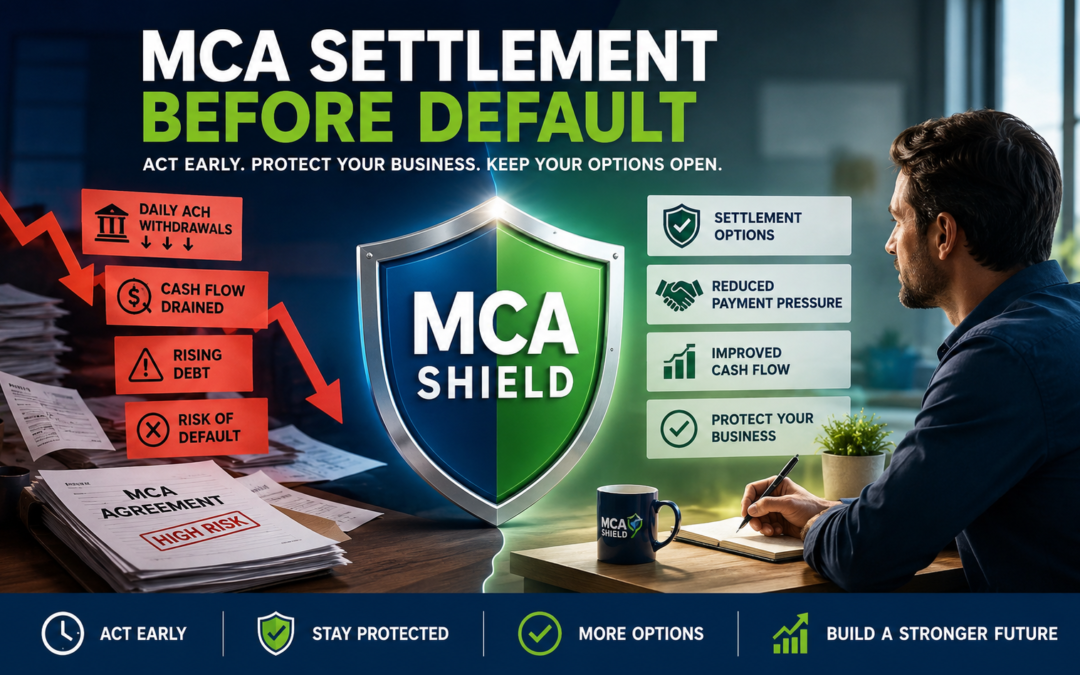
MCA settlement before default may be an option for business owners who are struggling with merchant cash advance payments but have not yet missed payments or entered default. You may not have to wait until your financial situation reaches a crisis point before exploring potential solutions.
If daily or weekly MCA withdrawals are putting increasing pressure on your cash flow, acting early may give you more time to evaluate your options. Understanding how settlement works before default can help you make a more informed decision about protecting your business and addressing your MCA debt.
Schedule Your Free Consultation
What Does MCA Settlement Before Default Mean?
MCA settlement before default means exploring a potential resolution with a merchant cash advance funder before your business stops making its required payments. Rather than waiting for missed withdrawals, collection efforts, or other consequences, a business may begin evaluating settlement options while payments are still being made.
For businesses experiencing increasing financial pressure, addressing the problem earlier may provide more time to understand the MCA agreement, evaluate cash flow, and determine an appropriate strategy.
Understanding MCA Settlement Before a Payment Default
A merchant cash advance typically requires daily or weekly withdrawals from a business’s bank account or receivables. When revenue declines or expenses increase, those frequent withdrawals can begin consuming a significant portion of available cash.
Settlement involves negotiating with the MCA funder to reach a modified resolution of the outstanding obligation. Depending on the circumstances and the funder’s willingness to negotiate, this could involve changes to the amount owed, payment terms, or repayment structure.
Importantly, a business does not need to wait to be in default before discussing its financial hardship. If current MCA payments are becoming difficult to maintain, exploring settlement before default may allow the business to address the problem before its cash flow deteriorates further.
Why You May Not Have to Wait Until You Default
Waiting until an MCA reaches default can expose a business to greater financial pressure, collection activity, and potential legal complications. Meanwhile, daily or weekly withdrawals may continue reducing the cash available for payroll, rent, inventory, utilities, and other essential operating expenses.
That is why businesses should consider their options when warning signs first appear, rather than assuming missed payments must come first.
If your business can still make its MCA payments but is struggling to cover other expenses, now may be the time to evaluate MCA settlement before default. Acting earlier can provide additional time to review your finances, understand your agreements, and pursue a potential resolution before the situation becomes more difficult to manage.
Can You Settle an MCA Before You Default?
Yes, it may be possible to settle an MCA before you default, although every situation is different. A business does not necessarily have to stop making payments before discussing financial hardship or exploring a potential settlement with an MCA funder.
If daily or weekly withdrawals are becoming difficult to maintain, addressing problems early may provide more time to evaluate your financial situation and potential MCA settlement options. However, settlement is never guaranteed, and the outcome depends on the funder, the agreement, and the circumstances surrounding the business.
When MCA Funders May Consider a Settlement
An MCA funder may be more willing to discuss a potential resolution when there is evidence that the existing payment structure is creating significant financial strain.
Several factors may influence a funder’s willingness to negotiate, including the outstanding MCA balance, payment history, current business revenue, cash flow, financial hardship, and ability to continue making payments.
The goal is to demonstrate the business’s actual financial situation and determine whether an alternative arrangement could provide a workable resolution for both sides.
How Financial Hardship Can Affect Your Options
Financial hardship can play an important role in MCA settlement negotiations. A decline in revenue, unexpected expenses, seasonal changes, loss of a major customer, or multiple MCA withdrawals can make an existing payment structure increasingly difficult to maintain.
Clear financial records can help demonstrate how MCA payments are affecting the business. Bank statements, revenue reports, operating expenses, and current MCA obligations may provide a clearer picture of the hardship.
The earlier these warning signs are recognized, the more time a business may have to explore its options. MCA settlement before default can allow business owners to address growing payment pressure before missed payments and additional financial problems occur.
Why Consider MCA Settlement Before Default?

Considering MCA settlement before default can allow a business to address growing payment pressure before the situation becomes more difficult. If daily or weekly MCA withdrawals are already affecting your ability to cover operating expenses, waiting for a default may allow financial problems to grow.
Acting earlier does not guarantee a settlement or specific outcome. However, it can provide more time to evaluate your MCA obligations, understand your cash flow, and explore potential solutions before missed payments occur.
Reducing Financial Pressure Before It Gets Worse
MCA payments can become increasingly difficult when business revenue falls, expenses rise, or multiple advances are repaid together. Even when payments are still current, frequent withdrawals can gradually drain the cash a business needs to operate.
Waiting until payments become impossible may create additional challenges. A business could face missed payments, collection activity, mounting expenses, or pressure to take out another MCA to maintain cash flow.
Exploring settlement earlier may help identify a potential resolution before those problems escalate. The objective is to address the existing MCA debt rather than allowing payment pressure to create a larger financial crisis.
Protecting Your Business Cash Flow and Operations
Healthy cash flow is essential for keeping a business running. Money withdrawn for MCA payments is cash that cannot be used for payroll, rent, inventory, utilities, equipment, taxes, or other operating expenses.
When MCA withdrawals begin competing with these essential costs, the business may struggle even if it is still generating revenue.
MCA settlement before default may provide an opportunity to address this cash flow pressure before operations are seriously disrupted. Depending on the circumstances and the funder’s willingness to negotiate, a settlement could potentially result in a more manageable resolution.
The goal is not simply to avoid default. It is to protect the cash flow your business needs to continue operating while working toward a sustainable solution for your MCA obligations.
Warning Signs You Should Consider MCA Settlement Before Default
You do not necessarily have to miss payments before recognizing that an MCA is becoming difficult to manage. Certain warning signs may indicate that your current repayment structure is putting too much pressure on the business.
Recognizing these problems early can give you time to explore MCA settlement before default rather than waiting until your business can no longer meet its existing obligations.
MCA Withdrawals Are Consuming Too Much Cash Flow
Daily or weekly MCA withdrawals can become a serious problem when they consume too much of your available revenue. Your business may still be current on its MCA, but frequent withdrawals can leave too little cash available for essential operating expenses.
If MCA payments consistently leave your bank account with little room for unexpected expenses or normal revenue fluctuations, it may be time to evaluate your options.
Operating Expenses Are Becoming Harder to Pay
Another warning sign appears when MCA payments begin competing with essential business expenses. Payroll, rent, inventory, utilities, taxes, insurance, and vendor payments should not become increasingly difficult to cover because of frequent MCA withdrawals.
Falling behind on operating expenses can create problems throughout the business. Addressing MCA payment pressure earlier may help prevent a cash flow problem from developing into a broader financial crisis.
You Are Considering Another MCA to Cover Existing Payments
One of the strongest warning signs is considering another merchant cash advance simply to keep up with an existing one.
Taking additional funding may provide temporary cash, but it can also create another repayment obligation and additional daily or weekly withdrawals. This can lead to MCA stacking, where multiple advances compete for the same business revenue.
Before taking another advance to cover existing MCA payments or operating expenses, consider whether MCA settlement before default could provide a more sustainable way to address the underlying debt. Acting before another MCA is added may help prevent payment pressure from becoming even harder to manage.
How Does the MCA Settlement Process Work Before Default?
The MCA settlement process before default typically begins with a detailed review of your merchant cash advance obligations and current financial condition. The goal is to understand how MCA payments are affecting your business and determine whether a negotiated resolution is appropriate.
Starting this process before default can provide more time to evaluate your options and address MCA debt before financial pressure increases. However, settlement terms depend on the funder, the MCA agreement, and the business’s financial circumstances.
Review Your MCA Agreements and Financial Situation
The first step is reviewing each MCA agreement, outstanding balance, payment schedule, withdrawal frequency, and repayment terms. If your business has multiple MCAs, each obligation should be evaluated separately.
Your financial situation is equally important. Recent bank statements, revenue, operating expenses, and cash flow can help show how MCA withdrawals are affecting the business.
This review provides a clearer picture of what the business can realistically afford while continuing to cover essential expenses.
Develop a Settlement Strategy
Once the agreements and finances have been reviewed, the next step is developing a strategy based on the business’s circumstances.
This may involve determining which MCA obligations require immediate attention, what payment structure may be sustainable, and how financial hardship can be documented. Businesses with multiple MCAs may also need a coordinated strategy that considers all active obligations.
A strong settlement strategy should focus on reaching a potential resolution that addresses the MCA debt while improving the business’s ability to maintain healthy cash flow.
Negotiate With MCA Funders
The next step is to communicate with MCA funders and attempt to negotiate a resolution. Financial hardship, current cash flow, outstanding balances, and the business’s ability to pay may all influence the discussion.
Depending on the circumstances, negotiations may seek changes to the repayment structure, payment terms, or outstanding obligation. Not every funder will agree to a settlement, and specific results cannot be guaranteed.
If an agreement is reached, review the settlement terms carefully and obtain the agreement in writing before moving forward. The objective is to create a clear resolution that the business can realistically fulfill without creating additional financial strain.
MCA Settlement Before Default vs. After Default
The timing of an MCA settlement can make a meaningful difference in how a business approaches its financial situation. Exploring MCA settlement before default allows you to address growing payment problems while your business is still current on its obligations.
After default, the situation can become more complicated. Missed payments may lead to collection efforts, increased communication from funders, potential legal action, or additional strain on business operations. For this reason, understanding your options before reaching default can be valuable.
How Timing May Affect Your Settlement Options
Every MCA settlement is different, and settlement terms are never guaranteed. Funders consider several factors, including the outstanding balance, payment history, financial hardship, current revenue, and the business’s ability to pay.
Starting the process earlier can provide more time to review MCA agreements, document financial hardship, evaluate cash flow, and develop a settlement strategy. It can also help business owners make decisions before their financial situation becomes more urgent.
After default, settlement may still be possible, but the business could face additional financial and operational challenges. Acting before default can provide valuable time to pursue a resolution without waiting for the situation to hit a crisis point.
Why Waiting Until Default Can Increase Financial Pressure
Waiting for default does not stop the underlying cash flow problem. Until something changes, daily or weekly MCA withdrawals can continue reducing the cash available for essential business expenses.
As financial strain increases, a business may begin struggling with payroll, rent, inventory, taxes, utilities, or vendor payments. It may also become tempting to take another MCA to meet existing obligations, potentially creating additional withdrawals and even greater cash flow strain.
Default can also introduce new challenges, including collection activity and possible legal action, depending on the agreement and the funder’s response.
Exploring MCA settlement before default allows your business to address the underlying problem sooner. The objective is to pursue a workable resolution before MCA payments create greater financial and operational difficulties.
What Happens to Daily ACH Withdrawals During MCA Settlement?
Daily or weekly ACH withdrawals are often one of the biggest sources of financial strain for businesses with merchant cash advances. During the settlement process, those withdrawals do not automatically stop or decrease simply because negotiations have started.
What happens to your payments depends on the MCA agreement, the funder, your financial circumstances, and any arrangement reached during negotiations. Business owners should understand their current obligations before making changes to scheduled payments.
Can Daily or Weekly Withdrawals Be Reduced?
In some situations, negotiations with an MCA funder can include a request to reduce or modify daily or weekly withdrawals. A lower payment could give the business more cash for payroll, rent, inventory, utilities, and other essential expenses.
However, a reduction is not guaranteed. The funder must agree to any change in the existing payment structure.
If current withdrawals are creating serious cash flow problems, financial records can help demonstrate the strain on the business. Bank statements, revenue reports, operating expenses, and existing MCA obligations can provide useful information during negotiations.
Why Payment Changes Depend on the Funder and Agreement
Every MCA agreement is different. The contract terms, outstanding balance, payment history, financial condition of the business, and individual funder’s policies can all influence whether payment changes are available.
Some agreements may also contain provisions related to reconciliation or adjustments based on business receivables. These provisions should be reviewed carefully to determine whether they apply to your situation.
Most importantly, do not assume that beginning an MCA settlement automatically changes your ACH withdrawals. Any modification should be clearly communicated and documented by the funder.
For businesses struggling with frequent withdrawals, exploring MCA settlement before default can provide an opportunity to review payment obligations and pursue a more manageable resolution before cash flow problems become more severe.
Can You Settle Multiple MCAs Before Default?
Yes, it may be possible to settle multiple MCAs before default. Businesses with two or more merchant cash advances often face greater cash flow strain because several daily or weekly withdrawals can draw from the same revenue.
Each MCA is a separate obligation, so settlement depends on the individual agreements, outstanding balances, funders, payment histories, and financial condition of the business. A coordinated approach can help identify which obligations require the most attention and how each one affects overall cash flow.
Addressing Multiple MCA Payments at the Same Time
When several MCAs are active, focusing on a single payment can underestimate the total financial strain on your business. The combined withdrawals can leave significantly less cash available for payroll, rent, inventory, taxes, utilities, and other operating expenses.
A complete review should identify each MCA’s balance, withdrawal schedule, repayment terms, and impact on available cash. This can help determine which obligations are creating the greatest financial strain and where negotiations could have the greatest impact.
Addressing multiple MCAs before default can also help a business avoid waiting until several obligations become difficult to manage at once.
Creating a Coordinated Settlement Strategy
A coordinated settlement strategy considers all active MCA obligations together rather than treating each advance as an isolated problem. This provides a clearer picture of the business’s total payment burden and its ability to support negotiated payments.
The strategy may involve prioritizing certain MCA obligations, documenting financial hardship, communicating with multiple funders, and pursuing resolutions that align with the business’s financial capacity.
Not every funder will agree to the same terms, and settlement results cannot be guaranteed. However, developing a coordinated strategy before default can help prevent one MCA resolution from creating problems with another obligation.
For businesses carrying multiple advances, exploring MCA settlement before default can provide an opportunity to address the overall debt burden before multiple withdrawals create even greater cash flow strain.
Frequently Asked Questions About MCA Settlement Before Default
Business owners often assume they must stop making payments before exploring settlement. That is not necessarily the case. These frequently asked questions explain when to consider MCA settlement before default, what settlement can potentially change, and what to expect from the process.
❓ Do I Have to Miss MCA Payments Before I Can Settle?
No. You do not necessarily have to miss MCA payments before exploring settlement. If daily or weekly withdrawals are creating financial strain, you can review your options while the account is still current.
Every situation is different, and a funder is not required to accept a settlement. However, you do not have to wait for a financial crisis to evaluate your MCA obligations and potential solutions.
⏰ How Early Should I Consider MCA Settlement?
Consider your options when MCA withdrawals begin interfering with the normal operation of your business. Warning signs can include:
- 💵 Too much revenue going toward MCA withdrawals
- 📉 Declining operating cash flow
- 🧾 Difficulty covering payroll, rent, inventory, taxes, or vendors
- 🔄 Using one source of funding to meet another obligation
- 📚 Multiple active MCAs drawing from the same revenue
- ⚠️ Considering another MCA because cash is becoming tight
You do not need to wait for every warning sign to appear. The earlier you recognize that the current payment structure is becoming unsustainable, the more time you have to evaluate potential solutions.
💳 Does MCA Settlement Before Default Guarantee Lower Payments?
No. MCA settlement does not guarantee lower payments, a reduced balance, or specific settlement terms. The outcome depends on the funder, MCA agreement, repayment history, financial hardship, and the business’s current financial condition.
Negotiations could seek changes to the payment amount, withdrawal frequency, repayment structure, or overall obligation, but the funder must agree to the proposed resolution.
🤝 Will Every MCA Funder Negotiate Before Default?
No. Each MCA funder has its own policies and approach to negotiations. Some may consider modifying an existing arrangement when a business demonstrates genuine financial hardship, while others may be less willing to negotiate.
This is why reviewing the MCA agreement and financial situation is important before developing a settlement strategy.
📑 What Documents Can Help With an MCA Settlement?
Financial documentation can help establish the business’s financial position and demonstrate how MCA withdrawals affect cash flow. Useful records can include recent bank statements, revenue reports, operating expenses, MCA agreements, payment histories, and outstanding balances.
Having this information organized can also make it easier to evaluate what type of payment arrangement the business can reasonably support.
🔄 Can I Settle More Than One MCA Before Default?
Potentially, yes. Businesses with multiple merchant cash advances can explore settlement options for several obligations. However, each MCA typically requires separate negotiations with its funder.
A coordinated strategy addresses all active MCA obligations and withdrawals together, helping the business pursue resolutions that account for how each agreement affects its overall cash flow and financial stability.
⚖️ Is It Better to Pursue MCA Settlement Before or After Default?
There is no single answer for every business. However, exploring MCA settlement before default can give you more time to review agreements, document financial hardship, understand your cash flow, and evaluate potential solutions before additional problems arise.
Waiting until default can introduce collection activity, possible legal action, and greater financial strain. For that reason, businesses experiencing significant MCA payment pressure should consider reviewing their options sooner rather than later.
Take Action Before MCA Payments Become Unmanageable
You do not have to wait until your business misses payments or reaches default to address growing MCA debt. If daily or weekly withdrawals are reducing the cash available for essential expenses, taking action now can help you understand your options before the financial strain intensifies.
Exploring MCA settlement before default gives you an opportunity to review your obligations, evaluate your cash flow, and determine whether a negotiated resolution could provide a more sustainable path forward.
Why Acting Early May Give Your Business More Options
MCA problems rarely become easier when they are ignored. As frequent withdrawals continue, your business may have less cash available for payroll, rent, inventory, taxes, utilities, vendors, and other operating expenses.
Acting early provides valuable time to review your MCA agreements, document financial hardship, assess your current finances, and develop a settlement strategy. It can also help you avoid taking another merchant cash advance simply to meet existing obligations.
You do not need to wait for missed payments to begin evaluating your situation. Recognizing the warning signs early can help you pursue a resolution before MCA debt creates greater financial and operational challenges.
Schedule a Free Consultation With MCA Shield
If MCA payments are putting increasing strain on your business, MCA Shield can help you understand your settlement options before default.
During a free consultation, the MCA Shield team can review your current MCA obligations, discuss how withdrawals are affecting your cash flow, and help determine which potential strategies fit your financial situation. If you have multiple MCAs, the team can also evaluate how those obligations interact and whether a coordinated approach is appropriate.
Every MCA situation is different, and settlement results cannot be guaranteed. The first step is understanding where your business stands and what options are available.
Do not wait until MCA payments become unmanageable. Schedule a free consultation with MCA Shield today and take the first step toward addressing your MCA debt before default.