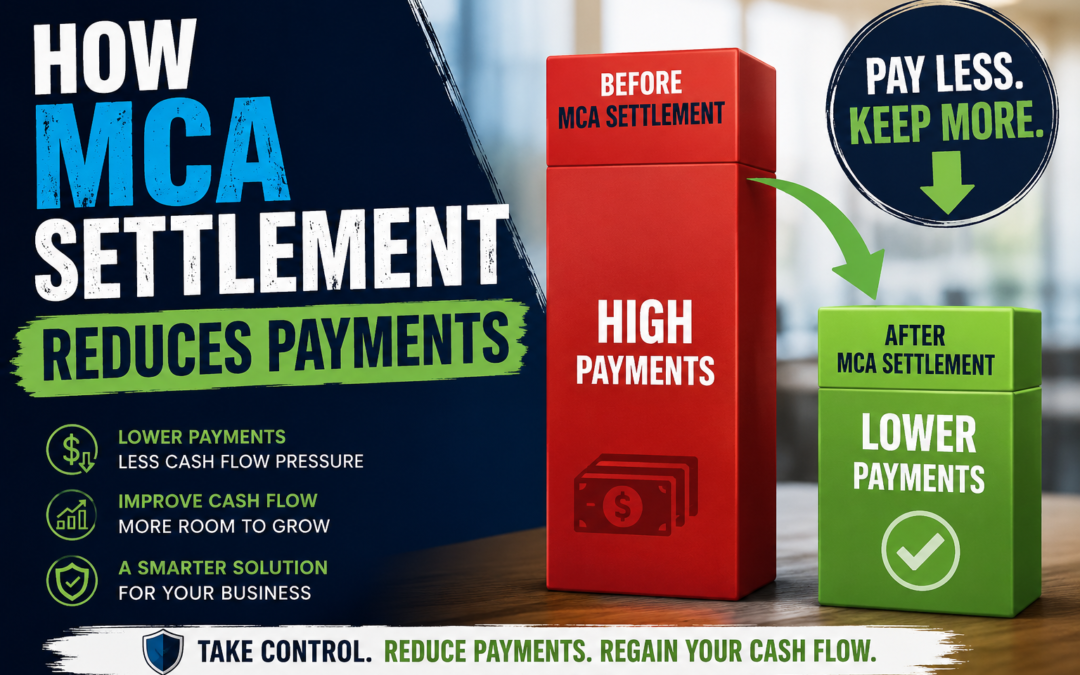
Merchant Cash Advance payments can put serious pressure on a business. Daily or weekly withdrawals may leave less money for payroll, inventory, rent, and other expenses. When those payments become difficult to manage, MCA settlement may provide a path toward relief.
Understanding how MCA settlement reduces payments can help business owners evaluate their options. Settlement may involve negotiating with MCA funders to modify existing obligations. Depending on the situation, this could result in lower payments, reduced financial pressure, or a more manageable repayment structure.
In this guide, we explain how MCA settlement works, what can affect payment reductions, and how lower MCA payments may improve business cash flow.
Schedule Your Free Consultation
What Does It Mean to Reduce MCA Payments?
Reducing MCA payments means making the repayment obligation more manageable for the business. This may involve lowering the amount withdrawn on a regular basis, modifying repayment terms, or negotiating the overall obligation.
For a business struggling with Merchant Cash Advance payments, even a change in regular withdrawals can make a difference. More available cash may help the business cover essential expenses and maintain normal operations.
However, lower payments and lower total MCA debt are not always the same thing. Understanding that difference is important when considering settlement.
How MCA Payments Can Create Cash Flow Pressure
Merchant Cash Advances often involve frequent withdrawals from business revenue or a bank account. When those withdrawals are high, they can quickly reduce the cash available for daily operations.
A business may still generate strong sales but struggle with available cash. Frequent MCA payments can leave less money for payroll, rent, inventory, utilities, and other operating costs.
The pressure can become even greater when a business has multiple MCAs. Several withdrawals may occur within the same week or even the same day. As a result, the business has less flexibility when unexpected expenses arise.
This is one reason business owners may explore MCA settlement to reduce payment pressure and regain more control over cash flow.
What Can Change Through an MCA Settlement
An MCA settlement seeks to resolve an existing Merchant Cash Advance obligation through negotiation. The exact outcome depends on the agreement, the funder, and the financial circumstances of the business.
Depending on the situation, an MCA settlement may result in changes to the payment amount, repayment schedule, total amount required to resolve the obligation, or a combination of these factors.
For example, a negotiated resolution may make regular payments easier to manage. In other cases, the focus may be on reaching an agreed amount to resolve the outstanding MCA.
Settlement results are not guaranteed, and every business situation is different. However, successful negotiations may help reduce the financial pressure created by the original payment structure.
Reduced Payments vs. Reduced Total MCA Debt
There is an important difference between reducing MCA payments and reducing the total amount needed to resolve an MCA.
A lower payment usually refers to the amount a business must pay at one time or on a regular schedule. This can help improve short-term cash flow. However, lower payments alone do not necessarily mean the total obligation has been reduced.
A reduction in the total MCA debt means the funder agrees to accept an amount that is different from the existing obligation as part of a negotiated resolution.
In some settlements, both the payment structure and the amount required for resolution may change. In others, only one may change. That is why business owners should understand the complete settlement terms rather than focusing only on the size of each payment.
How Does MCA Settlement Reduce Payments?

Understanding how MCA settlement reduces payments starts with the negotiation process. Instead of adding another advance, settlement focuses on the MCA obligations the business already has.
The goal is to reach a resolution that reflects the business’s current financial situation. Depending on the circumstances, this may involve lower payments, different payment terms, or a negotiated settlement amount.
Every MCA settlement is different. The outcome depends on factors such as the agreement, outstanding balance, business cash flow, and willingness of the funder to negotiate.
Negotiating the Existing MCA Obligation
The first step is usually reviewing the existing MCA agreement and current payment requirements. This helps identify how much the business owes and how the payments affect cash flow.
From there, negotiations may begin with the MCA funder. Financial hardship, current revenue, and the ability to continue making payments may all be considered.
The objective is to find a resolution that works with the business’s financial reality. A successful negotiation may result in less payment pressure and a clearer path toward resolving the MCA obligation.
Changing the Payment Structure
An MCA settlement may also change how payments are made. For example, the original agreement may require frequent withdrawals that place significant pressure on working capital.
Through negotiation, the payment structure may be modified. This could mean lower regular payments, a different payment schedule, or another negotiated arrangement.
Reducing frequent payment pressure can leave more cash inside the business. That money may then be available for payroll, inventory, rent, utilities, and other essential operating expenses.
Creating a More Manageable Repayment Arrangement
The purpose of reducing MCA payments is not simply to create a smaller withdrawal. The broader goal is to establish an arrangement the business has a better chance of maintaining.
A more manageable payment structure can help a business plan expenses with greater confidence. It may also reduce the need to use new financing to cover existing MCA payments.
Most importantly, MCA settlement addresses existing obligations instead of adding another layer of debt. When successful, the result may provide more breathing room and help the business work toward greater financial stability.
What Factors Affect How Much MCA Payments Can Be Reduced?
There is no standard amount by which an MCA payment can be reduced. Every business has different finances, agreements, and repayment challenges. Therefore, the results of an MCA settlement depend on the specific circumstances of the business.
Several factors can influence a potential settlement. These include the outstanding balance, current cash flow, financial hardship, and the status of the MCA account. The funder’s willingness to negotiate can also play an important role.
Understanding these factors helps explain how MCA settlement reduces payments and why results can vary from one business to another.
Outstanding MCA Balance
The outstanding MCA balance is one of the first factors reviewed during the settlement process. This is the amount that remains under the existing MCA obligation.
A larger balance may require a different negotiation strategy than a smaller balance. In addition, the amount already paid can provide important context when reviewing the account.
If a business has several active MCAs, the total financial burden must also be considered. Multiple obligations can create overlapping withdrawals that put even greater pressure on available cash.
For this reason, the settlement process should consider the entire MCA debt picture, not just one payment or agreement.
Business Cash Flow and Financial Hardship
Current business cash flow can have a major impact on settlement negotiations. A business may have revenue coming in but still lack enough available cash to maintain its MCA payments.
For example, frequent withdrawals may make it difficult to cover payroll, rent, inventory, taxes, or utilities. Seasonal revenue changes and unexpected expenses can create additional pressure.
Financial information can help demonstrate why the existing MCA payment structure is no longer sustainable. It may also help determine what type of payment arrangement the business can realistically maintain.
The goal is to pursue a resolution based on actual business cash flow rather than an unrealistic payment amount.
Funder and Account Status
The MCA funder and status of the account can also affect the potential outcome. Different funders may have different policies and approaches to settlement negotiations.
The status of the MCA matters as well. An account that is current may be handled differently from one that has missed payments or entered collections. Other developments can also affect the options available.
That is why timing can be important. Waiting until financial pressure becomes severe may change the situation and limit certain options.
Ultimately, MCA payment reductions are determined through negotiation and are not guaranteed. Reviewing the full financial situation can help identify realistic options for reducing payment pressure and resolving the existing MCA obligation.
Can MCA Settlement Reduce Daily ACH Withdrawals?
For many businesses, daily ACH withdrawals are one of the most difficult parts of an MCA. Money may leave the business bank account every business day. Over time, these withdrawals can place significant pressure on working capital.
An MCA settlement may provide an opportunity to negotiate changes to the existing payment arrangement. Depending on the funder and circumstances, this could include lower payments or a modified payment schedule.
However, changes to ACH withdrawals are not automatic. Any modification depends on the agreement reached with the MCA funder.
How Daily Withdrawals Affect Working Capital
Working capital is the money a business uses to cover everyday operating expenses. When MCA payments are withdrawn frequently, less cash remains available for those needs.
A business may generate steady revenue and still experience a cash shortage. Daily ACH withdrawals can reduce the money available for payroll, inventory, rent, utilities, and other expenses.
The problem can become more serious when several MCAs are active at the same time. Multiple withdrawals can quickly consume a large portion of incoming revenue.
As a result, the business may struggle to maintain normal operations even when sales remain consistent.
How Modified Payments May Improve Cash Flow
Reducing the amount or frequency of MCA payments may give a business more financial flexibility. Instead of losing a large portion of available cash to frequent withdrawals, the business may retain more money for operations.
This can make it easier to plan for upcoming expenses. It may also reduce the need to rely on additional financing just to meet existing obligations.
For example, lower MCA payments may leave more cash available for payroll, supplies, inventory, and other essential costs. This can help relieve immediate cash flow pressure while the business works toward resolving its MCA debt.
Improved cash flow does not mean the underlying obligation disappears. However, a more manageable payment structure may give the business greater room to operate.
What May Happen to ACH Withdrawals During Settlement
What happens to ACH withdrawals during an MCA settlement depends on the specific situation. Business owners should not assume that ACH withdrawals will automatically stop when settlement negotiations begin.
In some cases, negotiations may lead to a different payment amount or schedule. In others, existing withdrawals may continue until a new arrangement is reached.
For this reason, businesses should understand the terms of any proposed settlement before making financial decisions. The payment amount, frequency, total settlement obligation, and other conditions should all be reviewed carefully.
When successful, MCA settlement may reduce daily ACH payment pressure and create a more manageable path forward. The specific outcome, however, depends on the funder, agreement, and financial circumstances of the business.
How Reduced MCA Payments Can Improve Business Cash Flow
One of the biggest potential benefits of reducing MCA payments is the effect on business cash flow. When less money is committed to frequent payments, more cash may remain available for everyday operations.
This additional flexibility can be important for a business already under financial pressure. Instead of constantly trying to keep up with MCA withdrawals, the owner may have more room to manage expenses and plan ahead.
Ultimately, lower MCA payments may help create a healthier balance between debt obligations and operating needs.
Keeping More Cash Available for Operations
Every business needs working capital to function. However, high daily or weekly MCA payments can quickly reduce the cash available in a business bank account.
When MCA payments are reduced, the business may be able to keep more of its incoming revenue available for operations. This can provide greater flexibility when managing both planned and unexpected expenses.
More available cash can also make it easier to respond to changes in sales, seasonal fluctuations, or sudden business costs. Instead of having most available funds committed to MCA payments, the business may have more financial breathing room.
Making Essential Business Expenses Easier to Cover
A business cannot operate successfully if MCA payments make it difficult to cover basic expenses. Payroll, rent, inventory, utilities, insurance, and taxes still need to be paid.
When frequent MCA withdrawals consume too much revenue, business owners may be forced to choose which expenses receive priority. That can create additional financial stress.
Reducing MCA payment pressure may make essential operating expenses easier to manage. It can also help the business develop a more predictable budget.
The goal is not simply to lower a payment. It is to create enough financial flexibility for the business to meet its obligations while continuing normal operations.
Reducing the Need for Additional MCA Funding
When cash flow becomes tight, taking out another Merchant Cash Advance can seem like a quick solution. However, new funding usually creates another repayment obligation.
This can lead to MCA stacking, where a business has several advances with overlapping payments. As more withdrawals occur, even more revenue may be diverted away from operations.
Reducing existing MCA payments may help interrupt this cycle. Instead of borrowing again to cover current obligations, the business can focus on addressing the debt it already has.
For some businesses, MCA settlement can help reduce payment pressure without adding another MCA. This may create a more sustainable path toward stronger cash flow and long-term financial stability.
MCA Settlement vs. Taking Out Another MCA
When MCA payments become difficult to manage, taking out another advance may seem like a fast way to create breathing room. However, new funding also creates a new repayment obligation. That can place even more pressure on future cash flow.
MCA settlement takes a different approach. Instead of adding another advance, it focuses on resolving existing MCA obligations. For businesses already struggling with frequent withdrawals, this may offer a more sustainable path forward.
Why Another MCA Can Increase Payment Pressure
A new Merchant Cash Advance can provide immediate access to capital. However, the business must repay that new advance while continuing to manage its existing obligations.
As a result, another MCA can increase the amount of revenue committed to daily or weekly payments. The short-term cash infusion may help temporarily, but the additional withdrawals can create greater financial pressure later.
For a business already experiencing cash flow problems, this can make it harder to cover payroll, rent, inventory, taxes, and other operating expenses.
In contrast, MCA settlement focuses on reducing existing payment pressure rather than creating another payment obligation.
How MCA Stacking Can Compound Cash Flow Problems
MCA stacking occurs when a business takes out multiple Merchant Cash Advances before previous advances have been resolved. Each additional MCA may bring another payment and withdrawal schedule.
For example, a business may use a second MCA to cover expenses after the first MCA reduces available cash. Later, another advance may be used to manage the combined payment pressure.
This cycle can quickly become difficult to maintain. Multiple MCA payments may consume more working capital and leave less cash available to operate the business.
The more obligations a business adds, the harder it may become to regain control of cash flow.
Addressing Existing MCA Debt Instead of Adding More
Rather than borrowing additional money, MCA settlement focuses on the obligations already creating financial pressure. The process may involve negotiating lower payments, modified payment terms, or another settlement arrangement with MCA funders.
When successful, this approach may help the business keep more cash available for essential expenses. It may also reduce the pressure to seek another advance simply to cover existing payments.
MCA settlement does not guarantee lower payments or a specific outcome. However, addressing existing MCA debt can help a business explore alternatives to repeatedly adding new funding.
For businesses caught in a cycle of MCA payments, the goal is clear: resolve existing obligations, reduce payment pressure, and create a more manageable path forward.
Can Multiple MCA Payments Be Reduced Through Settlement?
Yes, businesses with more than one Merchant Cash Advance may be able to pursue settlement with multiple funders. However, settling multiple MCAs can be more complex than resolving a single obligation.
Each MCA may have different payment terms, balances, and funder requirements. Therefore, the settlement strategy should consider how all of the payments affect the business together.
The goal is to reduce overall MCA payment pressure while creating a financial structure the business can realistically manage.
Working With Multiple MCA Funders
When a business has several MCAs, each funder typically needs to be addressed separately. One funder may be willing to negotiate certain terms, while another may take a different approach.
This makes coordination important. The business must understand how each MCA payment affects total cash flow and how one settlement could affect the ability to resolve another.
A coordinated approach can help prevent one obligation from consuming the cash needed to address the others. It can also provide a clearer picture of the business’s total MCA debt.
Prioritizing the Most Difficult Payment Obligations
Not every MCA creates the same level of financial pressure. Some may have larger payments, more frequent withdrawals, or terms that place greater strain on working capital.
For that reason, a settlement strategy may prioritize the obligations causing the greatest problems. The goal is to identify which MCA payments are having the biggest impact on business cash flow.
Account status may also affect the strategy. An MCA that has fallen behind or entered collections may require different attention than an account that remains current.
By reviewing each obligation individually, the business can develop a more organized approach to resolving multiple MCAs.
Creating a More Sustainable Overall Payment Structure
Reducing one MCA payment may provide some relief. However, a business with several advances must consider its total payment burden.
For example, lowering one payment may not solve the cash flow problem if several other large withdrawals continue. A broader strategy can evaluate how all MCA obligations work together.
When successful, multiple MCA settlements may help create lower overall payment pressure, improved working capital, and a more manageable financial structure.
Results vary, and settlement terms are not guaranteed. Still, addressing multiple existing MCAs through a coordinated strategy may be more sustainable than taking out another advance to keep up with current payments.
When Should You Consider MCA Settlement to Reduce Payments?
Timing can play an important role when dealing with Merchant Cash Advance debt. Business owners do not always need to wait until payments become completely unmanageable before exploring their options.
If MCA withdrawals are affecting normal operations, it may be time to consider a different approach. MCA settlement may help reduce payment pressure by addressing existing obligations through negotiation.
Recognizing the warning signs early may give a business more time to evaluate its finances and determine a realistic path forward.
MCA Payments Are Consuming Too Much Cash Flow
One of the clearest warning signs is when MCA payments consume a large portion of incoming revenue. Even a business with consistent sales can struggle if too much cash is withdrawn each day or week.
This can create a cycle where revenue comes into the business but quickly leaves to cover MCA payments. As a result, less working capital remains available for normal operations.
If frequent withdrawals are creating ongoing cash shortages, it may be time to explore whether MCA settlement could provide a more manageable payment structure.
Operating Expenses Are Becoming Difficult to Cover
MCA payments should not prevent a business from covering the expenses required to operate. When payroll, rent, inventory, utilities, taxes, or insurance become difficult to pay, the financial pressure may be reaching a critical point.
Business owners may begin delaying purchases or moving money between accounts just to keep up. They may also fall behind on other important obligations.
These are signs that the existing MCA payment structure may no longer fit the business’s cash flow.
Exploring settlement earlier may provide more options than waiting until financial problems become more severe.
You Are Considering Another MCA to Make Payments
Another major warning sign is using new financing to keep up with existing MCA payments. A new advance may provide immediate cash, but it also creates another repayment obligation.
This can lead to MCA stacking, with multiple advances withdrawing money from the business at the same time. As payment pressure increases, the business may need even more financing to cover everyday expenses.
Before taking out another advance, it may be worth exploring how MCA settlement reduces payments by addressing existing obligations instead of adding new ones.
The objective is to break the cycle of increasing payment pressure. Acting before another MCA becomes necessary may give the business more opportunities to regain control of its cash flow.
Frequently Asked Questions About Reducing MCA Payments
Business owners considering MCA settlement often want to know how much their payments could change. They may also have questions about daily withdrawals and the total amount owed.
The answers depend on the business, the MCA agreement, and the funder. Below are answers to some of the most common questions about reducing MCA payments through settlement.
How Much Can MCA Settlement Reduce Payments?
There is no standard amount that MCA settlement can reduce payments. Every MCA settlement is based on the specific circumstances of the business and its existing obligations.
Factors may include the outstanding balance, current cash flow, financial hardship, account status, and the funder’s willingness to negotiate. The number of active MCAs can also affect the potential outcome.
For some businesses, settlement may result in lower regular payments or a more manageable payment structure. However, specific reductions cannot be guaranteed.
Can MCA Settlement Lower Daily ACH Withdrawals?
Yes, an MCA settlement may result in lower daily ACH withdrawals in some situations. This depends on the settlement terms negotiated with the funder.
Reducing frequent withdrawals can help keep more working capital inside the business. That money may then be available for payroll, inventory, rent, utilities, and other operating expenses.
However, business owners should not assume ACH withdrawals will automatically decrease or stop when negotiations begin. Any change to ACH payments should be part of an agreed settlement or modified payment arrangement.
Does MCA Settlement Reduce the Total Amount Owed?
MCA settlement may reduce the amount required to resolve an obligation, but this is not guaranteed. The final outcome depends on the funder, account status, outstanding balance, and other financial factors.
It is also important to understand the difference between lower payments and a lower settlement amount. A reduced regular payment does not necessarily mean the total amount required for resolution has decreased.
In some cases, negotiations may affect both the payment structure and the amount required to resolve the MCA. Therefore, businesses should review the complete terms of any proposed agreement.
Ultimately, understanding how MCA settlement reduces payments means looking beyond a single payment amount. The goal is to determine whether the overall resolution can create a more manageable financial path for the business.
Take the First Step Toward Lower MCA Payments
When Merchant Cash Advance payments begin consuming too much of your revenue, waiting may make the problem harder to manage. Daily or weekly withdrawals can continue reducing the cash available for essential business expenses.
Exploring your options early can help you understand whether MCA settlement may reduce payment pressure and provide a more manageable path forward. Instead of taking on another advance, you can focus on addressing the MCA obligations you already have.
Why Acting Early May Give Your Business More Options
Financial pressure often becomes more difficult to manage over time. Missed payments, multiple MCAs, collection activity, and declining cash flow can add new challenges.
By acting early, you may have more time to review your MCA agreements and understand your financial position. You can also explore potential solutions before another advance seems like the only option.
You do not have to wait until your business reaches a financial crisis to explore MCA settlement. Recognizing the warning signs early may give you more opportunities to protect working capital and maintain normal operations.
While settlement results are never guaranteed, taking action sooner can help you make informed decisions about your existing MCA obligations.
Schedule a Free Consultation With MCA Shield
If MCA payments are putting pressure on your business, MCA Shield can help you understand your settlement options.
During a free consultation, the MCA Shield team can review your current MCA obligations and discuss how the payments are affecting your cash flow. You can also learn what settlement strategies may be available based on your specific financial situation.
Every business is different. That is why the first step is understanding your agreements, payments, and current challenges before determining the best path forward.
Schedule a free consultation with MCA Shield today to explore your options for lower MCA payments, improved cash flow, and a more manageable approach to resolving your MCA debt.