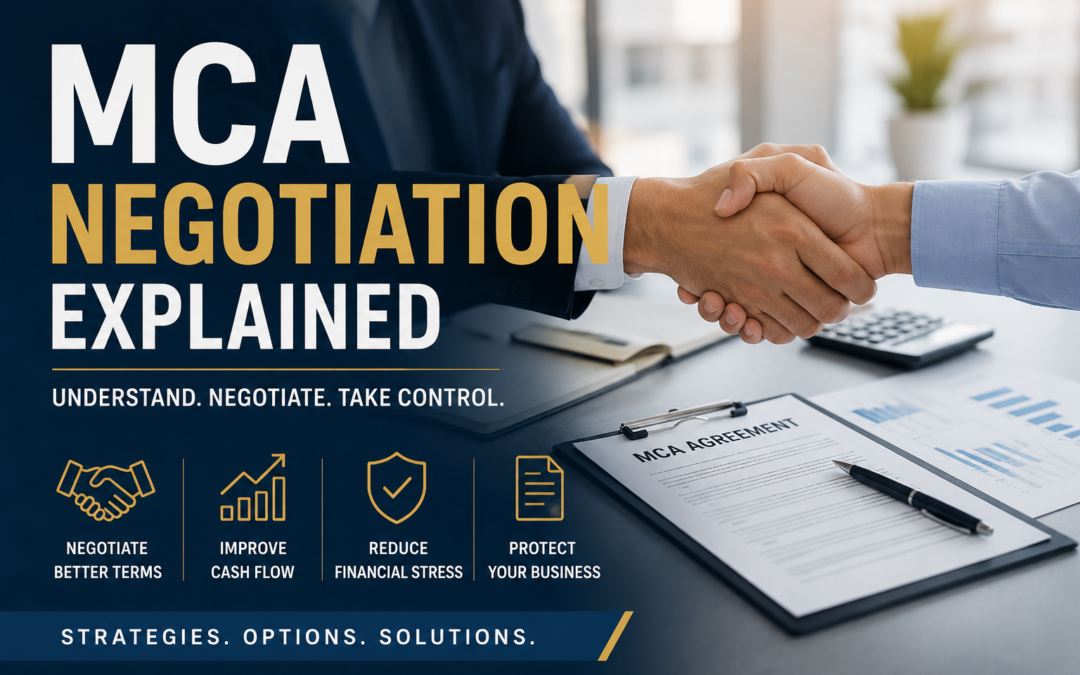
MCA negotiation may create opportunities for business owners struggling with merchant cash advance payments that are disrupting daily cash flow. When frequent withdrawals make it harder to cover payroll, inventory, rent, and other operating expenses, negotiating the existing MCA may be worth exploring.
The goal of MCA negotiation is to work with the funder toward terms that better reflect the business’s current financial situation. Depending on the circumstances, this could involve changes to payments, repayment terms, or another negotiated resolution.
In this guide, we explain how MCA negotiation works, what may be negotiated, when to consider it, and what business owners should know before starting the process.
Schedule Your Free Consultation
What Is MCA Negotiation?

MCA negotiation is the process of communicating with a merchant cash advance funder to explore changes to an existing agreement or repayment arrangement. Businesses often consider negotiation when daily or weekly withdrawals begin straining cash flow and make normal operating expenses harder to manage.
The goal is to identify a resolution that meets the MCA obligation while giving the business greater flexibility in managing its available cash. The outcome depends on the agreement, the funder, the amount owed, and the business’s financial circumstances.
How Merchant Cash Advance Negotiation Works
The process typically begins with a review of the MCA agreement, the current payment structure, the outstanding balance, and the business finances. This helps identify the source of the financial pressure and determine which changes may be worth requesting.
Next, the business or its representative communicates with the MCA funder and presents a proposed resolution. The funder may review the business’s financial condition before deciding whether to consider different terms.
MCA negotiation does not guarantee that a funder will agree to changes. However, a clear strategy supported by accurate financial information may create an opportunity to reach terms that are more manageable for the business.
What Terms May Be Negotiated
Depending on the situation and the funder’s willingness to negotiate, several parts of an MCA obligation may be discussed. These can include daily or weekly payment amounts, payment frequency, repayment schedules, or a potential settlement arrangement.
For example, reducing the size or frequency of withdrawals may help a business retain more working capital for payroll, inventory, rent, and other essential expenses.
The specific terms available will vary. That is why it is important to understand both the existing MCA agreement and the business’s financial position before entering negotiations.
Why Would an MCA Funder Negotiate?
An MCA funder may be willing to negotiate when a business can no longer comfortably maintain its current payment structure. If financial conditions have changed, MCA negotiation may offer a practical way to address the obligation rather than allowing the situation to become more difficult for both sides.
A funder is not required to modify an agreement. However, certain circumstances may encourage the funder to consider adjusted payments, revised terms, or another negotiated resolution.
Financial Hardship and Cash Flow Problems
Business finances can change quickly. A decline in revenue, unexpected expenses, seasonal fluctuations, or multiple MCA withdrawals can leave a business with less working capital available for everyday operations.
When MCA payments begin competing with payroll, rent, inventory, utilities, taxes, and other essential expenses, maintaining the existing payment schedule may become increasingly difficult.
Showing the funder clear evidence of financial hardship can help explain why the current arrangement is no longer sustainable. Accurate financial information may also provide a stronger foundation for MCA negotiation.
Why Funders May Consider Modified Terms
In some situations, a funder may determine that modified terms offer a more workable path toward repayment than continuing an arrangement the business is struggling to maintain.
For example, a funder may consider changes that allow the business to continue operating while still addressing its MCA obligation. Keeping the business financially stable may improve the likelihood that it can continue making payments.
Every situation is different, and there is no guarantee that an MCA funder will agree to modified terms. However, presenting a realistic proposal based on the business’s current finances may create an opportunity to reach an agreement that works better for both parties.
When Should You Consider MCA Negotiation?
The right time to consider MCA negotiation is often before financial pressure becomes a serious threat to normal business operations. If merchant cash advance payments are consuming too much available revenue, acting early may give you more time to evaluate your options.
Several warning signs may indicate that your current MCA payment structure is becoming harder to manage.
MCA Payments Are Straining Cash Flow
Daily or weekly MCA withdrawals can quickly reduce the cash your business has available to operate. When a large portion of incoming revenue is directed to MCA payments, your working capital may continue to shrink.
You may find yourself constantly moving money between accounts, delaying purchases, or waiting for the next deposit to cover upcoming expenses. These cash flow problems can signal that your current MCA payments no longer fit your business’s financial reality.
Exploring MCA negotiation at this stage may help determine whether different payment terms or another resolution is possible.
Essential Business Expenses Are Becoming Harder to Cover
Your business still needs money for payroll, rent, inventory, supplies, utilities, taxes, and other essential operating costs. When MCA withdrawals make those expenses increasingly difficult to cover, the payment structure may be interfering with your ability to run the business effectively.
Falling behind on essential expenses can create additional financial problems. It may also force you to choose which obligations get paid first.
MCA negotiation may provide an opportunity to address the existing obligation while working toward a more manageable payment arrangement.
You Are Considering Another MCA
Considering another merchant cash advance simply to cover expenses or make payments on an existing MCA is an important warning sign.
Taking additional funding may provide temporary cash, but it can also add another repayment obligation and additional withdrawals. This can lead to MCA stacking, where several advances compete for the same business revenue.
Before taking another advance, consider whether negotiating your existing MCA debt could address the underlying cash flow problem. A negotiation strategy focuses on resolving current obligations rather than adding another layer of financial pressure.
What Can Be Negotiated With an MCA Funder?
The terms that may be discussed during MCA negotiation depend on the funder, the MCA agreement, the outstanding obligation, and the financial condition of the business. There is no single negotiation structure that applies to every situation.
The objective is often to identify changes that could reduce immediate cash flow pressure while creating a more manageable system to address the MCA obligation.
Daily or Weekly Payment Amounts
For many businesses, the size of the daily or weekly withdrawal creates the greatest financial strain. If revenue has declined or operating costs have increased, the original payment amount may no longer align with the business’s current cash flow.
Negotiations may focus on reducing the amount withdrawn from the business account each day or week. A lower payment could leave more cash available for payroll, rent, inventory, supplies, and other essential expenses.
Any adjustment depends on the funder’s willingness to negotiate and the circumstances surrounding the MCA.
Repayment Schedules and Terms
MCA negotiation may also involve changes to the payment schedule or other repayment terms. For example, discussions could focus on modifying payment frequency or creating a different arrangement to address the remaining obligation.
Changes that reduce short-term payment pressure may extend the amount of time needed to resolve the MCA. Therefore, business owners should carefully review the total financial impact of any proposed terms, not simply the size of each payment.
Understanding the complete agreement can help determine whether the proposed arrangement actually improves the business’s financial position.
Potential Settlement of the MCA Balance
In some situations, negotiations may involve a potential settlement of the outstanding MCA balance. A settlement generally involves reaching an agreement to resolve the obligation under terms accepted by both the business and the funder.
The availability and amount of any settlement can depend on several factors, including the outstanding balance, payment history, financial hardship, and the funder’s willingness to negotiate.
Settlement is not guaranteed, and every MCA situation is different. If a settlement is offered, the business should understand the amount required, payment deadlines, and all terms of the agreement before accepting it.
How Does the MCA Negotiation Process Work?
The MCA negotiation process starts with understanding the business’s current obligations and determining what type of resolution may be realistic. Entering negotiations with accurate financial information and a clear strategy can help keep discussions focused and productive.
Although every situation is different, the process generally involves reviewing the MCA agreements, evaluating business finances, developing a strategy, and communicating with the funder.
Review Your MCA Agreements and Business Finances
The first step is to review each MCA agreement and understand the current payment amount, payment frequency, outstanding obligation, and other important terms.
Next, examine the business’s financial position. Revenue, operating expenses, bank activity, and available working capital can help show how MCA withdrawals affect cash flow.
This review helps identify what the business can realistically afford while continuing to cover essential operating expenses.
Develop a Negotiation Strategy
Once the financial picture is clear, the next step is determining what type of arrangement may provide meaningful relief. The strategy should reflect both the MCA obligation and the business’s ability to make payments.
Depending on the circumstances, the proposed solution could involve lower payments, changes to the payment schedule, modified terms, or a potential settlement.
A realistic strategy is important. Agreeing to terms the business cannot maintain could create another cash flow problem later.
Negotiate With the MCA Funder
The next step is to communicate with the MCA funder and present the proposed resolution. This may include explaining the financial hardship, providing supporting information, and discussing potential changes to the existing arrangement.
The funder may accept the proposal, reject it, or suggest different terms. Negotiation may require multiple conversations before both sides reach an agreement.
If new terms are offered, review them carefully before accepting. Make sure the business understands the payment requirements, deadlines, total financial obligation, and any other conditions included in the agreement.
Can You Negotiate an MCA Before Default?
Yes, MCA negotiation may be possible before a business defaults on its payments. In fact, you do not necessarily need to wait until payments are missed or financial conditions become severe before exploring your options.
If MCA withdrawals are beginning to strain cash flow, starting the conversation early may give the business more flexibility to address the problem while payments are still current.
Why Acting Early May Provide More Options
Waiting until the business can no longer make its MCA payments may allow financial pressure to build. During that time, working capital can shrink, essential expenses may become harder to cover, and the risk of missed payments can increase.
Acting earlier allows the business to evaluate its finances and explore potential solutions before the situation becomes more urgent. It may also provide more time to develop a realistic proposal based on current revenue, expenses, and available cash.
Early action does not guarantee that a funder will modify the agreement. However, addressing cash flow problems before default may help prevent the business from falling further behind.
Negotiating When Payments Are Still Current
A business does not always need to miss payments before contacting an MCA funder. If revenue has declined or the existing withdrawals are becoming increasingly difficult to manage, the business may be able to explain its financial circumstances while the account remains current.
Supporting the request with accurate financial information can help demonstrate why the existing payment structure is creating problems and what the business can realistically afford.
Most importantly, business owners should avoid intentionally missing payments simply to create negotiating leverage. MCA negotiation should focus on finding a workable resolution based on the business’s actual financial condition, not creating a default that could introduce additional risks.
Can You Negotiate Multiple MCAs at the Same Time?
Yes, businesses with two or more merchant cash advances may be able to negotiate multiple MCAs at the same time. However, each MCA is a separate obligation, often with different funders, payment amounts, terms, and outstanding balances.
When several withdrawals draw from the same revenue stream, resolving only one MCA may provide limited relief. A broader MCA negotiation strategy considers each obligation and its combined impact on the business’s overall cash flow.
Why Multiple MCAs Require a Coordinated Strategy
Multiple MCAs can create significant financial pressure because several daily or weekly withdrawals may compete for the same available cash. Even if one payment is reduced, the remaining withdrawals could continue to strain the business.
A coordinated strategy examines each MCA alongside the others. This includes reviewing balances, payment amounts, withdrawal schedules, agreement terms, and the business’s ability to meet its obligations.
The goal is to understand the complete financial picture before negotiations begin. This can help the business pursue solutions that address the combined impact of multiple MCAs rather than treating each obligation in isolation.
Prioritizing Different MCA Obligations
Not every MCA needs to be handled in the same way. One funder may be open to modified payments, while another situation could require a different negotiation approach.
Prioritizing MCA obligations involves evaluating which payments are creating the most immediate cash flow pressure, the status of each account, and the options available from each funder.
The business must also consider how any proposed agreement will affect its other obligations. Accepting new terms with one funder without considering the remaining MCAs could leave the underlying cash flow problem unresolved.
With multiple advances, the objective is to develop a coordinated MCA negotiation strategy that makes the business’s overall debt obligations more manageable while preserving cash for essential operations.
What Are the Risks of MCA Negotiation?
MCA negotiation can provide a path toward resolving financial pressure, but it also carries potential risks. A funder does not have to accept a proposed change, and starting negotiations does not automatically alter the existing MCA agreement.
Before moving forward, business owners should understand their current obligations, consider possible outcomes, and carefully evaluate any new terms offered during negotiations.
Negotiation Does Not Guarantee an Agreement
An MCA funder may accept a proposal, reject it, or respond with different terms. The outcome can depend on the agreement, outstanding balance, payment history, financial circumstances, and the funder’s willingness to negotiate.
Even when a business demonstrates financial hardship, there is no guarantee that payments will decrease or other terms will change.
For this reason, a negotiation strategy should remain realistic about what the business can afford and account for the possibility that the funder may not approve the requested changes.
Collection and Legal Action May Still Occur
Entering MCA negotiation does not necessarily stop collection activity or potential legal action. Depending on the circumstances and the MCA agreement, a funder may continue pursuing remedies available to it while discussions take place.
Missed or disrupted payments can also increase the urgency of the situation. Business owners should avoid assuming that negotiations alone protect collection efforts.
Understanding the existing agreement and responding promptly to collection notices, legal documents, or other communications can help the business make informed decisions as negotiations continue.
Why You Should Understand Any New Terms
A lower daily or weekly payment may sound attractive, but the payment amount is only one part of a negotiated agreement. Changes to the payment schedule, repayment period, fees, deadlines, or other conditions can affect the overall cost and obligations of the business.
Before accepting new terms, review the entire agreement and determine whether the proposed arrangement fits the business’s actual cash flow.
The goal should be more than temporary relief. Any negotiated resolution should be carefully evaluated to determine whether the business can realistically maintain the new terms and continue to operate.
Frequently Asked Questions About MCA Negotiation
Business owners often have questions about MCA negotiation, payment changes, timing, and what to expect during the process. Here are answers to some of the most common questions.
Can You Negotiate an MCA Yourself?
Yes. A business owner can contact an MCA funder directly and attempt to negotiate different terms.
Before starting, review your:
- Outstanding MCA obligation
- Daily or weekly payment
- Current business revenue
- Operating expenses
- Available working capital
The key is knowing what your business can realistically afford before proposing or accepting new terms.
How Long Does MCA Negotiation Take?
There is no standard timeline. Some negotiations may progress quickly, while others require several conversations or proposals.
Timing can depend on:
- The MCA funder
- The number of MCAs
- Your financial circumstances
- The changes being requested
- How quickly information and proposals are exchanged
Having accurate financial information ready can help keep the MCA negotiation process moving.
Can MCA Negotiation Reduce Your Payments?
Potentially. Depending on the funder and circumstances, negotiations may explore:
- Lower daily or weekly payments
- Different payment frequency
- Modified repayment terms
- A potential settlement arrangement
Reducing withdrawals could leave more working capital available for payroll, rent, inventory, supplies, and other essential expenses. However, payment reductions are not guaranteed.
Can You Negotiate an MCA Before Missing Payments?
Yes, potentially. You do not necessarily need to wait until your business misses payments before exploring MCA negotiation.
If withdrawals are beginning to strain cash flow, acting earlier may give you more time to review your finances, communicate with the funder, and explore potential solutions before the situation becomes more urgent.
Can You Negotiate Multiple MCAs?
Yes. Businesses with multiple merchant cash advances may pursue negotiations with more than one funder.
Because each MCA has its own balance, payment structure, and agreement, it is important to consider the combined impact of all MCA withdrawals on your cash flow. A coordinated strategy can help prevent changes to one MCA from leaving the larger financial problem unresolved.
Does MCA Negotiation Stop Collection Activity?
Not automatically. Beginning negotiations does not necessarily stop collection efforts or potential legal action.
Continue monitoring funder communications, collection notices, and legal documents throughout the negotiation process. If you receive legal documents, consider seeking qualified legal advice promptly.
💡 Bottom line: MCA negotiation may create opportunities to modify existing obligations, but every business, agreement, and funder is different. Understanding your finances and the terms proposed is essential before making a decision.
Take Control of Your MCA Debt Through Negotiation
When merchant cash advance payments begin consuming too much working capital, waiting can make it harder to keep your business finances on track. MCA negotiation may provide an opportunity to address existing obligations before cash flow pressure becomes more severe.
The goal is not simply to lower a payment. It is to pursue a resolution that considers your MCA obligations, available cash flow, essential operating expenses, and long-term needs of your business.
Why the Right MCA Negotiation Strategy Matters
Every business has a different financial situation. The right strategy starts with understanding what you owe, how much your business can realistically afford, and which negotiation options may be available.
A well-planned approach can help you:
- Understand your MCA agreements and obligations
- Identify the payments creating the greatest cash flow strain
- Evaluate realistic negotiation options
- Address multiple MCAs through a coordinated strategy
- Protect working capital needed for essential business expenses
Most importantly, the objective should be to pursue terms your business can realistically manage rather than replacing one financial problem with another.
Schedule a Free Consultation With MCA Shield
If MCA payments are making it harder to cover payroll, inventory, rent, or other operating expenses, you may have options.
MCA Shield can review your current merchant cash advance obligations, evaluate how the payments are impacting your cash flow, and help determine which negotiation strategies may fit your situation.
You do not have to wait until your business misses payments or reaches a financial crisis to explore MCA negotiation. Acting sooner can give you more time to understand your options and determine the next step.
🛡️ Schedule a Free Consultation With MCA Shield today and take the first step toward a more manageable path forward.