If daily or weekly merchant cash advance payments are putting pressure on your business, you may be wondering: Can MCA debt be settled? In some situations, the answer is yes. MCA debt settlement may provide a way to negotiate existing obligations and create a more manageable path forward.
However, every merchant cash advance situation is different. The available options can depend on your MCA agreements, outstanding balances, cash flow, number of advances, and overall financial circumstances.
Understanding how MCA debt settlement works can help you evaluate your options before financial pressure becomes more difficult to manage. Below, we’ll explain what settlement means, how the process works, and when it may make sense for your business.
Schedule Your Free Consultation
What Is MCA Debt Settlement?
MCA debt settlement is a process that may allow a business to negotiate the terms of an existing merchant cash advance obligation. When daily or weekly withdrawals become difficult to manage, settlement may provide an alternative to continuing under the original payment structure.
The goal is to find a more manageable resolution based on the business’s financial situation and the MCA funder’s willingness to negotiate. Depending on the circumstances, this could involve changes to payment terms, a negotiated payoff amount, or another agreed-upon resolution.
However, MCA debt settlement is not guaranteed. Every situation is different, and the available options depend on factors such as the MCA agreement, outstanding balance, business cash flow, payment history, and funder.
H3: What MCA Debt Settlement Actually Means
MCA debt settlement generally involves negotiating with an MCA funder to resolve an outstanding obligation under different terms than originally expected. The process often begins with reviewing the MCA agreement and the business’s current financial condition.
If a business is struggling with withdrawals, the funder may be willing to discuss a potential resolution. Depending on the situation, negotiations could focus on a modified payment arrangement, reduced payoff amount, or other settlement terms.
The purpose is not simply to stop payments. Instead, the goal is to establish a clear path toward resolving the MCA debt while considering what the business can realistically afford.
H3: How MCA Settlement Differs From Paying the Original Agreement
Under the original MCA agreement, the business generally continues making payments or remittances according to the agreed structure until the required amount has been satisfied. When cash flow declines, however, those withdrawals can place increasing pressure on payroll, inventory, rent, utilities, and other operating expenses.
With MCA settlement, the business seeks to negotiate a different resolution rather than simply continuing under the existing terms. If an agreement is reached, the new arrangement may change how the remaining obligation is resolved.
The key difference is negotiation. Paying the original agreement means continuing under its existing terms. Settlement involves working toward an agreed-upon alternative resolution that may better reflect the business’s current financial circumstances.
.
How Does MCA Debt Settlement Work?
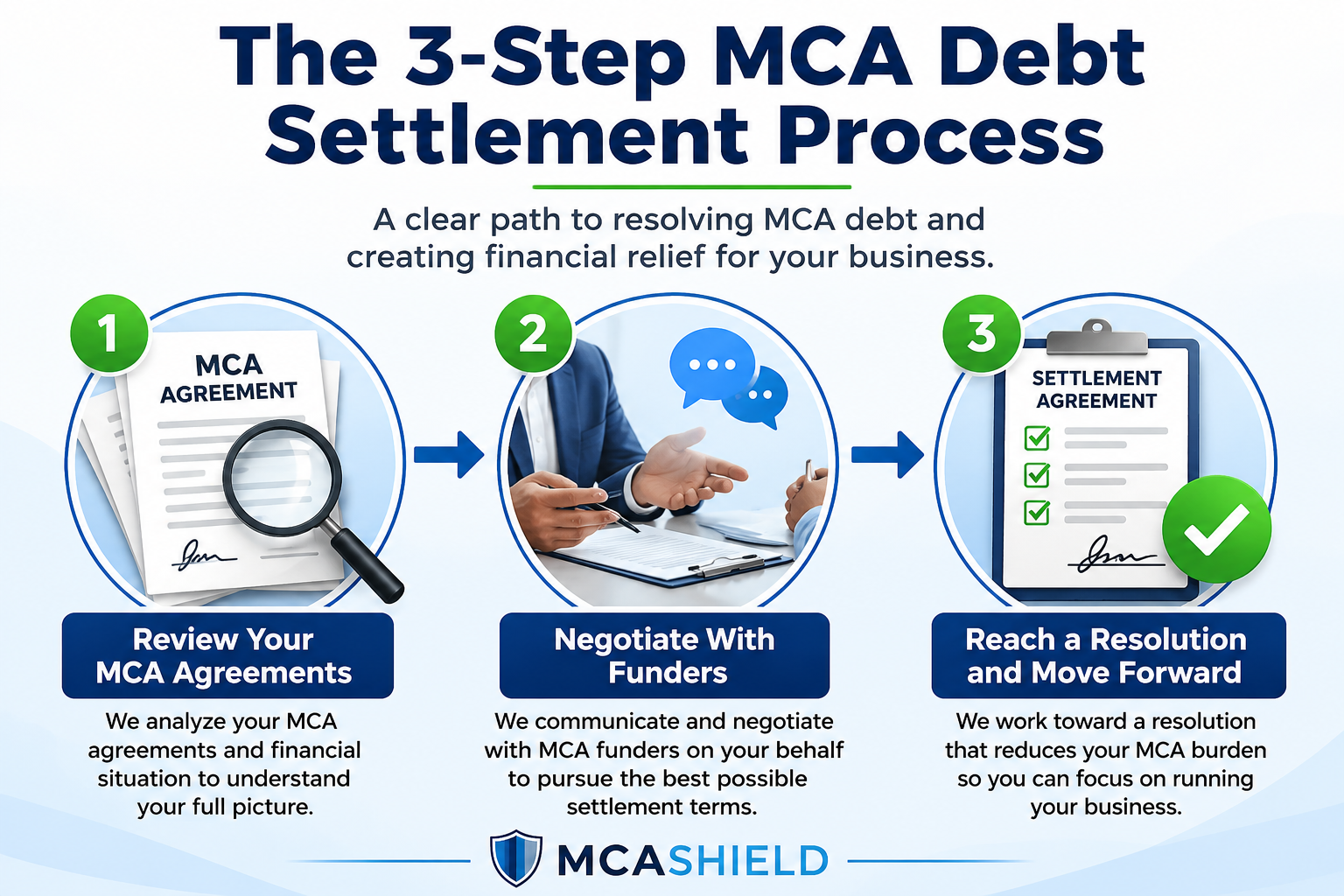
The MCA debt settlement process typically begins with a detailed review of the business’s merchant cash advance obligations and current financial condition. From there, the business or its representative may communicate with MCA funders to explore whether alternative terms are available.
The exact process can vary because every MCA agreement and business situation is different. However, settlement generally involves understanding what is owed, evaluating what the business can realistically afford, negotiating with funders, and working toward an acceptable resolution.
Reviewing Your MCA Agreements and Current Financial Situation
The first step is to understand the full scope of the business’s MCA obligations. This includes reviewing outstanding balances, payment schedules, daily or weekly withdrawals, active MCA agreements, and other financial commitments.
Cash flow should also be carefully evaluated. A business needs enough working capital to cover essential expenses such as payroll, rent, inventory, utilities, taxes, and operating costs.
This financial review helps determine the pressure MCA payments are placing on the business. It can also provide the information needed to develop a realistic MCA debt settlement strategy.
Negotiating With MCA Funders
Once the financial situation is understood, communication with the MCA funder can begin. The goal is to explain the business’s circumstances and determine whether the funder is willing to consider different payment terms or a negotiated settlement.
Negotiations may involve discussing the outstanding obligation, current cash flow, payment history, and what the business can reasonably manage. Depending on the circumstances, a funder may consider adjusted payments, a modified repayment structure, or a negotiated payoff.
Not every funder will respond the same way. Therefore, MCA settlement results can vary, and businesses should avoid assuming that a specific reduction or payment arrangement is guaranteed.
Reaching a Modified Repayment or Settlement Agreement
If negotiations are successful, the business and MCA funder may reach an agreement outlining how the remaining obligation will be resolved. The terms should clearly explain the payment amount, payment schedule, settlement amount, deadlines, and any other requirements that apply.
Before accepting an agreement, it is important to understand exactly what the new terms require and how they will affect the business’s cash flow.
A successful MCA debt settlement should provide a clear resolution while giving the business a more realistic opportunity to meet its obligations and continue covering essential operating expenses.
Why Would an MCA Funder Agree to Settle Debt?
An MCA funder may consider settlement when a business is experiencing serious financial pressure and the original payment structure is becoming difficult to maintain. In some cases, negotiating a workable resolution may be preferable to allowing the situation to become more complicated for everyone involved.
That does not mean a funder is required to settle. MCA debt settlement is negotiated, and the outcome depends on the agreement, the funder, the outstanding obligation, and the business’s financial circumstances.
When Financial Hardship Affects the Original Payment Structure
A merchant cash advance may have been manageable when sales and cash flow were stronger. However, circumstances can change. Declining revenue, unexpected expenses, seasonal slowdowns, or multiple MCA obligations can make daily or weekly withdrawals increasingly difficult to manage.
As MCA payments consume more available cash, a business may struggle to cover payroll, rent, inventory, utilities, taxes, and other essential expenses. At that point, continuing with the existing payment structure may become challenging.
If the business can demonstrate genuine financial hardship, the funder may be willing to discuss a different arrangement. Depending on the circumstances, this could include modified payments, adjusted terms, or a negotiated settlement amount.
Why a Negotiated Resolution May Benefit Both Sides
A negotiated resolution can sometimes create a more practical outcome for both the business and the MCA funder. The business gains an opportunity to address its MCA obligation while protecting the cash flow needed to continue operating.
The funder, meanwhile, may gain a clearer path toward recovering an agreed-upon amount rather than facing continued payment difficulties or uncertainty.
For the business, the goal of MCA debt settlement is to reach terms it can realistically manage. For the funder, the goal is to resolve the outstanding obligation. When those interests can be brought together, a negotiated agreement may provide a more sustainable path toward resolution for both sides.
How Much Can MCA Debt Potentially Be Settled For?
One of the first questions business owners often ask about MCA debt settlement is how much they may ultimately be required to pay. There is no standard percentage or guaranteed reduction. The outcome depends on the specific MCA obligation, the funder, and the business’s financial situation.
In some situations, a funder may be willing to negotiate the outstanding obligation. However, businesses should be cautious of any company that promises a specific settlement amount or guaranteed reduction before reviewing the details.
Factors That Can Affect an MCA Settlement
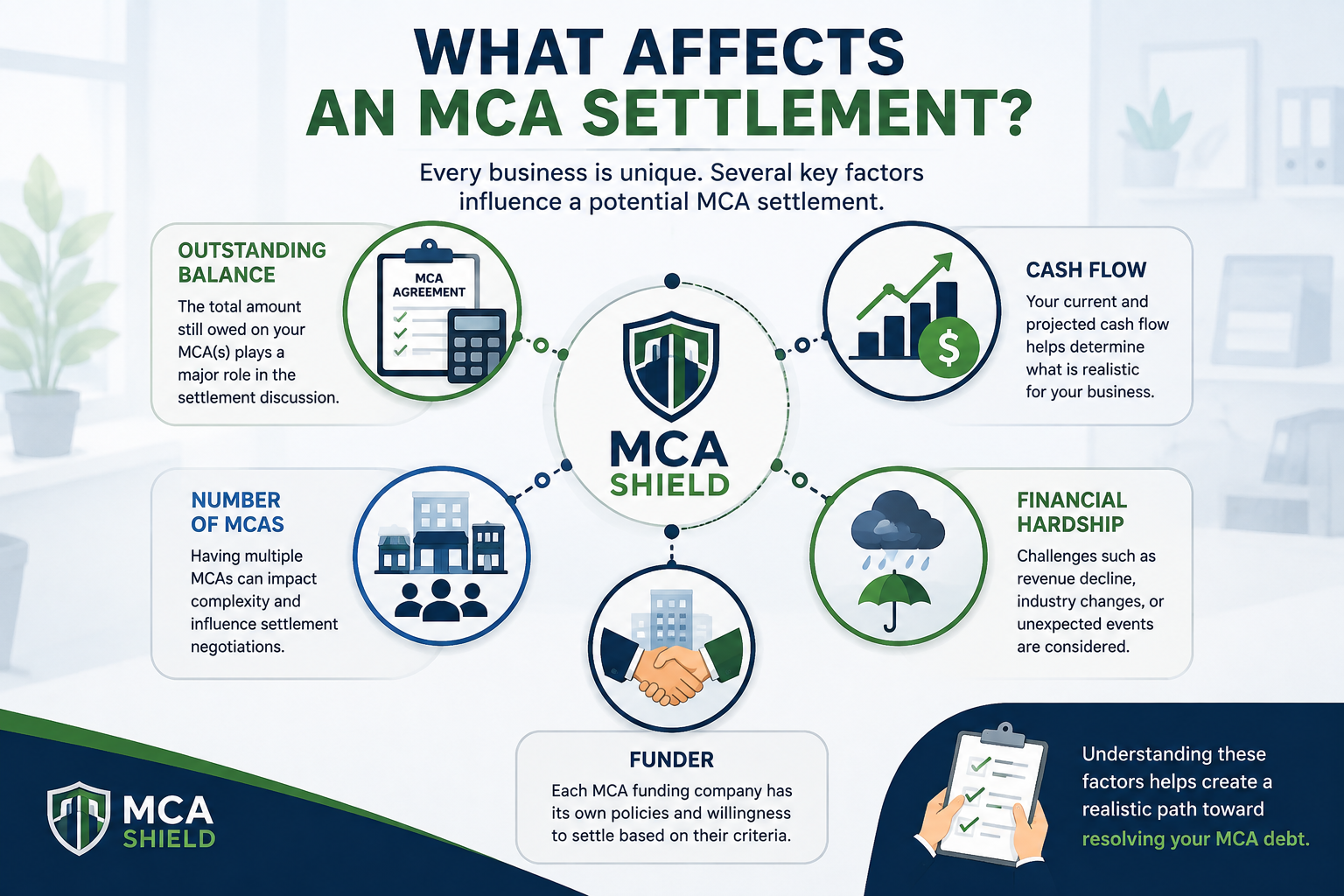
Several factors may influence whether an MCA funder is willing to negotiate and what settlement terms may be available. These can include the outstanding balance, payment history, current revenue, cash flow, number of active MCAs, and severity of the business’s financial hardship.
The MCA agreement itself also matters. Different funders may have different policies, negotiation practices, and requirements when considering a settlement.
A business’s ability to fund a proposed settlement can also affect negotiations. A realistic proposal should consider both the outstanding obligation and the amount the business can reasonably afford without creating additional financial strain.
Why Settlement Results Vary From Business to Business
No two businesses enter MCA debt settlement under the same circumstances. One company may have a single MCA and a temporary decline in revenue. Another may be dealing with multiple advances, shrinking cash flow, and difficulty covering basic operating expenses.
Funders can also respond differently to similar situations. Some may be willing to consider alternative arrangements, while others may be less flexible. For that reason, MCA settlement results should be evaluated on a case-by-case basis.
Rather than focusing on a promised percentage, businesses should focus on reaching a resolution that is realistic, clearly defined, and sustainable for their financial situation. The right settlement strategy should address the MCA obligation without creating another financial problem for the business.
Can You Settle Multiple MCA Debts?
Yes, it may be possible to settle multiple MCA debts, but having several merchant cash advances can make the situation more complex. Each MCA may have a different funder, outstanding balance, payment schedule, and agreement. As a result, each obligation may need to be reviewed and addressed individually.
For businesses with multiple MCAs, the goal is to evaluate the entire financial picture rather than focusing on a single advance. A coordinated strategy can help determine which obligations are creating the most pressure and what options may be available.
How Stacked MCAs Can Increase Cash Flow Pressure
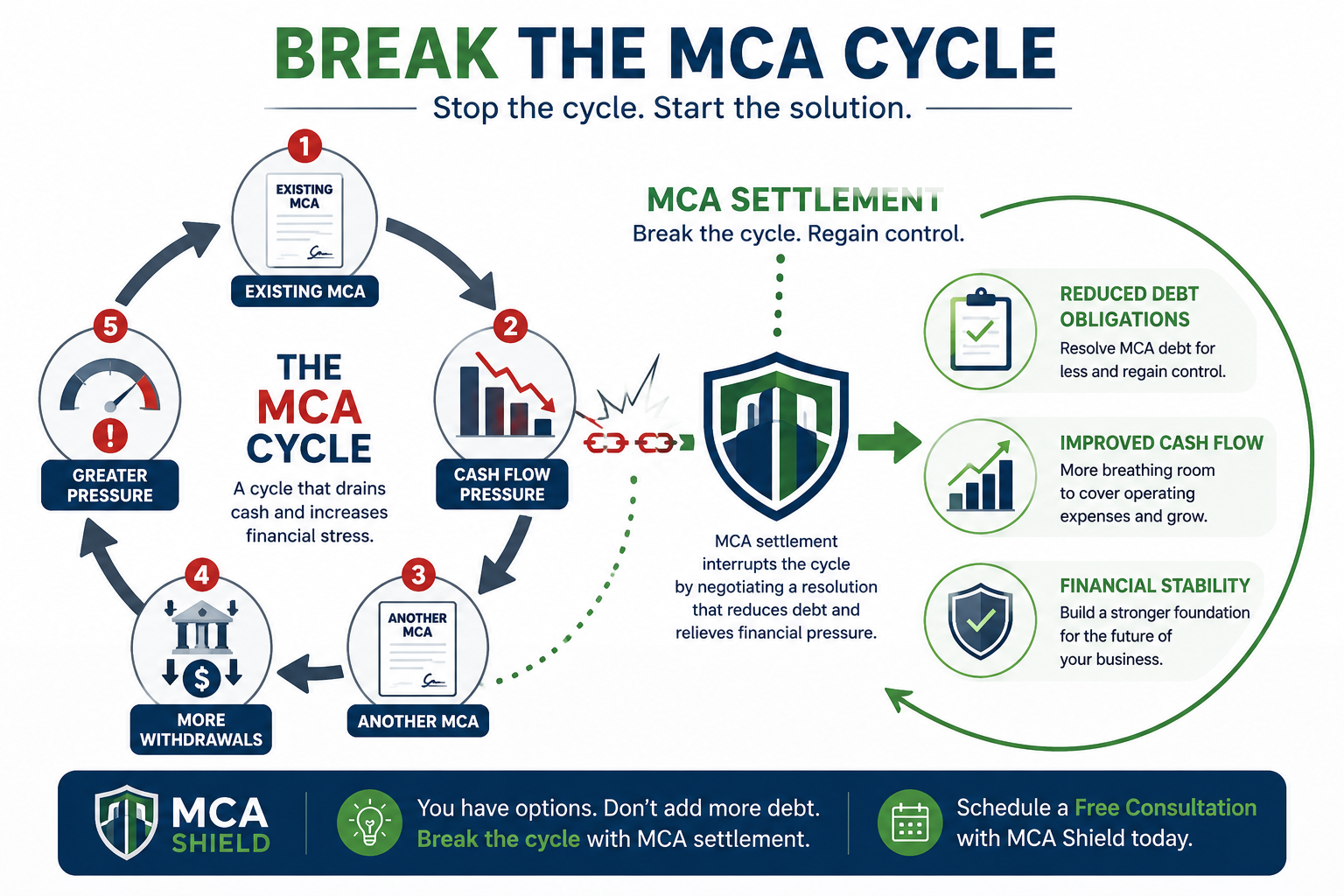
MCA stacking occurs when a business takes out an additional merchant cash advance while one or more existing advances are still active. Although the additional funding may provide short-term working capital, it also increases the business’s overall payment obligations.
Multiple daily or weekly withdrawals can quickly consume a significant portion of incoming revenue. This can leave less money available for payroll, inventory, rent, utilities, taxes, and other operating expenses.
The pressure can become even greater if a business takes out another MCA to cover expenses or payments on existing advances. Over time, this pattern can create a cycle of increasing MCA debt and declining available cash flow.
Creating a Strategy for Multiple MCA Obligations
Addressing multiple MCAs begins with identifying all active advances. Businesses should review the remaining balances, withdrawal amounts, payment frequency, funders, and terms of each agreement.
From there, the business can evaluate how much total cash is leaving the account each day or week. This makes it easier to see the combined impact of the MCAs and determine what the business can realistically afford.
An MCA debt settlement strategy may involve communicating with multiple funders and pursuing separate agreements based on each obligation. The goal is to create a coordinated approach that addresses the MCA debt while helping the business preserve enough cash flow to continue operating.
When several MCAs are involved, addressing the problem early can be especially important. Waiting until cash flow is severely strained may make it harder for the business to maintain operations while working toward a resolution.
MCA Settlement vs. Taking Out Another MCA
When MCA payments strain cash flow, taking out another merchant cash advance may seem like a quick way to gain working capital. However, additional funding does not resolve the existing MCA debt. Instead, it can increase the amount of revenue committed to daily or weekly withdrawals.
MCA debt settlement takes a different approach. Rather than creating a new financial obligation, settlement focuses on addressing existing MCA debt and exploring whether a negotiated resolution is possible.
Why Additional MCA Funding Can Increase Financial Pressure
A new MCA can provide immediate access to capital, but it also comes with its own repayment requirements. If the business already has one or more active advances, the new withdrawals can place even greater pressure on available cash flow.
As more revenue goes toward MCA payments, less may be available for payroll, inventory, rent, utilities, taxes, and other operating expenses. The business may then need additional funding to cover expenses that would normally be paid from operating revenue.
This can create a difficult pattern: cash flow becomes tight, another MCA provides temporary relief, and the additional withdrawals make future cash flow even tighter. What solves an immediate cash shortage may create greater financial pressure in the weeks or months ahead.
Breaking the Cycle of Repeated MCA Borrowing
Breaking the MCA cycle often requires addressing existing debt instead of continuing to rely on new advances. The first step is to understand how much revenue is going toward MCA payments and whether the current structure is sustainable.
For some businesses, MCA debt settlement may provide an alternative to repeated borrowing. If a funder is willing to negotiate, a settlement could help establish a more manageable way to resolve the existing obligation without taking on another MCA.
The goal is to move away from short-term fixes and toward a longer-term financial strategy. Preserving working capital, resolving existing MCA obligations, and reducing dependence on additional advances can give the business a better opportunity to regain control of its cash flow.
When Should You Consider Settling MCA Debt?
Businesses do not necessarily need to wait until they have missed payments to explore MCA debt settlement. If daily or weekly withdrawals are making it increasingly difficult to manage normal operating expenses, it may be time to evaluate your options.
The earlier a business recognizes that its current MCA payments are creating financial strain, the more time it may have to assess the situation. Waiting until cash flow reaches a critical point can make an already difficult situation more challenging.
Warning Signs Your Current MCA Payments Are Becoming Unsustainable
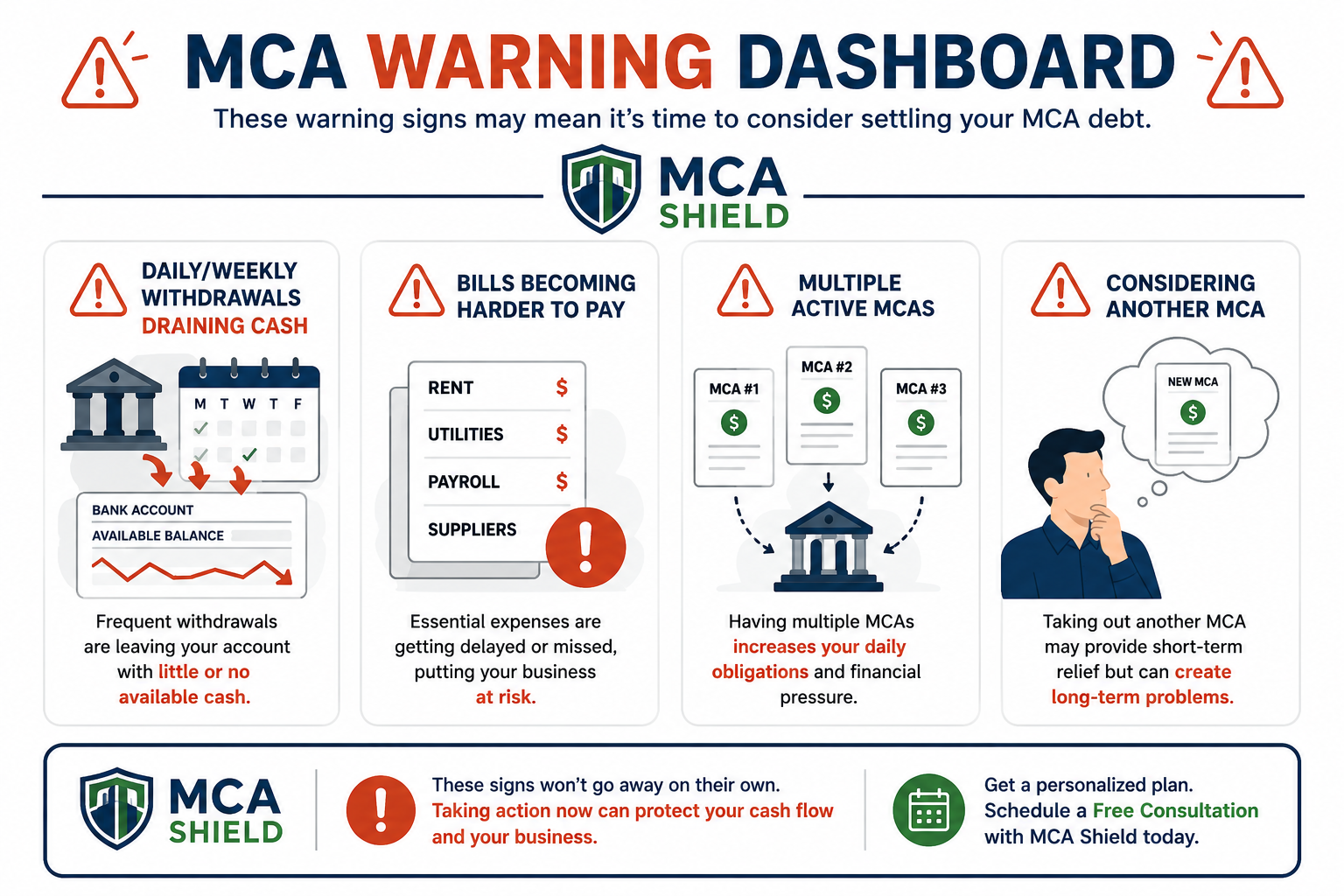
One of the clearest warning signs is when MCA withdrawals consistently leave the business without enough cash to cover essential expenses. Payroll, rent, inventory, utilities, taxes, and vendor payments should not become increasingly difficult to manage because of MCA payments.
Other warning signs may include overdrawing the business bank account, falling behind on bills, delaying vendor payments, using credit to cover operating expenses, or taking out another MCA to maintain cash flow.
Multiple active MCAs can create additional pressure. If a growing share of daily or weekly revenue is committed to MCA withdrawals, the business may have less flexibility when sales decline, or an unexpected expense occurs.
These warning signs do not automatically mean settlement is the right solution. However, they are a strong reason to review the business’s MCA obligations and financial condition before the pressure grows.
Why Acting Early May Give Your Business More Options
Financial problems are often easier to address when a business still has revenue, working capital, and the ability to maintain essential operations. Acting early provides more time to understand the MCA agreements, evaluate cash flow, and determine which potential solutions are realistic.
Early action may also allow a business to explore MCA debt settlement or other repayment options before financial pressure becomes severe. Funders are not required to negotiate, and no particular settlement outcome can be guaranteed. Still, having time to communicate and develop a realistic strategy can be valuable.
Most importantly, acting early can help a business avoid making short-term decisions that create additional pressure, such as taking out another MCA simply to cover existing payments.
If MCA withdrawals are beginning to interfere with normal operations, the time to evaluate your options is before the business reaches a financial crisis.
Frequently Asked Questions About Settling MCA Debt
Business owners considering MCA debt settlement often have questions about timing, payments, and what to expect from the process. Because every MCA agreement and financial situation is different, there is no single outcome that applies to every business.
Here are answers to three common questions about settling MCA debt.
Can MCA Debt Be Settled Before You Default?
Potentially, yes. A business does not always need to miss payments before exploring MCA debt settlement. If daily or weekly withdrawals are already creating significant cash flow pressure, it may make sense to review the situation early.
Addressing the problem before payments become unmanageable may provide more time to review MCA agreements, organize financial information, communicate with funders, and evaluate possible solutions.
However, a funder is not required to negotiate or accept a settlement. The options available will depend on the MCA agreement, the funder, and the business’s financial situation.
Can Settlement Reduce Daily or Weekly MCA Withdrawals?
In some situations, negotiations may result in modified payment terms or a different repayment arrangement. This could change the amount or frequency of withdrawals while the MCA obligation is being resolved.
However, reduced payments should never be assumed or guaranteed. Each funder may approach negotiations differently, and the terms of any agreement will depend on the circumstances.
The goal of MCA debt settlement is to pursue a resolution that addresses the outstanding MCA obligation while considering what the business can realistically afford.
How Long Does It Take to Settle MCA Debt?
There is no standard timeline for settling MCA debt. Some MCA settlements move more quickly than others. The timeline may vary based on the number of MCA agreements, how quickly funders respond, and the details of each negotiation.
Having MCA agreements and financial information organized may help the process move more efficiently. Multiple funders or complicated obligations can require additional time.
Rather than focusing on a specific deadline, businesses should focus on reaching a clear, realistic, and sustainable settlement. A well-structured resolution is more important than rushing into an agreement that could create additional financial pressure.
Take the First Step Toward Resolving Your MCA Debt
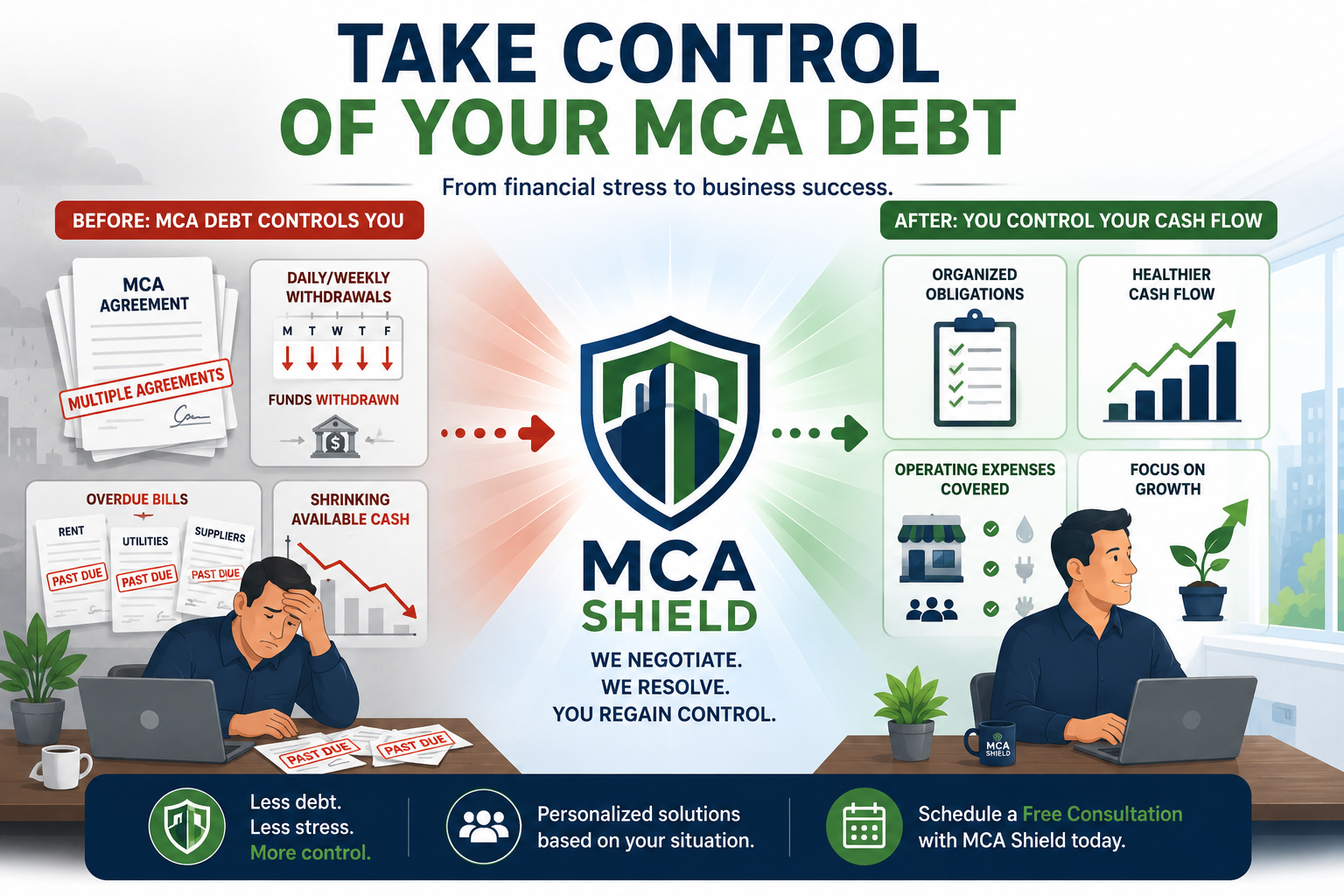
If merchant cash advance payments are putting increasing pressure on your business, waiting may make the situation more difficult. MCA debt settlement may offer a path toward resolving existing obligations, but understanding your financial position is an important first step.
You do not have to wait until daily or weekly withdrawals threaten your ability to operate. Reviewing your MCA agreements and cash flow now can help you determine which options may be available.
Understand Your Options Before the Financial Pressure Gets Worse
MCA problems often become more difficult as cash flow declines. When MCA withdrawals consume a larger share of revenue, businesses may struggle to cover payroll, inventory, rent, utilities, taxes, and other essential expenses.
Taking action early gives you time to understand what you owe, evaluate your cash flow, and consider possible solutions. It may also help you avoid relying on another merchant cash advance to cover existing payments or operating expenses.
The right solution will depend on your MCA agreements and financial situation. However, understanding your options now can help you make a more informed decision about your business’s financial direction.
Schedule a Free Consultation With MCA Shield
If you are asking, “Can MCA debt be settled?”, MCA Shield can help you better understand your situation and available options.
During a free consultation, the MCA Shield team can review your current MCA obligations, assess your financial situation, and help you understand potential next steps. There are no guaranteed settlement results, and each situation requires an individual review.
Schedule a Free Consultation With MCA Shield today to learn more about your MCA debt settlement options and take the first step toward developing a more manageable financial path for your business.