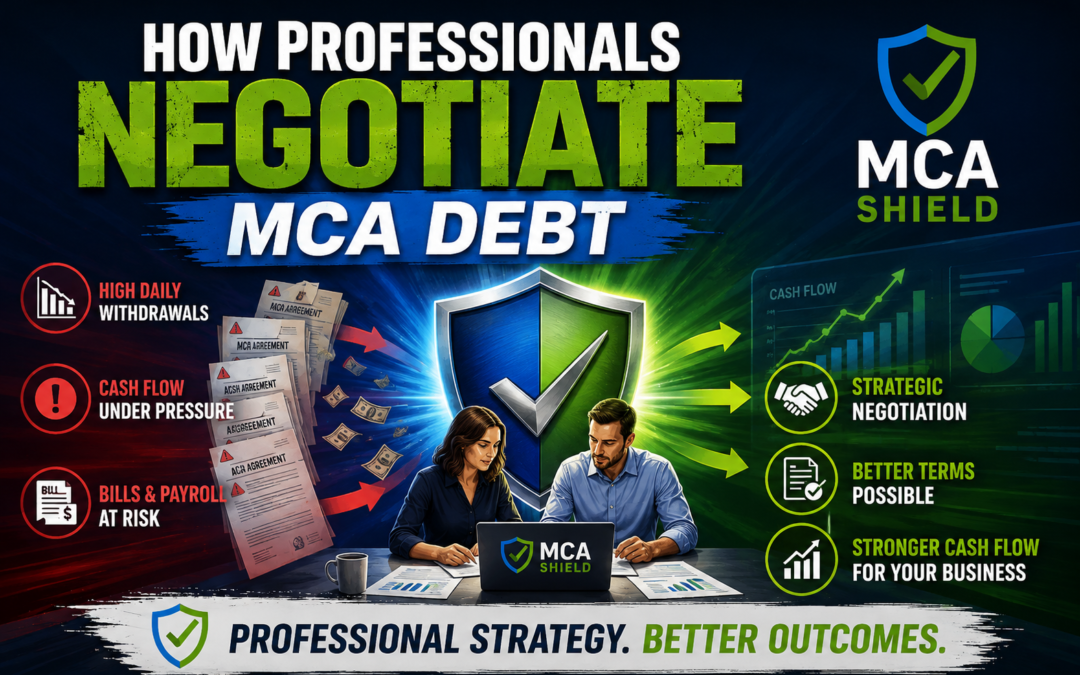
If merchant cash advance payments are putting pressure on your business, negotiation may offer a way to regain control. However, effective MCA debt negotiation involves more than simply asking a funder to lower your payments. It requires preparation, financial analysis, and a clear strategy.
Professionals start by reviewing your MCA agreements, outstanding balances, payment history, and business cash flow. They then use that information to develop a negotiation approach based on what your business can realistically afford.
In this guide, we explain how professionals negotiate MCA debt, what they may try to change, and how an organized negotiation strategy can help protect working capital while pursuing a more manageable path forward.
Schedule Your Free Consultation
How Professional MCA Debt Negotiation Works
Professional MCA debt negotiation starts with understanding the business’s full financial situation. A skilled negotiator does not approach an MCA funder without preparation. Instead, they review the agreements, payment history, outstanding balances, and current cash flow before developing a strategy.
The goal is to determine what the business can realistically afford while continuing to cover payroll, rent, inventory, utilities, taxes, and other essential operating expenses. From there, the negotiator can communicate with MCA funders and pursue more manageable repayment terms or other possible resolutions.
A strong MCA debt negotiation strategy is based on facts, documentation, and realistic financial numbers.
What Professionals Review Before Negotiations Begin
Before contacting an MCA funder, professionals usually conduct a detailed review of the business’s MCA obligations. This helps them understand the size of the problem and identify possible negotiation options.
The review may include:
- Current MCA agreements
- Outstanding balances
- Daily or weekly payment amounts
- ACH withdrawal history
- Number of active MCA funders
- Business revenue and expenses
- Available working capital
- Missed or returned payments
- Previous communication with funders
If the business has multiple merchant cash advances, each obligation should be reviewed together. Negotiating one MCA without considering the others may leave the business with the same overall cash-flow problem.
Professionals use this information to build a coordinated negotiation strategy instead of treating each MCA as an isolated debt.
Why MCA Agreements and Payment History Matter
Every merchant cash advance agreement may contain different repayment terms, payment structures, reconciliation provisions, default language, and remedies. Reviewing those details helps a professional understand what the funder expects and what options may exist.
Payment history is also important.
A business that has consistently made payments may be in a different negotiating position than one that has already missed several withdrawals. Likewise, repeated returned ACH payments or an existing default can change how quickly the situation needs to be addressed.
Professionals also review how much has already been paid and what remains outstanding. This creates a clearer picture of the business’s total MCA debt exposure before negotiations begin.
The more complete the financial information, the easier it becomes to develop a realistic approach.
How Business Cash Flow Shapes the Negotiation Strategy
Cash flow is one of the most important factors in MCA debt negotiation.
A proposed payment structure only works if the business can actually maintain it. Agreeing to payments that remain too high may simply delay the same financial problem.
Professionals therefore examine how much revenue enters the business and how much cash must remain available for essential operations. They may review expenses such as payroll, rent, inventory, insurance, utilities, taxes, and vendor payments.
For example, if several MCA withdrawals are consuming a large portion of weekly revenue, the negotiation strategy may focus on creating more room for operating expenses.
The objective is not simply to negotiate a different payment. It is to pursue a structure that is more realistic for the business’s current financial condition.
A well-prepared strategy gives professionals stronger information when communicating with MCA funders and helps the business avoid making payment promises it cannot reasonably maintain.
How Professionals Evaluate Your MCA Debt
Before negotiations begin, professionals need a clear picture of how much MCA debt the business carries and how those payments affect daily operations. Looking at one balance or one withdrawal is rarely enough.
A complete MCA debt evaluation considers outstanding balances, payment frequency, multiple funders, business revenue, and available working capital. This helps determine where the greatest pressure exists and what type of negotiation strategy may be realistic.
The goal is to understand the entire financial picture before approaching MCA funders.
Reviewing Outstanding MCA Balances and Payments
The first step is identifying exactly what the business still owes.
Professionals review each MCA to determine the remaining balance, current payment amount, payment frequency, and estimated payoff timeline. They also compare those numbers with what the business has already paid.
Important details may include:
- Outstanding MCA balance
- Daily or weekly ACH withdrawal amount
- Original advance amount
- Total repayment amount
- Payments already completed
- Returned or missed withdrawals
- Current payoff or reconciliation information
This review helps show how much cash is leaving the business each week.
For example, one MCA payment may appear manageable on its own. However, when combined with payroll, rent, inventory, and other obligations, it may create serious cash-flow pressure.
Professionals use these numbers to establish a realistic starting point for MCA debt negotiation.
Identifying Multiple MCA Obligations
Many businesses seeking help are not dealing with just one merchant cash advance. They may have two, three, or several MCA obligations withdrawing money at the same time.
This makes a complete debt review especially important.
Professionals identify every active MCA, including its balance, payment schedule, and withdrawal amount. They then calculate the combined financial impact.
For example, several smaller withdrawals can become a major burden when they occur every business day. One funder may withdraw in the morning while another takes a payment later the same day.
This can quickly reduce the cash available for normal business expenses.
When multiple MCAs exist, professionals may develop a coordinated negotiation strategy rather than negotiating each obligation without considering the others. The objective is to understand how all MCA payments interact and determine which obligations may require the most immediate attention.
A complete view of the debt can also help prevent the business from agreeing to one new payment structure that makes another MCA impossible to maintain.
Measuring the Impact on Working Capital
Outstanding balances alone do not show how serious the problem has become. Professionals also measure how MCA payments affect working capital.
Working capital is the money a business needs to keep operating. It covers expenses such as payroll, inventory, rent, utilities, insurance, taxes, and vendor payments.
When MCA withdrawals consume too much available cash, the business may begin delaying essential expenses or relying on additional financing to fill the gap.
Professionals may compare:
- Weekly or monthly business revenue
- Total MCA withdrawals
- Essential operating expenses
- Available cash reserves
- Upcoming payroll and vendor obligations
- Remaining cash after MCA payments
This analysis helps determine whether the current payment structure is sustainable.
If MCA payments are repeatedly leaving the business without enough operating cash, that information becomes an important part of the MCA debt negotiation strategy.
The goal is to identify a payment level the business has a better chance of maintaining while still funding essential operations. By measuring the real effect of MCA debt on working capital, professionals can enter negotiations with clear numbers, realistic goals, and a stronger understanding of what the business needs to remain operational.
How Professionals Build an MCA Negotiation Strategy
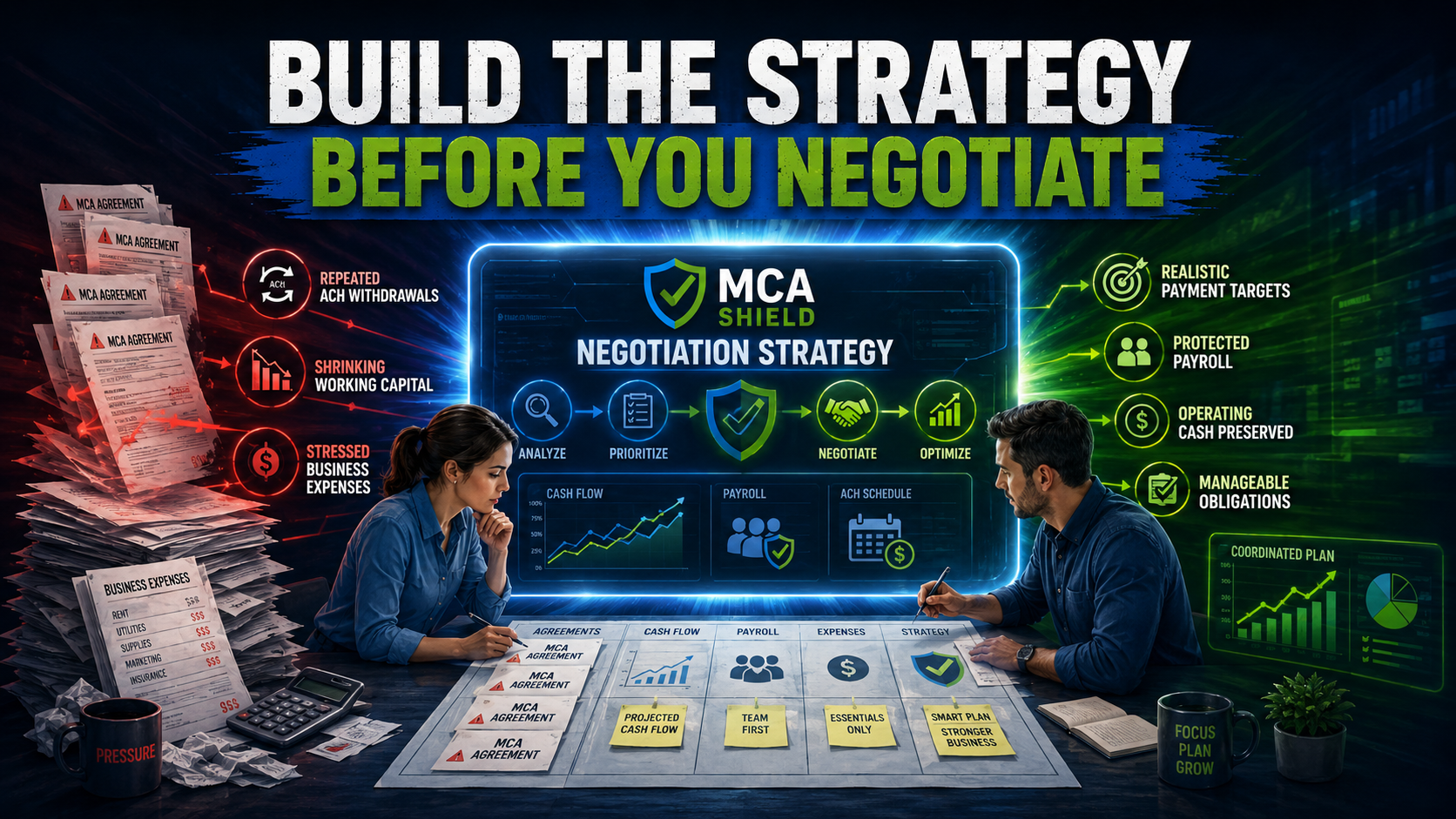
Once the business’s MCA obligations and cash flow have been reviewed, the next step is building a clear MCA negotiation strategy. Professionals use the financial information they gathered to determine what the business can reasonably afford and what outcome may be worth pursuing.
A strong strategy is not based on guesswork. It considers current balances, payment frequency, available cash, operating expenses, and the number of MCA funders involved.
The goal is to pursue a resolution that reduces financial pressure without creating another payment structure the business cannot maintain.
Setting Realistic Payment and Settlement Goals
Before negotiations begin, professionals establish realistic goals based on the business’s current financial condition.
Depending on the circumstances, the strategy may focus on lower payments, modified repayment terms, or a potential MCA settlement. However, any proposed arrangement should fit within the business’s actual cash flow.
Professionals may consider:
- How much the business can realistically pay
- Current and projected revenue
- Essential monthly operating expenses
- Available cash reserves
- Total outstanding MCA balances
- The number of active MCA obligations
- Whether the business can support a lump-sum or structured settlement
Setting a target that is too aggressive can make negotiations harder. At the same time, agreeing to payments that remain unaffordable may simply recreate the same financial pressure.
For that reason, professional MCA debt negotiation focuses on finding a balance between what the funder may accept and what the business has a realistic chance of maintaining.
Prioritizing MCA Funders When Multiple Advances Exist
When a business has multiple merchant cash advances, professionals may need to decide which funders should be addressed first.
Not every MCA will create the same level of urgency. One may have a much larger daily withdrawal. Another may already be in default. A third may have begun aggressive collection activity.
Professionals look at the entire situation before deciding how to proceed.
Factors that may influence priority include:
- Size of the outstanding balance
- Daily or weekly withdrawal amount
- Current payment status
- Default or collection activity
- Impact on available working capital
- Communication from the funder
- How each MCA affects the broader negotiation plan
The objective is to avoid negotiating one obligation in a way that makes the others impossible to manage.
A coordinated MCA negotiation strategy can help professionals address multiple funders while keeping the business’s total financial burden in view.
Protecting Essential Business Cash Flow
One of the most important parts of professional MCA negotiation is protecting enough cash for the business to continue operating.
A business still needs money for payroll, rent, inventory, utilities, insurance, taxes, vendors, and other essential expenses. If MCA payments consume too much revenue, even a profitable company can experience serious cash-flow problems.
Professionals therefore examine how much cash must remain available after any proposed MCA payment.
For example, a lower payment may sound attractive. However, if it still leaves the business unable to cover payroll or purchase inventory, the arrangement may not solve the underlying problem.
A stronger strategy considers both the MCA obligation and the business’s need to remain operational.
That is why protecting working capital often becomes a central goal during MCA debt negotiation. The aim is to pursue more manageable obligations while preserving enough cash to keep the business functioning.
When professionals build a strategy around realistic numbers, coordinated priorities, and essential expenses, the business enters negotiations with a clearer plan and a better understanding of what it can actually sustain.
How Professionals Negotiate With MCA Funders
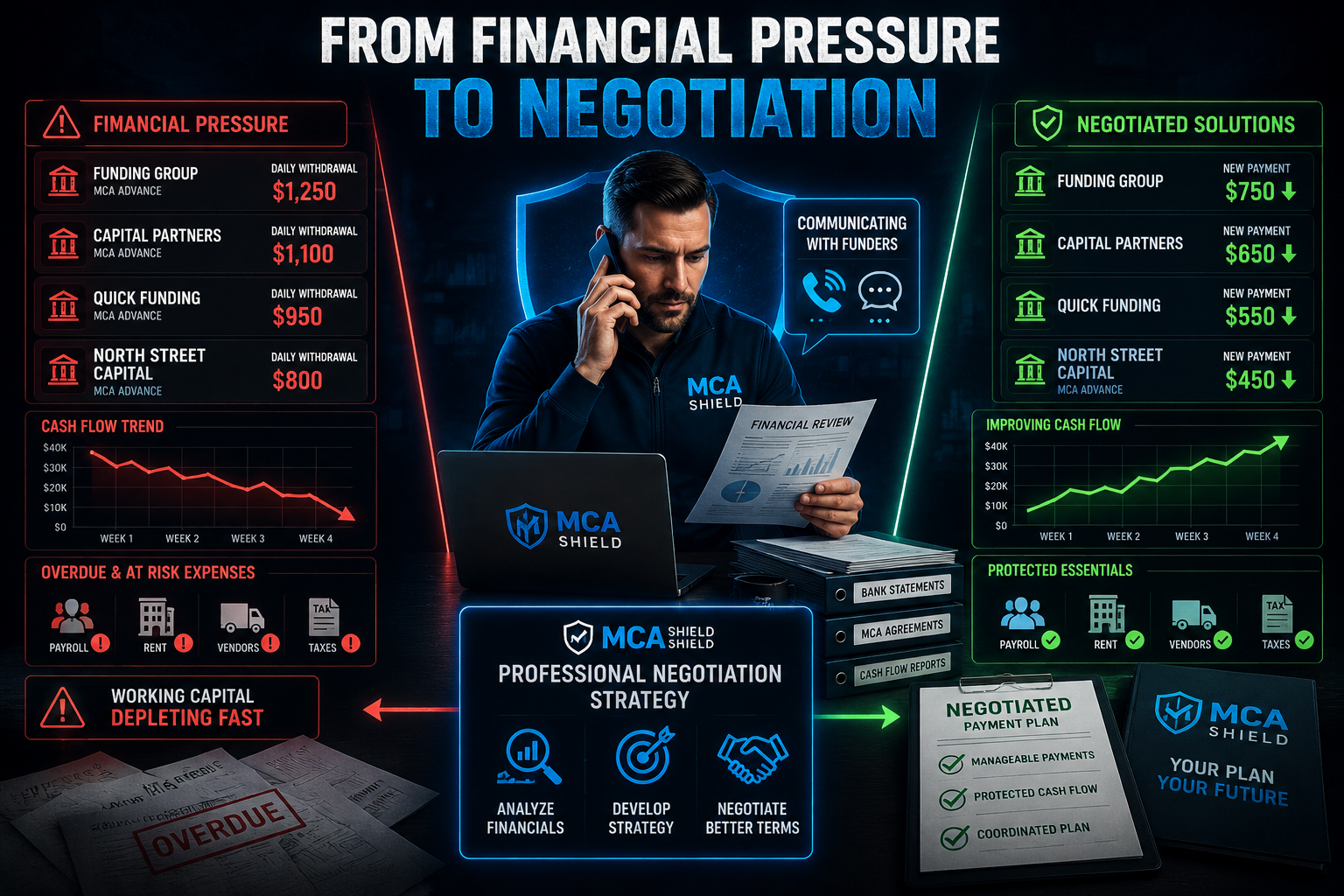
After reviewing the agreements and building a strategy, professionals move into direct MCA debt negotiation with the funders. This stage requires clear communication, accurate financial information, and realistic expectations.
Professionals do not simply ask for lower payments. Instead, they explain the business’s financial position, identify the pressure created by the current repayment structure, and discuss possible alternatives.
The objective is to work toward payment terms or settlement options that the business has a realistic chance of maintaining.
Opening Communication With the MCA Funder
Professional negotiation usually begins by opening a clear line of communication with the MCA funder.
The negotiator may contact the funder to discuss the account, confirm the current balance, and explain that the business is experiencing financial pressure. Early communication can be especially important when daily or weekly MCA withdrawals are becoming difficult to maintain.
Professionals generally approach these conversations with a specific strategy rather than making promises too quickly.
They may discuss:
- Current payment difficulties
- Outstanding MCA balances
- Recent revenue changes
- Returned or missed payments
- Existing MCA obligations
- The business’s ability to continue under the current payment structure
Clear communication can also help prevent confusion between the business and the funder.
Instead of reacting to each collection call or withdrawal separately, professionals attempt to create a more organized negotiation process. This allows the conversation to focus on possible solutions rather than short-term payment promises.
Presenting the Business’s Financial Situation
MCA funders may want to understand why the business can no longer maintain its current payments.
Professionals therefore present the financial situation in a way that is clear, accurate, and supported by real numbers.
This may include information about:
- Business revenue
- Bank account activity
- Current MCA withdrawals
- Payroll obligations
- Rent and operating expenses
- Vendor payments
- Other MCA balances
- Available working capital
For example, a business may still generate strong sales but have several MCA withdrawals hitting its bank account each day. Those payments can leave too little cash for payroll, inventory, taxes, and other essential expenses.
Professionals use financial information to explain why the current repayment structure may no longer be sustainable.
This is an important part of professional MCA negotiation because funders need a realistic picture of what the business can afford. A proposed solution is more credible when it is based on documented cash flow instead of an arbitrary payment request.
Negotiating Payment Terms or Potential Settlement Options
Once the financial situation has been presented, the negotiator can begin discussing possible ways to resolve the MCA debt.
Depending on the circumstances and the funder, negotiations may focus on reduced payments, modified payment schedules, temporary payment changes, or a potential settlement.
Possible negotiation goals may include:
- Lower daily or weekly payments
- A longer repayment period
- A different payment schedule
- Reduced pressure on business cash flow
- A structured settlement arrangement
- A potential lump-sum settlement
Not every funder will agree to every option, and MCA settlements are never guaranteed. The outcome depends on the agreement, the account status, the business’s finances, and the funder’s willingness to negotiate.
Professionals also evaluate any proposed agreement before recommending that the business accept it.
A payment reduction only helps if the new amount is actually sustainable. Likewise, a settlement may not make sense if the business cannot realistically fund the required payments.
The purpose of MCA debt negotiation is not simply to obtain different terms. It is to pursue an arrangement that addresses the MCA obligation while giving the business enough room to continue operating.
When negotiations are based on accurate financial information and realistic payment goals, the business has a clearer path toward more manageable obligations and stronger working capital.
What Professionals Try to Negotiate in MCA Debt
The goal of MCA debt negotiation is to find a repayment structure that better fits the business’s current financial condition. Professionals look at the full picture before deciding which terms to pursue.
Depending on the funder and the situation, negotiations may focus on lower payments, modified repayment terms, or a potential MCA settlement. The right approach depends on the outstanding balance, payment history, cash flow, and the business’s ability to fund a new arrangement.
Professionals also consider whether the proposed terms leave enough cash available for essential business expenses.
Lower or More Manageable Payments
One of the most common goals in MCA debt negotiation is reducing the amount leaving the business each day or week.
High ACH withdrawals can place heavy pressure on working capital. Even a business with steady revenue may struggle when too much cash is removed before payroll, rent, inventory, and other expenses are paid.
Professionals may try to negotiate:
- Lower daily or weekly withdrawals
- Reduced payment amounts
- A payment level based on current business revenue
- A structure that leaves more operating cash available
- More predictable payment obligations
The key is determining what the business can realistically afford.
A lower payment is only helpful if it gives the business enough room to cover payroll, rent, inventory, taxes, utilities, vendors, and other essential expenses.
Professionals use cash-flow information to support the request and explain why the existing payment amount may no longer be sustainable.
Modified Repayment Terms
In some cases, professionals may pursue broader changes to the repayment structure.
Modified MCA repayment terms can take several forms depending on the agreement and the funder’s willingness to negotiate. The goal is often to make the obligation easier to manage without creating another cash-flow crisis.
Possible changes may include:
- A longer repayment period
- Lower payment frequency
- Adjusted withdrawal amounts
- A revised payment schedule
- Temporary changes based on financial hardship
- A structured repayment arrangement
For example, reducing the size of each payment while extending the repayment period may help preserve working capital. In other situations, changing the timing of payments may provide additional flexibility.
Professionals evaluate any proposed modification carefully. They look beyond the immediate payment reduction and consider the total cost, duration, and effect on future cash flow.
The objective is to avoid replacing one difficult payment structure with another.
Potential MCA Settlement Agreements
A potential MCA settlement may also be part of the negotiation strategy.
In a settlement, the parties may agree to resolve the outstanding obligation under different terms than the original repayment structure. Depending on the circumstances, this could involve a negotiated lump-sum payment or a structured settlement plan.
Professionals may evaluate:
- The current outstanding balance
- Amount already repaid
- Available settlement funds
- Business cash flow
- Number of MCA obligations
- Account status
- Funder willingness to negotiate
- Whether a lump sum or structured arrangement is realistic
Settlement amounts and terms vary, and no specific reduction is guaranteed.
A professional negotiator should also review the proposed agreement before the business commits to it. Important details may include the payment schedule, settlement amount, deadlines, and what happens after the agreed payments are completed.
For businesses with multiple advances, settlement negotiations may also need to be coordinated across several funders.
The best outcome is not necessarily the largest reduction. A successful MCA debt negotiation strategy seeks terms the business can realistically complete while preserving enough cash to continue operating.
By focusing on manageable payments, practical repayment terms, and realistic settlement options, professionals can pursue a resolution designed around the business’s actual financial condition.
Why Professional MCA Negotiation Can Be More Effective Than Going It Alone
Business owners can try to negotiate directly with MCA funders. However, professional MCA debt negotiation may offer important advantages when the situation is complex, time-sensitive, or involves multiple advances.
Professionals understand how to organize financial information, communicate with funders, and evaluate proposed repayment terms. They can also help the business avoid making decisions that create even more pressure on cash flow.
The goal is not simply to reach an agreement. It is to pursue a realistic resolution that the business can actually maintain.
Experience Communicating With MCA Funders
Negotiating with an MCA funder can be difficult, especially when payments are already becoming unmanageable.
Professionals who regularly handle MCA debt negotiation understand how these conversations typically work. They know what financial information may be important, what questions to ask, and how to present the business’s situation clearly.
This experience can help keep negotiations focused on the facts.
Professionals may communicate about:
- Outstanding MCA balances
- Current daily or weekly payments
- Business revenue and cash flow
- Financial hardship
- Missed or returned withdrawals
- Multiple MCA obligations
- Possible repayment modifications
- Potential settlement options
Business owners may feel pressure to accept the first offer presented by a funder. A professional can review the proposed terms and determine whether they fit the broader financial strategy.
Clear communication is especially important when the business needs to explain why the current MCA payment structure is no longer sustainable.
Avoiding Costly Negotiation Mistakes
MCA negotiations can become more difficult when decisions are made too quickly.
One common mistake is agreeing to a new payment amount without first calculating whether the business can afford it. Another is making payment promises simply to reduce immediate collection pressure.
Professionals can help businesses avoid mistakes such as:
- Agreeing to unaffordable payments
- Making unrealistic payment promises
- Negotiating without reviewing the MCA agreement
- Ignoring important deadlines or communications
- Failing to document proposed terms
- Accepting an agreement without reviewing the full repayment obligation
- Taking another MCA to cover existing payments
A short-term solution may not help if it creates another cash-flow problem a few weeks later.
Professionals evaluate proposed terms against the business’s revenue, operating expenses, available cash, and other obligations. This helps determine whether an agreement is realistic before the business commits to it.
Careful planning can also reduce the risk of solving one MCA problem while creating another.
Coordinating Negotiations With Multiple MCA Funders
Professional assistance can become even more valuable when a business has multiple MCA funders.
Several daily or weekly withdrawals can place tremendous pressure on working capital. Negotiating each MCA separately without considering the others may lead to conflicting payment commitments.
For example, a business might negotiate a manageable payment with one funder. However, that payment could still be unaffordable when two other MCA withdrawals are included.
Professionals look at the entire debt structure before deciding how to approach each funder.
A coordinated strategy may consider:
- Which MCA creates the greatest cash-flow pressure
- Which accounts are current or in default
- Total daily or weekly withdrawals
- Outstanding balances with each funder
- Collection activity
- Available working capital
- How one proposed agreement affects the others
This broader view can help the business avoid committing too much cash to one obligation.
When several advances exist, coordinated MCA debt negotiation can create a more organized approach. Instead of reacting to each funder separately, the business can work from one financial strategy designed around its total obligations.
Professional negotiation does not guarantee a specific outcome. However, experience, preparation, and coordination can help a business approach MCA funders with clearer goals and a better understanding of what it can realistically afford.
Take Control of MCA Debt With a Professional Negotiation Strategy
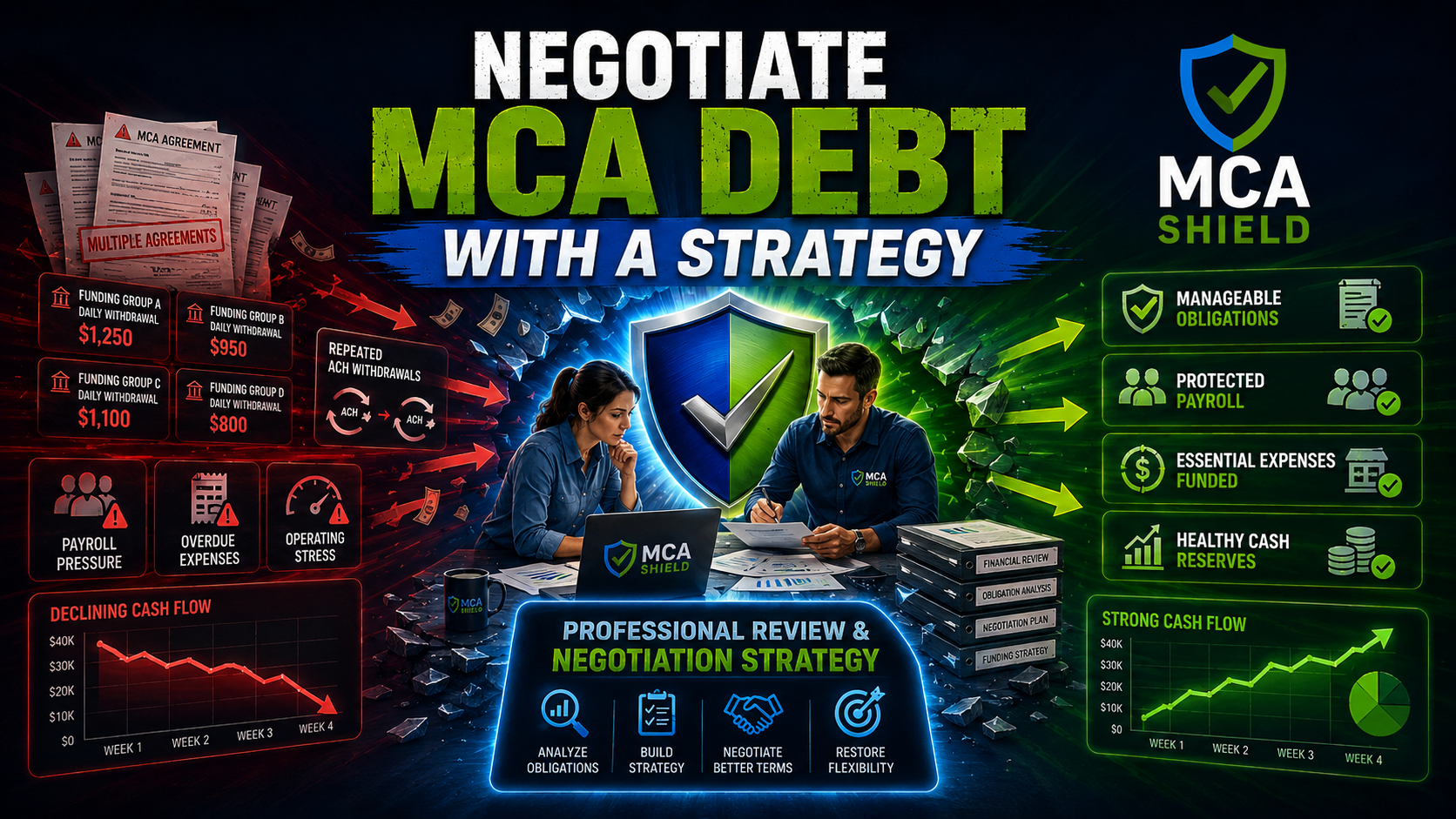
When MCA payments begin consuming too much working capital, waiting can make the situation harder to manage. A professional MCA debt negotiation strategy can help you understand your obligations, evaluate your options, and determine what type of resolution may be realistic.
The earlier you review the problem, the more time you may have to develop a strategy before missed payments, collection pressure, or additional MCA debt complicates the situation.
Taking action starts with understanding exactly where your business stands.
Why Acting Early May Give Your Business More Options
Business owners often wait until MCA payments become overwhelming before seeking help. However, acting early may give your business more options.
If your daily or weekly withdrawals are already making it difficult to cover payroll, inventory, rent, taxes, or other expenses, that is a sign the current payment structure may be placing too much pressure on cash flow.
Early action may provide more time to:
- Review MCA agreements before a serious default
- Evaluate current balances and withdrawals
- Identify cash-flow problems
- Organize financial records
- Develop realistic negotiation goals
- Communicate with MCA funders
- Coordinate multiple MCA obligations
- Avoid taking another advance simply to cover existing payments
Waiting can reduce flexibility.
For example, missed payments may lead to increased collection activity or other actions allowed under the MCA agreement. Meanwhile, taking another MCA to create temporary breathing room can add another withdrawal and make the underlying problem worse.
A professional review can help you evaluate the situation before financial pressure limits your choices.
What to Expect From an MCA Debt Review
An MCA debt review gives professionals the information they need to understand your current obligations and develop a possible negotiation strategy.
The process typically starts by reviewing your existing merchant cash advances and your business finances.
You may be asked to provide information such as:
- MCA agreements
- Current outstanding balances
- Daily or weekly payment amounts
- Bank statements
- Payment history
- Business revenue
- Operating expenses
- Payroll obligations
- Other active MCA accounts
- Collection or default notices
Professionals can then compare the amount leaving your bank account with the money your business needs to continue operating.
This can reveal how much of your working capital is being consumed by MCA payments and whether the current structure appears sustainable.
If you have multiple MCA obligations, the review becomes even more important. Each advance should be considered as part of the overall financial picture.
The objective is to identify a realistic strategy based on your actual cash flow, outstanding debt, and essential operating expenses.
From there, professionals can evaluate whether negotiations may focus on lower payments, modified repayment terms, settlement possibilities, or another potential resolution.
Schedule a Free Consultation With MCA Shield
If MCA payments are putting pressure on your business, you do not have to wait until the situation becomes unmanageable.
MCA Shield can review your merchant cash advance obligations, evaluate your financial situation, and help you understand potential negotiation options. The goal is to develop a strategy based on what your business can realistically afford while protecting the cash needed for essential operations.
Whether you are dealing with one MCA or several funders, getting a clear picture of the problem is an important first step.
Schedule a free consultation with MCA Shield today to review your MCA debt, discuss your available options, and determine whether a professional negotiation strategy may help your business move toward a more manageable financial position.