
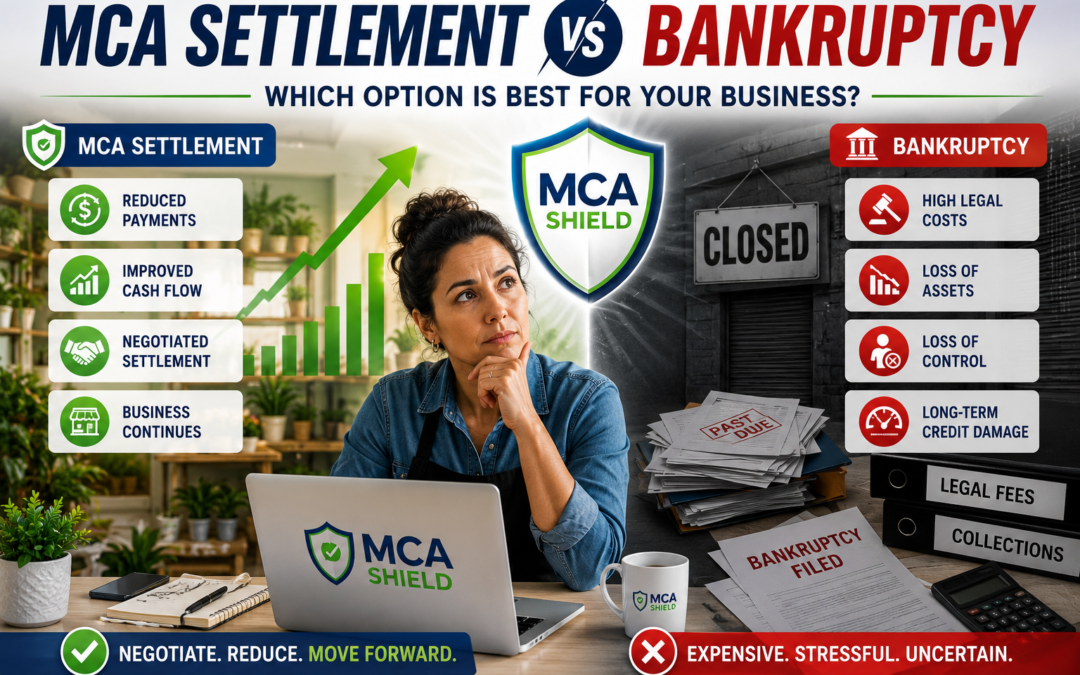
When merchant cash advance (MCA) payments become difficult to manage, business owners may begin searching for ways to regain control of their finances. Two options that may come up are MCA settlement and bankruptcy, but they work very differently and can have very different consequences.
Understanding MCA settlement vs. bankruptcy can help you evaluate your options before financial pressure grows. MCA settlement may provide an opportunity to negotiate existing MCA obligations and improve cash flow. In contrast, bankruptcy is a formal legal process that can affect multiple debts and have broader financial consequences for the business.
This guide compares MCA settlement and bankruptcy, including how each works, the potential impact on your business, and factors to consider when deciding what steps to take next.
Schedule Your Free Consultation
MCA Settlement vs. Bankruptcy: What’s the Difference?
When MCA payments create serious financial pressure, business owners may consider several ways to address the problem. MCA settlement and bankruptcy are two very different approaches. Understanding those differences can help you determine which options deserve further consideration.
In general, MCA settlement focuses on negotiating merchant cash advance obligations directly with funders. Bankruptcy, on the other hand, is a formal legal proceeding that may address a broader range of business debts.
How MCA Settlement Works
MCA settlement involves working toward a negotiated resolution with an MCA funder. Depending on the agreement, financial circumstances, and the funder’s willingness to negotiate, the process may involve changes to the payment arrangement or the amount required to resolve the obligation.
The process often begins with a review of the business’s MCA agreements, outstanding obligations, cash flow, and financial hardship. This information can help determine which settlement strategy may be realistic.
A successful MCA settlement may help a business:
- Reduce payment pressure
- Improve available operating cash flow
- Address one or multiple MCA obligations
- Work toward a more manageable financial structure
However, settlement results are not guaranteed. Each MCA funder, agreement, and financial situation is different.
How Business Bankruptcy Works
Business bankruptcy is a formal legal process handled through federal bankruptcy court. Depending on the type of business, its debts, assets, and financial circumstances, different bankruptcy chapters may be available.
For example, some businesses may use bankruptcy to reorganize qualifying debts and continue operating. In other situations, bankruptcy may involve liquidation and the closure of the business.
Bankruptcy can affect more than MCA obligations. It may also involve other creditors, business assets, contracts, secured debts, and additional financial obligations.
Because bankruptcy involves complex legal and financial issues, a business considering this option should speak with a qualified bankruptcy attorney about its specific circumstances.
Key Differences for Business Owners
The biggest difference in MCA settlement vs. bankruptcy is how each option addresses financial problems.
MCA settlement is generally a negotiated process focused on resolving MCA obligations. It does not require filing a bankruptcy case to pursue settlement negotiations. This may make settlement worth exploring when MCA payments are a major source of cash flow pressure and the business remains viable.
Bankruptcy is a court-supervised legal process that can address a much broader financial scope. It may offer legal protections and restructuring options that are not available through private MCA negotiations. However, bankruptcy can also involve significant legal, operational, and long-term financial consequences.
For a business struggling primarily due to merchant cash advances, exploring MCA settlement before financial pressure becomes severe may reveal additional options. If the business has substantial debts beyond its MCAs, consulting a bankruptcy attorney can help determine whether bankruptcy should be considered.
How MCA Settlement May Help a Business Avoid Bankruptcy

For some businesses, overwhelming MCA payments can create a cash flow problem that becomes difficult over time. MCA settlement may offer an alternative to bankruptcy when merchant cash advances are a major source of financial strain. By addressing these obligations early, a business may have more opportunities to stabilize its finances and continue operating.
Settlement is not guaranteed to prevent bankruptcy. However, reducing the burden created by MCA payments may help a viable business regain greater control over its cash flow before the situation becomes severe.
Addressing MCA Debt Before Financial Pressure Grows
Waiting until a business can no longer meet its obligations may limit the options available. Daily or weekly MCA withdrawals can steadily reduce working capital, making it harder to cover payroll, rent, inventory, taxes, utilities, and vendor expenses.
Addressing MCA debt earlier allows the business to evaluate its agreements and financial position before cash reserves become critically low. A settlement strategy may include reviewing MCA balances, documenting financial hardship, prioritizing obligations, and communicating with funders about potential resolutions.
Early action can be especially important when a business is still generating revenue, but MCA withdrawals are consuming too much of the available cash.
Reducing Payment Pressure and Improving Cash Flow
One of the primary goals of MCA settlement is to create a financial arrangement that better reflects what the business can realistically manage.
Depending on the funder and circumstances, negotiations may result in modified payment terms or another negotiated resolution. A lower payment burden can free up more money available for essential operating expenses.
Improved cash flow may help the business:
- Meet payroll and operating expenses
- Maintain important vendor relationships
- Purchase necessary inventory or supplies
- Avoid taking another MCA to cover existing payments
- Build greater financial stability
When less revenue is being diverted to MCA payments, more working capital may remain available to support day-to-day operations.
Keeping the Business Operating
Bankruptcy is not always the first or only option for a business experiencing MCA-related financial pressure. If the underlying business remains viable, addressing merchant cash advances may help remove one of the biggest obstacles affecting its finances.
MCA settlement can focus directly on the obligations that cause payment pressure without requiring the business to pursue bankruptcy solely because its MCA payments have become difficult to maintain.
The goal is not simply to lower a payment. It is to help create a financial structure that gives the business a better opportunity to cover essential expenses, maintain operations, and work toward long-term stability.
For business owners struggling with merchant cash advances, exploring settlement options early may help determine whether MCA debt can be addressed before bankruptcy becomes a more serious consideration.
What Happens to MCA Debt in Bankruptcy?
What happens to merchant cash advance debt in bankruptcy depends on several factors. These include the MCA agreement, the business structure, the nature of the obligation, and the type of bankruptcy filed. Unlike MCA settlement, bankruptcy places qualifying financial matters within a formal federal court process.
Because MCA agreements can differ significantly, business owners should avoid assuming that every merchant cash advance will receive the same treatment in bankruptcy.
How MCA Obligations May Be Treated
When a business files for bankruptcy, its MCA obligations must be evaluated along with its other debts and financial commitments. The treatment of an MCA can depend on how the transaction is structured and how the obligation is characterized under applicable law.
Bankruptcy may affect collection activity and repayment obligations. In many cases, filing a bankruptcy petition also triggers an automatic stay, which generally restricts creditors from continuing certain collection efforts. However, the scope and application of the stay can depend on the circumstances.
The eventual treatment of an MCA may also depend on factors such as security interests, guarantees, liens, claims filed by the funder, and the terms of the underlying agreement.
Why the MCA Agreement and Bankruptcy Chapter Matter
There is no single outcome for MCA debt in bankruptcy. The specific agreement and bankruptcy chapter can significantly influence what happens next.
For example, Chapter 7 generally involves liquidation of eligible business assets. Chapter 11 may allow a qualifying business to reorganize its debts and continue operating. Certain eligible small businesses may also use the streamlined Subchapter V process under Chapter 11.
The MCA agreement itself can also affect how a funder’s claim is handled. Important details may include personal guarantees, collateral provisions, security interests, reconciliation terms, and other contractual provisions.
This is why a business should evaluate its overall financial position instead of focusing primarily on its MCA balance.
When Legal Guidance May Be Necessary
Bankruptcy is a legal proceeding with consequences that can extend beyond MCA debt. It may affect business assets, creditor rights, contracts, ownership interests, personal guarantees, and future financial decisions.
If bankruptcy is being considered, speaking with a qualified bankruptcy attorney is an important step. An attorney can review the MCA agreements, explain which bankruptcy chapters may be available, and advise the business about how filing could affect its specific obligations.
MCA settlement professionals can help businesses explore negotiated solutions for merchant cash advances, but they should not replace legal counsel when bankruptcy advice is needed. Understanding both paths can help a business owner make a more informed decision before choosing how to address serious MCA payment pressure.
MCA Settlement vs. Bankruptcy: Comparing the Impact on Your Business
Choosing between MCA settlement and bankruptcy can affect more than the amount a business pays on its merchant cash advances. Business owners should also consider the potential costs, day-to-day operations, control of the company, and long-term financial effects.
Understanding these differences can help determine which option may better address the business’s financial challenges.
Cost and Financial Impact
The cost of MCA settlement vs. bankruptcy can vary considerably. With MCA settlement, the financial impact depends on factors such as outstanding obligations, number of funders, financial hardship, and negotiated terms.
A successful settlement may reduce payment pressure and improve business cash flow. This can help redirect working capital toward payroll, rent, inventory, taxes, vendors, and other essential expenses.
Bankruptcy involves a formal legal process and may include court costs, attorney fees, administrative expenses, and other professional fees. The financial outcome depends heavily on the bankruptcy chapter, business assets, debts, and circumstances surrounding the case.
For this reason, business owners should compare the potential cost and financial consequences of each option before deciding how to proceed.
Business Operations and Control
For a viable business, maintaining normal operations can be a major priority. MCA settlement generally focuses on negotiating existing merchant cash advance obligations without placing the business into a bankruptcy proceeding.
If negotiations are successful, reduced payment pressure may make it easier to maintain inventory, compensate employees, pay vendors, and handle other operating costs.
Bankruptcy can create different requirements. Depending on the chapter and circumstances, the business may face court oversight, reporting requirements, creditor involvement, or restrictions on certain financial decisions. Some businesses continue operating during bankruptcy, whereas others may ultimately close or liquidate assets.
The potential effect on operations makes it important to consider how much control the business needs to maintain during the financial recovery process.
Credit and Long-Term Financial Consequences
Both MCA settlement and bankruptcy can have financial consequences. However, the nature and extent of those consequences can differ significantly.
MCA settlement may affect relationships with funders and could influence the business’s ability to obtain financing in the future. The specific impact can vary based on how the account is resolved and how information is reported.
Bankruptcy generally creates a public court record and can have broader effects on future borrowing, financing opportunities, business relationships, and financial planning. The duration and severity of those effects depend on the type of bankruptcy and the business’s circumstances.
When comparing MCA settlement vs. bankruptcy, business owners should consider both immediate payment relief and the longer-term impact. The right approach should address today’s financial pressure while supporting the business’s ability to recover, operate, and build greater financial stability moving forward.
When MCA Settlement May Be the Better Option
MCA settlement may be worth considering when merchant cash advance payments are a primary source of financial pressure, but the underlying business remains viable. Instead of immediately heading into bankruptcy, a business may be able to negotiate its MCA obligations and develop a more sustainable payment structure.
The best approach depends on the business’s finances, MCA agreements, other debts, and ability to continue operating. However, several signs may indicate that exploring MCA settlement before bankruptcy makes sense.
The Business Is Still Operating
A business that continues to generate revenue may have more opportunities to navigate its MCA obligations through negotiation. The company may still have customers, employees, inventory, equipment, and other resources necessary to maintain operations.
The problem may not be the business model itself. Instead, daily or weekly MCA withdrawals may be consuming too much working capital and making expenses increasingly difficult to cover.
If the business remains viable, MCA settlement may help address the payment burden without immediately entering a formal bankruptcy proceeding. The goal is to stabilize cash flow and give the business greater financial flexibility to continue operating.
MCA Payments Are Creating Cash Flow Problems
Merchant cash advances can become difficult to manage when withdrawals take a substantial portion of incoming revenue. As working capital shrinks, the business may struggle to cover payroll, rent, taxes, inventory, utilities, and vendor payments.
Warning signs can include:
- MCA withdrawals consuming an increasing share of revenue
- Essential operating expenses becoming harder to pay
- Falling behind on vendor or tax obligations
- Using savings or reserves to cover MCA payments
- Considering another MCA to meet existing obligations
When MCA payments are driving the cash flow pressure, settlement may target the source of the problem. Negotiating the existing obligations may help reduce payment pressure and preserve more working capital for business operations.
There Is Still an Opportunity to Negotiate
Timing can make an important difference. A business does not necessarily need to wait until its financial condition becomes critical before exploring MCA settlement.
Acting earlier can create more time to review MCA agreements, document financial hardship, evaluate cash flow, and develop a coordinated negotiation strategy. If multiple MCAs are active, the business can also examine how the obligations interact instead of addressing each payment separately.
Funders are not required to accept a settlement, and results vary. Still, opening negotiations before financial pressure becomes overwhelming may give the business more room to pursue a workable resolution.
For a company that remains operational but is struggling under merchant cash advance payments, MCA settlement may offer a path to address the debt before bankruptcy becomes necessary.
When Bankruptcy May Need to Be Considered
MCA settlement can address merchant cash advance obligations, but it may not solve every financial problem affecting a business. If the company is struggling with substantial debt beyond its MCAs, bankruptcy may be an option to discuss with a qualified attorney.
The decision should consider the business’s overall debt, assets, revenue, operating expenses, creditor activity, and ability to remain financially viable.
MCA Debt Is Only Part of the Financial Problem
For some businesses, merchant cash advances represent only one portion of a much larger debt burden. The company may also owe money for business loans, credit cards, taxes, equipment financing, leases, vendors, judgments, or other obligations.
In this situation, settling the MCAs may reduce one source of payment pressure without resolving the broader financial strain.
Bankruptcy can address multiple types of qualifying debt through a formal legal process. Depending on the bankruptcy chapter and circumstances, this may include restructuring certain obligations or liquidating assets to satisfy creditors.
If MCA debt is just one part of a larger financial problem, the business should evaluate whether settlement alone can create enough relief to restore stability.
The Business Has Significant Unmanageable Debt
Bankruptcy may deserve consideration when the business has more debt than it can realistically manage through normal operations or individual creditor negotiations.
Warning signs may include persistent cash shortages, multiple delinquent accounts, lawsuits or judgments, growing tax obligations, and an inability to meet essential operating expenses.
At this stage, simply reducing MCA payments may not be enough. The business may need a strategy that addresses multiple creditors and different categories of debt together.
Bankruptcy can offer a structured process for addressing qualifying obligations. However, the outcome depends on the type of filing, the company’s finances, and applicable bankruptcy law.
Why You Should Speak With a Bankruptcy Attorney
Bankruptcy can have significant legal and financial consequences. Before filing, business owners should understand which debts may be affected, what happens to business assets, whether personal guarantees are involved, and how the filing could affect future operations.
A qualified bankruptcy attorney can evaluate the business’s circumstances and explain the options available under federal bankruptcy law. Legal counsel can also help determine whether bankruptcy is appropriate or whether alternatives should be explored first.
MCA Shield can help businesses evaluate merchant cash advance settlement options, but bankruptcy questions require legal guidance. If bankruptcy is a serious possibility, consulting an attorney can help you compare your options and make a more informed decision about your business’s future.
Can You Settle Multiple MCAs Instead of Filing Bankruptcy?
Having several merchant cash advances does not automatically mean a business must file for bankruptcy. If the company remains viable, settling multiple MCAs may be an option worth exploring before bankruptcy.
Multiple MCAs can create intense cash flow pressure because each funder may withdraw payments separately. A settlement strategy can evaluate the combined impact of those obligations and pursue resolutions designed around the business’s financial capacity.
Negotiating With Multiple MCA Funders
Settling multiple merchant cash advances can be more complicated than addressing a single agreement. Each MCA may have a different balance, payment schedule, contract terms, funder, and account status.
Rather than treating each MCA as an isolated obligation, the business should examine how all withdrawals affect its working capital. Negotiations can then focus on finding potential resolutions with each funder.
This process may involve documenting financial hardship, communicating with funders, reviewing proposed settlement terms, and determining which obligations require the most immediate attention.
Funders are not required to accept settlement proposals. However, successful negotiations may help reduce the combined payment pressure created by multiple MCAs.
Creating a Coordinated Settlement Strategy
When several MCAs are active, resolving one agreement without considering the others may not significantly improve the business’s finances. A reduced payment to one funder could have limited value if several other withdrawals continue consuming revenue.
A coordinated strategy considers the total MCA burden, available cash flow, essential operating expenses, and each funder’s position. From there, obligations can be prioritized, and negotiations pursued to improve the company’s overall financial position.
The objective is to create a more sustainable overall structure rather than simply moving financial pressure from one MCA to another.
For businesses with multiple advances, coordinated MCA settlement may provide a more comprehensive approach to restoring cash flow and maintaining operations.
Avoiding Additional MCA Stacking
When existing MCA payments become difficult to maintain, taking another merchant cash advance seems to offer quick relief. However, using new funding to cover existing obligations may create MCA stacking, adding another withdrawal to an already strained cash flow.
Each additional advance can increase the amount of revenue being diverted from payroll, rent, inventory, taxes, vendors, and other essential expenses. Over time, this can make the overall debt burden increasingly difficult to manage.
Instead of adding another MCA, businesses can explore ways to address their existing merchant cash advance obligations directly. Settlement may help break the cycle of relying on new advances to keep up with previous ones.
If multiple MCA payments are pushing a viable business toward bankruptcy, addressing the existing obligations through a coordinated settlement strategy may be worth exploring before taking on additional debt.
Frequently Asked Questions About MCA Settlement vs. Bankruptcy
Business owners comparing MCA settlement vs. bankruptcy often have questions about cost, eligibility, business operations, and the potential consequences of each option. The answers depend on the company’s finances, debt obligations, MCA agreements, and long-term outlook.
💡 Is MCA Settlement Better Than Bankruptcy?
Neither option is automatically better for every business. MCA settlement may make sense when merchant cash advances are a primary source of financial pressure and the underlying business remains viable.
Bankruptcy may deserve consideration when the company has substantial debts beyond its MCAs or cannot realistically meet its financial obligations. Because bankruptcy is a legal proceeding, businesses considering it should consult a qualified bankruptcy attorney.
🛡️ Can MCA Settlement Stop a Business From Filing Bankruptcy?
Potentially. A successful MCA settlement may reduce payment pressure and improve cash flow, which helps some businesses avoid reaching the point where bankruptcy becomes necessary.
However, settlement does not guarantee that bankruptcy can be avoided. The outcome depends on the company’s MCA obligations, other debts, revenue, expenses, and ability to maintain operations.
⚖️ Should I Settle MCA Debt Before Considering Bankruptcy?
If MCA payments are a major source of financial pressure, it may be worthwhile to explore settlement options before deciding to file for bankruptcy. Acting early can create more time to review agreements, evaluate finances, and determine whether negotiations could improve the company’s position.
If the business has significant debts beyond its merchant cash advances, it may also be appropriate to speak with a bankruptcy attorney before making a decision.
🤝 Can Multiple MCAs Be Settled Without Filing Bankruptcy?
Yes, it may be possible to negotiate settlements with multiple MCA funders without filing bankruptcy. Each funder and agreement must be evaluated separately. However, a coordinated strategy can account for the combined effect of multiple withdrawals.
Settlement terms are not guaranteed. Still, addressing several MCA obligations together may help a viable business pursue a more manageable overall payment structure.
📊 Does MCA Settlement Affect Business Credit?
It can. MCA settlement may have financial and credit-related consequences, depending on how the account is handled, how information is reported, and the business’s overall credit profile.
Before agreeing to settlement terms, business owners should understand the potential short- and long-term consequences.
📄 Does Filing Bankruptcy Automatically Eliminate MCA Debt?
Not necessarily. The treatment of MCA obligations in bankruptcy depends on several factors, including the agreement, nature of the claim, bankruptcy chapter, security interests, guarantees, and applicable law.
A bankruptcy attorney can review the specific MCA agreements and explain how the obligations may be treated in a particular case.
🏪 Can My Business Continue Operating During MCA Settlement?
In many cases, yes. MCA settlement focuses on negotiating existing merchant cash advance obligations rather than closing the business. Maintaining operations may also be important, as continued revenue can affect what type of settlement arrangement the company can realistically sustain.
If MCA withdrawals threaten the company’s ability to operate, exploring settlement sooner may create more opportunities to address the payment pressure before financial conditions deteriorate further.
Key Takeaway: 🛡️ If MCA payments are creating serious cash flow pressure but the business remains viable, exploring MCA settlement early may reveal options that could help address the problem before bankruptcy becomes necessary.
Explore MCA Settlement Options Before Financial Pressure Gets Worse
When merchant cash advance payments begin consuming too much working capital, waiting can make the problem harder to resolve. Exploring MCA settlement options early may give your business more time to evaluate its finances, communicate with funders, and pursue a workable resolution.
If your business remains viable but MCA payments are creating serious cash flow pressure, settlement may be worth exploring before bankruptcy becomes a more immediate concern.
Why Acting Early May Give Your Business More Options
Financial pressure can build quickly when daily or weekly MCA withdrawals compete with payroll, rent, inventory, taxes, utilities, and vendor expenses. As cash flow tightens, keeping up with every obligation can become increasingly difficult.
Acting early creates an opportunity to review MCA agreements, evaluate outstanding obligations, document financial hardship, and develop a settlement strategy before working capital becomes severely strained.
Early action may also help your business avoid relying on another merchant cash advance to cover existing payments. Instead of adding another obligation, you can focus on addressing the MCA debt already affecting your cash flow.
There is no guarantee that a funder will agree to modified terms. However, exploring settlement before financial pressure escalates can give your business more time to pursue potential solutions.
Schedule a Free Consultation With MCA Shield
If MCA payments are putting your business under financial pressure, you do not have to wait until bankruptcy looks like the only remaining option.
MCA Shield can review your merchant cash advance obligations and help you explore potential settlement strategies. The goal is to understand what is affecting your cash flow and determine whether negotiated resolutions may help create a more manageable financial structure.
During your consultation, you can discuss:
- 🛡️ Your current MCA agreements and obligations
- 💵 How MCA withdrawals are affecting cash flow
- 📋 Potential settlement strategies for one or multiple MCAs
- 📈 Steps toward a more sustainable payment structure
Schedule a free consultation with MCA Shield today to explore your MCA settlement options before financial pressure grows.