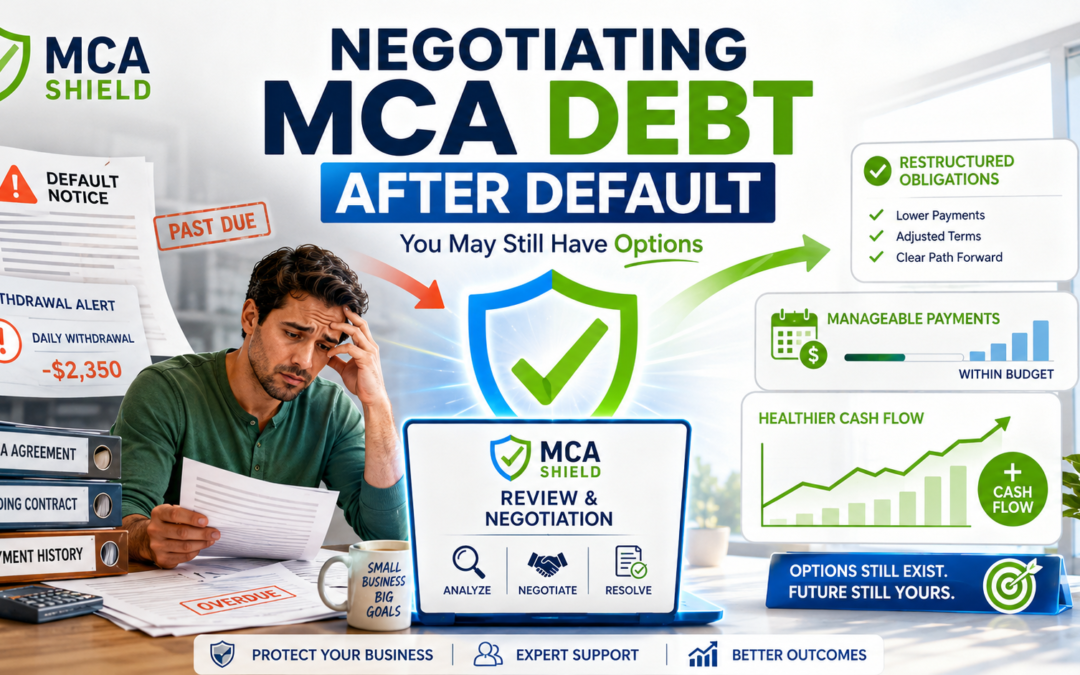
Defaulting on a merchant cash advance can create serious pressure on your business. Daily withdrawals, collection calls, overdue expenses, and shrinking cash flow can quickly make the situation feel unmanageable. However, negotiating MCA debt after default may give your business a chance to pursue more workable repayment terms.
In some cases, MCA funders may be willing to discuss reduced payments, adjusted repayment terms, or a negotiated settlement. The options available will depend on your agreement, outstanding balance, financial situation, and the funder’s willingness to negotiate.
The sooner you understand your options, the better prepared you may be to protect your cash flow and make informed decisions. This guide explains how MCA debt negotiation works after default, what funders may consider, and what steps your business can take toward a more manageable resolution.
Schedule Your Free Consultation
What Happens When You Default on a Merchant Cash Advance?
A merchant cash advance default can quickly increase financial pressure on a business. Depending on the MCA agreement, a default may occur after missed payments, blocked ACH withdrawals, insufficient funds, or another event defined in the contract.
Once a default occurs, the funder may begin collection efforts or take other steps allowed under the agreement. That is why businesses should understand their situation quickly. Negotiating MCA debt after default may still be possible, but waiting can make the situation more complicated.
How MCA Default Can Affect Your Business
An MCA default can affect much more than the outstanding balance. If your business is already struggling with cash flow, additional collection pressure can make it harder to cover payroll, rent, inventory, utilities, taxes, and other operating expenses.
You may also experience increased communication from the MCA funder or collection representatives. In some cases, additional fees or other contractual remedies may apply.
For businesses with several merchant cash advances, the pressure can become even greater. Multiple MCA defaults can create competing demands on the same limited cash flow, making a coordinated resolution strategy especially important.
What MCA Funders May Do After Default
What happens after default depends on the MCA agreement, the funder, and the circumstances surrounding the account. A funder may attempt to collect the outstanding obligation, contact the business more frequently, demand payment, or pursue remedies provided in the contract.
Some MCA funders may also refer the account to a collection company or pursue legal action. These possibilities make it important to review notices carefully and avoid ignoring communications.
At the same time, collection activity does not necessarily prevent negotiation. Depending on the circumstances, MCA debt negotiation after default may involve discussing payment terms, settlement possibilities, or another repayment arrangement.
Why Default Does Not Always Mean You Are Out of Options
Default is serious, but it does not automatically mean your business has reached the end of the road. Some MCA funders may prefer a negotiated resolution when the original repayment structure is no longer sustainable.
The available options will depend on factors such as your outstanding balance, business revenue, cash flow, number of MCA obligations, and the funder’s willingness to negotiate.
Acting early can also help your business better understand its financial position before pressure increases. If the current repayment structure is no longer workable, negotiating MCA debt after default may provide an opportunity to pursue a more manageable resolution and protect essential operating cash flow.
Can You Negotiate MCA Debt After Default?
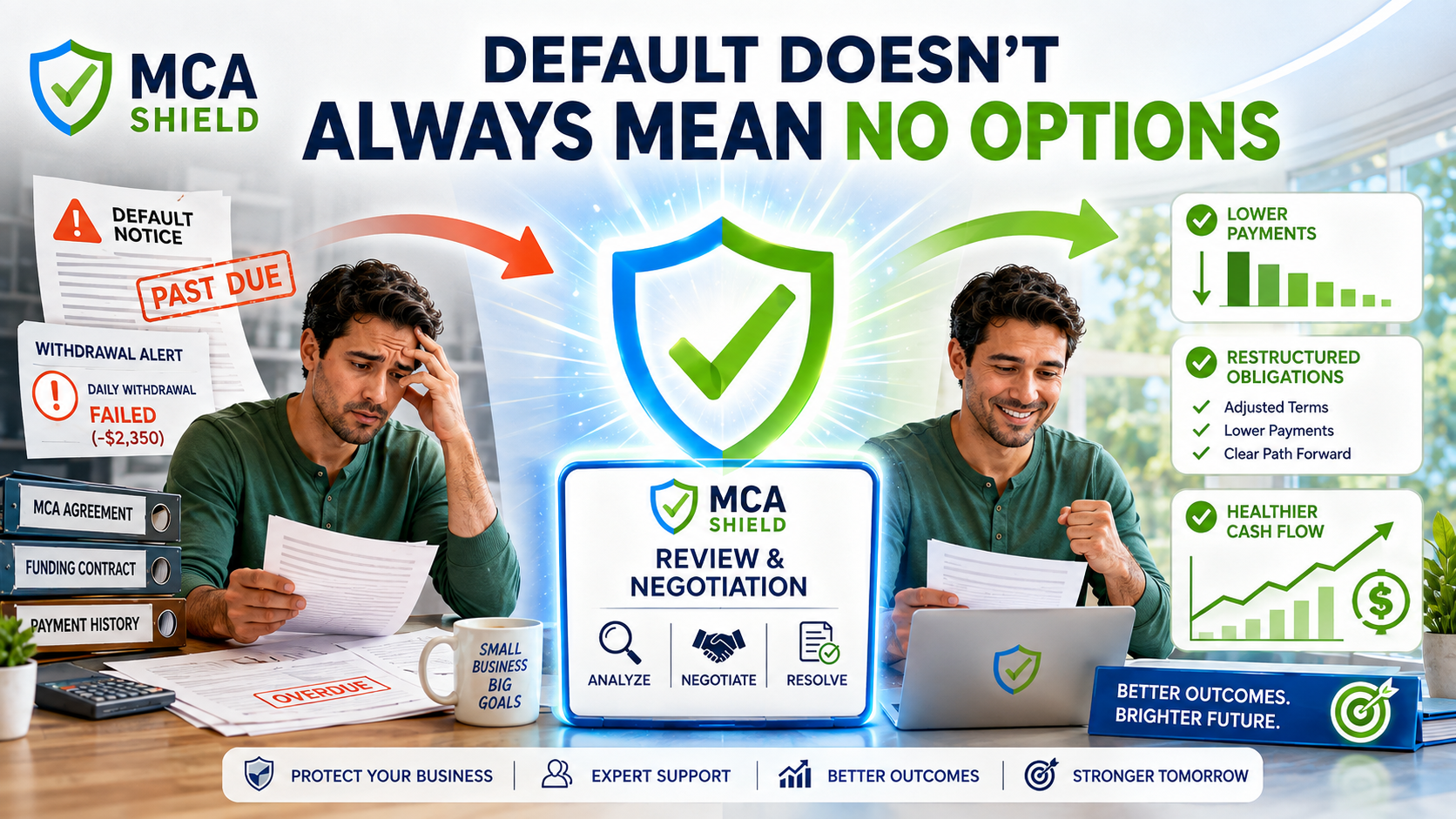
Yes, negotiating MCA debt after default may still be possible. A default can make the situation more urgent, but it does not always eliminate the possibility of reaching a new arrangement with the funder.
The outcome will depend on the MCA agreement, the amount owed, the condition of the business, and the funder’s willingness to negotiate. In many cases, the goal is to find a resolution that is more realistic than continuing under an unaffordable payment structure.
Why MCA Funders May Be Willing to Negotiate
An MCA funder may be willing to negotiate when it becomes clear that the current repayment structure is no longer sustainable. If the business cannot continue making the required withdrawals, a negotiated arrangement may offer the funder a more practical path toward repayment.
Funders may also consider factors such as current revenue, payment history, financial hardship, remaining balance, and the likelihood of future repayment.
For the business, this can create an opportunity to discuss terms that better reflect current cash flow. A negotiated resolution may be preferable to continued missed payments, collection pressure, or prolonged disputes.
What Parts of an MCA Agreement May Be Negotiated
The exact terms that may be negotiated will vary from one situation to another. Depending on the funder and the agreement, discussions may involve payment amounts, payment frequency, repayment timing, outstanding balances, or settlement terms.
Some businesses may seek lower daily or weekly withdrawals. Others may pursue a longer repayment period or a negotiated settlement of the remaining obligation.
There is no guarantee that a funder will agree to every request. However, a well-prepared negotiation can focus on terms that the business can realistically maintain while still working toward a resolution.
How Your Business Finances Can Affect Negotiations
Your current financial condition can play a major role in MCA negotiations. Funders may want to understand whether the business can support a modified payment arrangement.
Important factors may include monthly revenue, operating expenses, payroll, existing debt, available cash, and the number of active MCA obligations.
Accurate financial information can also make negotiations more productive. It helps show what the business can reasonably afford instead of relying on estimates or promises that may not be sustainable.
When negotiating MCA debt after default, the strongest strategy is usually one based on realistic numbers. A payment arrangement only helps if the business can maintain it while continuing to cover essential operating expenses.
How Does MCA Debt Negotiation Work After Default?
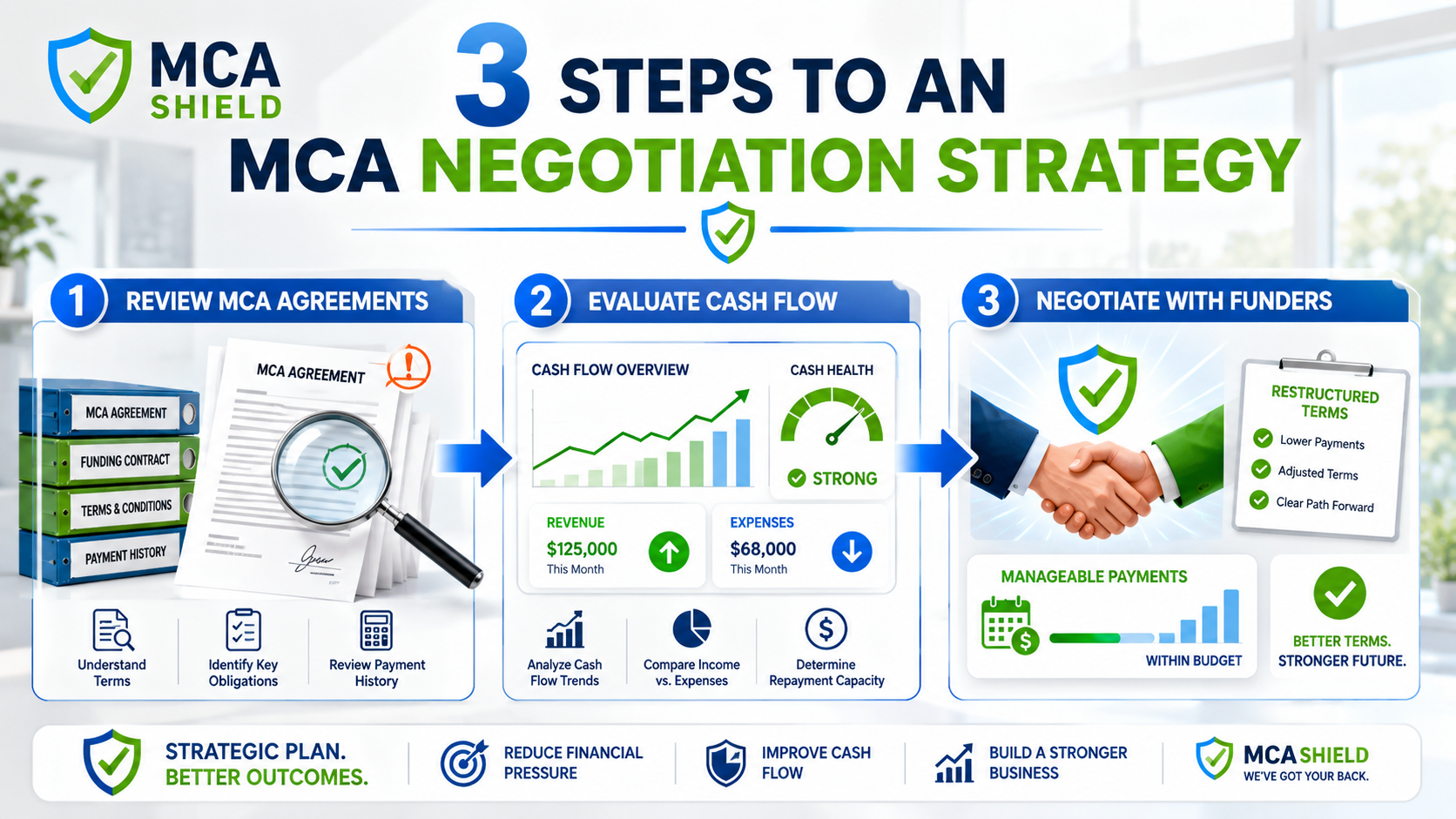
The process of negotiating MCA debt after default usually starts with understanding exactly what your business owes and what it can realistically afford. A strong negotiation strategy should be based on your MCA agreements, current balances, cash flow, and operating needs.
The goal is not simply to ask for lower payments. It is to develop a realistic proposal that addresses the debt while giving the business enough room to continue operating.
Review Your MCA Agreements and Current Balance
Start by reviewing each MCA agreement carefully. Identify the remaining balance, payment schedule, withdrawal amount, fees, default provisions, and any collection or legal notices you have received.
If your business has more than one merchant cash advance, organize each obligation separately. This helps create a clear picture of the total financial pressure on the business.
Knowing exactly what you owe is an important first step. It also helps prevent confusion when discussing possible repayment changes or settlement terms with MCA funders.
Evaluate Your Business Cash Flow
Next, determine what your business can actually afford. Review monthly revenue, payroll, rent, inventory, taxes, utilities, existing debt payments, and other essential operating expenses.
This step is critical because an agreement that looks manageable on paper may still put too much pressure on working capital.
A realistic cash-flow review can help identify how much money is available for MCA payments without putting essential business expenses at risk. Sustainable payment terms should reflect the business’s current financial condition, not what it earned months ago.
Develop a Negotiation Strategy With MCA Funders
Once you understand the debt and your available cash flow, you can develop a negotiation strategy. Depending on the circumstances, this may involve requesting lower payments, a different payment schedule, modified repayment terms, or a negotiated settlement.
Businesses with multiple MCAs may need a coordinated approach so that one agreement does not consume the cash needed to resolve another.
When negotiating MCA debt after default, preparation can make a major difference. A clear financial picture and a realistic proposal can help create more productive discussions with funders and increase the chances of reaching a payment structure your business can maintain.
Can Negotiating MCA Debt Reduce Your Payments?
In some cases, negotiating MCA debt after default may help reduce the payment pressure on your business. The exact outcome depends on the funder, your agreement, the balance owed, and your current financial situation.
A successful negotiation may focus on lowering daily or weekly withdrawals, changing the payment schedule, or creating a repayment structure that better matches your available cash flow. The goal is to make the obligation more manageable without placing unnecessary strain on business operations.
Reducing Daily or Weekly Withdrawal Pressure
Daily or weekly MCA withdrawals can quickly drain working capital, especially after revenue declines. When too much cash leaves the business each day, it can become harder to cover payroll, rent, inventory, utilities, taxes, and other essential expenses.
Negotiations may include a request to reduce the amount withdrawn or change how often payments are collected. Even a temporary reduction in payment pressure may give the business more room to operate.
However, lower withdrawals are not automatic. Any reduction will depend on the funder’s willingness to negotiate and the financial facts supporting the request.
Negotiating a More Manageable Repayment Structure
A more manageable repayment structure may involve more than simply lowering one payment. Depending on the situation, negotiations could address payment amount, payment frequency, repayment length, or settlement terms.
For example, a business making large daily withdrawals may seek smaller weekly payments instead. Another business may need a longer repayment period to reduce the burden on cash flow.
The most effective arrangement is usually one the business can realistically maintain. Agreeing to payments that are still too high may only lead to another default and additional financial pressure.
How Better Payment Terms Can Improve Business Cash Flow
Cash flow is essential to keeping a business operating. When MCA payments consume too much revenue, the business may struggle to fund the expenses needed to generate future sales.
More manageable payment terms may allow the business to keep additional cash available for employees, inventory, equipment, marketing, rent, and other operating costs. This can help create greater financial stability while the MCA debt is being resolved.
When negotiating MCA debt after default, the objective should be more than obtaining a lower payment. The stronger goal is to create a repayment structure that allows the business to address its MCA obligations while preserving enough working capital to continue operating.
Can You Negotiate Multiple MCAs After Default?
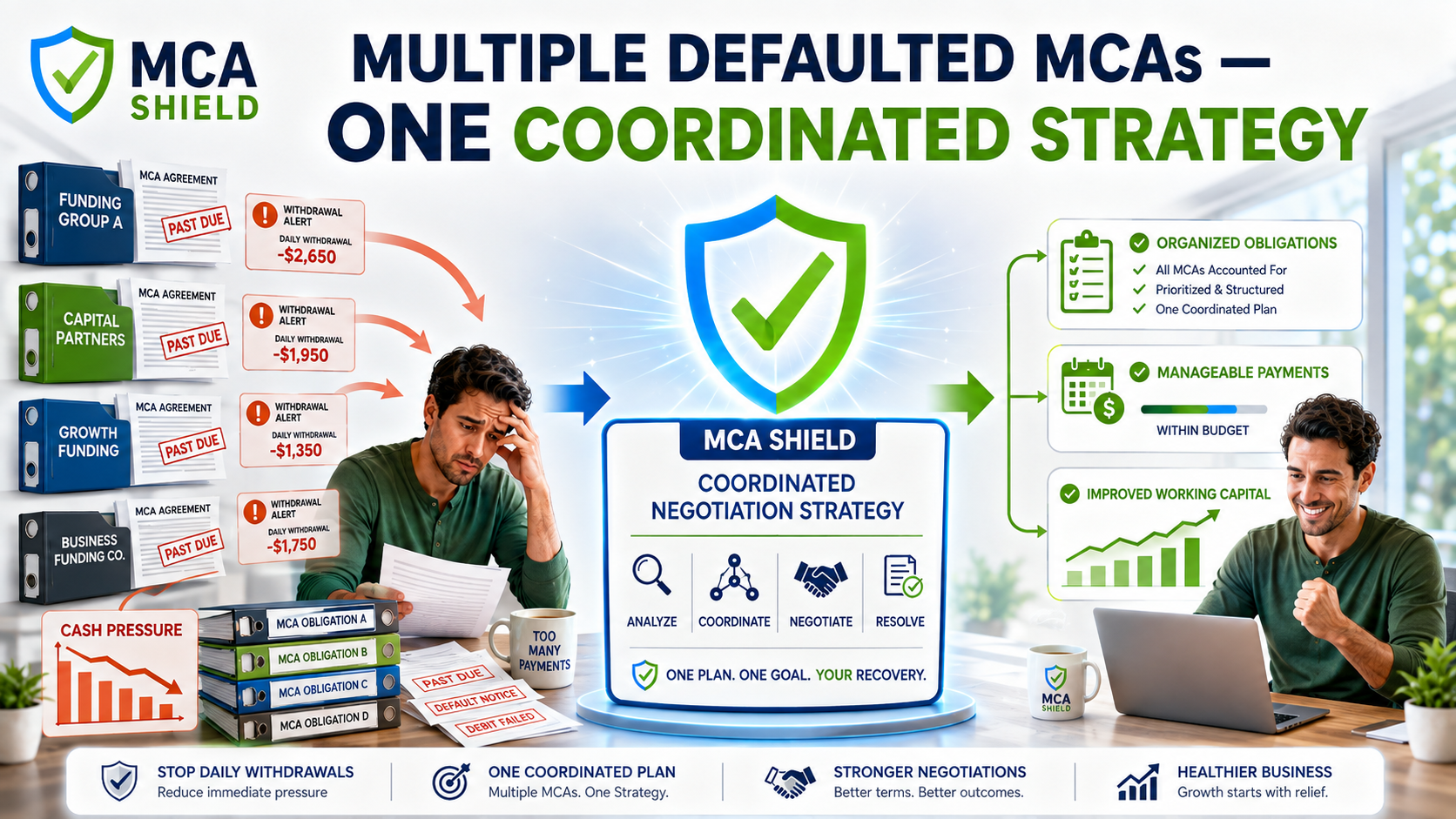
Yes, it may be possible to negotiate more than one merchant cash advance after default. However, multiple MCA defaults can make the situation more complex because several funders may be seeking payment from the same limited cash flow.
When a business has stacked MCA debt, one payment arrangement can affect the ability to handle another. That is why negotiating multiple MCAs after default usually requires a coordinated strategy rather than handling each obligation separately without a broader plan.
Why Multiple Defaults Require a Coordinated Strategy
Several defaulted MCAs can create competing demands on your revenue. One funder may require daily withdrawals, while another may be seeking a lump-sum payment or a different repayment schedule.
Without coordination, a business may agree to terms with one funder that leave too little cash available for payroll, rent, taxes, or another MCA obligation.
A coordinated approach looks at all MCA balances, payment demands, collection activity, and available cash flow together. This can help the business avoid creating one solution that causes another financial problem.
Prioritizing MCA Funders and Obligations
Not every MCA account will be in the same position. Some may have larger balances, more aggressive collection activity, or different contractual terms.
A negotiation strategy may need to prioritize obligations based on factors such as payment size, remaining balance, legal activity, current collection pressure, and the impact on business cash flow.
The goal is to understand which obligations require immediate attention and which may offer more flexibility. This can help create a more organized path toward resolving multiple MCA debts.
Avoiding Another MCA to Cover Existing Debt
Taking out another merchant cash advance may seem like a quick way to cover defaulted payments. In many cases, however, it can increase the overall financial pressure.
Using new MCA funding to pay existing MCA debt can create a cycle of stacked withdrawals, higher total obligations, and shrinking working capital. The business may temporarily catch up on one payment while taking on another expensive obligation.
Before adding more debt, it may be better to explore whether existing MCA obligations can be negotiated. When negotiating MCA debt after default, addressing the current problem directly may provide a more sustainable path than borrowing again to cover old payments.
What If an MCA Funder Has Started Collections or Filed a Lawsuit?
Collection activity or a lawsuit can make an MCA default more urgent. However, the start of collections does not necessarily mean that negotiation is no longer possible. The business may still be able to discuss a repayment arrangement or other resolution with the MCA funder.
If a lawsuit has already been filed, the situation requires additional care. Court deadlines can be short and vary by jurisdiction, so legal documents should never be ignored. For example, federal defendants generally have 21 days after service to respond, while state deadlines can differ significantly.
Negotiating MCA Debt During Collection Activity
Once an MCA account enters collections, the funder or a collection representative may increase efforts to recover the outstanding balance. Your business may receive payment demands, phone calls, emails, notices, or settlement proposals.
This is often a critical time to understand the amount being claimed and evaluate what the business can realistically afford. A negotiation may focus on reduced payments, a modified repayment schedule, or potential settlement terms, depending on the circumstances and the funder’s willingness to negotiate.
Keep records of communications, payment history, MCA agreements, and notices. Having accurate information can help your business approach negotiations with a clearer picture of the debt and available cash flow.
What to Do If Legal Action Has Already Started
If an MCA funder has filed a lawsuit, do not ignore the summons, complaint, or other court documents. Courts impose specific deadlines for responding, and failing to act can affect your legal rights.
Review the documents immediately and consider speaking with a licensed attorney familiar with commercial debt or MCA disputes in your state. An attorney can evaluate the allegations, deadlines, defenses, and available legal options based on your specific situation.
Negotiation may still occur while litigation is pending, but a lawsuit creates a separate legal process that must be addressed. Your business should not assume that settlement discussions automatically stop or extend a court deadline.
Why Acting Quickly Can Matter After Default
Time becomes especially important once an MCA has entered collections or litigation. Waiting can allow deadlines to pass and may reduce the amount of time available to evaluate financial and legal options.
Acting quickly gives your business an opportunity to review the MCA agreement, organize financial records, understand collection demands, and determine whether negotiation is practical.
When negotiating MCA debt after default, early action can also make it easier to develop a realistic strategy before financial pressure grows. The sooner your business understands the situation, the sooner it can begin working toward a resolution while protecting essential operating cash flow.
Common Mistakes to Avoid When Negotiating MCA Debt After Default
When a business is under financial pressure, it can be easy to make quick decisions that create even more problems. Negotiating MCA debt after default requires careful planning, realistic expectations, and clear communication.
Avoiding a few common mistakes can help your business stay focused on a resolution that fits its actual financial condition.
Ignoring MCA Funders or Collection Notices
Ignoring calls, emails, letters, or collection notices usually does not make the problem disappear. In fact, delays may allow the situation to become more complicated.
Review every notice carefully and keep records of all communications. If you receive legal documents, pay close attention to any response deadlines and consider seeking qualified legal advice.
Staying informed can also help you understand what the funder is requesting and whether there may be an opportunity to negotiate. Clear communication can be an important part of reaching a workable resolution after MCA default.
Making Promises Your Business Cannot Afford
Agreeing to a payment amount just to stop collection pressure can create another problem if your business cannot maintain it.
Before accepting new terms, review your revenue, payroll, rent, taxes, inventory costs, existing debt, and other essential expenses. Then determine what amount your business can realistically afford.
A negotiated agreement should help stabilize the situation, not lead to another missed payment a few weeks later. Sustainable terms are more valuable than promises your business cannot keep.
Taking Another MCA Before Addressing Existing Debt
Another merchant cash advance may appear to provide fast relief, especially when your business needs immediate cash. However, using new MCA funding to cover existing MCA obligations can deepen the debt cycle.
The new advance may add another daily or weekly withdrawal, additional fees, and even more pressure on working capital. This can leave the business with less cash available for normal operating expenses.
Before taking on another MCA, consider whether the existing debt can be addressed directly. When negotiating MCA debt after default, focusing on the current obligations may offer a more sustainable path than adding another layer of debt.
Frequently Asked Questions About Negotiating MCA Debt After Default
Business owners often have questions about what happens once an MCA goes into default. Although every situation is different, default does not necessarily eliminate the possibility of negotiation or settlement. The available options will depend on the MCA agreement, the funder, the outstanding balance, and the financial condition of the business.
Will MCA Funders Negotiate After Default?
Some MCA funders may be willing to negotiate after default, but there is no guarantee that a funder will agree to modified terms. Possible discussions may involve payment amounts, repayment schedules, or another arrangement designed to resolve the outstanding obligation.
Businesses should review the agreement and understand exactly what they can afford before making a proposal. The FTC has also taken enforcement action against MCA providers over deceptive financing and collection practices, reinforcing the importance of carefully reviewing MCA terms and communications.
When negotiating MCA debt after default, a realistic proposal based on current cash flow may help create a more productive discussion with the funder.
Can Defaulted MCA Debt Be Settled?
In some situations, defaulted MCA debt may be resolved through a negotiated settlement. A settlement could involve an agreed payment or payment arrangement that resolves the remaining obligation under negotiated terms.
Whether settlement is available depends on the funder and the specific circumstances. Business owners should get any settlement terms in writing and review them carefully before making payment.
Settlement should also be evaluated alongside the business’s other obligations. The goal should be a resolution the company can afford without creating another immediate cash-flow problem.
Can You Negotiate an MCA Without an Attorney?
A business owner can generally communicate and negotiate directly with an MCA funder. However, professional legal guidance may become especially important if a lawsuit, judgment, or other legal action is involved.
Rules for representing a business in court vary by jurisdiction and business structure. For example, New York courts generally require corporations to appear through an attorney in many civil proceedings, although certain commercial claims have exceptions.
Even when an attorney is not required for negotiation itself, legal counsel can help review contractual obligations and evaluate legal risks. When negotiating MCA debt after default, understanding both the financial and legal consequences of any proposed agreement can help your business make a more informed decision.
Take Action Before MCA Default Puts More Pressure on Your Business
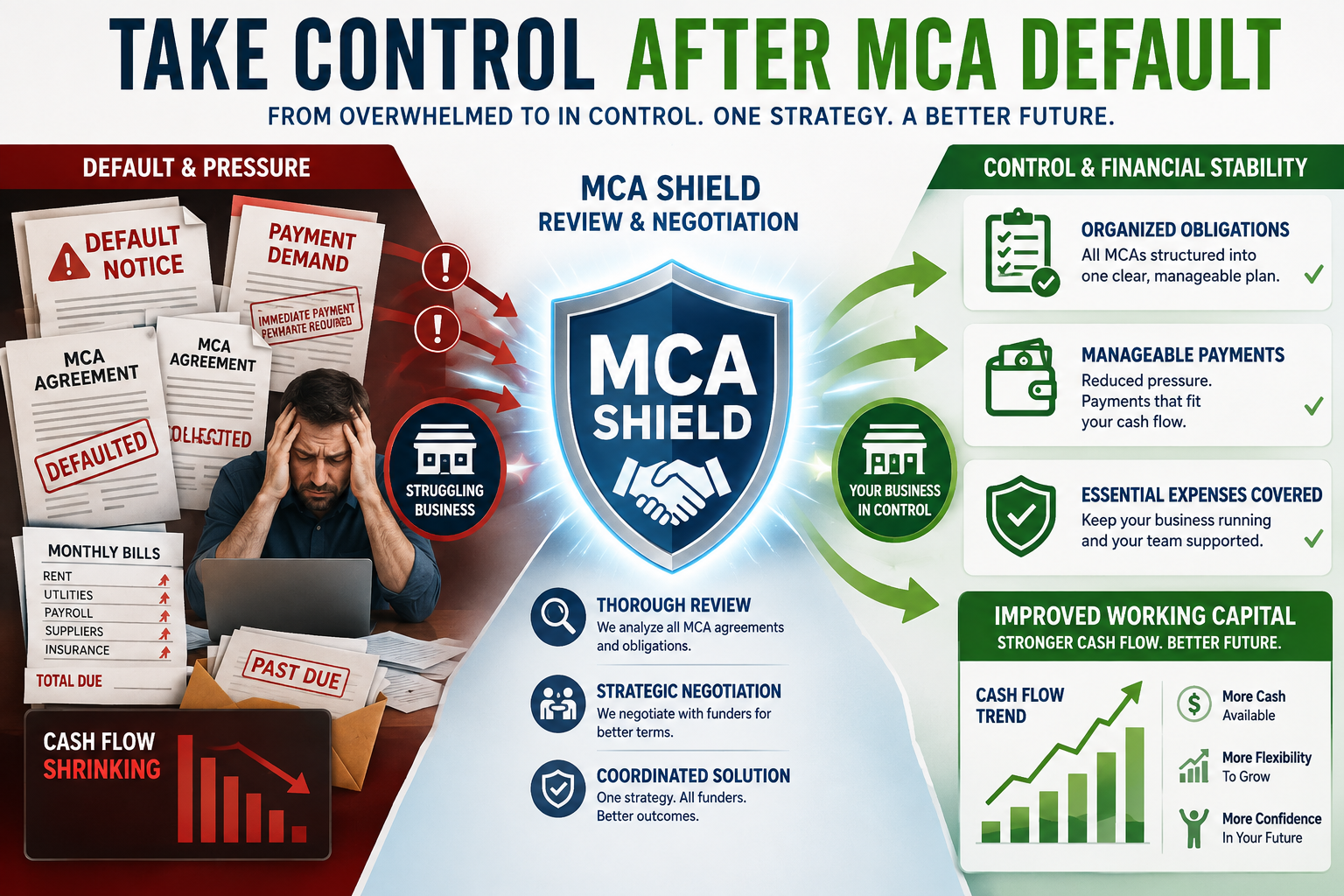
MCA default can put growing pressure on cash flow, operations, and day-to-day decision-making. The longer the situation continues, the harder it may become to keep up with payroll, rent, inventory, taxes, and other essential business expenses.
If your current MCA payment structure is no longer sustainable, waiting may limit your options. Negotiating MCA debt after default may be easier to address when you act before collection pressure or legal complications increase.
Why Acting Early May Give Your Business More Options
Acting early gives you more time to review your agreements, organize your financial information, and understand what your business can realistically afford.
It may also create more room to explore reduced payments, modified repayment terms, settlement possibilities, or a coordinated strategy for multiple MCAs.
The goal is to address the problem before it creates even greater strain on working capital. A proactive strategy can help your business pursue a more manageable resolution while protecting the cash needed to keep operating.
Schedule a Free Consultation With MCA Shield
If your business has defaulted on one or more merchant cash advances, you do not have to wait for the pressure to get worse.
MCA Shield can review your MCA situation, evaluate your current financial position, and help you understand potential resolution strategies. Every business is different, so the right approach should reflect your actual obligations, cash flow, and operating needs.
Schedule a free consultation with MCA Shield to discuss your MCA debt, understand your options, and take the first step toward a more manageable financial path.