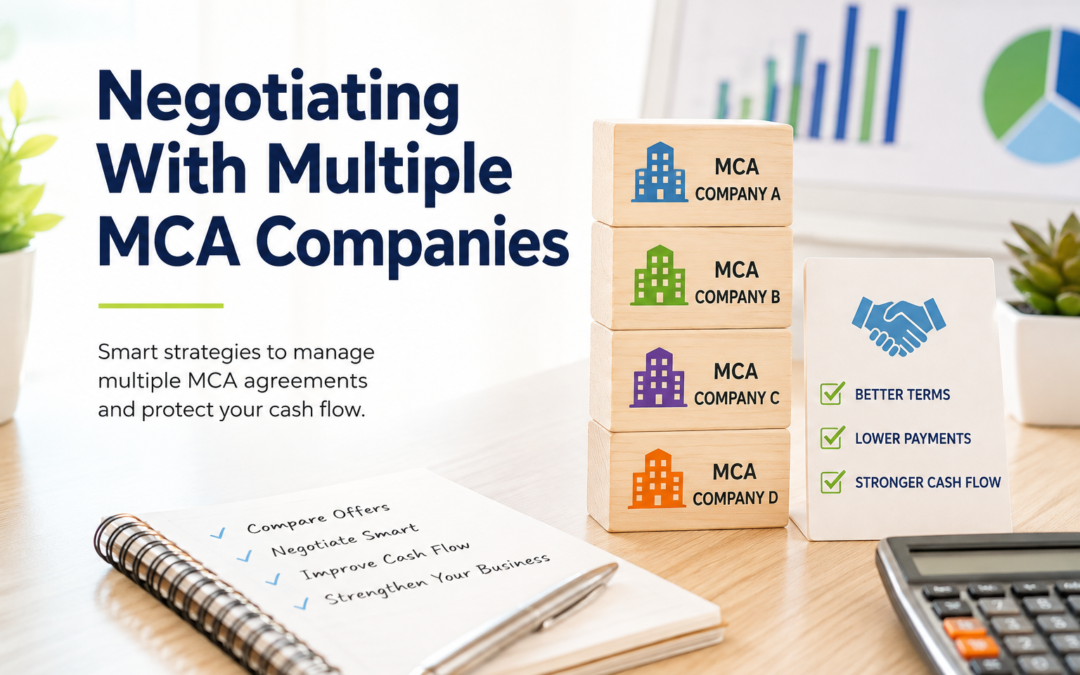
Negotiating with multiple MCA companies can become complicated quickly when several daily or weekly payments are pulling money from the same business revenue. Without a coordinated plan, those withdrawals can put pressure on payroll, operating expenses, inventory, and working capital.
The key is to look at every merchant cash advance collectively rather than treating each agreement as a separate problem. A well-organized negotiation strategy may help your business pursue more manageable payments, better cash flow, and greater financial stability.
In this article, we explain how negotiating with multiple MCA companies works, what terms may be discussed, which mistakes to avoid, and why acting early can give your business more options.
Schedule Your Free Consultation
What Makes Negotiating With Multiple MCA Companies Different?
Negotiating with one merchant cash advance company can be challenging. Negotiating with multiple MCA companies adds another layer of complexity because each funder may have different payment terms, withdrawal schedules, balances, and negotiation policies.
The biggest challenge is that all the MCA payments are drawing from the same business cash flow. One funder may agree to a lower payment, but that change may not solve the larger problem if several other MCA withdrawals continue at the same rate.
Why Multiple MCA Payments Require a Broader Strategy
For that reason, review all MCA agreements together. A business needs to understand how much revenue is coming in, how much each MCA is taking, and how much cash must remain available for essential expenses such as payroll, rent, inventory, taxes, and utilities.
Timing can also become more important. Different MCA companies may contact the business at different stages, and each negotiation can affect the overall strategy. Making an aggressive promise to one funder without considering the others could leave the business unable to meet its remaining obligations.
A coordinated approach focuses on the entire financial picture, not just one payment. The goal is to pursue terms that are realistic across all MCA obligations while preserving enough working capital to keep the business operating.
When several advances are involved, negotiating with multiple MCA companies requires organization, realistic cash-flow planning, and a clear strategy for dealing with each funder.
When Multiple MCA Payments Become a Cash Flow Problem
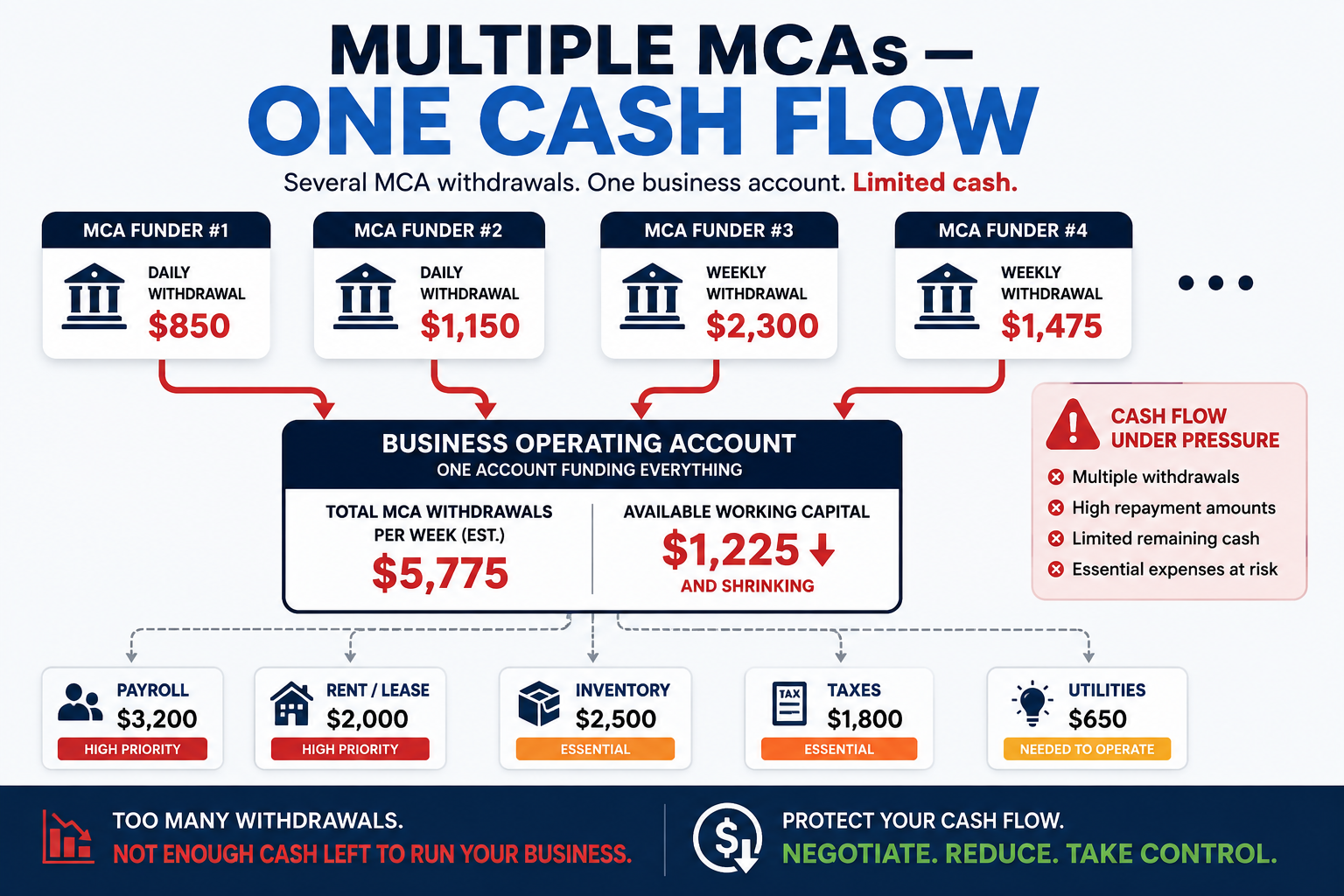
Multiple merchant cash advances can become a serious cash flow problem when daily or weekly withdrawals begin consuming too much of your business revenue. Each MCA payment may seem manageable on its own. However, when several funders withdraw money from the same account, the combined impact can quickly strain working capital.
For example, your business may still be generating steady sales, yet there may not be enough cash left after MCA withdrawals to cover payroll, rent, inventory, taxes, utilities, or other essential operating expenses. At that point, the problem is no longer just the cost of one advance. It is the cumulative effect of several obligations competing for the same revenue.
This pressure can create a dangerous cycle. A business may begin delaying expenses, using credit cards to cover operating costs, or considering another merchant cash advance to replace the cash being withdrawn. Adding another MCA can increase the number of payments and make the cash flow problem even harder to manage.
When this happens, negotiating with multiple MCA companies may require a coordinated strategy that considers every agreement together.
Warning Signs Your Business Needs a Coordinated Strategy
Businesses should pay close attention to changes in their daily cash position. The earlier you recognize the warning signs, the more time you may have to evaluate your options.
Common warning signs include:
- MCA withdrawals are making payroll difficult to cover.
- Operating expenses are delayed because available cash is too low.
- Several MCA companies withdraw payments within the same week.
- You are using credit cards or other financing to cover basic expenses.
- Your bank balance frequently drops to dangerously low levels.
- You are considering another MCA simply to keep up with existing payments.
- One or more MCA payments are becoming difficult to maintain.
- Your business is generating revenue but working capital continues to shrink.
When MCA Payments Start Controlling Business Decisions
Another major warning sign is when you begin making financial decisions based almost entirely on upcoming MCA withdrawals. Instead of using revenue to operate and grow the business, you may find yourself constantly moving money around just to keep payments current.
At that stage, negotiating with each MCA company separately may not be enough. A coordinated MCA negotiation strategy looks at the total payment burden, available revenue, operating expenses, and the amount your business can realistically afford.
The objective is not simply to reduce one payment. It is to create a strategy that addresses multiple MCA obligations while protecting enough cash flow to keep the business operating.
If multiple MCA payments are already putting pressure on your business, acting before missed payments or default may give you more room to evaluate possible solutions.
How to Prepare Before Negotiating With Multiple MCA Companies
Before negotiating with multiple MCA companies, it is important to understand exactly what your business owes and how each payment affects cash flow. Going into negotiations without a complete financial picture can make it harder to determine which terms your business can realistically handle.
Gather and Review Every MCA Agreement
Start by gathering all MCA agreements and creating a clear list of the obligations. For each advance, identify the remaining balance, daily or weekly payment, method of withdrawal, payment frequency, and current status. If any accounts are already behind, include missed payments, notices, or recent communications from the funder.
Determine What Your Business Can Realistically Afford
Next, review your current business finances. Look at average revenue, payroll, rent, inventory, taxes, utilities, and other essential expenses. The goal is to determine how much cash your business actually needs to continue operating before committing to any new payment arrangement.
It can also help to calculate the combined amount being withdrawn by all MCA companies. A single payment may appear manageable, while the total of four or five withdrawals may reveal why working capital is disappearing so quickly.
Before negotiations begin, organize:
- Current MCA agreements and balances
- Daily or weekly withdrawal amounts
- Business bank statements
- Recent revenue and sales information
- Payroll and essential operating expenses
- Upcoming tax or vendor obligations
- Any default notices or funder communications
- The amount your business can realistically afford to pay
Once you organize this information, you can begin identifying which MCA obligations create the greatest pressure. Do not base your proposed payments only on what a funder wants. Any negotiated arrangement should also reflect what the business can reasonably maintain.
It is also important to avoid making promises to one MCA company before considering the effect on the others. Agreeing to a payment that consumes too much available cash could make another agreement impossible to maintain.
Preparation gives you a stronger foundation for a coordinated MCA negotiation strategy. Instead of reacting to each funder separately, you can approach negotiations with a clearer understanding of your total obligations, available cash flow, and the payment structure your business may actually sustain.
Why You Should Not Negotiate With Each MCA Company in Isolation
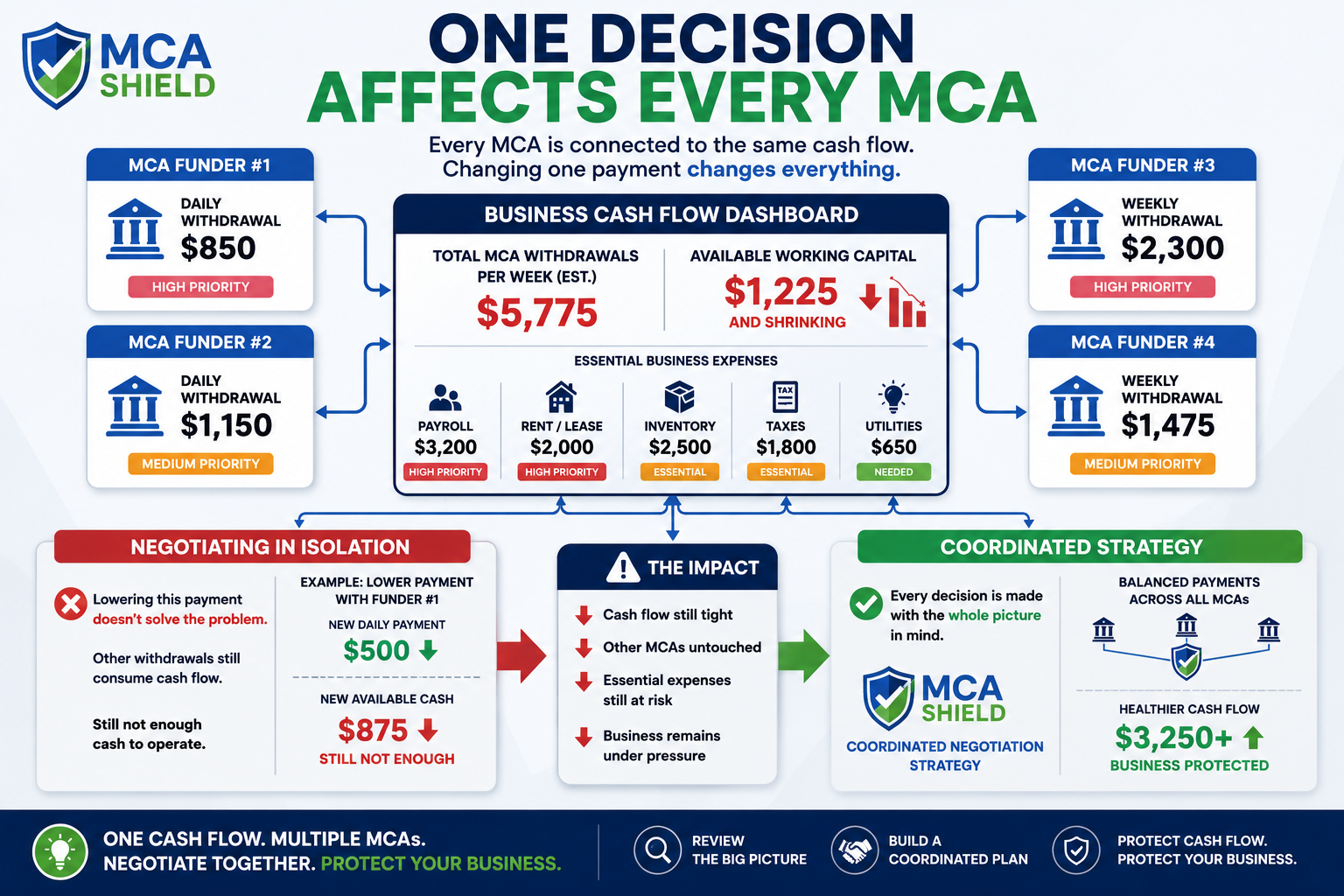
When a business has several merchant cash advances, negotiating with each funder separately can create new problems. Every MCA payment affects the same pool of business revenue, so an agreement with one company can directly affect your ability to pay another.
How One MCA Agreement Can Affect the Others
For example, one MCA company may offer a reduced payment that sounds manageable on its own. However, if that payment is accepted without considering the remaining advances, the combined withdrawals may still leave too little cash for payroll, rent, inventory, taxes, and other essential expenses.
This is why negotiating with multiple MCA companies requires a broader view of the business finances. Each agreement should be considered as part of the total MCA payment burden, not as an isolated obligation.
Negotiating separately can also lead to inconsistent commitments. A business may promise one funder a certain amount, then discover there is not enough cash left to maintain arrangements with the others. That can create additional missed payments, collection pressure, or repeated renegotiations.
Build a Strategy Around Your Total Payment Burden
A coordinated strategy helps determine:
- How much the business can realistically afford to pay overall
- Which MCA agreements are creating the greatest cash flow pressure
- How proposed changes with one funder may affect the others
- How much working capital must remain available for operations
- Which negotiations may need to be addressed first
The goal is to avoid solving one MCA problem while making another one worse.
When several advances are involved, the entire payment structure needs to work together. A coordinated approach can help the business pursue realistic payment arrangements while preserving enough cash to continue operating.
Instead of asking, “What can we afford to pay this MCA company?” the better question is, “What can the business afford across all MCA obligations while still covering essential expenses?”
That distinction is what makes a coordinated negotiation strategy so important when dealing with multiple MCA companies.
When a business has several merchant cash advances, negotiating with each funder separately can create new problems. Every MCA payment affects the same pool of business revenue, so an agreement with one company can directly affect your ability to pay another.
For example, one MCA company may offer a reduced payment that sounds manageable on its own. However, if that payment is accepted without considering the remaining advances, the combined withdrawals may still leave too little cash for payroll, rent, inventory, taxes, and other essential expenses.
This is why negotiating with multiple MCA companies requires a broader view of the business finances. Each agreement should be considered as part of the total MCA payment burden, not as an isolated obligation.
Negotiating separately can also lead to inconsistent commitments. A business may promise one funder a certain amount, then discover there is not enough cash left to maintain arrangements with the others. That can create additional missed payments, collection pressure, or repeated renegotiations.
How to Prioritize Multiple MCA Agreements During Negotiations
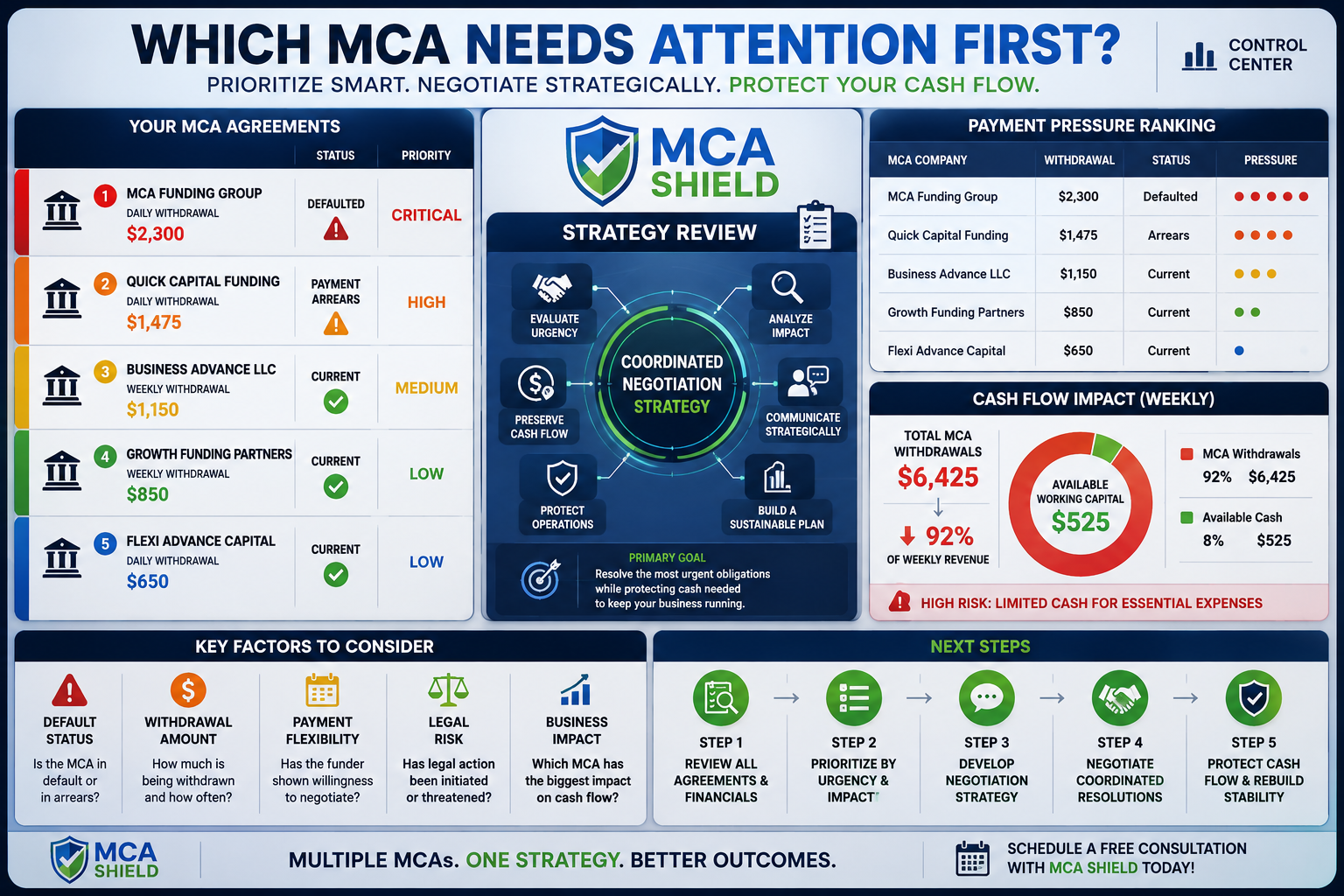
When a business has several merchant cash advances, pursuing negotiations for every agreement at once without a clear order can create confusion. Prioritizing multiple MCA agreements helps you focus on the obligations of greatest financial pressure while keeping the overall cash flow picture in mind.
Start by reviewing each MCA separately. Investigate the remaining balance, payment amount, withdrawal frequency, current account status, and ways the payment is restricting available working capital.
However, the largest balance is not always the most urgent problem. A smaller MCA with aggressive daily withdrawals may place more immediate pressure on cash flow than a larger advance with a more manageable payment structure.
The goal is to identify which agreements require attention first without losing sight of the combined payment burden.
Factors That Determine Which MCA Needs Priority
Factors to consider include:
- Daily or weekly withdrawal amounts
- Remaining balances on each MCA
- Whether payments are current or already behind
- The percentage of business revenue being withdrawn
- Recent collection or default notices
- The impact each payment has on payroll and operating expenses
- Whether a funder has already increased collection activity
- Any deadlines or urgent communications from MCA companies
After you rank the agreements by urgency and financial impact, you can approach negotiations more strategically. This can help prevent the business from committing too much cash to one MCA while leaving insufficient funds for the others.
Which MCA Payments Should Be Addressed First?
There is no single order that works for every business. You may need to address the MCA creating the greatest immediate risk or cash flow pressure first.
For example, an agreement may deserve priority if its withdrawals are preventing the business from covering payroll, rent, inventory, or other critical expenses. An MCA that is already in default or generating frequent collection demands may also require immediate attention.
At the same time, decisions should not be based only on which funder is applying the most pressure. Agreeing to an unrealistic payment simply to resolve the loudest demand could make the overall situation worse.
A stronger approach considers both urgency and affordability.
Before committing to new terms, determine how much money must remain available for essential operations and if the business can reasonably allocate funds to all MCA obligations combined. This creates a clearer framework for deciding which agreements to address first and what payment terms may be sustainable.
When negotiating with multiple MCA companies, prioritization is not about favoring one funder over another. It is about creating an organized strategy that addresses the most urgent obligations while protecting the cash flow the business needs to continue operating.
What Terms Can Be Negotiated With Multiple MCA Funders?
How a Coordinated MCA Negotiation Strategy Can Protect Working Capital
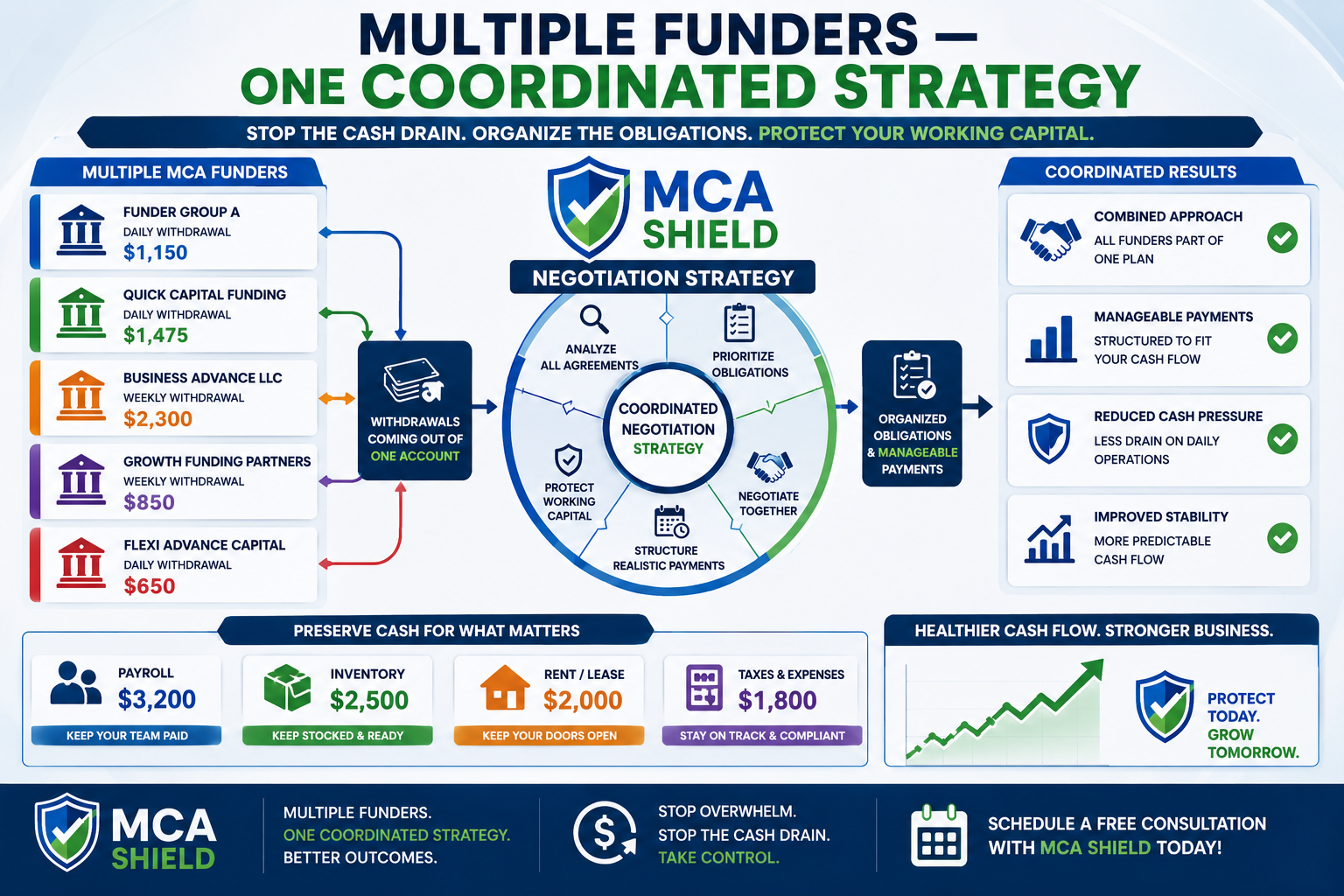
When several MCA companies are withdrawing from the same business account, working capital can disappear quickly. Even a profitable business may struggle if too much revenue is committed to daily or weekly MCA payments.
Balance MCA Payments With Essential Business Expenses
A coordinated negotiation strategy looks at all MCA obligations together. The goal is to determine how much the business can reasonably pay while keeping cash available for payroll, rent, inventory, taxes, utilities, and other essential expenses.
Without this broader approach, a business may negotiate a lower payment with one funder but still face excessive withdrawals from the others. That can leave the company in nearly the same financial position.
A coordinated strategy can help protect working capital by:
- Reviewing the total amount being withdrawn across all MCAs
- Identifying which payments are placing the most pressure on cash flow
- Establishing a realistic amount the business can afford across all obligations
- Avoiding payment promises that leave too little money for operations
- Preserving cash for payroll, inventory, vendors, and other critical expenses
- Creating a more organized approach to communicating with multiple funders
Preserve Cash Needed to Keep Your Business Operating
Protecting working capital is important because a business still needs money to operate during negotiations. If MCA payments consume nearly all available revenue, the company may struggle to serve customers, purchase materials, pay employees, or maintain normal operations.
A stronger strategy focuses on balancing MCA payments with the financial needs of the business. That may mean pursuing payment arrangements that reduce immediate cash flow pressure while keeping the overall repayment plan realistic.
When negotiating with multiple MCA companies, preserving operating cash should remain a central part of the strategy. The objective is not simply to change payment terms. It is to create enough financial breathing room for the business to continue operating while addressing its MCA obligations.
Mistakes to Avoid When Negotiating With Several MCA Companies
When several merchant cash advances are involved, small negotiation mistakes can create larger financial problems. Each agreement affects the same business cash flow, so you should make decisions with the entire payment structure in mind.
One of the biggest mistakes is negotiating with each MCA company separately without considering the others. A payment arrangement may look affordable on its own but become unrealistic once you add the remaining withdrawals.
Avoid Unrealistic Payment Commitments
Other common mistakes include:
- Agreeing to payments the business cannot realistically maintain
- Focusing only on the most aggressive MCA funder
- Ignoring the combined amount being withdrawn each week
- Making promises before reviewing current cash flow
- Waiting until several accounts are already in default
- Failing to keep records of conversations and proposed terms
- Overlooking payroll, taxes, rent, inventory, and other essential expenses
- Taking another MCA to cover existing MCA payments
Another mistake is reacting too quickly to pressure. A funder may request an immediate commitment, but agreeing to terms without reviewing the financial impact can leave the business with even less working capital.
Businesses should also avoid assuming that a temporary reduction automatically solves the problem. Lower payments may help short-term cash flow, but the complete repayment structure still needs to be sustainable.
Do Not Add Another MCA to the Problem
Taking another merchant cash advance can be especially risky. New funding may provide temporary cash, but it also adds another obligation to an already crowded payment schedule. This can compound cash flow pressure and make future negotiations more difficult.
Clear communication is equally important. Keep detailed records of payment proposals, emails, calls, and any changes discussed with each funder. This can help prevent confusion when several negotiations are happening at the same time.
When negotiating with multiple MCA companies, the goal should be to avoid short-term decisions that create long-term problems. A coordinated approach can help keep proposed payments realistic, preserve working capital, and give the business a clearer path to resolving its MCA obligations.
Can Multiple MCA Companies Be Negotiated After Default?
Yes, multiple MCA companies may still be willing to negotiate after default, although missed payments can complicate the process. At that stage, a business may face increased collection activity, repeated payment demands, or other actions that the agreements allow.
Default does not automatically mean that negotiation is no longer possible. In some situations, an MCA funder may still consider modified payment terms, reduced payment arrangements, repayment plans, or a negotiated settlement based on the circumstances.
When several MCA agreements are already in default, coordination becomes even more important. Each funder may be pursuing payment at the same time, and committing too much cash to one company can leave the business unable to address the others.
How to Prioritize MCA Agreements After Default
The first step is to review:
- Which MCA agreements are currently in default
- The remaining balance owed to each funder
- Current daily or weekly payment demands
- Collection notices or recent communications
- Any legal action that has already been initiated
- Available business revenue and essential operating expenses
- What the business can realistically afford across all MCA obligations
From there, the agreements can be prioritized based on urgency, financial impact, and the business’s available working capital.
It is especially important to avoid making unrealistic promises simply to stop immediate collection pressure. An arrangement that cannot be maintained may only delay the problem and could make negotiations more difficult later.
Businesses should also avoid ignoring communications after default. Staying organized and responding strategically can provide a clearer picture of which funders may be open to discussing alternative terms.
When negotiating with multiple MCA companies after default, the objective is to develop a coordinated plan that addresses the most urgent obligations while preserving enough cash for the business to continue operating.
The earlier a business evaluates its options, the more time it may have to organize its finances, communicate with funders, and pursue a workable resolution.
Take Control Before Multiple MCA Payments Limit Your Options
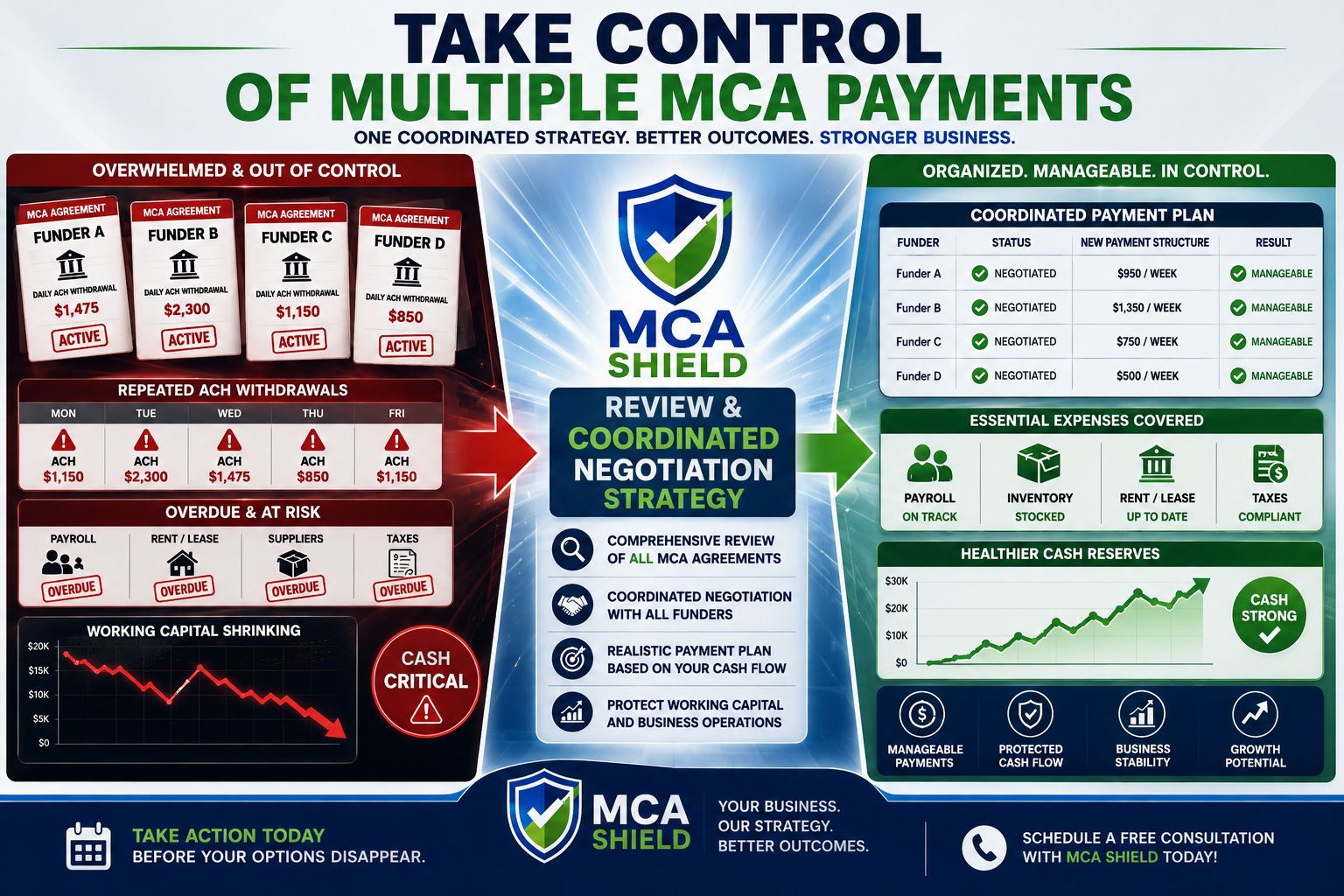
When several merchant cash advances are pulling money from the same business revenue, waiting can make the situation harder to manage. Multiple MCA payments can steadily reduce working capital, leaving less money available for payroll, inventory, rent, taxes, and other essential expenses.
As cash flow pressure increases, businesses may begin missing payments, delaying vendors, using credit cards, or considering another MCA for temporary relief. These short-term decisions can compound the financial strain and reduce the number of practical options available.
Taking action earlier gives you more time to understand the complete picture. That means reviewing every MCA agreement, measuring the combined payment burden, identifying the most urgent obligations, and determining what the business can realistically afford.
A coordinated strategy may help you:
- Identify which MCA payments require immediate attention
- Evaluate possible payment modifications or settlement options
- Avoid making commitments that strain cash flow further
- Protect money needed for essential business operations
- Communicate with multiple funders through a more organized approach
- Develop a realistic plan for addressing several MCA obligations
The goal is not simply to stop the immediate pressure. It is to create a strategy that addresses the MCA debt while helping the business maintain enough cash to continue operating.
If multiple MCA payments are already limiting your working capital, MCA Shield can review your agreements, financial situation, and current payment structure to help identify possible negotiation strategies.
Schedule a Free Consultation With MCA Shield
You do not have to wait until every MCA account is in default before exploring your options. Schedule a free consultation with MCA Shield to review your multiple MCA agreements and discuss a coordinated approach to reducing payment pressure and protecting your business cash flow.