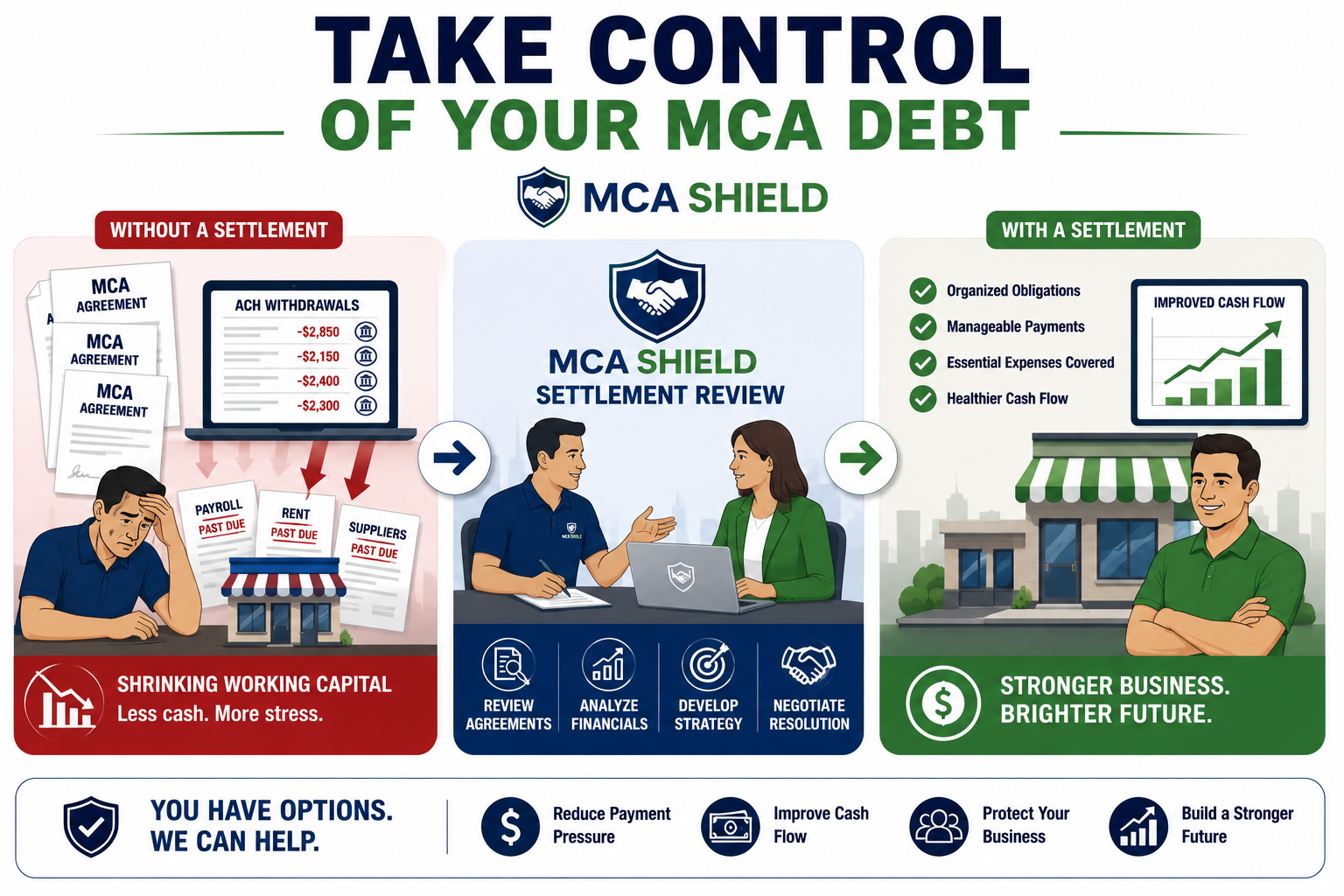
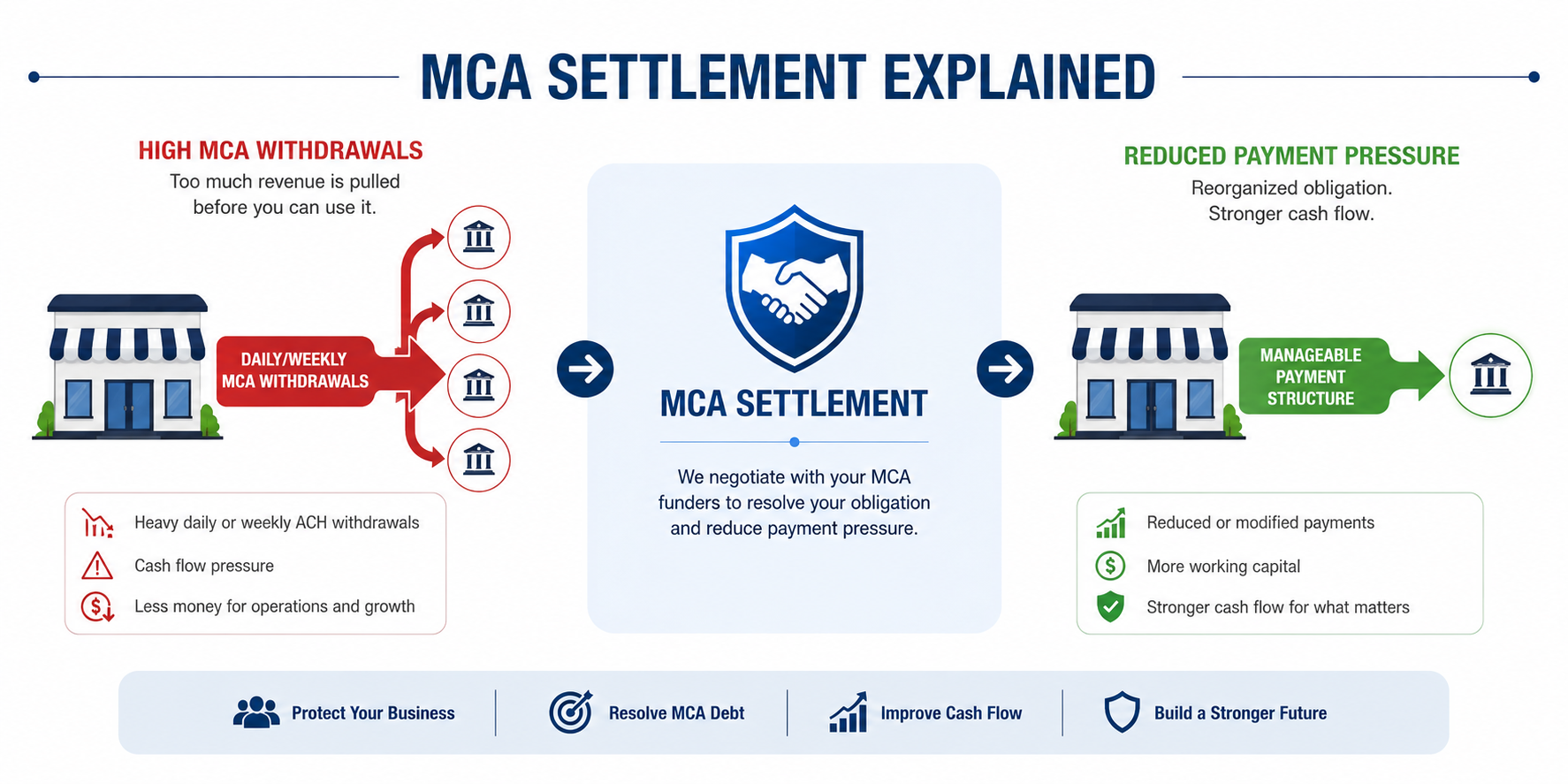
Merchant cash advances can provide fast access to capital, but the payments can quickly put pressure on a business. When daily or weekly withdrawals begin consuming too much revenue, MCA settlement may provide a way to address the debt and regain control of cash flow.
This Ultimate Guide to MCA Settlement explains how the process works, when settlement may make sense, and what can affect the outcome. You will also learn about reducing MCA payments, settling multiple MCAs, potential risks, and alternatives to settlement.
If MCA debt is making it harder to cover payroll, inventory, rent, or other essential expenses, understanding your options is an important first step. The earlier you address MCA payment pressure, the more options your business may have.
Schedule Your Free Consultation
What Is MCA Settlement and How Does It Work?
When Should a Business Consider MCA Settlement?
How the MCA Settlement Process Works
How Much Can MCA Debt Be Reduced Through Settlement?
There is no standard percentage for how much MCA debt can be reduced through settlement. Every merchant cash advance agreement and financial situation is different. The final outcome depends on the amount owed, the business’s financial condition, the status of the account, and the funder’s willingness to negotiate.
In some situations, negotiations may focus on reducing the total obligation. In others, the priority may be creating a payment arrangement that places less pressure on cash flow. MCA settlement should be evaluated based on the overall resolution, not a promised reduction percentage.
Factors That May Affect the Settlement Amount
Several factors can influence the terms a funder may consider. These can include the outstanding MCA balance, payment history, current revenue, financial hardship, account status, and number of MCA obligations.
The business’s ability to fund a proposed settlement also matters. A realistic offer should reflect both the business’s financial circumstances and its ability to meet the negotiated terms.
Timing may play a role as well. Financial conditions can change quickly when MCA payments consume a significant portion of revenue. Reviewing the situation early can provide a clearer picture of the options available.
Why Settlement Results Vary by Business and Funder
No two MCA settlements are exactly alike. Funders can have different policies, negotiation practices, and requirements. Businesses also differ in their revenue, expenses, outstanding balances, and overall financial condition.
For example, a business dealing with one MCA may require a different strategy than a company managing several stacked advances. The status of each account can also affect how negotiations proceed.
For these reasons, a settlement result achieved by one business should not be viewed as a guarantee of what another business will receive. Each MCA obligation needs to be evaluated individually.
Reduced MCA Debt vs. Reduced Payments
Reducing the total MCA debt and reducing the payment amount are not the same thing. A settlement may focus on lowering the amount required to resolve an obligation, while a modified payment arrangement may focus on changing how payments are made.
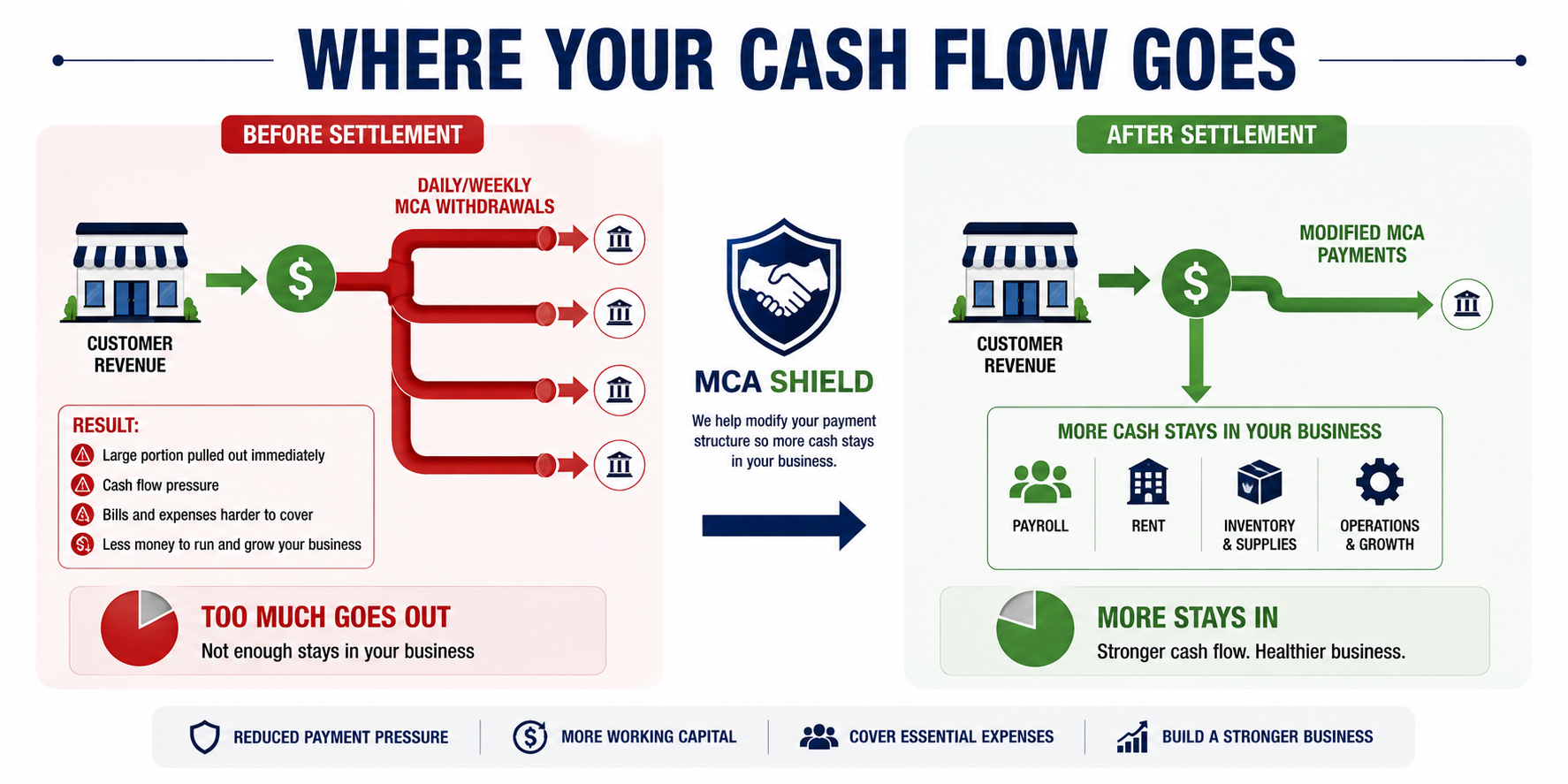
Lower payments can reduce the immediate strain on cash flow, even when the total amount owed does not decrease by the same percentage. A reduction in the overall settlement amount, on the other hand, can change how much the business ultimately pays to resolve the MCA.
The right approach depends on the company’s circumstances. For a business struggling to meet daily expenses, the payment structure can be just as important as the total settlement amount.
Can MCA Settlement Reduce Daily or Weekly Payments?
Can You Settle Multiple Merchant Cash Advances?
MCA Settlement vs. Other Debt Relief Options
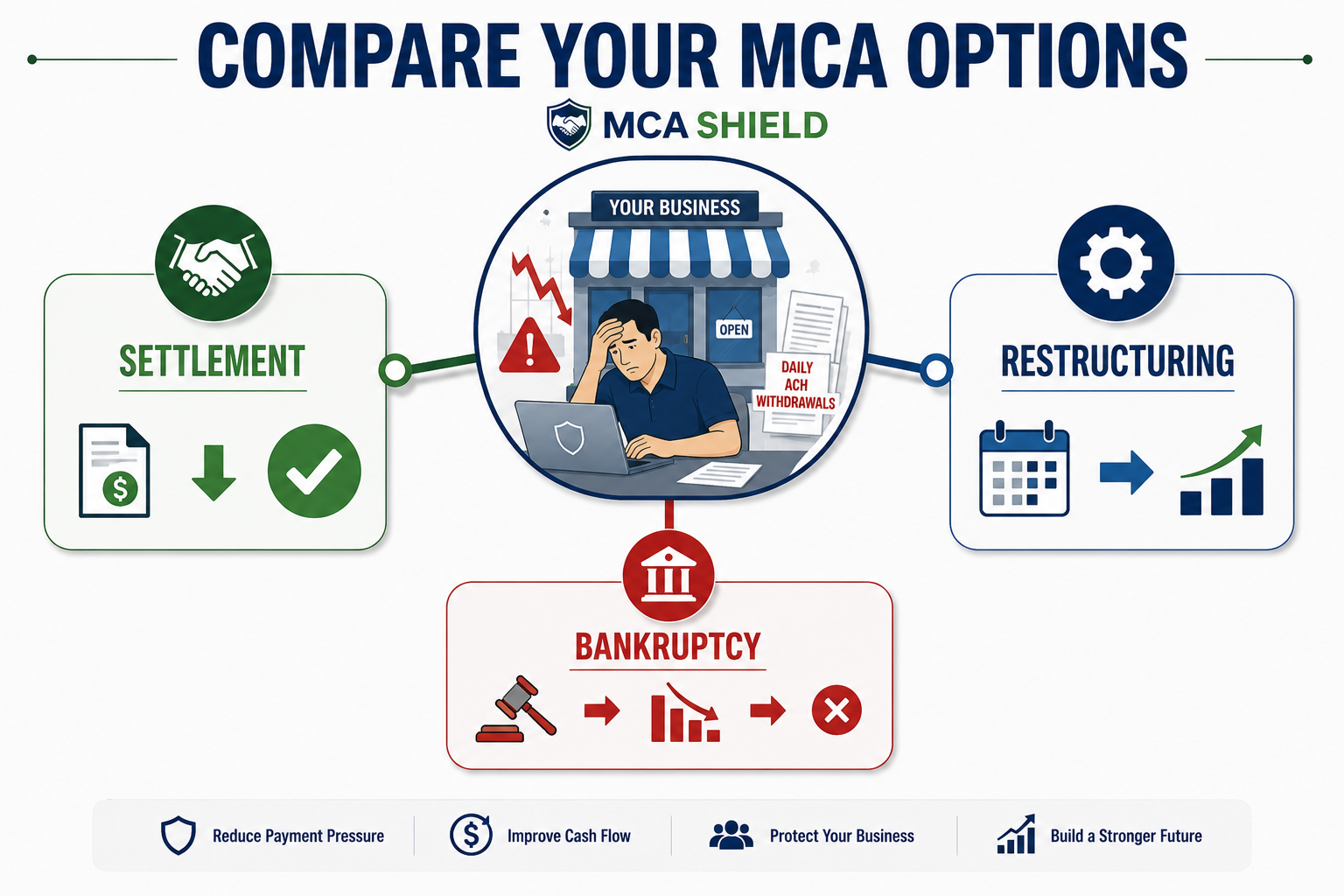
Businesses struggling with merchant cash advance payments may have several ways to address the financial pressure. MCA settlement, restructuring, additional funding, and bankruptcy are different strategies with different potential consequences.
The right approach depends on the business’s cash flow, outstanding obligations, ability to continue operating, and long-term financial goals. Understanding these differences can help a business evaluate which direction may fit its situation.
MCA Settlement vs. Restructuring
MCA settlement generally focuses on negotiating a resolution of an existing merchant cash advance obligation. Depending on the circumstances, negotiations may involve the settlement amount, payment terms, or repayment structure.
MCA restructuring typically focuses more on changing the existing payment arrangement. For example, a business may seek smaller payments, a different payment frequency, or a longer repayment period.
Both strategies may reduce immediate payment pressure, but they do not accomplish the same thing. Settlement may focus on resolving the obligation for negotiated terms, while restructuring primarily changes how the obligation is repaid.
MCA Settlement vs. Taking Out Another MCA
Taking out another MCA can provide an immediate injection of cash. However, it also adds another funding obligation and another payment demand on future business revenue.
If the new advance is used to cover existing MCA payments or operating expenses, the business may enter a cycle known as MCA stacking. Multiple withdrawals can consume an even larger portion of revenue and increase cash flow pressure.
MCA settlement takes a different approach. Instead of adding another obligation, settlement focuses on addressing the MCA debt the business already has.
For a company struggling with existing withdrawals, resolving current obligations may offer a more sustainable direction than repeatedly using new advances to cover older ones.
MCA Settlement vs. Bankruptcy
Bankruptcy is a formal legal process that can address a wide range of business debts. Depending on the type of bankruptcy and the circumstances, it may involve restructuring debts, liquidating assets, or creating a court-supervised repayment plan.
MCA settlement is different because it generally involves negotiating directly with MCA funders outside of bankruptcy. It focuses specifically on resolving merchant cash advance obligations rather than placing the business into a broader bankruptcy proceeding.
Bankruptcy may be appropriate in some situations, especially when MCA debt is only one part of a much larger financial problem. However, it can involve significant legal, financial, and operational consequences.
A business facing serious MCA pressure may want to evaluate its available options before deciding how to proceed. Settlement, restructuring, and bankruptcy each serve different purposes, so the best strategy depends on the company’s complete financial situation.
Risks and Mistakes to Avoid During MCA Settlement
Frequently Asked Questions About MCA Settlement
Take the First Step Toward Resolving MCA Debt