

If your business is making payments on several merchant cash advances, the daily or weekly withdrawals can quickly put pressure on cash flow. You may be wondering whether you can consolidate multiple merchant cash advances into a more manageable payment structure.
MCA consolidation can take different forms. Depending on your situation, it may involve restructuring existing obligations, negotiating lower payments, or coordinating multiple MCA agreements around what your business can realistically afford.
The right strategy should do more than move debt from one place to another. It should help reduce payment pressure, protect working capital, and give your business more room to operate. Understanding your options before taking on another advance can help you make a more informed financial decision.
Schedule Your Free Consultation
Can You Consolidate Multiple Merchant Cash Advances?
Yes, in some situations, a business may be able to consolidate multiple merchant cash advances or restructure them into a more manageable payment arrangement. However, MCA consolidation does not always mean replacing several advances with one traditional consolidation loan.
For many businesses, the better solution may involve reviewing all existing MCA agreements together and determining how much the business can realistically afford to pay. From there, a strategy may include negotiating payment changes, restructuring obligations, or coordinating several MCA payments around the company’s available cash flow.
The goal is to reduce the pressure created by multiple daily or weekly withdrawals. When several MCA companies are pulling funds from the same business account, working capital can disappear quickly. That can make it harder to cover payroll, inventory, rent, taxes, and other essential operating expenses.
A successful consolidation or restructuring strategy should focus on creating a payment structure that the business can maintain without immediately needing another cash advance.
When MCA Consolidation May Be Possible
MCA consolidation may be possible when the business still has enough revenue to support a more affordable payment structure. The specific options available will depend on the number of MCA agreements, outstanding balances, current payment amounts, business revenue, and overall financial condition.
For example, consolidation or restructuring may be worth exploring when:
- Several MCA payments are draining working capital
- Daily or weekly withdrawals are making it difficult to cover essential expenses
- The business has multiple MCA agreements with different funders
- Current payments are no longer affordable
- The business is considering another MCA simply to keep up with existing payments
- Revenue remains strong enough to support a revised payment arrangement
Before choosing any solution, it is important to look at the total MCA payment burden, not just one agreement at a time. Reducing one payment may provide temporary relief, but it may not solve the larger cash-flow problem if several other withdrawals continue.
The strongest approach is usually one that considers all MCA obligations, operating expenses, available cash, and future payment capacity together. This helps determine whether consolidation, negotiation, restructuring, or another form of relief may provide the most sustainable path forward.
What MCA Consolidation Actually Means
The term MCA consolidation can be confusing because it may describe several different approaches to dealing with multiple merchant cash advances. In some cases, consolidation means replacing several obligations with one new financing product. In other cases, it means restructuring or coordinating existing MCA payments to reduce the pressure on business cash flow.
For a business with several advances, the most important issue is not simply reducing the number of payments. The real goal is to create a structure that leaves enough money available for payroll, rent, inventory, taxes, utilities, and other essential expenses.
Before deciding how to consolidate multiple merchant cash advances, it is important to understand the difference between true consolidation and restructuring.
True Consolidation vs. Restructuring Multiple MCA Agreements
True MCA consolidation generally involves replacing multiple existing obligations with a new financing arrangement. The new funding is used to pay off some or all of the current MCA balances. Instead of making payments to several funders, the business may then have one new payment obligation.
This can sound attractive, especially when a business is dealing with several daily or weekly withdrawals. However, replacing multiple MCAs with new financing does not automatically solve the underlying cash-flow problem.
A business should carefully review:
- The total cost of the new financing
- The size and frequency of the new payment
- Any fees or additional financing costs
- The length of the repayment period
- Whether the new obligation actually improves monthly cash flow
- Whether existing MCA balances will be completely satisfied
Restructuring multiple MCA agreements works differently. Rather than borrowing additional money to pay off existing advances, the business may seek changes to the payment structure of the obligations it already has.
Depending on the circumstances, restructuring may involve lower payments, different payment schedules, temporary payment adjustments, or coordinated negotiations with multiple MCA funders.
The objective is to make the overall payment burden more manageable while preserving enough working capital to keep the business operating.
Why MCA Consolidation Does Not Always Require a New Loan
Many business owners hear the word consolidation and assume they must qualify for another loan. That is not always the case.
When existing MCA payments have already created significant financial pressure, taking on additional debt can sometimes make the situation worse. A new obligation may provide short-term relief while creating another repayment burden that the business must manage later.
Instead, it may be possible to address the existing agreements directly.
For example, a business may explore MCA negotiation or restructuring to determine whether current payment terms can be adjusted. If several advances are involved, those obligations can also be reviewed together to determine what the business can realistically afford across all payments.
This approach focuses on the company’s actual cash flow rather than simply replacing old debt with new debt.
The key question is not, “Can we borrow enough to pay off these MCAs?” A better question is, “What payment structure can the business realistically sustain while continuing to operate?”
That distinction matters. The best MCA consolidation strategy should help reduce payment pressure, preserve working capital, and improve financial stability without automatically adding another advance to the existing debt burden.
How Multiple MCA Payments Create a Cash-Flow Problem
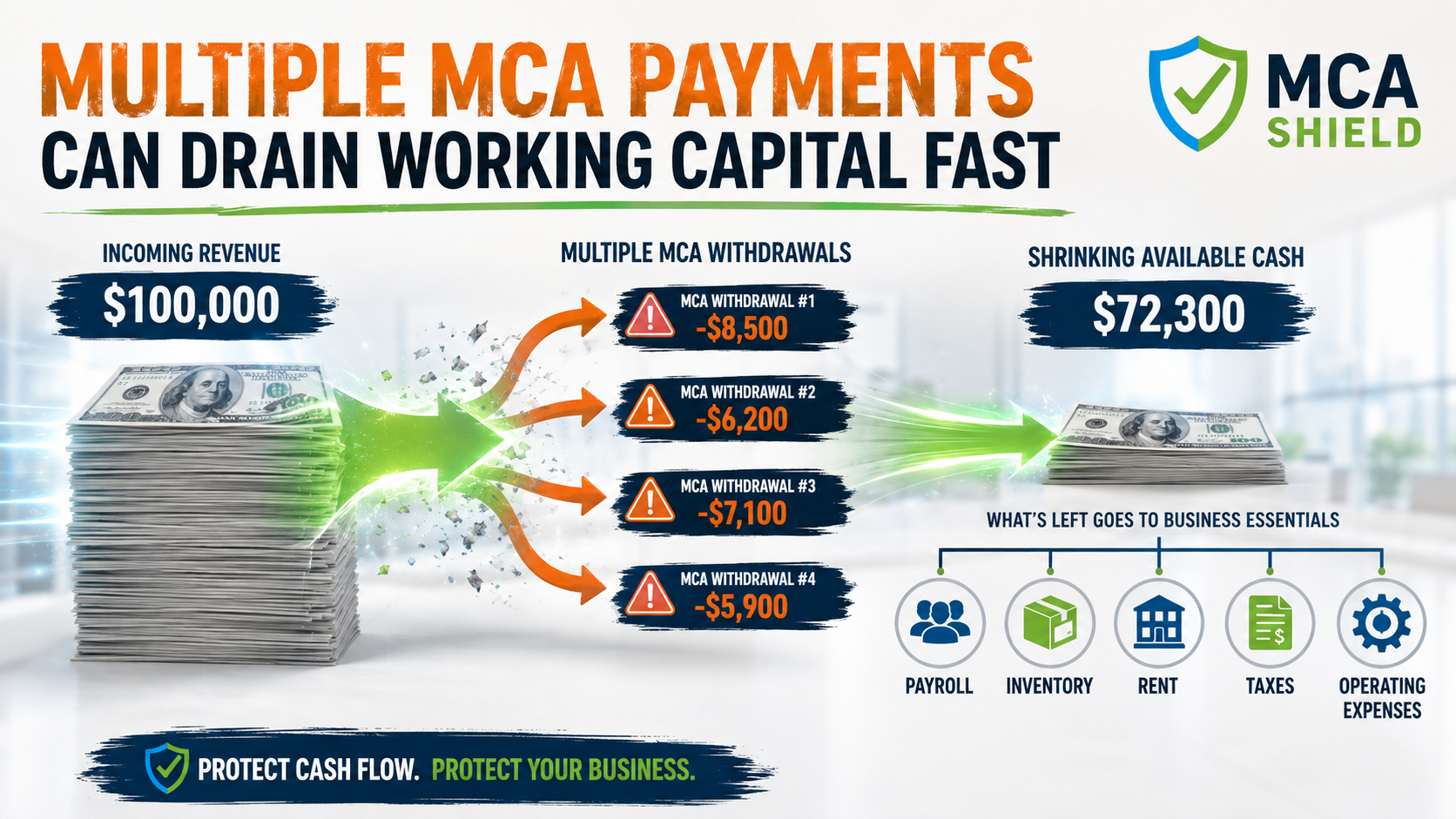
A single merchant cash advance can already take a noticeable share of daily or weekly revenue. When a business has several advances at the same time, those withdrawals can begin competing with the money needed to operate.
The problem often develops gradually. At first, each payment may appear manageable on its own. However, once several MCA payments are deducted from the same revenue stream, the combined payment burden can place serious pressure on cash flow.
This is one reason businesses begin looking for ways to consolidate multiple merchant cash advances. The issue is not simply the number of agreements. It is how much cash remains after all of the required withdrawals are made.
How Daily and Weekly Withdrawals Reduce Working Capital
Merchant cash advances commonly require payments through daily or weekly withdrawals. When several funders are collecting payments, a significant portion of incoming revenue may leave the business before other expenses are paid.
For example, money that would normally be available for payroll, inventory, rent, utilities, or taxes may instead go toward MCA payments.
Over time, this can reduce the amount of working capital available for normal business operations.
The business may begin experiencing:
- Smaller cash reserves
- Difficulty covering payroll on time
- Delayed payments to vendors
- Less money available for inventory or supplies
- Increased pressure when unexpected expenses arise
- Greater dependence on future borrowing
Even a profitable business can struggle when too much revenue is committed to frequent withdrawals. Revenue may still be coming in, but the business may not have enough available cash left to meet its everyday obligations.
That distinction is important. Strong sales do not always mean strong cash flow.
Why Multiple MCA Payments Become Difficult to Manage
Managing several MCA agreements can become especially difficult because each funder may have a different balance, payment amount, withdrawal schedule, and agreement structure.
One MCA payment may appear affordable by itself. However, the business must consider all MCA payments together.
For example, a company could have four separate advances taking withdrawals throughout the week. Each payment may seem relatively small. Combined, however, those withdrawals could consume a large portion of the business’s available revenue.
As cash becomes tighter, the business may start shifting money between expenses just to keep up. Payroll may depend on the next deposit. Vendor payments may be delayed. Taxes or operating expenses may be pushed to the following week.
In some cases, the business may even consider taking another advance to cover the shortfall. That can increase the total payment burden and continue the MCA stacking cycle.
For this reason, businesses with several advances should evaluate the entire payment structure rather than focusing on one MCA at a time. Understanding the total amount leaving the business each day or week can make it easier to determine whether consolidation, restructuring, or negotiation could provide meaningful cash-flow relief.
What Options Are Available for Consolidating Multiple MCAs?
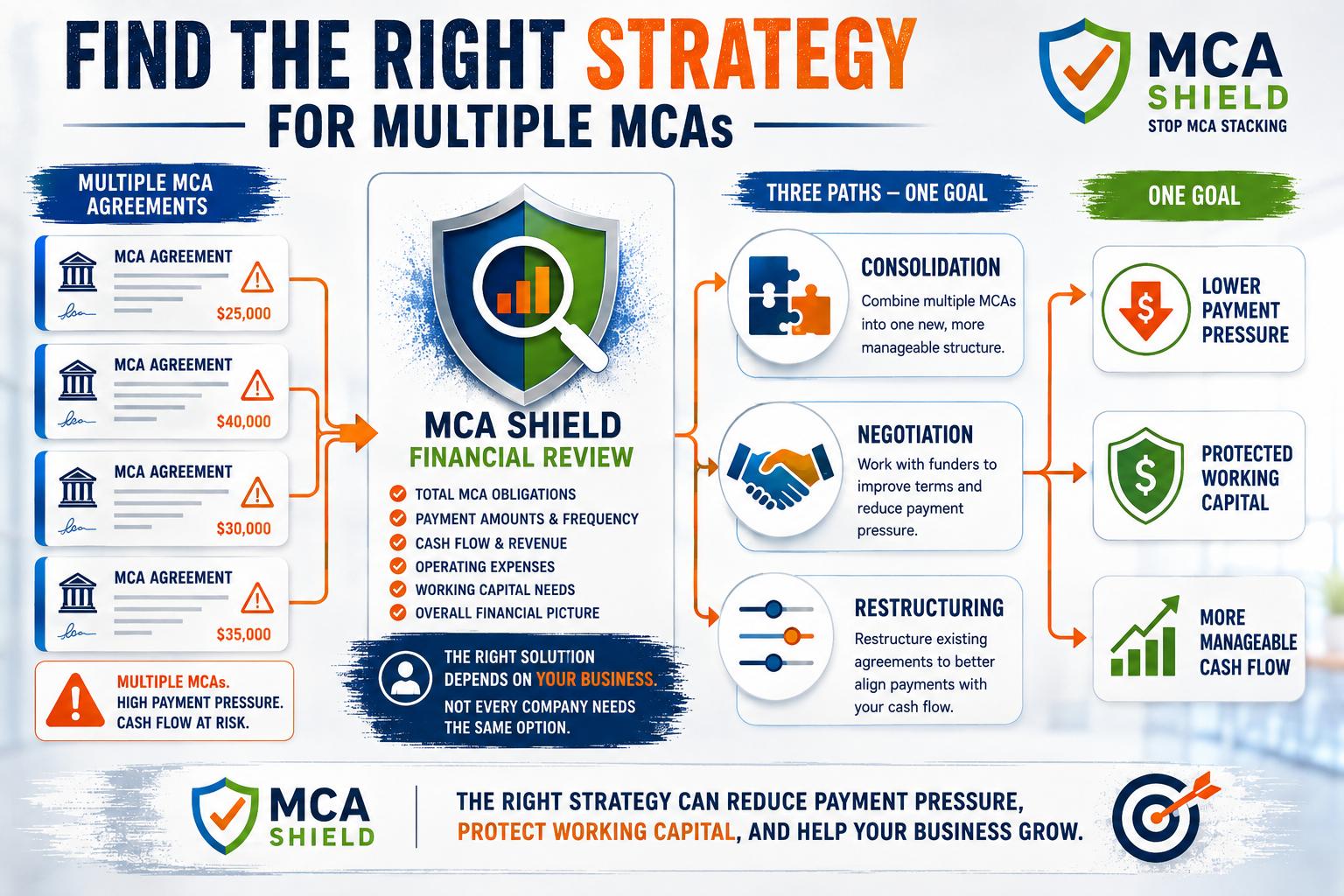
Businesses looking to consolidate multiple merchant cash advances may have several options, depending on their cash flow, number of MCA agreements, outstanding balances, and current financial pressure.
There is no single solution that works for every business. Some companies may qualify for new financing that pays off existing advances. Others may benefit more from negotiating or restructuring their current MCA payments without adding another debt obligation.
The right approach should focus on one main goal: creating a payment structure the business can realistically afford while still covering essential operating expenses.
Before choosing a strategy, it is important to review the entire MCA debt picture. That includes every payment, every funder, and the total amount being withdrawn from business revenue.
Negotiating or Restructuring Existing MCA Payments
One option is to work with existing MCA funders to seek changes to the current payment structure.
Depending on the agreement and the business’s financial situation, negotiation or restructuring may involve:
- Lower daily or weekly payments
- A different payment frequency
- Temporary payment adjustments
- Revised payment terms
- A more manageable schedule based on current cash flow
The purpose is not simply to delay payments. Instead, the goal is to reduce immediate payment pressure so the business has more cash available for payroll, inventory, rent, taxes, and other operating costs.
This can be especially important when several MCA withdrawals are occurring at the same time.
For example, reducing one payment may help temporarily. However, if four other MCA withdrawals remain unchanged, the business could still face serious cash-flow pressure. That is why each agreement should be reviewed as part of the larger financial picture.
In some situations, restructuring existing obligations may provide relief without requiring the business to take out another loan or cash advance.
Coordinating Multiple MCA Obligations Into One Affordable Strategy
When several merchant cash advances are involved, the strongest approach is often to evaluate them together rather than treating each agreement as a separate problem.
A coordinated strategy begins by determining how much the business can realistically afford to pay across all MCA obligations combined.
That calculation should also account for the money needed to keep the company operating, including:
- Payroll
- Rent or lease payments
- Inventory and supplies
- Taxes
- Utilities
- Insurance
- Vendor expenses
- Other essential operating costs
Once those expenses are considered, the business can get a clearer picture of how much cash may be available for MCA payments.
This creates an affordable payment target that can guide negotiations or restructuring efforts.
For example, agreeing to a reduced payment with one MCA company may not help if that arrangement leaves too little cash to pay the remaining funders. Each proposed change should therefore be considered in relation to the other MCA obligations.
The objective is to create a coordinated payment strategy in which all obligations fit within the business’s realistic cash-flow capacity.
For businesses struggling with several advances, this can be more effective than simply searching for another source of funding. A well-planned strategy can help reduce payment pressure, preserve working capital, and create a more manageable path forward.
Can You Consolidate MCAs Without Taking Out Another Loan?
Yes, in some cases, a business may be able to consolidate multiple merchant cash advances without taking out another loan. Instead of borrowing new money to pay off existing advances, the business may explore ways to change the payment structure of the obligations it already has.
This can include MCA negotiation, restructuring, or a coordinated payment strategy across several funders.
For businesses already struggling with daily or weekly withdrawals, avoiding additional debt can be important. A new loan or cash advance may create temporary breathing room, but it can also add another payment to an already strained cash-flow situation.
The better question is whether the existing MCA payments can be adjusted to create a more sustainable structure.
Reducing Payment Pressure Through Negotiation and Restructuring
Negotiation and restructuring focus on the current MCA obligations rather than replacing them with new debt.
Depending on the agreements and the business’s financial condition, this may involve requesting changes such as:
- Lower daily or weekly payments
- A different withdrawal schedule
- Temporary payment reductions
- Revised payment terms
- A payment structure that better reflects current revenue
The goal is to reduce the amount of cash leaving the business so more money remains available for essential expenses.
For example, if several MCA withdrawals are making it difficult to cover payroll and operating costs, a lower payment structure may help restore some working capital. This can give the business more room to manage payroll, inventory, rent, taxes, utilities, and vendor expenses.
When multiple MCAs are involved, each obligation should be reviewed as part of the same strategy. Negotiating one payment without considering the others may not provide enough relief.
A coordinated approach looks at the total MCA payment burden and compares it with what the business can realistically afford.
Why Adding New Debt May Not Solve the Existing Problem
Taking out another loan or merchant cash advance can appear to be a quick solution. The new funding may be used to pay off one or more existing obligations or provide cash for immediate operating expenses.
However, new financing does not automatically fix the underlying cash-flow problem.
If the new payment is still too large, too frequent, or too expensive, the business may soon face the same financial pressure again. In some cases, it may end up with another obligation while still carrying some of the original MCA debt.
This can continue the MCA stacking cycle:
Cash-flow pressure → New advance → Additional payment → Less available cash → More financial pressure
Before adding new debt, a business should compare the proposed financing with its existing payment burden. It is important to determine whether the new arrangement will actually reduce total payment pressure and improve available cash flow.
If it does not, restructuring existing obligations may be a more practical option.
The purpose of any MCA consolidation strategy should be to create lasting cash-flow improvement, not simply move the financial pressure from one obligation to another.
When Taking Another MCA Can Make the Debt Problem Worse
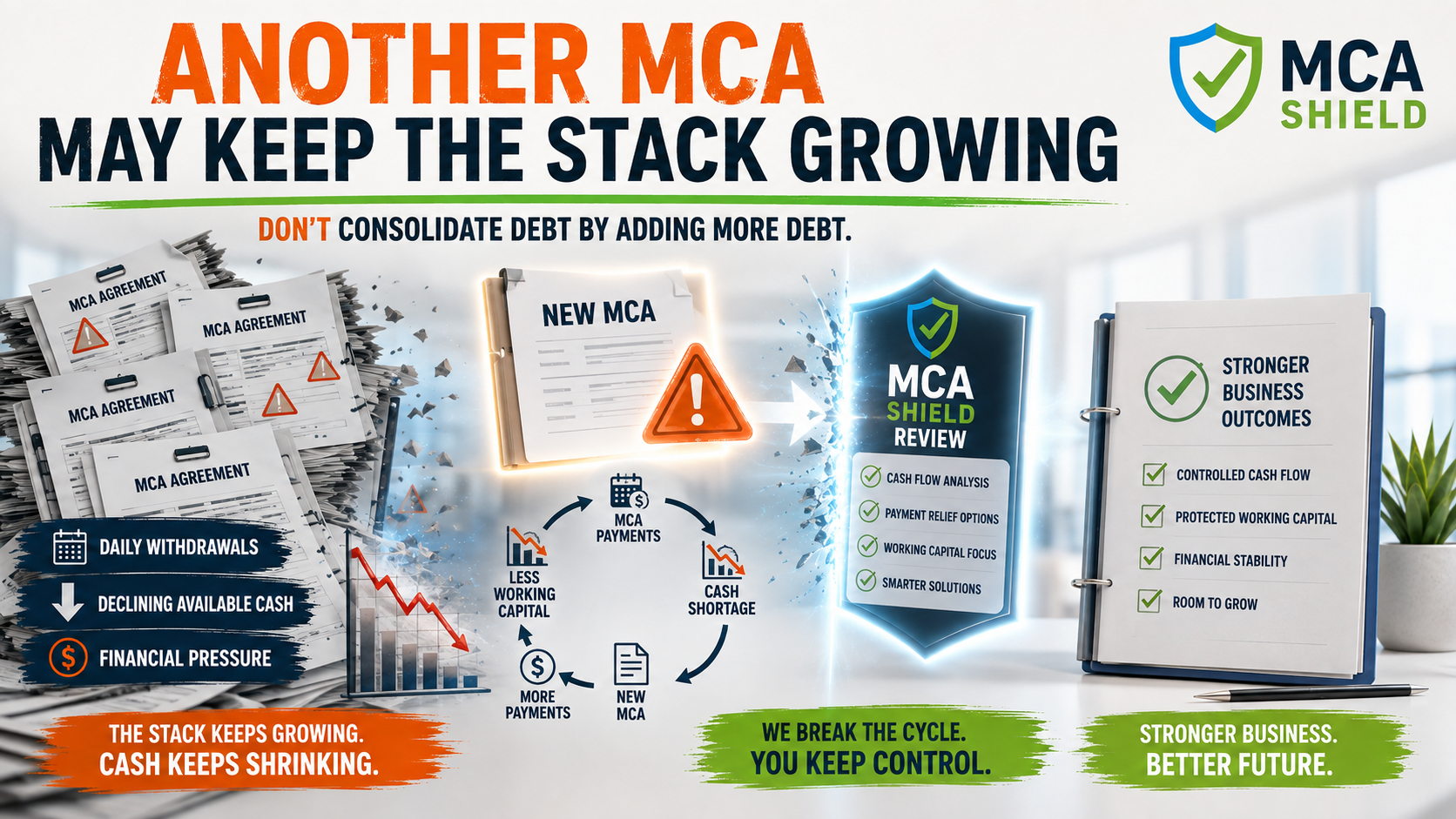
When cash flow is tight, taking another merchant cash advance can seem like a fast way to create breathing room. The new funds may help cover payroll, rent, inventory, taxes, or even payments on existing advances.
However, another advance can also increase the total payment burden and make an already difficult situation harder to manage.
This is especially important when a business is already trying to consolidate multiple merchant cash advances. If new financing does not meaningfully reduce the overall cost or payment pressure, it may simply add another obligation to the stack.
Before accepting another MCA, the business should look closely at how the new payment will affect available cash flow.
How Replacing One Payment With Another Can Continue the Stacking Cycle
Using a new MCA to pay off an existing advance does not always solve the original problem.
For example, a business may take a new advance to eliminate one daily payment. At first, this can feel like progress. However, if the new MCA comes with another aggressive repayment schedule, the business may soon face the same cash-flow pressure again.
In some cases, only part of the new funding is used to satisfy existing debt. The business may then be left with multiple remaining MCA obligations plus a new payment.
This can continue the stacking cycle:
Cash-flow pressure → New MCA → Additional payment burden → Less working capital → More cash-flow pressure
Over time, the business may become increasingly dependent on new financing just to keep up with existing obligations.
That is why the focus should not simply be on replacing one payment with another. The real objective should be to create a structure that reduces the total burden on business cash flow.
Warning Signs That Another Advance Could Hurt Cash Flow
Before taking another merchant cash advance, look for signs that the new financing could make the situation worse.
Warning signs may include:
- Current MCA payments are already difficult to afford
- Payroll or essential expenses are being delayed
- The business is using new funding mainly to make existing MCA payments
- Cash reserves continue to shrink despite steady revenue
- Several daily or weekly withdrawals are already coming from the same account
- The proposed new payment leaves little room for operating expenses
- The business cannot clearly identify how the new advance will improve long-term cash flow
One of the strongest warning signs is using one MCA to cover another. When borrowed funds are mainly being used to support existing debt payments, the business may be moving deeper into the MCA stacking cycle rather than solving the underlying problem.
Before adding another advance, it can be more useful to review all existing MCA agreements, total withdrawals, operating expenses, and available working capital.
That review can help determine whether consolidation, negotiation, or restructuring may offer a more sustainable way to reduce payment pressure.
The goal should be to protect working capital and improve cash flow, not simply create enough temporary cash to make the next round of payments.
How Much Could Consolidating MCA Payments Reduce Your Payment Pressure?
The amount of relief a business may receive from MCA consolidation depends on its specific financial situation. There is no standard percentage or payment reduction that applies to every company.
However, the right strategy may help reduce daily or weekly payment pressure and leave more revenue available for normal business operations.
For a business trying to consolidate multiple merchant cash advances, the focus should be on more than simply lowering one payment. The goal is to determine how much the business can realistically afford across all MCA obligations while still maintaining enough working capital to operate.
A payment structure is only helpful if the business can sustain it.
Factors That Determine an Affordable Payment Level
An affordable MCA payment should reflect the company’s actual cash flow rather than an amount that looks manageable on paper.
Several factors can affect what a business can reasonably pay, including:
- Average weekly or monthly revenue
- Total outstanding MCA balances
- Number of active MCA agreements
- Current daily or weekly withdrawal amounts
- Payroll obligations
- Rent or lease expenses
- Inventory and supply costs
- Taxes and insurance
- Seasonal changes in revenue
- Available cash reserves
- Other essential business expenses
For example, two businesses may owe the same amount in MCA debt but have very different payment capacities. One may have stable monthly revenue and low operating expenses. The other may have higher payroll, inventory costs, or seasonal revenue swings.
That is why the total financial picture matters.
An affordable payment level should leave enough cash available to keep the business functioning. If MCA payments are reduced but the company still cannot cover payroll or essential expenses, the payment structure may not provide meaningful relief.
The objective is to find a balance between meeting MCA obligations and protecting the working capital needed to operate.
Why Every MCA Consolidation Situation Is Different
Every business enters MCA consolidation with a different combination of agreements, balances, payment schedules, revenue, and operating costs.
Some businesses may have two advances with relatively manageable payments. Others may be dealing with four or five MCA companies withdrawing funds from the same account.
The condition of each agreement can also matter. One MCA may still be current, while another may already be creating payment problems. In addition, different funders may respond differently to requests for revised terms.
As a result, there is no one-size-fits-all MCA consolidation strategy.
A business should avoid choosing a solution based only on the promise of a lower payment. Instead, it should consider whether the overall arrangement improves cash flow across all obligations.
A strong review should answer questions such as:
- How much is currently being withdrawn for MCA payments?
- How much can the business realistically afford?
- How much working capital must remain available each week?
- Which MCA agreements are creating the greatest pressure?
- Would the proposed strategy provide enough relief to make the payment structure sustainable?
The goal is not simply to make the next payment easier. It is to create a structure that helps the business reduce payment pressure, preserve working capital, and regain control of cash flow.
For that reason, the potential benefit of MCA consolidation should be measured by how much financial breathing room it creates for the business, not just by how much one individual payment is reduced.
What to Review Before Choosing an MCA Consolidation Strategy
Before you consolidate multiple merchant cash advances, it is important to understand the full financial picture. A lower payment may sound attractive, but the right strategy should do more than provide short-term relief.
It should help the business reduce payment pressure, protect working capital, and maintain enough cash for normal operations.
A careful review can also help determine whether consolidation, negotiation, or restructuring is the better option. The goal is to choose a solution based on what the business can realistically afford, not simply on which option appears easiest.
Review Your Total MCA Balance and Payment Burden
Start by identifying every active MCA agreement and the amount each one is costing the business.
For each advance, review:
- Outstanding balance
- Daily or weekly payment amount
- Payment frequency
- Estimated remaining term
- Total amount currently being withdrawn
- Any past-due or defaulted payments
- Current status with each MCA funder
Looking at each agreement separately is useful. However, the combined payment burden is even more important.
For example, one $500 daily withdrawal may appear manageable. Four separate withdrawals totaling $2,000 per day can create a very different cash-flow problem.
Add the payments together to determine how much revenue is currently going toward MCA obligations each day, week, and month. This gives you a clearer starting point for evaluating whether a new strategy would provide meaningful relief.
Determine How Much Cash the Business Needs to Keep Operating
The next step is to calculate how much cash must remain in the business after MCA payments are made.
Essential operating expenses may include:
- Payroll
- Rent or lease payments
- Inventory and supplies
- Taxes
- Insurance
- Utilities
- Vendor payments
- Transportation or equipment costs
- Other necessary operating expenses
This calculation helps establish how much the business can realistically afford to put toward MCA payments.
For example, a proposed payment structure may look affordable based on revenue alone. However, it may become unsustainable once payroll, inventory, and other essential costs are included.
That is why available cash flow matters more than gross revenue alone.
A workable strategy should leave enough money in the business to continue operating without creating an immediate need for another advance.
Compare Consolidation, Negotiation, and Restructuring Options
Once the total payment burden and operating needs are clear, the business can compare the available options.
MCA consolidation may involve replacing several obligations with a new financing arrangement. This can simplify payments, but the new financing should be carefully reviewed for cost, payment frequency, and long-term affordability.
MCA negotiation focuses on working with existing funders to seek more manageable payment terms. This may help reduce immediate pressure without automatically adding new debt.
MCA restructuring may involve changing how existing obligations are paid so the overall payment structure better matches the company’s current cash flow.
Each option has different advantages and risks. Therefore, businesses should compare:
- The new or revised payment amount
- Total cost over time
- Payment frequency
- Effect on working capital
- Whether new debt is required
- How all existing MCA agreements will be handled
- Whether the business can realistically maintain the proposed arrangement
The best strategy is not necessarily the one with the lowest advertised payment. It is the one that creates a sustainable payment structure while protecting the cash the business needs to operate.
A complete financial review can make it easier to choose between consolidation, negotiation, and restructuring before cash-flow pressure becomes more severe.
Consolidate Multiple Merchant Cash Advances Before Cash Flow Becomes Critical
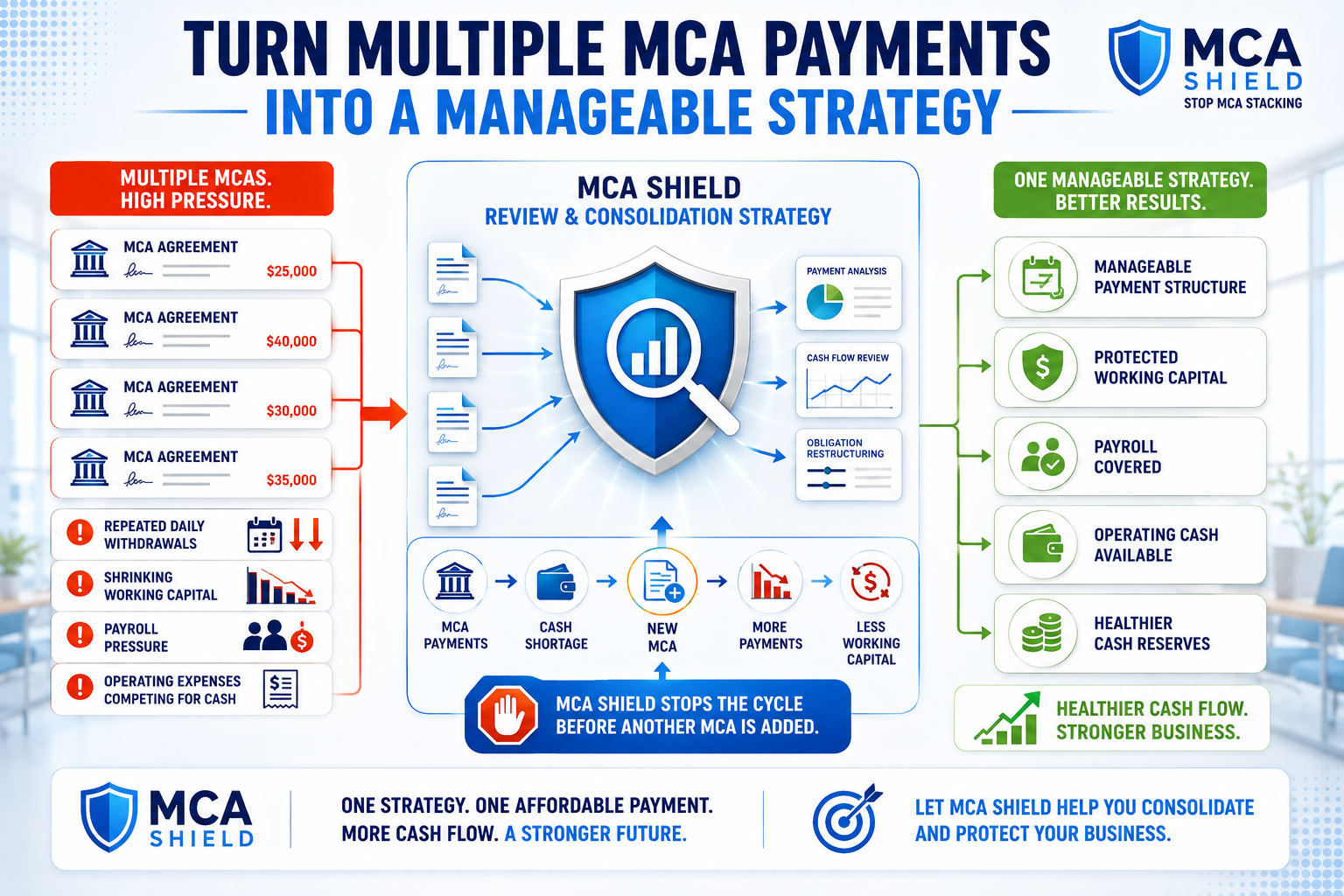
Waiting too long to address multiple merchant cash advances can make a difficult financial situation even harder to manage. As daily or weekly withdrawals continue, the business may have less cash available for payroll, inventory, rent, taxes, and other essential expenses.
If you are considering whether to consolidate multiple merchant cash advances, it is often better to review your options before cash flow reaches a critical point.
Early action can provide more time to understand the full payment burden, evaluate available strategies, and determine what the business can realistically afford. It may also help you avoid relying on another advance simply to cover existing obligations.
The goal is to address the problem while the business still has revenue, working capital, and operating flexibility.
Signs It May Be Time to Get Professional Help
MCA payment problems do not always begin with a missed payment. In many cases, the warning signs appear much earlier.
It may be time to seek professional help if:
- Daily or weekly MCA withdrawals are consuming too much revenue
- Payroll is becoming difficult to cover
- Vendor or operating expenses are being delayed
- Cash reserves continue to decline
- Several MCA companies are withdrawing from the same account
- The business is regularly moving money around to make payments
- Another MCA is being considered to cover existing obligations
- One or more MCA payments are becoming difficult to maintain
- The business is unsure which MCA obligation should be addressed first
These warning signs can indicate that the current payment structure is no longer working with the company’s cash flow.
Professional review can help identify the total MCA payment burden, determine an affordable payment level, and compare possible consolidation, negotiation, or restructuring strategies.
Instead of focusing only on the next withdrawal, the business can begin looking at the larger financial picture.
Protect Working Capital Before Your Options Narrow
Working capital keeps a business operating. When too much of that cash is committed to MCA payments, even ordinary expenses can create financial pressure.
That is why timing matters.
The longer a business waits, the more difficult it may become to maintain payments while also covering essential costs. Missed payments, depleted cash reserves, and increasing financial pressure can also limit the options available.
Taking action earlier gives the business an opportunity to protect working capital before the situation becomes more severe.
Start by reviewing every MCA agreement together. Determine how much is leaving the business each day or week, how much cash is needed for operations, and what payment level the company can realistically sustain.
Then compare the available options for consolidating, negotiating, or restructuring multiple MCA obligations.
The objective should be a payment strategy that gives the business enough room to continue operating while addressing its existing obligations.
If multiple MCA payments are putting your business under pressure, MCA Shield can review your current obligations and help you understand the options available based on your cash flow.
Schedule a Free Consultation With MCA Shield to review your MCA payment burden before financial pressure limits your options.