
ClickCease
Explore options for your business’s MCA payments.Call (918) 608-0117

When daily or weekly merchant cash advance withdrawals become unaffordable, bankruptcy may feel like the only way to protect your business. However, it may be possible to stop MCA payments without filing bankruptcy by reviewing your agreements, negotiating with funders, or pursuing restructuring, consolidation, or settlement.

Before blocking withdrawals or changing bank accounts, it is important to understand the possible financial and legal consequences. This guide explains what can happen when MCA payments stop, which relief options may be available, and how to protect your business as you pursue an affordable solution.

Schedule Your Free Consultation

What Happens When Your Business Can No Longer Afford MCA Withdrawals?

Daily or weekly MCA withdrawals can become difficult to maintain when revenue declines, expenses increase, or several advances are active at once. Each automatic debit removes money that may be needed for payroll, inventory, rent, vendor payments, and other essential operating costs.

When the business cannot keep up, owners may consider blocking ACH debits, closing the bank account, or moving deposits elsewhere. These actions may temporarily stop money from leaving the account, but they do not address the underlying MCA agreement. Before taking action, the business should review the contract, confirm the remaining balance, and understand the possible consequences of missed payments.

Stopping Withdrawals Does Not Automatically Resolve the Debt

Stopping automatic withdrawals is not the same as resolving the MCA obligation. The funder may consider the interrupted payments a default and begin contacting the business to collect the remaining balance. Depending on the agreement and applicable law, the funder may also impose fees, contact guarantors, pursue receivables, or take legal action.

Changing bank accounts does not erase the obligation either. It may also violate provisions requiring the business to maintain a designated account open or allow access to its receivables. Businesses attempting to stop MCA payments without filing bankruptcy need a strategy that addresses both immediate cash-flow needs and the unresolved balance.

Possible solutions may include reconciliation, a temporary reduction of payment, restructuring, consolidation, or a negotiated settlement. The right approach depends on the agreement, current revenue, remaining balance, and the amount the business can realistically afford.

Acting Without a Strategy Can Increase Financial and Legal Risk

Blocking payments without reviewing the agreement can cause the situation to escalate quickly. The business may receive repeated collection calls, default notices, demands for payment, or threats involving a UCC filing or personal guarantee. If the funder files a lawsuit, the business may face additional expenses and tighter deadlines for responding.

A rushed decision can also disrupt banking relationships and make it harder to maintain normal operations. Before stopping withdrawals, organize all MCA agreements, review recent bank activity, confirm the balances, and calculate how much the business can afford after essential expenses are covered.

A planned response gives the business a better opportunity to protect operating cash while pursuing a realistic resolution. If legal action has already begun, consult a qualified attorney promptly to understand the business’s rights and response deadlines.

How Do MCA Withdrawals Push Business Cash Flow Toward a Breaking Point?

Merchant cash advances are commonly repaid through automatic daily or weekly withdrawals. When business revenue is strong, these payments may appear manageable. If sales decline, expenses increase, or several advances overlap, the same withdrawals can begin consuming the cash needed to operate.

The problem is not always a lack of revenue. A business may generate consistent sales but still experience a cash-flow crisis because money is withdrawn before essential expenses can be paid. Over time, this imbalance can leave the business constantly deciding which obligation to delay.

Daily Withdrawals Are Draining Essential Operating Cash

Daily MCA debits reduce the amount of money available in the business account before the owner can allocate it toward normal operations. Unlike monthly expenses, these withdrawals may occur each business day, allowing the account little time to recover.

The financial strain can become especially severe when revenue fluctuates. A fixed withdrawal that was affordable during a strong month may become unsustainable during a slower season. The business may begin using incoming revenue to cover previous withdrawals rather than inventory, materials, payroll, or future growth.

Warning signs that MCA payments are draining operating cash include:

  • Repeated overdrafts or insufficient-funds fees
  • Declining account balances despite steady sales
  • Difficulty maintaining a cash reserve
  • Using credit cards to pay routine business expenses
  • Taking another advance to cover an existing MCA payment

When this pattern continues, the business may become dependent on new financing simply to remain current on old obligations.

Payroll, Vendors, and Business Expenses Are Falling Behind

Payroll, rent, taxes, insurance, utilities, inventory, and vendor invoices are necessary to keep the business operating. When MCA withdrawals are processed first, there may not be enough money left to cover these essential expenses on time.

Late payroll can damage employee trust and create serious operational problems. Delayed vendor payments may result in lost payment terms, paused deliveries, or difficulty obtaining the supplies needed to complete work. Falling behind on rent, taxes, or insurance can expose the business to additional penalties and interruptions.

This creates a damaging cycle. The business needs revenue to meet its MCA payments, but it also needs employees, materials, and operating resources to generate that revenue. When withdrawals interfere with those resources, the business may lose some of its ability to earn the money required to recover.

Multiple Advances Are Withdrawing From the Same Account

The cash-flow burden can intensify when several MCA agreements are active at the same time. Each funder may withdraw a separate payment from the same business account, sometimes on different schedules.

Individually, each payment may appear manageable. Combined, the withdrawals can consume a substantial portion of daily deposits. The owner may also find it difficult to track how much has been paid, what balances remain, and which withdrawal is creating the greatest strain.

Stacked MCA payments can lead to:

  • Multiple withdrawals competing for the same deposits
  • Unpredictable available balances throughout the week
  • Increased overdraft and returned-payment risk
  • Renewals used to cover earlier advances
  • Less cash available for payroll and business growth

Before the account reaches a breaking point, review every agreement and bank withdrawal together. Calculating the total daily or weekly MCA burden can reveal how much revenue is being diverted and help determine whether reconciliation, restructuring, consolidation, or another relief strategy may provide a more affordable path forward.

What Happens If You Block or Revoke MCA ACH Withdrawals?
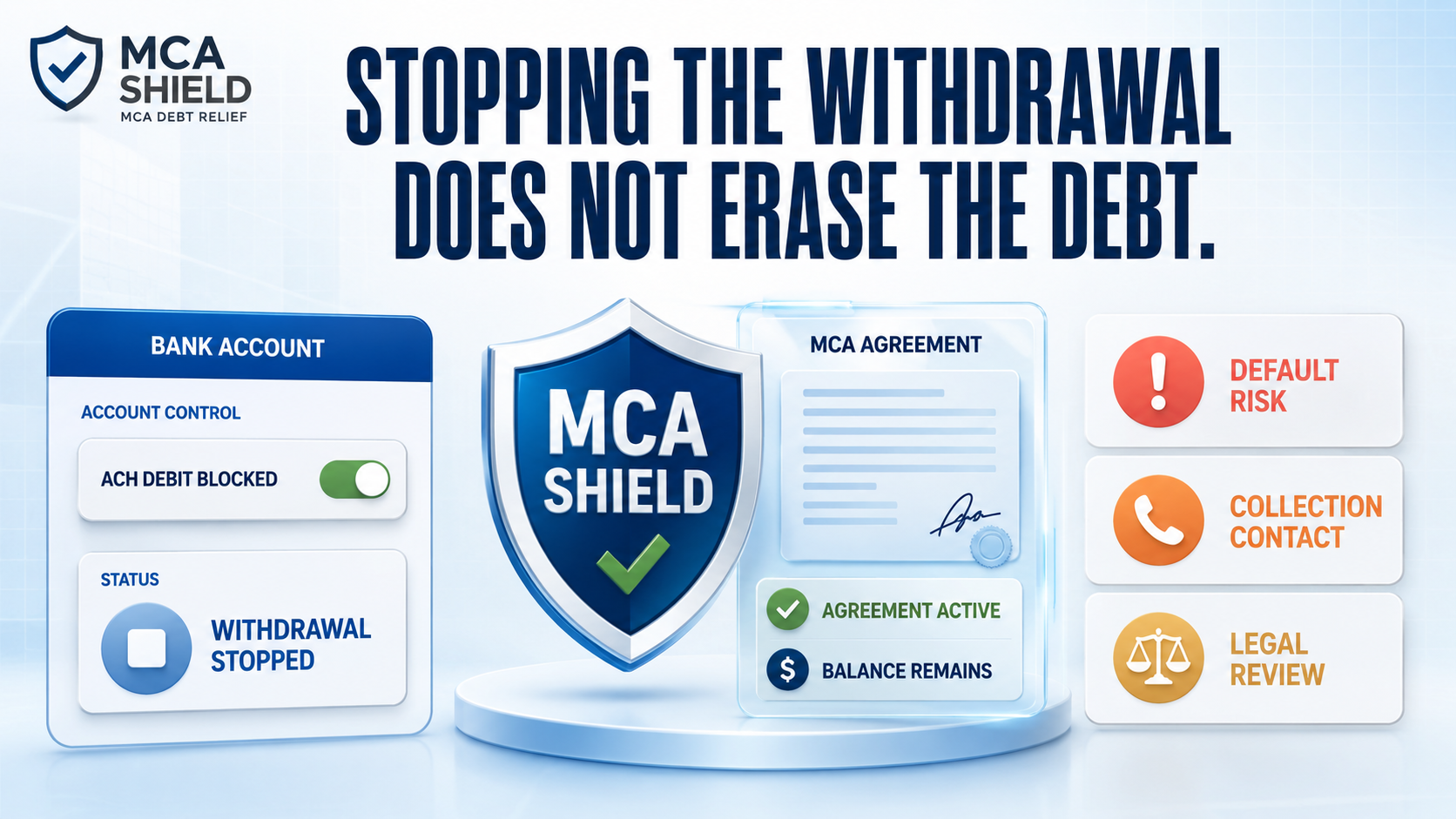
MCA ACH withdrawal blocked while the agreement remains active with default collection and legal risks

A business may ask its bank to block a particular debit or revoke authorization for future ACH withdrawals. This can prevent additional payments from being removed from the account, but it does not cancel the MCA agreement or eliminate the remaining balance.

The consequences depend on the contract, the reason payments were stopped, the business’s revenue, and applicable law. Before blocking an ACH debit, review the agreement and prepare a plan for communicating with the funder.

The Funder May Declare the Business in Default

Many MCA agreements identify actions that the funder may treat as a default. These can include blocking authorized withdrawals, closing the designated bank account, redirecting receivables, or interfering with the agreed collection process.

After a default, the funder may demand payment, add contractually permitted fees, suspend reconciliation rights, or begin collection activity. If the agreement includes a personal guarantee, security interest, or UCC filing, the funder may also attempt to enforce those provisions.

A blocked withdrawal does not always mean the business is refusing to pay. Insufficient funds, declining revenue, or unexpected expenses may have made the scheduled payment unaffordable. Communicating the problem and requesting a payment review may offer a better path than stopping debits without explanation.

Collection Calls and Legal Notices May Begin

Once payments are interrupted, the business may begin receiving calls, emails, default notices, or demands for payment. The funder or a third-party collection company may request that the missed payments be restored or that the remaining obligation be addressed through another arrangement.

If the matter escalates, the business could receive a legal demand or lawsuit. The potential response may depend on the agreement, governing state law, and any provisions involving collateral, receivables, UCC filings, or personal guarantees.

Keep copies of all agreements, bank statements, emails, letters, and payment records. Do not ignore formal legal documents. Lawsuit response deadlines can be short, and failing to respond may limit the business’s options. A qualified attorney should review the situation promptly if legal action has begun or assets are being threatened.

Changing Bank Accounts Does Not Eliminate the Obligation

Closing the original account or moving deposits to another bank may stop withdrawals from being processed, but it does not erase the MCA balance. The funder may still pursue collection based on the agreement.

Some contracts require the business to maintain a designated bank account, notify the funder before making changes, or avoid diverting receivables. Opening a new account to prevent collection could therefore create additional contractual issues.

The safer approach is to determine why the withdrawals became unaffordable and address the obligation directly. This may involve:

  • Confirming the remaining balance
  • Reviewing the agreement for reconciliation provisions
  • Documenting changes in business revenue
  • Calculating an affordable payment amount
  • Requesting a temporary reduction or modified schedule
  • Comparing restructuring, consolidation, and settlement options

If the goal is to stop MCA payments without filing bankruptcy, interrupting ACH withdrawals should not be treated as the complete solution. The business also needs a strategy to resolve the balance, protect essential operating cash, and reduce the risk of further collection or legal action.

Can MCA Payments Be Reduced Without Bankruptcy?

In many cases, a business may be able to pursue lower MCA payments without filing bankruptcy. The available options depend on the language of each agreement, current business revenue, remaining balances, payment history, and the funder’s willingness to modify the existing arrangement.

Reducing the payment is only helpful when the new amount fits the business’s actual cash flow. Before contacting a funder, calculate how much money must remain available for payroll, vendors, taxes, rent, and other essential operating expenses.

Requesting Reconciliation Based on Actual Revenue

Many merchant cash advance agreements describe the transaction as a purchase of future receivables. The funder collects an estimated daily or weekly amount based on a percentage of the business’s revenue.

If actual revenue falls below the amount used to calculate those withdrawals, the agreement may allow the business to request reconciliation. This process compares the payments collected with the receivables the business generated during a specific period. If the business has paid more than the agreed percentage, the funder may adjust future withdrawals or credit the difference.

A reconciliation request may require:

  • Recent business bank statements

  • Credit card processing statements

  • Revenue or sales reports

  • A completed reconciliation form

  • Written notice submitted within a specific deadline

Reconciliation is not available under every agreement, and the requirements can vary. Review the contract carefully and provide complete, accurate financial records when requesting an adjustment.

Renegotiating the Daily or Weekly Withdrawal Amount

When reconciliation is unavailable or does not provide enough relief, the business may ask the funder to reduce the withdrawal directly. A lower daily or weekly payment can leave more cash available for essential expenses and reduce the risk of overdrafts.

The request should be based on documented financial information rather than a number selected without analysis. The business should show its current revenue, necessary operating costs, existing MCA payments, and the amount it can consistently afford.

Possible modifications may include:

  • A temporary reduction in the withdrawal amount

  • A change from daily to weekly payments

  • A short payment pause

  • An extended payment period

  • A longer-term modified payment arrangement

A funder is not automatically required to approve a modification outside the original agreement. However, a clear proposal supported by current financial records may allow both parties to avoid repeated returned payments and further escalation.

Any change should be confirmed in writing. The document should explain the new payment amount, schedule, duration, fees, total remaining obligation, and what happens when the temporary arrangement ends.

Restructuring MCA Obligations Into an Affordable Plan

Restructuring may be considered when the original withdrawals are no longer sustainable or when several MCA payments are competing for the same revenue. The goal is to replace the existing payment burden with a structured arrangement the business can manage while continuing to operate.

A restructuring review typically examines:

  • Every active MCA agreement

  • Confirmed balances and payment histories

  • Current daily or weekly withdrawals

  • Average monthly revenue

  • Payroll and essential operating expenses

  • Available working capital

  • UCC filings, personal guarantees, and legal exposure

This information can be used to calculate a payment that the business can realistically maintain. Depending on the circumstances, restructuring may involve reduced withdrawals, extended terms, coordinated payments, or negotiated changes with individual funders.

Businesses seeking to stop MCA payments without filing bankruptcy should focus on resolving the underlying obligations, not only interrupting automatic debits. A properly evaluated payment plan can help preserve operating cash, reduce immediate strain, and create a clearer path toward completing the MCA obligations.

Which MCA Relief Options Can Help You Avoid Bankruptcy?
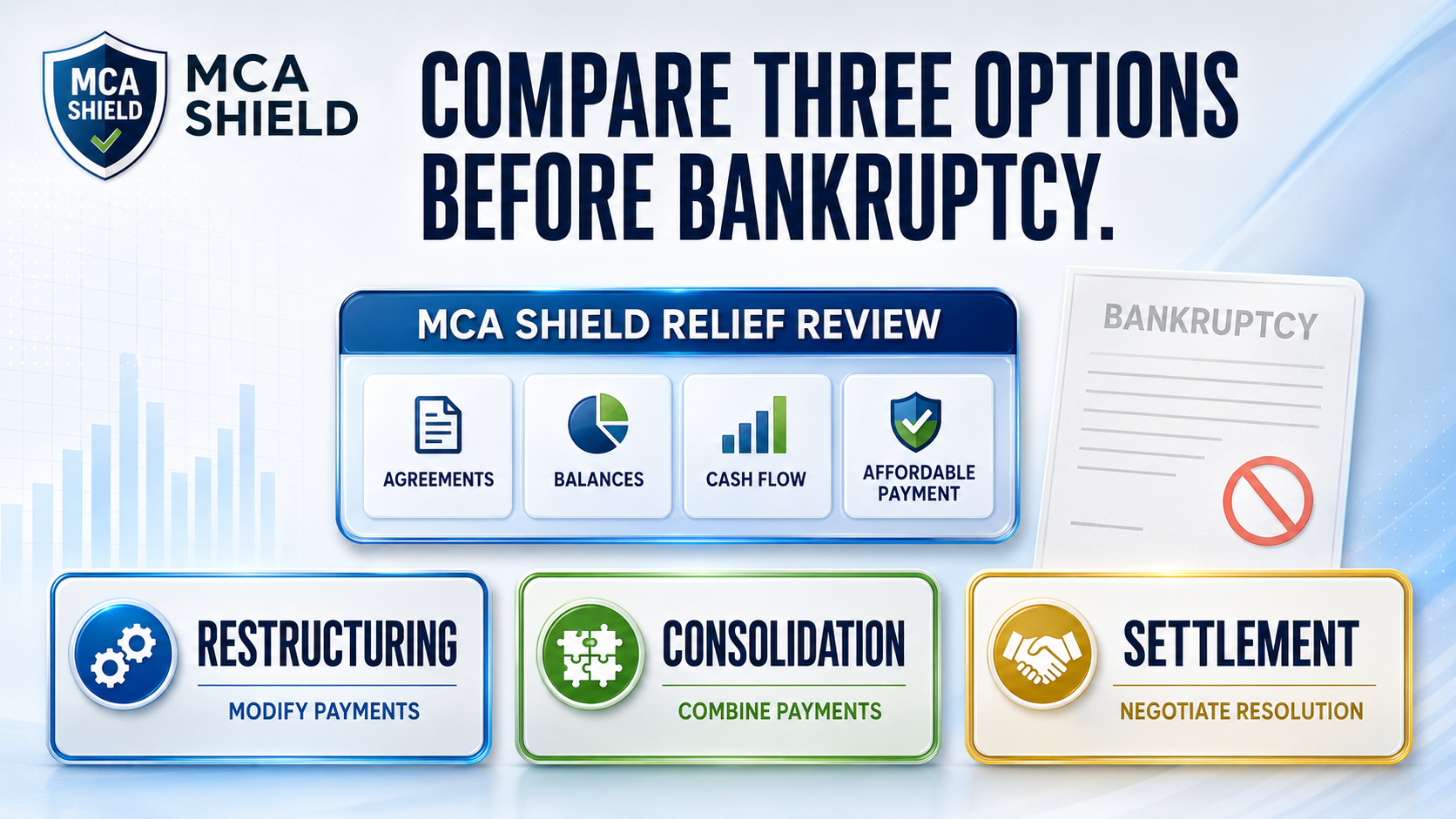
MCA Shield compares restructuring consolidation and settlement options for MCA relief before bankruptcy

Bankruptcy is not the only option when merchant cash advance payments become unaffordable. Depending on the business’s financial condition, it may be possible to reduce payment pressure through restructuring, consolidation, or settlement.

Each strategy works differently and carries its own costs, risks, and qualification requirements. Before choosing an option, review every agreement, confirm the balances, calculate the total withdrawal burden, and determine what the business can afford after essential expenses are covered.

MCA Debt Restructuring

MCA debt restructuring seeks to modify the current payment arrangement so it better matches the business’s available cash flow. This option may be appropriate when the business can continue making payments but cannot sustain the original daily or weekly withdrawal amounts.

A restructuring plan may involve:

  • Lower daily or weekly payments
  • A change in the withdrawal schedule
  • Extended repayment periods
  • Temporary payment reductions
  • Coordinated negotiations with multiple funders
  • Written modifications to existing terms

The primary objective is to design a manageable payment while keeping enough money for payroll, vendors, taxes, rent, and other essential expenses. Extending the payment period may increase the total cost or keep the obligation active longer, so the complete terms should be reviewed before accepting a proposal.

MCA Consolidation

MCA consolidation may combine multiple merchant cash advance obligations into one more organized payment structure. Instead of managing several separate withdrawals, the business makes one payment under the new arrangement.

Consolidation may help simplify cash-flow management and reduce the total amount withdrawn each day or week. However, approval may depend on revenue, existing balances, bank activity, creditworthiness, and the overall financial health of the business.

Before consolidating, compare:

  • The new payment with the combined existing withdrawals
  • The repayment period
  • Fees and financing costs
  • The total amount the business will repay
  • Any collateral or personal guarantee requirements
  • The treatment of existing UCC filings

A lower payment does not always mean a lower total cost. The business should confirm that the new structure provides meaningful cash-flow relief without creating an obligation it cannot maintain.

Negotiated MCA Settlement

Settlement involves negotiating an agreement to resolve an MCA obligation for an amount or payment structure different from the original balance. It may be considered when the business cannot afford the full obligation and restructuring or consolidation is not realistic.

A settlement may be paid through a lump sum or scheduled installments. Any agreement should clearly state the amount due, payment deadlines, treatment of the remaining balance, and whether related UCC filings or collection activity will be released after completion.

Settlement can involve significant risks. A funder may not agree to settle, collection efforts may continue during negotiations, and missed payments can lead to legal escalation. A reduced balance could also have tax consequences; the business may need guidance from an attorney or tax professional.

The best MCA relief option is the one that addresses the debt while preserving the cash needed to operate. Businesses seeking to stop MCA payments without filing bankruptcy should compare the payment amount, total cost, legal exposure, and long-term effect of each strategy before making a decision.

How Do UCC Filings and Personal Guarantees Affect Your Options?
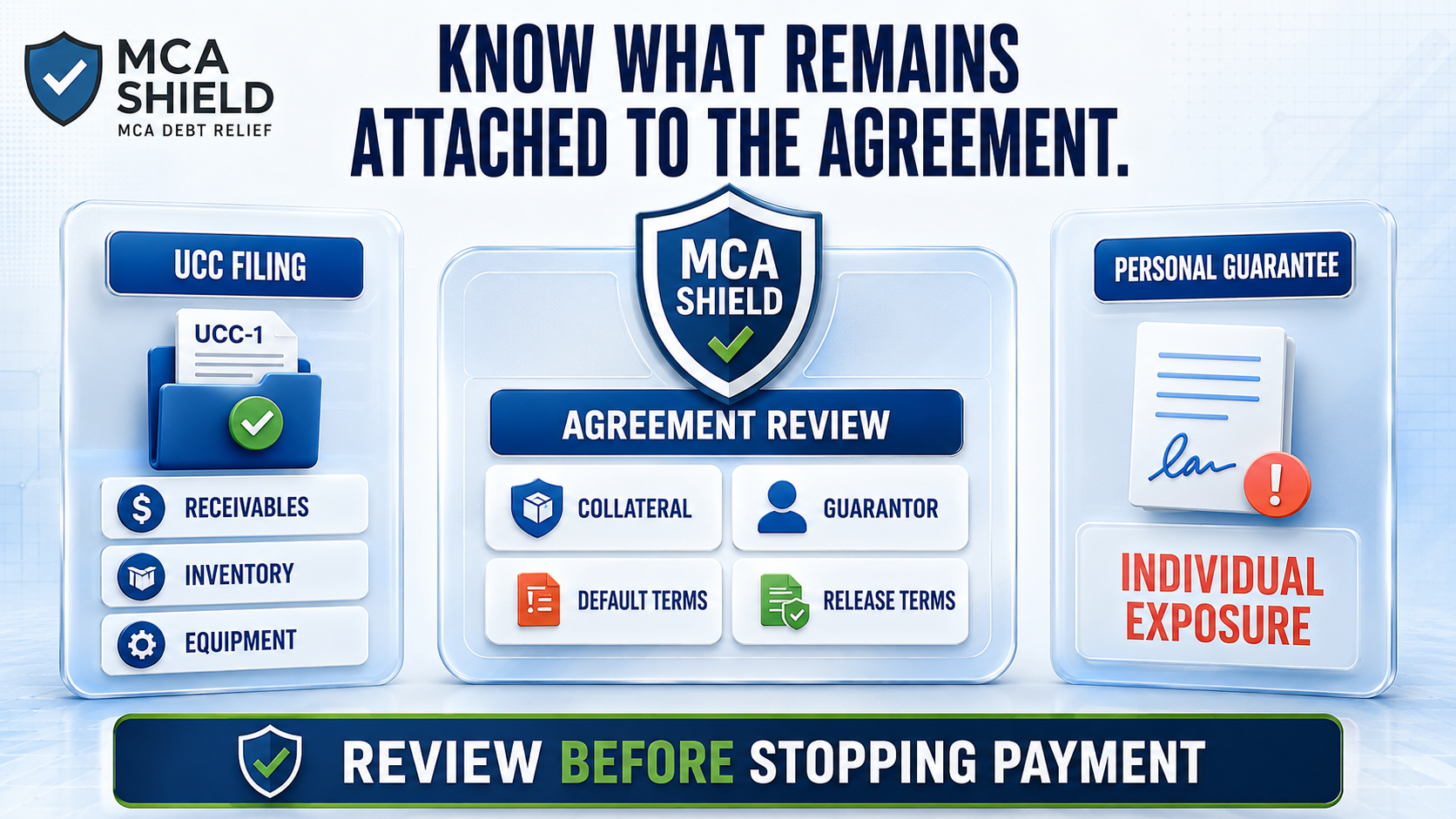
MCA Shield reviews UCC filings personal guarantees collateral default terms and individual financial exposure before stopping MCA payments

UCC filings and personal guarantees can affect what happens when MCA payments stop and how much leverage each party has during negotiations. These provisions do not automatically prevent restructuring, consolidation, or settlement, but they should be reviewed before changing bank accounts, blocking withdrawals, or missing payments.

Understanding what the funder may claim against the business or its owner can help determine which relief strategy presents the least risk.

A UCC Filing May Affect Business Assets and Receivables

A funder may file a UCC financing statement to provide public notice of its claimed security interest in certain business property. The agreement may identify collateral such as receivables, inventory, equipment, deposit accounts, or other business assets.

The scope of the filing can affect the business’s ability to obtain new financing. Another lender may be unwilling to provide funding while an existing funder claims a priority interest in the same assets. This can complicate consolidation or limit access to additional working capital.

A UCC filing does not automatically allow a funder to take every asset or freeze an account immediately. Enforcement rights depend on the agreement, the collateral described, applicable law, and any required legal process. Business owners should review both the MCA contract and the actual UCC filing to understand what property is covered.

Any negotiated resolution should explain what happens to the filing after the obligation is completed. If the balance is fully resolved, the business may need written confirmation stating the funder will terminate or release its UCC filing.

A Personal Guarantee May Create Individual Financial Exposure

A personal guarantee may allow the funder to pursue the business owner or another guarantor under circumstances described in the agreement. The exact exposure depends on the language and scope of the guarantee.

Some guarantees apply broadly after a payment default. Others are triggered only by specific conduct, such as diverting receivables, closing the designated bank account, providing inaccurate financial information, or interfering with the funder’s collection rights.

Possible consequences may include:

  • Personal collection demands
  • A lawsuit against the guarantor
  • A judgment if the funder prevails
  • Attempts to collect from nonexempt personal assets

A personal guarantee does not mean the funder automatically owns the guarantor’s personal property. The funder may still need to establish liability and follow the collection procedures required by applicable law.

Because guarantee provisions vary considerably, a qualified attorney should review the agreement if the funder is threatening personal assets or has started legal action.

Review the Agreement Before Stopping Any Payment

Stopping an ACH withdrawal without reviewing the agreement can trigger provisions involving default, collateral, receivables, or personal guarantees. The business may unintentionally give the funder additional grounds for collection or legal action.

Before stopping a payment, identify:

  • What actions the agreement defines as a default
  • Whether the business granted a security interest
  • Which assets are listed as collateral
  • Whether a UCC financing statement was filed
  • Who signed a personal guarantee
  • What conduct can trigger the guarantee
  • Whether the agreement provides reconciliation rights
  • Which state’s law governs the agreement

This review can reveal which relief options remain available and which actions may carry the greatest risk. It can also help the business prepare a more informed proposal for reconciliation, restructuring, consolidation, or settlement.

Businesses seeking to stop MCA payments without filing bankruptcy should understand every obligation within the agreement before interrupting payments. A carefully planned response can protect more options and reduce the possibility of avoidable financial or legal escalation.

Can MCA Funders Freeze Your Bank Account or Contact Customers?

An MCA funder generally cannot freeze a business bank account merely because an ACH withdrawal was blocked or returned. However, the funder may pursue legal remedies or attempt to enforce rights involving receivables, payment processors, and other collateral identified in the agreement.

The funder’s options depend on the contract, UCC documents, applicable state law, and whether a court judgment has been entered. It is important to understand how an automatic debit, a bank-account restraint, and an attempt to redirect business receivables differ.

Bank Account Restraints Usually Require Legal Action

A funder typically needs to pursue legal action and obtain a judgment before it can restrain or levy funds held in a business bank account. The required process varies by state and may include filing a lawsuit, serving the business, obtaining a judgment, and delivering the appropriate legal documents to the bank.

A routine ACH withdrawal is different from a bank-account freeze. ACH authorization allows the funder to debit an agreed-upon payment, but it generally does not give the funder unrestricted control over the entire account.

If an account has been frozen, the business should request copies of the restraint, levy, judgment, or other legal documents provided to the bank. An attorney can review those records and determine whether the restraint was properly obtained and whether any response options are available.

Ignoring a lawsuit can increase the risk of a default judgment. Business owners should respond promptly to court documents, even if they are already negotiating directly with the funder.

Confessions of Judgment and State Law May Affect Enforcement

Some commercial financing agreements contain a confession of judgment, also called a cognovit provision. Depending on the agreement and applicable law, this provision may allow a creditor to obtain a judgment without completing the ordinary lawsuit process.

Confessions of judgment are restricted, prohibited, or subject to special requirements in many jurisdictions. Their enforceability can depend on where the agreement was signed, where the business operates, where the judgment was entered, and whether required procedures were followed.

If an MCA agreement includes a confession-of-judgment provision, the business should not assume it is automatically enforceable or automatically invalid. A qualified attorney should review the contract, judgment documents, and governing law.

Early legal review may be especially important when the business receives:

  • Notice that a judgment has been entered
  • A bank-account restraint or levy
  • A demand involving personal assets
  • A subpoena or information request
  • Documents naming a personal guarantor
  • A notice involving customers or payment processors

Funders May Contact Payment Processors or Account Debtors

Some MCA agreements grant the funder rights involving the business’s receivables. If the business defaults, the funder may attempt to contact a credit card processor, marketplace, customer, or other party that owes money to the business.

These third parties may be referred to as account debtors. For example, if a customer has received an invoice but has not yet paid it, the customer may be considered an account debtor for that receivable.

A funder may send a notice instructing a payment processor or account debtor to redirect payments. The validity and effect of that demand depend on the agreement, any security interest, the UCC filing, and applicable law. Receiving a notice does not necessarily mean the funder is legally entitled to every payment or all future revenue.

Customer contact can create operational and reputational problems, even when legal rights remain disputed. The business should preserve notices, identify which customers or processors were contacted, and avoid making unsupported statements about the funder’s authority.

Businesses seeking to stop MCA payments without filing bankruptcy should understand these enforcement risks before blocking withdrawals. If a funder has restrained an account, entered a judgment, or contacted customers and payment processors, prompt legal review can help the business determine its rights and protect its remaining options.

When Should an MCA Attorney Become Involved?

An MCA attorney should become involved when the situation extends beyond a payment challenge and develops into a legal dispute. A debt relief company may help evaluate cash flow and explore payment options; however, only a qualified attorney can provide legal advice, represent the business in court, or challenge enforcement actions.

Seeking legal guidance early can help the business understand its rights, meet important deadlines, and avoid actions that could weaken its position.

The Business Has Received a Lawsuit or Legal Demand

A lawsuit, summons, complaint, demand letter, subpoena, or notice of judgment should be reviewed promptly. These documents may contain strict response deadlines. Ignoring them can allow the funder to pursue a default judgment or additional collection remedies.

An attorney can examine:

  • Whether the business was properly served
  • Which claims the funder is making
  • How the agreement defines default
  • Whether the amount demanded is accurate
  • Which state’s law governs the dispute
  • Whether defenses or counterclaims may be available
  • What must be filed before the response deadline

Ongoing negotiations do not automatically pause a lawsuit. Unless a written agreement or court order states otherwise, the business should continue meeting all legal deadlines while discussing a possible resolution.

The Funder Is Threatening Assets or Enforcing a Guarantee

Legal guidance is especially important when the funder threatens to restrain a bank account, pursue business assets, redirect receivables, contact customers, or enforce a personal guarantee.

An attorney can review the security agreement, UCC filing, guarantee, and collection documents to determine what the funder may legally pursue. The review may also clarify whether the funder must obtain a judgment before taking a particular action.

Contact an attorney promptly if the business receives:

  • A bank levy or account-restraint notice
  • A demand directed to a personal guarantor
  • Notice that customers or processors must redirect payments
  • Documents claiming a right to inventory or equipment
  • A notice of judgment or enforcement action
  • Threats involving personal or business property

These situations may affect both the company and the individual who signed the guarantee. Waiting until assets have already been restrained can make the problem more difficult to address.

Contract Terms or Collection Practices Are Disputed

An attorney may also be needed when the parties disagree about the meaning or enforcement of the MCA agreement. Common disputes can involve reconciliation rights, default provisions, unauthorized fees, the remaining balance, UCC collateral, or the scope of a personal guarantee.

The business may also question whether collection communications, customer contacts, or payment demands are consistent with the agreement and applicable law. An attorney can evaluate the facts and explain which legal protections or remedies may apply.

Helpful documents for the attorney may include:

  • The complete MCA agreement and all addenda
  • Bank and payment-processing statements
  • Payment histories and balance records
  • UCC financing statements
  • Emails, letters, and collection notices
  • Court documents and legal demands
  • Communications involving customers or processors

Working with an attorney does not necessarily prevent restructuring, consolidation, or settlement. Legal counsel and an MCA relief professional may address different parts of the same problem. The attorney can handle legal risks and disputes, while the financial review focuses on cash flow and an affordable payment strategy.

Businesses seeking to stop MCA payments without filing bankruptcy should involve an attorney when legal action, asset enforcement, personal liability, or disputed contract rights become part of the situation. Prompt advice can protect the business’s response options while negotiations continue.

When Is Bankruptcy Considered for MCA Debt?
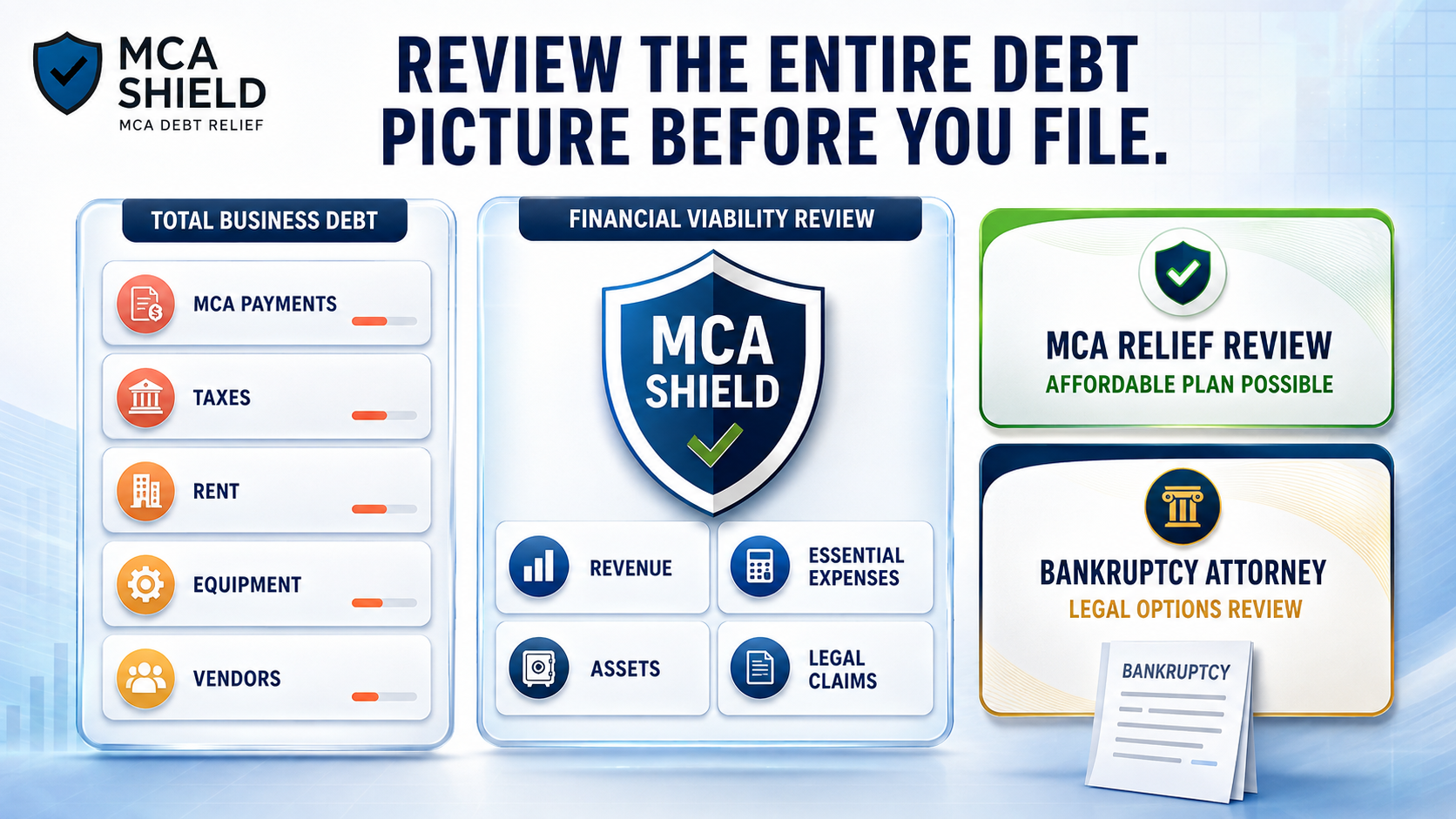
MCA Shield reviews business debt revenue expenses assets and legal claims before considering bankruptcy for MCA debt

Bankruptcy may be considered when MCA obligations are part of a larger financial crisis that the business cannot resolve through ordinary negotiations. It is a formal legal process that can affect business assets, credit, contracts, ownership interests, and future operations.

The decision should be based on the business’s financial condition, not one unaffordable withdrawal. Before filing, review all debts, assets, income, expenses, legal claims, UCC filings, and personal guarantees with a qualified bankruptcy attorney.

Bankruptcy May Be Considered When Multiple Debts Are Unmanageable

A business may reach a point where reducing its MCA payments would not solve the larger problem. It may also be behind on taxes, rent, equipment financing, credit cards, vendor accounts, payroll obligations, or other loans.

Bankruptcy may require serious consideration when:

  • The business cannot meet essential expenses
  • Several creditors are pursuing collection at the same time
  • Lawsuits or judgments threaten business operations
  • Bank accounts or receivables are being restrained
  • The company has more debt than its cash flow can support
  • Negotiated payment plans remain unaffordable
  • The business cannot realistically recover under its current obligations

A business bankruptcy may provide an organized process for addressing multiple creditors. However, filing can also involve substantial costs, reporting requirements, court supervision, and long-term consequences. It should not be treated as a simple way to cancel MCA payments.

A bankruptcy filed by a business entity may not automatically eliminate an owner’s liability under a personal guarantee. The treatment of guarantees depends on who files, the contract, and the type of bankruptcy involved.

MCA Relief May Be Possible Before Bankruptcy Becomes Necessary

If the business remains operational and can afford a reduced payment, an MCA relief strategy may ensure an alternate path. Reconciliation, restructuring, consolidation, or settlement could reduce immediate pressure without placing the entire business into bankruptcy.

Before deciding that bankruptcy is necessary, determine:

  • The total balance of every MCA obligation
  • The combined daily or weekly withdrawal amount
  • The revenue the business currently generates
  • The amount needed for essential operating expenses
  • The payment the business can consistently afford
  • The status of any lawsuits, UCC filings, or guarantees
  • Whether funders are willing to negotiate

MCA relief is not appropriate in every case. Reducing one category of payment may not be enough when the business also has substantial tax debt, secured loans, judgments, or other unmanageable obligations.

The business should also avoid delaying legal advice simply to continue negotiations. If lawsuits, account restraints, or asset-enforcement actions are already underway, an attorney can explain how those developments affect the available options.

A Bankruptcy Attorney Can Explain the Available Legal Options

A bankruptcy attorney can evaluate the business structure, debts, assets, income, guarantees, and long-term goals. The available options differ for corporations, limited liability companies, partnerships, sole proprietors, and individual business owners.

Depending on the circumstances, the attorney may discuss:

  • Chapter 7 liquidation
  • Chapter 11 reorganization
  • Subchapter V for qualifying small-business debtors
  • Chapter 13 for eligible individuals, including some sole proprietors

The attorney can also explain how filing may affect collection activity, business assets, leases, secured creditors, employees, and personal guarantees. If the owner has personally guaranteed an MCA, separate advice may be needed concerning the owner’s individual exposure.

Businesses seeking to stop MCA payments without filing bankruptcy should compare relief options before financial and legal problems become more difficult to manage. When the company cannot support any realistic repayment plan, a bankruptcy consultation can provide a clearer understanding of the risks, protections, and possible next steps.

Stop MCA Payment Pressure Before It Threatens Your Business
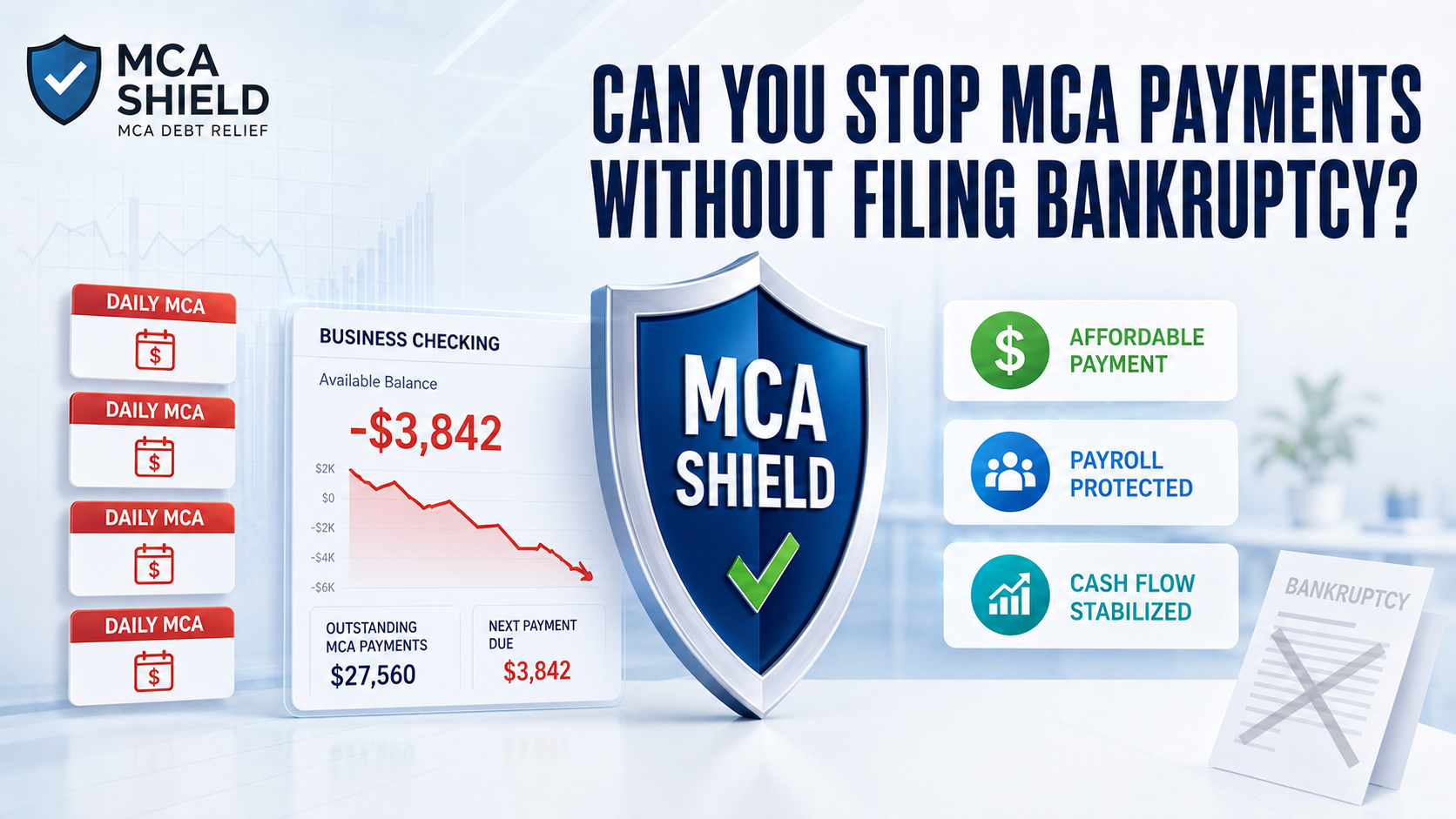
MCA Shield reviews MCA payment pressure and creates an affordable plan to protect payroll vendors operating cash and business stability

Unaffordable MCA withdrawals can affect far more than the business bank account. When daily or weekly payments begin interfering with payroll, vendors, inventory, taxes, and essential expenses, waiting can allow the financial strain to spread.

Taking action early gives the business more time to understand its obligations, evaluate available relief options, and work toward a structured solution before returned payments or collection activity intensify.

Review Every Agreement, Balance, and Withdrawal

Begin by gathering each active MCA agreement, bank statement, payment record, and funder communication. Reviewing the complete financial picture can reveal how much the business owes, how much is being withdrawn, and which obligations are creating the greatest strain.

The review should confirm:

  • Each funder and remaining balance
  • Daily or weekly withdrawal amounts
  • Payment histories and disputed charges
  • Reconciliation provisions
  • Default terms and potential fees
  • UCC filings and collateral provisions
  • Personal guarantees
  • Pending collection or legal activity

Do not rely solely on estimated balances or verbal statements. Accurate information is essential when comparing reconciliation, restructuring, consolidation, and settlement.

Calculate a Payment the Business Can Realistically Afford

A lower payment only helps if the business can maintain it. Before accepting a new arrangement, calculate the amount available after payroll, rent, taxes, utilities, inventory, vendor invoices, and other essential expenses are covered.

The calculation should account for seasonal revenue changes and slower operating periods. A payment based only on the business’s strongest month could recreate the same cash-flow problem later.

An affordable plan should leave enough operating cash to:

  • Cover payroll on time
  • Keep vendors current
  • Maintain necessary inventory and supplies
  • Pay taxes and fixed expenses
  • Avoid repeated overdrafts
  • Begin rebuilding a working-capital reserve

The new arrangement should also be reviewed for fees, total cost, payment duration, and written release terms. A reduced daily withdrawal may provide immediate relief, but the complete proposal must work for the business over time.

Schedule a Free Consultation With MCA Shield

If MCA withdrawals are placing your business under increasing strain, MCA Shield can review your agreements, balances, payment activity, and current cash flow. The goal is to identify the source of the payment burden and determine which relief options may fit the business’s financial situation.

Depending on the agreements and circumstances, potential strategies may include reconciliation, payment restructuring, consolidation, or negotiated settlement. If lawsuits, judgments, or disputed legal rights are involved, the business may also need guidance from a qualified attorney.

You may be able to stop MCA payments without filing bankruptcy, but acting before the situation escalates can protect more options. Schedule a free consultation with MCA Shield to review your MCA obligations and begin building a more manageable path forward.

Schedule Your Free Consultation