
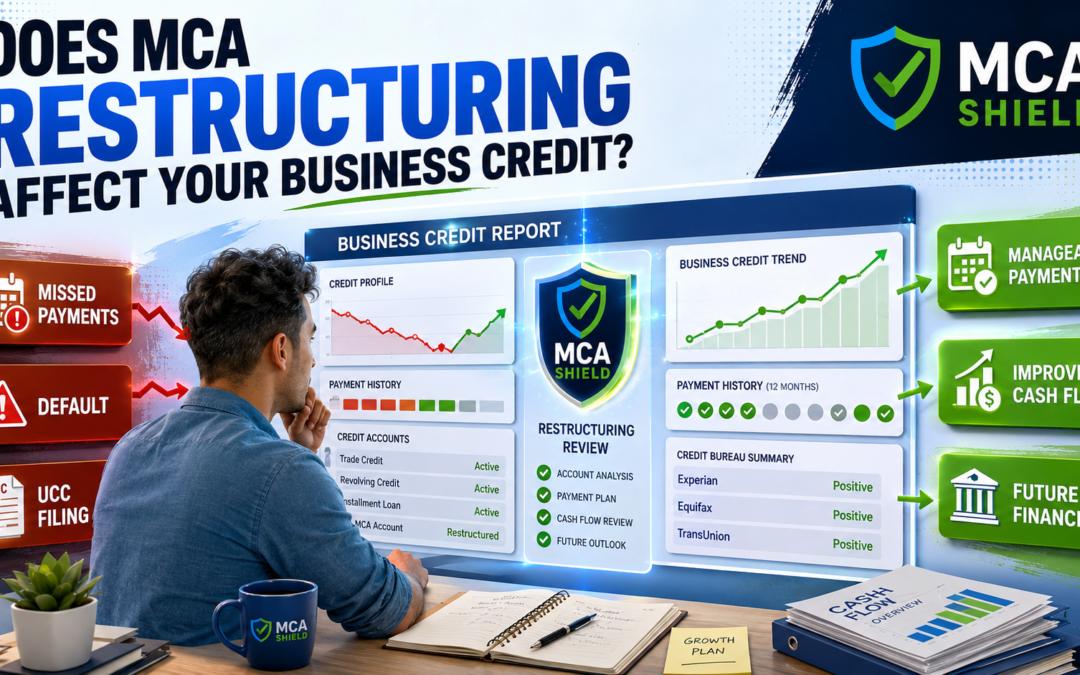
MCA restructuring and business credit are closely connected, but restructuring does not automatically damage your credit profile. The impact often depends on whether the MCA provider reports payment activity, whether payments were missed before restructuring, and how the new agreement is handled.
Restructuring may help reduce payment pressure and stabilize cash flow before the business falls further behind. However, defaults, collection activity, lawsuits, and unresolved UCC filings can create additional financial problems. Understanding these risks can help you protect your business credit while working toward more manageable MCA payments.
Schedule Your Free Consultation
How MCA Restructuring Can Affect Your Business Credit
MCA restructuring and business credit can be connected in several ways. However, restructuring does not automatically lower your business credit score. The outcome depends on how the MCA provider reports the account, whether the business has already missed payments, and what appears in the new agreement.
Restructuring may help a business replace unaffordable withdrawals with a more manageable payment arrangement. That can protect working capital and reduce the risk of returned payments, collections, or default. Still, business owners should understand both the direct and indirect credit effects before accepting new terms.
Direct Credit Reporting vs. Indirect Financial Impact
Some MCA providers may report payment activity to commercial credit bureaus, while others may not. If the account appears on a business credit report, missed payments, defaults, settlements, or other changes could affect the company’s credit profile. The way the provider reports a restructured account may also vary.
Even when the MCA does not appear on a business credit report, it can still affect the company indirectly. High daily or weekly withdrawals may reduce available cash and make it harder to pay vendors, credit cards, equipment loans, or other obligations on time. Late payments on those accounts may then damage the business’s credit history.
Future lenders may also review financial information beyond a credit score. They could examine:
- Recent business bank statements
- Returned ACH payments and overdrafts
- Existing UCC filings
- Collection activity or public legal records
- Current debt payments and available cash flow
- The business’s ability to cover operating expenses
Therefore, restructuring may help protect business credit when it prevents further missed payments and increases cash flow. However, it cannot automatically remove accurate negative information that has already been reported.
Why the Terms of the Restructuring Agreement Matter
The details of the new agreement can influence whether MCA restructuring improves the company’s financial position or creates additional problems. A lower payment may provide immediate relief, but the business must also review the repayment period, total cost, withdrawal schedule, fees, and default provisions.
Before committing, the owner should confirm whether the agreement clearly explains:
- The new payment amount and frequency
- The total amount the business must repay
- Any additional fees or charges
- How previous missed payments will be handled
- Whether collection activity will stop
- What happens to existing UCC filings
- How the account may be reported after completion
Every restructuring agreement should be carefully evaluated and kept in writing. Verbal promises may be difficult to verify if a dispute develops later.
Most importantly, the revised payment must fit the business’s actual cash flow. An agreement that still leaves too little money for payroll, taxes, inventory, and operating expenses may only delay another default. A sustainable restructuring plan should reduce payment pressure while protecting the cash the business needs to continue operating.
Do Merchant Cash Advance Companies Report to Business Credit Bureaus?
Some merchant cash advance companies report account activity to business credit bureaus, while others do not. There is no universal reporting policy across the MCA industry. Whether the advance appears on a business credit report depends on the provider, the reporting agency, and how the account is handled.
Business owners should not assume an MCA is invisible simply because it does not appear as a traditional loan. Payment activity, collection accounts, UCC filings, and public records may still reveal the obligation or affect the company’s overall credit profile.
Which Business Credit Reports May Show MCA Activity
MCA activity may appear on commercial credit reports maintained by agencies such as Experian Business, Dun & Bradstreet, or Equifax Business. However, the information shown can differ between reports because each agency collects data from its own sources.
If an MCA provider reports directly, the report may include the account balance, payment history, delinquency status, collection activity, or other details. Experian business credit reports can include trade payment history, collections, UCC filings, liens, judgments, and bankruptcies. Dun & Bradstreet reports may also contain payment experiences, risk indicators, and legal events. (Experian, Dun & Bradstreet)
A business owner should review reports from more than one credit bureau. An MCA account or related filing may appear on one report but not another. Monitoring each report also allows the owner to identify outdated, incomplete, or inaccurate information.
Why Some MCA Obligations Never Appear on a Credit Report
Some MCA obligations never appear as individual accounts because the provider does not submit payment data to commercial credit bureaus. Business credit reporting is not as uniform as consumer credit reporting. Even legitimate business obligations may be absent when the creditor or supplier does not participate in a bureau’s reporting system.
Experian explains that not every supplier reports payment history. Therefore, an account may be missing even though the obligation is active and legally enforceable. (Experian)
An MCA may also be categorized differently from a conventional business loan. Because merchant cash advances are generally structured as purchases of future receivables, they may not appear under the same account category as a term loan or line of credit.
However, the absence of a reported account does not mean missed payments have no consequences. The provider may still pursue collection activity, enforce contractual remedies, file a lawsuit, or rely on a UCC filing connected to the agreement. Those developments can become visible through other records.
Other Ways Future Lenders May Discover the Advance
Future lenders usually review more than a business credit score. During underwriting, they may examine recent bank statements, existing obligations, public filings, cash-flow trends, and the company’s ability to support an additional payment.
A lender may discover an MCA through:
- Daily or weekly ACH withdrawals shown on bank statements
- Deposits split through a payment processor
- Existing UCC financing statements
- Collection accounts or legal records
- Payoff or balance verification requests
- Debt schedules included with a financing application
- Reduced cash flow caused by multiple withdrawals
A UCC filing can be especially important during a financing review. It identifies a creditor’s claimed security interest and may affect another lender’s position relative to existing creditors. Experian and Dun & Bradstreet both include UCC information in certain commercial credit reports. (Experian, Dun & Bradstreet)
Business owners should disclose active MCA obligations accurately when applying for financing. Hiding an advance may create concerns if the lender discovers it through bank statements, UCC searches, or other financial records. Clear documentation of the MCA restructuring agreement and a consistent payment history may help demonstrate that the business has taken steps to control the obligation.
Does MCA Restructuring Hurt Your Business Credit Score?
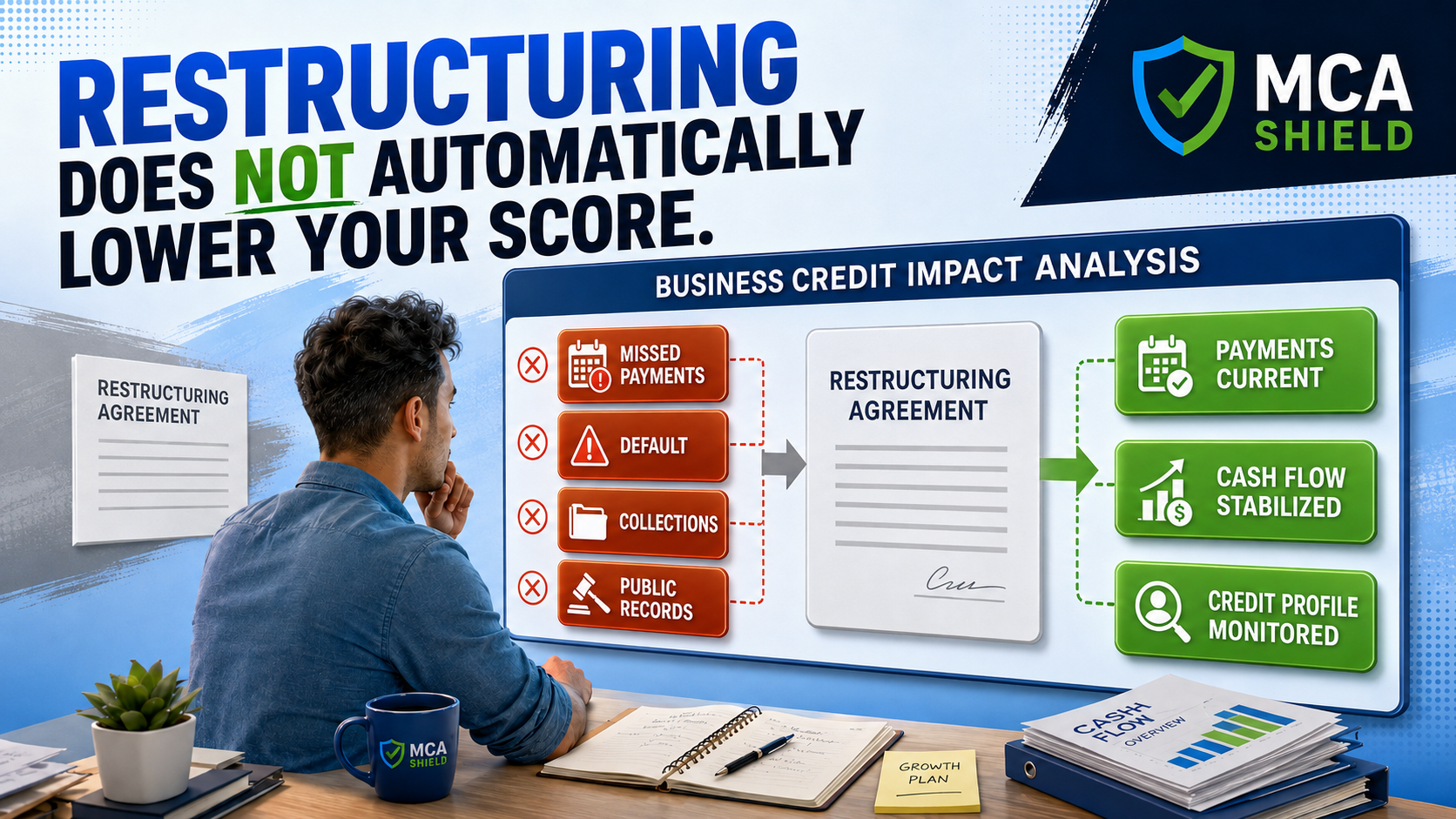
MCA restructuring does not automatically hurt your business credit score. The effect depends on what the MCA provider reports, how the account was handled before restructuring, and whether the business adheres to the new payment agreement.
In many cases, continuing with unaffordable withdrawals creates more risk than restructuring the obligation. If a revised agreement helps the business avoid missed payments, returned withdrawals, or default, it may reduce the chance of further financial damage.
Restructuring Alone May Not Lower Your Score
Business credit bureaus use different scoring systems and collect information from different sources. Therefore, simply entering an MCA restructuring agreement may not trigger an immediate decrease.
If the MCA provider does not report account activity, the restructuring itself may never appear as a separate item. Even when the provider reports the account, the effect can depend on how it describes the new arrangement. The account might appear as restructured, modified, delinquent, settled, or paid according to new terms.
Business owners should ask how the MCA provider plans to report the account. They should also request written confirmation of the new payment schedule, total repayment amount, and account status.
After the agreement begins, monitor business credit reports for changes. If inaccurate information appears, gather the agreement and payment records before contacting the appropriate credit bureau to dispute the error.
Missed Payments and Defaults Can Create Greater Risk
A business may face more serious consequences when it waits until payments begin failing. Missed or returned withdrawals can lead to collection activity, default notices, lawsuits, or enforcement of remedies included in the MCA agreement.
These developments may affect the company even when the original MCA account was never reported. For example, collection activity or public records may appear on a business credit report. Existing UCC filings may also become more important when another lender reviews the business.
Payment pressure can create indirect credit damage. Heavy daily or weekly withdrawals may leave too little money for other obligations. As a result, the business could fall behind on credit cards, equipment financing, supplier invoices, rent, or taxes.
Warning signs may include:
- Repeated overdrafts or returned ACH withdrawals
- Late payments to vendors and creditors
- Declining cash reserves
- Delayed payroll or tax payments
- New borrowing used to cover existing MCA payments
- Collection notices or default warnings
Addressing the payment problem early may give the business more options. Once several accounts become delinquent, restoring cash flow and protecting business credit can become more difficult.
How Improved Cash Flow May Support Future Creditworthiness
Improved cash flow does not erase accurate negative information or guarantee that a business credit score will rise. However, it can help the business build stronger financial habits and avoid additional late payments.
A manageable restructuring plan may leave more money for payroll, taxes, vendors, inventory, and operating expenses. It may also reduce the need to use another high-cost advance to cover short-term shortages.
Over time, stronger cash flow may help the business:
- Make financial obligations on time
- Reduce dependence on emergency financing
- Maintain more stable bank balances
- Avoid returned payments and overdrafts
- Lower outstanding balances
- Rebuild cash reserves
Future lenders may review business credit reports alongside bank statements, revenue, current obligations, and payment history. Consistent deposits and manageable withdrawals may present a stronger financial picture than an account showing repeated payment failures.
For that reason, the goal of MCA restructuring should extend beyond decreasing one payment. The new arrangement should support the business’s overall ability to meet its obligations while maintaining enough working capital to operate.
How MCA Default Can Cause More Credit Damage Than Restructuring
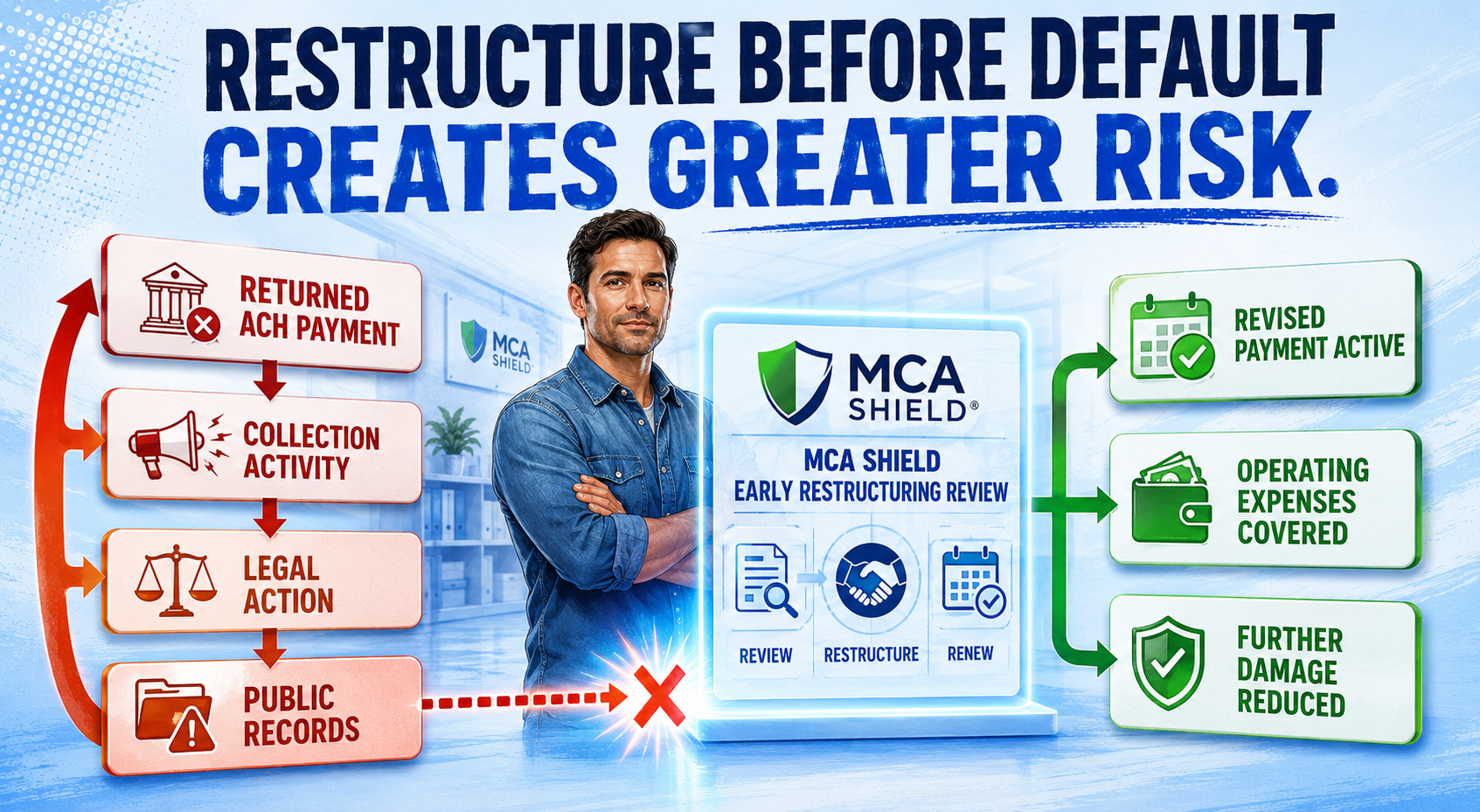
Defaulting on a merchant cash advance may create greater financial and credit risk than restructuring the obligation before payments fail. Restructuring can provide a controlled way to address unaffordable withdrawals. Default, however, may trigger collection activity, legal action, or other remedies included in the MCA agreement.
The exact consequences depend on the contract and the provider’s response. Still, acting before default may help the business avoid a chain of problems that becomes harder to control over time.
Returned ACH Payments and Collection Activity
Many MCA providers collect payments through daily or weekly ACH withdrawals. If the business account lacks sufficient funds, the withdrawal may be returned. One returned payment may not directly lower a business credit score. However, it can become evidence of cash-flow trouble and may trigger default provisions in the agreement.
Repeated returned withdrawals can also lead to:
- Bank overdraft and returned-payment fees
- Increased collection calls and notices
- Additional fees under the MCA agreement
- Attempts to debit the account again
- Demands for immediate payment
- Referral to an outside collection agency
Collection activity may become visible on a business credit report if the provider or collection agency submits the account information. Even when it does not appear on a credit report, future lenders may notice repeated withdrawal attempts and negative balances when reviewing bank statements.
Returned payments can also create problems beyond the MCA. If the withdrawals leave insufficient money for vendors, credit cards, rent, taxes, or equipment financing, those accounts may become delinquent. Therefore, one unaffordable MCA payment can contribute to broader credit damage.
UCC Filings, Lawsuits, and Business Public Records
Many MCA agreements authorize the provider to file a UCC financing statement. A UCC filing identifies a claimed security interest in certain business assets. It may exist before any default occurs, so the filing alone does not necessarily prove that the business failed to pay.
However, an active UCC filing may affect future financing decisions. Another lender may review the filing to determine which creditor has priority over business assets. This can complicate approval, reduce available financing options, or create payoff requirements before new funding is issued.
If default continues, the provider may also pursue legal remedies allowed by the agreement and applicable law. Depending on the circumstances, this could include a lawsuit, judgment, or enforcement against business assets.
Lawsuits, judgments, liens, and other public records may appear in commercial credit reports or lender background searches. These records can raise concerns because they indicate a more serious dispute than a privately negotiated restructuring agreement.
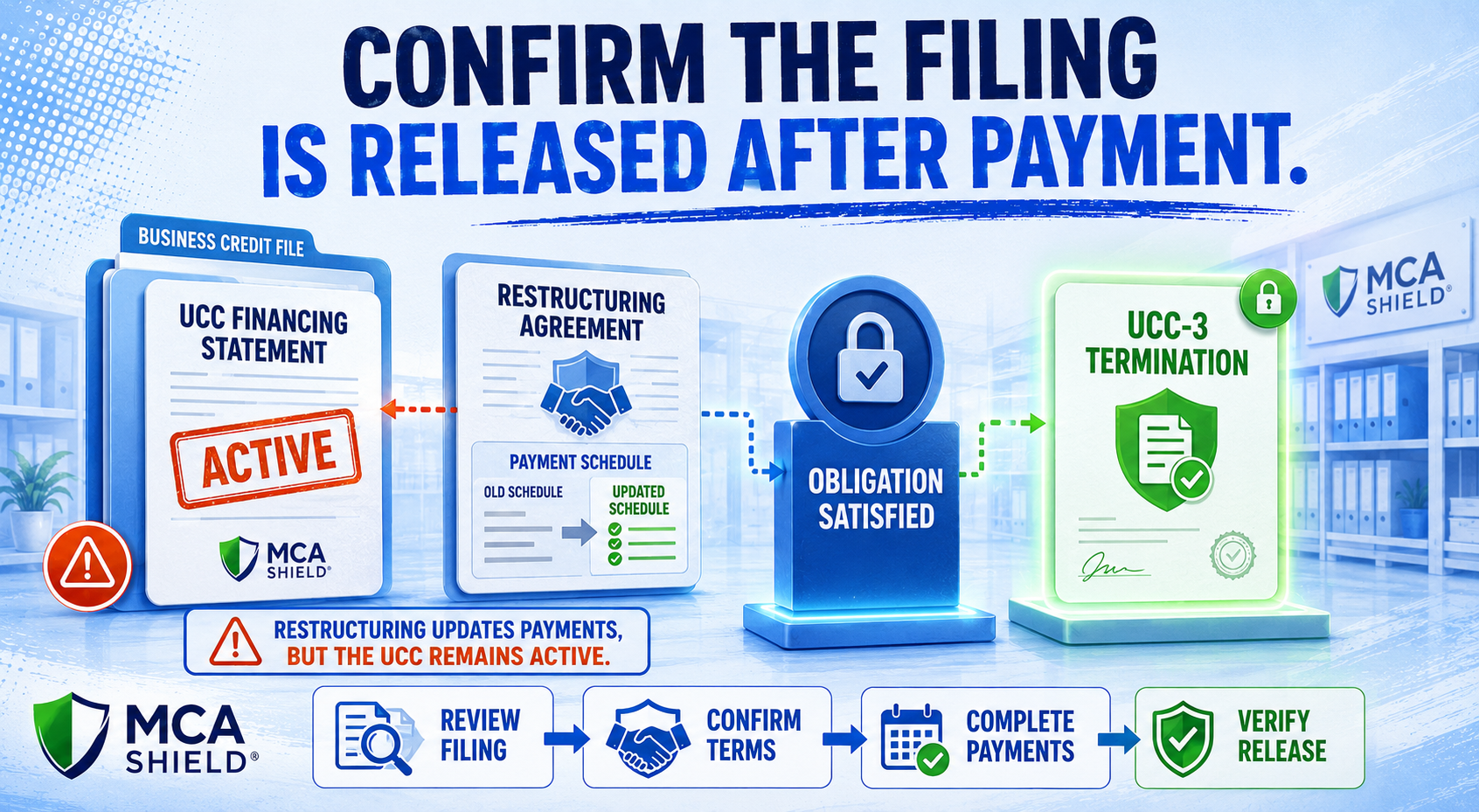
Business owners should review all UCC filings for accuracy after an obligation is satisfied. Paying or restructuring an MCA does not automatically remove a filing. The agreement should clearly explain whether and when the provider will file a termination statement.
The Risks of Waiting Until the Business Is in Crisis
Waiting until cash flow collapses can reduce the options available to the business. By that point, the owner may already be dealing with returned payments, frozen vendor relationships, collection demands, or legal notices.
A crisis can also push the business toward short-term decisions. For example, the owner may accept another MCA to cover the first one. That choice can increase the number of withdrawals and place even more pressure on working capital.
Signs that the business should consider its options include:
- MCA payments consuming too much daily revenue
- Payroll or operating expenses becoming difficult to cover
- Frequent overdrafts or returned ACH withdrawals
- Vendors receiving late payments
- Cash reserves continuing to decline
- Another advance being used to cover existing debt
- Default or collection notices arriving
Early restructuring does not guarantee that business credit will remain unaffected. However, it may help prevent additional missed payments and reduce the risk of collections or legal escalation.
The goal is to address the payment problem while the business still has revenue, records, and enough working capital to support a realistic agreement. Acting before the crisis becomes severe may protect more options and create a clearer path toward financial stability.
Can MCA Restructuring Affect Your Personal Credit?
MCA restructuring usually focuses on a business obligation. Therefore, it does not automatically affect the owner’s personal credit. However, the original agreement may include a personal guarantee that creates additional risk if the business defaults or violates specific contract terms.
The potential impact depends on the agreement, the provider’s reporting practices, and how the restructuring is documented. Owners should review both the original MCA contract and the proposed restructuring agreement before accepting new terms.
Review the Personal Guarantee in Each MCA Agreement
A personal guarantee may allow the MCA provider to pursue the business owner under certain circumstances. However, guarantees do not all contain the same language. Some apply broadly to payment obligations, while others focus on specific actions or breaches.
The owner should determine whether the guarantee applies to:
- Missed or returned payments
- Blocking authorized ACH withdrawals
- Diverting receivables to another account
- Closing or changing the business bank account
- Providing inaccurate financial information
- Selling business assets without permission
- Filing for bankruptcy or closing the business
- Other events defined as a default
The restructuring agreement may modify, reaffirm, expand, or release parts of the original guarantee. Any change should appear clearly in writing. Owners should not assume that restructuring automatically removes personal liability.
Before signing, review which obligations remain enforceable and what happens after the restructured balance is paid. The agreement should also explain whether the provider will issue a written release when all required payments are complete.
When Business Debt May Become a Personal Liability
A business obligation may become a personal concern when the provider seeks to enforce a valid guarantee. Whether it can do so depends on the contract language, the facts surrounding the default, and applicable law.
Restructuring alone does not necessarily activate the personal guarantee. In fact, a negotiated agreement may help the owner address the obligation before enforcement becomes more likely. Problems may arise if the business stops making payments, fails to follow the revised agreement, or takes an action that breaches the contract.
Potential consequences may include:
- Collection demands directed to the guarantor
- A lawsuit naming the business owner personally
- Legal costs associated with defending a claim
- A negotiated payment funded with personal money
- Pressure on personal savings or other assets
- Difficulty qualifying for future credit
Personal financial strain can also indirectly affect credit. For example, an owner who uses personal credit cards to cover payroll or MCA payments may increase personal balances. If the owner then misses personal payments, the consumer credit score may suffer.
Because personal guarantee laws and contract terms vary, owners facing enforcement should consider having a qualified attorney review the agreement.
Why Owners Should Monitor Both Business and Personal Credit
Business and personal credit reports contain different information. An MCA may appear on neither report, one report, or through related activity such as collections or credit inquiries. Therefore, owners should monitor both profiles during and after restructuring.
Reviewing business credit reports may reveal:
- Reported payment activity
- Collection accounts
- UCC filings
- Liens, judgments, or other public records
- Incorrect balances or account statuses
Reviewing personal credit reports may reveal:
- Unauthorized or unexpected inquiries
- Personal accounts used to support the business
- Collection accounts reported under the owner’s name
- Increased balances or missed personal payments
- Inaccurate information connected to the business obligation
Owners should keep copies of the original MCA agreement, restructuring documents, payment confirmations, and final release. These records may be needed to correct inaccurate reporting or prove that the obligation was completed.
Monitoring both credit profiles does not prevent every problem. However, it can help the owner identify changes early and respond before an error or unresolved account triggers further damage.
Will MCA Restructuring Make It Harder to Get Business Financing?
MCA restructuring may influence future financing decisions, but it does not automatically prevent a business from qualifying. Each lender uses different approval standards. Some may focus on the restructuring, while others may place greater weight on recent revenue, payment history, and available cash flow.
A successful restructuring may show that the business addressed an unsustainable payment problem. However, lenders may still want to know why the business needed relief and whether it can handle another obligation.
What Future Lenders May Review
Future lenders usually review more than a business credit score. They may examine the company’s full financial position to determine whether the requested financing is affordable.
The review may include:
- Business and personal credit reports
- Recent bank statements
- Monthly revenue and expenses
- Existing MCA and loan payments
- Returned ACH withdrawals or overdrafts
- UCC filings and public records
- Tax returns or financial statements
- Time in business and industry risk
- The purpose of the new financing
A lender may also ask for a copy of the MCA restructuring agreement. The document can show the current payment amount, remaining balance, and expected completion date.
Accurate records can make this process easier. Businesses should keep copies of the original MCA agreement, revised payment terms, payment confirmations, and any final release. Clear documentation can help the owner explain the restructuring and show that the account remains under control.
How Bank Statements and Cash Flow Influence Approval
Bank statements often reveal more than a credit report. They show the company’s deposits, withdrawals, average balances, overdrafts, and payment patterns.
A lender may look for signs that the business has enough cash to support a new payment. Stable revenue and consistent balances may strengthen the application. In contrast, frequent overdrafts or negative balances may indicate that the company remains under financial pressure.
Common warning signs include:
- Daily withdrawals consuming a large share of revenue
- Multiple payments sent to MCA providers
- Frequent nonsufficient-funds fees
- Returned ACH withdrawals
- Declining monthly deposits
- Large transfers used to cover shortages
- Insufficient cash for payroll or operating expenses
A lower restructured payment may improve these patterns over time. It can leave more money for essential expenses and help the business maintain healthier balances. However, lenders may want to see several months of improved cash flow before approving new financing.
Therefore, the value of restructuring extends beyond reducing one payment. It should create enough room for the business to operate without relying on constant emergency funding.
Why Taking Another MCA Can Create More Financing Problems
Taking another MCA may provide immediate cash, but it can also increase long-term payment pressure. The new withdrawal competes with the restructured payment, payroll, taxes, inventory, and other operating costs.
Additional MCA debt may trigger several problems:
- More daily or weekly withdrawals
- Less available working capital
- A greater risk of overdrafts
- Additional UCC filings
- Higher total repayment costs
- More difficulty qualifying for traditional financing
- A return to the MCA stacking cycle
Another advance may also conflict with the restructuring agreement. Some agreements limit additional borrowing or require approval before the business accepts new financing. Owners should review those terms before signing another contract.
Most importantly, new financing should solve a specific business need without restarting the same cash-flow crisis. If the business cannot manage the added payment from normal revenue, another MCA may delay the problem instead of resolving it.
A stronger approach is to stabilize the restructured account, rebuild cash reserves, and establish consistent payment history. Over time, those improvements may help the business present a more stable financial profile to future lenders.
What Happens to UCC Filings During MCA Restructuring?
How to Protect Your Business Credit During MCA Restructuring
Protecting business credit requires more than agreeing to a lower payment. The business must follow the revised terms, document every payment, and monitor its credit reports for inaccurate information.
Get Every Payment Arrangement in Writing
The restructuring agreement should clearly list the new payment amount, withdrawal schedule, remaining balance, fees, and completion date. It should also explain how the account will be reported and what happens to collection activity or UCC filings. Never rely on verbal promises. A written agreement gives the business a clear record of the terms both parties accepted.
Avoid Missed Payments Under the New Agreement
The revised payment must fit the business’s actual cash flow. Keep enough money in the account to cover each scheduled withdrawal. If revenue declines or a payment problem develops, contact the appropriate party before the withdrawal fails. Consistent payments may help the business avoid another default, added fees, collection activity, and further financial pressure.
Keep Accurate Records of Payments and Communications
Save the original MCA contract, restructuring agreement, bank statements, payment confirmations, emails, letters, and final release. Record the date and details of important phone calls as well. These documents can help resolve disputes and correct inaccurate credit reporting. After completing the agreement, confirm the balance is satisfied and any promised UCC termination is filed.
Can Your Business Credit Recover After MCA Restructuring?
Restructure MCA Debt Before the Damage Gets Worse
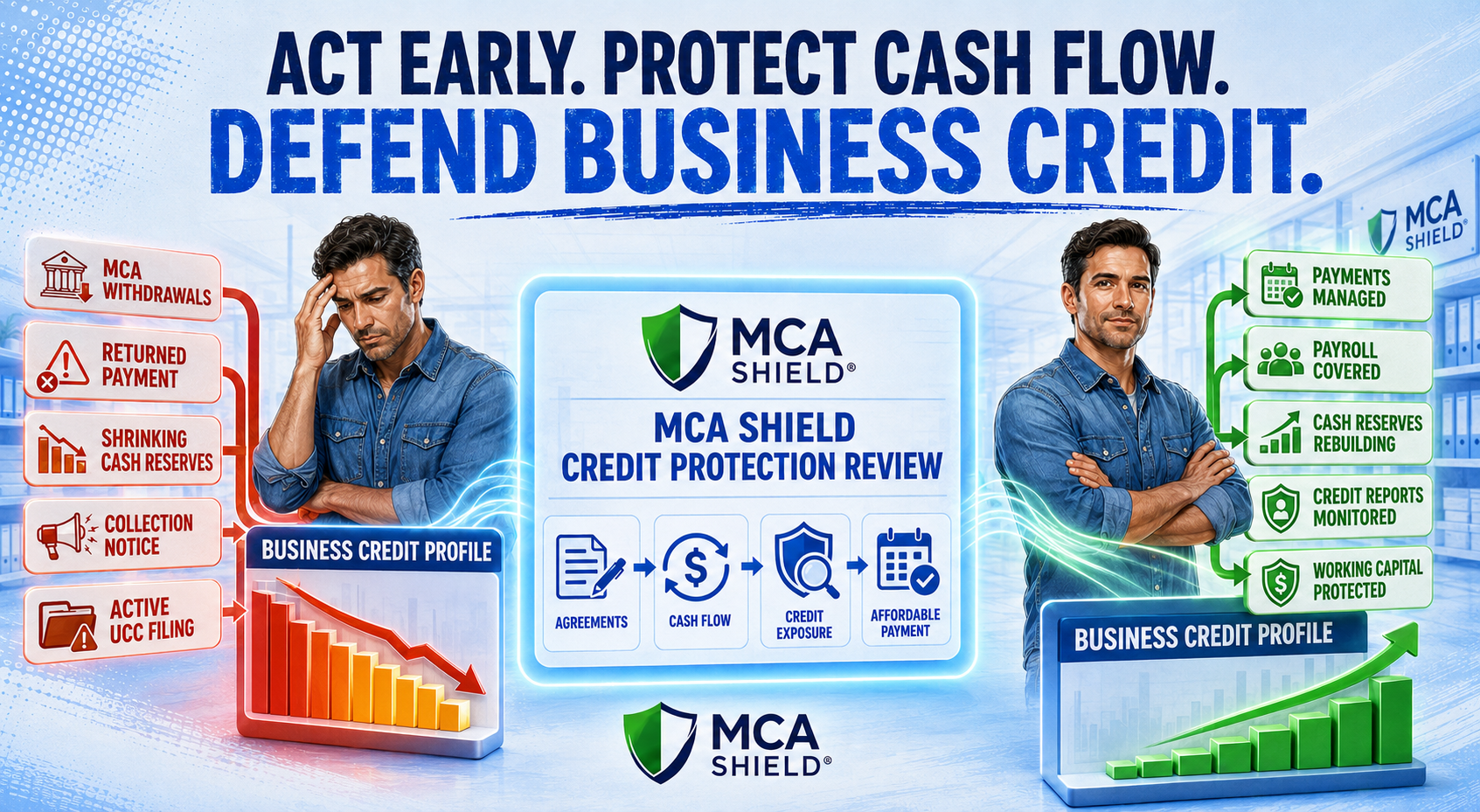
Understanding the connection between MCA restructuring and business credit can help owners act before payment pressure causes greater damage. Waiting for repeated withdrawals to fail may lead to overdrafts, collection activity, legal demands, or missed payments on other business obligations.
Early action may preserve more options. It also gives the business time to evaluate its financial position before cash flow reaches a crisis point.
Review Your Agreements, Cash Flow, and Credit Exposure
A complete review should begin with every active MCA agreement. Owners need to understand the current balances, payment schedules, personal guarantees, default provisions, and UCC filings connected to each obligation.
The review should also include:
- Recent business bank statements
- Average monthly revenue
- Payroll, taxes, rent, and operating expenses
- Daily or weekly MCA withdrawals
- Existing loans and credit accounts
- Returned payments or overdrafts
- Collection notices and legal documents
- Business and personal credit reports
These records help show how much payment pressure the business can realistically manage. They may also reveal risks that need immediate attention, such as declining cash reserves or missed payments to other creditors.
The goal is not simply to lower one withdrawal. A sustainable restructuring strategy should protect enough working capital to cover essential expenses and keep the business operating.
Schedule a Free Consultation With MCA Shield
If MCA payments are placing your cash flow or business credit at risk, waiting may make the situation harder to resolve. MCA Shield can review your current obligations, payment pressure, and available financial information to help you understand possible next steps.
Every business has different revenue, expenses, agreements, and credit exposure. Therefore, the right approach should reflect your actual financial position instead of relying on a temporary solution that creates another unaffordable payment.
Schedule a Free Consultation With MCA Shield today. Taking action now may help your business regain control of its payments, protect working capital, and reduce the risk of further financial damage.