
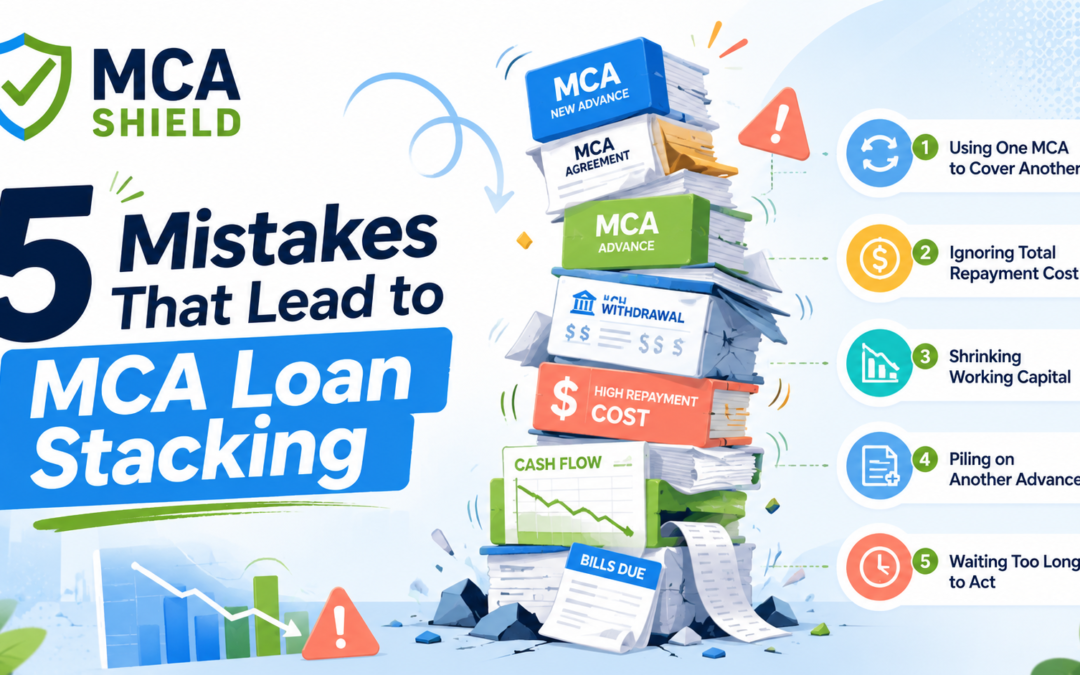
MCA loan stacking mistakes can quickly turn short-term business funding into a serious cash-flow problem. When a business takes on multiple merchant cash advances, the combined daily or weekly withdrawals can make it harder to cover payroll, inventory, rent, and other essential expenses.
In many cases, MCA loan stacking does not happen all at once. It often starts with one advance, followed by another to relieve financial pressure. Over time, repayment costs increase, working capital shrinks, and the business may become dependent on new funding just to keep up with existing obligations.
Understanding the five common mistakes that lead to MCA loan stacking can help business owners recognize warning signs earlier. More importantly, it can help them consider better options before multiple MCA payments become unmanageable.
Schedule Your Free Consultation
What Is MCA Loan Stacking and Why Does It Happen?
MCA loan stacking happens when a business takes on multiple merchant cash advances at the same time. Instead of paying one MCA provider, the business may have two, three, or even more funders withdrawing money from its revenue.
Stacking often begins when a business needs additional working capital before an existing MCA has been repaid. A new advance may provide temporary relief, but it also adds another repayment obligation. As these payments accumulate, more of the business’s daily or weekly revenue goes toward MCA withdrawals.
One of the biggest MCA loan stacking mistakes is viewing each new advance separately. Business owners need to consider the combined effect of every payment on their available cash flow.
How Multiple Merchant Cash Advances Build Up
Multiple merchant cash advances can build up faster than many business owners expect. A company may take its first MCA to cover inventory, equipment, payroll, or an unexpected expense. If cash flow remains tight, another funding offer can appear to provide an easy solution.
The problem is that the original MCA payment usually remains in place.
Now the business has two repayment obligations competing for the same revenue. If another cash shortage occurs, the owner may consider a third advance. This creates a cycle where new funding is used to manage financial pressure created partly by previous funding.
For example, a business could have several withdrawals occurring every business day. Each payment may appear manageable on its own. However, the combined amount can consume a significant portion of incoming revenue.
This is how MCA stacking can turn a temporary cash-flow problem into a much larger financial burden.
Why Stacking Can Quickly Strain Business Cash Flow
Cash flow is essential for keeping a business operating. Revenue must cover expenses such as payroll, rent, inventory, utilities, taxes, insurance, and vendor payments.
When several MCA funders are withdrawing payments, less money remains available for those expenses.
The pressure can become even greater when business revenue changes from week to week. MCA payments that seemed affordable during a strong sales period may become difficult to manage when revenue slows.
As available working capital declines, a business may begin delaying bills, reducing inventory purchases, or struggling to make payroll. Some owners then consider another MCA to close the gap, which can make the stacking problem worse.
Recognizing the warning signs early is important. If multiple MCA payments are already consuming a large share of operating cash, adding another advance may increase financial pressure instead of solving it.
Mistake #1: Taking a New MCA to Pay Off an Existing MCA

One of the most common MCA loan stacking mistakes is taking a new merchant cash advance to deal with an existing one. At first, this can seem like a practical way to relieve immediate payment pressure. However, it often creates a new obligation before the original problem has been fully resolved.
A business may use part of the new advance to pay down an older MCA. The remaining funds may then go toward payroll, inventory, rent, or other expenses. While this can provide short-term breathing room, the business is still responsible for the new repayment schedule.
As a result, one MCA obligation may simply be replaced by another, sometimes with additional fees and continued cash-flow pressure.
Why Replacing One Daily Payment With Another Can Backfire
Replacing an existing MCA with a new one does not automatically improve the financial position of the business. In many cases, it only resets the repayment cycle.
The business receives fresh capital, but it also takes on a new daily or weekly withdrawal. If the new payment is still too large for current revenue, the same cash-flow problem can return quickly.
This can be especially dangerous when the business does not calculate the total repayment cost, payment frequency, and impact on working capital before accepting the new advance.
Instead of solving the original problem, the new MCA may leave the business with less flexibility and fewer options if revenue drops.
How Repeated MCA Borrowing Creates a Debt Cycle
Repeated MCA borrowing can create a cycle that becomes increasingly difficult to break. A business takes one advance, struggles with the payments, then accepts another advance to relieve the pressure.
When that new payment also strains cash flow, another funding offer may seem like the fastest solution.
Over time, new MCA funding can become a way to support older MCA obligations rather than business growth. More revenue goes toward repayments, while less money remains available for normal operating expenses.
This pattern can eventually lead to multiple advances, overlapping withdrawals, and shrinking working capital.
Breaking the cycle usually starts with understanding the full financial picture. Before taking another MCA, business owners should review all existing balances, payment obligations, and available operating cash. A coordinated strategy may offer a better path than continuing to add new advances.
Mistake #2: Focusing on Fast Funding Instead of the Total Repayment Cost

Another common MCA loan stacking mistake is focusing on how quickly funding can arrive instead of what the advance will cost over time. Merchant cash advances can provide fast access to capital, but speed should not be the only factor in the decision.
When cash flow is tight, a business owner may focus on the amount being deposited into the account. However, the more important question is how much money will be withdrawn during repayment.
A new MCA can create immediate relief while also adding another expensive repayment obligation. If several advances are already active, that added payment can put even more pressure on working capital.
Why the Advance Amount Does Not Tell the Whole Story
The amount a business receives is only one part of the transaction. Business owners also need to understand the total payback amount, repayment frequency, and expected withdrawal size.
For example, receiving $50,000 in new capital may sound helpful. However, the true impact depends on how much the business must repay and how quickly those payments will be collected.
A business should also consider whether the new advance will help generate enough additional revenue to justify the added obligation.
If the repayment structure consumes cash faster than the business can replace it, the advance may create another shortage. That can increase the risk of MCA loan stacking and make future funding decisions even more difficult.
Understanding the Impact of Multiple Daily or Weekly Withdrawals
One MCA withdrawal may seem manageable by itself. The problem grows when several funders are taking payments from the same stream of business revenue.
For example, a business may have one daily withdrawal of $700, another of $500, and a third of $400. Together, those payments equal $1,600 every business day before payroll, rent, inventory, taxes, or other operating costs are paid.
This is why business owners should evaluate the combined impact of all MCA payments, not just the payment attached to a new advance.
Multiple daily or weekly withdrawals can quickly reduce available cash, especially during slower sales periods. As working capital falls, the business may become more likely to delay expenses or seek another advance.
Before accepting fast funding, it is important to look beyond the deposit amount. The total repayment burden and its effect on cash flow should drive the decision.
Mistake #3: Ignoring the Effect of MCA Payments on Working Capital
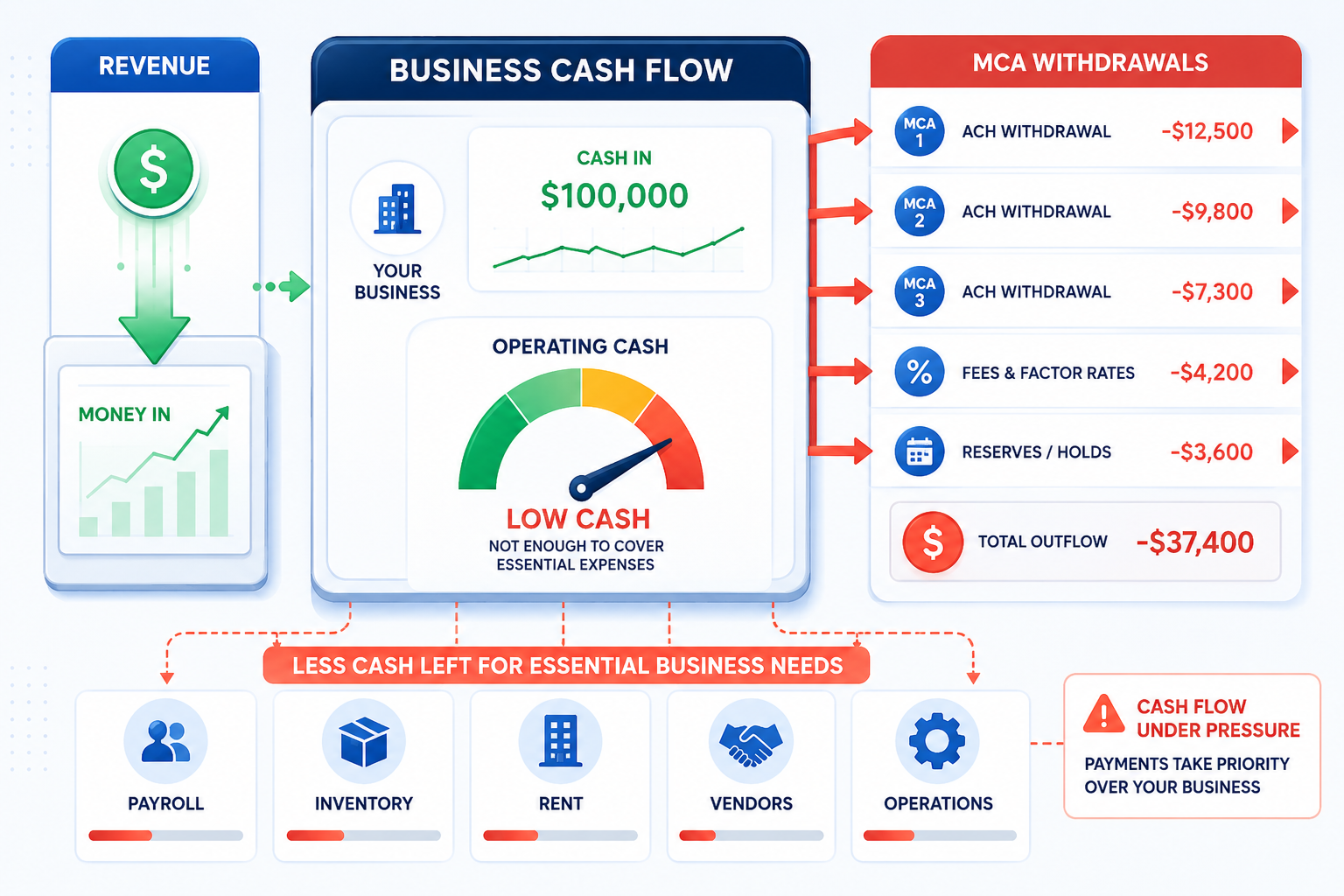
One of the most damaging MCA loan stacking mistakes is failing to track how much working capital remains after daily or weekly MCA withdrawals. A business may still be generating revenue, yet have very little cash left to operate after funders take their payments.
Working capital helps cover the everyday costs that keep a business moving. That includes payroll, inventory, rent, utilities, taxes, insurance, and vendor payments. When MCA withdrawals consume too much of that cash, normal business expenses can become harder to manage.
The danger increases when several merchant cash advances are active at the same time. Each additional withdrawal reduces the amount of revenue available for operations. Eventually, the business may start using new funding simply to fill the gaps created by existing MCA payments.
When MCA Withdrawals Begin Competing With Payroll and Operating Expenses
MCA payments become a serious concern when they start competing with essential business expenses.
For example, a business may have enough revenue to cover payroll and inventory before its MCA withdrawals occur. Once several payments are deducted, however, the remaining balance may no longer be enough to handle both.
This can force difficult choices. A business owner may delay a vendor payment, reduce inventory purchases, postpone taxes, or move money between accounts just to keep operations running.
When MCA payments consistently come before essential operating expenses, the business may be losing the financial flexibility it needs to stay stable.
That pressure can also make another advance appear attractive. However, adding a new MCA creates another withdrawal and may make the underlying working-capital problem worse.
Warning Signs Your Business Is Running Out of Cash-Flow Flexibility
Cash-flow problems often develop gradually. Recognizing the warning signs early can help a business avoid deeper MCA loan stacking.
Common warning signs include struggling to make payroll, delaying vendor payments, falling behind on bills, reducing inventory purchases, and transferring money between accounts to cover withdrawals.
Another warning sign is relying on future sales before that revenue has arrived. If every incoming deposit is already needed to cover MCA payments and overdue expenses, the business has very little room for an unexpected slowdown or emergency.
Business owners should also pay attention when they begin considering another merchant cash advance simply to restore working capital. That may signal that existing MCA obligations are already consuming too much revenue.
The goal should be to preserve enough cash for the business to operate. If MCA withdrawals are leaving too little money for essential expenses, it may be time to review the entire payment structure before adding another advance.
Mistake #4: Adding Another MCA Before Addressing Existing Cash-Flow Problems
Another major MCA loan stacking mistake is accepting a new merchant cash advance before identifying why the business is already short on cash.
A new MCA can create an immediate boost in the bank account. However, that money does not fix problems such as declining revenue, high operating costs, overdue expenses, or existing MCA withdrawals. Instead, the business takes on another repayment obligation.
If the underlying cash-flow problem remains, the new advance may only provide temporary relief. Once daily or weekly withdrawals begin, available working capital can start shrinking again.
Before adding another MCA, business owners should understand where their cash is going and whether current revenue can support another payment.
Why More Funding May Only Delay the Underlying Problem
More funding can help when it supports a clear business opportunity. However, problems can develop when a new MCA is used mainly to cover shortages created by existing obligations.
For example, a business may use new funding to catch up on payroll, vendors, rent, or overdue bills. Those expenses may be covered temporarily, but the business now has another MCA payment coming out of future revenue.
If cash flow does not improve, the same shortage can return.
This is how MCA loan stacking can grow from one temporary solution into several overlapping repayment obligations. Each new advance may buy time, but it can also increase the amount of cash leaving the business.
Instead of immediately seeking another MCA, it may be better to review existing payments, expenses, and revenue first. That review can help identify whether additional funding would solve the problem or simply postpone it.
When Short-Term Capital Creates Long-Term Financial Pressure
Merchant cash advances are generally designed to provide short-term access to capital. The problem begins when a business depends on repeated advances to maintain normal operations.
A new MCA may cover an immediate need today, while its repayment structure affects cash flow for weeks or months afterward. When several advances overlap, short-term funding can create longer-term financial pressure.
The business may have less money available for inventory, payroll, marketing, equipment, and other expenses that support future revenue. As a result, growth can slow while repayment obligations continue.
Eventually, another advance may seem necessary just to restore the working capital lost to previous withdrawals. That cycle can lead directly to deeper MCA stacking.
Business owners should consider the full effect of a new obligation before accepting additional funding. If another MCA is needed simply to keep up with existing payments and operating expenses, the business may need a different strategy rather than another advance.
Mistake #5: Waiting Too Long to Deal With Multiple MCA Payments
One of the most serious MCA loan stacking mistakes is waiting until cash flow is already under extreme pressure before taking action. When several merchant cash advances are active, the combined withdrawals can gradually reduce the money available to run the business.
At first, an owner may be able to move money between accounts, delay certain bills, or rely on stronger sales weeks. However, those temporary adjustments can become harder to maintain as MCA payments continue.
The longer the problem goes unaddressed, the more difficult it may become to protect payroll, inventory, rent, taxes, vendor payments, and other essential expenses.
Waiting can also make another advance look like the easiest solution. In reality, adding more debt to an already strained payment structure may deepen the stacking problem.
Why Acting Early May Give Your Business More Options
Addressing multiple MCA payments early can give a business more time to understand the full financial picture.
That means reviewing every MCA agreement, the remaining balances, payment frequency, total withdrawals, and current operating expenses. It also means identifying how much working capital is left after all obligations are paid.
When a business acts before cash flow reaches a critical point, it may have more flexibility to consider negotiation, restructuring, revised payment arrangements, or other strategies.
Early action also gives the owner more time to plan instead of reacting to an immediate crisis.
The goal is not simply to stop financial pressure for a few days. It is to develop a strategy that helps the business maintain operations while addressing existing MCA obligations.
What Can Happen When MCA Stacking Continues
If MCA stacking continues, more of the business’s revenue may be committed before normal operating expenses are paid.
Over time, this can lead to shrinking working capital, delayed bills, missed vendor payments, payroll pressure, and difficulty purchasing inventory or supplies. A slower sales period can make those problems even more severe.
In some cases, the business may take another MCA to cover the growing shortage. That creates another withdrawal and can push the business deeper into the same cycle.
Continued stacking may also leave the owner with fewer practical choices as financial pressure increases.
Recognizing the problem early is critical. If multiple MCA payments are already limiting your ability to cover essential expenses, waiting for the situation to improve on its own may make the problem harder to resolve.
How to Break the MCA Loan Stacking Cycle
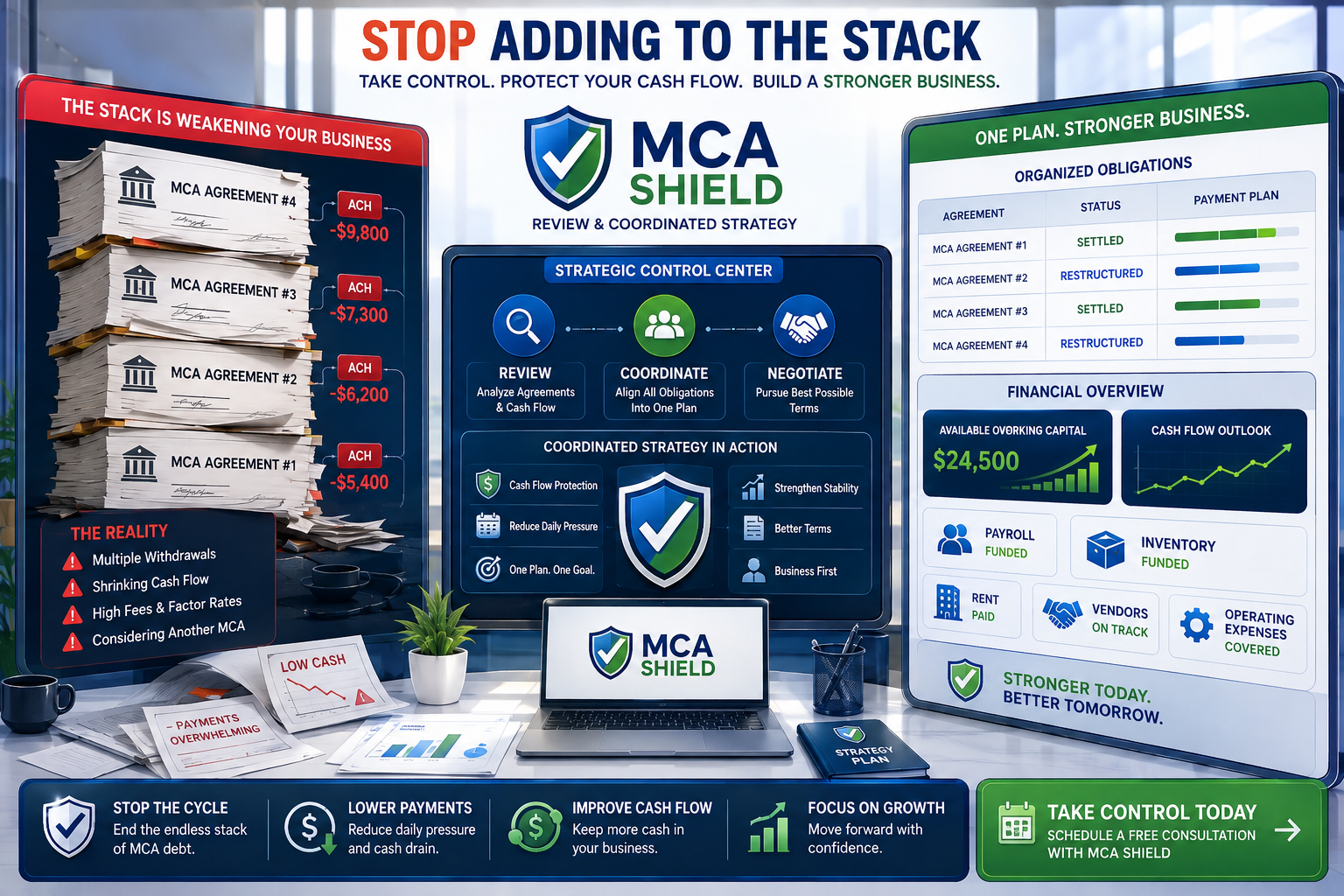
Breaking the MCA loan stacking cycle starts with understanding the full financial picture. When several merchant cash advances are active, treating each payment as a separate problem can make it harder to see how much pressure the combined obligations are placing on the business.
Instead of taking another advance for temporary relief, business owners should review their existing MCA obligations, available working capital, and operating expenses. The goal is to determine whether the current payment structure is still sustainable.
A more coordinated approach can help a business identify where the pressure is coming from and what options may be available. The sooner the entire MCA stack is reviewed, the sooner the business can begin working toward a more manageable strategy.
Review Every MCA Agreement and Payment Obligation
The first step is to gather every MCA agreement and create a clear picture of what the business currently owes.
Review the remaining balance, payment amount, withdrawal frequency, estimated payoff timeline, and terms of each agreement. Business owners should also identify which bank accounts are being debited and how much money is leaving the business each day or week.
Looking at these obligations together is critical. One payment may appear manageable on its own, while several combined withdrawals may be consuming a large share of operating revenue.
It is also helpful to compare MCA payments with essential expenses such as payroll, rent, inventory, taxes, utilities, and vendor costs.
This review can show whether multiple MCA payments are leaving enough working capital for the business to operate normally. It can also help identify which obligations are creating the greatest pressure.
Consider Negotiation or Restructuring Before Taking Another Advance
When cash flow becomes tight, another MCA may seem like the fastest way to create breathing room. However, adding another withdrawal can make an existing stacking problem worse.
Before accepting new funding, it may be worth exploring whether negotiation or restructuring could change the way existing MCA obligations are handled.
Depending on the circumstances and the funders involved, a business may be able to pursue changes designed to make its obligations more manageable. The available options will depend on the agreements, financial condition of the business, and willingness of the parties to work toward a resolution.
The key is to address existing obligations before automatically adding another one.
If a business is already using new advances to cover old MCA payments or everyday operating expenses, another MCA may continue the debt cycle rather than break it.
Build a Coordinated Strategy for Multiple MCA Funders
Businesses with several merchant cash advances should avoid dealing with each MCA in isolation.
Every payment affects the same pool of revenue. Changing one obligation without considering the others may provide temporary relief while leaving the overall cash-flow problem unresolved.
A coordinated strategy looks at all MCA balances, withdrawal schedules, operating expenses, available cash, and business priorities together. This creates a clearer picture of what the business can realistically manage.
It may also help determine which obligations require immediate attention and how different payment arrangements could affect overall cash flow.
Most importantly, the business should maintain enough working capital to support essential operations whenever possible. Payroll, inventory, rent, and other core expenses cannot be ignored while MCA obligations are being addressed.
Breaking the MCA loan stacking cycle is not simply about replacing one payment with another. It is about creating a coordinated plan that addresses existing obligations while protecting the cash flow the business needs to operate.
Take Action Before MCA Loan Stacking Becomes Unmanageable
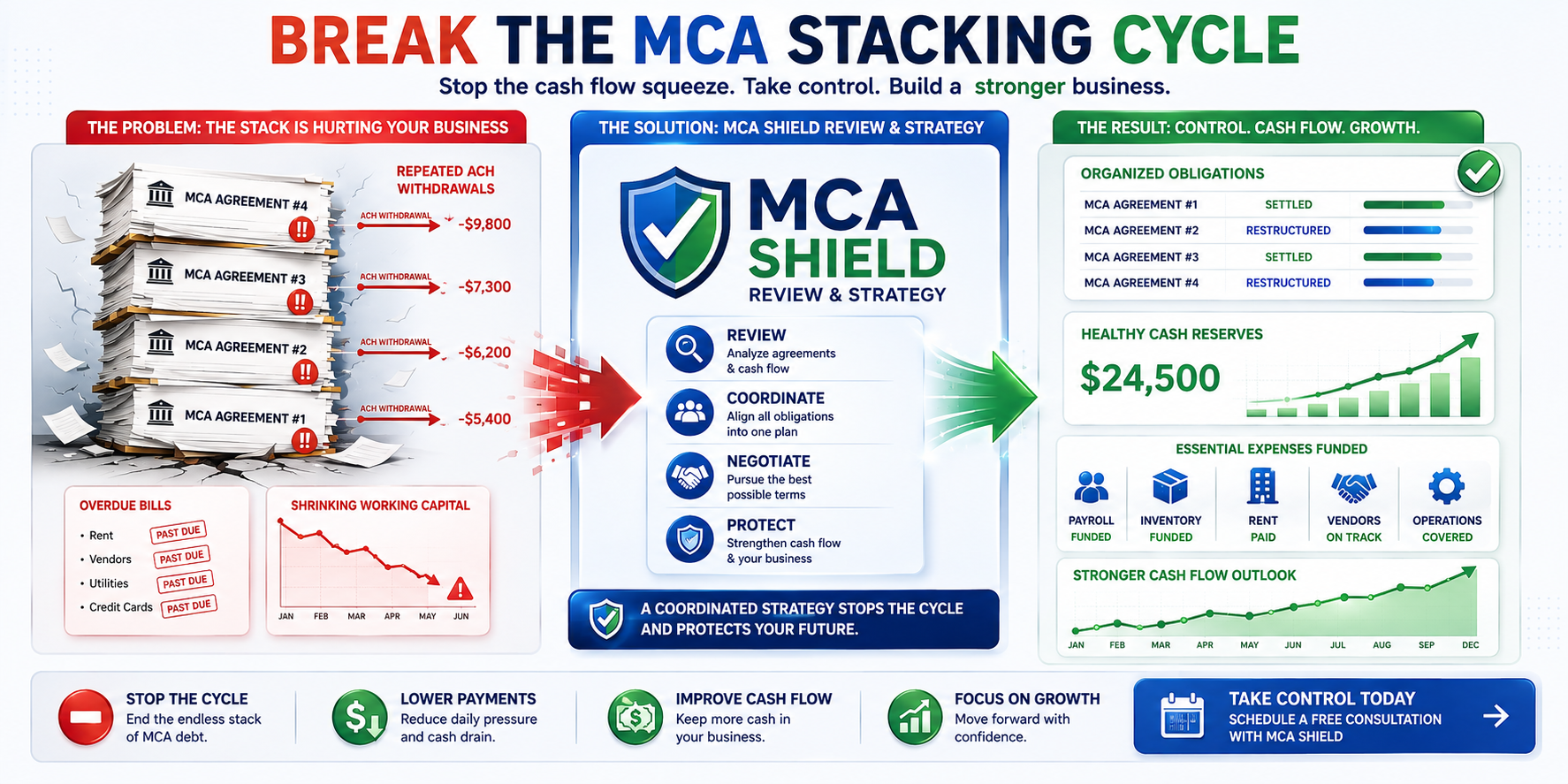
MCA loan stacking can become much harder to manage when multiple payments are already draining working capital. The longer those withdrawals continue, the less flexibility a business may have to cover everyday expenses and respond to unexpected costs.
Business owners should not wait until cash flow reaches a crisis point. Reviewing existing MCA obligations early can provide a clearer picture of what is happening and what options may be available.
If several merchant cash advances are active, the priority should be to reduce financial pressure without adding another repayment obligation. A coordinated plan can help the business address existing MCAs while protecting the cash needed to continue operating.
Protect Working Capital and Essential Business Expenses
Working capital keeps a business functioning from one day to the next. It supports payroll, inventory, rent, utilities, taxes, vendor payments, insurance, and other essential expenses.
When MCA withdrawals consume too much revenue, those operating costs can become difficult to manage. That is often when businesses begin falling behind or considering another advance.
Instead, business owners should compare total MCA payments with current revenue and essential expenses. This can help identify whether the existing payment structure is putting too much pressure on cash flow.
The goal is to protect enough operating cash to keep the business stable while addressing MCA obligations. Preserving working capital can give a business more room to make informed decisions instead of reacting to the next withdrawal.
Schedule a Free Consultation With MCA Shield
If your business is dealing with multiple merchant cash advances, you do not have to wait until the situation becomes unmanageable.
MCA Shield can review your existing MCA agreements, payment obligations, and current cash-flow pressure to help you better understand your situation. From there, a coordinated strategy can be developed around the needs of your business.
Taking action early may provide more flexibility than continuing to stack additional advances.
Schedule a free consultation with MCA Shield to review your MCA obligations, understand your options, and take the first step toward regaining control of your business cash flow.