
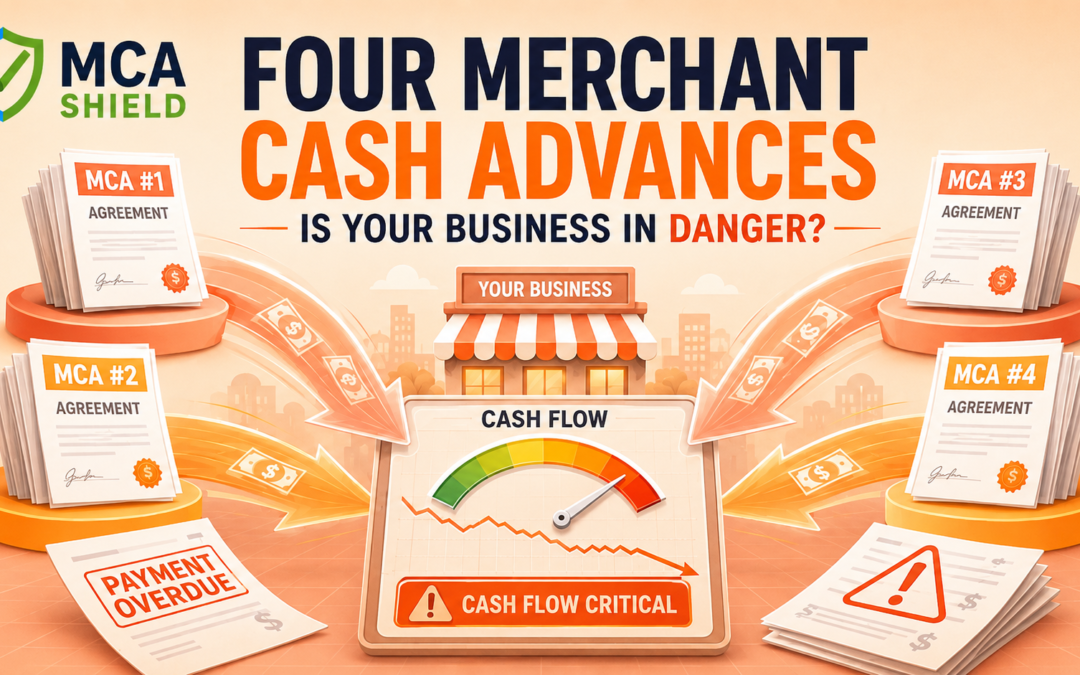
Having four merchant cash advances at the same time can put serious pressure on your business. Multiple daily or weekly withdrawals may quickly reduce available cash and make it harder to cover payroll, inventory, rent, taxes, and other essential expenses.
As MCA payments consume more of your revenue, your business may have less flexibility to handle slow weeks or unexpected costs. This can lead to shrinking working capital, missed obligations, additional borrowing, and a growing risk of default.
If your business is juggling four MCAs, it is important to understand the warning signs and your available options. In this guide, we will explain how multiple merchant cash advances can affect cash flow, when the situation may become dangerous, and what steps you can take to regain control.
Schedule Your Free Consultation
What Happens When Your Business Has Four Merchant Cash Advances?
Having four merchant cash advances at the same time can create significant financial pressure. Each MCA may have its own payment schedule, withdrawal amount, and remaining balance. However, all four payments usually depend on the same source: your business revenue.
As more money leaves your account, less remains for normal operating expenses. That can make it harder to manage payroll, inventory, rent, taxes, utilities, and other obligations.
The problem often becomes more serious when MCA stacking causes several withdrawals to hit the business account within the same week.
How Multiple MCA Payments Compete for the Same Revenue
Every merchant cash advance requires repayment from the money your business generates. With one MCA, the payment may be manageable. With four, several funders may be collecting from the same pool of operating cash.
For example, your business may receive customer payments in the morning. Shortly afterward, multiple MCA withdrawals may leave the account. The money that remains must cover everything else.
This can create a constant competition between:
- MCA payments
- Payroll
- Inventory and supplies
- Rent and utilities
- Taxes
- Vendor payments
- Insurance and other operating costs
The issue is not simply the size of one withdrawal. Instead, business owners should consider the combined impact of all four MCA payments.
Even when each payment appears manageable on its own, the total amount withdrawn may consume a large portion of daily or weekly revenue.
Why Four MCAs Can Create Serious Cash-Flow Pressure
Healthy businesses need working capital to operate. When four MCAs are pulling money from the same account, that working capital can disappear quickly.
A business may still generate strong sales but struggle to keep enough cash available between withdrawals. This creates a situation where revenue looks healthy while available cash continues to shrink.
As cash-flow pressure increases, business owners may begin delaying expenses or moving money between accounts just to keep operations running.
Common warning signs include difficulty covering payroll, late vendor payments, unpaid taxes, reduced inventory, and shrinking cash reserves.
Unexpected expenses can make the situation even harder. A slow sales week, equipment repair, seasonal decline, or large supplier bill may leave the business without enough cash to absorb the setback.
At that point, four merchant cash advances can begin affecting the stability of the entire business, not just its debt payments.
When MCA Stacking Becomes Difficult to Sustain
MCA stacking occurs when a business takes multiple merchant cash advances before earlier advances have been fully repaid. Having four active MCAs is a strong reason to examine whether the current payment structure remains sustainable.
One major warning sign is using new financing to cover payments on existing MCAs. This may provide temporary relief, but it can also add another withdrawal to an already strained cash flow.
Another warning sign appears when the business can make MCA payments only by delaying essential expenses.
If payroll, rent, taxes, vendors, inventory, or other critical costs are repeatedly being pushed aside, the repayment structure may no longer fit the business’s financial reality.
Business owners should also watch how much revenue remains after all MCA withdrawals are completed. If there is consistently too little cash left to operate normally, waiting may increase the pressure.
Recognizing the problem early can provide more time to review the situation and explore potential solutions. The goal is to understand how all four merchant cash advances affect the business together and determine whether the current structure can realistically continue.
Warning Signs Four Merchant Cash Advances Are Putting Your Business in Danger
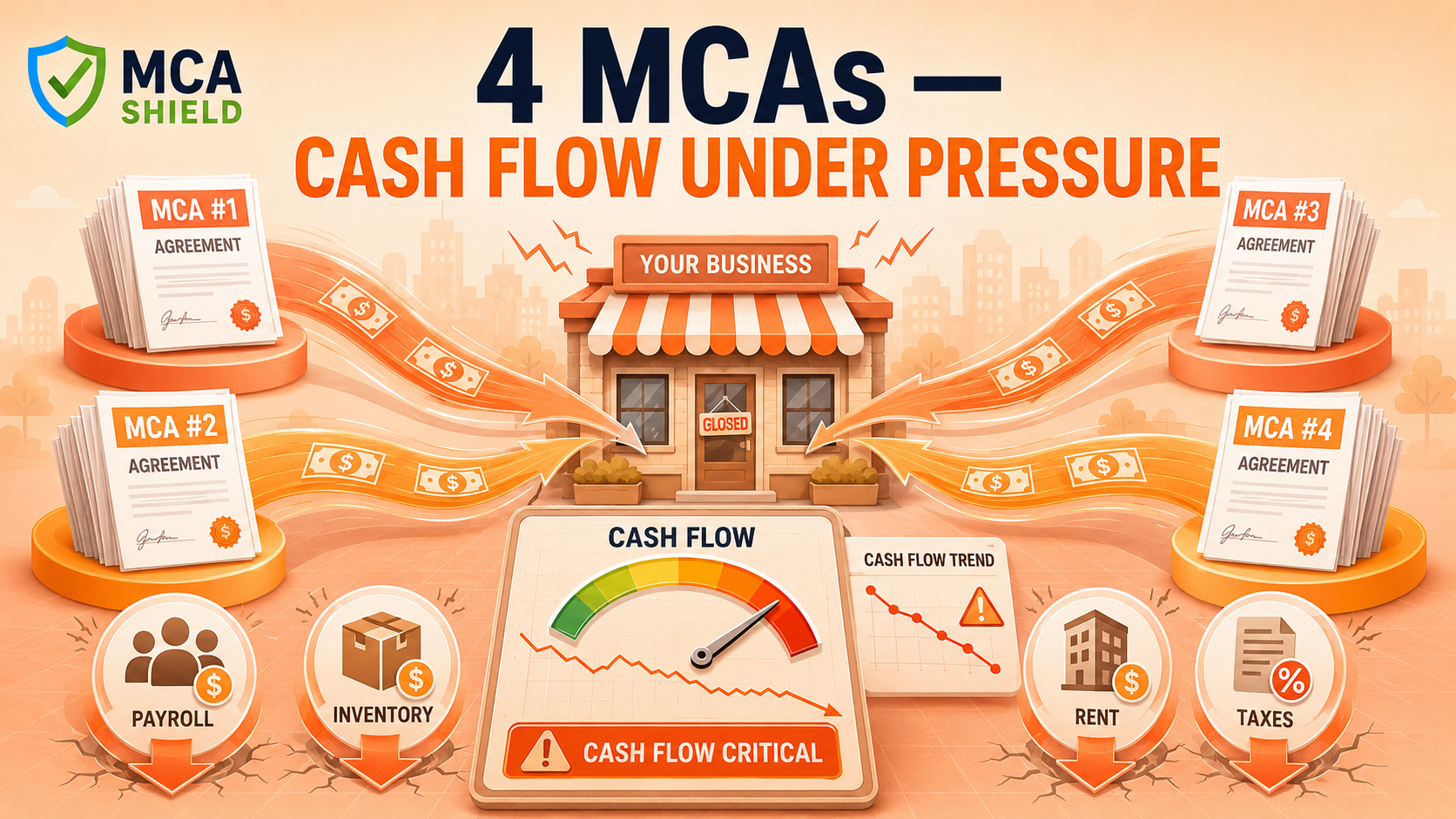
Having four merchant cash advances does not automatically mean your business will fail. However, it can create serious financial stress when the combined payments begin to consume too much of your available cash.
The key is watching for signs that your business is losing financial flexibility. If MCA withdrawals are interfering with normal operations, the repayment structure may be becoming difficult to sustain.
Several warning signs can show that multiple merchant cash advances are putting your business in danger.
Daily or Weekly Withdrawals Are Consuming Too Much Revenue
One of the clearest warning signs is when daily or weekly MCA withdrawals take an increasingly large share of your revenue.
Each individual payment may seem manageable. The real problem is the combined effect of all four withdrawals.
For example, your business may generate strong sales during the week. However, after four MCA payments leave the account, there may not be enough cash remaining to operate comfortably.
This can create a cycle where revenue comes in and quickly disappears.
Watch for signs such as:
- Cash balances dropping immediately after MCA withdrawals
- Little working capital remaining at the end of the week
- Difficulty building or maintaining cash reserves
- Constantly transferring money to keep the operating account funded
- Using incoming customer payments primarily to cover MCA obligations
If MCA payments consistently leave too little money for normal operations, the issue may no longer be temporary. It may indicate that the combined MCA payment burden is too high for your current revenue.
Payroll and Operating Expenses Are Becoming Harder to Cover
A business needs cash for more than debt payments. It must also cover employees, suppliers, taxes, rent, utilities, insurance, inventory, and other essential costs.
When four merchant cash advances begin competing with these expenses, business operations can suffer.
You may find yourself delaying a vendor payment until the next deposit arrives. You might postpone buying inventory or paying a tax bill because several MCA withdrawals are scheduled first.
Payroll is an especially important warning sign. If your business is struggling to keep enough cash available for employees, the current payment structure deserves immediate attention.
Other warning signs include falling behind on rent, reducing inventory purchases, delaying equipment repairs, or stretching vendor terms longer than usual.
These problems often indicate that MCA payments are no longer being funded by excess cash flow. Instead, they are beginning to consume money needed to keep the business running.
When essential operating expenses repeatedly take second place to MCA withdrawals, financial pressure can escalate quickly.
Your Business Is Considering Another MCA to Make Payments
One of the strongest warning signs is considering a fifth merchant cash advance simply to keep up with the first four.
New funding can appear to solve an immediate cash shortage. It may cover payroll, refill the operating account, or provide enough money to handle upcoming MCA withdrawals.
However, taking another advance can also add another payment obligation to an already strained cash flow.
This is how MCA stacking can become a difficult cycle. A business takes new financing to create temporary breathing room, but the additional withdrawal creates even more pressure later.
Before accepting another MCA, ask what problem the new funding is actually solving.
If the money would mainly be used to pay existing MCAs, cover expenses that current revenue can no longer support, or replace cash being removed by daily withdrawals, the underlying problem may be the repayment structure itself.
At that point, adding another advance may not address the real issue. Reviewing all four obligations together may provide a clearer picture of what your business can realistically afford.
Recognizing these warning signs early can help you evaluate your options before the pressure becomes more severe.
How Four MCA Payments Can Affect Your Business Cash Flow
When a business is making four MCA payments at the same time, cash flow can become difficult to manage. Revenue may still be coming in, but a large portion of that money can leave the account almost immediately through daily or weekly withdrawals.
The result is often less cash available for normal operations. Over time, this can weaken the business’s ability to cover essential expenses, respond to problems, and maintain healthy working capital.
Understanding how four merchant cash advances affect business cash flow can help you recognize when the current payment structure is becoming too aggressive.
Less Working Capital for Essential Expenses
Working capital is the money your business needs to handle day-to-day expenses. It helps pay for payroll, inventory, rent, utilities, insurance, supplies, and other operating costs.
With four active MCAs, multiple withdrawals can reduce working capital before the business has a chance to use that revenue elsewhere.
This can create a constant cash shortage. Even a profitable business may struggle if too much money is leaving the account too quickly.
For example, the business may generate enough monthly revenue to appear financially healthy. However, after four MCA payments are deducted, there may not be enough cash remaining to comfortably cover operations.
That can force the owner to make difficult choices about which bills to pay first.
When MCA payments consistently reduce the cash available for essential expenses, the business may be operating with very little room for error.
Falling Behind on Vendors, Taxes, or Payroll
As cash flow tightens, important obligations may begin to get delayed.
A business owner may postpone paying a supplier because several MCA withdrawals are scheduled that week. A tax payment may be pushed back to protect payroll. Inventory purchases may also be reduced to keep more cash in the account.
These decisions may provide temporary relief, but repeated delays can create additional financial problems.
Warning signs may include:
- Vendor invoices remaining unpaid longer than usual
- Difficulty making payroll on time
- Falling behind on sales, payroll, or other business taxes
- Reducing inventory or supply purchases
- Delaying rent, utilities, or insurance payments
If four MCA payments are causing the business to fall behind on basic obligations, the problem may be more serious than a temporary cash-flow shortage.
The business may be using too much of its revenue to service MCA debt and not enough to support normal operations.
Losing the Financial Flexibility to Handle Unexpected Costs
Every business faces unexpected expenses. Equipment can break. Sales can slow. A customer may pay late. Inventory costs may increase without warning.
Healthy working capital gives a business the flexibility to absorb these problems.
However, four merchant cash advances can leave very little cash available for unexpected costs.
A surprise repair that would normally be manageable may suddenly create a crisis. A slow week can become much more difficult when multiple MCA withdrawals continue regardless of other expenses.
This lack of flexibility can also make it harder to take advantage of opportunities. The business may have to turn down a large order, delay hiring, or avoid purchasing needed equipment because cash is already committed elsewhere.
Over time, this can affect both stability and growth.
If your business has reached the point where one unexpected expense could disrupt payroll or other essential obligations, it may be time to review how much pressure the four MCA payments are placing on your cash flow.
The goal is not simply to keep making payments. It is to maintain enough cash for the business to continue operating, adapt to problems, and remain financially stable.
Why Taking a Fifth Merchant Cash Advance Can Make the Problem Worse

When your business is already carrying four merchant cash advances, taking a fifth may seem like a quick solution. The new funding can provide immediate cash for payroll, bills, or upcoming MCA withdrawals.
However, another advance also creates another repayment obligation. That can place even more pressure on the same revenue that is already supporting four MCA payments.
In many cases, adding another MCA does not fix the underlying cash-flow problem. It may simply delay it while increasing the amount of money leaving the business.
Using New MCA Funding to Pay Existing MCAs
One major warning sign is using proceeds from a new merchant cash advance to make payments on existing MCAs.
This can happen when current revenue is no longer enough to cover both MCA withdrawals and normal business expenses. A new advance may temporarily refill the bank account and create short-term breathing room.
However, the business now has five MCA obligations competing for the same future revenue.
If a large portion of the new funding is immediately used to cover old debt, the business may receive very little long-term benefit from the additional advance.
Instead of improving operations, the new money may simply move from one funder to another.
Before accepting another MCA, consider whether the funding will help generate enough additional revenue to support the new payment. If not, the business may be adding debt without solving the original problem.
How Repeated MCA Stacking Can Create a Debt Cycle
MCA stacking can become a cycle when businesses repeatedly take new advances while older ones are still active.
The pattern may look like this:
- Existing MCA payments reduce available cash
- The business experiences a working-capital shortage
- Another MCA provides temporary funding
- A new daily or weekly withdrawal begins
- Cash-flow pressure increases again
As the cycle continues, more of the business’s revenue may become committed to repayment.
This can make it harder to maintain payroll, pay vendors, purchase inventory, or build cash reserves. Eventually, the business may need even more funding simply to maintain normal operations.
The danger is that each new MCA can create additional pressure instead of reducing the existing burden.
If your business is repeatedly borrowing to cover earlier borrowing, it may be time to examine the entire MCA structure rather than adding another obligation.
Why More Funding Does Not Always Solve the Cash-Flow Problem
Additional financing can make sense when it is used for a productive business purpose. For example, funding may help purchase inventory, complete a profitable project, or expand capacity.
The situation is different when new funding is needed because existing MCA payments are consuming too much cash flow.
In that case, the real problem may not be a lack of revenue. It may be the amount and frequency of money leaving the business.
A fifth MCA can increase available cash today while reducing cash flow tomorrow.
That is why business owners should look beyond the amount of money being offered. Consider the new payment, the total repayment obligation, and the combined effect of all active MCAs.
If four merchant cash advances are already making it difficult to cover essential expenses, adding another advance may increase the risk rather than provide a lasting solution.
A broader review of your MCA debt may help determine whether negotiation, restructuring, settlement, or another strategy could better address the financial pressure.
What Happens If You Default on Multiple Merchant Cash Advances?
Defaulting on one merchant cash advance can create serious pressure. Defaulting on several at the same time can make the situation much more complicated.
With four merchant cash advances, multiple funders may begin responding to missed or disrupted payments at once. Depending on the agreements and applicable state law, this may lead to collection activity, payment demands, or legal action.
Merchant cash advances commonly involve automatic withdrawals from a business bank account, which is why payment problems can quickly affect day-to-day cash flow.
If your business is approaching default, understanding the potential consequences can help you make informed decisions before the situation becomes harder to manage.
Increased Collection Pressure From Multiple MCA Funders
When payments are missed, collection efforts may increase. With four MCAs, the business could be communicating with several funders or collection representatives at the same time.
This may create multiple payment demands, frequent calls or emails, and pressure to bring accounts current.
The situation becomes especially challenging when every funder wants payment from the same limited amount of available cash.
Instead of reacting to each MCA separately, it can be helpful to understand:
- How much is owed on each MCA
- The current daily or weekly payment
- Which accounts have missed payments
- What each agreement says about default
- How much the business can realistically afford
A complete review can provide a clearer picture of the business’s total exposure.
Federal and state enforcement actions also show why businesses should carefully document collection communications. Regulators have taken action against certain MCA providers for unlawful or deceptive collection practices, although those cases do not mean every collection effort is improper.
Possible ACH, Bank Account, or Legal Complications
Because many merchant cash advances are repaid through automatic bank withdrawals, payment problems may affect the business’s operating account. The FTC describes daily automatic withdrawals as a common MCA repayment method.
Business owners should be cautious about making sudden changes to ACH arrangements without first reviewing their agreements and understanding the possible consequences.
Depending on the contract and applicable law, a funder may also pursue contractual remedies or litigation after an alleged default. However, a missed MCA payment does not automatically mean a funder can immediately freeze or seize a bank account. The legal process and available remedies can vary significantly by agreement and jurisdiction.
This is one reason it is important to review the specific MCA documents rather than assume every funder has the same rights.
Regulators have challenged MCA companies in cases involving unauthorized withdrawals and improper attempts to seize business or personal assets, which highlights how important the exact agreement and legal process can be.
Why Multiple Defaults Can Be More Difficult to Manage
When multiple merchant cash advances default at the same time, the business may face several problems simultaneously.
One funder may be requesting payment while another is escalating collection activity. Meanwhile, the business still needs enough cash to cover payroll, inventory, rent, taxes, and other essential expenses.
This can make it difficult to decide which obligation requires attention first.
Multiple defaults may also make individual negotiations more complicated. A payment arrangement that appears affordable for one MCA may not work once the other three obligations are considered.
That is why four merchant cash advances should be evaluated together, not simply as four separate payment problems.
A coordinated review can help identify the total payment burden, the most urgent issues, and the amount of cash the business actually needs to continue operating.
If default has already occurred, acting quickly may provide more time to evaluate potential options. Waiting for collection pressure to increase can make an already difficult cash-flow situation harder to manage.
Can Four Merchant Cash Advances Be Negotiated at the Same Time?
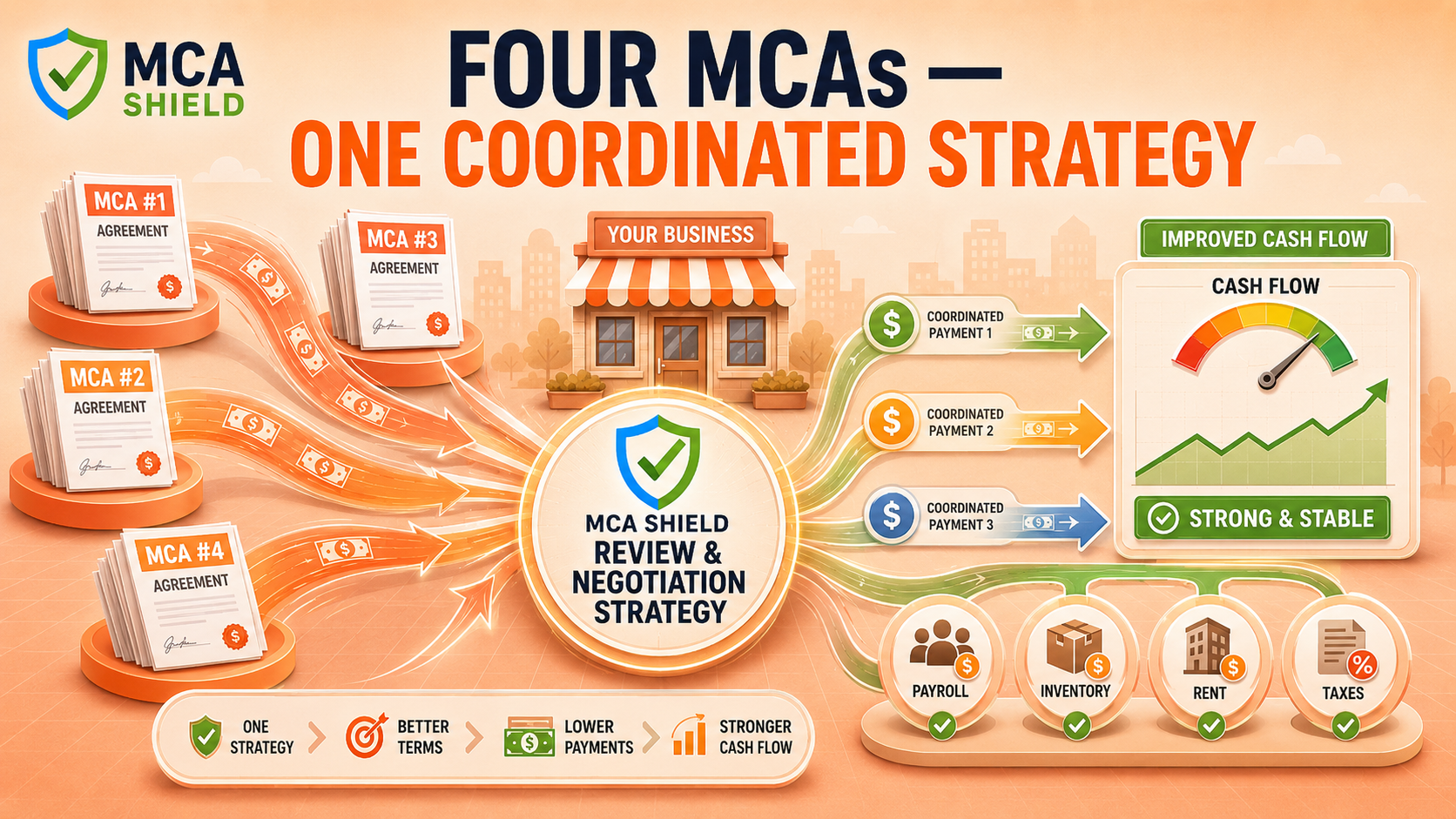
Yes, businesses with four merchant cash advances may be able to negotiate multiple MCA obligations at the same time. However, each advance has its own balance, payment terms, funder, and circumstances. That makes a coordinated approach especially important.
Instead of treating each MCA as an isolated problem, it often makes more sense to review the complete financial picture. The goal is to understand how all four payments affect cash flow and determine what the business can realistically support.
A successful outcome is never guaranteed. Still, a coordinated MCA negotiation strategy may help create a clearer path forward when multiple payments have become difficult to maintain.
Why Each MCA Should Be Reviewed as Part of the Bigger Picture
When a business has four MCAs, focusing on only one payment can create problems.
For example, reducing one withdrawal may provide temporary relief. However, the business could still struggle if the other three payments continue consuming a large share of revenue.
That is why each MCA should be evaluated alongside the others.
A complete review should consider:
- The remaining balance on each MCA
- Daily or weekly withdrawal amounts
- Payment frequency
- Current payment status
- Terms contained in each agreement
- The business’s current revenue and operating expenses
This broader view helps determine the total MCA payment burden, rather than focusing on one funder at a time.
It also helps identify which obligations are creating the most immediate pressure and how much cash the business needs to maintain normal operations.
Coordinating Negotiations Across Multiple MCA Funders
Negotiating with several MCA funders can be more complicated than dealing with only one.
Each funder may have different policies, expectations, and willingness to discuss changes. One may respond quickly, while another may require additional financial information or a different approach.
For that reason, multiple MCA negotiations should be coordinated around one realistic business budget.
The business must consider what it can afford across all four obligations. Agreeing to a payment with one funder without accounting for the others could create another cash-flow shortage.
A coordinated strategy may involve reviewing each account, prioritizing urgent issues, and communicating with funders based on the business’s overall financial situation.
This approach can also help prevent one negotiation from undermining another.
The objective is not simply to secure the lowest possible payment from each funder. It is to develop a structure that gives the business enough remaining cash to cover essential operating expenses.
Creating a More Manageable Overall Payment Structure
The ultimate goal of negotiating four merchant cash advances is to create an overall payment burden the business can realistically maintain.
Depending on the circumstances and the willingness of individual funders, discussions may involve modified payment amounts, adjusted payment schedules, restructuring, settlement, or other negotiated arrangements.
What matters most is the combined result.
For example, four individually reduced payments may still be too expensive if their total continues to consume most of the business’s available cash. Any proposed arrangement should therefore be measured against the company’s actual revenue and essential expenses.
A sustainable structure should leave enough cash available for:
- Payroll
- Rent and utilities
- Inventory and supplies
- Taxes and insurance
- Vendor obligations
- Normal operating expenses
When four MCAs are creating severe cash-flow pressure, looking at them together can provide a much clearer picture of the problem.
A coordinated negotiation strategy for multiple merchant cash advances can help the business focus on the larger objective: reducing financial pressure while preserving enough working capital to keep operations moving.
What Are Your Options When Four MCA Payments Become Unmanageable?
When four merchant cash advance payments become unmanageable, continuing under the same repayment structure may put even more pressure on your business.
At this stage, the goal should be to understand the full financial picture and determine which options may reduce the strain. The right approach depends on your balances, current payments, revenue, expenses, and the terms of each MCA agreement.
Possible options may include MCA negotiation, restructuring, settlement, or a combination of strategies.
MCA Negotiation and Restructuring
MCA negotiation and restructuring may help when current daily or weekly withdrawals are no longer sustainable.
Negotiation can involve discussing changes to the repayment structure with one or more MCA funders. Depending on the circumstances, this may include lower payments, longer repayment periods, or other modified terms.
The main objective is to create a payment structure that better reflects the business’s current cash flow.
With four MCAs, this should be approached carefully. A lower payment on one account may not provide enough relief if the remaining three withdrawals are still consuming too much revenue.
That is why it is important to consider the combined payment burden of all four merchant cash advances.
A workable restructuring strategy should leave enough cash available for essential expenses, including:
- Payroll
- Rent and utilities
- Inventory and supplies
- Taxes and insurance
- Vendor payments
- Other necessary operating costs
The goal is not simply to reduce one payment. It is to create enough breathing room for the business to continue operating.
MCA Settlement
MCA settlement may be another option when a business can no longer maintain its existing repayment obligations.
Settlement generally involves negotiating with a funder in an effort to resolve an MCA obligation under different terms. Depending on the situation, this could involve an agreed payment amount or repayment arrangement that differs from the original agreement.
However, settlement is not guaranteed, and outcomes can vary by funder and financial circumstances.
When four MCAs are involved, settlement discussions may need to be coordinated carefully. Resolving one account without considering the others could leave the business with the same cash-flow problem.
A business should review the total amount owed, available cash, and future operating needs before agreeing to any settlement arrangement.
In some situations, one MCA may be negotiated while another is restructured or settled differently. There is no single solution that fits every business.
Evaluating the Right Strategy for Your Business
The right strategy depends on more than the number of MCAs.
Two businesses with four merchant cash advances may require completely different solutions. One may still have strong revenue but need lower weekly payments. Another may have experienced a major revenue decline and need a more significant change.
Start by looking at the complete financial picture.
Consider:
- Total outstanding MCA balances
- Combined daily or weekly withdrawals
- Current monthly revenue
- Essential operating expenses
- Available working capital
- Whether any accounts are already in default
- The terms of each MCA agreement
This information can help determine what your business can realistically afford.
The most effective approach is often one that addresses all four merchant cash advances as part of one coordinated strategy.
If current payments are draining working capital or forcing you to delay essential expenses, continuing without a plan may increase the financial pressure. Reviewing negotiation, restructuring, and settlement options early may give your business more room to regain control.
When Should You Get Help With Multiple MCA Debts?
If multiple MCA debts are putting increasing pressure on your cash flow, it may be time to consider getting help. Waiting until the business reaches a crisis point can make the situation harder to manage.
You do not have to wait until payments are missed or accounts are in default. In many cases, reviewing the problem early can provide more time to understand your options and develop a coordinated strategy.
For a business carrying four merchant cash advances, early action can be especially important because several funders may be drawing from the same limited revenue.
Why Acting Before Default May Create More Options
One of the best times to review your MCA situation is before the business begins missing payments.
At this stage, you may still have more flexibility. Your business may have stronger cash flow, better records, and more time to evaluate possible solutions.
Acting early can also help you avoid making rushed decisions under pressure.
Signs that it may be time to seek help include:
- MCA withdrawals are consuming too much revenue
- Working capital is steadily shrinking
- Payroll or operating expenses are becoming difficult to cover
- You are falling behind on vendors or taxes
- You are considering another MCA to make existing payments
- You are worried that default may be approaching
These warning signs can indicate that the current structure is becoming unsustainable.
Getting help before default does not guarantee that a funder will agree to modified terms. However, addressing the problem early may give the business more time to explore negotiation, restructuring, settlement, or other potential strategies.
What Information to Gather Before Seeking Help
Before discussing your situation with an MCA debt professional, gather as much information as possible about each advance.
A complete financial picture makes it easier to understand how much pressure the MCAs are placing on your business.
Helpful documents and information may include:
- Copies of all MCA agreements
- Current balances for each advance
- Daily or weekly withdrawal amounts
- Recent business bank statements
- Monthly revenue figures
- Payroll and operating expenses
- Vendor and tax obligations
- Any default notices or collection communications
If your business has four merchant cash advances, organize the information for all four accounts.
Do not focus only on the MCA with the largest payment. The real issue is often the combined impact of every withdrawal on your available cash flow.
You should also calculate how much money the business needs each month to cover essential expenses. This can help determine what type of payment structure may be realistic.
Why Waiting Can Increase Financial Pressure
It can be tempting to wait and hope that higher sales will solve the problem.
Sometimes revenue does improve. However, if four MCA payments are already consuming too much cash, waiting can allow other financial problems to grow.
Vendor balances may increase. Taxes may fall behind. Cash reserves may disappear. Payroll can become harder to meet.
Meanwhile, the business may become more dependent on additional borrowing just to maintain normal operations.
If payments are eventually missed, the business could also face increased collection activity and additional pressure from multiple MCA funders.
The sooner you understand the full situation, the more time you have to evaluate your next move.
If multiple MCA debts are interfering with normal business operations, that is a strong sign to take action. Getting help early can allow you to review all four merchant cash advances together and build a strategy based on what your business can realistically afford.
Take Control Before Four Merchant Cash Advances Put Your Business at Greater Risk
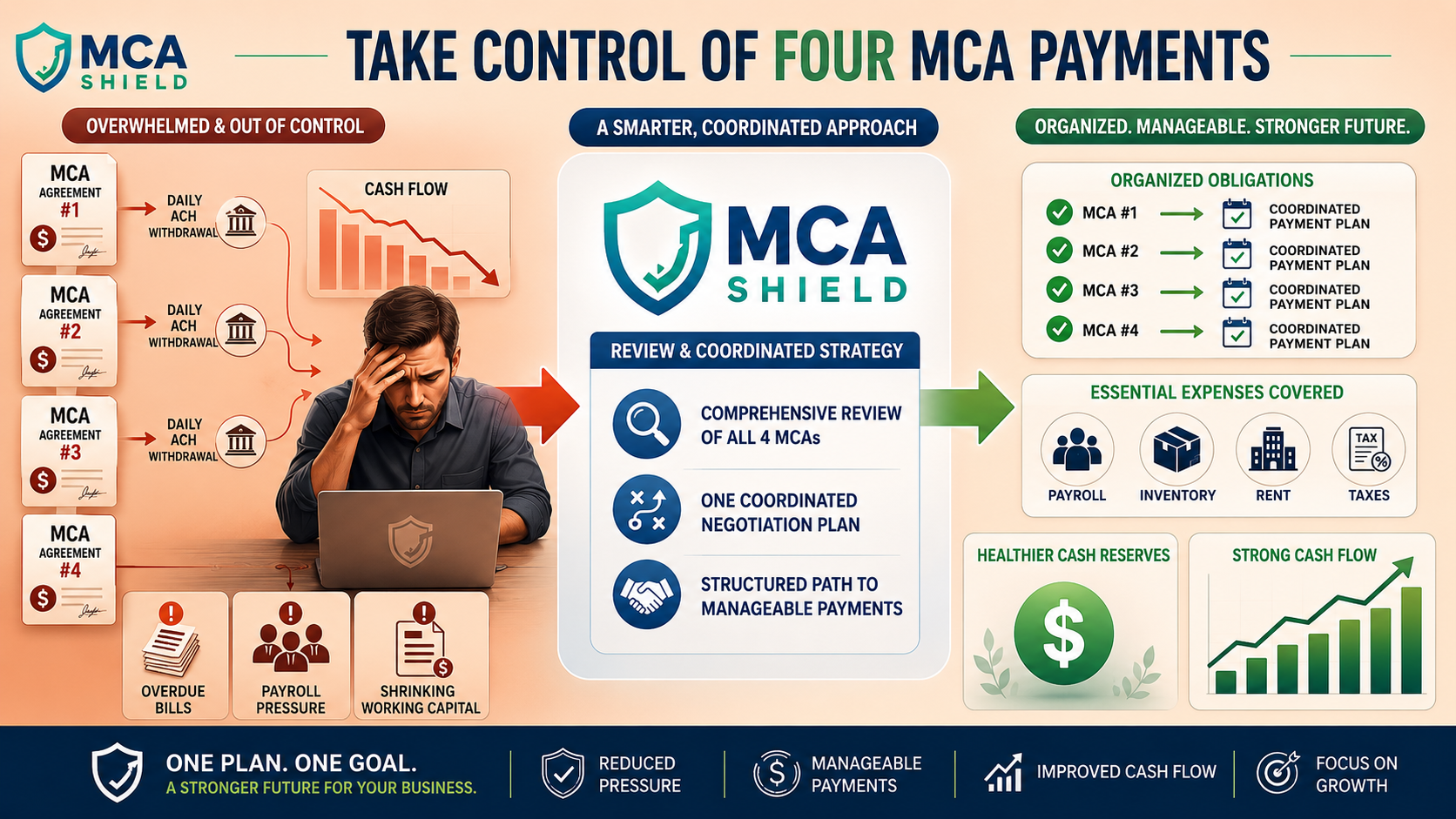
When your business is carrying four merchant cash advances, waiting for the situation to improve on its own can be risky. Multiple daily or weekly withdrawals may continue reducing working capital while other expenses keep coming due.
The sooner you understand the full financial picture, the sooner you can decide what steps may make sense for your business.
Taking action does not necessarily mean making an immediate major decision. It starts with understanding what you owe, how much cash is leaving the business, and whether the current payment structure is still sustainable.
Review Your Complete MCA Debt Situation
Start by reviewing all four merchant cash advances together.
Look at the remaining balance, payment amount, withdrawal frequency, and current status of each MCA. Then compare those obligations with your revenue and essential operating expenses.
Your review should include:
- Current balances for all four MCAs
- Daily or weekly withdrawal amounts
- Total monthly MCA payments
- Business revenue and recent cash-flow trends
- Payroll, rent, taxes, vendors, and other essential expenses
- Available working capital and cash reserves
- Any missed payments, default notices, or collection activity
This process can show how much of your revenue is being consumed by MCA payments.
You may discover that one advance is creating most of the pressure. In other cases, the real problem is the combined effect of four separate withdrawals.
Understanding the complete situation is an important first step toward determining what your business can realistically afford.
Build a Coordinated Strategy for All Four MCAs
When several merchant cash advances are active at the same time, handling each one in isolation may not solve the larger problem.
For example, negotiating a lower payment with one funder may create some breathing room. However, that relief may be limited if the other three payments remain unchanged.
A better approach may involve developing a coordinated strategy for all four MCAs.
Depending on your circumstances, that strategy could involve negotiation, restructuring, settlement, or different approaches for different obligations.
The goal should be to create an overall payment structure that leaves enough cash available for the business to operate.
That means protecting the money needed for payroll, inventory, rent, taxes, utilities, vendors, and other essential expenses.
Any proposed arrangement should also be evaluated as part of the bigger picture. A payment that seems manageable on its own may still be too high when combined with the other MCA obligations.
The objective is not simply to deal with four funders. It is to develop a plan that addresses the total MCA debt burden while protecting business cash flow.
Schedule a Free Consultation With MCA Shield
If four merchant cash advances are putting your business under financial pressure, you do not have to wait until the situation becomes more severe to review your options.
MCA Shield can evaluate your current MCA obligations, review how the payments are affecting cash flow, and discuss potential strategies based on your business’s financial circumstances.
Every situation is different, and no particular result can be guaranteed. However, understanding your options early may help you make more informed decisions before working capital is reduced further.
Schedule a free consultation with MCA Shield to review your four merchant cash advances and learn what options may be available.
The sooner you understand the full picture, the sooner you can begin working toward a more manageable path forward for your business.