
ClickCease
Explore options for your business’s MCA payments.Call (918) 608-0117

Business owners often have important questions about MCA debt restructuring, especially when daily withdrawals begin to affect payroll, vendors, and working capital. Understanding how the process works can help you evaluate your options before financial pressure becomes more difficult to manage.

These MCA debt restructuring FAQs explain payment changes, eligibility, timelines, stacked obligations, ACH withdrawals, UCC filings, business credit, and other common concerns. The answers can help you make informed decisions to protect your cash flow and move your business toward greater financial stability.

Schedule Your Free Consultation

What Is MCA Debt Restructuring and How Does It Work?

MCA debt restructuring is the process of seeking changes to the payment terms of one or more merchant cash advance obligations. The primary goal is usually to reduce immediate payment pressure and create a more manageable repayment structure.

Many MCA agreements require daily or weekly withdrawals from a business bank account. When revenue declines or expenses increase, those withdrawals can begin consuming the cash needed for payroll, inventory, rent, taxes, and other operating costs.

Restructuring may involve reviewing the existing agreements, outstanding balances, payment history, current revenue, and essential business expenses. That information helps determine whether modified payment arrangements may be possible.

What Happens During the Restructuring Process?

The process typically begins with a complete financial review. This may include MCA agreements, recent bank statements, payment records, current balances, and information about the company’s operating expenses.

After reviewing the business’s financial position, a restructuring professional may contact the MCA providers to discuss payment modifications. Depending on the circumstances and each provider’s willingness to cooperate, proposed changes could include:

  • Lower daily or weekly withdrawals
  • A longer repayment period
  • Temporary payment modifications
  • A payment schedule aligned more closely with current cash flow
  • One organized payment strategy for multiple MCA obligations

Every situation is different. MCA providers are not automatically required to approve new terms, and restructuring results cannot be guaranteed. However, acting early may provide more options than waiting until the business has missed several payments or entered default.

Does Restructuring Eliminate the MCA Balance?

No. MCA debt restructuring generally does not eliminate the remaining balance. Instead, it focuses on changing how the obligation is repaid.

For example, a business making several aggressive daily withdrawals may seek lower payments spread across a longer period. This could provide additional room in the operating budget, but it does not necessarily reduce the total amount owed.

Business owners should carefully review any proposed plan. Lower payments may improve short-term cash flow, but extending the repayment timeline can affect the total cost and length of the obligation. The final terms should be realistic enough for the business to maintain without sacrificing essential expenses.

How Is Restructuring Different From MCA Settlement?

The primary difference involves the intended outcome.

MCA restructuring usually seeks to modify payment terms while the business continues repaying the obligation. The emphasis is on affordability, payment consistency, and protecting operating cash flow.

MCA settlement, however, generally involves negotiating an agreement to resolve the obligation for an amount different from the claimed balance. Settlement is often considered when a business is already in severe financial distress and cannot reasonably repay under the existing terms.

Settlement can also involve different credit, tax, collection, and legal considerations. Therefore, it should not be treated as interchangeable with restructuring.

The appropriate strategy depends on the business’s cash flow, payment status, outstanding obligations, and ability to maintain a revised plan. A careful review can help determine which approach may fit the company’s financial position.

Who May Qualify for MCA Debt Restructuring?

A business may qualify for MCA debt restructuring when its current daily or weekly payments are no longer sustainable. However, the company must usually have enough ongoing revenue to support a modified payment plan.

Restructuring may be an option for businesses dealing with:

  • Multiple or stacked MCA obligations
  • Declining or inconsistent revenue
  • Frequent overdrafts or returned payments
  • Difficulty covering payroll and vendor expenses
  • Daily withdrawals that consume too much operating cash
  • Seasonal cash-flow changes
  • An increased risk of default

Qualification is not based on any single factor. Each business has a different combination of revenue, expenses, MCA balances, and payment obligations. Therefore, a detailed financial review is necessary before determining which options may be available.

Can a Business Qualify Before Missing Payments?

Yes. A business may be able to pursue restructuring before missing an MCA payment. In fact, starting the review early may provide more time to evaluate the agreements and address payment pressure.

A business does not have to wait until its bank account is overdrawn or an MCA provider begins collection activity. Warning signs may appear much earlier. For example, the company may be transferring money between accounts, delaying vendor payments, reducing inventory purchases, or struggling to meet payroll.

Taking action before default may also show that the business wants to continue meeting its obligations under more realistic terms. However, approval depends on the MCA providers, the agreements, and the company’s financial condition. Restructuring is not guaranteed, even when the business has remained current.

The key is to identify the problem before daily withdrawals cause more serious financial damage.

What Financial Information Is Usually Reviewed?

A restructuring review usually examines the company’s complete MCA burden and its ability to maintain a revised payment plan. The business may need to provide:

  • Current MCA agreements
  • Recent business bank statements
  • A list of MCA providers and remaining balances
  • Daily or weekly withdrawal amounts
  • Payment and transaction histories
  • Recent revenue information
  • Payroll, rent, inventory, and vendor costs
  • Tax and insurance expenses
  • Information about UCC filings or collection notices

This information helps show how much money enters the business and how much leaves through MCA withdrawals and essential expenses.

The review should also account for seasonal changes and unusual expenses. A payment that looks manageable during the company’s busiest month may become unaffordable when revenue slows.

Complete and accurate records make it easier to calculate an affordable payment range. They also help prevent the business from accepting a plan that creates the same cash-flow problem several weeks later.

Can MCA Debt Restructuring Lower Daily or Weekly Payments?

MCA debt restructuring review showing how lower payments may improve cash flow and protect essential business expenses

Yes, MCA debt restructuring may lower daily or weekly payments by modifying the existing payment schedule. The goal is to reduce the immediate pressure on the business while creating a payment plan it can realistically maintain.

For example, a business may have several MCA withdrawals leaving its bank account every business day. Even when sales remain steady, those payments can consume the money needed for payroll, rent, inventory, taxes, and vendor expenses.

A restructuring plan may seek to replace aggressive withdrawals with:

  • Lower daily payments
  • Reduced weekly payments
  • A longer repayment schedule
  • Temporary payment adjustments
  • One organized strategy for multiple MCA obligations

However, results depend on the MCA agreements, provider cooperation, outstanding balances, and the business’s financial condition. Lower payments are not automatic or guaranteed.

How Are More Affordable Payments Determined?

More affordable payments should be based on the company’s actual cash flow, not an arbitrary amount. A careful review compares average revenue with essential operating expenses and existing MCA obligations.

The review may consider:

  • Average monthly deposits
  • Seasonal revenue changes
  • Payroll and contractor expenses
  • Rent, utilities, and insurance
  • Inventory and material costs
  • Taxes and vendor obligations
  • Current daily or weekly MCA withdrawals
  • The minimum working capital needed to operate

After reviewing these numbers, the business can estimate how much it may be able to pay without creating another cash-flow shortage.

The proposed amount must be realistic during both strong and slow revenue periods. A payment plan that only works during the company’s busiest month may quickly become unaffordable.

Extending the repayment period may reduce each withdrawal. However, it can also increase the timeframe the obligation remains active. Therefore, business owners should review the full proposed terms, not only the new payment amount.

Will Lower Payments Improve Business Cash Flow?

Lower payments can improve cash flow by allowing the business to keep more money in its operating account. This added breathing room may help the company cover essential expenses on time.

The business may have more cash available for:

  • Employee payroll
  • Inventory and supplies
  • Rent and utilities
  • Vendor payments
  • Equipment repairs
  • Taxes and insurance
  • Emergency reserves

However, lower payments do not automatically solve every financial problem. The business still needs to monitor expenses, maintain accurate records, and avoid taking on additional obligations it cannot afford.

The strongest restructuring plans combine manageable payments with responsible cash-flow management. When the payment terms align with the company’s actual revenue, the business may be better positioned to stabilize operations and rebuild its working capital.

How Long Does MCA Debt Restructuring Take?

The MCA debt restructuring timeline varies from one business to another. Some cases may move forward within several days, while more complex situations can take several weeks.

There is no standard timeline because each restructuring involves different agreements, MCA providers, balances, payment histories, and financial circumstances. A business with one MCA obligation may complete the review faster than a company with several stacked advances.

The process generally includes:

  • Collecting financial documents
  • Reviewing MCA agreements and balances
  • Evaluating business revenue and expenses
  • Calculating an affordable payment range
  • Contacting MCA providers
  • Discussing possible payment changes
  • Reviewing and finalizing any approved terms

Business owners can help prevent unnecessary delays by providing complete and accurate information at the beginning of the process.

What Can Affect the Restructuring Timeline?

Several factors can influence how quickly MCA debt restructuring progresses. One of the most important is the number of MCA obligations involved.

A company with multiple advances may require additional time because each agreement must be reviewed separately. The providers may also respond at different speeds or request additional financial information.

Other factors that can affect the timeline include:

  • Missing or incomplete MCA agreements
  • Delayed bank statements or payment records
  • The number of MCA providers involved
  • Disputed balances or payment histories
  • Existing defaults or returned withdrawals
  • Active collection or legal activity
  • UCC filings and personal guarantees
  • The business’s current revenue and cash flow
  • The provider’s willingness to consider modified terms

The company’s responsiveness also matters. Quickly supplying requested documents and answering questions can keep the review moving.

However, a faster process is not always better. The proposed terms must be reviewed carefully to ensure the payment remains affordable and does not create another cash-flow problem.

When Could New Payment Terms Begin?

New payment terms could begin after the MCA provider accepts the arrangement and the required documentation is completed. Depending on the circumstances, the revised schedule may start shortly after approval or on a specific future date.

Until the provider confirms a change, the existing MCA agreement and payment schedule may remain active. Business owners should not assume that submitting a restructuring request automatically reduces or pauses ACH withdrawals.

Before relying on new terms, the business should receive clear documentation showing:

  • The revised payment amount
  • The payment frequency
  • The first payment date
  • The expected length of the plan
  • Any fees or additional costs
  • The consequences of missing a payment

The business should review the complete arrangement before accepting it. A clear start date and realistic payment schedule can help the company plan expenses, protect working capital, and avoid unexpected withdrawals.

Can Multiple Merchant Cash Advances Be Restructured Together?
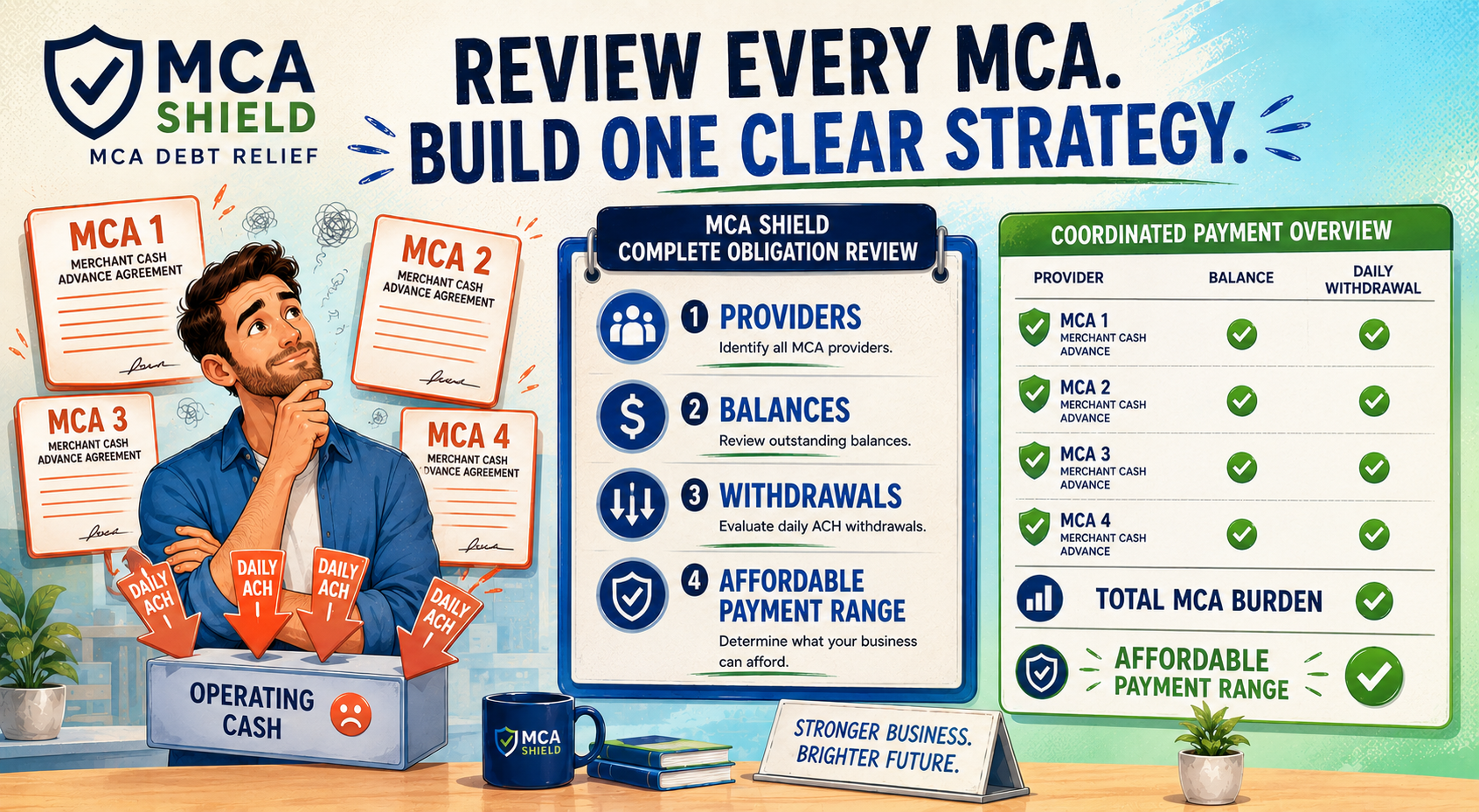
Business owner reviewing multiple MCA agreements, balances, withdrawals, and an affordable payment range with MCA Shield

Yes, multiple merchant cash advances can be addressed through one coordinated MCA debt restructuring strategy. This approach can help a business understand its total payment burden and pursue more manageable arrangements with several MCA providers.

However, restructuring multiple obligations does not automatically combine them into one new loan. Each MCA agreement remains separate unless the final arrangement specifically changes that structure.

A complete review should examine:

  • Every MCA agreement
  • The balance claimed by each provider
  • Daily or weekly withdrawal amounts
  • Payment histories
  • Remaining estimated repayment periods
  • UCC filings and personal guarantees
  • The business’s current revenue and operating expenses

This information provides a clear picture of the company’s total MCA burden. It also helps determine how much the business may realistically afford across all obligations.

How Does Restructuring Address Stacked MCA Obligations?

Stacked MCA obligations occur when a business takes out additional merchant cash advances before paying off earlier agreements. As each new withdrawal is added, the combined payments can quickly overwhelm cash flow.

A restructuring review evaluates the entire stack rather than focusing on only one provider. The goal is to prevent one modified payment from leaving too little money for the remaining obligations.

The process may involve:

  • Confirming each outstanding balance
  • Calculating the total daily or weekly withdrawal amount
  • Identifying which payments create the greatest pressure
  • Reviewing the order and timing of the MCA agreements
  • Estimating an affordable combined payment range
  • Communicating with each provider about possible changes

A coordinated strategy can make the payment structure easier to understand and manage. Still, the final result depends on what each MCA provider agrees to accept.

Business owners should also avoid taking another advance during restructuring. Adding new MCA debt can increase the total payment burden and disrupt the proposed plan.

Does Every MCA Provider Have to Participate?

No. Not every MCA provider has to participate for the business to explore restructuring. However, the outcome may be less effective if one or more providers continue withdrawing the full payment amount.

Each provider makes its own decision based on the agreement, payment history, outstanding balance, and financial information presented. One provider may accept lower payments, while another may reject the proposal or request different terms.

Therefore, the business must understand exactly which obligations are included in the restructuring plan. Any proposed arrangement should identify:

  • The participating MCA providers
  • The payment owed to each provider
  • The frequency of each withdrawal
  • The first payment date
  • Any remaining obligations outside the plan
  • The consequences of missing a payment

Clear documentation is essential. The business should not assume that an agreement with one provider automatically changes its obligations to another.

A successful strategy must account for all active MCA payments, including any providers that choose not to participate. This helps the business avoid accepting a plan that still leaves its cash flow under severe pressure.

What Happens to ACH Withdrawals During MCA Restructuring?

ACH withdrawals may continue during MCA debt restructuring until the provider approves and implements a different payment arrangement. Starting a restructuring review does not automatically pause or change the withdrawals authorized under the original agreement.

If a new arrangement is accepted, the MCA provider may reduce the withdrawal amount, change the payment frequency, or begin collecting payments through another approved method. The specific result depends on the agreement and the terms accepted by the provider.

The business should monitor its bank account closely throughout the process. Unexpected withdrawals can create overdrafts, returned payments, and additional pressure on the company’s operating cash.

Are Automatic Withdrawals Reduced Immediately or Stopped?

No. Automatic withdrawals are not usually reduced or stopped simply because a business requests restructuring. The existing payment schedule may remain active until the MCA provider confirms a change.

A business should not rely on a verbal conversation alone. Before adjusting its cash-flow plan, it should receive clear confirmation of:

  • The new withdrawal amount
  • Whether payments will remain daily or become weekly
  • The date the revised payments will begin
  • Which bank account will be used
  • Whether the original ACH authorization remains active
  • Any fees or consequences tied to the new arrangement

If multiple MCA providers are withdrawing from the same account, each provider may respond differently. One may agree to a lower payment while another continues to collect the original amount.

Therefore, the business must account for every active withdrawal. Otherwise, the remaining debits could leave the company without enough cash for payroll, rent, inventory, and other essential expenses.

What Should a Business Do About Its Operating Bank Account?

The business should continue monitoring its operating account and maintain accurate records of every MCA withdrawal. Daily account reviews can help identify duplicate debits, unexpected amounts, returned payments, and changes in withdrawal activity.

Business owners should also keep copies of:

  • Bank statements
  • ACH authorizations
  • Payment confirmations
  • Provider emails
  • Modified payment agreements
  • Notices of returned or rejected withdrawals

A business should not close its bank account, block withdrawals, or redirect revenue without first reviewing its MCA agreements and understanding the possible consequences. These actions could violate contract terms or trigger collection and legal activity.

Instead, the company should seek appropriate professional guidance before making major banking changes. It should also communicate with its bank and MCA providers when necessary.

The goal is to protect essential operating cash while following any confirmed restructuring arrangement. Careful account management can help the business avoid unnecessary disruptions and maintain enough working capital to continue operating.

How Are UCC Filings and Personal Guarantees Handled?
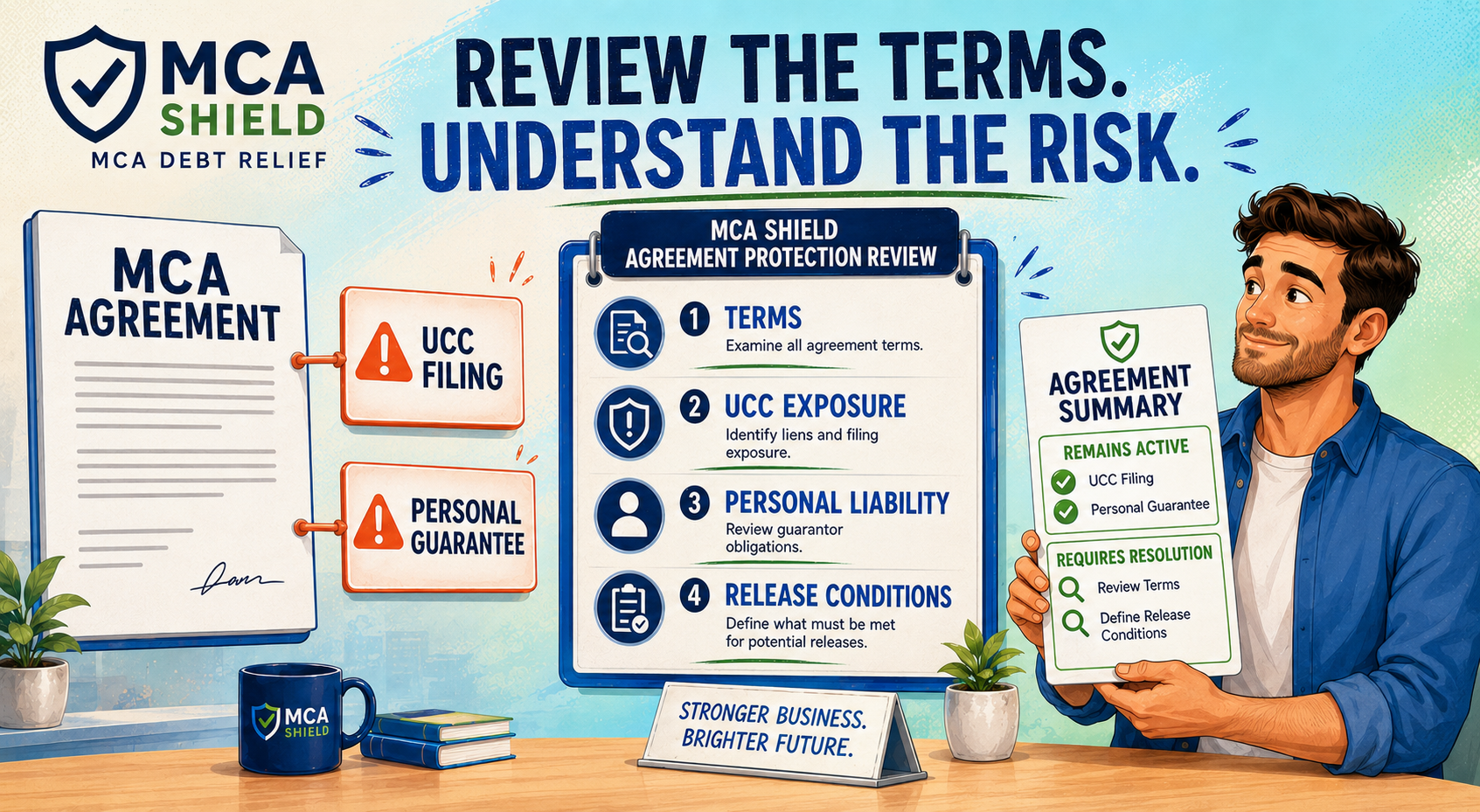
MCA Shield review of UCC filings, personal guarantees, liability, and release conditions during MCA debt restructuring

UCC filings and personal guarantees may remain active during MCA debt restructuring. Changing the payment schedule does not automatically cancel the provider’s contractual rights or security interests.

Many MCA providers use UCC filings to give public notice of a claimed security interest in certain business assets. Some agreements also include a personal guarantee from the owner. This provision may allow the provider to pursue the guarantor under specific circumstances.

Before accepting new payment terms, the business should review how the proposed arrangement addresses both protections. Important questions include:

  • Will the existing UCC filing remain active?
  • Which business assets does the filing cover?
  • When will the provider file a termination statement?
  • Does the personal guarantee remain in effect?
  • Could a missed restructured payment trigger enforcement?
  • Does the new agreement add or expand any protections?

The answers should appear in the written restructuring documents. Business owners should not rely only on verbal promises.

Does Restructuring Automatically Remove a UCC Filing?

No. MCA debt restructuring does not automatically remove a UCC filing. The filing may remain in place while the restructured obligation is active.

A modified payment arrangement usually changes how the business repays the obligation. Unless the provider agrees otherwise, it may not release its claimed security interest simply because the payment amount has changed.

Once the obligation has been fully resolved, the provider may need to file a UCC termination statement. This record indicates that the secured party is releasing the filing. However, the timing and requirements depend on the agreement, applicable law, and the facts of the case.

The business should confirm:

  • Whether a UCC filing currently exists
  • The filing number and jurisdiction
  • The assets covered by the filing
  • The conditions required for its release
  • Who is responsible for filing the termination
  • How the business will verify that the filing was removed

A UCC filing can affect future financing and relationships with other creditors. Therefore, the business should monitor the public record after completing the restructuring plan.

Can a Personal Guarantee Still Be Enforced?

Yes. A personal guarantee may still be enforceable during or after restructuring unless the provider agrees to release or modify it.

The guarantee may allow the provider to pursue the business owner personally if certain events occur. These events may include missed payments, misrepresentation, unauthorized banking changes, or other defaults listed in the agreement.

A new payment arrangement does not automatically eliminate the original guarantee. In some cases, the restructured agreement may confirm that the guarantee remains active.

Before signing, the owner should review:

  • Which actions could trigger the guarantee
  • Whether the new agreement changes its scope
  • What happens if the business misses a revised payment
  • Whether the provider will release the guarantee after final payment
  • Whether any additional personal liability is being added

The enforceability of a personal guarantee can depend on the contract and applicable state law. Therefore, a qualified attorney should review any concerns involving personal liability, UCC filings, collection activity, or legal enforcement.

Does MCA Debt Restructuring Affect Business Credit or Legal Risk?

MCA debt restructuring can affect business credit and legal risk, although the impact depends on the company’s agreements, payment history, and financial condition. Restructuring does not guarantee that credit damage, collection activity, or legal action will be avoided.

Some MCA providers may not report payments to traditional business credit bureaus. However, other events connected to the obligation can still affect the company’s financial profile. These may include:

  • Missed or returned payments
  • Collection accounts
  • UCC filings
  • Lawsuits and court judgments
  • Frozen or restrained accounts
  • Defaults reported to industry databases
  • Difficulty obtaining future financing

Business owners should review the proposed restructuring terms carefully. They should also ask how payments will be recorded and what happens to existing collection activity.

Can Restructuring Help Prevent Further Financial Damage?

Restructuring may help reduce further damage by replacing unsustainable withdrawals with a more manageable payment structure. Lower payments could help the business avoid repeated overdrafts, missed payroll, late vendor payments, and depleted cash reserves.

Acting early may also give the company more time to communicate with MCA providers before the situation escalates. A business that waits until several payments have failed may face fewer options and greater collection pressure.

A sustainable restructuring plan may help the company:

  • Keep payments on schedule
  • Protect essential operating cash
  • Reduce returned ACH withdrawals
  • Avoid taking another MCA
  • Maintain payroll and vendor relationships
  • Begin rebuilding cash reserves
  • Lower the risk of additional defaults

However, restructuring cannot reverse every financial consequence. Existing UCC filings, negative records, fees, or collection activity may remain unless the written agreement addresses them.

The business must also maintain the revised payment schedule. Accepting another unaffordable plan could trigger additional financial damage rather than preventing it.

Could an MCA Provider Still File a Lawsuit?

Yes. An MCA provider may still file a lawsuit during or after restructuring, depending on the agreement and the circumstances. Requesting modified terms does not automatically prevent legal action.

A provider may pursue a claim if it believes the business breached the original agreement or failed to follow the new arrangement. Potential triggers may include:

  • Missing restructured payments
  • Blocking authorized withdrawals
  • Closing or changing bank accounts
  • Redirecting business revenue
  • Providing inaccurate financial information
  • Violating other contractual requirements

The provider may also continue an existing lawsuit unless the restructuring agreement specifically pauses, resolves, or dismisses the action.

Therefore, any new arrangement should explain how current and future legal activity will be handled. The business should obtain written confirmation of payment terms, collection restrictions, and any conditions related to an active lawsuit.

If the company has received a demand letter, summons, complaint, account restraint, or other legal notice, it should promptly speak with a qualified attorney. MCA debt restructuring may reduce legal risk, but it does not provide automatic protection from a lawsuit.

Can a Business Continue Operating While Restructuring MCA Debt?

Yes, a business can often continue operating while restructuring MCA debt. In fact, the purpose of restructuring is usually to reduce payment pressure so the company can maintain normal operations.

The business may continue serving customers, collecting revenue, paying employees, ordering supplies, and working with vendors. However, it must carefully manage its cash flow throughout the process.

Until new terms are approved, the original daily or weekly withdrawals may continue. Therefore, the company should not assume that beginning a restructuring review immediately creates more available cash.

The business should closely monitor:

  • Daily bank balances
  • Incoming revenue
  • MCA withdrawals
  • Payroll deadlines
  • Rent and utility payments
  • Inventory and material costs
  • Tax and insurance obligations
  • Vendor payment schedules

A short-term cash-flow plan can help the owner prioritize essential expenses while the restructuring process moves forward.

Can the Business Still Pay Employees and Vendors?

Yes. A business should continue paying employees and essential vendors whenever possible. These expenses are critical to keeping the company open and generating revenue.

A restructuring review should calculate how much money the business needs for:

  • Employee wages and payroll taxes
  • Independent contractors
  • Inventory and supplies
  • Rent and utilities
  • Equipment and vehicle expenses
  • Insurance and taxes
  • Essential vendor obligations

These costs help determine an affordable range for MCA payments. A payment plan may not be sustainable if it leaves too little money for payroll or the supplies needed to serve customers.

Lower withdrawals may create more room in the operating budget. However, the business should still communicate with vendors if payment delays are likely. Clear communication can help preserve important relationships and prevent service disruptions.

The company should also avoid promising payments it cannot realistically make. A detailed cash-flow forecast can help the owner decide which expenses require immediate attention.

Should the Business Take Another MCA During Restructuring?

In most cases, taking another MCA during restructuring can make the situation more difficult. A new advance adds another repayment obligation and may restart the cycle of stacked MCA payments.

The additional funds may provide temporary relief. However, the new daily or weekly withdrawals can quickly reduce the cash-flow improvement created by restructuring.

Another MCA may also:

  • Increase the total payment burden
  • Reduce available working capital
  • Interfere with existing negotiations
  • Violate terms in earlier agreements
  • Make a revised payment plan unaffordable
  • Create additional UCC filings or personal guarantees
  • Increase the risk of default

Before taking on new financing, the business should evaluate why it needs the funds. If the company needs another MCA to cover existing MCA payments, payroll, or routine operating expenses, the underlying cash-flow problem likely remains unresolved.

A stronger approach is to stabilize expenses, follow the revised payment plan, and rebuild reserves gradually. MCA debt restructuring should create a path away from repeated borrowing, not make room for another unaffordable obligation.

How Do You Choose an MCA Debt Restructuring Company?
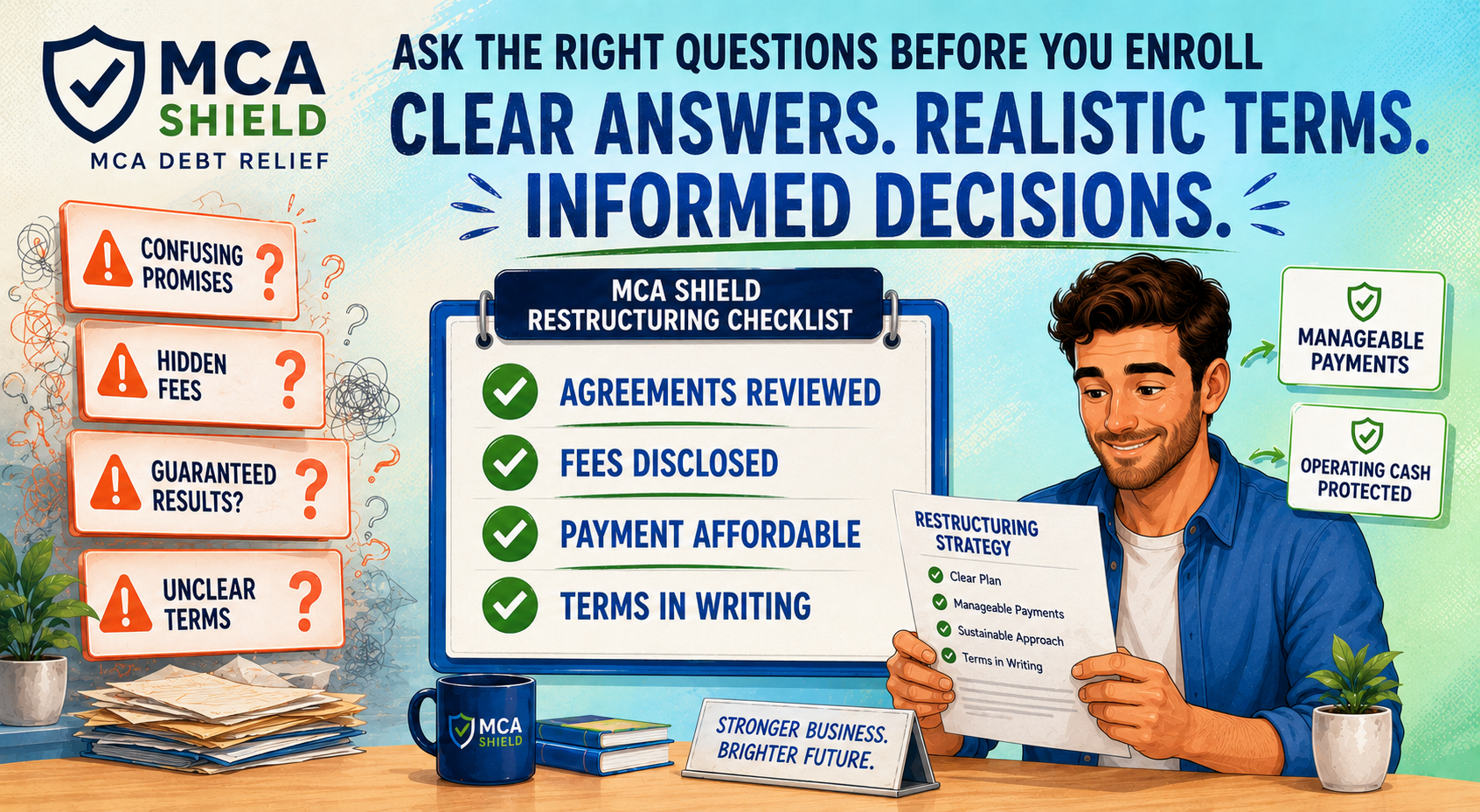
Business owner reviewing fees, agreements, affordable payments, and written terms when choosing an MCA debt restructuring company

Choosing the right MCA debt restructuring company requires more than comparing advertisements or monthly payment estimates. The company should take time to understand your agreements, cash flow, operating expenses, and long-term ability to maintain a revised plan.

A reputable provider should clearly explain its process before asking you to enroll. It should also be honest about possible risks, costs, timelines, and outcomes.

Look for a company that provides:

  • A complete review of your MCA obligations
  • Clear written terms and fee disclosures
  • A payment strategy based on actual cash flow
  • Consistent updates throughout the process
  • Honest explanations without guaranteed outcomes
  • A clear point of contact for questions
  • Experience addressing multiple or stacked MCAs

Be cautious of any company that pressures you to enroll immediately or promises to eliminate your obligations. MCA restructuring results depend on the agreements, providers, and financial circumstances involved.

What Questions Should You Ask Before Enrolling?

Before enrolling, ask detailed questions about the company’s process and responsibilities. The answers should be specific and easy to understand.

Important questions include:

  • How will you review my MCA agreements?
  • Will you contact every MCA provider?
  • How will you calculate an affordable payment?
  • What documents will I need to provide?
  • Who will communicate with me during the process?
  • How often will I receive updates?
  • What happens if a provider refuses to participate?
  • Will my current ACH withdrawals continue?
  • How are UCC filings and personal guarantees addressed?
  • What happens if I cannot maintain the proposed plan?
  • Does the company provide legal services or work with attorneys?
  • How can I cancel the program?

The company should also explain what it needs from you. This may include complete financial records, timely communication, and enough available cash to maintain the proposed payments.

Do not enroll until you understand the process, your responsibilities, and the possible outcomes.

What Fees, Terms, and Promises Should You Review?

Review every fee and program term before signing. The agreement should clearly state what you will pay, when charges will occur, and which services the company will provide.

Pay close attention to:

  • Enrollment or setup fees
  • Monthly service charges
  • Performance-based fees
  • Payment processing fees
  • Cancellation and refund policies
  • Estimated program length
  • Required payment amounts
  • Missed-payment consequences
  • Services included and excluded
  • Conditions that may change the plan

You should also examine every promise made during the sales process. Be cautious of claims such as “guaranteed approval,” “instant payment reduction,” “automatic lawsuit protection,” or “complete debt elimination.”

No restructuring company can control how every MCA provider responds. A trustworthy company should explain both the possible benefits and the limitations of the process.

Keep copies of the service agreement, payment schedule, emails, and other written communications. If a promise is important to your decision, make sure it appears in writing.

Schedule a Free Consultation With MCA Shield

If daily or weekly MCA withdrawals are putting pressure on your business, MCA Shield can review your current obligations and cash flow. The goal is to help you understand the available options before the situation becomes more difficult to manage.

During your consultation, MCA Shield can examine your MCA agreements, balances, payment schedules, and essential operating expenses. This review can help identify the total burden and determine whether a more manageable approach may be possible.

You will have an opportunity to ask questions about:

  • Your daily or weekly payments
  • Multiple or stacked MCA obligations
  • Restructuring timelines
  • ACH withdrawals
  • UCC filings
  • Personal guarantees
  • Cash-flow concerns
  • Possible next steps

Schedule a Free Consultation With MCA Shield to learn whether MCA debt restructuring may fit your business’s current financial needs.

Schedule Your Free Consultation