

If you are trying to lower daily MCA payments, the goal is usually bigger than simply reducing one withdrawal. You need to create enough breathing room to cover payroll, vendors, operating expenses, and other essential business costs without shutting down or falling further behind.
High daily or weekly merchant cash advance withdrawals can put serious pressure on cash flow, especially when a business has multiple stacked MCAs. When too much revenue is being pulled from the account, even a profitable business can struggle to keep enough working capital available for normal operations.
The good news is that there may be ways to reduce MCA payment pressure through restructuring, consolidation, or other repayment strategies. In this guide, we will explain how to evaluate your current obligations, protect your cash flow, and work toward a more manageable payment structure while keeping your business open and operating.
Schedule Your Free Consultation
Why Daily MCA Payments Can Put Your Business at Risk
Merchant cash advances can provide quick access to capital, but the repayment structure can become difficult when revenue slows or operating costs increase. For many business owners, the biggest problem is not the total balance. It is the frequency and size of the withdrawals coming out of the business account.
When a large portion of daily revenue is being used for MCA payments, there may not be enough cash left for payroll, rent, inventory, vendors, taxes, and other operating expenses. Over time, this can create a cycle where the business is constantly trying to catch up.
If you need to lower daily MCA payments, it is important to understand how those withdrawals are affecting your cash flow before the pressure becomes more difficult to manage.
How Daily ACH Withdrawals Affect Cash Flow
Many MCA agreements are repaid through daily or weekly ACH withdrawals from the business bank account. These automatic payments can make repayment convenient, but they can also reduce the amount of working capital available each day.
For example, a business may generate strong monthly revenue but still struggle with cash flow if several thousand dollars are withdrawn every week. Revenue does not always arrive at the same time that expenses are due. A large daily withdrawal can leave the business short when it is time to cover payroll, supplier invoices, equipment costs, or rent.
Daily ACH withdrawals can create even more pressure when sales fluctuate. A business may have a strong week followed by a slower one, but the payment may remain the same unless the agreement includes a reconciliation feature that applies to the situation.
Common signs that MCA payments are putting too much pressure on cash flow include:
- Difficulty covering payroll or vendor payments
- Frequent overdrafts or low account balances
- Delayed purchases of inventory or supplies
- Using credit cards to cover normal operating expenses
- Taking another MCA to make existing payments
- Having little or no working capital available
These warning signs may indicate that the current payment structure is no longer sustainable. Addressing the problem early can provide more options for protecting the business.
What Happens When Multiple MCAs Are Stacked
The pressure can become much greater when a business has multiple merchant cash advances at the same time. This is often referred to as stacked MCAs.
Each funder may be withdrawing a separate payment on a daily or weekly schedule. Instead of managing one payment, the business could have several withdrawals coming from the same bank account.
For example, one MCA may withdraw $600 per day, another may take $450, and a third may withdraw $300. That means the business is losing $1,350 every business day before many other expenses are paid.
Stacked MCAs can quickly reduce available cash and make it difficult to maintain normal operations. Some businesses respond by taking another advance to cover the shortage. However, adding more debt can increase the overall payment pressure and make the situation harder to resolve.
The goal should be to create a payment structure that reflects what the business can realistically afford based on current cash flow. Depending on the agreements and financial situation, MCA restructuring or consolidation may help reduce the number or size of payments.
Taking action before cash flow reaches a critical point can make it easier to lower daily MCA payments, protect working capital, and keep the business operating.
How to Lower Daily MCA Payments Before Cash Flow Gets Worse
If your business is struggling with frequent merchant cash advance withdrawals, it is important to act before the payment pressure becomes more serious. The longer a business operates with limited working capital, the harder it can become to cover payroll, vendors, taxes, rent, inventory, and other essential expenses.
One of the first steps to lower daily MCA payments is understanding exactly what your business owes and how much cash is leaving the account each week. A clear financial picture can help you determine whether the current payment structure is sustainable or whether you need to explore restructuring or consolidation options.
Review Your Current MCA Agreements and Payment Obligations
Start by gathering every active merchant cash advance agreement. Do not rely only on bank withdrawals or memory. Review the actual documents so you can see the terms attached to each obligation.
For each MCA, identify important details such as:
- The remaining balance
- The current daily or weekly payment
- The original funding amount
- The factor rate or total repayment amount
- The estimated payoff date
- Any reconciliation provisions
- Personal guarantees or UCC-related terms
- Fees that may apply after default or missed payments
You should also calculate how much is being withdrawn across all MCA agreements. A business with several advances may discover that a large percentage of its weekly revenue is going directly toward MCA payments.
This review can also help identify stacked MCAs, overlapping withdrawals, and agreements that are creating the most pressure on cash flow. Once you understand the full picture, you can begin evaluating which options may provide meaningful relief.
Calculate What Your Business Can Realistically Afford
Lowering payments only helps if the new payment amount is actually sustainable. A payment that looks better on paper can still create problems if it leaves too little cash for normal business operations.
Start by reviewing your average weekly or monthly revenue. Then subtract the expenses required to keep the business running. These may include payroll, rent, utilities, inventory, insurance, taxes, fuel, equipment, and vendor payments.
The amount left after essential expenses gives you a better idea of what your business may realistically be able to put toward MCA obligations.
It is also important to account for slower sales periods. A payment should not be based only on your strongest revenue weeks. A more sustainable structure should consider normal cash-flow fluctuations and leave enough working capital available to handle unexpected expenses.
The goal is not simply to get the lowest possible payment. The goal is to create a payment structure your business can maintain while continuing to operate.
When you understand your agreements and know what your business can realistically afford, you are in a much stronger position to explore options that may reduce MCA payment pressure, protect working capital, and help keep your business open.
Can MCA Restructuring Reduce Your Daily Payments?
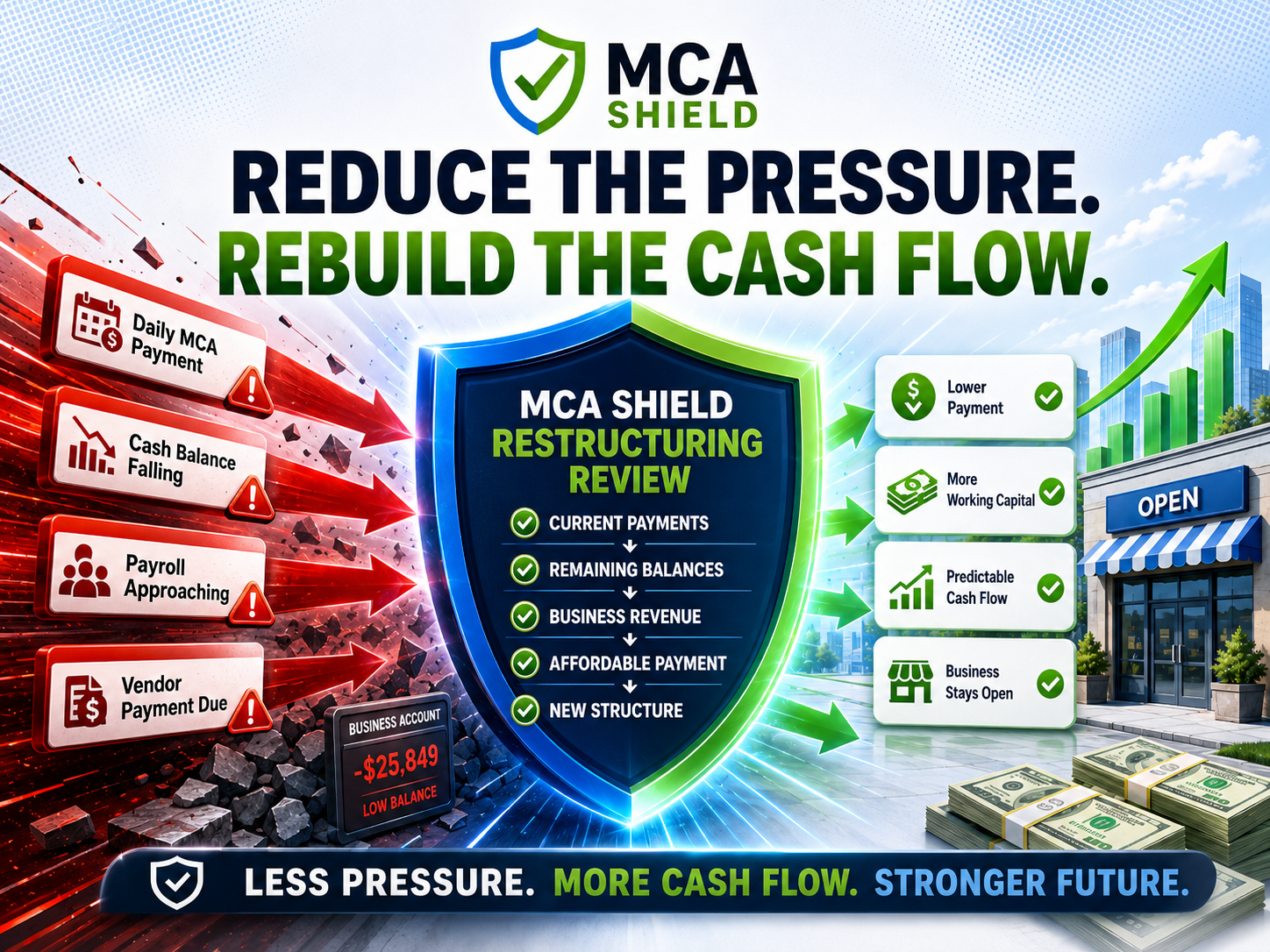
MCA restructuring may help a business reduce the pressure created by large daily or weekly merchant cash advance withdrawals. Instead of continuing with a payment schedule that no longer fits the company’s cash flow, restructuring may create a more manageable repayment arrangement.
The goal is to make the payment easier to sustain while allowing the business to continue covering payroll, vendors, rent, inventory, taxes, and other operating expenses. For business owners trying to lower daily MCA payments, restructuring can be one option worth reviewing.
The exact outcome depends on the agreements, remaining balances, revenue, and the willingness of the parties involved to accept revised terms.
How MCA Restructuring May Change Your Payment Schedule
A restructuring plan may change how often payments are made or how much is withdrawn at one time. For example, a business that is struggling with several large daily ACH withdrawals may seek a structure with lower payments spread over a longer period.
Depending on the situation, restructuring may involve:
- Reducing the amount withdrawn each day or week
- Moving from multiple payments to a more organized payment structure
- Adjusting the repayment timeline
- Creating payments that better reflect current business cash flow
- Negotiating terms that provide more room for essential operating expenses
The purpose is not simply to move the debt around. A successful restructuring should create a payment schedule that the business has a better chance of maintaining.
If a business is currently paying $1,500 every business day across several MCA obligations, even a meaningful reduction could free up thousands of dollars in monthly working capital. That additional cash may help the company stay current on payroll, suppliers, insurance, rent, and other necessary expenses.
Before agreeing to any restructuring plan, the business should understand the new payment amount, repayment period, fees, total cost, and any legal or contractual terms that remain in place.
Why a Longer Repayment Structure Can Improve Cash Flow
One reason MCA payments can become difficult is that a large repayment obligation is compressed into a relatively short period. High-frequency withdrawals can remove cash faster than the business can comfortably replace it.
Extending the repayment period may allow the balance to be spread across more payments. This can potentially reduce the amount leaving the business account each day or week.
For example, lowering a daily payment from $1,500 to $900 would leave an additional $600 in the business account each business day. Over a 20-day operating month, that could mean approximately $12,000 more cash remaining available for operations.
That breathing room can make a major difference when a company is trying to cover:
- Employee payroll
- Vendor and supplier invoices
- Rent and utilities
- Inventory or materials
- Taxes and insurance
- Equipment and vehicle expenses
- Unexpected operating costs
However, a longer repayment period can also increase the amount of time the business remains obligated under the agreement. Depending on the restructuring terms, it may also affect the overall cost.
That is why business owners should evaluate both the immediate cash-flow relief and the total financial impact before accepting a new arrangement.
The best restructuring strategy is one that does more than temporarily lower a payment. It should help the business create a sustainable payment structure, preserve working capital, and continue operating without constant cash-flow pressure.
Can You Consolidate Multiple MCA Payments Into One Payment?
When a business has several merchant cash advances at the same time, managing the withdrawals can become difficult very quickly. Each funder may have a different payment amount, withdrawal date, and repayment schedule. This can make cash flow harder to predict and increase the risk of overdrafts or missed operating expenses.
MCA consolidation may help simplify the situation by combining multiple obligations into a more organized payment structure. Instead of managing several separate withdrawals, a business may be able to work toward one structured payment that is easier to track and potentially more manageable.
For business owners trying to lower daily MCA payments, consolidation may provide a clearer way to organize stacked obligations and protect working capital.
How MCA Consolidation Can Simplify Multiple Withdrawals
With stacked MCAs, several daily or weekly ACH withdrawals may hit the same business bank account. Even when each payment seems manageable on its own, the combined impact can create serious cash-flow pressure.
For example, a business may have three separate MCA payments of $500, $400, and $350 per day. Together, those withdrawals remove $1,250 every business day from the operating account.
A consolidation strategy may replace multiple payments with a single, more predictable payment. This can make it easier to:
- Track the amount leaving the account
- Plan for payroll and vendor payments
- Reduce payment confusion
- Avoid multiple withdrawals hitting on the same day
- Better forecast weekly and monthly cash flow
- Maintain more consistent working capital
Simplifying the payment structure can also make financial planning easier. Instead of reacting to several withdrawals each day, the business can work with a clearer repayment schedule.
However, consolidation should be reviewed carefully. A lower payment does not automatically mean the overall arrangement is better. Business owners should compare the new payment, repayment term, total cost, fees, and remaining obligations before making a decision.
When Consolidation May Make Sense for a Business With Stacked MCAs
MCA consolidation may be worth considering when multiple advances are consuming too much of the company’s daily or weekly revenue.
Common signs that consolidation may make sense include:
- The business is making multiple MCA payments every day
- Daily withdrawals are interfering with payroll
- Vendor or supplier payments are being delayed
- The business is frequently overdrawing its bank account
- Another MCA is being considered just to cover existing payments
- There is not enough cash left for normal operating expenses
- The owner is having difficulty tracking balances and payoff dates
The key question is whether the new structure would create a more sustainable payment without putting the business under even more financial pressure.
Consolidation can be especially useful when stacked MCAs have created a confusing repayment situation. A simpler payment structure may help the owner see exactly what is owed, what is affordable, and how much cash needs to remain available for operations.
Before moving forward, review the full financial picture. The goal should be to lower daily MCA payments, simplify repayment, and preserve enough cash to keep the business running.
How to Protect Payroll, Vendors, and Working Capital While Paying MCA Debt
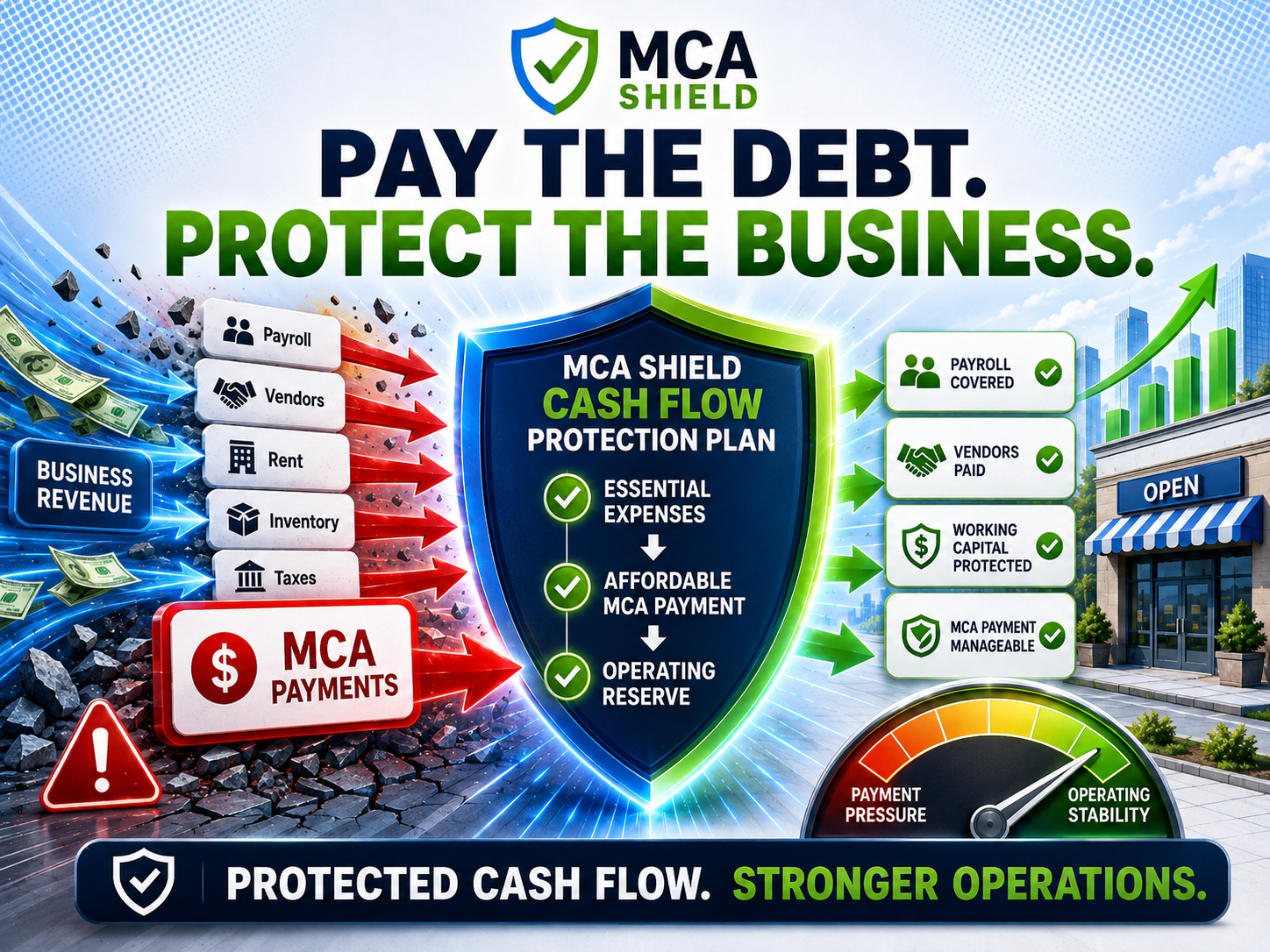
When MCA payments begin taking too much cash out of the business, the problem can quickly affect more than the repayment itself. A company still needs enough money available for payroll, rent, vendors, inventory, taxes, insurance, and daily operating costs.
That is why reducing payment pressure should not focus only on the MCA balance. The bigger goal is to protect the cash your business needs to stay open.
For business owners trying to lower daily MCA payments, the payment plan should leave enough working capital available to support normal operations.
Prioritize Essential Business Operating Expenses
Before deciding how much your business can afford to pay toward MCA debt, identify the expenses that must be covered first.
These usually include:
- Payroll and employee costs
- Rent or mortgage payments
- Utilities
- Inventory and materials
- Vendor and supplier invoices
- Insurance
- Taxes
- Fuel and transportation
- Equipment or vehicle expenses
- Other necessary operating costs
These expenses keep the business functioning. If MCA withdrawals regularly prevent you from covering them, the current payment structure may be too aggressive for your cash flow.
It is also important to separate essential expenses from costs that can be reduced, delayed, or eliminated. This gives you a clearer picture of the minimum amount of cash the business needs each week or month.
Protecting payroll is especially important. Missing employee pay can quickly create operational problems. The same is true for important vendors and suppliers. If those relationships are damaged, the business may struggle to deliver products or services.
The goal is to maintain enough cash to keep the company operating while still making progress on the MCA obligations.
Build an MCA Payment Around Your Actual Cash Flow
A sustainable MCA payment should be based on actual business cash flow, not on an amount that only works during your strongest sales periods.
Start by reviewing recent bank statements and revenue records. Look at how much money normally enters the business each week or month. Then subtract the essential operating expenses required to keep the company running.
The remaining amount gives you a better starting point for determining what the business may realistically be able to afford.
For example, if a business generates $80,000 per month but needs $62,000 for payroll, rent, inventory, vendors, and other essential costs, it would be risky to commit most of the remaining $18,000 to MCA payments. The business still needs a cushion for unexpected expenses and slower revenue periods.
A better payment structure should consider:
- Average monthly revenue
- Seasonal sales changes
- Essential operating expenses
- Current cash reserves
- Existing debt payments
- Unexpected business costs
- The amount of working capital needed to operate safely
This is why the lowest possible payment is not always the only goal. The payment needs to be manageable and sustainable over time.
A business that keeps enough cash available for operations is in a stronger position to continue making payments, serve customers, pay employees, and rebuild financial stability.
When an MCA payment is aligned with real cash flow, it becomes easier to protect payroll, keep vendors current, preserve working capital, and keep the business moving forward.
What Should You Avoid When Trying to Lower MCA Payments?
When cash flow is tight, it can be tempting to choose the fastest option available. However, some short-term decisions can make MCA debt harder to manage and create even more pressure on the business.
If your goal is to lower MCA payments, it is important to avoid strategies that increase your total obligations, create legal problems, or leave you with a payment plan that still does not fit your cash flow.
Taking Another MCA to Cover Existing Payments
One of the biggest mistakes a business can make is taking out another merchant cash advance simply to keep up with existing MCA payments.
This may provide temporary relief, but it can also create a cycle of stacked MCAs. Instead of solving the original problem, the business now has another balance, another payment, and another withdrawal competing for the same revenue.
Over time, this can lead to:
- Higher total payment obligations
- More frequent ACH withdrawals
- Less working capital
- Greater difficulty covering payroll and vendors
- Increased pressure to borrow again
A new advance may seem like a quick fix, but it can make the underlying cash-flow problem worse.
Before adding another obligation, review whether the business needs a different payment structure instead. A restructuring or consolidation strategy may be more useful if the current payments are already too difficult to manage.
Ignoring Payments or Blocking ACH Withdrawals Without a Strategy
Another risky move is simply stopping payments or blocking ACH withdrawals without first understanding the possible consequences.
In some situations, a business owner may feel that there is no other option. However, taking action without a clear plan can trigger default provisions, collection activity, additional fees, or legal disputes.
Depending on the agreement, missed payments may also lead to issues involving:
- Personal guarantees
- UCC filings
- Bank account activity
- Collection efforts
- Lawsuits or judgments
This does not mean a business should continue making unaffordable payments forever. It means that any change should be approached carefully.
If the current withdrawals are no longer sustainable, the better approach is to understand the agreement, review your options, and develop a strategy before making major changes to payment activity.
Accepting a Relief Plan Without Reviewing the Total Cost
A lower daily payment can sound attractive, especially when cash flow is under pressure. But the daily payment amount is only one part of the deal.
Before accepting any restructuring, consolidation, or relief plan, review the full cost of the arrangement.
Ask questions such as:
- What is the new payment amount?
- How long will the repayment period last?
- Are there additional fees?
- What will the total repayment amount be?
- Are there penalties for missed payments?
- Will existing guarantees or UCC-related terms remain in place?
- Does the plan actually leave enough cash for business operations?
A payment can be lower and still be a poor option if the total cost becomes much higher or the new terms create additional risk.
The best strategy is one that balances payment relief, total cost, and long-term sustainability.
If you are trying to lower daily MCA payments, avoid making decisions based only on immediate pressure. Review the numbers carefully and choose a plan that gives the business enough room to operate while creating a realistic path forward.
Take Action Before Daily MCA Payments Force You to Close Your Business
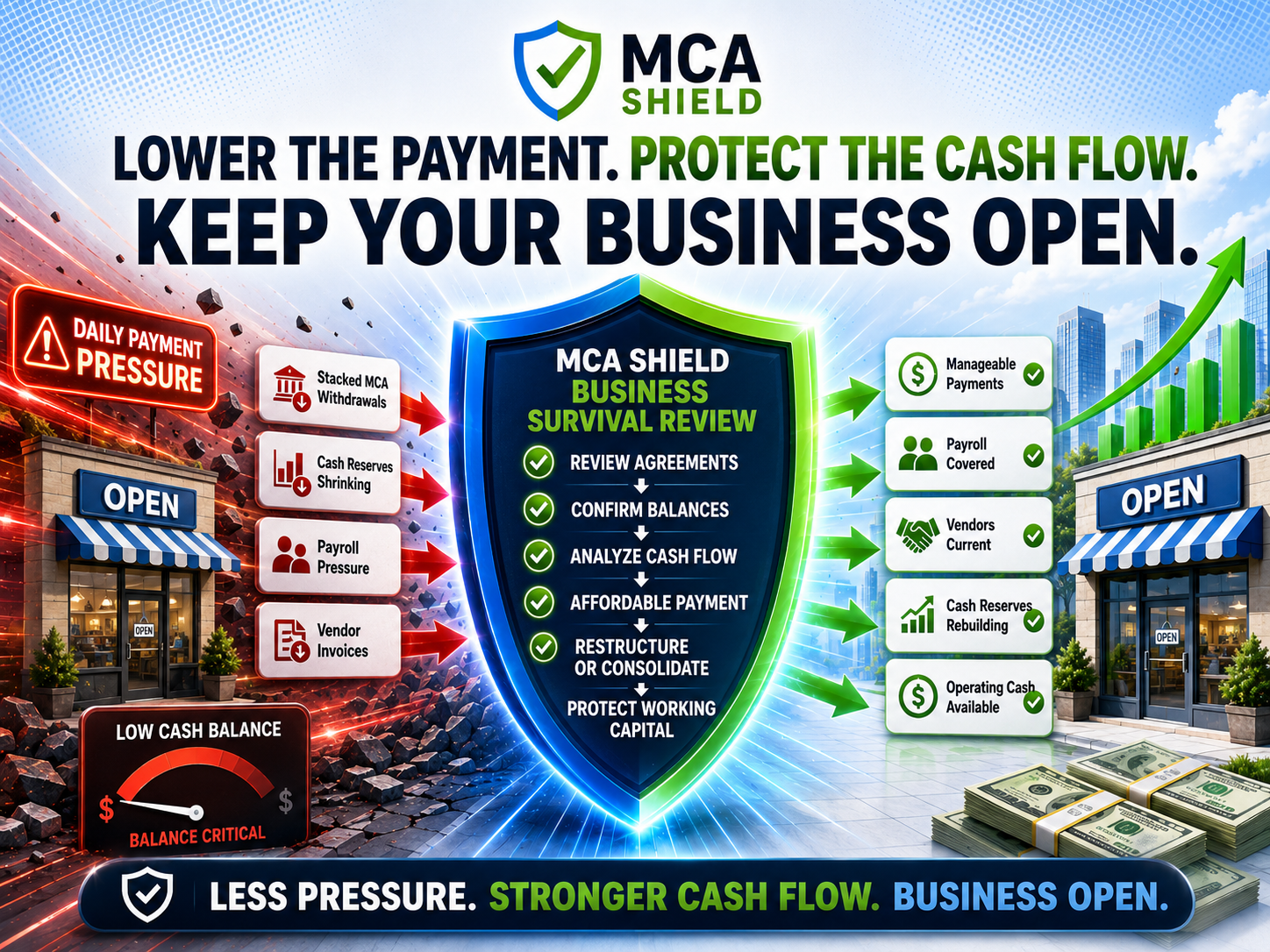
When daily MCA withdrawals are taking too much cash out of your business, waiting can make the situation harder to manage. The sooner you understand the problem, the sooner you can begin looking for ways to lower daily MCA payments and protect the cash needed to keep your company operating.
The goal is not to ignore the debt. The goal is to create a more manageable path forward before payment pressure begins affecting payroll, vendors, inventory, taxes, and other essential business expenses.
Taking action early can give you more time to review your options and avoid making rushed financial decisions.
Review Your Agreements, Balances, and Current Cash Flow
Start by getting a complete picture of your MCA obligations. Gather every active agreement and confirm the details of each account.
Review:
- The remaining balance on each MCA
- Daily or weekly payment amounts
- Current ACH withdrawal schedules
- Total monthly payment obligations
- Factor rates and repayment amounts
- Reconciliation provisions
- Personal guarantees
- UCC-related terms
- Fees or default provisions
Next, compare those obligations with your actual business cash flow.
Look at your average revenue and subtract the money needed for payroll, rent, utilities, vendors, inventory, taxes, insurance, and other operating expenses. This helps show how much cash your business can realistically afford to put toward MCA payments.
If the current withdrawals are consistently leaving the business without enough working capital, that is a strong sign that the payment structure needs to be reviewed.
Find a Payment Structure Your Business Can Sustain
A successful payment strategy should do more than provide temporary relief. It should create a structure that your business can realistically maintain.
That may mean exploring options such as MCA restructuring or MCA consolidation, depending on your agreements and financial situation.
A sustainable plan should consider:
- Your current revenue
- Essential operating expenses
- Seasonal changes in sales
- Existing MCA balances
- Available working capital
- The total cost of the new arrangement
- How long repayment will continue
The goal should be to create a payment that allows the business to keep operating while still addressing its obligations.
A lower payment can help, but only if it leaves enough cash available to cover the expenses that keep the company running. The right structure should support manageable payments, stronger cash flow, and continued business operations.
Speak With MCA Shield About Your Available Options
If daily or weekly MCA withdrawals are putting your business under increasing pressure, you do not have to wait until the situation reaches a crisis point.
MCA Shield can review your current MCA obligations, payment structure, and business cash flow to help you better understand the options that may be available.
The first step is understanding exactly what you owe and how much your business can realistically afford. From there, you can evaluate whether MCA restructuring, consolidation, or another relief strategy may provide a more manageable path forward.
If your goal is to lower daily MCA payments without closing your business, now is the time to review the numbers and take action.
Schedule a free consultation with MCA Shield to discuss your current MCA payments and explore options designed to help protect your working capital and keep your business moving forward.