

Daily or weekly merchant cash advance withdrawals can quickly consume the money your business needs for payroll, vendors, inventory, and other essential expenses. When revenue slows or multiple advances are active, these automatic payments may create an immediate cash-flow crisis. Learning how to stop MCA withdrawals responsibly starts with reviewing your agreements, understanding your legal and financial risks, and choosing a strategy that protects your business without worsening the situation.
Schedule Your Free Consultation
Why MCA Withdrawals Can Quickly Drain Your Business Cash Flow
Merchant cash advances are often repaid through automatic withdrawals taken directly from a business bank account. Because these payments may occur daily or weekly, they can deplete available cash before the owner has an opportunity to cover essential operating expenses.
The problem becomes more serious when revenue declines, customers pay late, or several MCA payments are withdrawn at the same time. Even a business generating steady sales can experience a cash-flow crisis when too much of its incoming revenue is immediately redirected toward MCA obligations.
How Daily and Weekly ACH Debits Affect Available Cash
Daily and weekly ACH debits create a fixed payment demand even when business revenue changes. A company may have enough monthly revenue to appear financially healthy, but the timing of its income may not match the timing of its withdrawals.
For example, an MCA payment may be deducted before customer invoices are collected or before credit card sales are deposited. This can leave the business without enough available cash to cover payroll, rent, inventory, utilities, taxes, and vendor payments.
Repeated withdrawals can also eliminate the cash reserves that help a business manage slow days or unexpected expenses. As the account balance falls, the owner may begin transferring personal funds, delaying bills, using credit cards, or seeking another advance to keep the business operating.
Why Multiple Withdrawals Create a Cash-Flow Shortfall
When a business has several active merchant cash advances, each funder may withdraw money on a different schedule. These overlapping payments can take a significant portion of daily revenue before the business has paid its basic operating costs.
A cash-flow shortfall occurs when the money leaving the account exceeds the cash available for current expenses. Warning signs may include:
- Difficulty covering payroll on time
- Delayed payments to vendors
- Returned ACH transactions or overdraft fees
- Declining inventory or operating supplies
- Dependence on credit cards or new MCA renewals
- Little or no working capital remaining after withdrawals
Taking another advance may temporarily increase the money in the account, but it also introduces another payment. This can create a cycle in which new financing is used to cover withdrawals from earlier agreements.
Business owners who want to stop MCA withdrawals from draining their cash flow should act before the account is repeatedly overdrawn or essential expenses go unpaid. Reviewing every agreement, confirming the current balances, and calculating an affordable payment range can help identify the most appropriate next step.
Review Your MCA Agreement Before Attempting to Stop Withdrawals
Before attempting to stop MCA withdrawals, carefully review every active merchant cash advance agreement. Blocking an ACH debit does not automatically cancel the underlying obligation, and taking action without understanding the contract could lead to default notices, collection activity, or legal escalation.
Create a complete file containing the original agreement, payment history, bank statements, funder communications, and any modifications made after enrollment. Reviewing these documents can help you understand what the funder is authorized to withdraw, how payments may be adjusted, and what could happen if a scheduled payment is interrupted.
Locate the ACH Authorization and Reconciliation Terms
The ACH authorization explains how the MCA provider may withdraw payments from the business bank account. Look for details about the withdrawal amount, payment frequency, designated account, authorization period, and procedure for changing or revoking the authorization.
The agreement may also contain a reconciliation provision that allows payments to be adjusted when actual receivables are lower than originally estimated. Review the provision carefully to determine:
- How a reconciliation request must be submitted
- Which financial records are required
- How frequently an adjustment may be requested
- How long the funder has to review the request
- Whether the adjustment applies temporarily or permanently
A reconciliation request may require recent bank statements, merchant-processing reports, revenue records, or other verification of reduced receivables. Follow the agreement’s instructions closely and keep copies of everything submitted.
Confirm the Purchased Amount, Remaining Balance, and Payment Schedule
An MCA agreement typically identifies the amount of future receivables purchased by the funder. This figure is different from the amount originally deposited into the business account because it generally includes the cost of the advance.
Confirm the following information for each agreement:
- The original advance amount
- The total purchased amount
- The amount already collected
- The estimated remaining balance
- The current daily or weekly withdrawal
- The expected payment schedule
- Any additional fees that may have been charged
Compare the agreement and payment history with withdrawals shown on the business bank statements. If the numbers do not match, request a current transaction history or payoff statement from the funder. Knowing the correct balances is essential before calculating what the business can afford or proposing a modified payment plan.
Identify Default Provisions and Personal Guarantees
The default provisions explain which actions the agreement considers a breach. Depending on the contract, a default may include blocking authorized withdrawals, changing bank accounts without notice, providing inaccurate information, diverting receivables, or failing to submit required financial records.
Review which remedies the agreement provides the funder after a claimed default. These may include collection activity, additional fees, enforcement of a UCC filing, or legal action, depending on the agreement and applicable law.
Also determine whether the contract includes a personal guarantee. A personal guarantee may allow the funder to pursue the individual guarantor under certain circumstances described in the agreement. The exact scope and enforceability of these provisions can vary.
Because MCA contracts and state laws differ, a business owner facing a possible default, lawsuit, or personal guarantee claim should consider having the agreement reviewed by a qualified attorney. A complete contract review makes it easier to evaluate reconciliation, restructuring, consolidation, or another strategy before attempting to stop MCA withdrawals.
Request Reconciliation When Revenue Has Declined
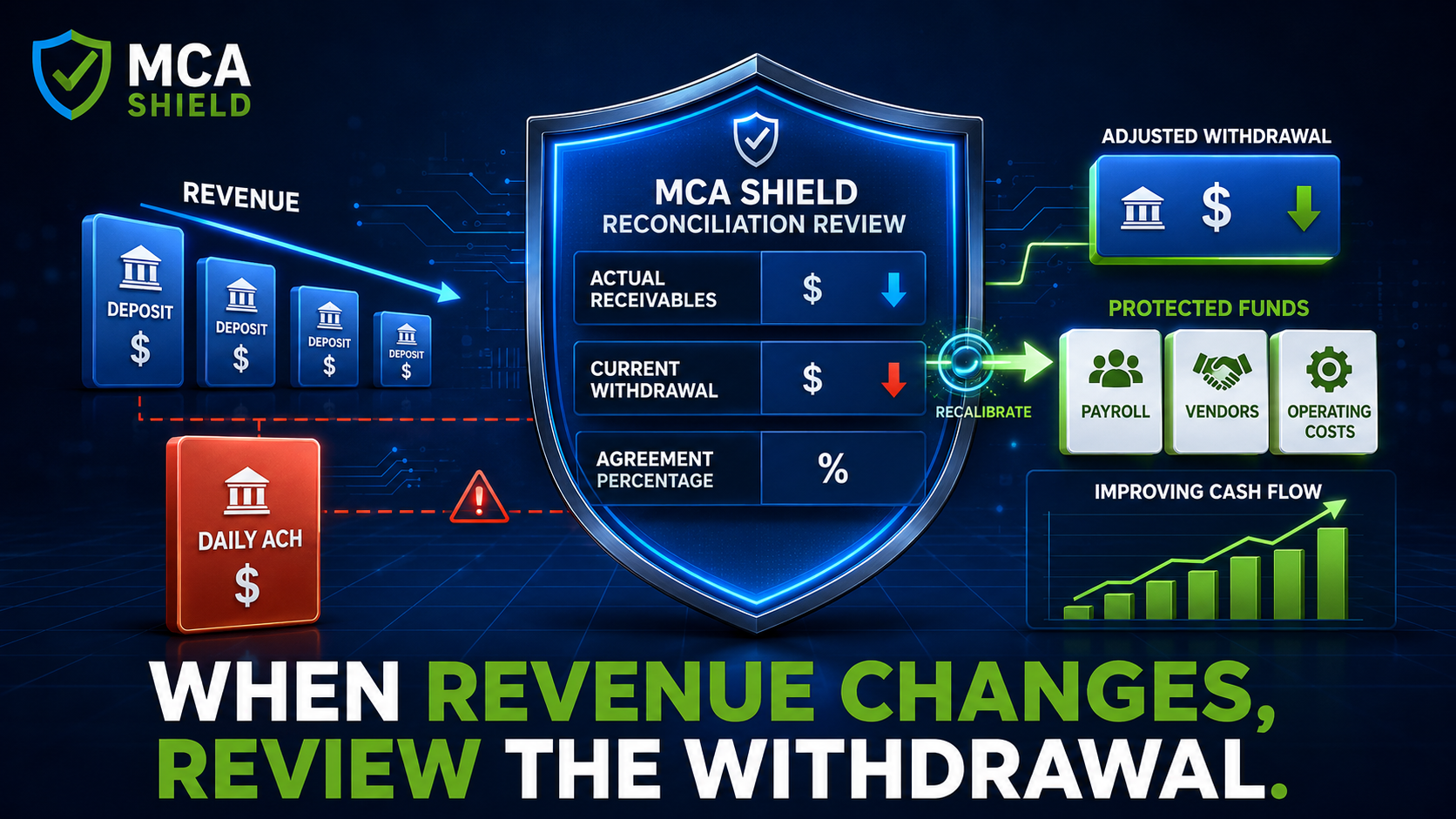
If your MCA agreement includes a reconciliation provision, you may be able to request a payment adjustment when business revenue falls below the amount used to calculate the original withdrawal. Reconciliation can be especially important when seasonal changes, lost customers, delayed invoices, or an unexpected slowdown make the existing payment difficult to maintain.
A reconciliation request does not eliminate the remaining obligation. Its purpose is to align the withdrawals more closely with the percentage of receivables described in the agreement.
How Reconciliation Can Adjust Withdrawals to Actual Receivables
Many merchant cash advance agreements establish a specified percentage of future receivables while collecting an estimated amount through daily or weekly ACH debits. If actual revenue becomes lower than the original estimate, the scheduled withdrawal may represent a much larger percentage of current receivables than intended.
Reconciliation allows the funder to review recent revenue and determine whether the withdrawal should be reduced. Depending on the agreement, this process may result in:
- A lower daily or weekly withdrawal
- A credit for amounts previously collected above the specified percentage
- A temporary payment adjustment
- A revised withdrawal based on current receivables
Reconciliation terms vary by agreement, and an adjustment is not automatic. The business must generally submit a request according to the contract and provide enough information for the funder to verify the revenue decline.
What Financial Records the MCA Funder May Require
The funder may request financial documents showing the business’s current receivables and account activity. Providing complete and accurate records can prevent unnecessary delays in the review.
Requested documents may include:
- Recent business bank statements
- Current merchant-processing statements
- Accounts receivable reports
- Profit-and-loss statements
- Monthly sales reports
- Tax returns or tax filings
- Proof of a temporary closure or operational disruption
- A completed reconciliation request form
Review the agreement before submitting the request because it may specify which documents are required and the deadline for providing them. Make sure the reporting period is consistent across the records and explain any unusual deposits, transfers, or revenue changes that could affect the review.
Why Reconciliation Requests Should Be Made in Writing
A written request creates a record of when reconciliation was requested, what information was provided, and how the funder responded. A phone conversation alone may not be enough to establish that the business followed the procedures in the agreement.
The written request should identify the agreement, explain that revenue has declined, reference the applicable reconciliation provision, and include the required financial records. Keep copies of emails, forms, attachments, delivery confirmations, and responses from the funder.
Continue monitoring the bank account while the request is under review. Do not assume the withdrawal has changed until the funder confirms the new amount and effective date in writing.
For a business trying to stop MCA withdrawals from overwhelming its cash flow, reconciliation may provide relief without immediately pursuing a broader restructuring. If the funder denies the request or the adjusted payment remains unaffordable, the business may need to evaluate additional options.
Contact the MCA Funder Before Your Bank Account Is Overdrawn
Contacting the MCA funder before a scheduled withdrawal fails may give your business more time to discuss available options. Waiting until the account is repeatedly overdrawn can lead to returned-payment fees, default notices, collection calls, and additional strain on the business.
Begin the conversation as soon as you determine that an upcoming withdrawal could interfere with payroll, rent, inventory, or another essential expense. Explain the situation clearly and be prepared to support your request with current financial information.
Explain the Cash-Flow Problem With Accurate Financial Records
A funder is more likely to understand the severity of the problem when the request is supported with reliable numbers. Instead of stating only that the payment is unaffordable, explain what changed and how the current withdrawal affects daily operations.
Useful records may include:
- Recent business bank statements
- Merchant-processing statements
- Profit-and-loss reports
- Accounts receivable records
- Current payroll obligations
- Vendor invoices and operating expenses
- A short-term cash-flow projection
These documents can help show whether the problem resulted from declining sales, seasonal revenue, late customer payments, unexpected expenses, or several MCA withdrawals occurring together. Submit accurate information and avoid making promises the business cannot realistically keep.
Request a Temporary Reduction or Modified Payment Schedule
Ask whether the funder will consider a temporary reduction, reconciliation, modified withdrawal schedule, or alternate payment arrangement. The available options will depend on the agreement, the funder’s policies, and the business’s current financial condition.
Before proposing a new amount, calculate how much the business can afford after covering essential expenses. A lower payment is only useful if it leaves enough working capital to continue operating.
A reasonable proposal should account for:
- Payroll and payroll taxes
- Rent or mortgage payments
- Utilities and insurance
- Inventory and necessary supplies
- Vendor obligations
- Transportation and equipment costs
- A small reserve for unexpected expenses
Do not agree to a payment simply because it is lower than the current withdrawal. Review the frequency, duration, fees, total repayment amount, and consequences of missing the modified payment.
Get Every Payment Agreement in Writing
Any approved change should be documented before the business relies on it. A verbal promise from a representative may not clearly establish the new withdrawal amount, effective date, or duration of the arrangement.
The written confirmation should identify:
- The revised payment amount
- How often the payment will be withdrawn
- The date the change begins
- How long the modification remains active
- Whether any fees are being added
- Whether the remaining balance or total cost changes
- What happens when the temporary arrangement ends
Keep copies of all emails, letters, payment proposals, and account records. Monitor the bank account to confirm that the withdrawal matches the written agreement.
Early communication does not guarantee that the funder will approve a change, but it may create more options than waiting for payments to fail. If the funder refuses to adjust an unaffordable withdrawal, the business may need to consider reconciliation, restructuring, consolidation, or legal guidance before the cash-flow problem becomes serious.
Can You Legally Revoke ACH Authorization for MCA Withdrawals?
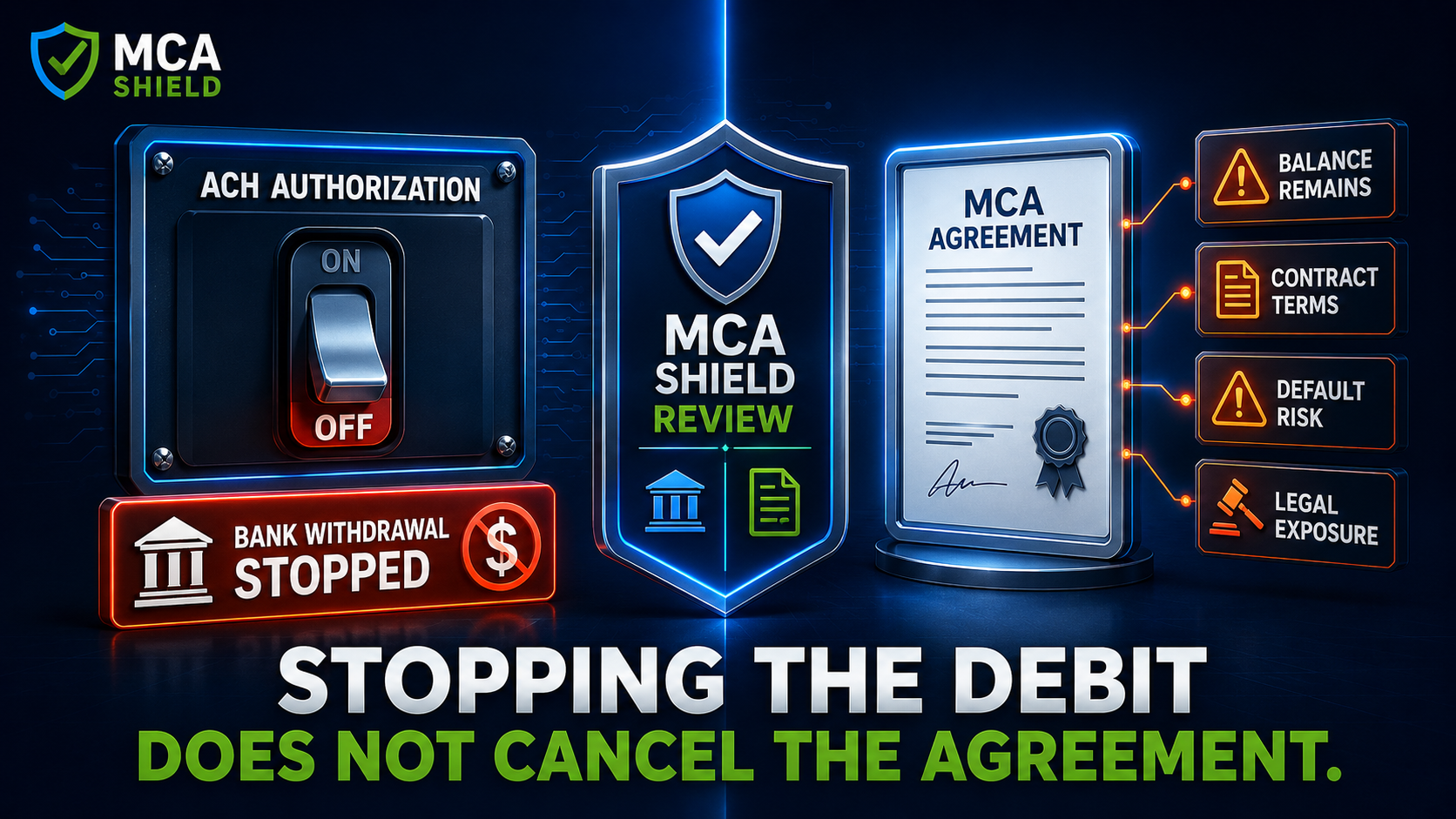
A business may be able to instruct its bank to stop or block future ACH debits, but doing so does not necessarily eliminate its contractual obligations to the MCA funder. The legal and financial consequences depend on the agreement, the method used to revoke authorization, applicable banking rules, and state law.
Before taking action, review the ACH authorization and default provisions in every active agreement. Blocking withdrawals without a broader strategy could protect the account temporarily while creating additional contractual and legal problems.
Revoking Bank Authorization Does Not Cancel the MCA Agreement
An ACH authorization gives the funder permission to withdraw payments electronically from a designated bank account. The MCA agreement separately establishes the relationship between the business and the funder, including the purchase of future receivables and the business’s responsibilities.
Stopping the electronic withdrawal method does not automatically:
- Cancel the MCA agreement
- Erase the remaining balance
- Resolve a claimed default
- Release a UCC filing
- Remove a personal guarantee
- Prevent collection or legal action
The agreement may require the business to maintain a specific bank account, preserve access to receivables, or notify the funder before changing payment arrangements. Closing the account, redirecting deposits, or blocking debits could be treated as a default if the contract prohibits those actions.
Understand the Risk of Default, Collections, and Legal Action
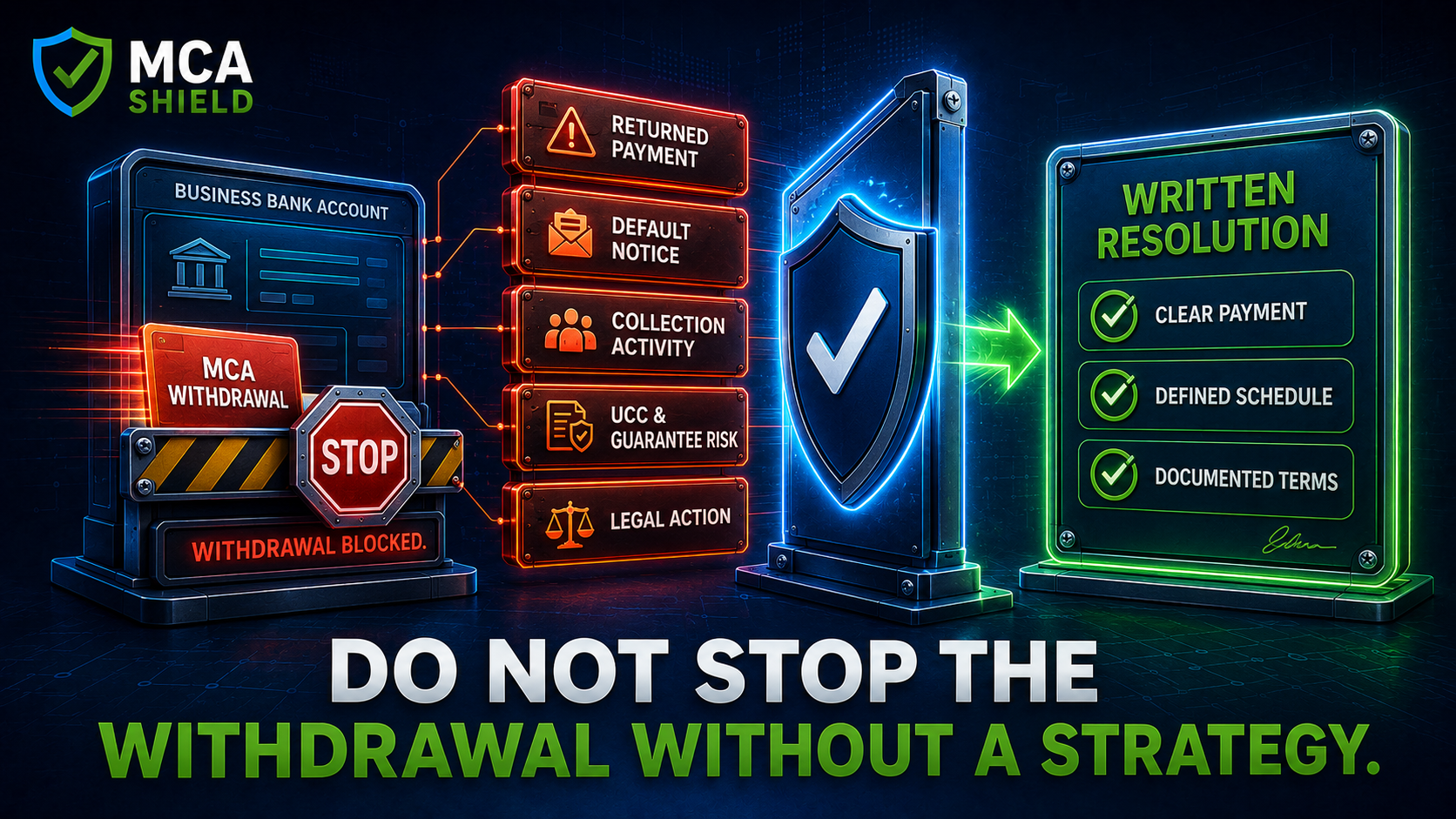
If an authorized withdrawal is blocked or returned, the funder may respond according to the remedies described in the agreement. The exact response will depend on the contract and the circumstances surrounding the missed payment.
Possible consequences may include:
- Returned-payment or default fees
- Increased collection calls and notices
- Acceleration of a claimed balance
- Enforcement efforts connected to a UCC filing
- Claims against a personal guarantor
- Arbitration or litigation
- Attempts to restrict access to business receivables
Not every interrupted payment leads to immediate legal action, but business owners should understand the potential risks before instructing a bank to block withdrawals. Review the agreement and preserve all communications, bank records, and payment history in case a dispute develops.
Speak With an Attorney Before Blocking Contractual Payments
An attorney familiar with merchant cash advance agreements can review whether the contract permits reconciliation, how the ACH authorization may be revoked, and what consequences could follow. Legal review becomes especially important when a business receives a default notice, collection demand, lawsuit, confession of judgment, or threat to enforce a personal guarantee.
An attorney may also help determine whether the agreement is being enforced properly under applicable law. MCA laws and contract requirements can vary by state, so advice based on another business’s experience may not apply to your situation.
If withdrawals are creating an immediate threat to payroll or essential operations, gather the agreements, payment records, bank statements, and funder communications before seeking help. The goal should be to address both the bank withdrawals and the underlying obligation through a documented strategy.
Attempting to stop MCA withdrawals without understanding the contract may exchange an immediate cash-flow problem for a more serious legal dispute. Professional guidance can help the business evaluate its options before taking an action that may be difficult to reverse.
Restructure MCA Withdrawals Into an Affordable Payment Plan
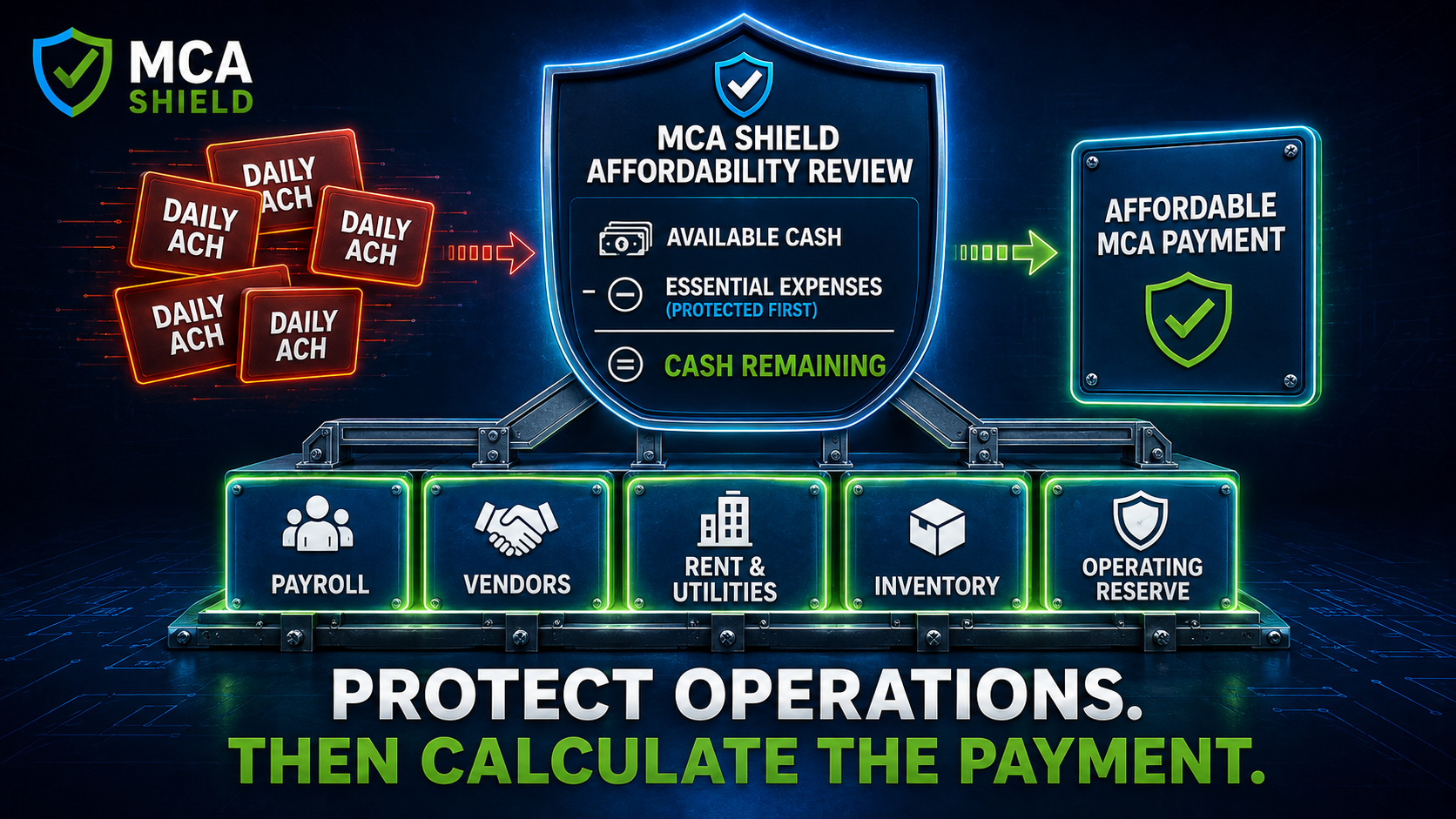
MCA restructuring seeks to replace unaffordable daily or weekly withdrawals with a payment arrangement that better reflects the business’s current financial condition. The goal is not simply to postpone payments. A workable plan should reduce immediate cash-flow strain while establishing clear terms for addressing the remaining obligation.
The outcome of restructuring depends on the MCA agreements, outstanding balances, business finances, funder participation, and any existing default or legal issues. Before negotiating, the business should understand what it can consistently pay without falling behind on essential expenses.
Calculate What the Business Can Realistically Afford
An affordable payment should be based on current cash flow rather than the amount the business hopes to generate in the future. Start by reviewing recent bank statements, monthly revenue, accounts receivable, and essential operating expenses.
The calculation should account for:
- Payroll and payroll taxes
- Rent or mortgage payments
- Utilities and insurance
- Inventory, materials, and supplies
- Vendor payments
- Equipment and transportation costs
- Taxes and required licenses
- A reasonable operating reserve
After these expenses are considered, the remaining cash can help establish a realistic payment range. Seasonal changes, uneven customer payments, and other active debts should also be included in the calculation.
Agreeing to an amount the business cannot maintain may only delay another default. A lower payment should leave enough room for the company to operate through both strong and slow revenue periods.
Replace Unmanageable Withdrawals With Structured Payments
A restructuring proposal may seek to reduce the withdrawal amount, change the payment frequency, extend the payment period, or establish another modified arrangement. Instead of allowing several large debits to disrupt the account throughout the week, the business may be able to follow a more predictable schedule.
Before accepting a restructuring plan, review:
- The new payment amount and frequency
- The effective date of the modification
- The length of the payment period
- The remaining balance
- Any added fees or restructuring costs
- The total amount expected to be paid
- The consequences of missing a modified payment
- The treatment of UCC filings and personal guarantees
Every approved change should be provided in writing. The document should clearly explain whether the arrangement modifies the original agreement, temporarily changes the withdrawals, or creates a separate repayment plan.
Protect Enough Working Capital for Essential Operations
A payment plan is not sustainable if it consumes the money required to keep the business open. Working capital must remain available to cover expenses that allow the company to generate revenue and continue making payments.
Protecting operating cash may require the business to build a weekly cash-flow budget, reduce nonessential spending, improve invoice collection, renegotiate vendor terms, and avoid taking another MCA during the restructuring period.
The plan should help the business maintain:
- Reliable payroll
- Current vendor relationships
- Necessary inventory and supplies
- Rent, utilities, and insurance
- Cash for unexpected expenses
- Enough operating capacity to continue producing revenue
Restructuring may help stop MCA withdrawals from consuming most of the business’s available cash, but the payment must be based on accurate numbers and realistic expectations. A strong plan balances repayment with the financial needs of the business so that both can be addressed over time.
Consolidate Multiple MCA Withdrawals Into One Payment
Protect Payroll, Vendors, and Operating Expenses During Negotiations
What Happens If MCA Withdrawals Are Stopped Without a Plan?
Stop MCA Withdrawals Before They Threaten Your Business
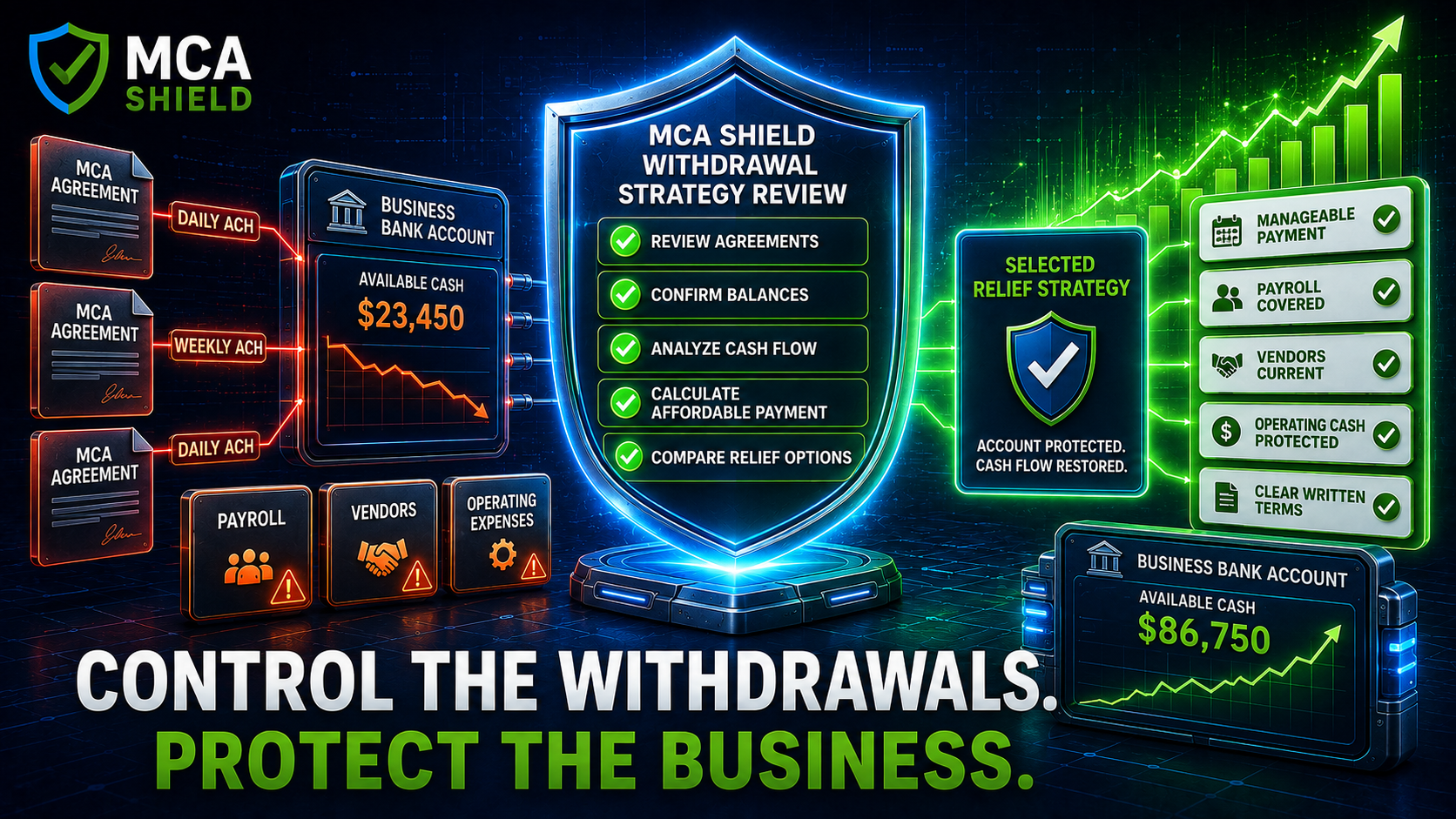
Daily and weekly MCA withdrawals can become increasingly difficult to manage as revenue fluctuates and operating costs continue. Acting before the bank account is repeatedly overdrawn may give the business more time to review its obligations, communicate with funders, and evaluate realistic relief options.
The goal is not simply to block a payment. The business needs a documented strategy that addresses withdrawals, remaining balances, operating expenses, and potential legal risks together.
Review Every Agreement and Confirm the Current Balances
Begin by gathering each MCA agreement, bank statement, payment record, and communication from the funders. Create a separate summary for each obligation that identifies:
- The original advance amount
- The total purchased amount
- The amount already collected
- The estimated remaining balance
- The daily or weekly withdrawal
- The reconciliation requirements
- The default provisions
- Any UCC filing or personal guarantee
Request updated balance information when necessary and compare it with the withdrawals shown on the bank statements. Accurate numbers provide the foundation for calculating an affordable payment and evaluating available solutions.
Choose the Right Relief Strategy for Your Financial Situation
The most appropriate strategy depends on the agreements, number of active MCAs, current revenue, operating expenses, available working capital, and any collection or legal activity.
Possible options may include:
- Reconciliation to align withdrawals with actual receivables
- Temporary payment modification during a short-term revenue decline
- Restructuring to create a more manageable payment arrangement
- Consolidation to organize multiple MCA obligations into one payment
- Settlement when repayment under the existing terms is no longer realistic
Each option has different costs, risks, and eligibility requirements. Compare the payment amount, repayment period, total cost, written terms, and effect on business operations before making a decision.
Schedule a Free Consultation With MCA Shield
If MCA withdrawals are consuming the money needed for payroll, vendors, inventory, or other operating expenses, waiting may reduce the options available to your business.
MCA Shield can review your agreements, confirm your current payment burden, examine your cash flow, and help you understand potential relief strategies. The objective is to identify a payment structure the business can realistically manage while protecting the working capital needed to continue operating.
Schedule a free consultation with MCA Shield to review your situation and take the first step toward stopping MCA withdrawals from threatening your business.