
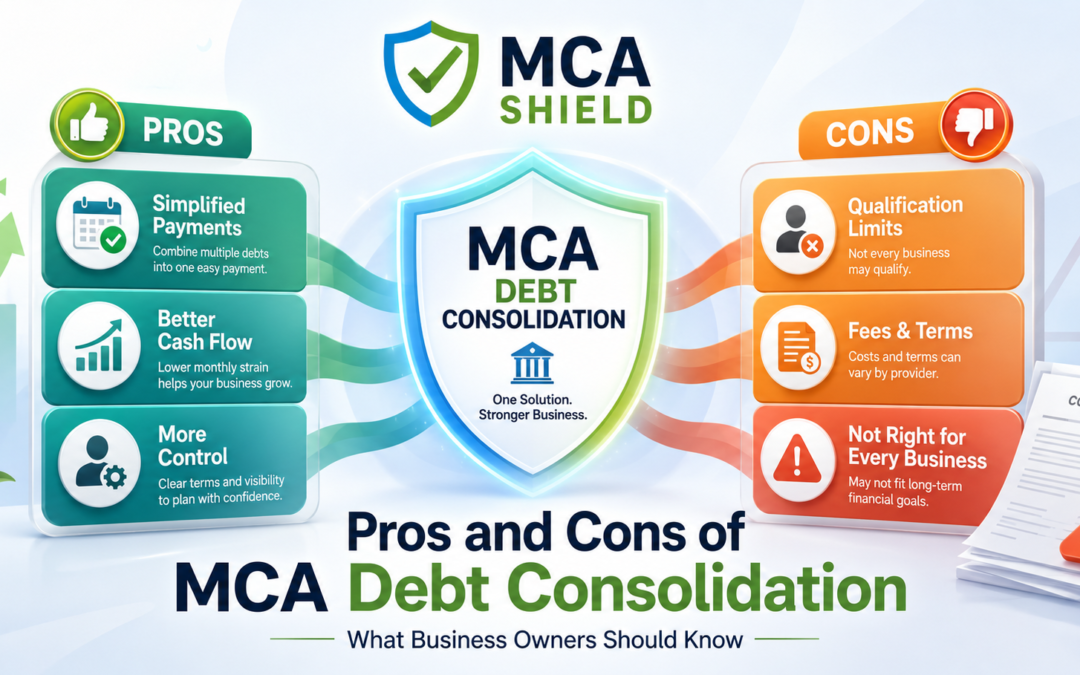
MCA debt consolidation can help business owners simplify multiple merchant cash advance obligations and reduce the strain of several daily or weekly withdrawals. By combining payments into a more organized structure, some businesses may gain better control over cash flow, working capital, and operating expenses.
However, consolidation is not the right solution for every company. The pros and cons of MCA debt consolidation depend on factors such as current balances, payment terms, business revenue, total cost, and the amount a business can realistically afford to pay.
Before moving forward, it is important to understand both the potential benefits and the possible drawbacks. In this guide, we will break down how MCA consolidation works, when it may help, and what business owners should review before choosing a debt relief strategy.
Schedule Your Free Consultation
What Is MCA Debt Consolidation and How Does It Work?
MCA debt consolidation is a strategy that may help a business combine multiple merchant cash advance obligations into a more organized payment structure. Instead of managing several separate withdrawals, the business may be able to make one structured payment.
The goal is to make repayment easier to track and reduce pressure on business cash flow. This can be especially helpful for companies dealing with stacked MCAs, frequent ACH withdrawals, or several funders collecting payments at the same time.
Before moving forward, the business should review its current balances, revenue, payment schedules, and operating expenses. A consolidation plan should be based on what the company can realistically afford while still keeping enough working capital available for daily operations.
Combining Multiple MCA Obligations Into One Payment Structure
When a business has several active merchant cash advances, each funder may collect payments separately. These withdrawals can happen daily or weekly, which can make cash flow harder to control.
With MCA debt consolidation, multiple obligations may be combined into one more organized payment structure. This can make it easier for the business owner to understand how much is being paid and when the payment will leave the account.
A simpler payment structure may also make budgeting easier. Instead of tracking several withdrawals, the business can focus on one scheduled payment while planning for payroll, vendor expenses, rent, inventory, and other operating costs.
However, consolidation does not automatically mean the total amount owed will decrease. Business owners should review the payment amount, repayment term, fees, and total cost before accepting any consolidation arrangement.
How MCA Consolidation Can Change Daily or Weekly Withdrawals
Multiple MCA withdrawals can remove a significant amount of cash from a business account throughout the week. When several advances are active, those withdrawals may leave less money available for normal business expenses.
An MCA consolidation plan may replace several daily or weekly payments with one structured payment. In some situations, this can reduce the amount leaving the business account during each payment period.
Lower payment pressure can help protect operating cash and working capital. That may give the business more room to cover payroll, pay vendors, purchase inventory, and handle unexpected expenses.
The new payment still needs to fit the company’s actual cash flow. Business owners should compare the proposed payment with current revenue and expenses to determine whether the consolidation plan creates a sustainable repayment structure.
Pros of MCA Debt Consolidation for Business Owners
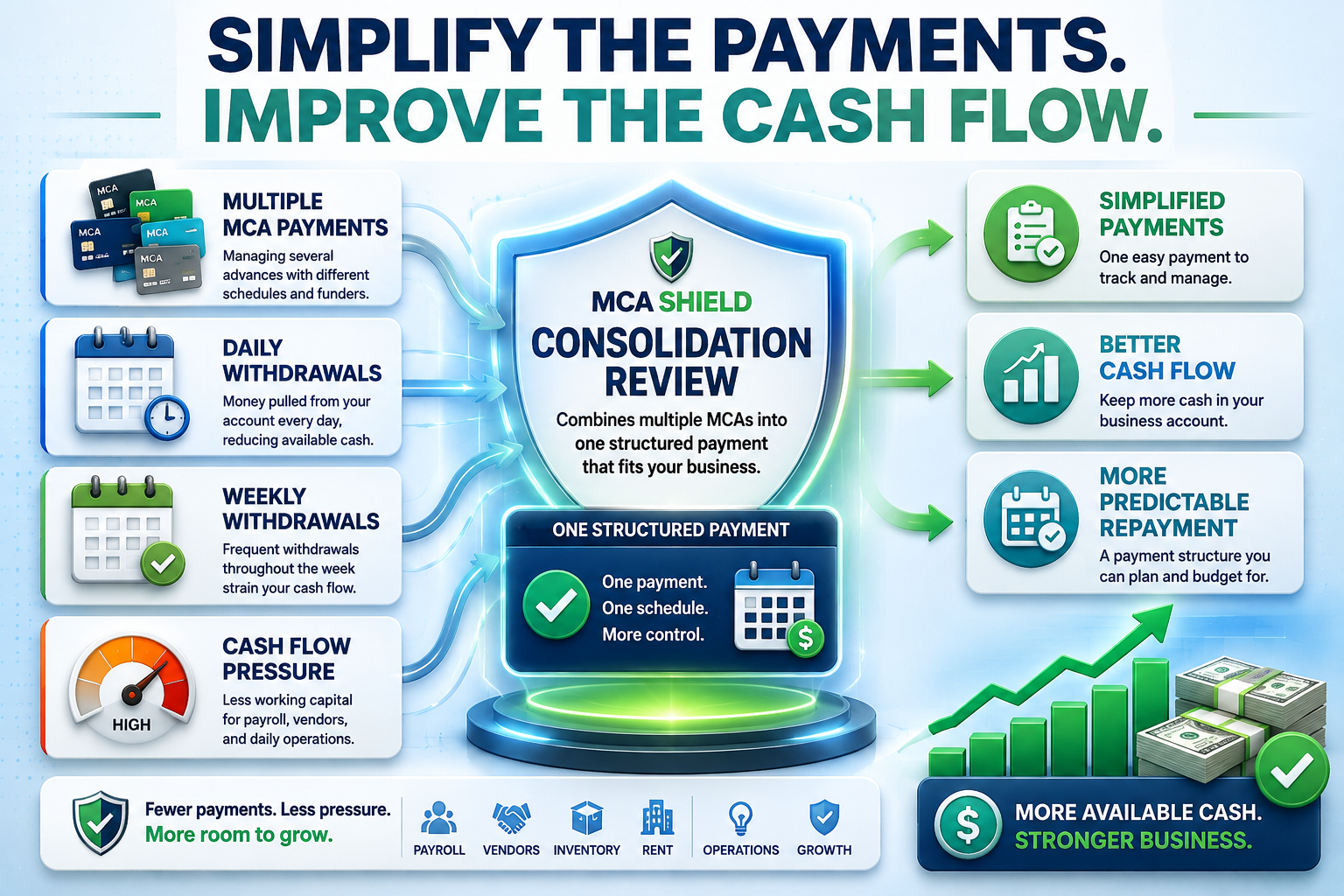
For businesses dealing with several merchant cash advances, MCA debt consolidation can offer a more organized way to manage repayment. Instead of trying to keep up with multiple funders and different withdrawal schedules, a business may be able to move into a simpler structure.
The biggest benefits often involve cash flow, payment organization, and predictability. When the new payment fits the business’s actual revenue, consolidation may make it easier to keep more money available for normal operating expenses.
Simplifying Multiple MCA Payments
Managing several MCA payments at the same time can quickly become difficult. Each advance may have its own balance, payment amount, withdrawal schedule, and repayment terms.
MCA consolidation may combine several obligations into one structured payment. This can make it easier to track what is being paid and reduce the confusion that comes with multiple daily or weekly withdrawals.
A simpler structure can also help business owners stay more organized. Instead of monitoring several separate payments, they can focus on one repayment plan while managing payroll, vendors, inventory, rent, and other business expenses.
Reducing Daily Payment Pressure on Cash Flow
One of the most common reasons businesses consider MCA debt consolidation is the pressure created by frequent withdrawals. When several funders are pulling money from the same account, available cash can fall quickly.
A consolidation plan may reduce the amount of money leaving the business account during each payment period. This can help protect working capital and leave more cash available for day-to-day operations.
Improved cash flow can make it easier to cover payroll, pay vendors on time, purchase supplies, and handle unexpected expenses. However, the new payment must still be affordable based on the company’s current revenue and operating costs.
Creating a More Predictable Repayment Structure
Multiple MCA withdrawals can make it difficult to predict how much cash will remain in the business account from one week to the next. A more organized payment structure can make budgeting easier.
With one predictable payment, business owners may have a clearer view of their upcoming expenses and available cash. This can improve financial planning and reduce uncertainty around daily operations.
A predictable structure can also help a business make better decisions about hiring, inventory, vendor payments, and future expenses. When repayment becomes easier to forecast, the company may be in a stronger position to protect cash flow and work toward greater financial stability.
How MCA Debt Consolidation Can Improve Business Cash Flow
Strong business cash flow is essential for covering everyday expenses and keeping operations running smoothly. However, multiple merchant cash advance payments can remove cash from a business account faster than revenue replaces it.
MCA debt consolidation may help reduce that pressure by creating a more manageable payment structure. When less cash is tied up in frequent withdrawals, a business may have more flexibility to handle operating costs and plan ahead.
Protecting More Working Capital for Business Operations
Working capital is the money a business needs to handle its regular expenses. This can include rent, utilities, inventory, equipment, marketing, insurance, and other operating costs.
When several MCA payments are being withdrawn throughout the week, available working capital can shrink quickly. This may force business owners to delay purchases, reduce spending, or use incoming revenue just to keep up with payments.
An MCA consolidation plan may lower the amount leaving the business account during each payment period. As a result, the company may be able to keep more cash available for normal operations.
Protecting working capital can also give the business more room to respond to unexpected expenses or changes in revenue. The goal is to create a payment structure that allows the company to meet its obligations without placing unnecessary pressure on daily operations.
Making Payroll and Vendor Payments Easier to Manage
Payroll and vendor expenses are often among the most important obligations a business has. When MCA withdrawals consume a large portion of available cash, keeping these payments current can become more difficult.
Reducing daily or weekly MCA payment pressure may leave more money available for payroll, supplier invoices, inventory purchases, and other essential costs. This can make cash flow easier to manage from week to week.
A more predictable payment schedule can also help business owners plan ahead. Instead of reacting to several withdrawals, they can budget around one organized payment and allocate the remaining cash to other priorities.
Keeping payroll and vendors current can help support stable operations and maintain important business relationships.
Reducing the Risk of Repeated MCA Renewals
When a business struggles to keep enough cash available after MCA payments, taking another advance can seem like a quick solution. However, repeated renewals can create a cycle of borrowing that adds more payment pressure.
For example, a business may take a new MCA to cover payroll, inventory, or expenses created by an existing advance. This can lead to stacked MCA debt and even more withdrawals from future revenue.
A sustainable MCA debt consolidation structure may help break that cycle by reducing immediate cash flow pressure. If the business can keep more working capital available, it may be less likely to depend on another MCA for short-term expenses.
The long-term goal should be to create enough breathing room for the company to operate without repeatedly relying on new advances. A consolidation plan that supports stable cash flow and responsible repayment may help the business move in that direction.
Cons of MCA Debt Consolidation to Consider
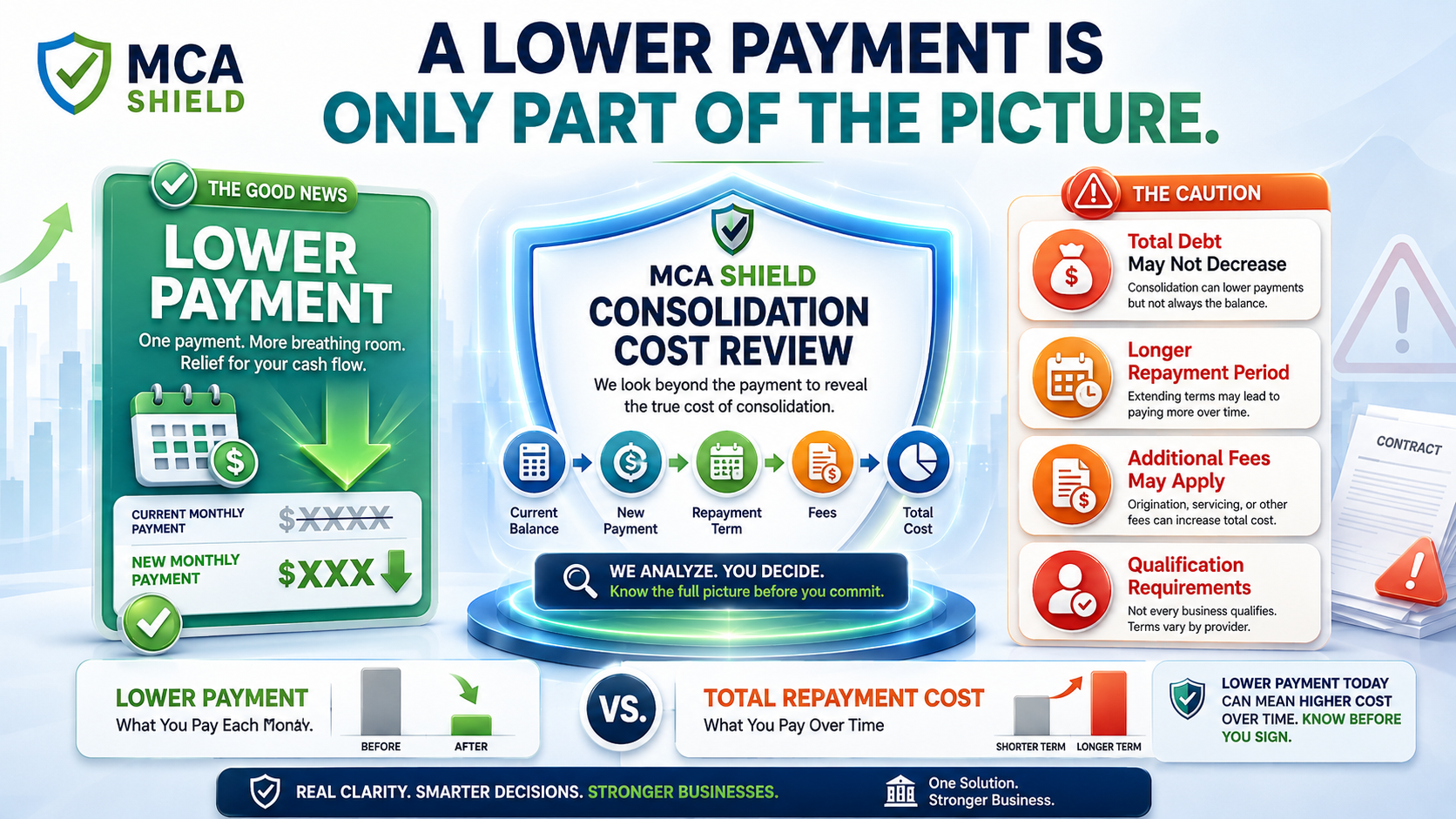
While MCA debt consolidation can make multiple payments easier to manage, it is important to understand the potential drawbacks before moving forward. A lower payment does not always mean the business will pay less overall.
Business owners should carefully review the total repayment amount, repayment term, fees, and qualification requirements. The best option should improve cash flow without creating a new financial problem later.
Consolidation May Not Reduce the Total Amount Owed
One of the main misconceptions about MCA debt consolidation is that it automatically reduces the amount a business owes. In many cases, consolidation focuses on reorganizing repayment rather than lowering the outstanding balance.
A business may receive a lower daily or weekly payment while still being responsible for the full amount owed under the new structure. Additional fees or costs may also be included, depending on the terms of the consolidation.
For this reason, business owners should compare the current total obligation with the total amount they would repay after consolidation. Looking only at the new payment amount can make an offer appear more affordable than it actually is.
The goal should be to find a structure that improves cash flow while keeping the overall repayment cost reasonable.
Longer Repayment Terms Can Affect the Overall Cost
Lower payments are often created by extending repayment over a longer period. This can provide immediate relief, but a longer term may also increase the total cost of repayment.
Before accepting an MCA consolidation plan, business owners should review how long payments will continue and how much they will pay by the end of the agreement.
A smaller payment can be helpful if it protects working capital and allows the business to operate more comfortably. However, stretching repayment too far may create a financial obligation that remains in place longer than expected.
It is important to compare the benefits of lower payment pressure with the total cost and length of repayment.
Not Every Business Will Qualify for Consolidation
MCA debt consolidation is not available to every business. Eligibility may depend on factors such as revenue, bank activity, existing MCA balances, payment history, time in business, and current financial condition.
A company with severe cash flow problems or multiple defaults may have fewer consolidation options. In some situations, the proposed payment may still be too high for the business to afford.
If consolidation is not a realistic option, the company may need to consider other strategies such as MCA restructuring or settlement.
Business owners should evaluate all available options before making a decision. The right solution should create an affordable payment structure while leaving enough cash available to keep the business operating.
When MCA Debt Consolidation May Not Be the Best Option
MCA debt consolidation can help some businesses simplify payments and improve cash flow. However, it is not always the best solution. The right strategy depends on the company’s financial condition, current MCA status, and ability to handle a new payment.
Before choosing consolidation, business owners should review whether the proposed structure is truly affordable. They should also consider whether default, collections, legal action, or contract disputes could affect the available options.
When the Business Cannot Afford the Proposed Payment
A consolidation plan only works if the business can consistently afford the new payment. A lower payment may look attractive, but it can still create problems if it takes too much money away from daily operations.
Business owners should compare the proposed payment with current revenue and essential expenses. This includes payroll, rent, vendors, inventory, utilities, taxes, and other operating costs.
The business should also keep enough working capital available for unexpected expenses or changes in revenue. If the new payment would leave the company short on cash each week, consolidation may not solve the underlying problem.
In that situation, another strategy such as MCA restructuring or settlement may deserve consideration. The goal should be to create a payment the business can maintain without placing operations at risk.
When MCA Debt Is Already in Default or Collections
MCA debt can become more complicated once an account enters default or collections. A funder may increase collection efforts, restrict available options, or begin taking additional steps allowed under the agreement.
At this stage, traditional consolidation may become harder to arrange. The business may need to address existing defaults before a new payment structure can be considered.
It is important to determine the current balance, payment status, collection activity, and terms of each MCA agreement. Business owners should also identify whether any ACH debits, UCC filings, or other collection measures are involved.
When several MCAs are already in default, a broader MCA debt relief strategy may be more appropriate than consolidation alone. Restructuring or settlement may offer another way to address payment pressure, depending on the circumstances.
When Legal or Contract Disputes Require Additional Review
Some MCA situations involve more than cash flow. Disputes may arise over contract terms, reconciliation provisions, collection activity, personal guarantees, or the amount a funder says is owed.
When legal issues are involved, business owners should avoid making a decision based only on the size of a proposed payment. The MCA agreement and related legal risks may need to be reviewed first.
This is especially important if the business is dealing with a lawsuit, disputed contract terms, enforcement of a personal guarantee, or questions about a UCC filing.
In these situations, an MCA attorney may need to review the agreement before the business enters a new consolidation arrangement. Understanding the legal position first can help the owner choose a strategy that addresses both the financial pressure and the underlying dispute.
MCA Debt Consolidation vs. Restructuring and Settlement
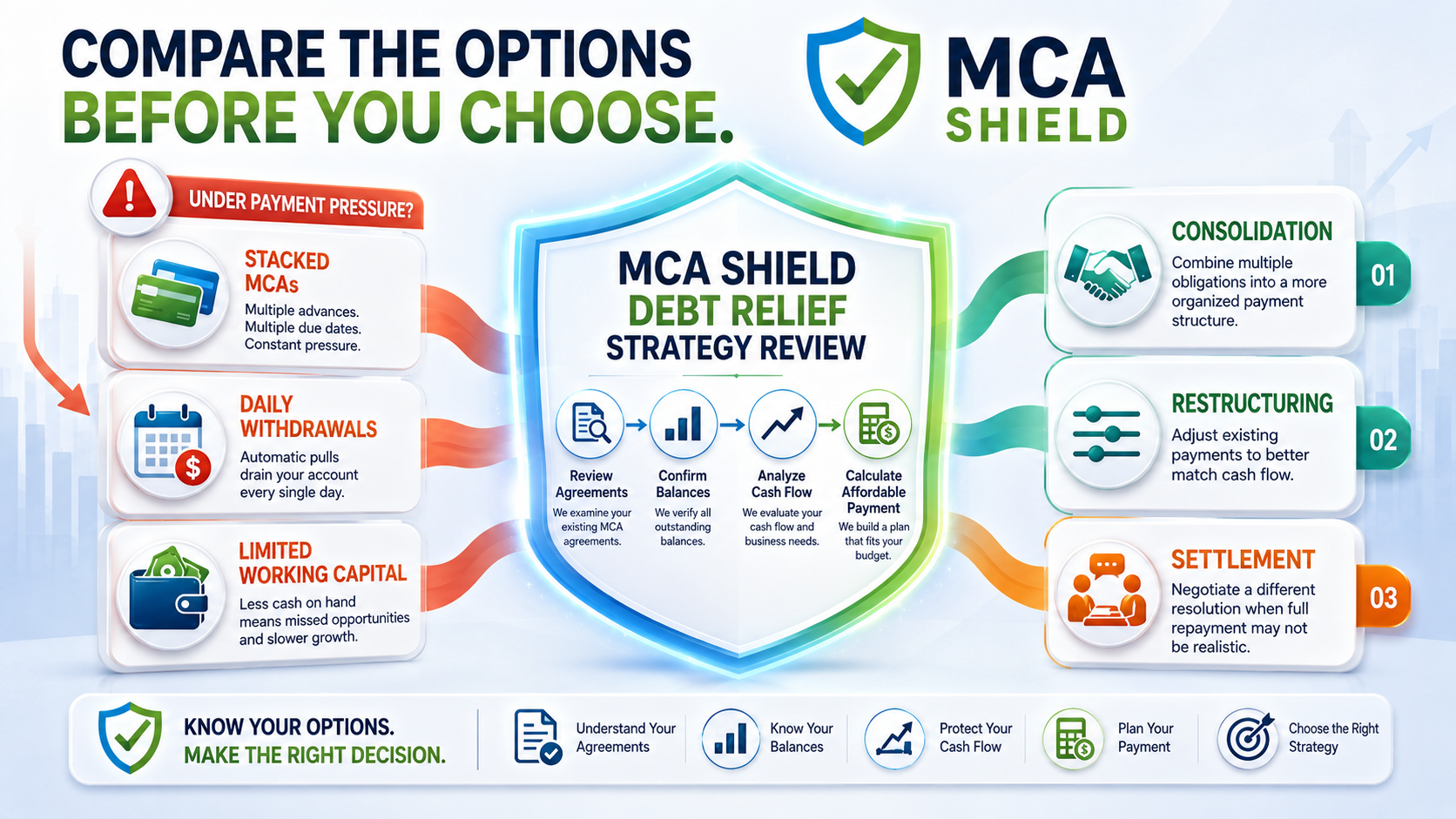
Businesses facing merchant cash advance pressure may have several possible paths. MCA debt consolidation, restructuring, and settlement can each address repayment problems in different ways.
The best choice depends on the company’s cash flow, outstanding MCA balances, payment status, and ability to continue repayment. Business owners should compare each option carefully before making a decision.
MCA debt consolidation generally focuses on combining multiple obligations into a more organized payment structure. Restructuring may focus on changing existing payment terms, while settlement may involve negotiating an amount that resolves the obligation for less than the remaining balance.
When MCA Restructuring May Be a Better Fit
MCA restructuring may be a better option when a business needs payment relief but consolidation is unavailable or does not create an affordable payment.
Instead of combining several MCAs into a new structure, restructuring may involve negotiating changes to existing payment arrangements. The goal is often to reduce daily or weekly payment pressure and create payments that better match current business revenue.
For example, a company experiencing a temporary decline in sales may still be able to repay its obligations over time. However, the existing withdrawal schedule may be taking too much money from the business account each week.
A restructuring strategy may help create additional room for payroll, vendors, inventory, rent, and other operating expenses while the business continues working through its MCA obligations.
Business owners should review the new payment amount, repayment period, fees, and total cost before agreeing to any restructuring plan.
When an MCA Settlement May Need to Be Considered
An MCA settlement may be considered when a business cannot realistically repay the remaining obligation under its current terms.
Settlement typically involves negotiating with the MCA provider to resolve the account for an agreed amount. Depending on the circumstances, payment may be made through a lump sum or structured settlement payments.
This option may be more relevant when a business is experiencing serious financial hardship, has fallen behind on payments, or cannot support a consolidation or restructuring plan.
However, settlement can involve additional risks. It may affect collection activity, legal rights, UCC filings, personal guarantees, and other provisions contained in the MCA agreement.
For that reason, business owners should understand the settlement amount, payment requirements, written release terms, and legal consequences before accepting an agreement.
Comparing Payment Relief, Cost, and Risk
There is no single MCA debt relief strategy that works for every business. Each option should be compared based on affordability, total cost, repayment length, and potential risk.
MCA debt consolidation may work well for a business that can continue repayment but needs a simpler and more manageable payment structure.
MCA restructuring may be appropriate when existing payments need to be adjusted to better match current cash flow.
MCA settlement may deserve consideration when full repayment is no longer realistic and the business needs to negotiate a different resolution.
Before choosing between MCA consolidation, restructuring, and settlement, business owners should review their agreements, confirm current balances, analyze cash flow, and calculate what the company can realistically afford.
The right strategy should do more than lower a payment. It should help the business protect working capital, maintain operations, and create a realistic path toward resolving MCA debt.
What to Review Before Consolidating MCA Debt
Before moving forward with MCA debt consolidation, business owners should review the full financial picture. A lower payment can be helpful, but the new structure needs to make sense over the long term.
The review should include current balances, payment obligations, business cash flow, fees, contract terms, UCC filings, and personal guarantees. Looking at these details can help determine whether consolidation will improve the company’s financial position or simply move the pressure into a different structure.
Confirming MCA Balances and Payment Obligations
The first step is to confirm exactly how much the business currently owes. This may include the remaining balance on each merchant cash advance, current payment amounts, and the frequency of withdrawals.
Business owners should also review how much has already been paid and how much remains under each agreement. This is especially important when several MCAs are active at the same time.
A clear picture of the total MCA debt makes it easier to compare the current situation with a proposed consolidation plan. It also helps prevent confusion when different funders are collecting payments on different schedules.
Before signing anything new, the business should verify the balance, payment frequency, repayment status, and remaining obligation for every MCA involved.
Calculating an Affordable Payment Based on Cash Flow
A consolidation payment should be based on what the business can realistically afford, not simply on what looks lower than the current withdrawals.
Business owners should review average monthly revenue and subtract essential operating expenses. These may include payroll, rent, utilities, vendors, inventory, insurance, taxes, and other recurring costs.
The amount that remains can help determine how much the company can safely devote to MCA repayment. It is also important to leave room for slower revenue periods and unexpected expenses.
An affordable payment should help protect working capital and allow the business to continue operating without relying on another advance. If the new payment still creates constant cash shortages, the consolidation plan may not be sustainable.
Reviewing Fees, Terms, UCC Filings, and Personal Guarantees
The payment amount is only one part of an MCA consolidation agreement. Business owners should also review the fees, repayment period, total cost, and any conditions attached to the new structure.
It is also important to understand how existing UCC filings and personal guarantees may be affected. A UCC filing can give a funder certain rights related to business assets or receivables, while a personal guarantee may create additional risk for the business owner.
The agreement should also be reviewed for provisions related to default, reconciliation, collection activity, and changes in payment terms.
Before accepting a consolidation plan, business owners should understand the full financial and legal impact of the agreement. If the terms are unclear or legal issues are involved, an attorney familiar with MCA agreements may need to review the documents before the business moves forward.
How to Decide if MCA Debt Consolidation Is Right for Your Business
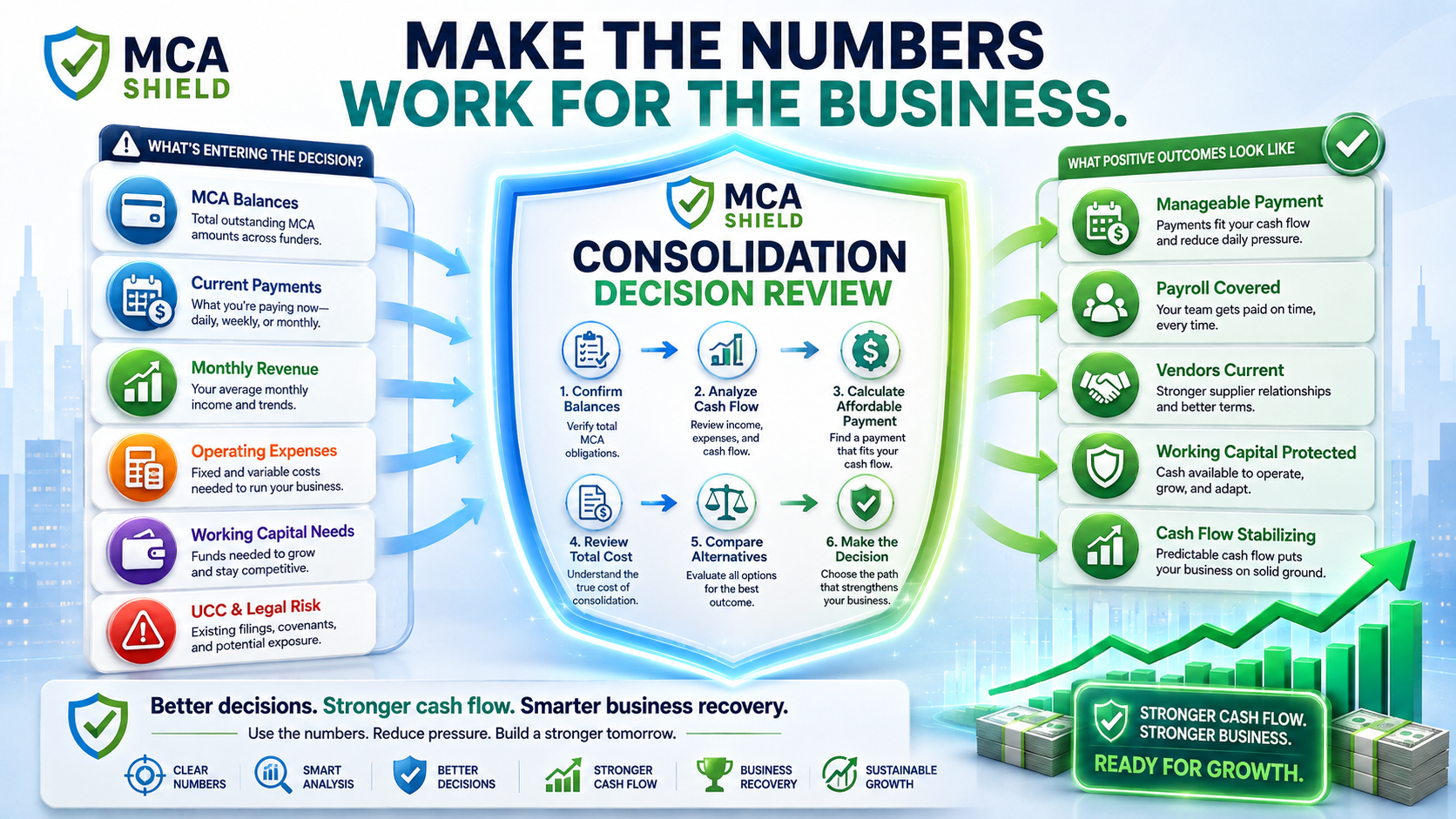
Choosing MCA debt consolidation should be based on more than the promise of a lower payment. The new structure needs to fit the company’s current revenue, operating expenses, and long-term financial goals.
A business owner should compare the benefits and drawbacks, determine how much cash must remain available for operations, and consider whether consolidation offers a realistic path forward.
Compare the Benefits Against the Potential Drawbacks
Start by comparing the main advantages of MCA debt consolidation with the possible disadvantages.
Potential benefits may include fewer payments, lower daily or weekly withdrawal pressure, improved cash flow, and easier budgeting. These advantages can be valuable for a business that is struggling with several active MCA obligations.
However, consolidation may also come with added fees, a longer repayment period, or qualification requirements. In some cases, the total amount paid may remain high even if the new payment is lower.
The key is to compare the payment amount, repayment length, total cost, and impact on cash flow before making a decision.
Determine How Much Working Capital the Business Needs
A consolidation plan should leave enough money available for normal business operations.
Business owners should calculate the amount needed each month for payroll, rent, vendors, inventory, utilities, taxes, insurance, and other essential expenses. They should also account for slower revenue periods and unexpected costs.
After these expenses are covered, the remaining cash can help determine what the business can realistically afford to put toward MCA repayment.
If the proposed payment leaves too little working capital, the business may continue facing cash shortages even after consolidation. A sustainable plan should reduce payment pressure without creating new financial stress.
Choose a Strategy That Supports Long-Term Financial Stability
The best MCA debt relief strategy should address the immediate payment problem while also supporting the future of the business.
For some companies, MCA debt consolidation may create the structure they need to regain control of cash flow. Others may be better suited for restructuring or settlement.
Before choosing a strategy, business owners should review their balances, agreements, cash flow, and legal risks. They should also consider whether the plan helps reduce dependence on future advances.
The goal is to create a repayment strategy that supports manageable payments, protected working capital, and long-term financial stability.
Take the Next Step Toward Reducing MCA Payment Pressure
If multiple merchant cash advance payments are putting pressure on your business, the next step is to understand exactly where you stand. A clear review of your MCA debt, cash flow, and current payment obligations can help you compare available options with greater confidence.
The right solution should do more than lower a payment. It should help protect working capital, support daily operations, and create a realistic path toward resolving MCA debt.
Review Your MCA Debt and Cash Flow Before Making a Decision
Start by reviewing each active MCA agreement, the remaining balances, and the amount being withdrawn each day or week. Then compare those payments with the cash your business needs for normal operations.
Pay close attention to revenue, payroll, vendor costs, rent, inventory, taxes, and other essential expenses. This can help you determine whether your current payment structure is sustainable.
You should also review whether your business is dealing with stacked MCAs, missed payments, collection pressure, or legal concerns. These factors can affect whether MCA debt consolidation, restructuring, or settlement may be the better fit.
The more complete the financial picture is, the easier it becomes to identify a strategy that matches what your business can actually afford.
Speak With MCA Shield About Your Consolidation Options
If you are unsure whether MCA debt consolidation is right for your business, speaking with an experienced relief company can help you review your options.
MCA Shield can evaluate your current agreements, balances, payment pressure, and business cash flow. From there, you can compare consolidation, restructuring, and settlement strategies based on your situation.
The goal is to find a solution that supports manageable payments, stronger cash flow, and continued business operations.
Schedule a free consultation with MCA Shield to review your MCA obligations and learn which options may make the most sense for your business.