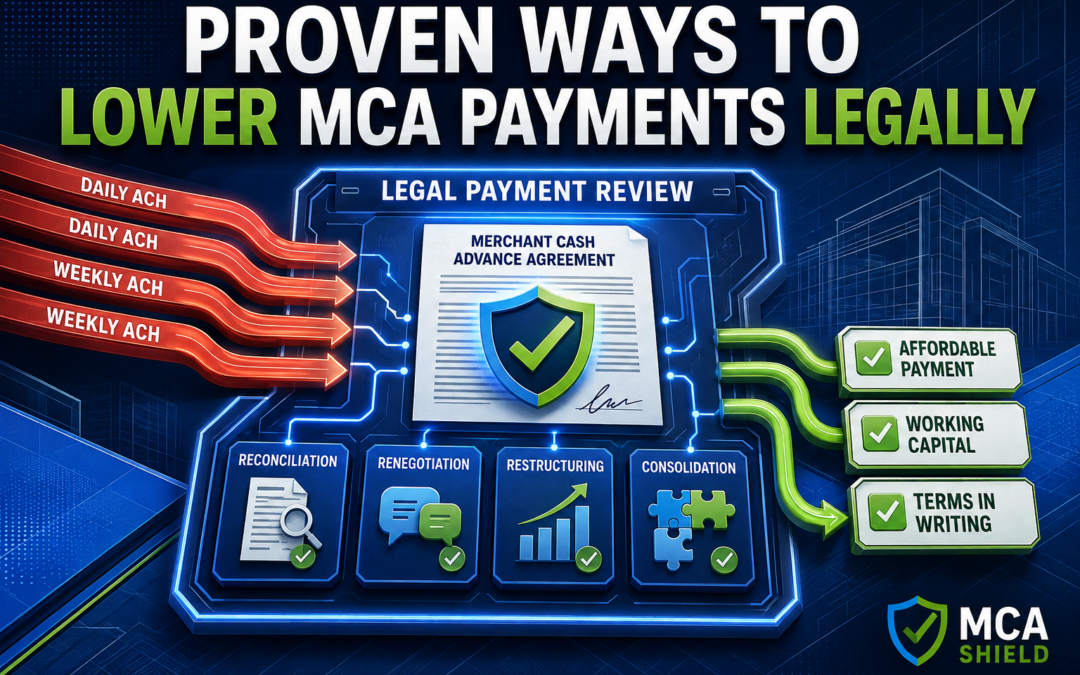
Business owners struggling with daily or weekly withdrawals may have options to lower MCA payments legally. Depending on the agreement and the company’s financial condition, solutions may include reconciliation, renegotiation, restructuring, consolidation, or settlement.
The right strategy should reduce payment pressure without creating additional legal or financial problems. That begins with reviewing each MCA agreement, confirming the current balances, and calculating a payment the business can realistically afford.
This guide explains proven ways to pursue more manageable MCA payments, protect working capital, and make an informed decision based on your company’s cash flow.
Schedule Your Free Consultation
Can You Legally Lower Merchant Cash Advance Payments?
Yes, it may be possible to legally lower merchant cash advance payments. However, the available options depend on the language in the agreement, the business’s current revenue, and whether the funder is willing to negotiate.
A lower payment does not automatically reduce the total amount owed. In many cases, it changes the withdrawal amount, payment frequency, or repayment timeline. Other strategies, such as settlement, may attempt to resolve the obligation for a negotiated amount.
Before taking action, the business should review its MCA documents and understand its responsibilities. Stopping payments without a written agreement can lead to default, collections, UCC enforcement, or legal action.
Why MCA Payment Terms May Be Open to Modification
Many merchant cash advances collect payments through daily or weekly ACH withdrawals. The original payment may have been calculated when the business had stronger sales. If revenue later declines, the withdrawal can become difficult to maintain.
Some MCA agreements include a reconciliation provision. This provision may allow payments to be adjusted based on the business’s actual receivables. To request reconciliation, the owner may need to provide bank statements, sales reports, or payment-processing records.
Even when reconciliation is unavailable, the funder may consider a voluntary modification. Possible changes can include:
- A lower daily or weekly withdrawal
- A different payment schedule
- A temporary payment reduction
- A longer repayment period
- A structured payoff arrangement
Funders are not always required to approve these requests. A business has a stronger position when it can provide accurate financial records and propose an affordable payment supported by actual cash flow.
Any approved modification should be documented in writing. The written terms should explain the new payment, payment frequency, effective date, and whether the change affects the remaining balance or other contractual obligations.
Negotiating Payments vs. Avoiding an MCA Obligation
There is an important difference between negotiating MCA payments and simply avoiding the obligation. Negotiation involves communicating with the funder, documenting financial hardship, and working toward revised terms.
Avoidance may involve blocking ACH withdrawals, closing a bank account, or stopping payments without a plan. These actions may violate the agreement and trigger additional consequences. Depending on the contract, the funder could pursue collection activities, enforce a personal guarantee, contact account debtors, assert rights related to a UCC filing, or initiate legal proceedings.
A legitimate MCA payment strategy should address both the immediate cash-flow problem and the underlying obligation. The goal is to create a payment the business can maintain while keeping essential expenses covered.
Business owners should also be cautious of companies that promise guaranteed results or instruct them to stop paying immediately. No MCA relief provider can guarantee that a funder will accept a particular modification or settlement.
Why Every MCA Agreement Must Be Reviewed Individually
No two MCA agreements are the same. Different funders may use different repayment structures, default provisions, reconciliation procedures, fees, and enforcement rights.
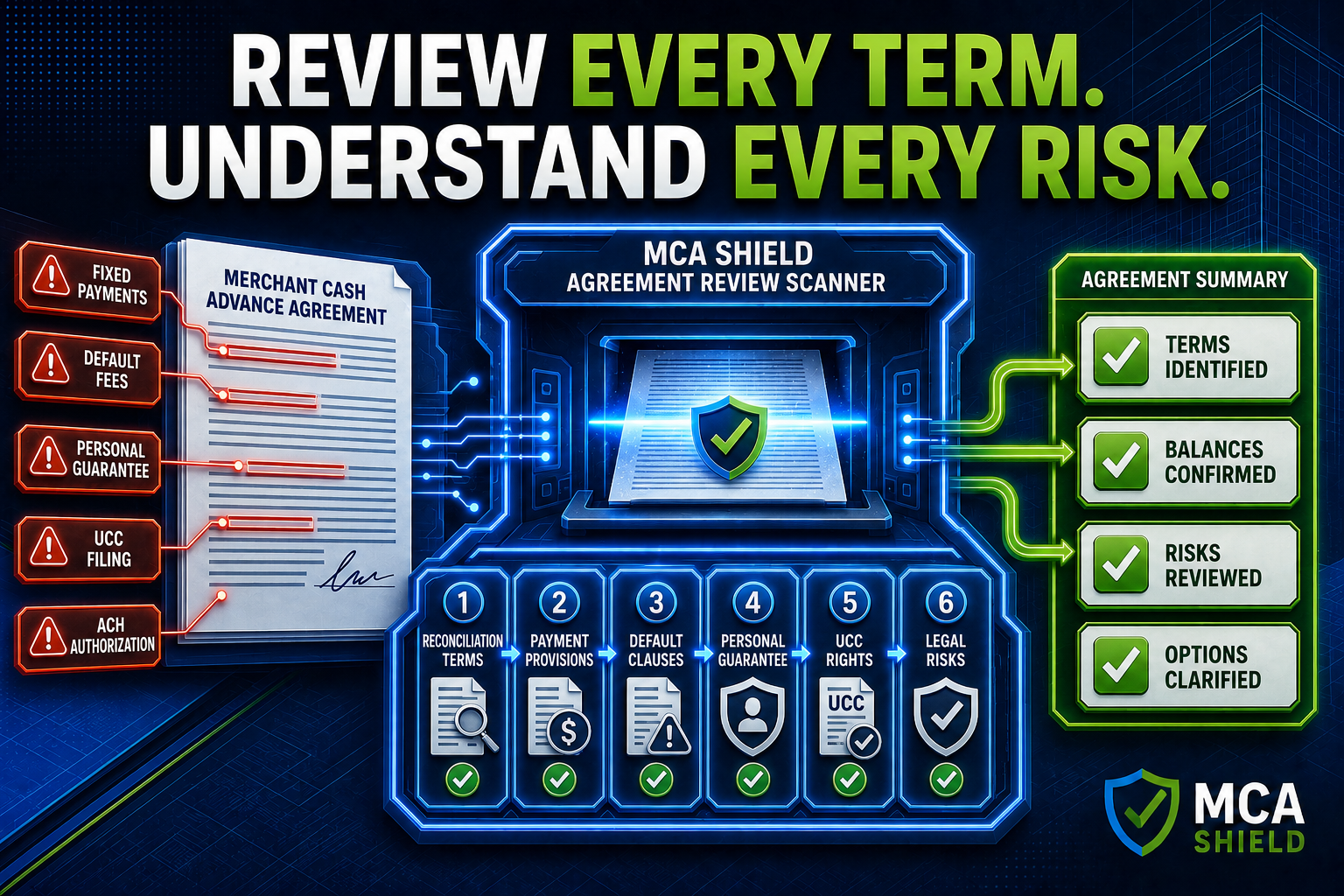
A complete agreement review should examine:
- The purchased amount and total amount to be delivered
- The daily or weekly withdrawal
- The reconciliation process
- Default and collection provisions
- Personal guarantees
- UCC filings
- Confessions of judgment, when applicable
- Restrictions on additional financing
- Fees connected to modification, default, or settlement
This review becomes especially important when a business has multiple or stacked MCAs. Each agreement may have different terms, payment priorities, and legal risks. Changing one payment could also affect the business’s ability to meet its other obligations.
Reviewing every agreement helps determine whether reconciliation, renegotiation, restructuring, consolidation, or settlement may be appropriate. It also allows the business to calculate a realistic payment based on revenue, payroll, taxes, vendor costs, and other essential expenses.
Request an MCA Reconciliation Based on Actual Revenue
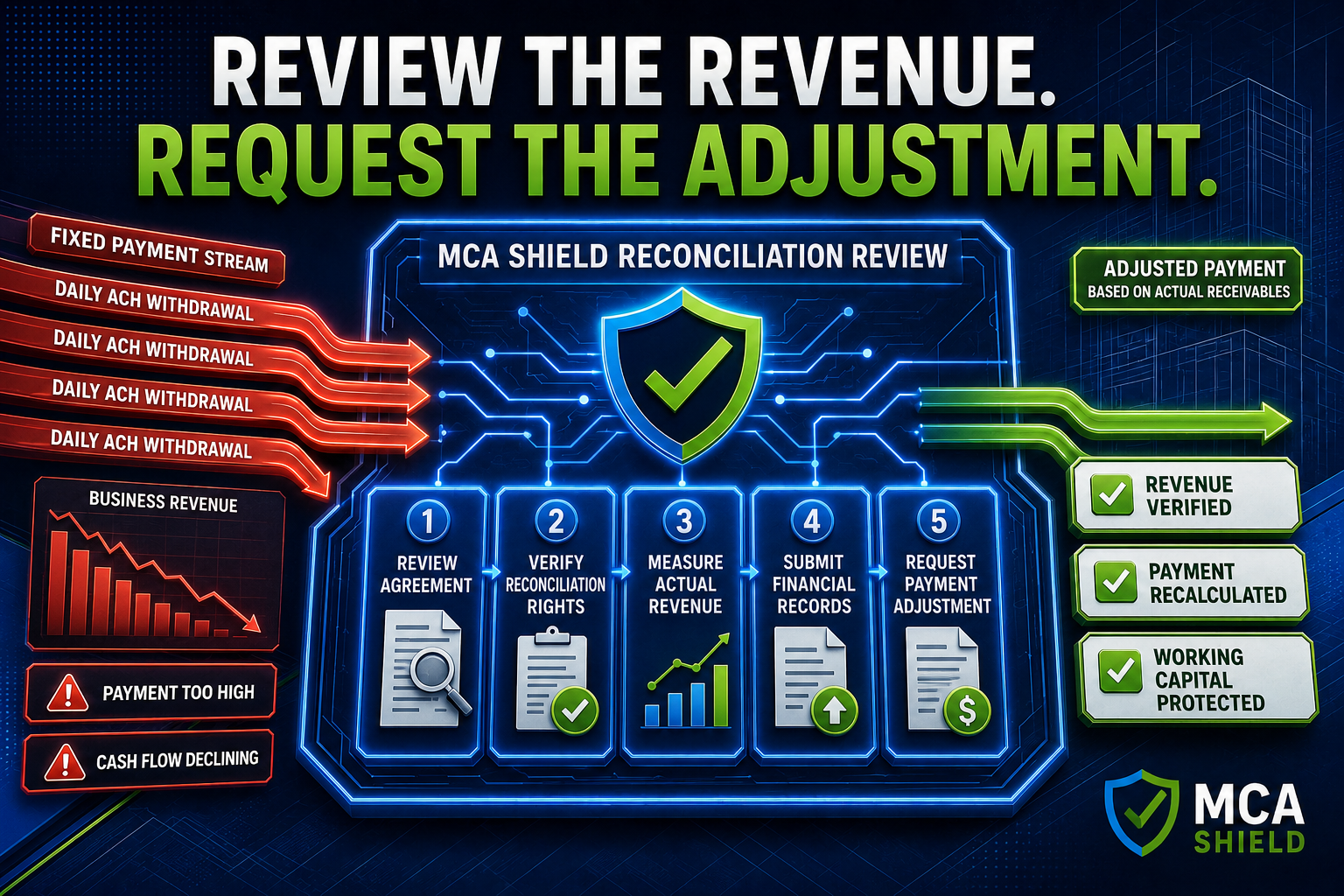
An MCA reconciliation request may help lower payments when a business’s current revenue is below the amount used to calculate its original withdrawals. This option is based on the idea that merchant cash advance payments should remain connected to the business’s actual receivables.
Reconciliation does not cancel the agreement or automatically reduce the total amount owed. Instead, it may adjust the daily or weekly withdrawal to reflect current sales. Whether this option is available depends on the specific language in the MCA agreement.
How a Reconciliation Provision May Adjust Your Payments
Many MCA agreements establish a fixed daily or weekly withdrawal as an estimate of the business’s future receivables. If sales decline, that fixed withdrawal may represent a much larger percentage of revenue than originally expected.
A reconciliation provision may allow the business to request an adjustment based on its actual receipts. For example, if the agreement states that the funder purchased a specific percentage of future receivables, the payment may need to be reviewed when revenue changes significantly.
A successful reconciliation could result in:
- A lower daily ACH withdrawal
- A reduced weekly payment
- A temporary adjustment based on recent sales
- A credit for previous withdrawals that exceeded the agreed percentage
- A revised payment amount for a specific review period
The exact result depends on the contract and the financial information provided. Some agreements require reconciliation requests to be submitted within a set number of days. Others may require the business to use a specific form, email address, or online portal.
Business owners should follow the agreement’s instructions carefully. Missing a deadline or sending incomplete information could delay the review or give the funder a reason to deny the request.
Documents Needed to Support a Reconciliation Request
An MCA funder will typically require financial records showing that the business’s revenue has declined or changed. The documents should be complete, current, and consistent with the information previously provided to the funder.
A reconciliation request may require:
- Recent business bank statements
- Merchant-processing statements
- Daily or monthly sales reports
- Accounts receivable reports
- Profit-and-loss statements
- Tax returns or sales tax reports
- Evidence of seasonal or temporary revenue changes
- A completed reconciliation request form
- A written explanation of the financial change
The funder may compare deposits, sales, and receivables with the amount being withdrawn. Clear records can help demonstrate that the current payment no longer reflects the percentage described in the agreement.
The business should also keep copies of every document and communication it submits. This creates a record of the request, the delivery date, and the information provided.
A complete request should explain the problem without overstating it. It should identify the current withdrawal, summarize the revenue change, and propose a payment that better reflects actual business receipts.
What Happens if an MCA Funder Denies Reconciliation?
A funder may deny reconciliation if it believes the agreement does not permit an adjustment, the request was submitted incorrectly, or the financial records are incomplete. The funder may also dispute how the business calculated its actual revenue.
If a reconciliation request is denied, the business should first ask for the reason in writing. It may be possible to correct missing information, provide additional records, or resubmit the request as outlined in the contract’s procedures.
The next steps may include:
- Reviewing the agreement’s reconciliation requirements
- Correcting errors or missing documentation
- Requesting a written explanation for the denial
- Escalating the request to a supervisor or account manager
- Negotiating a voluntary payment modification
- Exploring MCA restructuring or consolidation
- Asking an experienced attorney to review the agreement
A denial does not necessarily mean the business has no options. However, the owner should avoid stopping payments or blocking withdrawals without first understanding the possible contractual and legal consequences.
If the funder refuses to honor a clearly stated reconciliation provision, professional review may help determine whether the request was handled correctly and what alternatives are available. The objective is to find a lawful solution that reduces immediate payment pressure while responsibly addressing the MCA obligation.
Renegotiate Daily or Weekly MCA Withdrawals
When MCA withdrawals consume too much operating cash, a business may be able to renegotiate the payment amount or frequency. A successful modification can reduce immediate pressure and leave more money for payroll, vendors, taxes, and other essential expenses.
Renegotiation does not automatically reduce the total balance. It usually changes how quickly the obligation is paid. Therefore, the business should compare the lower payment with the revised repayment period, fees, and total cost before accepting new terms.
Requesting a Lower MCA Withdrawal Amount
A business can ask the funder to temporarily or permanently reduce its daily or weekly MCA withdrawal. The request should explain why the current payment is no longer affordable and what amount the business can reasonably maintain.
Before contacting the funder, the owner should calculate:
- Average weekly and monthly revenue
- Essential operating expenses
- Existing MCA withdrawals
- Available working capital
- A realistic payment amount
The proposed payment should be based on actual cash flow. Asking for an amount that is still unaffordable may only delay another payment problem.
A lower withdrawal could help the business:
- Maintain enough cash for payroll and taxes
- Keep important vendors current
- Reduce overdrafts and returned payments
- Avoid taking another MCA
- Build a more stable repayment history
The funder is not required to approve every request. However, a clear proposal supported by recent financial records may be a stronger basis for negotiation.
Changing the Payment Frequency to Improve Cash Flow
Changing the payment frequency may also provide relief. For example, a business could request that daily ACH withdrawals be replaced with one weekly payment. This can make cash flow easier to track and give deposits more time to accumulate before the next withdrawal.
A weekly schedule may be especially helpful for businesses that receive revenue unevenly throughout the week. It can also make daily bank account monitoring less demanding.
However, changing the frequency does not always lower the total amount withdrawn. Five smaller daily payments could be combined into one larger weekly payment. The business must confirm that the new schedule creates meaningful cash-flow relief.
Before agreeing to a different payment frequency, review:
- The amount of each new withdrawal
- The total withdrawn each week
- The payment dates
- The revised repayment period
- Any modification or administrative fees
- The consequences of a missed payment
All changes should be provided through a written modification agreement. A verbal promise may be difficult to verify if the original withdrawal continues or a dispute develops.
Using Financial Records to Support Your Request
Financial records help demonstrate why the original payment no longer fits the business’s revenue. They also allow the owner to propose a payment based on facts rather than a general statement about financial hardship.
Useful records may include:
- Recent business bank statements
- Merchant-processing statements
- Monthly sales reports
- Profit-and-loss statements
- Payroll records
- Vendor invoices
- Tax obligations
- Accounts receivable reports
- A short-term cash-flow forecast
The records should clearly show the relationship between business income, essential expenses, and the current MCA withdrawal. If the company has multiple advances, the request should also identify the combined daily or weekly payment burden.
A simple cash-flow summary can strengthen the proposal. It should show how much revenue enters the business, how much is needed for operations, and what payment the company can maintain consistently.
Once an agreement is reached, confirm every term in writing before relying on the new arrangement. The document should identify the new withdrawal amount, payment frequency, effective date, fees, and remaining obligation. This protects the business and creates a clear record of the modified terms.
Restructure MCA Payments Into an Affordable Payment Plan
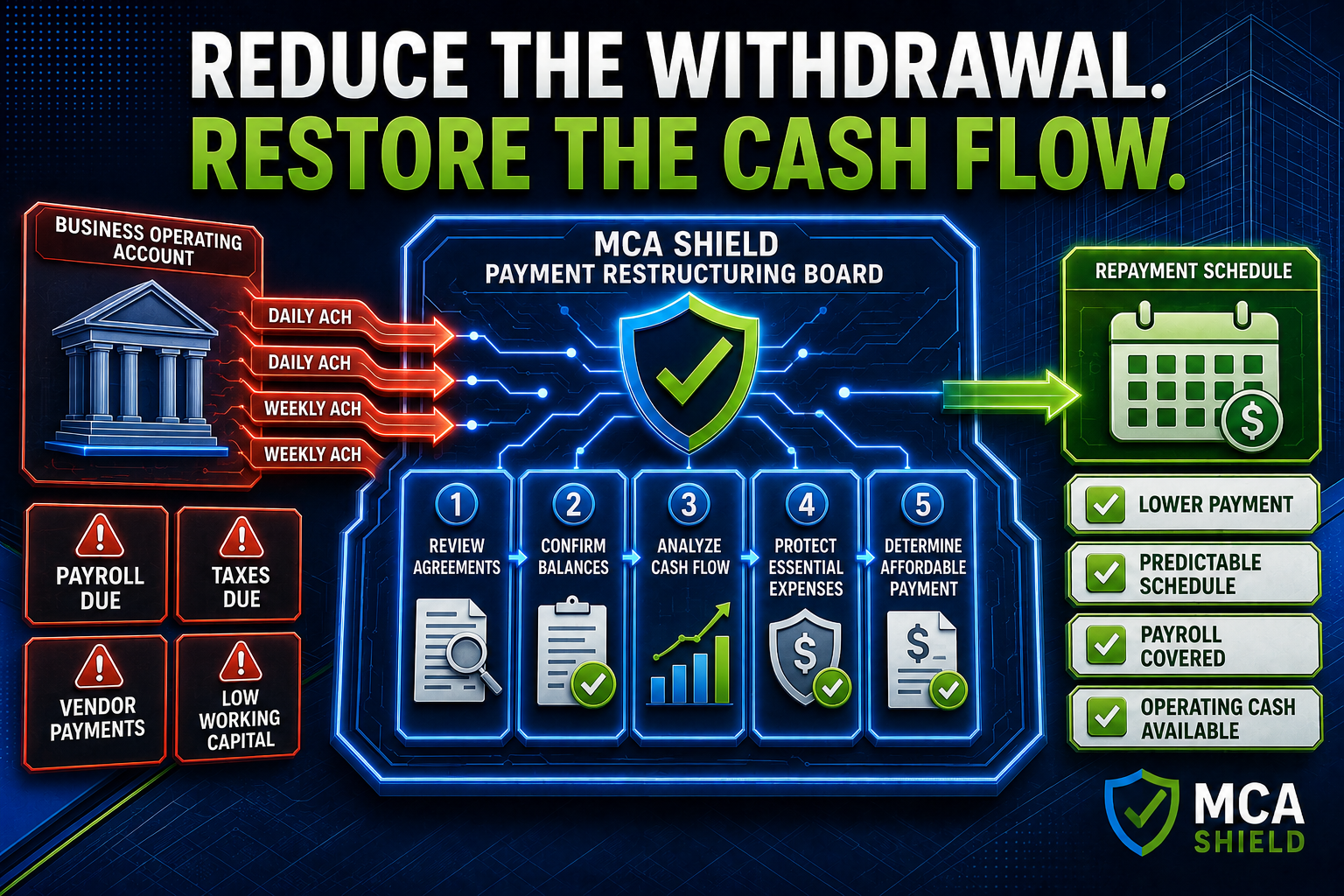
When daily or weekly withdrawals become unaffordable, MCA restructuring may provide a more manageable way to address the obligation. The process generally involves reviewing the agreement, analyzing the business’s cash flow, and negotiating revised payment terms.
Restructuring does not erase the obligation. Instead, it may change the payment amount, withdrawal frequency, repayment period, or other terms. The goal is to create an affordable MCA payment plan that the business can maintain without sacrificing essential operating expenses.
How MCA Restructuring Can Reduce Payment Pressure
Merchant cash advances can create serious cash-flow problems when withdrawals take place every business day. The burden becomes even greater when a company has multiple or stacked MCAs withdrawing from the same account.
A restructuring plan may replace the original payment schedule with terms that better reflect the company’s current financial condition. Depending on the agreement and the funder’s willingness to negotiate, restructuring may include:
- Reducing the daily or weekly withdrawal
- Changing daily payments to weekly payments
- Extending the repayment period
- Combining multiple payments into one structure
- Temporarily reducing payments
- Establishing a fixed repayment schedule
Lower withdrawals can leave more cash available for payroll, taxes, inventory, rent, and vendor payments. This can help stabilize operations and reduce the risk of overdrafts or returned ACH payments.
However, a smaller payment may extend the repayment timeline. It could also affect the total cost. Therefore, the business should compare the immediate cash-flow relief with the full financial impact of the proposed terms.
Calculating a Payment the Business Can Maintain
An affordable payment should be based on the business’s actual cash flow, not on the amount the owner hopes to pay. Agreeing to an unrealistic payment may lead to another default and additional financial problems.
The calculation should begin with the company’s average revenue. Seasonal businesses should review several months of financial activity rather than relying on one unusually strong or weak period.
Next, the business should subtract essential operating expenses, including:
- Payroll and payroll taxes
- Rent or mortgage payments
- Inventory and materials
- Vendor obligations
- Insurance
- Utilities
- Equipment expenses
- Business taxes
- Other debt payments
The amount remaining after essential expenses provides a clearer picture of the cash available for MCA payments. The business should also maintain a reasonable cash reserve for unexpected costs or temporary declines in sales.
A restructuring proposal should account for all active MCA obligations. Calculating one payment without considering the others could result in a plan that still leaves the business short on operating cash.
Recent bank statements, profit-and-loss statements, accounts receivable reports, and cash-flow forecasts can help support the proposed amount. These records also show the funder why the original payment is no longer sustainable.
Why Restructuring Terms Should Be Confirmed in Writing
Every approved change should be documented in a written restructuring agreement. Verbal statements from a representative may not provide enough protection if the withdrawal amount remains unchanged or a disagreement develops later.
The written agreement should clearly identify:
- The revised payment amount
- The new payment frequency
- The date the modification begins
- The remaining balance or obligation
- The expected repayment period
- Any restructuring or administrative fees
- Default provisions
- Whether collection activity will pause
- How UCC filings or personal guarantees will be handled
The business should also confirm whether the new agreement replaces the original terms or only modifies certain sections. Any provisions that remain active should be understood before the document is signed.
Owners should never assume that a lower payment automatically settles the entire obligation. The written terms must explain what happens after the final payment and whether the funder will provide a written satisfaction or release.
Clear documentation protects both parties and gives the business a reliable payment schedule. It also helps the owner plan future expenses, monitor progress, and avoid confusion about what is required under the restructured arrangement.
Consolidate Multiple MCA Payments Into One Structure
Negotiate an MCA Settlement When Full Repayment Is Not Realistic
When a business cannot afford the full balance noted in a merchant cash advance agreement, an MCA settlement may be another way to resolve the obligation. Settlement involves negotiating with the funder to accept an agreed amount instead of continuing under the original payment terms.
A settlement is not guaranteed. The funder will typically consider the business’s finances, payment history, remaining obligation, and ability to fund the proposed agreement. The business should also understand the legal and financial consequences before accepting any offer.
How MCA Settlement Negotiations Work
The settlement process usually begins with a complete review of the MCA agreement and current account status. The business must confirm the amount already paid, the remaining balance claimed by the funder, and any additional fees.
Next, the owner may provide financial records that reflect why full repayment is not realistic. These documents may include:
- Recent business bank statements
- Profit-and-loss statements
- Sales reports
- Payroll records
- Tax obligations
- Vendor invoices
- Accounts receivable reports
- Information about other active MCAs
The settlement proposal should be based on what the business can afford without jeopardizing essential operations. The funder may accept the proposal, reject it, or respond with a counteroffer.
Several rounds of negotiation may be necessary. During this process, the parties may discuss the settlement amount, payment schedule, collection activity, legal claims, UCC filings, and personal guarantees.
Any final agreement should clearly state that satisfaction of the settlement terms will resolve the specified obligation. The business should also confirm whether the funder will provide a written release or satisfaction letter after the final payment.
Lump-Sum Settlements vs. Structured Settlement Payments
A lump-sum settlement requires the business to pay the agreed amount in one payment. Funders may consider a lower settlement amount when funds are available immediately, as it provides a faster resolution.
However, using a large portion of the company’s cash reserves can create new operating problems. The owner should confirm that the payment will not prevent the business from covering payroll, taxes, inventory, rent, or other essential expenses.
A structured settlement allows the business to pay the negotiated amount through several scheduled payments. This option may be more realistic when the company has steady revenue but cannot provide a large payment at once.
Before choosing either option, compare:
- The total settlement amount
- The required initial payment
- The number and frequency of payments
- The settlement deadline
- Any additional fees
- The consequences of a missed payment
- The amount of cash that must remain available for operations
A structured agreement may provide more flexibility, but it can also create risk. Some settlement documents state that the original balance becomes due if the business misses a scheduled payment. This provision should be reviewed carefully before signing.
The most suitable option is one the business can complete while maintaining sufficient working capital.
Understanding the Risks Before Accepting a Settlement
Settlement can provide meaningful relief, but it may also carry financial and legal consequences. Business owners should evaluate the complete agreement rather than focusing only on the reduced amount.
Potential risks may include:
- Collection activity during negotiations
- Legal action if an agreement has already entered default
- Enforcement of a personal guarantee
- Continued UCC filings
- Business credit consequences
- Tax considerations related to the resolved amount
- Loss of the settlement if a payment is missed
- Additional fees or legal costs
The business should not assume that settlement automatically releases each obligation connected to the MCA. The written agreement should explain how the funder will handle UCC filings, personal guarantees, pending legal claims, and collection activity.
The owner should also verify whether the agreement includes a broad release. A proper release can help prevent future attempts to collect the resolved obligation after all settlement payments have been completed.
Depending on the circumstances, it may be wise to have an experienced attorney review the proposed terms. A tax professional can also explain whether the settlement may create reporting or tax consequences.
An MCA settlement should provide a clear and complete resolution. Before signing, the business should understand the payment requirements, default provisions, releases, and steps the funder will take upon receipt of the final payment.
Review the MCA Agreement for Problematic or Disputed Terms
Protect Cash Flow While MCA Payment Relief Is Being Negotiated
Negotiating MCA relief can take time. During that period, the business must preserve sufficient cash for daily operations. A short-term strategy should protect essential expenses, prevent additional borrowing, and establish clear spending priorities.
Prioritizing Payroll, Taxes, Vendors, and Essential Expenses
Identify the expenses the business must pay to remain open. These commonly include payroll, payroll taxes, rent, utilities, insurance, inventory, and critical vendor invoices.
Rank expenses by urgency and operational importance. Payroll and taxes often require immediate attention. Meanwhile, some vendors may accept revised payment dates or installment arrangements.
Contact important vendors before a payment becomes late. Clear communication may help the business secure more manageable terms while preserving valuable supplier relationships.
Avoid paying one obligation in a way that leaves the business unable to meet payroll or purchase necessary materials. The goal is to keep operations stable while MCA relief is being negotiated.
Avoiding Additional MCAs and Costly Renewal Cycles
Taking another MCA may offer temporary cash, but it can add another withdrawal to an already strained account. Additional advances may also increase the total repayment burden and make negotiations more complicated.
Avoid using new financing to cover existing MCA payments unless the full cost and cash-flow impact have been carefully reviewed. Repeated renewals can keep the business in a cycle of borrowing and repayment.
Before accepting another offer, review the new payment, factor rate, fees, repayment period, and effect on working capital. A lower initial payment does not always create long-term relief.
Focus on resolving existing obligations through reconciliation, renegotiation, restructuring, consolidation, or settlement before adding another payment.
Building a Short-Term Cash-Flow Plan
Create a weekly cash-flow plan using current bank balances, expected deposits, scheduled withdrawals, and essential expenses. The plan should cover the period needed to negotiate or implement payment relief.
Begin with verified revenue, not projected sales that may never arrive. Estimate when customer payments will clear and compare those deposits with upcoming obligations.
Update the plan at least once a week. Revise it whenever deposits, expenses, or payment negotiations change. This gives the owner a current view of available working capital.
Maintain a small reserve whenever possible. Even a modest cash cushion can help cover repairs, delayed customer payments, or other unexpected costs without creating a new borrowing need.
Choose the Right Strategy to Lower MCA Payments Legally
Lower MCA Payments Before Cash-Flow Pressure Gets Worse
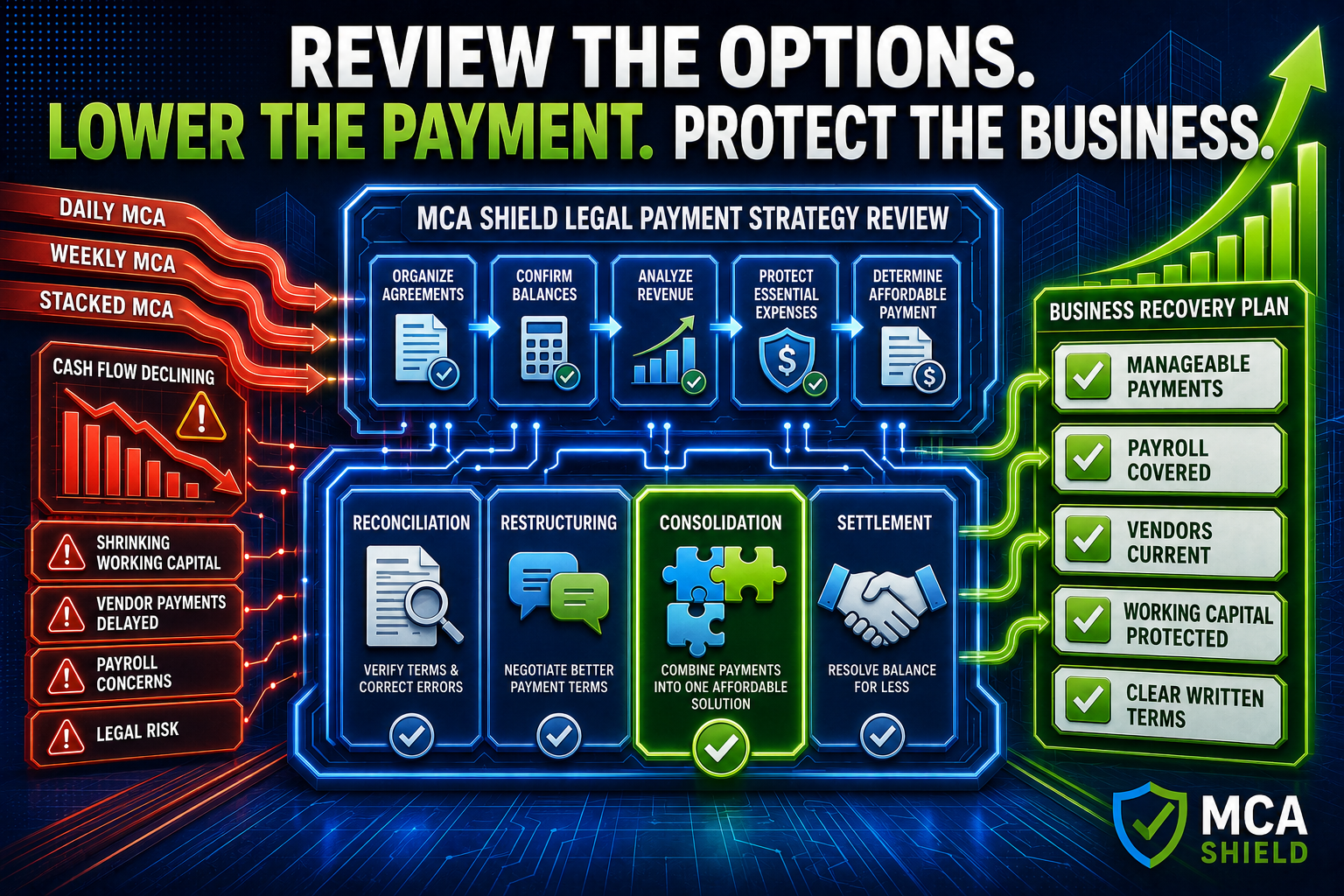
Unaffordable MCA withdrawals can quickly affect payroll, taxes, vendors, and daily operations. Taking action early gives the business more time to review its options and pursue a payment structure based on actual cash flow.
The first steps are to organize the necessary documents, establish an affordable payment, and speak with an experienced MCA relief professional. A clear financial picture can help the business compare reconciliation, restructuring, consolidation, and settlement.
Organize Your MCA Agreements and Financial Records
Begin by collecting all documents connected to the business’s merchant cash advances. Include the original agreements, payment authorizations, personal guarantees, modification documents, and communications from each funder.
The business should also gather:
- Recent bank statements
- Merchant-processing statements
- Current payoff or balance information
- Payment histories
- Profit-and-loss statements
- Payroll records
- Tax obligations
- Vendor invoices
- Accounts receivable reports
- Notices involving default, collections, or legal action
Create a separate summary for each MCA. Record the funder, initial advance amount, total repayment amount, current balance, withdrawal frequency, and payment amount.
If the business has stacked MCAs, calculate the combined daily or weekly withdrawals. This reveals how much cash is leaving the business account and which obligations are creating the greatest strain.
Accurate records also make it easier to identify reconciliation rights, disputed fees, incorrect balances, or terms that may require legal review.
Calculate What Your Business Can Realistically Afford
An affordable payment should reflect actual revenue and essential operating costs. It should not be based on the amount a funder demands or a payment the business can sustain only during its strongest sales period.
Start by calculating average weekly and monthly revenue. Then subtract essential expenses, such as:
- Payroll and payroll taxes
- Rent or mortgage payments
- Inventory and materials
- Vendor obligations
- Insurance
- Utilities
- Business taxes
- Equipment costs
- Other required debt payments
The remaining cash gives the business a starting point for evaluating an MCA payment. However, the company should also preserve a reasonable reserve for repairs, seasonal declines, delayed customer payments, and other unexpected expenses.
Review every active MCA before proposing a new payment. A modification for one agreement may not solve the problem if several other withdrawals continue.
The goal is to calculate a realistic payment the business can maintain consistently. This amount can support negotiations and help prevent the company from accepting another unaffordable arrangement.
Schedule a Free Consultation With MCA Shield
MCA Shield can review the business’s agreements, current balances, payment schedule, and available cash flow. This financial review can help identify which relief options may match the company’s circumstances.
Depending on the agreements and financial condition, possible strategies may include:
- Requesting reconciliation
- Negotiating lower withdrawals
- Restructuring payment terms
- Consolidating multiple MCA obligations
- Exploring a negotiated settlement
No company can guarantee that a funder will approve a specific payment reduction or settlement. However, an organized review can help the business understand its options and prepare a proposal supported by accurate financial information.
If daily or weekly MCA withdrawals are affecting your ability to cover essential expenses, waiting may reduce your available options. Schedule a free consultation with MCA Shield to review your obligations, calculate an affordable payment, and explore lawful strategies to protect your working capital.