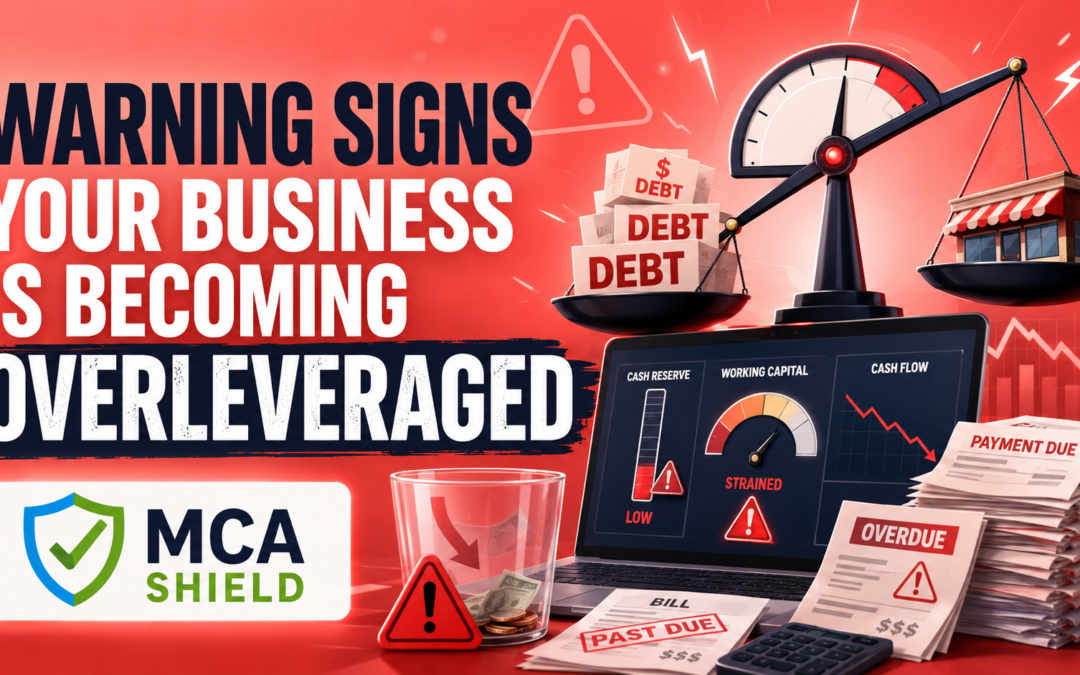
The signs your business is overleveraged can appear gradually. At first, debt payments may seem manageable. However, as more revenue goes toward loans, merchant cash advances, or other obligations, the business may have less money available for payroll, taxes, vendors, and everyday operating expenses.
An overleveraged business carries more debt than its cash flow can comfortably support. Warning signs may include shrinking cash reserves, repeated borrowing, difficulty covering essential expenses, and debt payments consuming too much revenue.
Recognizing these warning signs early can give a business more time to review its obligations and consider potential solutions. Understanding the problem is the first step toward protecting working capital, improving cash flow, and avoiding even greater financial pressure.
Schedule Your Free Consultation
What Does It Mean When a Business Becomes Overleveraged?
A business becomes overleveraged when its debt obligations become too large for its available cash flow to support comfortably. The company may still generate revenue and make payments, but too much of its incoming cash begins going toward debt instead of normal operating needs.
One of the clearest signs your business is overleveraged is that debt payments leave less money available for payroll, taxes, rent, inventory, vendors, and other essential expenses. As this pressure increases, the business may start relying on credit cards, loans, or additional merchant cash advances simply to keep operating.
The amount of debt alone does not determine whether a business is overleveraged. What matters most is whether the company can manage its debt payments while maintaining enough working capital to operate.
How Too Much Debt Starts Affecting Business Cash Flow
Debt becomes a serious problem when payments begin taking a disproportionate share of business revenue.
For example, a business may have several loans, lines of credit, or merchant cash advances requiring payments throughout the month. When those obligations are manageable, the company can pay them while still covering operating expenses. However, as the total payment burden grows, available cash can shrink quickly.
Merchant cash advances can create additional pressure because many require daily or weekly withdrawals. If several MCA payments occur at the same time, money may leave the business account almost as quickly as revenue enters it.
This can create a cycle in which the business:
- Struggles to maintain adequate working capital
- Delays vendor or supplier payments
- Has difficulty covering payroll or taxes
- Uses credit to pay routine operating expenses
- Takes additional financing to cover temporary cash shortages
These problems often become more serious when revenue slows unexpectedly. A business with very little cash left after debt payments has less room to handle seasonal declines, equipment repairs, unexpected expenses, or delayed customer payments.
As a result, too much debt can turn a temporary cash-flow problem into an ongoing financial burden.
The Difference Between Healthy Debt and Excessive Debt
Not all business debt is harmful. In fact, healthy business debt can help a company purchase equipment, expand operations, hire employees, increase inventory, or take advantage of growth opportunities.
The key difference is affordability.
Healthy debt should have a payment structure that fits within the company’s normal cash flow. After making required payments, the business should still have enough money available to cover essential expenses and maintain reasonable cash reserves.
Excessive debt, on the other hand, begins interfering with the company’s ability to operate.
A business may be carrying too much debt when it regularly needs new financing to cover existing obligations, postpones important expenses because payments have depleted available cash, or has almost no financial cushion after debt payments clear.
The situation can become even more difficult when multiple obligations overlap. Several individually manageable payments can combine into a total burden that the business can no longer comfortably support.
Business owners should therefore look beyond the original loan amounts or individual payment sizes. The more important question is how much total cash leaves the business for debt payments compared with how much cash remains for operations.
Recognizing that imbalance early can help a business identify the warning signs of becoming overleveraged before cash-flow pressure becomes more difficult to manage.
Warning Sign #1: Debt Payments Are Consuming Too Much of Your Revenue
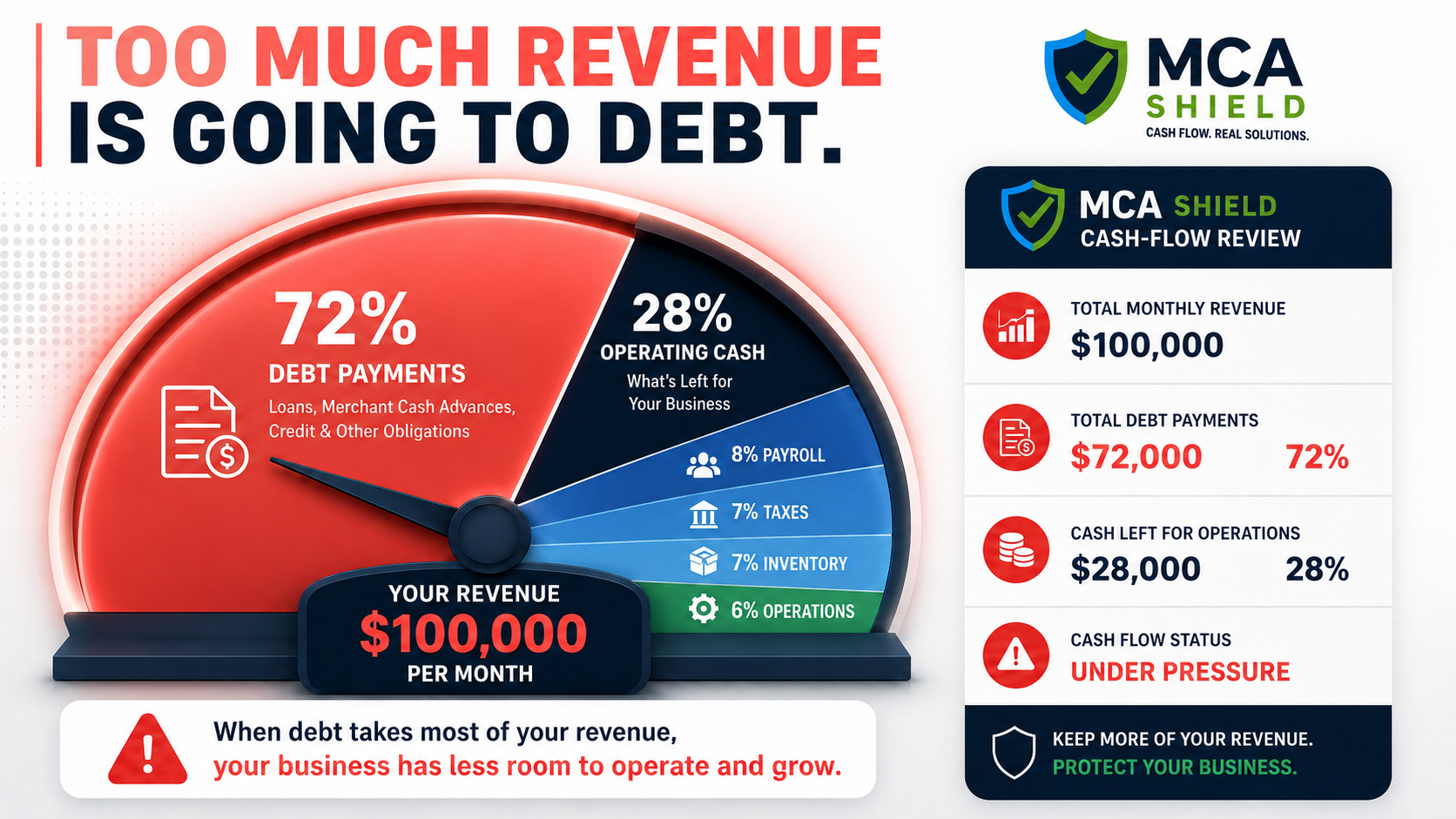
One of the clearest signs your business is overleveraged is when debt payments begin consuming too much of the revenue coming into the company.
A business can have strong sales and still experience serious financial pressure. The problem occurs when a large portion of each day’s or week’s revenue immediately goes toward loans, merchant cash advances, credit lines, or other debt obligations.
When that happens, the business may have less money available for payroll, taxes, inventory, rent, vendors, insurance, and operating expenses. Even if the company remains profitable on paper, its actual cash position can become increasingly difficult to manage.
Business owners should pay close attention to how much revenue remains after all required debt payments are made. If there is consistently very little cash left for normal operations, the company’s debt burden may no longer be sustainable.
When Daily and Weekly Payments Begin Squeezing Working Capital
Daily and weekly payments can create especially intense pressure on business working capital.
Merchant cash advances often require frequent withdrawals from the business bank account. One payment may seem manageable by itself. However, when several MCAs or other obligations are being paid at the same time, the combined withdrawals can significantly reduce available cash.
For example, a business might generate strong deposits throughout the week. Yet several automatic withdrawals may occur shortly afterward. By the time payroll, inventory, utilities, and other expenses are due, much of that revenue may already be gone.
This can lead to several warning signs:
- Cash balances repeatedly falling to uncomfortable levels
- Difficulty paying vendors on time
- Payroll becoming harder to cover
- Taxes or operating expenses being delayed
- Credit cards being used for routine expenses
- New financing being considered simply to restore working capital
The important issue is not just whether the business can make today’s debt payment. The company must also have enough cash remaining to continue operating after that payment clears.
When daily and weekly debt payments consistently squeeze working capital, the business has less flexibility to handle unexpected expenses or temporary declines in revenue. That lack of financial breathing room is a major warning sign that the company may be becoming overleveraged.
Why Revenue Growth Does Not Always Solve the Problem
Increasing sales may appear to be the obvious solution to a heavy debt burden. Unfortunately, higher revenue does not always result in stronger cash flow.
A growing business often has growing expenses as well. More sales may require additional inventory, labor, equipment, transportation, supplies, marketing, or other operating costs. Therefore, the company may need more working capital at the same time that debt payments are consuming a significant portion of its deposits.
This problem can become even more serious with merchant cash advances. If payments are tied to sales or bank activity, increased revenue may also lead to larger withdrawals. As a result, the business may generate more money without experiencing the expected improvement in available cash.
Growth can even hide an overleveraging problem temporarily. Strong sales may allow the business to keep making payments, but the underlying debt burden may still be leaving too little cash available for essential expenses and reserves.
That is why business owners should look beyond revenue alone. A better question is:
How much usable cash remains after debt payments and essential operating expenses are covered?
If revenue continues growing while available cash remains tight, the problem may not be sales. It may be the company’s debt structure.
Recognizing this warning sign early can give the business more time to review its obligations and determine whether restructuring, negotiation, consolidation, settlement, or another debt-relief strategy could reduce the pressure on cash flow.
Warning Sign #2: Your Business Is Struggling to Cover Essential Expenses
Another major warning sign appears when a business can make its debt payments but struggles to cover the expenses required to keep operating.
Payroll, taxes, rent, utilities, inventory, insurance, and vendor payments are not optional costs. When debt obligations begin competing with these expenses, the business may be carrying more debt than its cash flow can safely support.
This is one of the most important signs your business is overleveraged. The company may still be generating revenue, yet too much of that money leaves the business before essential expenses are paid.
At first, the problem may seem temporary. A business owner might delay a vendor payment or move money between accounts to cover payroll. However, if these decisions become routine, the underlying debt burden deserves closer attention.
Payroll, Taxes, Rent, and Vendors Begin Competing for Cash
A healthy business should have enough cash flow to meet its regular financial obligations without constantly deciding which bill gets paid first.
When a company becomes overleveraged, that changes.
For example, several loan or merchant cash advance payments may leave the business account during the week. Then payroll arrives. A tax payment is due. A supplier needs to be paid, and rent is approaching.
Suddenly, multiple essential expenses are competing for the same limited amount of cash.
Common warning signs include:
- Delaying payments to vendors or suppliers
- Struggling to make payroll on schedule
- Falling behind on tax obligations
- Paying rent or utilities later than usual
- Using credit cards for ordinary business expenses
- Moving money between accounts to cover immediate bills
- Waiting for the next customer deposit before paying an essential expense
These actions may help the business manage a short-term shortage. However, they do not address the reason the shortage keeps occurring.
If debt payments regularly force the business to choose between paying creditors and funding normal operations, the payment structure may no longer fit the company’s available cash flow.
This problem can become especially serious with multiple merchant cash advances. Frequent ACH withdrawals may remove cash before the business has an opportunity to allocate it toward payroll, taxes, inventory, or other priorities.
The goal should not simply be to keep every debt payment current. A sustainable financial structure must also leave the business with enough working capital to continue operating.
Falling Cash Reserves Can Signal Growing Financial Pressure
Declining cash reserves are another important warning sign.
Most businesses experience unexpected expenses. Equipment can break. A customer may pay late. Revenue may decline during a slow season. Inventory costs can rise without warning.
A reasonable cash reserve gives the company room to absorb those problems.
However, when debt payments continuously drain available cash, that financial cushion can begin to disappear. The business may finish each week or month with less money available than before.
Eventually, even a small unexpected expense can create a serious problem.
A business owner may then turn to another loan, credit card, or merchant cash advance to restore the missing cash. Unfortunately, that new obligation adds another payment and can create even greater pressure on future cash flow.
This pattern can become a cycle of borrowing to replace working capital that previous debt payments consumed.
Business owners should therefore monitor more than sales and account balances. They should also ask whether cash reserves are consistently growing, remaining stable, or declining.
If revenue remains relatively steady while available cash continues to fall, the debt burden may be consuming too much of the company’s financial capacity.
Recognizing this pattern early gives the business more time to review its obligations and explore ways to reduce payment pressure. Protecting cash reserves can help preserve payroll, essential expenses, working capital, and the company’s ability to keep operating.
Warning Sign #3: You Are Borrowing Money to Make Existing Debt Payments
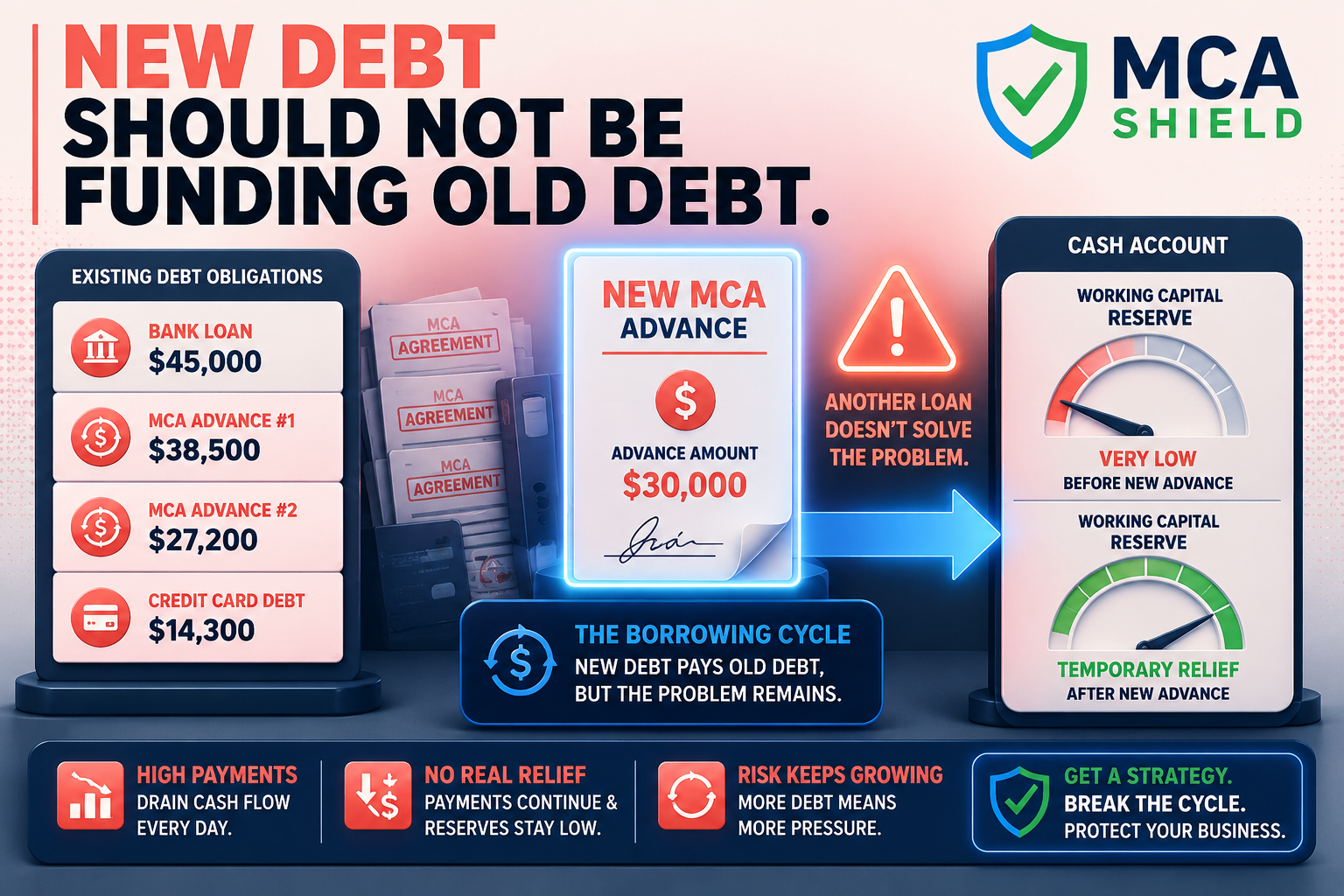
One of the most serious signs your business is overleveraged is when new borrowing is needed to keep up with existing debt payments.
A business may first use new financing to cover a temporary cash shortage. However, if borrowed money is repeatedly used to make loan payments, merchant cash advance withdrawals, payroll, or other obligations, the company may be entering a dangerous cycle.
The problem is simple: new debt does not eliminate the existing debt burden. It adds another payment that future cash flow must support.
Over time, the business may have less cash available for normal operations, even if sales remain steady.
How the Borrowing Cycle Can Make an Overleveraged Business Worse
Borrowing can provide immediate relief when cash is tight. The business receives new funds and suddenly has enough money to cover upcoming expenses.
But that relief can be temporary.
Once repayment begins, the company must support both the original obligations and the new debt. If cash flow was already strained, the additional payment may create another shortage.
That can lead to a repeating pattern:
- Existing debt payments reduce available cash
- The business struggles to cover operating expenses
- New financing is used to restore working capital
- The new financing creates another payment
- Available cash becomes even tighter
- The business considers borrowing again
This cycle can gradually turn a manageable debt problem into a much larger financial challenge.
A key warning sign is when the business is no longer borrowing primarily for growth, equipment, inventory, or expansion. Instead, the money is being used to fill cash-flow gaps created by previous debt payments.
When that happens, the company may need to review its entire debt structure rather than continue adding new obligations.
Why Taking Another Merchant Cash Advance May Increase the Pressure
A merchant cash advance can provide fast access to capital. For a business facing an immediate shortage, that speed may make another MCA appear attractive.
However, taking an additional advance can increase the pressure if the business is already struggling with existing payments.
Many MCAs require daily or weekly withdrawals. Adding another advance means another recurring deduction from future revenue.
If the business already has one or more MCA payments, the combined withdrawals can significantly reduce working capital.
For example, a new advance may provide enough cash to cover payroll, taxes, or an urgent vendor payment today. But once repayment starts, the business may have even less money available each day or week.
This is how MCA stacking can develop. One merchant cash advance is followed by another, and each new obligation takes a portion of the same business revenue.
The result can include:
- Larger total daily or weekly withdrawals
- Less cash available for payroll and operating expenses
- Shrinking cash reserves
- Greater reliance on future borrowing
- Increased risk of missed payments or default
Before taking another merchant cash advance, a business should understand how the new payment will affect total cash flow, not just how much money it will receive upfront.
If new borrowing is mainly being used to make existing debt payments or replace working capital lost to previous withdrawals, that is a strong indication the business may already be overleveraged.
At that point, reviewing options such as MCA restructuring, negotiation, consolidation, or settlement may provide a better opportunity to address the underlying payment problem instead of adding another layer of debt.
Warning Sign #4: Multiple Merchant Cash Advances Are Draining Cash Flow
Multiple merchant cash advances can place intense pressure on a business because each advance may require its own daily or weekly payment.
One MCA may be manageable when revenue is strong. However, problems can develop quickly when a business adds a second, third, or fourth advance before the earlier obligations are paid off.
At that point, several withdrawals may hit the same bank account within a short period. The business can still generate strong sales, yet a large share of those deposits may disappear almost immediately.
This is one of the clearest signs your business is overleveraged. When multiple MCA payments consume too much cash, the company may struggle to keep enough money available for payroll, taxes, inventory, rent, vendors, and other essential expenses.
How Stacked MCA Payments Create a Dangerous Debt Burden
MCA stacking happens when a business takes additional merchant cash advances while existing advances are still being repaid.
Each new advance adds another obligation to the company’s cash flow. Although the additional funding may solve an immediate problem, the new payment can make future cash shortages more likely.
For example, a business might use a second MCA to cover inventory or payroll after the first advance has reduced available cash. Later, another shortage develops because both advances are now withdrawing money from the account.
The business may then consider a third advance.
This pattern can create a cycle in which new financing temporarily replaces working capital while increasing the total payment burden.
Stacked MCA payments can lead to:
- Several automatic withdrawals each day or week
- Less working capital available between customer deposits
- Increasing difficulty covering payroll and operating costs
- Smaller cash reserves
- Greater dependence on credit or additional financing
- Higher risk of missed payments or default
The danger is not necessarily one individual payment. It is the combined effect of every MCA payment on the same pool of business revenue.
A business may therefore appear able to afford each obligation separately while struggling to support all of them at the same time.
When Multiple Withdrawals Become Difficult to Sustain
Multiple withdrawals become difficult to sustain when the business can no longer make its required payments and comfortably fund normal operations.
One important sign is a consistently low bank balance after MCA withdrawals clear. Another is when the company must wait for the next day’s sales before paying a vendor, covering payroll, or purchasing necessary supplies.
Cash-flow pressure may also become more noticeable during slower weeks. If revenue drops but the business still faces several frequent withdrawals, available working capital can disappear quickly.
Business owners should pay close attention when they begin:
- Moving money between accounts to prevent shortages
- Delaying payroll, taxes, or vendor payments
- Using credit cards for routine expenses
- Watching the bank account closely before each withdrawal
- Requesting changes to withdrawal dates because cash is unavailable
- Considering another MCA simply to keep existing payments current
These are signs that the business may no longer have enough financial flexibility to support its current debt structure.
The key question is not simply whether every MCA payment can still be made. The business also needs enough money left afterward to pay essential expenses, maintain working capital, and respond to unexpected costs.
If multiple merchant cash advances are draining cash flow faster than the business can rebuild it, adding another advance may increase the pressure. Reviewing every MCA obligation together can help determine whether restructuring, negotiation, settlement, consolidation, or a coordinated relief strategy could create a more sustainable payment structure.
Warning Sign #5: Your Business Has Little or No Financial Cushion
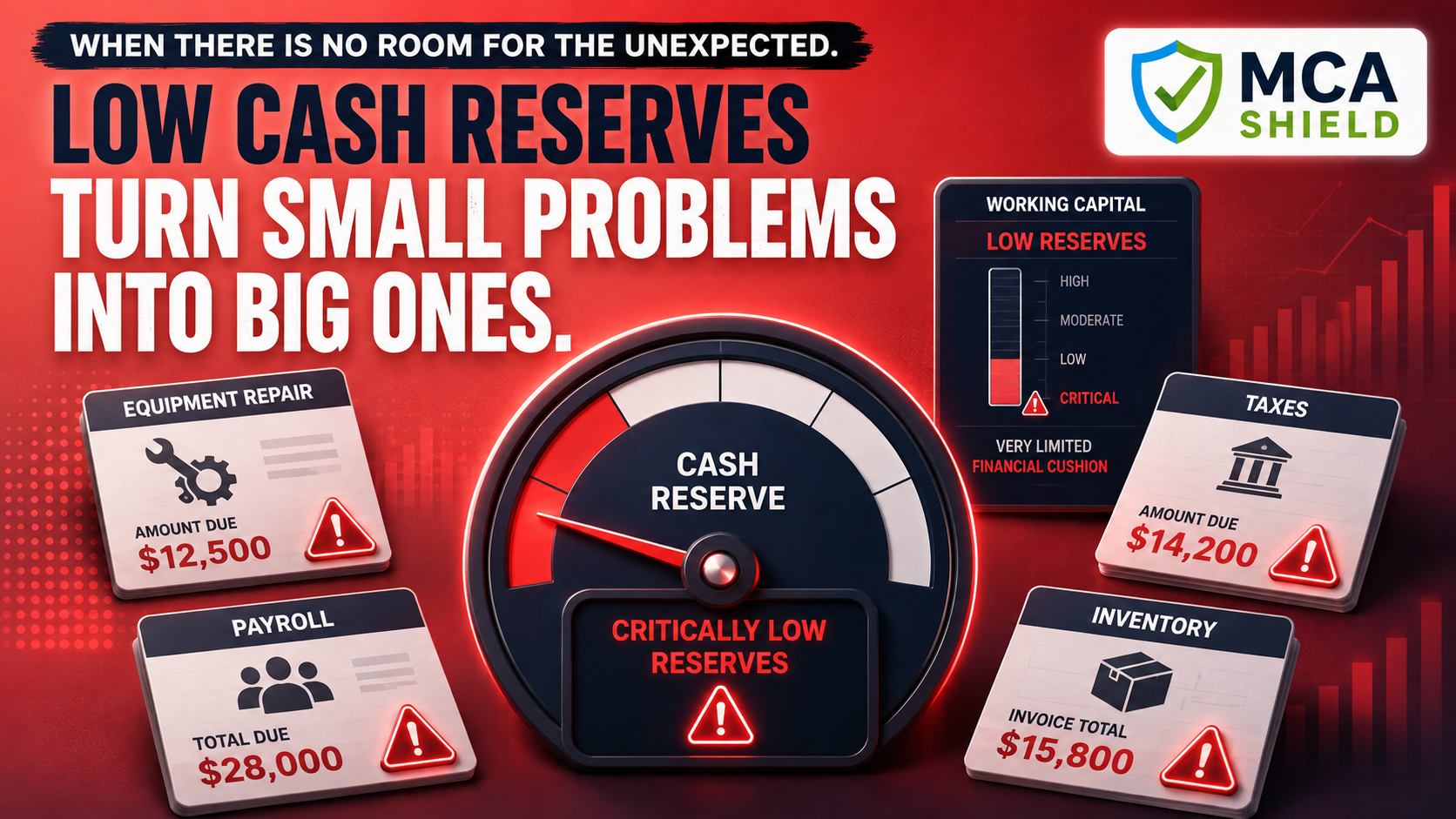
A business needs more than enough cash to cover today’s bills. It also needs a financial cushion to handle slower sales, unexpected costs, delayed customer payments, and normal changes in operating expenses.
When debt payments leave little or no money in reserve, the business becomes far more vulnerable. Even a minor disruption can create an immediate cash shortage.
This is another important sign your business is overleveraged. If nearly every dollar coming in is already committed to debt payments and operating expenses, the company has very little flexibility when something goes wrong.
A shrinking financial cushion may show up as consistently low bank balances, declining savings, increased credit card use, or a growing dependence on the next customer deposit.
Why Limited Working Capital Makes Small Problems More Serious
Working capital gives a business the ability to manage everyday expenses and absorb short-term changes in cash flow.
When working capital becomes limited, routine problems can suddenly feel much larger.
A customer who pays a week late may create a payroll problem. An equipment repair could delay a vendor payment. A slow sales period might leave the business struggling to cover taxes or rent.
With adequate reserves, these situations may be manageable. Without them, the business may have to choose which obligation gets paid first.
Limited working capital can also make it harder to take advantage of normal business opportunities. The company may not have enough cash to purchase inventory, accept a large order, repair equipment, or invest in marketing.
Common warning signs include:
- Bank balances regularly approaching zero
- Using incoming deposits immediately to cover existing bills
- Delaying purchases the business normally makes without difficulty
- Relying on credit cards for basic operating expenses
- Having little money available after debt withdrawals clear
- Depending on future sales to cover expenses that are already due
When these patterns become routine, the business may no longer have enough working capital to comfortably support its debt load.
Unexpected Expenses Can Trigger a Cash-Flow Crisis
Every business faces unexpected expenses at some point.
Equipment breaks. Vehicles need repairs. Insurance costs increase. Inventory prices rise. Customers pay late. Revenue may also fall during a slower-than-expected month.
A financially stable business usually has some ability to absorb these costs. However, an overleveraged business may have very little room to respond.
For example, a $5,000 repair might normally be inconvenient but manageable. If daily MCA withdrawals and other debt payments have already reduced available cash, that same repair could create an immediate cash-flow crisis.
The business may then turn to another loan or merchant cash advance to solve the problem. While that can provide short-term cash, it may also create another payment that reduces future working capital.
This is how a lack of reserves can contribute to a cycle of increasing debt.
The issue is not simply whether the business has cash today. Owners should consider whether the company has enough available capital to handle a setback without immediately relying on additional borrowing.
If one unexpected expense could prevent the business from covering payroll, taxes, rent, or other essential costs, the financial cushion may already be too thin.
Protecting working capital and cash reserves is an important part of maintaining a sustainable business. When debt payments repeatedly prevent those reserves from rebuilding, it may be time to review the company’s obligations and determine whether the current payment structure is still affordable.
What Happens If an Overleveraged Business Does Not Take Action?
When a business is already carrying more debt than its cash flow can comfortably support, waiting can allow the problem to become more serious.
At first, the company may still make every required payment. However, cash reserves may continue to fall, essential expenses may become harder to cover, and the business may rely more heavily on credit or additional financing.
These are important signs your business is overleveraged. If the underlying payment problem is not addressed, the company may eventually reach a point where it cannot keep every obligation current.
Taking action does not necessarily mean choosing one specific solution immediately. It means reviewing the numbers early enough to understand what the business can realistically afford and what options may still be available.
Missed Payments, Collection Pressure, and Increasing Financial Risk
As cash-flow pressure increases, a business may begin missing or delaying payments.
A missed payment can create new problems beyond the original cash shortage. Depending on the agreement, the creditor or MCA funder may begin contacting the business, increase collection activity, or take other steps permitted under the contract.
At the same time, the business still needs money for payroll, taxes, rent, inventory, vendors, and normal operations.
This can create an increasingly difficult situation in which debt pressure and operating pressure occur at the same time.
Warning signs may include:
- ACH withdrawals being returned because of insufficient funds
- Payments being made later than scheduled
- Frequent calls or emails regarding past-due obligations
- Vendors extending less favorable payment terms
- Cash reserves continuing to decline
- Payroll or tax payments becoming difficult to cover
- The business considering additional borrowing to avoid default
Multiple merchant cash advances can make this situation especially challenging. If several funders are withdrawing money from the same account, one unexpected decline in revenue may affect the company’s ability to keep every payment current.
The financial risk can grow quickly because the business is not only dealing with debt. It is also losing the working capital needed to continue generating revenue.
That is why identifying an overleveraging problem before missed payments become routine can be so important.
Why Waiting Can Reduce the Options Available to the Business
Business owners sometimes delay addressing debt because they hope sales will improve, a large customer payment will arrive, or the next busy season will solve the problem.
Sometimes cash flow does improve. However, if the underlying debt structure remains unaffordable, waiting may allow the business to fall further behind.
As financial pressure increases, the company may have fewer resources available to negotiate or restructure its obligations. Cash reserves may be depleted, payments may already be delinquent, and relationships with creditors or funders may become more difficult.
In addition, a business that waits too long may feel forced to accept another source of expensive financing simply to keep operating.
Acting early can provide more room to evaluate the situation instead of reacting to an immediate crisis.
A review should consider:
- The total amount owed across all obligations
- Daily, weekly, and monthly payment requirements
- Current business revenue
- Essential operating expenses
- Available working capital
- Cash reserves
- The payment amount the business can realistically sustain
Once those numbers are clear, the business can begin comparing possible strategies. Depending on the circumstances, those options may include MCA restructuring, negotiation, consolidation, settlement, or a coordinated approach involving multiple obligations.
The goal is not simply to delay payments. It is to determine whether the current debt structure can be changed in a way that allows the business to meet its obligations while preserving enough cash to continue operating.
If the signs your business is overleveraged are already becoming noticeable, waiting for a full cash-flow crisis can make recovery more difficult. Reviewing the problem early can help protect working capital and give the business more time to pursue a sustainable path forward.
What to Do When Your Business Is Becoming Overleveraged
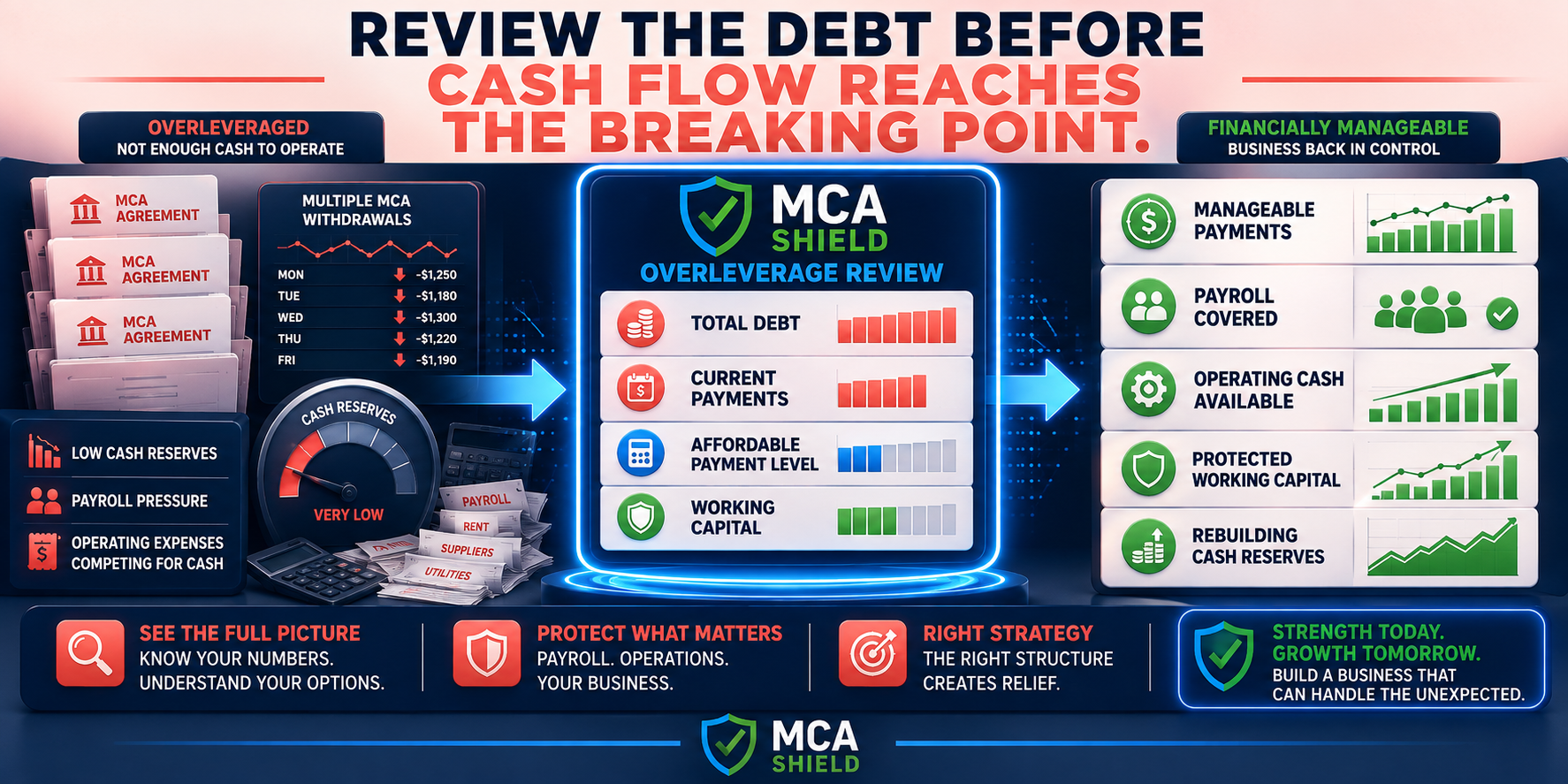
If you recognize the signs your business is overleveraged, the next step is to understand exactly where the financial pressure is coming from.
The goal should not be to add another payment simply to create temporary breathing room. Instead, the business needs a clear picture of its total debt burden, available cash flow, and the amount it can realistically afford to pay.
Acting early can provide more time to compare potential solutions before cash reserves disappear or missed payments create additional pressure.
Review Every Debt and MCA Obligation
Start by reviewing every financial obligation the business currently carries.
This should include bank loans, lines of credit, credit cards, equipment financing, merchant cash advances, and any other recurring debt payments.
For each obligation, identify:
- The current balance or remaining payoff amount
- Daily, weekly, or monthly payment requirements
- Payment frequency
- Remaining payment term
- Fees or other costs
- Automatic ACH withdrawals
- Any past-due amounts
- Important terms in the agreement
Merchant cash advances deserve particular attention because multiple daily or weekly withdrawals can have a significant effect on working capital.
Do not evaluate each MCA separately. Look at the combined amount leaving the business account.
For example, one $500 daily payment may appear manageable. However, four separate MCA withdrawals could mean $2,000 is leaving the account every business day. That combined payment burden may be the real reason cash flow has become difficult to manage.
Once every obligation is listed, compare the total debt payments with average business revenue and essential operating expenses.
This review can reveal whether the company has a temporary cash shortage or a more serious overleveraging problem.
Determine What Payment Level the Business Can Actually Afford
The next step is to calculate what the business can realistically afford after essential expenses are covered.
This number should come from the company’s actual cash flow, not from the amount a lender or funder wants to collect.
Begin with average revenue. Then account for necessary expenses such as:
- Payroll
- Taxes
- Rent or mortgage payments
- Utilities
- Inventory and supplies
- Insurance
- Vendor payments
- Transportation
- Equipment and operating costs
The cash remaining after these expenses provides a clearer picture of what may be available for debt payments.
A sustainable payment structure should allow the business to meet its obligations while still maintaining enough working capital to operate.
If nearly all available cash is going toward debt, even a reduced payment may not solve the underlying problem.
Business owners should also consider normal fluctuations in revenue. A payment that works during the busiest month of the year may become impossible during a slower period.
The better question is:
What payment can the business consistently afford without sacrificing payroll, taxes, essential expenses, or necessary working capital?
That figure can become the foundation for evaluating potential debt-relief strategies.
Explore Restructuring, Negotiation, Settlement, and Other Relief Options
Once the business understands its obligations and affordable payment level, it can begin comparing available options.
There is no single solution that works for every overleveraged business. The right strategy depends on the debt structure, payment history, cash flow, number of obligations, and the company’s ability to continue making payments.
MCA restructuring may involve changing the payment structure of existing obligations to create a more manageable schedule. The objective is generally to reduce immediate payment pressure without simply adding another layer of debt.
MCA negotiation may involve working with funders to seek modified payment terms or another arrangement that better reflects the company’s current financial position.
MCA settlement may be considered in certain situations when the business cannot reasonably satisfy the obligation under its existing terms. Settlement can have important financial and legal consequences, so the entire agreement and the business’s circumstances should be reviewed carefully.
MCA consolidation may also be available in some cases. However, business owners should compare the total cost and new payment structure closely. A lower payment does not automatically mean the new financing improves the company’s overall financial position.
Businesses with several merchant cash advances may need a coordinated strategy rather than addressing each obligation independently. Changing one payment without considering the others may provide limited relief if several other withdrawals continue draining the same account.
The most important goal is to create a structure that helps the business reduce payment pressure while protecting working capital and essential operations.
If your company is already showing the signs your business is overleveraged, taking action before the situation becomes critical can preserve more options. A complete review of the debt, cash flow, and available relief strategies can help determine the most practical path toward a more sustainable financial structure.