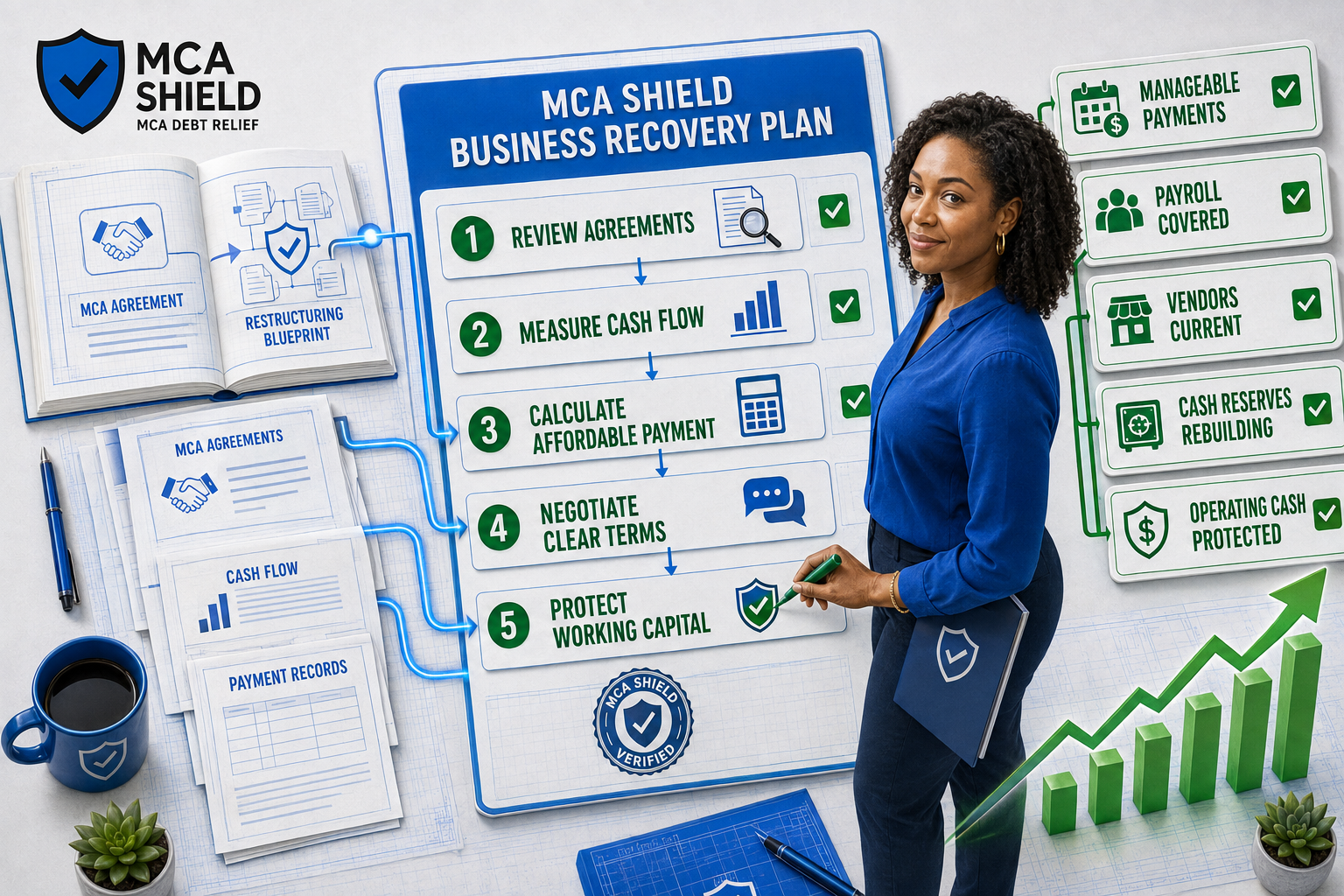
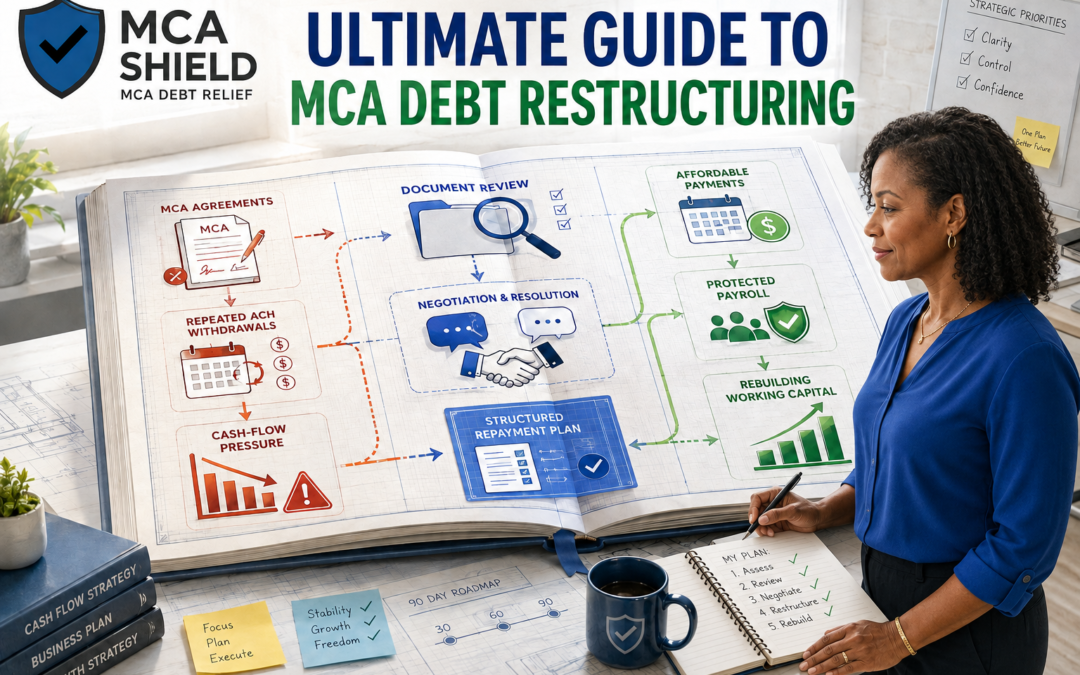
This MCA debt restructuring guide explains how businesses can address overwhelming daily or weekly payments before cash-flow pressure becomes unmanageable. When multiple withdrawals begin affecting payroll, vendors, taxes, and operating expenses, restructuring may provide a more sustainable path forward.
You will learn how the process works, how affordable payments are calculated, what happens during negotiations, and how UCC filings and personal guarantees may be handled. Most importantly, this guide will help you understand your options, avoid costly mistakes, and make informed decisions that protect your business and working capital.
Schedule Your Free Consultation
What Is MCA Debt Restructuring and How Does It Work?
How to Measure the Full MCA Burden on Your Business
Before choosing an MCA debt restructuring strategy, you need to understand the complete financial burden. Looking at one withdrawal or one agreement is not enough. The real impact comes from how every MCA payment interacts with payroll, vendors, taxes, rent, and other essential expenses.
A complete review helps reveal whether the current payment structure is sustainable and what the business can realistically afford.
Calculate Your Total Daily and Weekly Withdrawals
Start by listing every automatic MCA withdrawal from the business bank account. Include withdrawals made under different provider names or payment-processing descriptions.
Record the following information for each MCA:
- Provider name
- Daily or weekly withdrawal
- Number of withdrawals per week
- Payment method
- Remaining payment schedule
- Estimated payoff amount
Next, calculate the combined burden.
For example, if three MCA providers withdraw $350, $275, and $225 each business day, the total daily burden is $850. Over five business days, those withdrawals remove $4,250 per week from operating cash.
Compare the combined withdrawals with the business’s average weekly deposits. This reveals the percentage of incoming revenue being consumed before the business can pay its regular expenses.
Review at least three months of bank activity whenever possible. A longer review helps account for seasonal revenue, inconsistent deposits, returned payments, and unusually strong or weak weeks.
Identify Factor Rates, Remaining Balances, and Fees
The original advance amount does not represent the total repayment obligation. Most MCA agreements use a factor rate to determine the purchased amount or total payback.
For example, a $50,000 advance with a factor rate of 1.40 may require approximately $70,000 in total payments, excluding additional fees.
Review each agreement for:
- Original advance amount
- Factor rate
- Total purchased amount or repayment obligation
- Amount already paid
- Estimated remaining balance
- Origination or administrative fees
- Default or returned-payment fees
- Collection or legal costs
- Prepayment provisions
Do not estimate the remaining obligation based only on the original funding amount. Request an updated payment history or payoff statement from each provider when available.
This step is especially important when the business has renewed or stacked multiple MCAs. A renewal may pay off part of an earlier advance while adding a new obligation, making the true balance difficult to identify without complete records.
Determine How Much Operating Cash the Business Actually Needs
Affordable payments should be based on what remains after the business covers its essential operating expenses. They should not be based on revenue alone.
Begin with the business’s average weekly or monthly deposits. Then subtract expenses such as:
- Payroll and payroll taxes
- Rent or mortgage payments
- Inventory and materials
- Utilities and insurance
- Vendor obligations
- Equipment and vehicle costs
- Tax payments
- Minimum working-capital reserves
The amount left after essential expenses represents the cash potentially available for MCA payments. However, the business should also maintain a reasonable reserve for revenue changes, emergencies, and unexpected costs.
A payment may appear affordable during a strong week but become impossible during a slower period. Therefore, use realistic average revenue and account for seasonal declines.
This calculation provides the foundation for a sustainable restructuring proposal. It allows the business to pursue payments that address its MCA obligations without creating another immediate cash-flow crisis.
Warning Signs Your Business May Need MCA Debt Restructuring
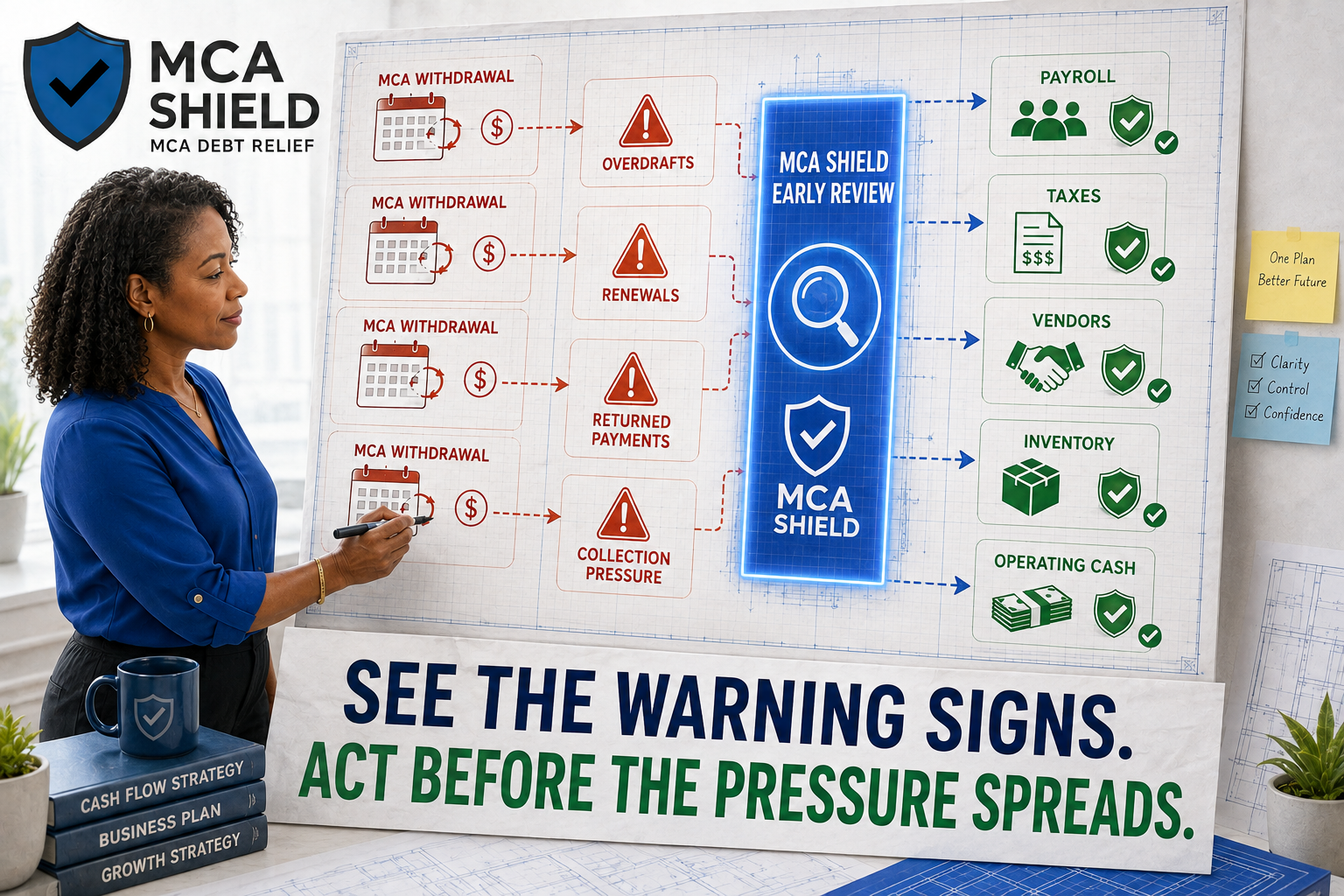
MCA payment problems rarely appear without warning. The pressure usually builds as withdrawals consume more revenue, leaving less cash available for normal operations.
Recognizing these warning signs early may give the business more options. Waiting until several payments have failed can make negotiations more difficult and increase the risk of collections or legal action.
MCA Withdrawals Are Disrupting Payroll and Essential Expenses
One of the clearest warning signs is having revenue to operate but not enough available cash after MCA withdrawals. Daily or weekly payments may leave the bank account before the business can cover its most important expenses.
Warning signs include:
- Delaying payroll or payroll taxes
- Paying vendors later than usual
- Falling behind on rent or utilities
- Postponing equipment repairs
- Reducing inventory purchases
- Using personal funds for business expenses
- Moving money between accounts to prevent shortfalls
These problems demonstrate that the existing payment structure may no longer match the business’s cash flow.
Revenue alone does not determine whether MCA payments are affordable. A business can generate strong sales and still face a cash-flow crisis when MCA payments are withdrawn before enough sales revenue comes in.
When essential expenses repeatedly compete with MCA payments, it may be time to explore MCA debt restructuring before operations are disrupted further.
Renewals or Additional Advances Are Covering Cash-Flow Gaps
Another warning sign is relying on new MCA funding to replace cash drained by existing withdrawals. The additional funding may provide temporary relief, but it also creates another payment obligation.
This can lead to a costly cycle:
- Existing withdrawals reduce operating cash.
- The business accepts another advance to cover expenses.
- The new advance adds another daily or weekly withdrawal.
- Cash-flow pressure returns at a higher level.
- Another renewal or advance appears necessary.
This pattern is commonly associated with MCA stacking. Instead of solving the underlying cash-flow problem, each new advance may increase the percentage of revenue committed to repayment.
Renewals also deserve careful review. A provider may offer additional funding before the current obligation is fully satisfied. However, part of the new advance may be used to pay the previous balance, leaving the business with less usable cash than expected.
If new funding is primarily being used to make existing MCA payments, the business may need a restructuring strategy rather than another advance.
Overdrafts, Returned Payments, and Collection Pressure Are Increasing
Frequent overdrafts and returned ACH withdrawals indicate that the business bank account can no longer support the current payment schedule.
Early warning signs may include:
- Repeated insufficient-funds fees
- Negative account balances
- Returned ACH withdrawals
- Frozen or restricted payment-processing activity
- Increased calls or emails from MCA providers
- Default notices or demand letters
- Contact with customers, vendors, or payment processors
- Threatened or pending legal action
Returned payments can also trigger additional fees and default provisions. As a result, the remaining obligation may grow while the business has even less money available.
Communication often becomes more urgent after payments begin failing. Business owners should document calls, emails, notices, payment histories, and any proposed arrangements. They should also avoid making promises the business cannot keep.
Increasing collection pressure is a sign that immediate action may be necessary. Reviewing the agreements and cash flow early can help the business understand its options before the situation becomes more expensive and difficult to control.
The MCA Debt Restructuring Process From Review to Resolution
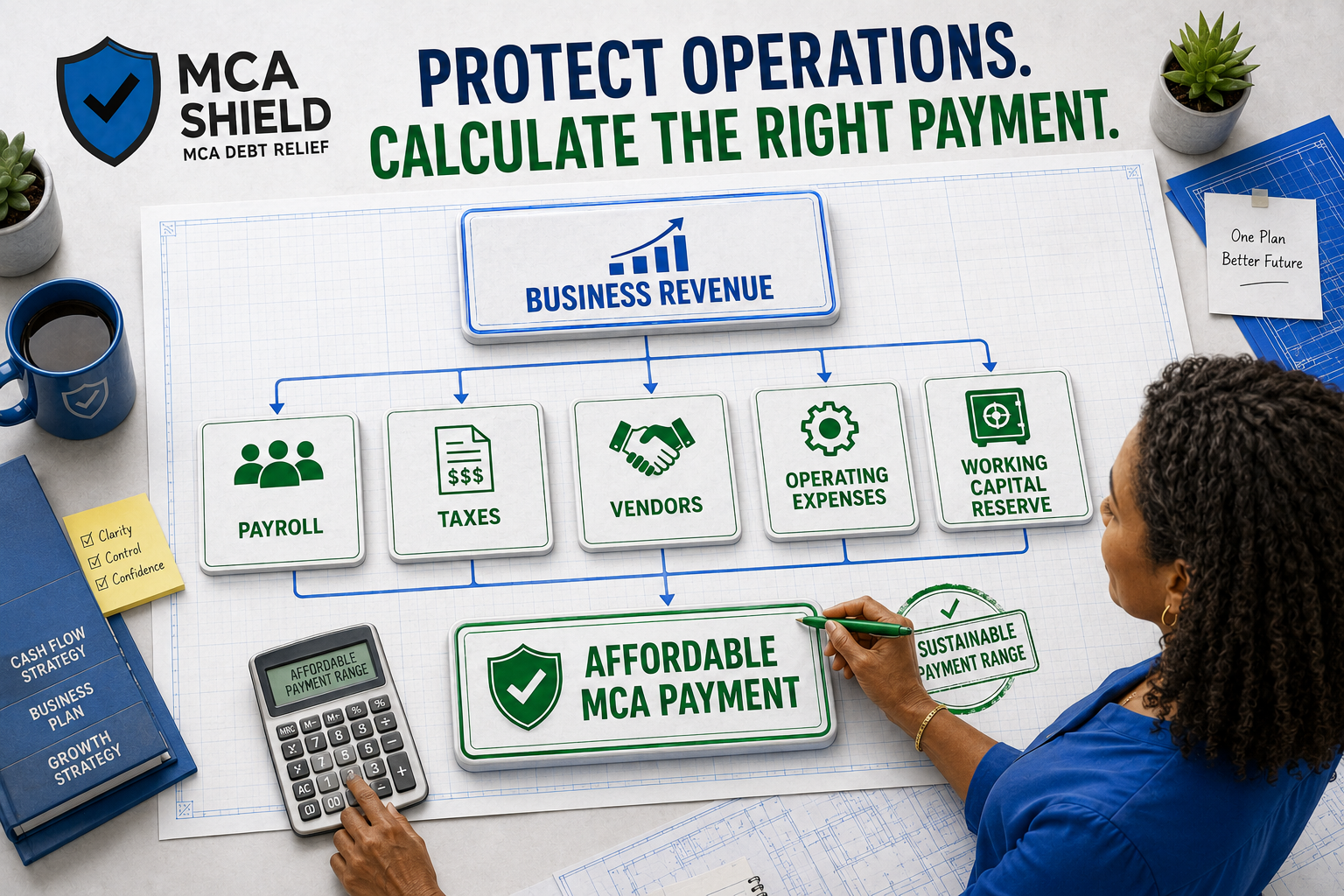
The MCA debt restructuring process begins with a complete financial review and ends with a clearly documented payment arrangement. Each stage should help the business understand its obligations, establish an affordable payment range, and avoid agreements that create additional financial pressure.
Although every situation is different, most restructuring efforts involve three essential steps.
Gather Agreements, Bank Statements, and Payment Records
The first step is collecting accurate information for every merchant cash advance. Missing agreements or incomplete payment records can make it difficult to calculate the total obligation or identify important contract terms.
Gather documents such as:
- Every current MCA agreement
- Recent business bank statements
- ACH withdrawal records
- Payment-processing statements
- Updated payment histories
- Payoff or balance statements
- Default notices and collection letters
- Emails or written payment arrangements
- Payroll, tax, rent, and vendor records
Bank statements should show the business’s deposits, withdrawals, overdrafts, and seasonal revenue changes. Reviewing several months of activity provides a more accurate picture than relying on one unusually strong or weak month.
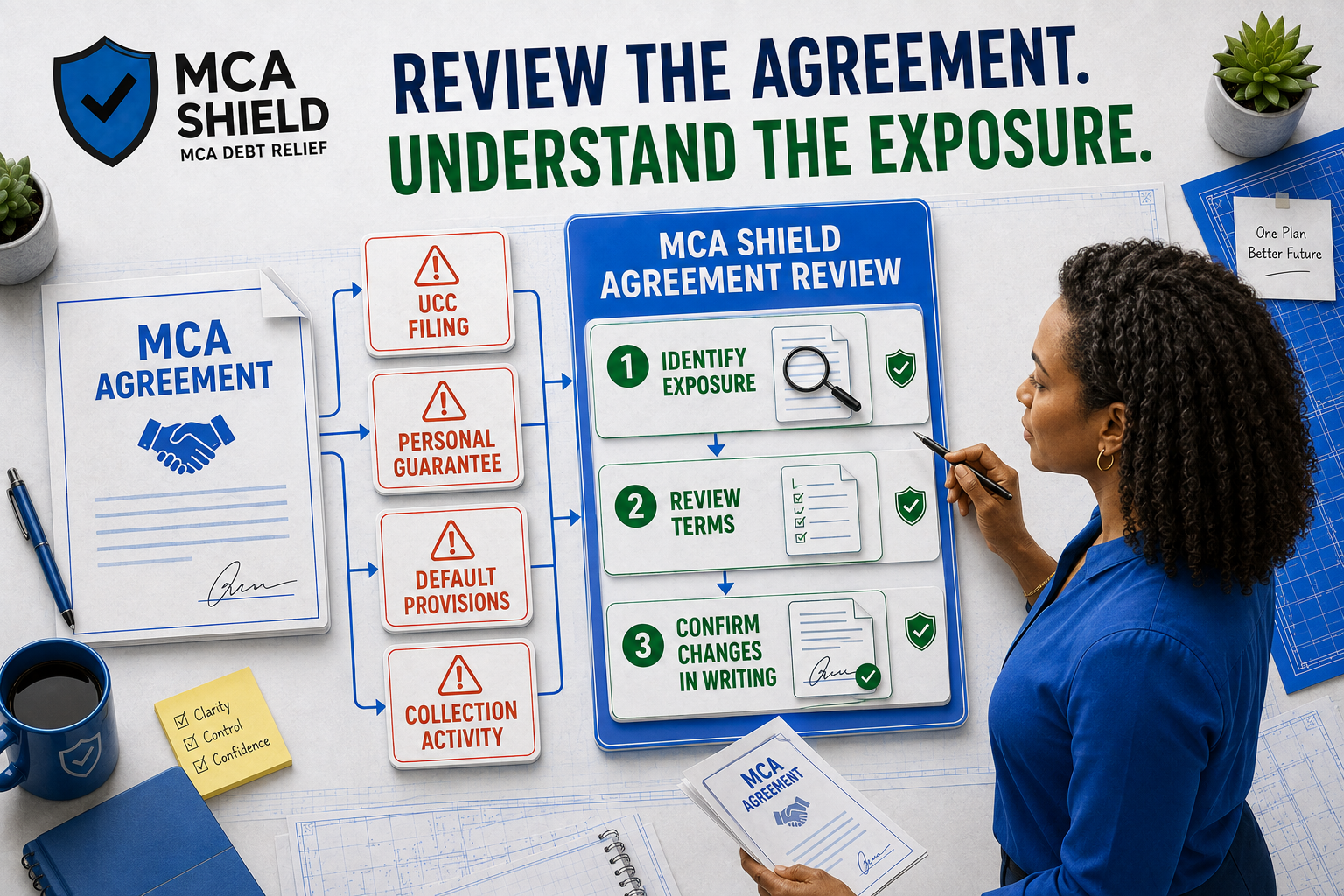
Each agreement should also be checked for payment terms, reconciliation provisions, UCC filing language, personal guarantees, default provisions, and additional fees.
The goal is to create a reliable summary of the business’s MCA obligations and cash-flow needs.
Build a Complete Restructuring Strategy
Once the documents are organized, the business can determine the type of payment arrangement that may be sustainable.
The strategy should consider:
- Total daily and weekly MCA withdrawals
- Remaining obligations
- Average business revenue
- Essential operating expenses
- Seasonal changes
- Working-capital needs
- Existing defaults or returned payments
- Collection and legal activity
- UCC filings and personal guarantees
An affordable payment should leave enough cash for payroll, taxes, vendors, rent, inventory, and other critical expenses. It should also include room for unexpected costs or slower revenue periods.
A complete strategy may seek lower withdrawals, less frequent payments, a longer payment timeline, or coordinated arrangements involving multiple MCA providers. However, the lowest immediate payment is not always the best option. Extending the timeline may increase the total amount paid.
For that reason, the business should compare the proposed payment, repayment period, fees, and total cost before making a decision.
Negotiate and Document the Revised Payment Arrangement
After establishing an affordable payment range, discussions can begin with the MCA provider or its representatives. The business may need to explain its current financial condition and provide records supporting the requested payment adjustment.
Negotiations may address:
- Reduced daily or weekly payments
- Changes to payment frequency
- Temporary payment relief
- Extended repayment terms
- Waived or reduced fees
- Negotiated payoff terms
- Arrangements for multiple obligations
No specific outcome is guaranteed. The available options depend on the agreement, payment history, financial condition, and whether each provider is willing to modify the arrangement.
Most importantly, the business should obtain the final terms in writing before relying on them. The written arrangement should identify the payment amount, schedule, remaining obligation, fees, default conditions, and what happens after the final payment.
Verbal promises can be misunderstood or disputed later. Therefore, the business should keep copies of every signed agreement, email, payment confirmation, and updated account statement.
A restructuring process is not complete simply because withdrawals have decreased. Resolution comes when the revised terms are clear, affordable, consistently followed, and properly documented.
How Affordable MCA Restructuring Payments Are Calculated
Affordable MCA restructuring payments should be based on the cash the business can consistently generate after covering essential expenses. A payment is not truly affordable if it forces the owner to delay payroll, miss tax obligations, or rely on another advance.
The calculation should use verified financial records rather than estimates or one unusually profitable month.
Start With Revenue and Essential Operating Expenses
Begin by calculating the business’s average weekly or monthly revenue. Review several months of bank and payment-processing statements to account for seasonal changes, slow periods, and irregular deposits.
Next, subtract essential operating expenses, including:
- Payroll and employee benefits
- Rent or mortgage payments
- Utilities and insurance
- Inventory and materials
- Equipment and vehicle costs
- Taxes and licensing expenses
- Vendor payments
- Necessary marketing expenses
- Existing loan payments
The amount remaining after these expenses helps establish the business’s available cash flow. However, the entire remaining amount should not automatically be committed to MCA payments. The business still needs a cushion for unexpected expenses and revenue changes.
For example, suppose a business generates an average of $30,000 per week and requires $24,000 for essential expenses and reserves. That leaves approximately $6,000 before accounting for an affordable MCA payment and additional financial protection.
The final payment should reflect normal operating conditions, not the best possible week.
Protect Payroll, Taxes, Vendors, and Working Capital
A restructuring plan should allow the business to continue operating while addressing its MCA obligations. That means protecting the expenses that keep the company open and producing revenue.
Payroll should remain a priority because missed wages can lead to employee turnover and operational problems. Payroll taxes must also be set aside rather than treated as available cash.
Likewise, the business needs enough money to pay vendors and purchase inventory or materials. Falling behind can damage important relationships, interrupt service, and prevent the company from completing revenue-producing work.
Working capital is equally important. It provides the short-term cash needed to manage expenses while waiting for customer payments or future sales.
Before accepting a restructured payment, confirm that the business can still:
- Pay employees on time
- Reserve money for taxes
- Maintain essential inventory
- Keep vendor accounts current
- Cover rent, utilities, and insurance
- Handle unexpected operating costs
- Maintain a reasonable cash reserve
A restructuring plan that consumes all available cash may temporarily address MCA payments while creating new problems elsewhere.
Avoid Accepting Payments the Business Cannot Sustain
A reduced payment can look attractive when the business is under immediate pressure. However, the proposed amount must remain manageable during both strong and slow revenue periods.
Before agreeing to revised terms, ask:
- Can the business make this payment during its slowest month?
- Will payroll and taxes still be covered?
- Does the payment leave enough working capital?
- Are additional fees included?
- How long will the revised arrangement continue?
- What happens if revenue drops unexpectedly?
- Will one missed payment cancel the agreement?
The business should also review whether the proposed arrangement includes automatic increases, large final payments, or strict default provisions. These terms can create another cash-flow crisis later.
If the business cannot cover the payment without overdrafts, delayed expenses, or new borrowing, the payment is not affordable.
A sustainable MCA debt restructuring plan should provide enough breathing room for the business to operate, stabilize its finances, and complete the revised payment arrangement without restarting the debt cycle.
What Happens During MCA Restructuring Negotiations?
During MCA restructuring negotiations, the business or its representative communicates with MCA providers about changing the current payment arrangement. The goal is to present the financial situation clearly and pursue terms the business can maintain.
Negotiations may involve several conversations, document requests, and revised proposals. MCA providers are not required to accept every request, and results can vary based on the agreement, payment history, and financial circumstances.
How Payment Frequency and Amounts May Be Addressed
The existing withdrawal amount is often one of the first issues discussed. If daily ACH payments are creating severe cash-flow pressure, the business may request a lower amount or a different payment schedule.
Possible payment adjustments may include:
- Lower daily withdrawals
- A change from daily to weekly payments
- Temporary payment reductions
- Extended payment timelines
- Modified withdrawal dates
- Coordinated payments across multiple MCAs
- Negotiated payoff arrangements
Some MCA agreements include a reconciliation provision that may allow payments to be adjusted based on actual receivables. The business should review the agreement carefully to determine whether this option exists and what documentation is required.
A lower payment can provide immediate relief, but it may also extend the payment period. Therefore, the business should compare the proposed payment amount with the total repayment cost.
The requested terms should reflect the amount the business can consistently afford—not simply the lowest amount it hopes the provider will accept.
Why Clear Financial Documentation Strengthens Negotiations
Clear, organized financial records help providers understand the seriousness of a business’s cash-flow problem.
Helpful documentation may include:
- Recent business bank statements
- Payment-processing reports
- Profit-and-loss statements
- MCA payment histories
- Payroll records
- Tax obligations
- Vendor invoices
- Rent and utility expenses
- Current accounts receivable
- Seasonal revenue comparisons
These records show how much money enters the business, how much is withdrawn, and what remains for essential operations. They can also demonstrate that the requested payment is based on actual financial conditions.
Incomplete or inconsistent records may weaken the request. For example, asking for a major payment reduction without showing revenue or operating expenses gives the provider little information to evaluate.
Accurate documents also help prevent the business from offering more than it can afford. A clear financial review supports a proposal that protects both continued operations and the revised payment arrangement.
What to Review Before Accepting Revised Terms
A verbal agreement or reduced withdrawal is not enough. Before accepting revised terms, the business should request a complete written explanation of the arrangement.
Review the following details:
- New payment amount
- Payment frequency
- First payment date
- Length of the revised schedule
- Remaining obligation
- Total amount expected to be paid
- Additional restructuring or administrative fees
- Default and missed-payment provisions
- Automatic payment increases
- Large final or balloon payments
- Prepayment terms
- UCC filing and personal guarantee language
- Conditions for completing the arrangement
The business should also confirm whether the revised agreement replaces, modifies, or supplements the original MCA contract. If multiple documents remain active, each one should be reviewed for conflicting terms.
Never assume that a payment reduction removes prior defaults, fees, UCC filings, or personal guarantees. Any release or modification should appear clearly in writing.
Finally, compare the revised payment with realistic cash flow. If the business must delay payroll, taxes, vendors, or other essential expenses to comply, the proposed arrangement may not provide meaningful relief.
The strongest negotiated terms are not simply those with the lowest immediate payment. They are the terms the business understands, can document, and can sustain through completion.
How Are UCC Filings, Personal Guarantees, and Legal Risks Handled?
How to Protect Business Operations While Restructuring MCA Debt
How Do You Choose an MCA Debt Restructuring Company?
Take Control of MCA Debt Before Cash-Flow Pressure Gets Worse