

If your business is struggling with daily or weekly withdrawals, you may be wondering what happens if you stop MCA payments. Stopping payments can create immediate relief for cash flow, but it can also trigger default notices, collection activity, legal pressure, or enforcement efforts depending on your agreement.
The next steps can vary from one merchant cash advance to another. A funder may contact you about the missed payment, attempt to collect the remaining balance, or review rights connected to UCC filings, personal guarantees, or business receivables. That is why it is important to understand your agreements before the situation becomes more serious.
However, stopping payments does not always mean your business has reached the end of the road. In many cases, there may still be options to restructure payments, consolidate MCA debt, negotiate new terms, or explore settlement. The goal is to protect working capital while creating a payment strategy your business can realistically afford.
Schedule Your Free Consultation
What Happens Immediately After You Stop MCA Payments?
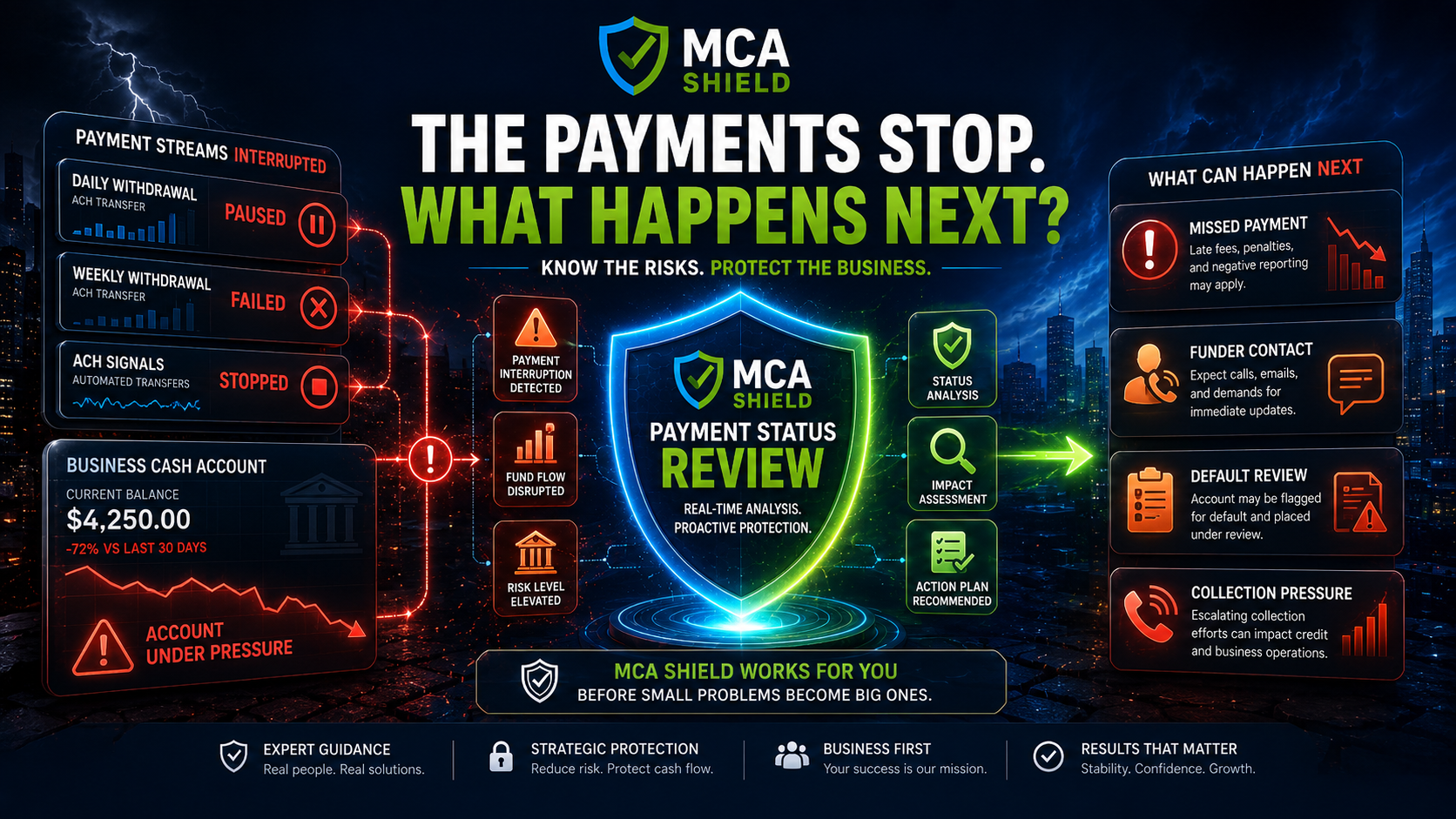
If your business decides to stop MCA payments, the response from the funder can happen quickly. In many cases, missed daily or weekly withdrawals are noticed almost immediately. What happens next depends on the terms of your MCA agreement, the payment method, and how the funder handles missed payments.
Stopping payments may provide short-term breathing room for your business account. However, it can also lead to collection calls, default notices, added fees, or legal pressure. Understanding the possible next steps can help you respond before the situation becomes harder to manage.
The Funder May Contact the Business About the Missed Payment
One of the first things that may happen is direct contact from the MCA funder. The funder may call, email, or send a written notice asking why the scheduled payment was missed.
In some cases, the funder may ask whether the business is experiencing a temporary cash-flow problem. This can be an important time to review your agreement and determine whether reconciliation, payment modification, restructuring, or another relief option may be available.
Avoid ignoring repeated communications. If you have stopped MCA payments because your business can no longer afford the withdrawals, it may be better to understand the balance, payment terms, and available options before agreeing to a new arrangement.
Failed or Blocked Withdrawals May Trigger Default Provisions
Many MCA agreements include specific terms explaining what happens after a failed, returned, or blocked ACH withdrawal. Depending on the contract, the funder may consider certain actions a default or breach of the agreement.
That does not mean every missed withdrawal creates the same result. MCA contracts can contain different default provisions, reconciliation rights, notice requirements, and payment terms. The exact language of the agreement matters.
Business owners should carefully review provisions related to ACH authorization, default, reconciliation, UCC filings, personal guarantees, and collection rights. Knowing what the agreement actually says can help you understand the level of risk before taking further action.
The Remaining MCA Balance May Become Due Faster
Some MCA agreements contain acceleration provisions or other default terms that may allow the funder to demand a larger portion of the remaining obligation after a default. Instead of continuing to collect through the normal daily or weekly payment schedule, the funder may seek faster repayment.
Additional fees or collection costs may also apply if they are permitted under the agreement. This can make an already difficult cash-flow situation more expensive.
If the business cannot afford the existing payments, it is important to calculate what it can realistically pay while still covering payroll, vendors, rent, taxes, and essential operating expenses. Addressing the problem early may create more room to explore an MCA restructuring, consolidation, or negotiated payment solution.
Does Stopping MCA Payments Automatically Put Your Business in Default?
Not always. Whether stopping payments places your business in MCA default depends on the language in your merchant cash advance agreement and the reason payments stopped. Some agreements treat a missed payment as a default, while others may provide procedures for temporary revenue changes, reconciliation, or payment adjustments.
This is why business owners should avoid assuming that every payment problem has the same result. Before making another decision, review the agreement carefully and determine what the contract defines as a default.
Your MCA Agreement Defines What Counts as a Default
The MCA agreement should explain which actions may be considered an event of default. These provisions can vary significantly from one funder to another.
Possible default triggers may include:
- Missing scheduled payments
- Blocking or interfering with authorized withdrawals
- Closing or changing a business bank account without proper notice
- Redirecting receivables in violation of the agreement
- Providing inaccurate financial information
- Violating other material terms of the contract
The agreement may also explain what the funder can do after a default. This could include demanding payment, assessing contractual fees, beginning collection efforts, or pursuing other remedies allowed under the agreement and applicable law.
Because the consequences can be serious, business owners should understand their payment obligations, default provisions, personal guarantees, and UCC-related terms before responding to a missed payment.
Missing a Payment and Revoking ACH Authorization Are Not Always the Same Issue
A missed MCA payment and a decision to revoke or block ACH withdrawals are related, but they are not necessarily the same contractual issue.
For example, a payment may fail because the business account does not contain enough money. In another situation, the business may instruct its bank to stop a particular ACH debit. Each action may be addressed differently under the MCA agreement.
Stopping an ACH withdrawal also does not automatically eliminate the underlying obligation. The funder may still claim that money is owed under the agreement and may pursue collection or other remedies.
If your business is considering changing or stopping withdrawals because the payments have become unaffordable, review the contract first. Understanding ACH authorization terms and default provisions can help you avoid making the situation more complicated.
Review Reconciliation and Payment-Adjustment Provisions
Many MCA agreements are structured around the purchase of future receivables rather than a traditional fixed loan payment. Because of this, some contracts contain a reconciliation provision that may allow payments to be adjusted when business revenue changes.
If revenue has dropped, a business may be able to request that its payment amount be reviewed. The agreement may require bank statements, merchant-processing reports, or other financial records to support the request.
A reconciliation request is not the same as simply stopping payments. The contract may require specific notice, documentation, or timing before an adjustment will be considered.
Before assuming that default is unavoidable, look for provisions involving reconciliation, payment adjustments, revenue changes, and hardship procedures. If the current withdrawal is no longer realistic, these provisions may provide another option for addressing the payment pressure.
The most important step is to understand exactly what the agreement allows. A careful review can help determine whether the business is already in default, whether an adjustment may be available, and what options exist to reduce MCA payment pressure before the problem escalates.
What Collection Actions Can MCA Funders Take After Payments Stop?
When a business stops making merchant cash advance payments, the funder may begin collection activity. The exact response depends on the MCA agreement, the amount still owed, and whether the funder believes a default has occurred.
Collection efforts can range from routine contact to more serious attempts to enforce contractual rights. Business owners should understand the difference between collection pressure, UCC-related rights, and formal legal action.
Collection Calls, Emails, and Demand Notices May Begin
One of the first steps may be increased communication from the funder or a third-party collection company. The business may receive phone calls, emails, letters, or formal demand notices asking for payment.
These communications may request the missed amount, the remaining balance, or a new payment arrangement. Some funders may also warn that additional collection or legal action could follow if the account is not brought current.
Do not assume every demand is the final word. Review the agreement, confirm the current balance, and compare the demand with the contract terms before agreeing to a new payment plan.
If the original MCA payment became unaffordable, replacing it with another unrealistic payment can create the same cash-flow problem again.
Funders May Attempt to Enforce Rights Against Business Receivables
Merchant cash advance agreements are often tied to a business’s future receivables. Because of this, a funder may claim rights involving credit card proceeds, account receivables, or other business revenue after payments stop.
The exact enforcement options depend on the contract and applicable law. A funder may send notices to payment processors or other parties if the agreement gives it certain rights.
However, a contractual claim does not always mean the funder can immediately take every dollar entering the business. The agreement, UCC documents, state law, and any required legal procedures can all affect what happens next.
Business owners should carefully review provisions involving receivables, payment processors, bank accounts, and collection rights before responding to an enforcement demand.
UCC Filings Can Become More Important After Default
Many MCA funders file a UCC financing statement to provide public notice of a claimed security interest in certain business assets. If payments stop, that filing may become more important in the collection process.
A UCC filing does not automatically mean the funder has frozen the business bank account or seized company assets. It may, however, support the funder’s claim to certain collateral or receivables if the agreement and applicable law allow it.
This is an important distinction because business owners may hear terms such as UCC lien, account freeze, levy, and garnishment used as though they mean the same thing. They do not.
If collection efforts begin after you stop MCA payments, review the MCA agreement, UCC filing, remaining balance, and current cash flow together. Understanding exactly what rights the funder may have can help the business evaluate restructuring, negotiation, or other MCA debt relief options before the situation escalates.
Can an MCA Funder Freeze Your Business Bank Account?
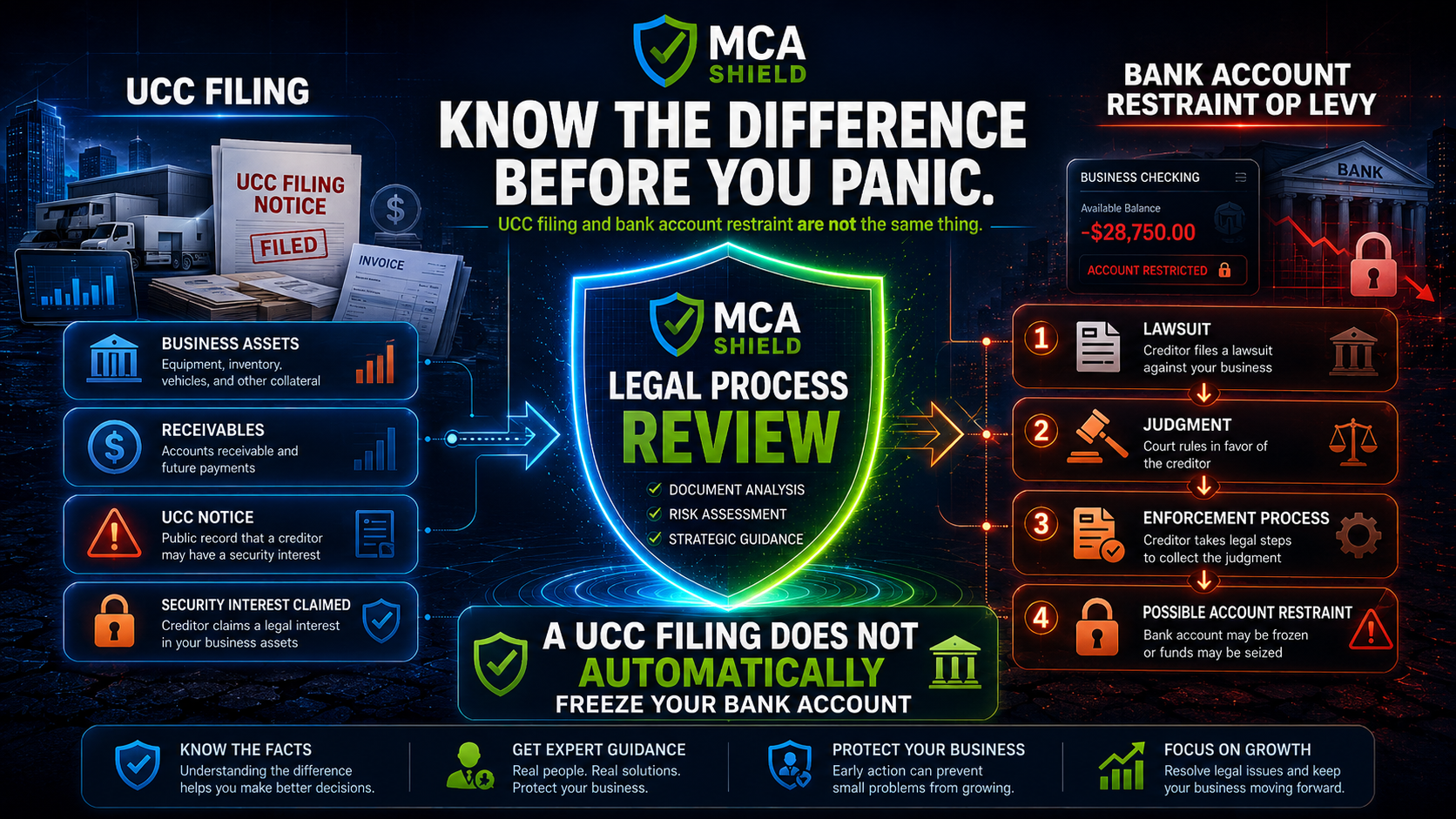
A business owner who stops making MCA payments may worry that the funder can immediately freeze the company’s bank account. In most cases, the situation is more complicated. A UCC filing, missed payment, bank-account restraint, and legal levy are not the same thing.
The funder’s rights depend on the MCA agreement, the type of security interest involved, the steps the funder takes, and the law that applies. Understanding these differences is important before assuming that a frozen account is automatic after an MCA default.
A UCC Filing Does Not Automatically Freeze a Bank Account
Many merchant cash advance companies file a UCC financing statement after providing funding. This filing generally gives public notice that the funder claims a security interest in certain business assets described in the agreement.
However, a UCC filing does not automatically freeze a business bank account. It is different from a bank levy, court-ordered restraint, or other formal enforcement process.
A UCC filing may still become important after payments stop. Depending on the agreement and applicable law, the funder may attempt to enforce rights involving certain receivables, business assets, or payment streams.
Business owners should review the exact language covering collateral, receivables, deposit accounts, UCC filings, and default remedies. These provisions can help explain what the funder may attempt to do after MCA payments stop.
A Lawsuit and Judgment May Lead to an Account Restraint or Levy
A bank-account restraint or levy is generally a more serious stage of collection. In many situations, a creditor must first pursue legal action and obtain the authority required under applicable law before money can be taken from a bank account through a judicial enforcement process.
If an MCA funder files a lawsuit and obtains a judgment, it may have additional collection options. Depending on the jurisdiction, those options may include attempting to restrain or levy funds held in a business bank account.
This is why a lawsuit, summons, or court notice should never be ignored. Missing a response deadline can reduce the business owner’s ability to challenge claims or raise available defenses.
It is also important to distinguish a court-ordered bank restraint from other MCA collection tactics. A funder may claim contractual rights involving receivables or payment processors without having a traditional bank levy. The legal basis and procedure can be different.
Legal Procedures Depend on the Agreement and Applicable State Law
There is no single collection process that applies to every merchant cash advance. The outcome can depend on the MCA contract, governing-law provision, location of the business, type of collateral, UCC documents, and state collection procedures.
Some agreements may include provisions involving receivables, personal guarantees, security interests, or other enforcement rights. State law can also affect how and when those provisions may be enforced.
For that reason, business owners should avoid assuming that a funder can automatically seize funds simply because MCA payments have stopped. Instead, review what has actually happened. Determine whether the business has received a collection notice, processor notice, lawsuit, judgment, bank restraint, or levy.
Keeping these terms separate is critical. A UCC filing is not the same as a frozen bank account, and a collection demand is not the same as a court judgment. Understanding the exact stage of the situation can help the business decide whether it needs payment restructuring, MCA debt relief assistance, or legal counsel before the problem becomes more serious.
Can You Be Sued After You Stop Paying a Merchant Cash Advance?
Yes. If a business stops making payments, an MCA funder may decide to file a lawsuit to recover money it believes is owed under the agreement. However, a missed payment does not automatically mean a lawsuit will be filed.
Some funders may first attempt collection calls, demand letters, or payment negotiations. Others may move more quickly if they believe the business has defaulted. The next steps depend on the MCA agreement, remaining balance, personal guarantee, and applicable law.
The Funder May Seek the Remaining Balance and Contractual Fees
If the funder believes an event of default has occurred, it may demand payment of the remaining MCA balance. Depending on the agreement, it may also claim certain contractual fees, collection costs, or other amounts.
If the dispute is not resolved, the funder may file a lawsuit seeking a judgment. The business then has an opportunity to respond and raise any available defenses or disputes.
Business owners should not automatically accept the amount listed in a demand letter as accurate. It is important to review the agreement and confirm the original advance amount, payments already made, remaining balance, fees, and default provisions.
A complete financial review can also help determine whether the business can resolve the problem through restructuring or negotiation before the dispute becomes more expensive.
A Personal Guarantee May Increase the Owner’s Exposure
Many merchant cash advance agreements include a personal guarantee signed by the business owner or another guarantor. This can become especially important after MCA payments stop.
A personal guarantee may allow the funder to pursue claims against the guarantor if the conditions in the agreement are met. However, the scope and enforceability of a guarantee depend on the exact contract language and applicable law.
This does not mean every business owner automatically becomes personally responsible for every MCA balance. The agreement should be reviewed carefully to determine what was guaranteed, when the guarantee may be enforced, and what remedies the funder claims to have.
If a funder is threatening personal assets or attempting to enforce a guarantee, the situation may require review by an attorney experienced with MCA disputes and commercial contracts.
Never Ignore a Lawsuit, Summons, or Legal Demand
A business owner should never ignore a lawsuit, summons, complaint, or formal legal demand from an MCA funder. Legal documents often contain strict response deadlines.
Failing to respond could allow the funder to seek a default judgment. A judgment may give the creditor additional collection options that were not available before the lawsuit.
If legal papers arrive, determine the filing date, response deadline, court, and amount being claimed. Keep copies of the MCA agreement, payment records, bank statements, emails, and prior communications with the funder.
Stopping MCA payments does not necessarily mean that the business has no options. However, once a lawsuit has been filed, it becomes even more important to address the situation quickly. A combination of legal review and a realistic cash-flow strategy can help the business understand its risks and determine the best next step.
How Can Stopping MCA Payments Affect Your Business Cash Flow?
Stopping merchant cash advance payments can create an immediate change in your company’s cash flow. If daily or weekly withdrawals are no longer leaving the account, the business may temporarily have more money available for operations.
However, that short-term improvement does not necessarily solve the underlying problem. Stopping MCA payments can also trigger collection activity, added costs, and legal pressure that may create new financial challenges.
Stopping Withdrawals May Temporarily Leave More Cash in the Account
For a business under heavy MCA payment pressure, stopping withdrawals may immediately increase the amount of cash remaining in the bank account.
That extra cash may help the company cover important expenses such as:
- Payroll
- Rent
- Vendor invoices
- Taxes
- Inventory
- Insurance
- Utilities
- Other operating expenses
This can provide temporary breathing room, especially when multiple MCA withdrawals have been draining the account every day or week.
However, the business should not assume that the remaining MCA obligation has disappeared. The funder may still claim money is owed under the agreement.
For that reason, any temporary cash-flow improvement should be used to evaluate the larger financial situation. The goal should be to determine how much the business can realistically afford to pay while continuing to operate.
Collection Activity Can Create New Cash-Flow Problems
Once MCA payments stop, collection activity may introduce additional financial pressure.
The business may face collection calls, demand notices, contractual fees, UCC-related enforcement efforts, or legal expenses. If several MCA funders are involved, those pressures can multiply quickly.
A business that suddenly has more cash in its account may still be financially unstable if there is no long-term plan for dealing with the outstanding obligations.
This is why simply stopping payments is usually not a complete MCA debt relief strategy. Business owners should review the total MCA balances, current revenue, operating expenses, and available working capital.
A realistic plan should address both the existing MCA debt and the company’s ability to continue operating.
Payroll, Vendors, and Essential Operating Expenses Still Need Protection
Protecting working capital should remain a priority when MCA payments become unaffordable.
A business may survive a missed MCA payment, but it can quickly face serious problems if it cannot pay employees, purchase inventory, maintain insurance, or keep important vendors current.
Start by identifying the expenses that are necessary to keep the company operating. Then compare those costs with current monthly revenue and available cash.
This can help determine how much money may realistically be available for MCA payments without putting the business back into financial distress.
The objective should be more than simply stopping withdrawals. A sustainable MCA relief strategy should help the company maintain manageable payments, protected working capital, covered payroll, current vendors, and enough cash to continue operating.
Can MCA Debt Be Restructured After You Stop Making Payments?
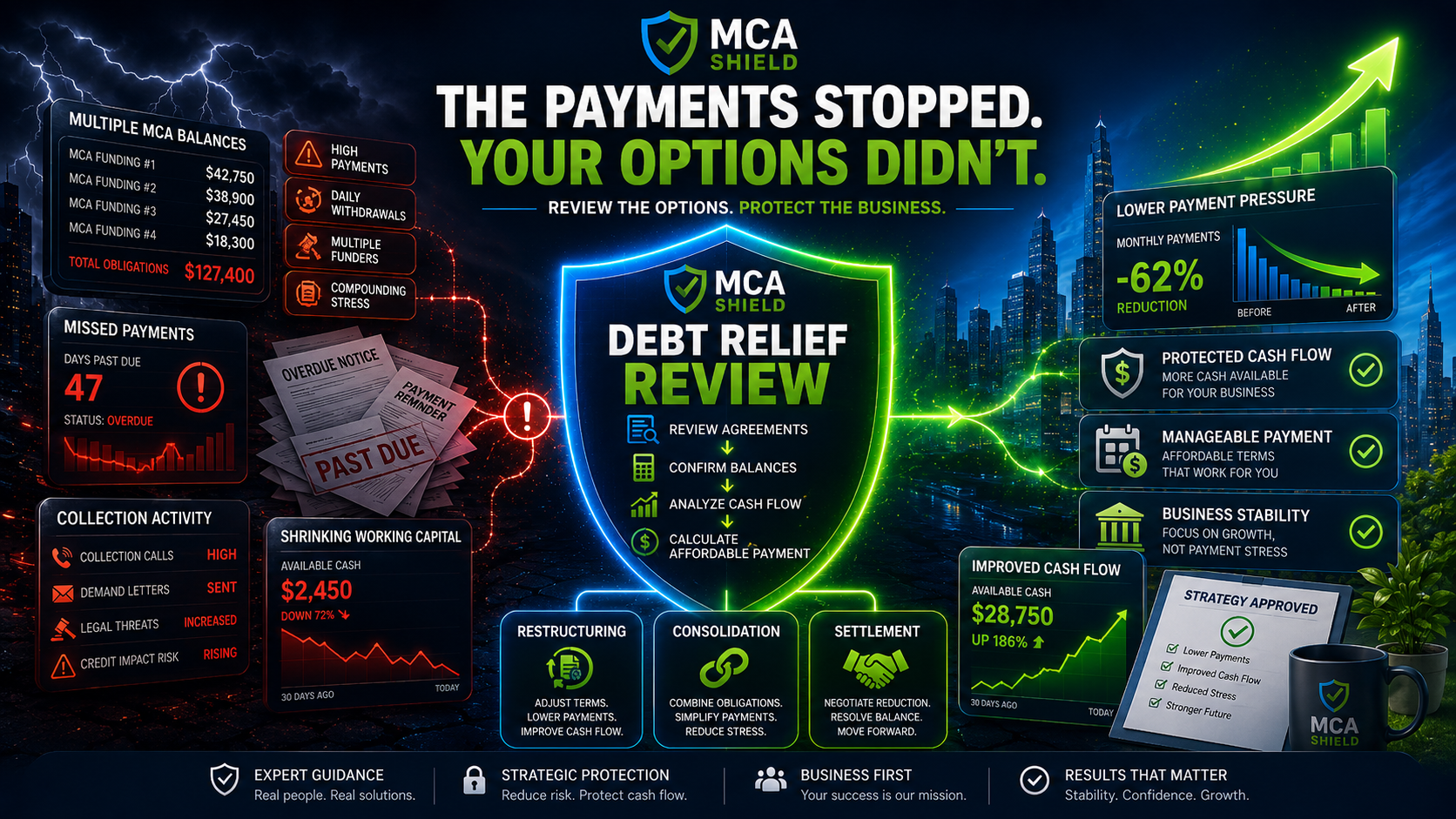
Yes. In many cases, MCA debt can still be restructured after payments have stopped. A missed payment or default does not always mean that the only options are collections or litigation.
If the business is still generating revenue, there may be an opportunity to negotiate a payment structure that better matches current cash flow. The goal is to create a plan that addresses the MCA balance without putting payroll, vendors, and essential operating expenses at risk.
An Affordable Payment May Still Be Negotiated
When the original daily or weekly withdrawal becomes too difficult to maintain, a business may be able to pursue a lower and more manageable payment.
A restructuring proposal should be based on the company’s actual financial condition. That means reviewing revenue, operating expenses, existing MCA balances, and available working capital before agreeing to new terms.
A payment that looks lower on paper may still be unaffordable if it leaves the business without enough cash to operate. The strongest approach is to calculate a payment the business can realistically support over time.
In some cases, funders may be willing to discuss modified payment terms because an organized repayment plan can be more practical than continued collection pressure.
Restructuring, Consolidation, and Settlement Serve Different Situations
Not every business needs the same MCA debt relief strategy.
MCA restructuring generally focuses on changing the payment terms of one or more existing obligations. The objective is often to reduce payment pressure and improve cash flow.
MCA consolidation may be considered when a business has multiple merchant cash advances and wants to replace several payments with a more organized repayment structure.
MCA settlement involves negotiating to resolve an obligation for an agreed amount. Settlement can involve different risks, costs, and consequences than restructuring or consolidation.
Each option should be evaluated carefully. The best solution is not simply the one with the lowest advertised payment. It should also make sense based on the business’s total debt, revenue, operating needs, and legal situation.
The Best Option Depends on Cash Flow, Balances, and Legal Risk
Before choosing an MCA debt relief strategy, review the entire financial picture.
Start with the remaining balances on every MCA, the current daily or weekly withdrawals, monthly revenue, essential operating expenses, and available cash reserves. Then identify any collection activity, UCC filings, personal guarantees, or pending legal claims.
A business with strong revenue but excessive daily withdrawals may be in a different position from a company facing several defaults and an active lawsuit.
That is why the right solution should be based on cash flow, total MCA balances, affordable payment capacity, and legal risk.
Stopping MCA payments may create urgency, but it can also be the point where the business takes a closer look at its obligations. A structured review can help determine whether MCA restructuring, consolidation, settlement, or another strategy offers the best path toward stabilizing the business.
What Should You Do After You Stop MCA Payments?
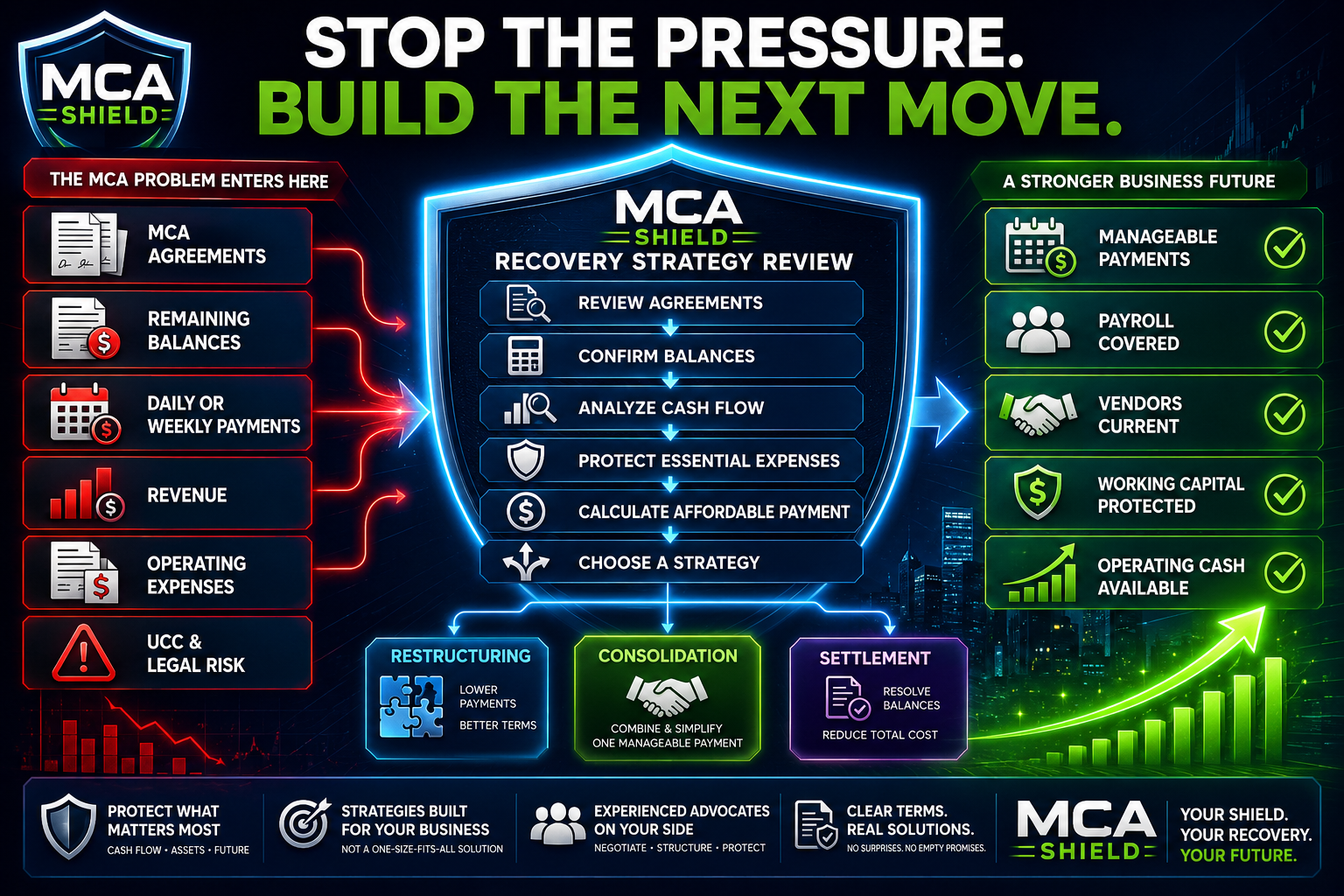
If you have already stopped making merchant cash advance payments, the next step should be to understand exactly where your business stands. Acting quickly can help you avoid making decisions based on pressure, incomplete information, or an unrealistic payment demand.
Start by reviewing your agreements, confirming what you owe, and looking closely at your current cash flow. The goal is to determine whether the business can support a restructured payment, consolidation plan, settlement strategy, or another form of MCA debt relief.
Review Every MCA Agreement, Balance, and Payment
Begin by gathering every active MCA agreement connected to the business. If you have multiple merchant cash advances, review them together rather than treating each obligation separately.
For each MCA, identify:
- Original funding amount
- Remaining balance
- Daily or weekly payment
- Payments already made
- Default provisions
- Reconciliation terms
- Personal guarantees
- UCC filings or security interests
- Any collection or legal notices
You should also review recent bank statements to confirm which withdrawals have stopped and whether any funder is still attempting to debit the account.
This information creates a clearer picture of the business’s total MCA exposure. It can also help identify errors, disputed balances, or payment terms that may need closer review.
If you have received a lawsuit, summons, or other formal legal notice, do not ignore it. Legal deadlines may apply, and an attorney can explain your rights and responsibilities.
Calculate What the Business Can Realistically Afford
The next step is to determine what your business can actually afford to pay.
Start with current revenue and subtract essential operating expenses such as payroll, rent, taxes, insurance, inventory, utilities, and vendor payments. The amount that remains can help show how much cash may realistically be available for MCA obligations.
This calculation is important because lowering an MCA payment does not help if the new payment still leaves the business short every week.
A sustainable strategy should protect enough working capital to keep the company operating. Ideally, the payment structure should allow the business to maintain:
Payroll covered. Vendors current. Operating expenses paid. Working capital protected.
The objective is not simply to replace one difficult payment with another. It is to create a payment strategy that fits the company’s actual cash flow.
Schedule a Free Consultation With MCA Shield
If you have stopped MCA payments and are unsure what happens next, MCA Shield can review your situation and help you understand the available options.
The process begins by reviewing your MCA agreements, balances, current payments, revenue, operating expenses, and overall cash-flow pressure. From there, you can evaluate whether MCA restructuring, consolidation, settlement, or another strategy may make sense for your business.
The sooner you understand the numbers, the more clearly you can evaluate your next move.
Schedule a free consultation with MCA Shield to review your merchant cash advance obligations and explore a payment strategy designed around what your business can realistically afford.